Tag Archives: 500

Grant Piston Ring Special – Ferrari 375 No: 2

For Ferrari Friday I hope readers of my Indianapolis series will forgive me getting a little out of sequence by a year or two in order to present the 1952 Grant Piston Ring Special, a Ferrari 375 captured in these photographs by my Nostalgia Forum acquaintance B² from Indiana who saw this vehicle in a Holiday Inn car park Dearborn, MI around 1971.
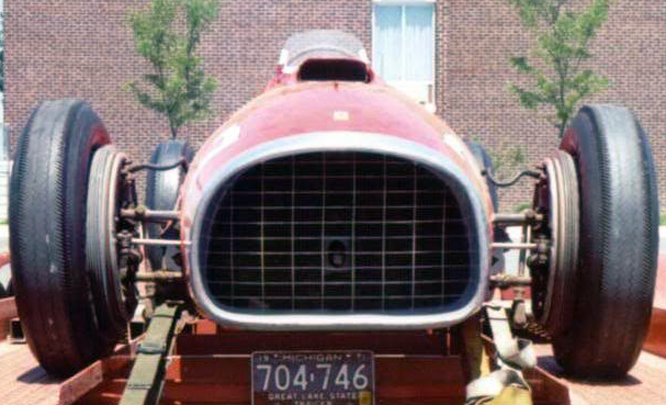
Ferrari 375, Holiday Inn, Dearborn, MI

The Ferrari 375 was originally conceived as a Formula One car to take advantage of the normally aspirated engine regulations that allowed for engines up to 4.5 litres / 274.6 cui as opposed to the maximum 1.5 litres /91.5 cui maximum capacity allowed for supercharged engines.

The 375 evolved through three stages, the first stage was the 275 which featured a new Lampredi designed 3322cc / 202 cui V12 which made its debut in Jume 1950, in July 1950 the 340 made its debut with a longer wheel base de Dion rear suspension and a 4101cc / 240 cui version of the Lambredi V12.

Finally in September 1950 the 375 with a 335 hp 4493 cc / 274 cui made its debut at Monza, by 1951 Jose Froilan Gonzalez driving a 375 scored Ferrari’s first formula one Grand Prix victory in Britain to begin cementing Ferrari’s place in the top echelon of motor racing.

There were so few contenders in races run to formula one regulations that in 1952 and 1953 the World Drivers Championship was run to Formula 2, 2 litre / 122 cui regulations both won by Alberto Ascari driving a nine race winning streak for Ferrari, making the 375 essentially obsolete. When the World Championship returned to a championship for drivers of formula one regulations the maximum mandated 2.5 litre 152 cui normally aspirated engines and the large Lamperdi V12’s were consigned to being
used in sports cars only.
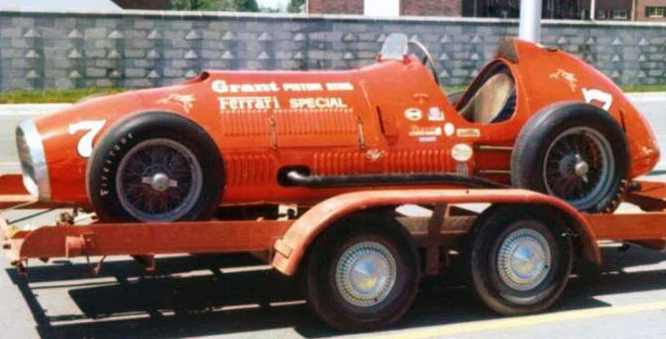
Ferrari 375, Holiday Inn, Dearborn, MI

With the Ferrari 375 being obsolete in the top echelon of European racing allegedly US importer Luigi Chinetti convinced Enzo Ferrari to develop the car further with a stronger longer chassis.

Ferrari was represented at the 1952 ‘Indy 500’ by four cars 1 works and 3 customers, No: 1 ‘Ferrari Special’ for his works driver Alberto Ascari, No: 2 Grant Piston Ring Special for drivers Jonnie Parsons and Danny Oakes, No: 3 ‘Kennedy Tank Special’ for driver Johnny Mauro, and No: 4 ‘Mobil Special’ for driver Bobby Ball.

Outwardly the Ferraris appearance at Indianapolis in 1952 showed Ferrari lacking finesse preparing their cars for oval racing and that the ‘Yanks’ had little idea of how to coax the most out of what was essentially a beefed up road course car at Indianapolis.

However in his description of the 1952 race (scroll half way down), fuel injection manufacturer Stuart Hilborn shows that at the very least Ferraris disdain of many things American and his legendary machiavellian gamesmanship had come into play.

In brief Hilborn discovered that the #38 Mobil Specials cylinder head fuel inlet ports had been tampered with resulting in the ports being undersize, thus reducing the power output and it was found that the power output had been further reduced by Ferrari not fitting the high compression pistons which had been specified by Hilborn during a meeting at the Ferrari factory and presumably paid for owner Howard Keck ! (Note only one Ferrari qualified for the 1952 race not two as Hilborn asserts.)

The four 375’s were around 200 lbs over weight in part due to the drum brakes being too large and more suited to road course racing.

Despite these problems Ascari drove some of the smoothest and most consistent qualifying laps ever seen at Indianapolis, which unusually possibly due to incorrect gearing, included changing down a gear for both the first and third corners to secure 19th place on the grid.

Parsons in the second 375, even after trying magnesium wheels, opted for a more powerful Offy powered vehicle and well known midget racer Danny Oakes also failed to qualify the Grant Piston Ring Special.

Mauro allegedly really only wanted his 375 for the Pikes Peak hill climb and did not take the ‘500’ seriously and never got near a qualifying time, his car today resides in the IMS Hall of Fame now painted red.

Bobby Ball like Parsons also opted for an Offy powered machine after he had tried the forth car with Hilbourn fuel injection in place of the usual Weber carburetion. This car was restored in the 80’s destroying it’s original patina and is now thought to be in the care of a New York collector.

Ascari fancied his chances in the race switching, pre race, from a one stop strategy to a three stop strategy to accommodate higher than expected tyre wear. During the race Ascari planned to keep the revs low for the first two segments in order to benefit from the tendency of his US competitors ‘win or bust’ strategies.

Due to his weight handicap Ascari got a slow start but rose from 21st to 7th when on lap 41 the right rear wire wheel collapsed causing his instant retirement. Ascari is generally acknowledged to have given a good account of himself with a possible race contending performance up to the point of his retirement.

The No: 1 375 appeared at the 1953 ‘500’ with a 3 litre 183 cui engine, new body and side tanks but was withdrawn from the race. In 1954 it appeared again with original body and 4.5 litre 274 cui engine but failed to qualify. Ascaris 375 is currently thought to reside in Hong Kong.

Which brings us back to the car in the photograph which is thought to be the No.2 Grant Piston Ring Special unsuccessfully qualified by Parsons and Oakes,

This car was seen around 1970 on former owner Lindley Bothwell’s estate in 1970. By 1998 this 375 belonged to a Brazilian Carlos Monteverde who allowed Ludovic Lindsey to demonstrate it at Imola in Italy. During the demonstration the car suffered heavy broadside impact with a track side wall which wrote off two Borani wheels, smashed the respective brake drums, and destroyed the differential casing.
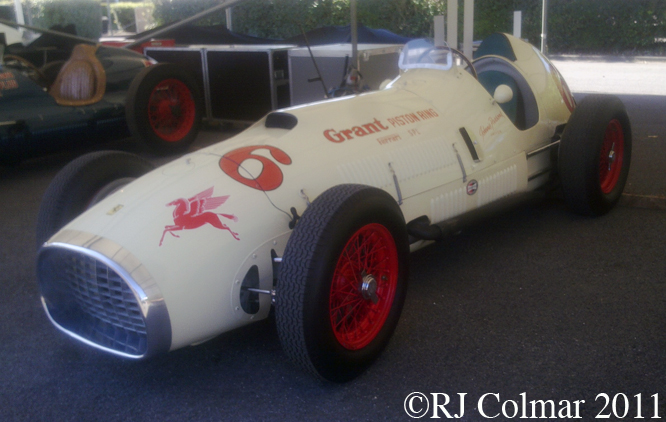
Ferrari 375, Goodwood, Festival of Speed

In August 2000 the No.2 375 now repaired was purchased by a Dutch owner and has been displayed in it’s white 1952 #6 Grant Piston Ring livery in the Netherlands at the Louwiman Museum and at festivals, above at Goodwood Festival of Speed in 2006, ever since.

My thanks to B² for todays photographs, and to everyone on the Ferrari 375 Indycar thread at Ferrari Chat for additional information.

There is some mystery alluding to the chameleon nature of the paint work of the Grant King Piston Ring website shows period photo’s of this car in white with cockpit wrap around screen with Johnny Parsons at the wheel and also a photo of Danny Oakes at the wheel of a red car with small screen,
if you know the correct sequence of colours and dates this car has appeared in, when it left the factory, ran in the hands of Parsons and Oakes and when it was returned to it’s current livery please do not hesitate to chime in below.

Hope you have enjoyed Ferrari Friday Indy Special edition of Gettin’ a lil’ psycho on tyres’ and that you’ll join me again tomorrow. Don’t forget to come back now !

Share

85% Stock Specials – Studebakers 1932 to 1933

Moving forward a couple of decades from yesterdays post today we are looking a couple of Studebakers that appeared at Indy in 1932 and 1933, thanks to photographs by Ed Arnaudin taken in 1962.

1962 012s

In 1932 Studebaker built and entered 5 boat tail specials for the Indianapolis 500.

Unlike most cars entered at Indianapolis at the time 85% of the mechanical parts used in these vehicles were stock items.

Indianapolis chassis specialist Hermann Rigling built the frames and bodies to accommodate the 200 hp 5.5 litre 336 cui straight 8 engines which were sourced from the Studebaker President along with most of the rest of the running gear. The finished cars were said to be capable of 140 mph.

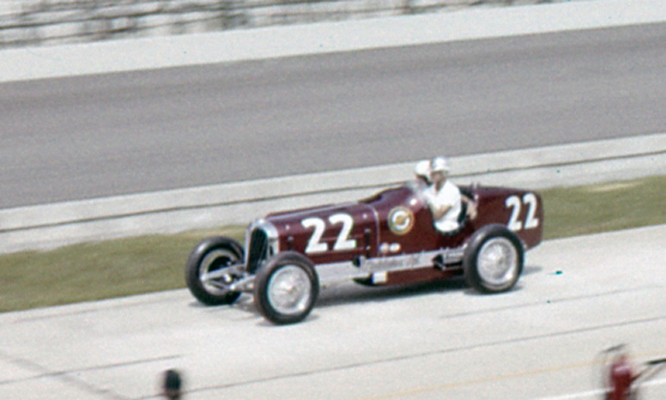
The #22 above was entered for Cliff Bergere and riding mechanic Vern Lake who qualified 10th and finished 3rd in the highest ranking Studebaker at the end of the race.

Cliff from Toledo Ohio first ran at Indianapolis in 1927, this was his best finish which he equalled in 1939. By the end of his career in 1947 Cliff had competed in a then record 16 starts having led 25 laps of a record, at the time, 2,426 laps of racing at the Brickyard.

Cliff is remembered for having completed the 1941 race without a pit stop although he was overcome by fumes after taking the lead and dropped to 5th at the finish line.

He was due to drive a highly rated Novi in 1948, but an ill advised fuel tank enlargement rendered the car unsafe in his opinion, this was in part substantiated after he quit the team.

The popular and ultimately unfortunate Ralph Hepburn took the Novi over he ran at close to record speeds before fatally loosing control and hitting the wall.

In 1940 Bergere helped the 57 year old ‘Racing Mayor’ Ab Jenkins set a 24 hour average speed of 161 mph in the fearsome Mormon Meteor III powered by a 750 horsepower 12 cylinder Curtis aircraft engine at Bonneville.

1962 013s

After the modest 3rd place success in 1932 Studebaker returned to Indianapolis in 1933 with some improved cars.

For 1933 the factory supported cars again with a combination of Rigling chassis and and 336 cui straight 8 President motors appeared with more streamlined body work than in 1932.

The the Studebaker post race advertising and studebakerracing.com shows Studebaker entered a five car team.

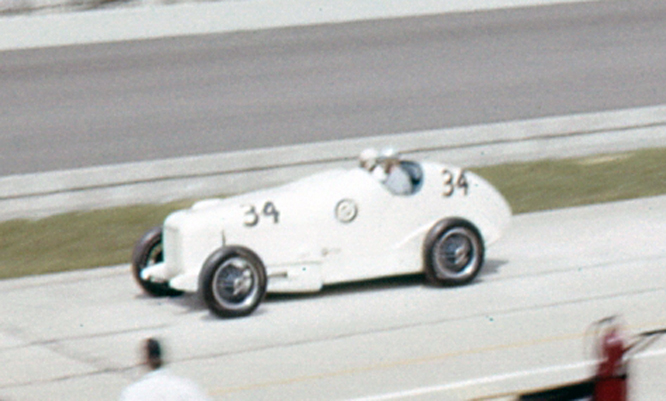
The #34 shown here was driven by Tony Gulotta finished 7th highest place amongst the 5 cars with 336 cui President engines and one place behind a smaller 250 cui Studebaker Commander powered Rigling Chassis known as the Art Rose Special driven by Dave Evans.

Tony Gulotta from New Orleans finished a career high 8th in the 1927 American Championship Car Racing National Championship aboard a Miller.

Thereafter Tony focused his efforts primarily on the ‘Indy 500’ coming within 18 laps of winning the race in 1928 driving a Stutz Blackhawk Special Miller when a clogged fuel line sent him to the pits resulting in a 10th place finish. Tony’s best finish at Indianapolis from 13 starts remained his 3rd place finish in 1927.

My thanks to Steve Arnaudin for sending me the scans of his Dad’s slides and to E.B. of The Nostalgia Forum for identifying both vehicles.

Hope you have enjoyed today’s 85% stock special edition of ‘Getting a lil’ psycho on tyres and that you will join me again tomorrow for Ferrari Friday. Don’t forget to come back now !

Share

AAA Champion – Stutz White Squadron Racer

Moving forward a year from yesterdays post today we are looking at this well known 1915 Stutz White Squadron Racer thanks to another photograph by Ed Arnaudin.

Indy64 8s

The Ideal Motor Company was founded in 1911 by Harry Stutz who entered a vehicle called a Stutz powered with a Wisconsin Motor in the very first Indianapolis 500 in 1911.

Despite having under gone no testing of any sort in preparation for the race Norwegian Gil Anderson started in tenth, qualifying was decided by the order in which the entries were received (!), and completed the full 200 laps in a creditable 11th, the first finisher not to receive any prize money. The entrepreneurial Stutz claimed the result a victory with the strap line ‘the car that made good in a day’.

In 1912 Charlie Merz brought his Wisconsin powered Stutz home in 4th and in 1913 went one better with a 3rd place finish. For 1914 Barney Oldfield brought his Stutz home 5th in the ‘500’ again using a Wisconsin engine.

Harry Stutz developed an engine based on the classic 115hp 1914 Mecedes Grand Prix car complete with single overhead cam and 4 valves per cylinder in 1915 and it is this type of vehicle we see in Ed’s photograph taken in 1964.

This car was driven and later owned by White Squadron driver Earl Cooper who’s story is no less fascinating than his cars. Nebrasken Earl got into racing by borrowing a customers Maxwell in 1904 after the proprietor of the Maxwell dealership Earl was working for refused to sponsor him.

Cooper won first time out beating his boss in the same race which earned him a victory garland and unemployment in the process. Earl decided to pursue racing and by 1912 formed a successful partnership with Stutz securing his first of three eventual AAA National Championships winning 5 out of 8 road races in 1913.

Sidelined for most of the 1914 season and a good part of the early 1915 season for some, as yet unknown to me, medical condition Earl came back strongly with a forth place at Indianapolis going on to win one of two events held at Elgin, IL and a 500 mile speedway race at Snelling MN to take his second championship aboard this particular Stutz.

After winning the war interrupted 1917 Championship Earl retired from full time racing in 1919 only to return in 1922 taking five wins in 1923. Cooper led much of the 1924 Indy 500 only for two separate punctures to force him to settle for a second place finish.

In May 1925 Cooper became the first man to lap Indianapolis at over 110 mph he started that race 4th but finished 17th after leading 4 laps and eventually crashing. Despite starting on pole for his final race at Indianapolis in 1926 Earl’s car suffered transmission failure and by 1928 he had retired for good aged 42.

Earl became a team manager building Cooper front wheel drive racing cars, one of which competed at Indianapolis into the the 1940’s. He also reacquired the car seen in this photograph in 1938, restored it and then donated it to the Collection of the Natural History Museum of Los Angeles who appear to have loaned the car to the Petersen Museum in LA where it is mostly to be found on display.

My thanks to Steve Arnaudin for sending me the scan of his Dad’s slide and to E.B. of The Nostalgia Forum for identifying this vehicle.

Hope you have enjoyed this AAA Champions edition of ‘Getting a lil’ psycho on tyres’ and that you will join me again tomorrow for a look at the first of two very different Studebakers. Don’t forget to come back now !

Share

1914 Indy Winner – Delage Y

Continuing this months series of blogs celebrating the 100th anniversary of the Indianapolis 500 today’s photograph by Ed Arnaudin was taken in 1964 and shows the most famous of the Delage Y’s which, in the hands of Rene Thomas, won the 4th running of the Indy 500 in 1914.

Indy64 6s

Designed by Arthur Michelat four Y models are thought to have been built between 1913 and 1914 at the Delage factory on Boulevard de Verdun in Courbevoie in NW Paris.

This one was fitted with a 113 hp, 4 cylinder 4.5 litre 275 cui motor, featuring 4 valves per cylinder, was connected to a 5 speed gearbox making it one of the most advanced racing cars of it’s time.

In 1913 Paul Bablot drove the pictured vehicle to victory in the, latter of two, French Grand Prix held at Le Mans.

With support from British journalist in Paris WF Bradley, the Indianapolis 500 attracted the first foreign entries in 1913 which in 1914 included two Delage Y’s, the 2nd Delage driven by Albert Guyot placed 3rd in the race.

Rene Thomas prior to winning the Indianapolis 500 at his first attempt is also known for surviving the worlds first mid air collision near Milan in 1910 after his Antoinette monoplane ‘fell’ onto the Farman biplane of Captain Bertram Dickson who was not so lucky.

Thomas went on to record a land speed record of 143 mph in 1924 at Arpajon south of Paris aboard another Delage. Amazingly after a full life of risk taking Rene Thomas died aged 89 in 1975.

The story goes that as this winning car was being loaded on to a ship to return to France it was purchased and ultimately remained in the USA. The car was later ‘found’ by Edgar L. Roy a founding member of the Vintage Sports Car Club of America and restored by him prior to the car finding it’s way to the IMS Hall of Fame Museum.

My thanks to Steve Arnaudin for sending me the scan of his Dad’s photo and to E.B. of The Nostalgia Forum for identifying this vehicle.

I hope you have enjoyed today’s 1914 edition of ‘Getting a lil psycho on tyres’ and that you’ll join me again tomorrow for a look at a 1915 White Squadron Stutz. Don’t for get to come back now !

Share

Myth & Skullduggery- 16b Marquette Buick

Today ‘Gettin’ a lil’ psycho on tyres’ will be starting a month long celebration of the 100th Anniversary of the first running of the Indianapolis 500.

Apart from tomorrow’s post, and the four Ferrari Friday posts, all blogs up until and including May the 29th will be about the Indy 500.

Combining Ed Arnaudin‘s and my own collection of photographs I hope to take you through a marginally less than random history of this extraordinary event.

Image340sc

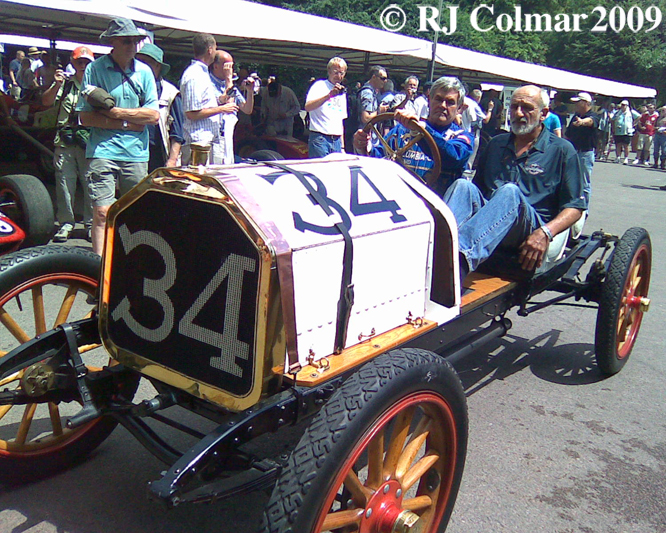
When I started reading up on this car a few hours ago all I knew about it was that according to the 2009 Goodwood Festival of Speed Guide was that it was a 4.8 litre 4 cylinder 293 cui Buick “thought to be the actual Buick that won the first race at Indy, driven by Louis Chevrolet on the four lap, 10 mile race”.

However I only had to check with the Wheels, Winter / Spring 1998 Journal of the National Automotive History Collection published by the Detroit Public Library to find that the winner of the first race at Indianapolis on Aug 19th was now well known automotive engineer Louis Schwitzer driving a four cylinder 212 cui Stoddard Dayton in a two lap 5 mile race.

Louis Schwitzer would become famous for designing the 1911 inaugural Indy 500 race winning engine for Marmon and later still for designing a variety of automotive pumps used in a wide variety of civil and military applications along with superchargers and latterly turbochargers as used by the, subject of a future blog in this series, 1952 Cummins Diesel.

Thanks to Gerry Godin’s ‘Buick City‘ blog I found the 16b Marquette Buick model name for today’s featured vehicle a wonderful photo of this vehicle on the Indy start line dated 1910 can also be seen on the blog.

Once armed with the model name I found out something about the myth of Buick winning the first automobile race at Indy dating back to at least the September – October 2002 Vol. 66, NO. 5 edition of Antique Automobile (Official Publication of the Antique Automobile Club of America, INC.) and the truth about some of the history of the #34 16b. Marquette Buick in an article by Terry B. Dunham which starts on page 29.

Terry asserts in paragraph 2 on page 43 of his article entitled ‘Something Wicked This Way Comes’ “The first races run at the Indianapolis Motor Speedway were held August 19th, 20th and 21st 1909, some two years before the first 500. Buick entered and won two of the three events, including the first race ever held at the track.”

Why Terry’s account in his otherwise excellent article should be at variance with the Journal of the National Automotive History Collection I cannot imagine but I believe the Journal of the National Automotive History Collection has got the story correct about Schweitzer winning the first automobile race at Indianapolis in 1909. May be someday Mr Dunham will chime in below. [EDIT See Post Script below]

So having cleared up a few myths here is what I do know about the 16b Marquette Buick seen here driven by 4 time Indianapolis 500 winner Al Unser Snr.

The origins of the 16b Marquette Buick can be traced to an accident in the 1908 Savannah Grand Prix which befell Fritz Erle after a tire on his, otherwise superior, overhead valve 11.7 litre 716 cui Benz threw a thread which knocked the unfortunate Erle unconscious causing him to loose control of the car which ended upside down on the side of the track.

This misfortune was all the opportunity Buick designer Walter Marr, who’s Buick stood no chance against the superior handling and power of the FIAT’s and Benz vehicles in Savanah that day, needed to inspect the superior suspension design of the Benz while it was upturned and commit the detail to memory.

Later Marr directed a Buick photographer to take photographs of the dismantled overhead valve Benz engine that was stripped down inside the Benz camp while it was left unattended. You can see photographs of this skullduggery on page 37 of Mr Dunham’s article.

Marr used this information to build three hot rods one of them, the one in the photograph, with a 5.2 litre / 318 cui 4 cylinder overhead valve racing engine and all three with chassis built by the Marquette Motor Company, part of the General Motors conglomerate.

These three hot rods were variously called regular model Buick 30 and then regular Buick 16 Roadster while they were actually ‘illegal’ racing specials with non production engines and chassis taking part in races designed for ‘stock’ vehicles.

The vehicle in the photograph above, entered as a Buick 30, is credited as the one driven by Louis Chevrolet to the most important of Buicks 166 (one hundred and sixty six) race victories during the 1909 season in The Cobe Trophy.

The race of attrition, held at Crown Point over 395 miles was won when Chevrolet running on only three cylinders thanks to a broken valve snatched a 65 second victory from a Locomobile which had been delayed by half an hour by magneto problems and beat an otherwise apparently healthy Knox.

By May 1910 the AAA got wise to the loose ways of Buick model naming policy and excluded the three Buick specials for not being ‘stock’ production vehicles.

An interesting foot note to the question of who won the first auto race at Indianapolis in 1909 is that in 1911 Louis Chevrolet turned up with a Marquette Buick for the first Indy 500 without a proper entry, despite being told to ‘sandbag’ go only as fast as necessary to qualify (around 75 mph) Louis foolishly went round at 93 mph.

The organisers of the race agreed to let Louis start on condition the owners of the other teams unanimously agreed to sign a waiver. Having blown every one into the weeds in qualifying three teams declined to sign one of them was Marmon who’s engine designer was Louis Schwitzer and who’s car went on to win the very first Indy 500, I wonder if there is some inter state rivalry between Indiana and Michigan afoot to explain the discrepancy in the answer as to who won the very first auto race at Indianapolis? [EDIT Turns out there is not see postscript]

My thanks to everyone mentioned in this blog for their contributions.

Hope you have enjoyed today’s extended history lesson edition of ‘Gettin’ a lil’ psycho on tyres’ and that you’ll join me and a very smart young lady tomorrow for a Birthday celebration. Don’t for get to come back now !

01 05 11 PS the mystery over who won the first race on the opening day at Indianapolis has been resolved thanks to Tim Murray at The Nostalgia Forum :-

Louis Schwitzer won the very first five mile race at Indianapolis aboard his Stoddart-Dayton.
A Buick was driven to victory in the 3rd 5 mile race.
Bob Burnham won the very first 250 mile ‘FEATURE’ race aboard his Buick !

Share

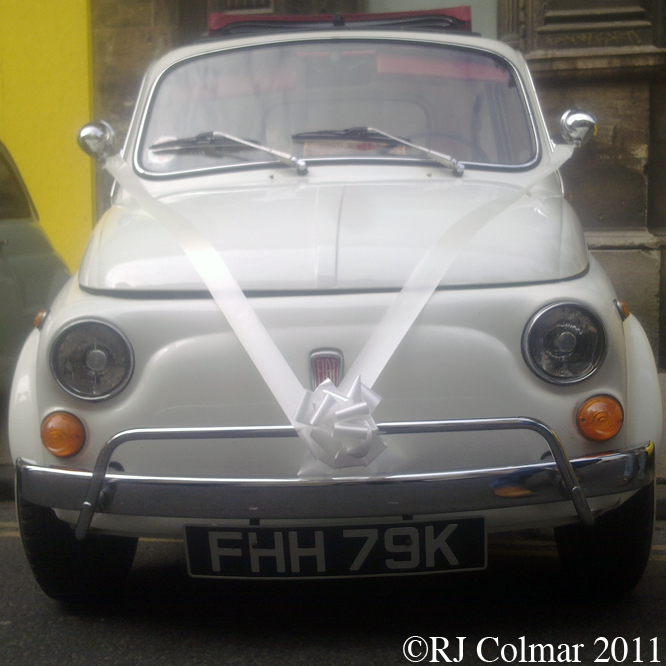
Perfect car for a wedding #3 – FIAT 500 Lusso

01 Image3294sc

Mindful of the fact that in a weeks time much of the TV watching world will be tuned in to the nuptials Mr William Windsor and Miss Kate Middleton, I thought it might be fun to look at a wedding mobile that will almost certainly not feature in next Fridays Royal extravaganza.

02 Image3293sc

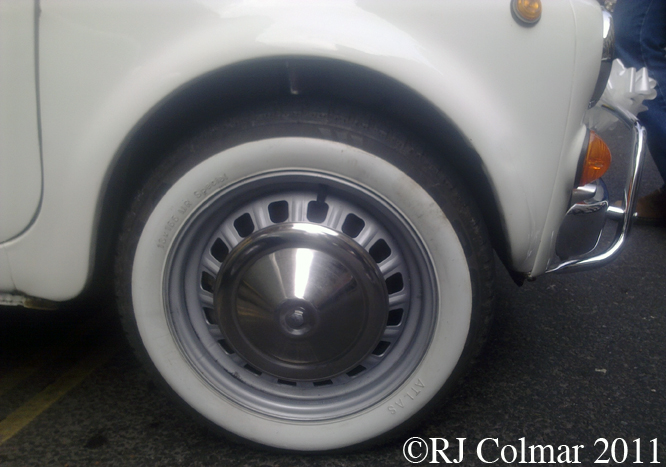
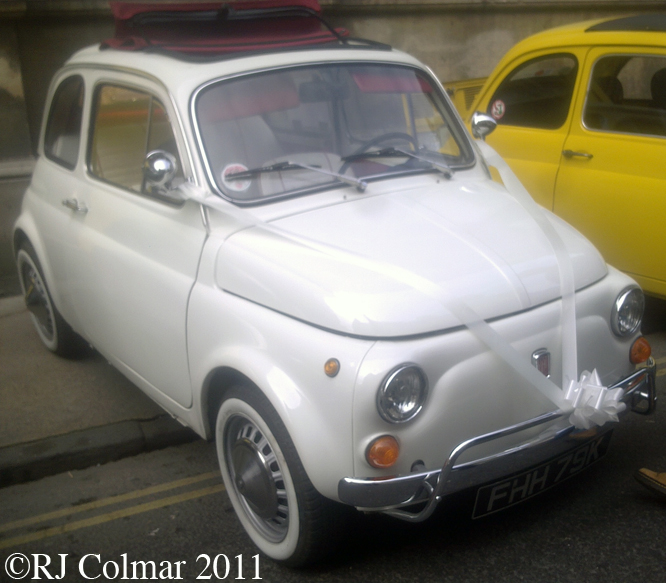
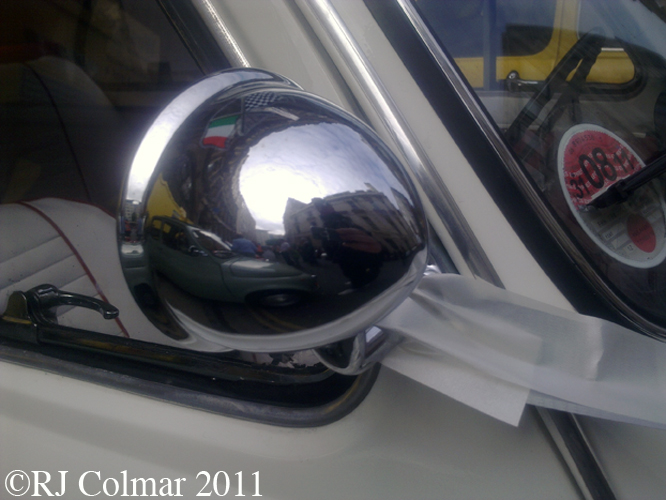
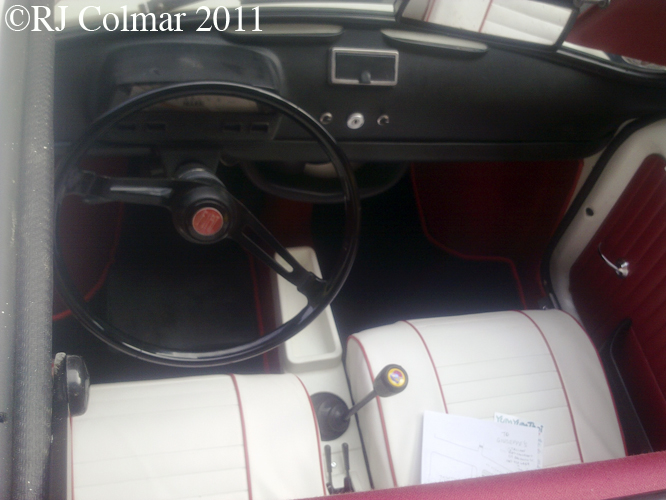
The FIAT 500 Lusso (Luxury), produced from 1968 to 1972, was externally distinguished from its base F (or Berlina) models by its extra chrome nudge bar.

03 Image3292sc

The original Nuova Cinquecento (500) was launched in in 1957 and replaced the delightful Topolino which had also been designed by Dante Giacosa.

04 Image3295sc

With a 6 ft wheel base carrying a body 4″ shy of 12 feet the 500 is considered to be one of the first city cars.

05 Image3296sc

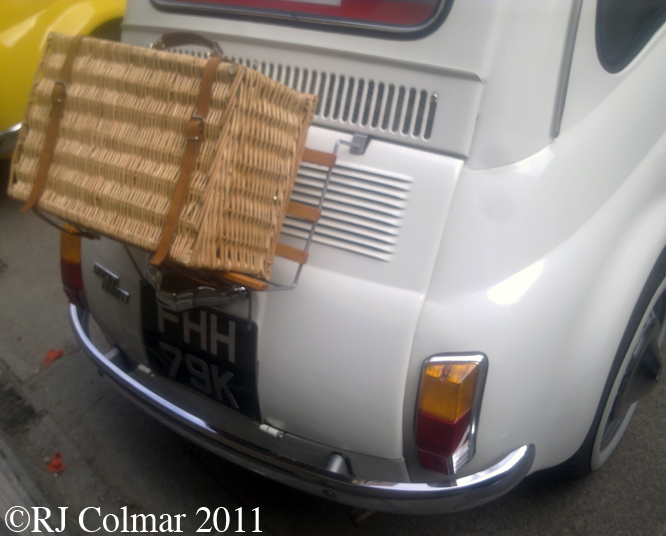
Like the Volkswagen Beetle and Renault 4CV the Cinquecento has its engine in the boot, this particular model was originally fitted with a 17 hp 499cc / 30.4 cui two cylinder motor.

06 Image3298sc

As one might expect from a vehicle less than 10′ long and just over 4′ wide the space inside might best be described as intimate, in fact just perfect for a couple of newly weds.

Wishing everyone getting married in the coming week all the best.

Hope you have enjoyed todays wedding edition of ‘Getting a lil’ psycho on tyres’ and hope that you will join me again tomorrow. Don’t forget to come back now !
Also in the Perfect car for a wedding series :-

Citroen Traction Avant

Humber Super Snipe MK IV

Share

When is a redhead not a redhead ? Ferrari 500 TRC #0690 MD TR

The other day Rowdizen jr Cracker asked if I had ever seen a Ferrari Testa Rossa driving around town the answer to which is no, but a couple of months ago I did see this Ferrari 500 TRC chassis number #0690 MD TR which came from the second batch of Ferrari vehicles with the Testa Rossa name.

Having noticed that the Alta engines of the HWM Formula 2 team had noticeably superior fuel efficiency compared to his own Colombo designed V12’s which dominated the Formula 2 class Enzo instructed Aurelio Lamperdi to design a 4 cylinder 2 litre / 121 cui engine.

The Lamperdi alloy four pot featured double over head cams acting on 2 valves per cylinder. Installed in a Formula Two car this engine powered Alberto Ascari two world championshops in 1953 and 54. This 4 cylinder engine was also used in the successful 500 Mondial Sports Cars of 1954 – 56 which scored numerous class wins.

Towards the end of 1956 Vittorio Jano completed work on his update of the 500 Mondial which featured red cam covers on its Lamperdi 2 litre 4 cylinder engine and so the Testa Rossa legend was born, the TR scored a maiden win at Monza in the hands of Brits Collins and Hawthorn.

The first batch of 500 TR’s were rendered almost instantly obsolete by new sports car regulations, written and introduced after the disaster at Le Mans in 1955, known as Appendix C which required sports cars to race with full width screens, a passenger door, and fuel tanks mounted outside of the cockpit. The second batch of Testa Rossa’s became known as the 500 TRC of which #0690 MD TR is one of less than 20 examples.

This particular car has an unfortunate history, it was entered in the 1958 Cuban GP, an event during which pole sitter Juan Manuel Fangio was kidnapped by Castros forces and he ended up watching the race on television. Armando Garcia Cifuentes was at the wheel of #0690 when he lost control on a patch of oil, hit a curb and promptly ploughed into a spectator area. Seven spectators were killed in the accident over 40 were injured, miraculously Armando survived after being taken to hospital on the bonnet of a competitors TR.

It is not clear what happened to #0690 after that crash but the Indiana Jones of finding forgotten cars Colin Crabbe located it and it has now been restored with a non standard 12 cylinder engine allegedly sourced from a 250 GT Lusso, one of the more expensive 250 GT variants ! It is not known what happened to the original 4 cylinder Testa Rossa engine.

Note uniquely for a 500 TRC #0690 now has a large central perspex bonnet scoop for the V12 carburettors.

In order to not disappoint jr Cracker entirely here is a photo by Ed Arnaudin of a 500 TRC compete with a 4 cylinder red cam cover engine and without the large central bonnet scoop. The vehicle in this photo taken at Lime Rock possibly 24th April 1959 appears to be chassis number #0706 MD TR entered by the MJ Garber team and driven by Swiss driver Gaston Andrey.

Thanks once again to Steve Arnaudin for letting me share one of his father Ed’s photos. Hope you enjoyed todays edition of ‘Gettin’ a lil’ psycho on tyres’ hope you’ll join me again tomorrow, don’t forget to come back now !

Share