Tag Archives: Benz

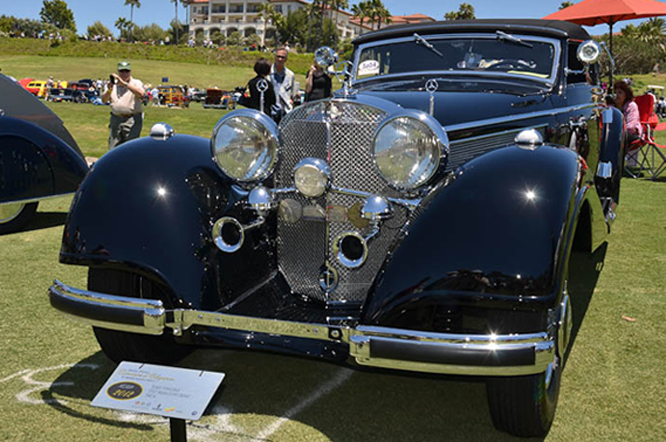
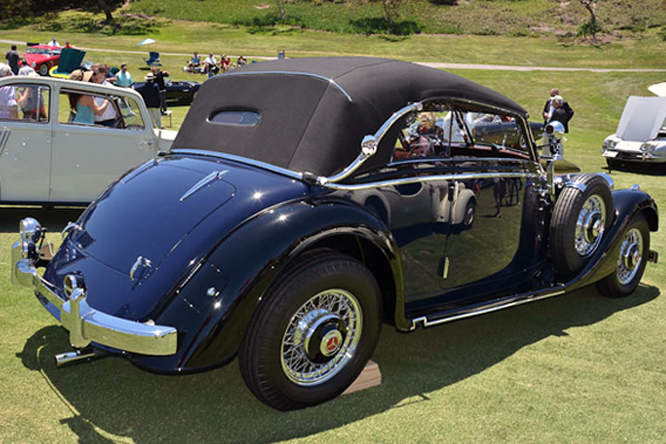
Out Of Aladdin’s Cave – Mercedes Benz W24 540K Cabriolet A

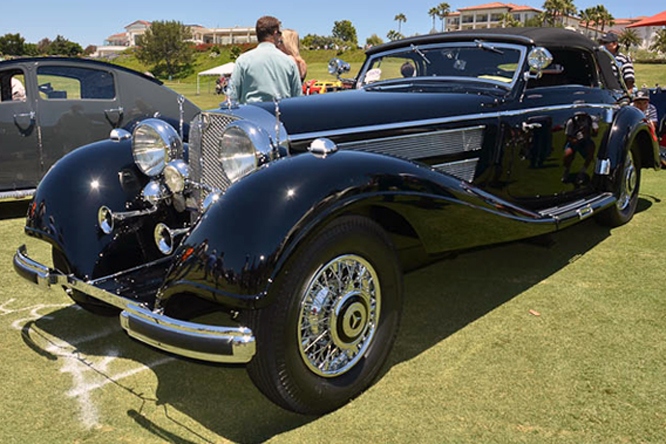
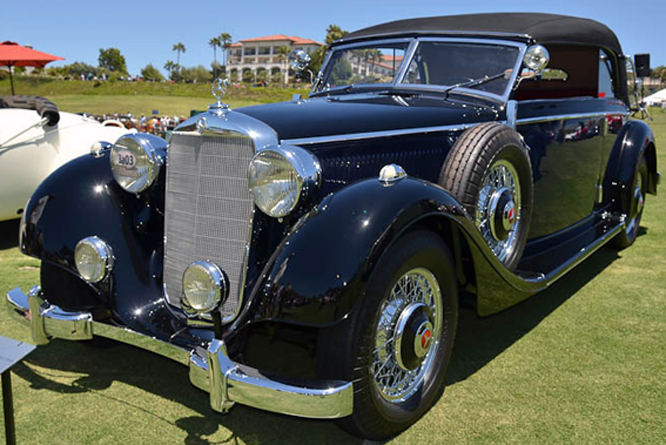
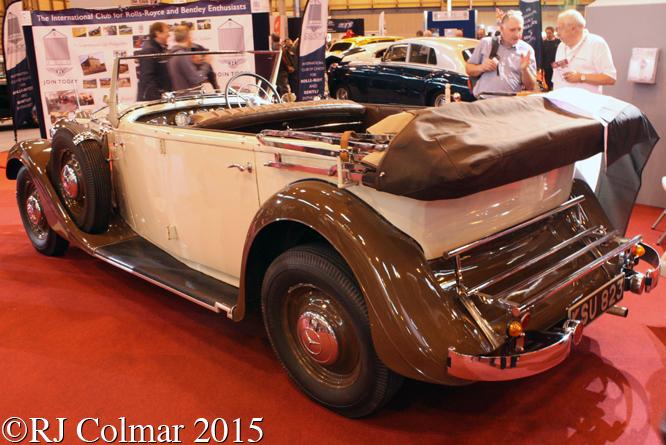
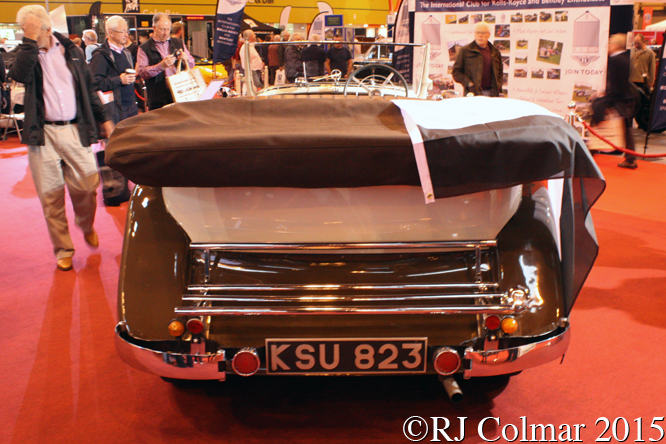
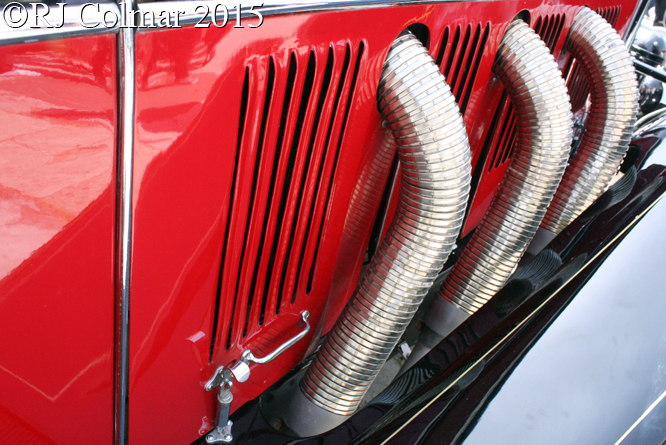
Friedrich Geiger was charged with the design of the straight 8 5 litre / 302 cui W29 500K launched in 1934 and then 5.4 litre / 329 cui Typ W24 540K in 1935.

540K Cabriolet A, Dana Point Concours d'Elegance

The supercharged 180hp W24 540 K motor was fitted to chassis of either 117″, 130″ or 153″ which differed from the 500K predecessor by using oval tubes as used by the Mercedes Benz Silver Arrows racing cars of the period.

540K Cabriolet A, Dana Point Concours d'Elegance

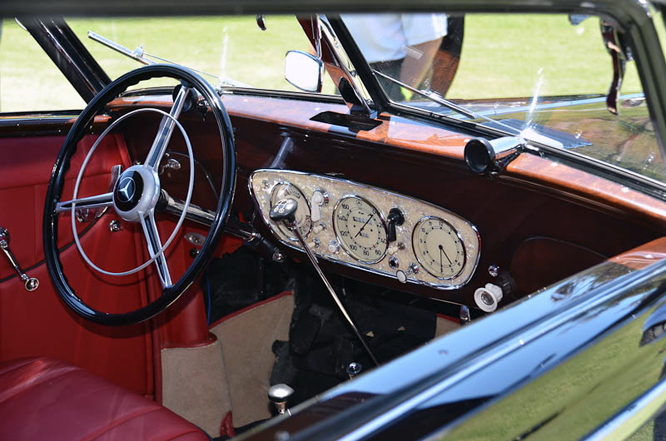
The 540K Cabriolet A seen here sits on the shorter 117″ chassis and would have been capable of 110 mph, production ended in 1944 by which time variants were being built with armored bodies for Gemran Government officials.

The 1937 example seen here at Dana Point Concours d’Elgance belongs to collector Anthony ‘Tony Vincent’ Zehenni who founded the Aladdin Developers Inc property development empire.

My thanks once again to Geoffrey Horton for sharing his photographs.

Thanks for joining me on this “Out Of Alladin’s Cave edition of “Gettin’ a li’l psycho on tyres” I hope you will join me again tomorrow when I’ll be looking at an off road Matra, don’t forget to come back now !

Share

2 Door 4 Seat – Mercedes Benz W142 320 Cabriolet B

In February 1937 Mercedes Benz launched the first two, of an eventual four, variations of the W142 Typ 320, that replaced the W18 Typ 290, with either 2,880 mm / 113″ or 3300 mm / 130″ chassis both of which remained in production from 1937 to 1938.

The new models were powered by enlarged 77hp 3,208 cc / 195 cui six cylinder side-valve engines that were fitted with manual all synchromesh 4 speed gearboxes.

Mercedes Benz W142 320 Cabriolet B, Dana Point Concours d'Elegance

As with the W18’s W142 were fitted with numerous Cabriolet options the long wheel base chassis cabriolet options included 2 door 3seat Cabriolet A, 2 door 4 seat Cabriolet B as seen in these photographs, 4 door 4 seat Cabriolet D and four-door 6-seat with three rows of seats Pullman-Cabriolet F.

With a top speed of 81 mph the W142’s had hydraulic brakes on all four wheels to slow then down and made use of the same suspension as the W18, transverse leaf and coil springs on the front and swing axles at the back.

Mercedes Benz W142 320 Cabriolet B, Dana Point Concours d'Elegance

The third W142 variant manufactured from 1938 to 1940 was for military use with 4 front hinged door, a canvass roof and off road tyres that reduced the top speed of the vehicle to 73 mph.

The final variant of the W142 built from 1938 to 1942 was powered by a motor enlarged to 3,405 cc / 207 cui, the power output remained the same thanks to a reduced compression ratio in anticipation of the increased use of fuel synthesized from coal which had a lower octane rating than the fuel refined from oil.

The military W142/III was also fitted with the larger engine in 1939 but tuned to give 79hp in order that the top speed remained at 73 mph.

Mercedes Benz W142 320 Cabriolet B, Dana Point Concours d'Elegance

4,326 of the W142’s were built with the smaller engine and 885 with the larger engine, additionally 1,806 military variants were built.

My thanks to Geoffrey Horton for sharing these photographs of the 1937 320 Cabriolet B belonging to Mercedes Benz Classic Center taken at Dana Point Concours d’Elegance a couple of years ago.

Thanks for joining me on this “2 Door 4 Seat” edition of “Gettin’ a li’l psycho on tyres” I hope you will join me again tomorrow when I’ll be looking at a three seat Talbot. Don’t forget to come back now !

Share

Left In Dar es Salaam – Mercedes Benz W18 Typ 290 Cabriolet

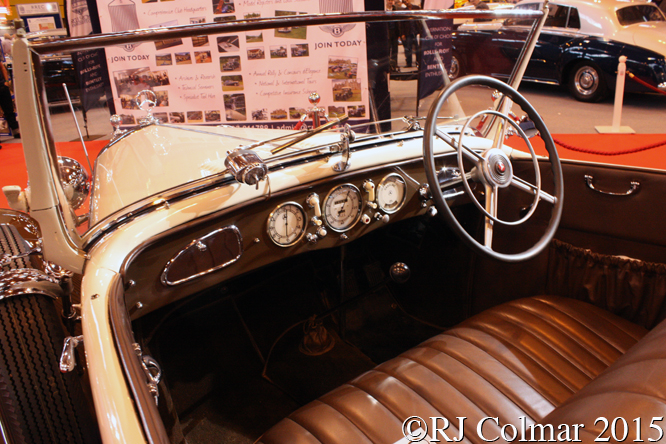
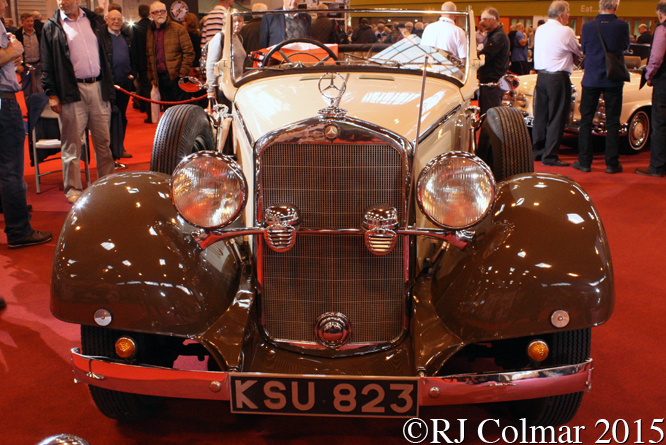
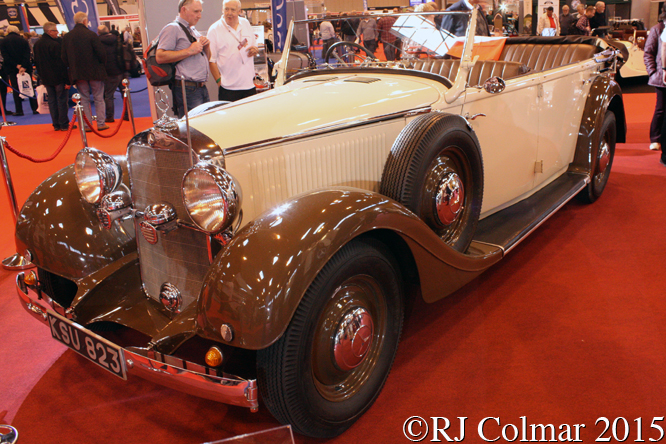
The Mercedes Benz W18 Typ 290 series cars were powered by a 60 hp 2,867 cc / 174 cui straight six side valve engine and first seen in 1933 was capable of 67mph.

Mercedes Benz W18 290 Tourer, Classic Motorshow, NEC, Birmingham

The W18 was initially offered only with a 113″ chassis which was supplemented from 1934 with a 130″ chassis option, the front suspension was by transverse leaf and coil springs while the rear wheels were attached to swing axles, hydraulic breaks were fitted all round.

Mercedes Benz W18 290 Tourer, Classic Motorshow, NEC, Birmingham

Among the body options offered on the original short wheel base chassis were three cabriolets, 4 door 4 seat as seen here, 2 door 4 seat and 2 door 2 seat which was supplemented by a fourth 2 door 2 seat cabriolet with a lower body in 1936.

Mercedes Benz W18 290 Tourer, Classic Motorshow, NEC, Birmingham

This particular right hand drive Cabriolet was built for the German Consul in Dar es Salaam, Tanganyika Territory which had been handed over to British Colonial rule, where driving on the left was the norm, from German Colonial Rule, where driving on the right was the norm, by a League of Nations Mandate in 1922.

Mercedes Benz W18 290 Tourer, Classic Motorshow, NEC, Birmingham

The Consul did not have long to enjoy the car before Adolph Hitler, who had no interest in the British colony, became the Chancellor and recalled the Consul and his staff back to Germany in 1934.

Mercedes Benz W18 290 Tourer, Classic Motorshow, NEC, Birmingham

The car appears to have remained warehoused in Africa until 1987 when it was shipped from Durban in South Africa to the UK with just 3,678 documented miles on the clock.

In all 3,566 short wheel base models, 3,929 long wheel base models and 719 military variants of the W18 were built between 1933 and 1937 when the 290 was replaced by the W142 Typ 320.

Thanks for joining me on this “Left In Dar es Salaam” edition of “Gettin’ a li’l psycho on tyres” I hope you will join me again tomorrow when I’ll be looking at a three seat sports car. Don’t forget to come back now !

Share

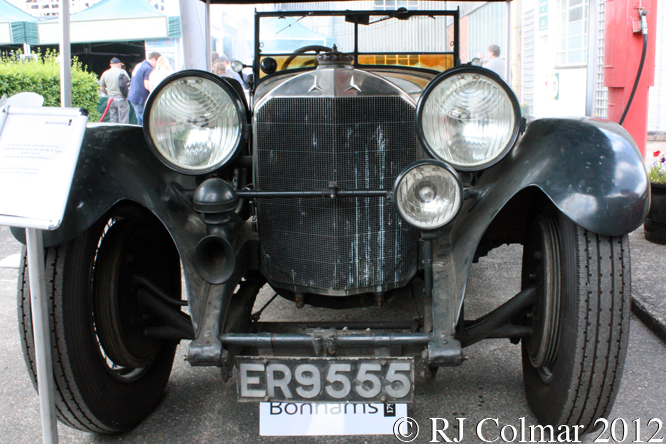
Tailor Made Motor House – Mercedes Benz 36/220 #35906

The original of today’s featured 1928 Mercedes Benz 36/220, Charles Gerald Brocklebank, is known to have competed with a Mathis in pre-World War 1 Oxford University Motor Club speed trials. After serving through out the 1914-18 war as a Captain with the Royal Engineers for which he was decorated with 1914 Star, Military Cross and Médaille militaire he forged a successful career as a broker in the City of London.

C.G., as he was often referred to in the contemporary press, also tuned a Schneider raising it’s top speed from 55 mph to 72 mph before buying a 1913 Grand Prix Peugeot which he named “Laura”.

He was to accompany Captain James Algernon Toop, formerly of Home Counties Divisional Supply, as passenger aboard the Peugeot for a race at Brooklands in 1924, but elected not to in order to save weight, Capt. Toop was killed while racing for lead when the Peugeot went over the Brooklands banking.
IMG_8045sc

C.G. Brocklebank also briefly owned the 1914 Mercedes Benz with which Christian Lautenschlager won the 1914 French Grand Prix.

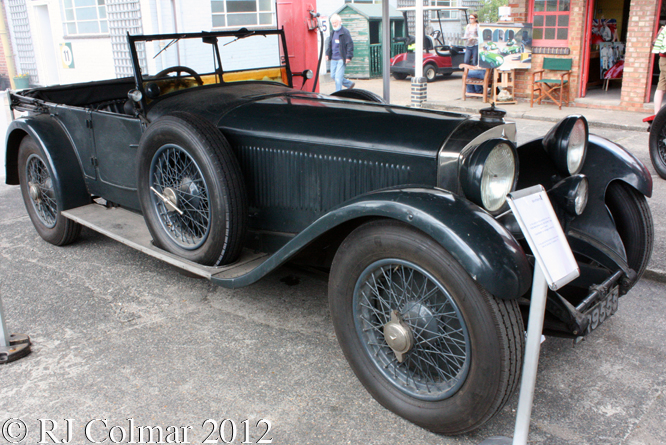
On the 28th of February 1928 C.G. ordered today’s featured Mercedes Benz 36/220, it was delivered sans body on April 13th the same year for Cadogan Motors Ltd. to create and fit the lightweight fabric-skinned body.

#35906 was registered for the road in the UK on the 22nd of May 1928 and C.G. had a tailor made motor house erected to accommodate it at his property Giffords Hall, Stoke-by-Nayland, Suffolk.
IMG_8046sc

Upon his death in 1940 C.G Brocklebank’s son inherited the car and kept it in the same tailor made motor house where it remained until C.G Brocklebank’s grandson inherited it.

When the grandson disposed of #35906 in 2012, after 84 years ownership in a single family, it was still in running condition showing just 8,375 “probably genuine” miles on the clock, the car is seen in these photographs at the Brooklands Double 12 meeting prior to it’s sale at auction for £2,801,500 including buyers premium.

My thanks to Tim Murray and Richard “Vitesse 2” Armstrong at The Nostalgia Forum for helping me to identify C.G. Brocklebank as the original owner of today’s featured car.

Thanks for joining me on this “Tailor Made Motor House” edition of “Gettin’ a li’l psycho on tyres” I hope you will join me again tomorrow when I’ll be looking at a Matra Simca. Don’t forget to come back now !
Share

Kick Down Supercharged – Mercedes Benz 36/220

With the merger of Karl Benz’s and Gottlieb Daimler’s companies into the Daimler-Benz company, the first vehicles to appear with the Mercedes Benz brand name appeared in 1926.

02 Mercedes Benz 36 220_2069sc

One of the first new models sold as a Mercedes Benz was the 36/220 for which chief engineer Prof. Dr. Ferdinand Porsche directed the design, the model was first seen in the UK at the 1927 Olympia Motor Show where the 4 1/2 litre Bentley also made it’s first appearance.

03 Mercedes Benz 36 220_2066sc

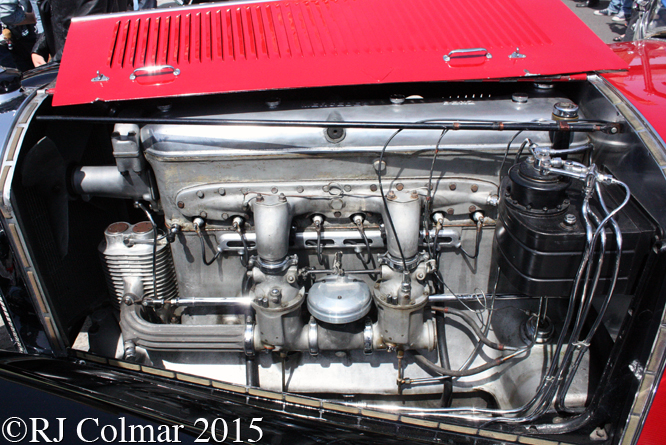
Among the novel features the 36/220 was powered by a 6 cylinder 6.8 litre / 414 cui motor fitted with a kick down supercharger that only deployed only when the throttle pedal was fully depressed boosting the motors output from “sufficient” to “most effective” as described in one contemporary report.

04 Mercedes Benz 36 220_2073sc

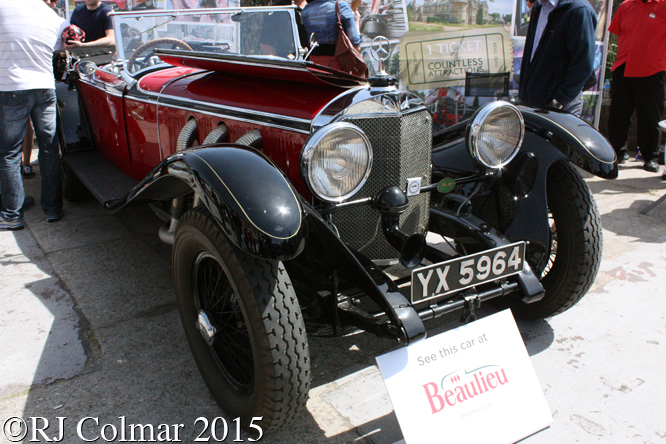
Today’s featured example seen earlier this year at the Wheels Festival in Bournemouth was once the property of Renaissance man and proto petrol head Sir Peter Ustinov who’s novelty record “Grand Prix of Gibraltar” drew on his creative wit and ability at car engine sound-effects and voices.

05 Mercedes Benz 36 220_2074sc

This car first registered in the UK on the 31st of December 1927, has recently been restored to it’s original condition by the National Motor Museum at Beaulieu.

06 Mercedes Benz 36 220_2067sc

Only 146 36/220’s were built they had a top speed of 110 mph, you can read an entertaining little story about a how a precocious 14 year by the name of Boddy was disappointed to be taken for a test drive in a chauffeur driven 36 220 that only recorded 99 mph on the Barnet By-Pass in 1927 here.

Thanks for joining me on this “Kick Down Supoercharged” edition of “Gettin’ a li’l psycho on tyres” I hope you will join me again tomorrow. Don’t forget to come back now !
Share

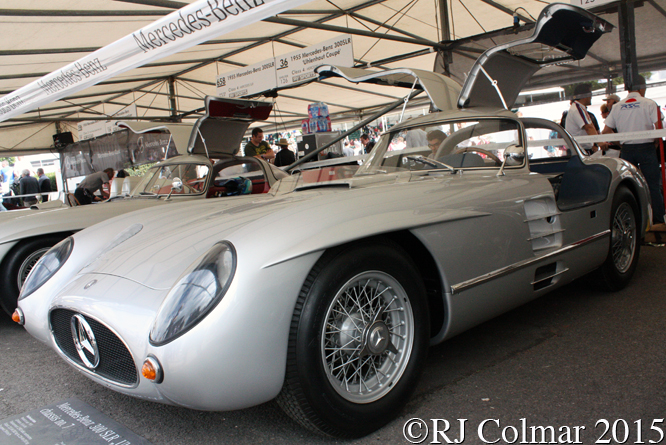
When 6 Is 9 – Mercedes Benz 300 SLR no.10

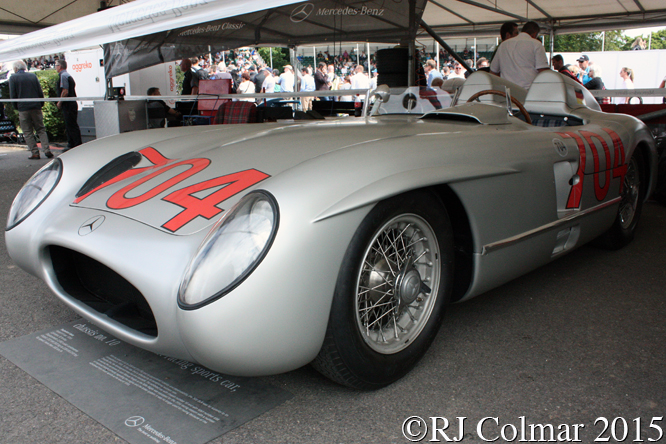
At 07:04 on the 1st of May 1955 Hans Hermann and Hermann Eger set off from the start ramp of for the Mille Miglia however unlike team mates Stirling Moss and Juan Manuel Fangio the two Germans never made it to the finish crashing out before reaching Bologna while in second place over 5 mins behind Moss and Jenkinson but well ahead of Fangio who was running on only 7 of his 8 cylinders.

Mercedes Benz 300 SLR Coupé, Goodwood Festival of Speed

The car Hans crashed on the Mille Miglia was chassis #no.6 and it’s next appearance was at Le Mans where Pierre Levegh and John Fitch were to drive the car and two hours into the race Pierre’s Mercedes 300 SLR clipped an errant Austin Healey and was launched into the air which set in motion the greatest disaster in motor racing history as 84 people and were killed as parts of the Mercedes scythed through the spectators and the magnesium bodied car went up in flames, Pierre to was killed as he was thrown out of the car.

Mercedes Benz 300 SLR Coupé, Goodwood Festival of Speed

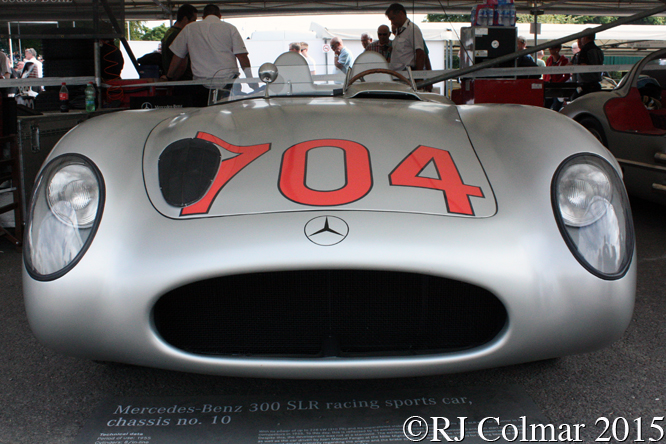
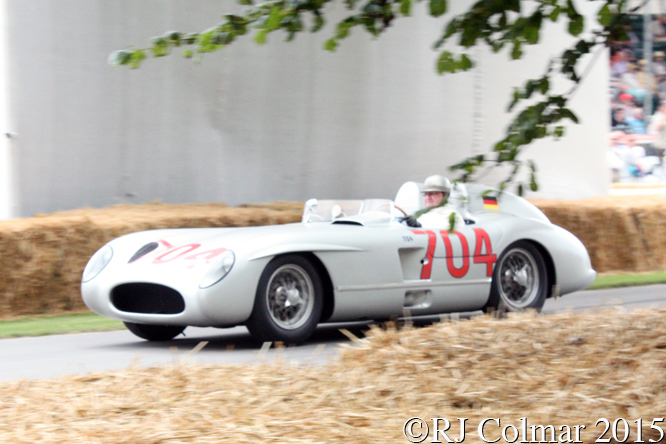
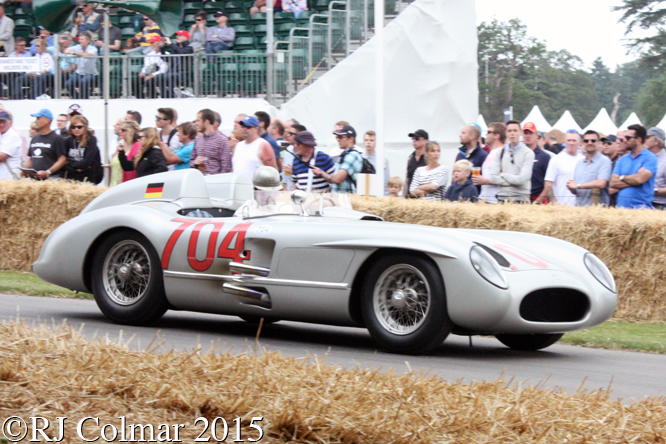
The car seen in these photographs bearing the #704 start number carried by chassis no.6 on the Mille Miglia is the last of the nine 300 SLR’s to be built, and is said to incorporate improvements in anticipation of the 1956 season which Mercedes Benz cancelled in the fall out of the disaster at Le Mans.

Mercedes Benz 300 SLR Coupé, Hans Hermann, Goodwood Festival of Speed

Logic tells us the chassis number should be #no.9 but for reasons that even Mercedes Benz are not sure of the car actually carries the chassis #no.10, quite simply there never was a chassis #no.9.

Mercedes Benz 300 SLR Coupé, Hans Hermann, Goodwood Festival of Speed

Hans Hermann is seen at the wheel of #no.10 at Goodwood Festival of Speed, where the Mercedes Benz blurb indicated that #no.10 has also carried the #658 Juan started the 1955 Mille Miglia with on occasion.

Thanks for joining me in this “When 6 is 9” edition of “Gettin’ a li’l psycho on tyres” I hope you will join me again tomorrow when I’ll be looking at the ultimate Simca Rallye 2. Don’t forget to come back now !
Share

Scoop & Simple Grill Coupé – Mercedes Benz 300 SLR #no.7

When Mercedes Benz told it’s drivers of the companies plans to return to sports car racing in 1955 with a gull wing bodied version of the W196 R formula one car the drivers were horrified and objected to the idea of sitting in a closed cockpit behind a formula one engine because the noise and heat would be difficult to endure over the longer races such as the 10 hour Mille Miglia where no driver change was permitted or the Le Mans 24 hours where two drivers were permitted.

As a consequence Chief Engineer Rudolf Uhlenhaut furnished his team with the 300 SLR Roadsters that would become the über successful World Sportscar Championship winning cars during a season in which the most famous win was that of Stirling Moss and his co driver Denis Jenkinson on the Mille Miglia.

Mercedes Benz 300 SLR Coupé. Goodwood Festival of Speed

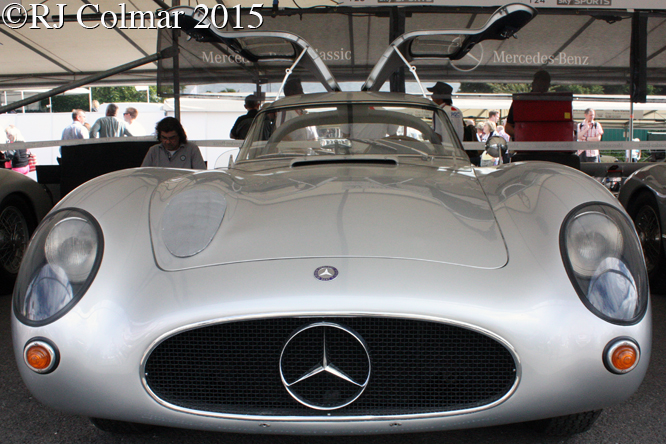
During the course of the 1955 season nine 300 SLR’s were built and two of them today’s featured chassis, which I believe is, #no.7 and #no.8 were built with Coupé bodies on the orders of Rudolf.

The two Coupés differ in detail with #no.7 having a squared scoop on the top of the bonnet that does not feature on #no.8, #no.7 also has a much simpler grill decoration, which possibly backs up Mercedes claim that the company was interested in exploring the idea of developing a Gull Wing Coupé for the 1956 season, regardless of the team drivers objections, before the companies plans changed in light of the tragedy at Le Mans in 1955.

Mercedes Benz 300 SLR Coupé. Goodwood Festival of Speed

I believe the 176mph 300 SLR Coupé Rudolf Uhlenhaut used as his personal transport was #no.8.

Thanks for joining me on this Scoop & Simple Grill edition of “Gettin’ a li’l psycho on tyres” I hope you will join me again tomorrow. Don’t forget to come back now !
Share