Tag Archives: Ed

Private Investigations – Maserati 300S #3053

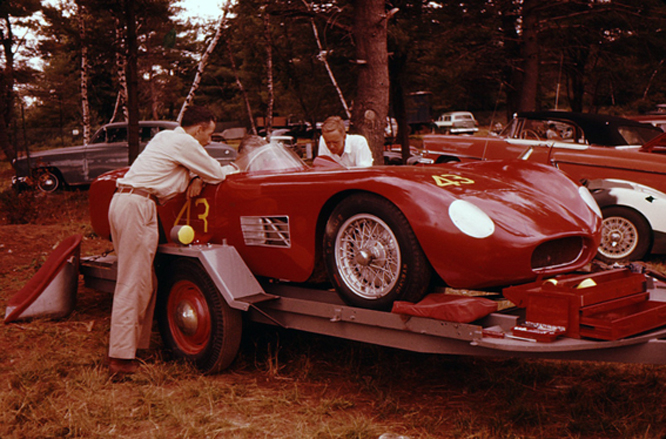
Thanks to Ed Arnaudin’s superb photography we can have a look at the Maserati 300S at Lime Rock on May 9th 1959 that was raced by Joe Guibardo in Northeastern America during the 1959 season.

Just 28 Maserati 300S models were built from 1955 to 1958 to compete in the World Sportscar Championship. Thanks to contributions from Sir Stirling Moss the 300S is credited with three World Sports Car Championship victories two of them on the 14 mile Nurburgring in ’56 and ’57 along with many other wins in national races in Europe and the United States. In fact as with the the Ferrari 860 Monza we looked at yesterday Juan Manuel Fangio also drove a Maserati 300S to victory this time on two occasions in Brazil in 1957.

The 300S was powered by a 3 litre / 183 cui variation, with a lengthened stroke, of the 6 cylinder motor that was used simultaneously in the Maserati 250 F with a lower compression ratio to cope with the most commonly available fuel as stipulated in Sports Car regulations of the time. The drum brakes and stiffened suspension also show strong signs of 250 F heritage.

A trellis structured chassis was covered in an aluminium body penned by Madardo Fantuzzi who was also responsible for the second version of the Maserati 150S.

Perhaps the most incredible of Maserati 300S stories is that a 300S was raced against both a Porsche 908 and 910 in Brazil as late as 1971 ! Unfortunately we do not know the end result for the Maserati in that race but even so I hope you’ll agree a quite remarkable achievement just to enter a 15 year old design into a contemporary sports car race.

Slightly of topic regular GALPOT readers who really pay attention may recognise the name of the 5th place driver at Interlagos Antônio Carlos Avallone.

Allegedly Mark Knopfler is a long term Maserati 300S Owner.

Joseph Giubardo appears to have raced in Austin Healeys and MGs from 1954 to 1962 and used this 300S chassis #3053 from at least 1957 to 1959 scoring at least one class win at Thompson CT in 1957.

My thanks as ever to the Arnaudins for taking and sending the photograph and to Walter Baemer of International Maserati Research for identifying who this vehicle belonged to.

I hope you have enjoyed today’s Dire Straights edition of “Gettin’ a lil’ psycho on tyres” and that you will join me again tomorrow for a look at a gargantuan Edwardian from the USA that recorded the first international race victory for an American driver. Don’t for get to come back now !

PS Slightly off topic but continuing the private investigation in to this photo graph wonderng if anybody recognises either the kid in front of, or the owner and hound in the, 1950 Cadillac Series 61 Sedan ? Thanking you in anticipation of your responses.

Share

Broken Promises – DB Panhard HBR

Somehow almost overlooked this photo by Ed Arnaudin of John B Mull in his DB Panhard competing in Race 1 at Thompson CT on the 20th July 1958, although John did not finish this race, we shall see this is a significant model in the world of national and international class H up to 750 cc 45.7 cui racing.

The manufacture of DB cars commenced after a promised drive failed to materialise at the 1936 French Sports Car Grand Prix for Charles Deutsch and René Bonnet. The following year they entered a special of their own devising using the remnants of of a Citroen Traction Avant 11 CV.

Their specials placed in the very first post war race in Paris in 1945 and with the construction of the open wheel DB7 Automobiles Deutsch & Bonnet became a business entity in 1947.

Unhappy with the supply of Citroen parts they switched primarily to using flat twin Panhard motors of 744 cc / 45.4 cui. DB Panhards took class victories at the Mille Miglia, four times, Le Mans, three times, Sebring, twice and SCCA class H, the latter in 1958 with Howard Hanna at the wheel and in 1959 with Ray Heppenstall at the wheel.

Despite their on track success after building nearly 1000 vehicles, a disagreement over the architecture of their next model led to Deutsch and Bonnet going their separate ways forming CD and Automobiles René Bonnet respectively, the latter using Renault power became part of Matra Automobiles in 1965.

Panhard which as Panhard et Levassor had been in business since 1897 was absorbed in to Citroen in 1965 with the last vehicle produced in 1967 the name is still to be found in use as a brand of French built military vehicle.

The HBR model seen here was built from 1954 to 1961 on the most common DB chassis shared with Mille Miles and Coach models of which a combined total of 660 were made.

John B Mull appears to have had a collection of vehicles to race with Evelyn Mull between them they are known to have raced a Jaguar XK120, AC Ace Bristol, Austin Healey 100 S and this DB Panhard, JB is also known to have raced an OSCA S750.

Hope you have enjoyed the Race 1 Thompson CT 20th July 1958 series, my thanks to Ed and Steve Arnaudin for the photograph and to Terry O’Neil for the race results. Join me tomorrow for Ferrari Friday when we will be looking at a vehicle driven by a reigning 3 time World Grand Prix Champion on it’s victorious debut and a month later was driven to a class victory by the USA’s first future world champion. Don’t forget to come back now!

Share

You can’t reverse that thing here mate ! – Lotus IX

Moving up the field at Thompson CT on 20th July 1958 today Ed Arnaudin’s photo’s feature a Lotus IX driven by Len Bastrup a respected Lotus driver who finished 2nd in Race 1 for class G, HP & HM cars.

Around thirty Lotus IX models were manufactured from 1954 to 1955 with a variety of engines available from MG, Connaught and Bristol, this particular model had the most common 4 cylinder 1098 cc / 65.4 cui Coventry Climax Class G spec motor .

The body was penned by Frank Costin, brother of Mike who gave the Cos to Cosworth, and manufactured by Williams & Pritchard, who GALPOT regulars might remember were responsible for an all time favourite of mine the special body on a BMW 315/1.

Colin Chapman the dynamo behind Lotus Cars and accomplished racing driver entered a IX for the Le Mans 24 hours in 1955.

During the race he crashed his car into a sand bank. Thinking nothing of the incident he reversed out and was promptly disqualified for unauthorised reversing.

Len Bastrup was racing from at least 1953 to 1960 starting in MG’s and then moving to Lotus cars in 1955. He shared a Lotus XI at the Sebring 12 hours in 1956 with Lotus founder Colin Chapman which burst into flames after an accident in practice which caused terminal damage and withdrawal from the race before it had started.

My thanks to Ed Arnaudin for the photographs, his son Steve for sending them on and Terry O’Neil for the race results.

Hope you have enjoyed today’s 45.5cui edition of Gettin’ a lil’ psycho on tyres’ and that you will join me again tomorrow. Don’t forget to come back now !

Share

Double Bubble – FIAT Abarth 750 GT Zagato Coupé

Continuing the series of posts relating to Race 1 at Thompson CT on the 20th July 1958 captured on camera by Ed Arnaudin, today we are looking at the fascinating FIAT Abarth 750 Zagato driven by Paul Sagan to 6th place overall the only class H finisher.

After the 22 hp FIAT 600 was launched in 1955 Carlo Abarth set about maximising the potential of tuning the engine by increasing the size from 633 / 38.6 cui to 747 / 45.6 cui fitting a Nardi inlet manifold and increasing the compression ratio to produce 47 hp.

Meanwhile while Zagato set about building a Coupé based on the same car the 30 hp 600 TS, when Abarth saw the coupe he suggested to Zagato they work together to produce a vehicle for racing in the popular 750 cc 45.6 cui sports car class prevalent in national and international racing at the time.

Over 600 of these successful racing vehicles which won the SCCA class H in ’59 ’60 and ’61, are thought to have been built between 1956 and 1960 when the maximum permitted engine sizes for the various national racing classes were changed. The ‘double bubble’ name which is derived from the two humps in the roof stuck in America where a chewing gum brand bearing the same name was popular.

Paul Sagan is known to have been successful driving Porsche 550’s in 1956 and 1957 before he moved over to running the #27 FIAT Abarth 750 during and after which his record is sketchy though he seems to have returned to racing Porsches by 1961.

My thanks to Terry O’Neil for the race results and Steve Arnaudin for his Dad Ed’s pictures, wishing Ed all the best on his return home from hospital.

Hope you have enjoyed today’s double bubble edition of ‘Gettin’ a lil’ psycho on tyres and that you’ll join me again tomorrow for a look at the cool 2nd place Lotus IX of Race 1 at Thompson CT on the 20 July 1958. Don’t forget to come back know !

Share

HM Racer – Nardi MD4 Spyder

Todays post comes courtesy of photographer Ed Arnaudin who’s photo’s were kindly forwarded to me courtesy of his son Steve.

Featured today is a Nardi ND 4 Spyder, seen here at the New York Championship Race meeting, Thompson CT July 20th 1958 where it came in 11th driven by John Igleheart in Race 1, a race which I will be returning to tomorrow.

Enrico Nardi was an Italian racing driver, engineer and designer who worked for Lancia and the works Alfa Romeo Scuderia Ferrari Team. Enrico is credited with being one of the first two drivers to race the Auto Avio Costruzioni 815, considered to be the very first Ferrari model in all but name, in the 1940 Mille Miglia.

In 1951 Nardi established his own workshops on Via Lancia, Torino to build prototypes and one of the strangest vehicles out side of Can Am 2 the twin boom Nardi Bisiluro for the 1955 Le Mans 24 Hours.

The mid 1950’s ND4 Spyder is one of many of Nardi’s 750 cc vehicles which came in a variety of shapes powered by a variety motors including JAP, Crosley, Panhard and in the case of this particular vehicle a 4 cylinder 43 hp 747 cc / 45.5 cui FIAT unit sourced from the FIAT 600 parts bin.

John Igleheart driver of the #95 seems to have been a specialist at racing cars with small motors he is known to have raced from at least 1953 to 1968, he seems to have been most successful driving a ‘Bobsy’.

My thanks again to Ed and Steve Arnaidin for todays valuable contribution and to Terry O’ Neil for the race results.

Hope you have enjoyed today’s 45.5cui edition of Gettin’ a lil’ psycho on tyres’ and that you will join me again tomorrow. Don’t forget to come back now !

Share

Piccoli Ferrari – Siata 208S

Today’s photograph by Carlyle Blackwell comes from Ed Arnaudin’s collection and I’d like to thank his son Steve for sending it to me.

Siata 208S, Blackwell Archive

Photo Carlyle Blackwell, Publised Courtesy Blackwell Archive, for sales enquiry’s please e-mail infoATpsychoontyres.co.uk and your contact details will be forwarded to the Blackwell Archive.

Just 35 Siata 208S’s were manufactured in Italy from 1953 to 1955. Of those 25 were imported into the USA by Ernie Mcafee.

The cars were fitted with a 105 hp FIAT 70 degree V8 2 litre / 122 cui ‘8V’ engine which allegedly was so named because FIAT erroneously believed Ford owned the V8 trade mark.

The 208S is known to have been driven to victories by among others Bob Kuhn, Dick Hayward and Douglas Diffenderfer who was winning races as late as 1960.

Probably the most famous owner of a 208S was Steve McQueen who apparently replaced the badges on his car with Ferrari badges and called it ‘Little Ferrari‘.

It should be noted that Ernie Mcafee and Jack McAfee, who appeared on this blog a couple of weeks ago, were not related, though the younger Jack did work for Ernie and on one occasion raced with Ernie sharing a Parravano Ferrari in the 1952 Panamericana.

They often raced against each other right up until Ernie’s last race at Pebble Beech on April 22nd 1956 in which he was killed when his car hit a tree. A crash incidentally that heralded the end of Pebble Beech as a venue for racing and led to the development of racing at Laguna Seca in 1957.

Hope you have enjoyed today’s ‘Piccoli Edition’ of getting a lil’ psycho on tyres and that you’ll join me again tomorrow. Don’t forget to come back now !

28 07 12 PS My thanks to Pamela Blackwell who has kindly retrospectively given me permission to post the photo’s her father took.

Share

Sweet and predictable – #43 Maserati 150 S #1643

Thanks to again to Ed Arnaudin for today’s photograph of a Maserati 150 S owned by EF Spicer seen here at Thompson CT 20th July 1958.

7 43 27s

By the time the smallest ever Maserati, the 150S, was built in 1955 the Maserati brothers were long gone from the company bearing their name working on their new OSCA vehicles.

The popularity of the 1500 cc / 91.5 CUI sports car class racing led Maserati to fill the gap in the lower end of their range with this vehicle.

Following Ferrari who in turn was inspired by the fuel efficient advantages of an HWM four cylinder Alta engine, Vittorio Bellanti also ditched the prevalent smooth 6 cylinder engine architecture in favour of a new 4 cylinder alloy block, dry sump lubricated engine featuring hemispherical combustion chambers, double overhead cams and twin plug ignition which produced 140 hp at 7,500 rpm.

Valerio Colotti designed the chassis with independent front and de Dion rear suspension originally covered in a 300S derived body by Celestino Fiandri in 1955.

For 1956 the slightly less derivative body seen here was designed by Medardo Fantuzzi. Stirling Moss drove one of the factory entered 150 S’s in a sports car race to second place on the Nurburgring in 1956 beaten by margin of ‘just’ 3 seconds over 100 miles by Hans Hermann in a Porsche 550 A.

Stirling is alleged to have said of the 150 S that it was ” sweet-handling and predictable but overbodied and gutless.”

EF (Edward Farnham) Spicer drove the #43 in the photo to 9th place in the final all comers race on July 20th, 8 spots behind the winning Porsche 550 of Newton Davis.

My thanks and best wishes to Ed Arnaudin and his son Steve for todays photograph, Jerry Entin for vehicle identification and Terry O’Neil for the results.

Hope you have enjoyed today’s sweet & predictable edition of ‘Gettin’ a lil psycho on tyres’ and that you’ll join me again tomorrow, don’t forget to come back now !

Share