Tag Archives: Ford

The Jaguar Judd – Mazda MX-R01

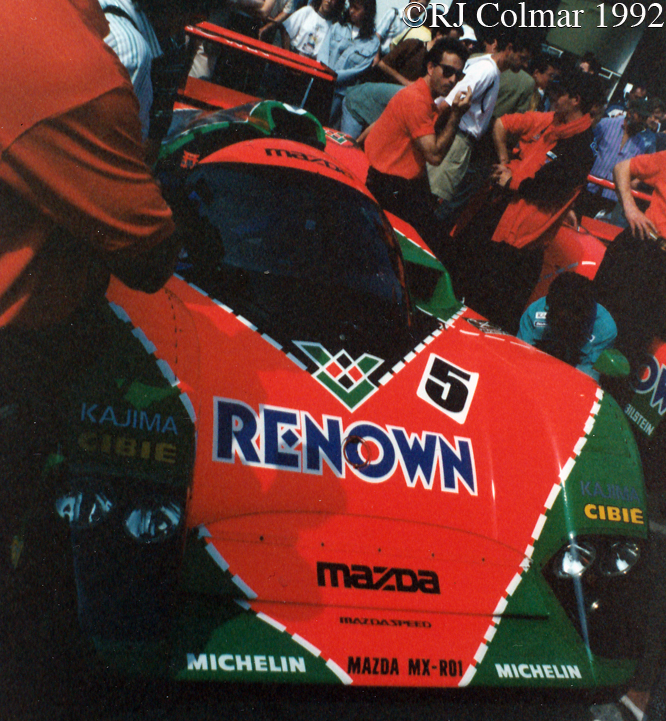
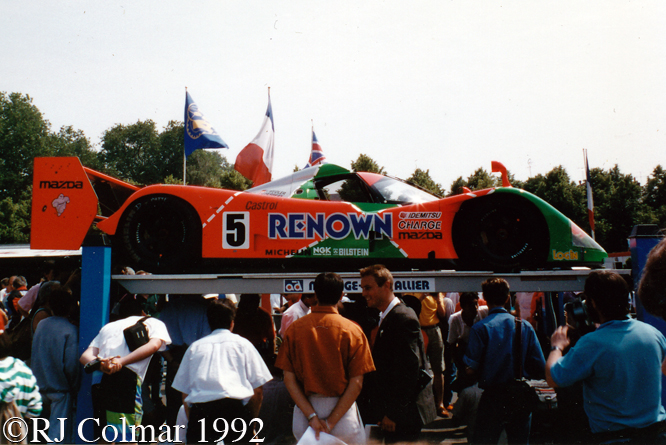
With the mandating of 3.5 litre / 213.5 cui piston engines for the 1992 World Sports Car Championship Mazda were left with no choice but to abandon their rotary powered 787B which won the 1991 Le Mans 24 Hours.
Mazda MX-R01, Le Mans

With insufficient funds to develop a new motor and or chassis they bravely decided not to abandon sports car racing altogether and elected instead to buy a suitable V10 from Judd Engine Developments and modify chassis bought from Tom Walkinshaw Racing that had been designed by Ross Brawn and run the previous year as the 1991 Championship wining Jaguar XJR14 with a Jaguar badged Ford HB V8.
Mazda MX-R01, Le Mans

Five Mazda MV10 powered Mazda MX-R01’s were built; chassis #001 was used exclusively in the Japanese Sports Car Series, #002 was a spare test car taken to Le Mans, #003 was another spare test car taken to Le Mans, today’s featured #004 raced in the whole 1992 World Sports Car Championship and #005 was only raced at Le Mans.
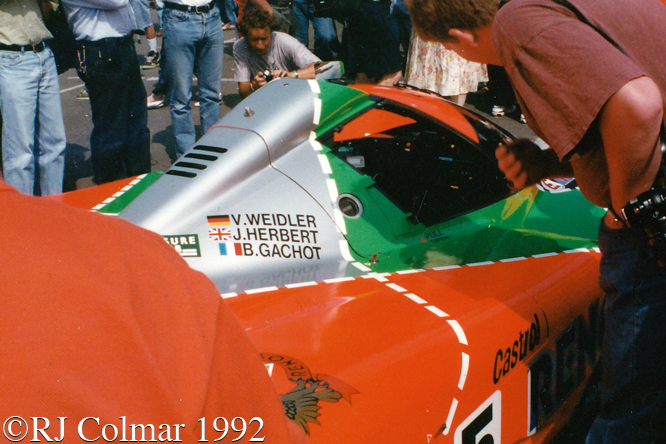
Mazda MX-R01, Le Mans

The MX-R01 made it’s debut in the 1992 Japanese Sports Car series at Suzuka where Youjirou Terada and Takashi Yorino drove chassis #001 to finish 7th from 8th on the grid in the 500 km race. Volker Weidler and Brazilian Maurizio Sandro Sala then drove #004 on it’s European debut at Monza where they retired with engine failure after starting from 7th on the grid.
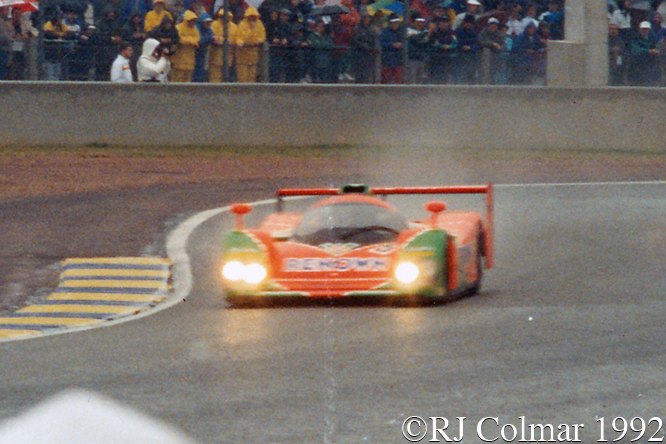
Mazda MX-R01, Volker Weidler (D)/Johnny Herbert (GB)/Bertrand Gachot (B)/Maurizio Sandro Sala, Le Mans

For the Fuji 1000 kms Youjirou Terada, Takashi Yorino and Maurizio Sandro Sala qualified #001 8th but also retired with engine failure, before #004 scored the teams best result of the season in the BRDC Empire Trophy at Silverstone where Maurizio Sandro Sala and Johnny Herbert finished second from 7th on the grid.
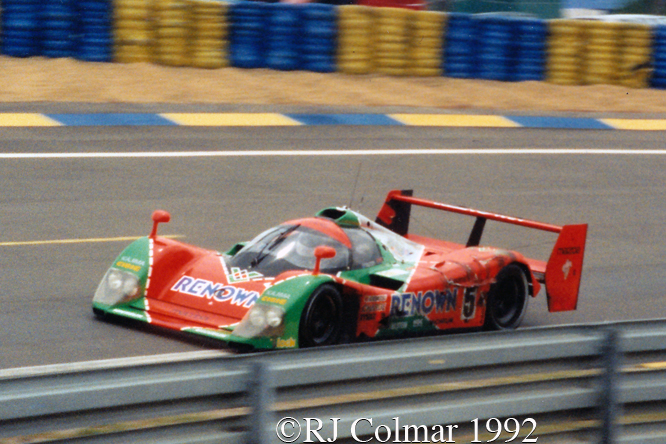
Mazda MX-R01, Volker Weidler (D)/Johnny Herbert (GB)/Bertrand Gachot (B)/Maurizio Sandro Sala, Le Mans

Chassis #005 driven by Maurizio Sandro Sala, Takashi Yorino and Yojiro Terada qualified 10th at Le Mans, but retired with accident damage after 124 laps which allowed Sala to join Volker Weidler, Johnny Herbert and Bertrand Gachot in chassis #004 that started 7th on the grid and finished 4th, 16 laps down on the winning Peugeot, having lead itself briefly led during the opening hours of the race.
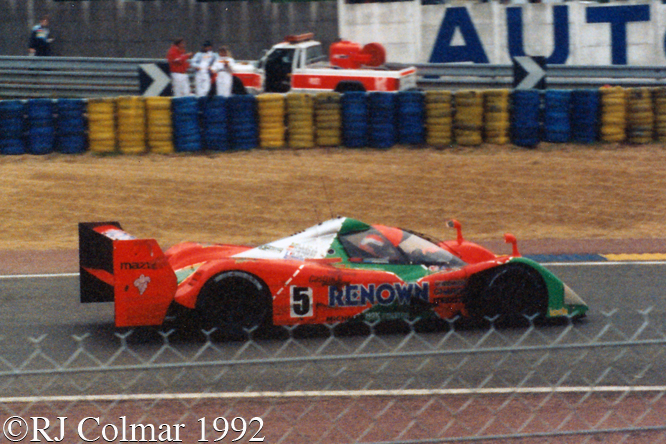
Mazda MX-R01, Volker Weidler (D)/Johnny Herbert (GB)/Bertrand Gachot (B)/Maurizio Sandro Sala, Le Mans

Over the remaining World Sports Car Championship season #004 finished 5th at Donington and 6th at Magny Cours with Sala and Alex Caffi at the wheel, posting a retirement with gearbox failure at Suzuka when Takashi joined Maurizio and Alex in the cockpit.

In the Japanese series Takashi Yorino and Youjirou Terada finished a season high 7th in the Fuji 1000kms, Mazda finished 3rd in the final 1992 World Sportscar Championship standings and 2nd in the final 1992 All Japan Sports Prototype Championship standings.

Mazda withdrew from sportscar racing at the end of the 1992 season and the World Sportscar Championship was cancelled in 1993 with only Peugeot willing to compete in the series.

Thanks for joining me on this “The Jaguar Judd” edition of “Gettin’ a li’l psycho on tyres” I hope you will join me again tomorrow when I’ll be looking at this years Le Mans LMP2 winner. Don’t forget to come back now.

Share

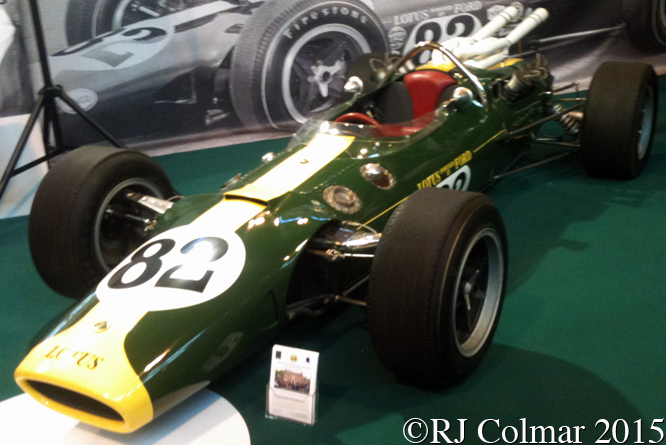
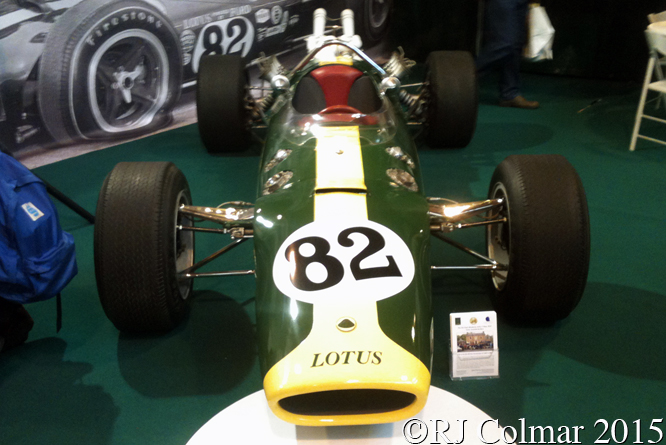
Soft Alloy Special – Lotus Ford 38/7

On the back of their success with Jim Clark in 1965 Lotus took orders for two new Ford powered Lotus 38’s for the 1966 season, while the now STP Oil Treatment sponsored works Lotus team intended to use a new car powered by a 4.2 litre / 256 cui version of the fearsome BRM H16.

Lotus were busy preparing new cars for the new 3 litre era Formula One season and so they subcontracted the building of the chassis for these cars, ordered by Dean Van Lines and Sheraton Thompson to be driven by Mario Andretti and AJ Foyt respectively, out to Abbey Panels of Coventry, when it became apparent the BRM H16 would not be available a third Lotus 38 chassis was ordered from Abbey Panels for works driver Al Unser to drive.

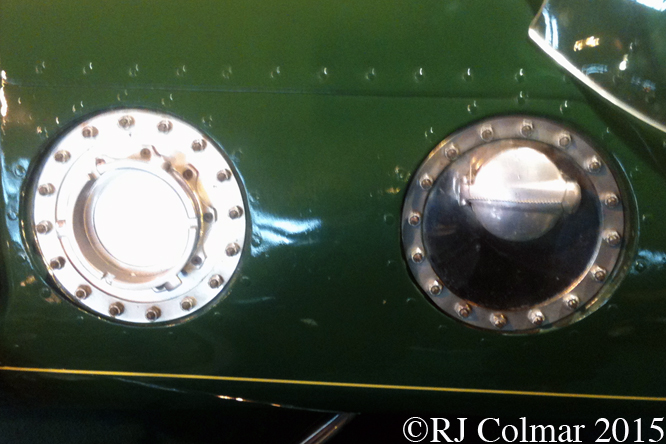
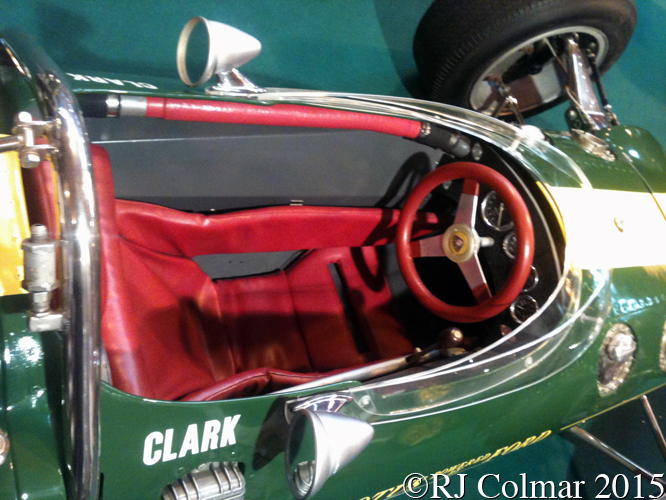
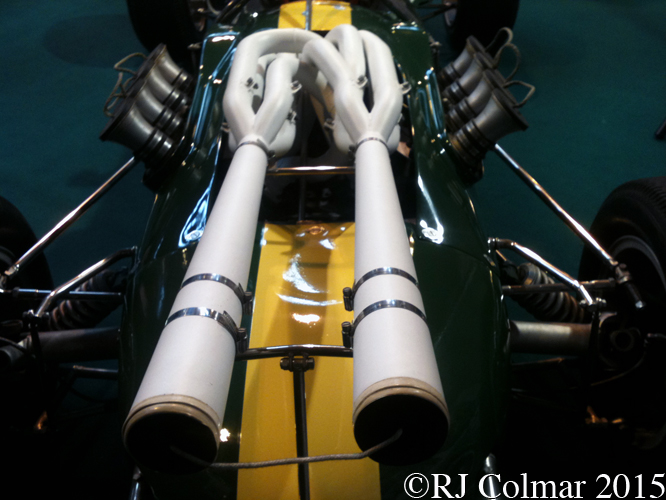
Lotus 38, Autosport International, NEC Birmingham

For reasons unknown Abbey Panels of Coventry built the three Lotus 38 chassis with regular aluminium instead of the high tensile alloy used to build the first four Lotus 38 chassis and as a consequence the “Soft Alloy Specials”, as they are unofficially dubbed, needed substantial strengthening to make them race worthy.

Mario only practiced his Dean Van Lines Lotus 38 and opted instead to race the Dean Van Lines Brawner Ford, AJ qualified his Sheraton Thompson/Anstead Lotus 38 18th after wrecking his Coyote only to wreck the Lotus in the opening lap meleé of the 1966 Indy 500.

Lotus 38, Autosport International, NEC Birmingham

Al Unser meanwhile qualified #38/7 23rd and was classified 12th after crashing in turn 4, 39 laps short of the race full race distance.

Once it became apparent the BRM H16 would not be available for the 1967 Indy 500 Team Lotus hastily prepared two Lotus 38’s for ’65 winner / ’66 second place finisher Jim Clark and ’66 Indy 500 winner, aboard a Lola, Graham Hill.

Lotus 38, Autosport International, NEC Birmingham

Jim was assigned #38/7, which had been “rebuilt” around a new chassis while Graham was given #38/8 and a Lotus 42F, intended for the BRM H16 motor, but fitted with the by now ubiquitous twin cam Ford.

After qualifying #38/7 16th Jim retired with a burned piston classified 31st after 35 laps, lasting 12 laps more than Graham who retired the faster Lotus 42F for exactly the same reason.

Lotus 38, Autosport International, NEC Birmingham

#38/7 became the subject of a legal dispute after Colin Chapman and mid west Lotus dealer Jim Spencer managed to sell the car to two parties.

After the dispute was settled Middleton M. Caruthers bought #38/7 and entered it for Wib Spalding into three events in 1969.

Wib only started on his third attempt at Continental Divide where he retired with a clutch problem that may have been responsible for his non starting earlier at Hanford and failure to qualify at Langhorne.

Lotus 38, Autosport International, NEC Birmingham

Until #38/7 appeared at the Autosport International, as seen in these photographs wearing the 1965 Jim Clark winners livery, the car was believed to have been residing with a collector in Japan.

Thanks for joining me on this “Soft Alloy Special” edition of “Gettin a Li’l psycho on tyres”, I hope you will join me again tomorrow for the start of a look at the first of next months 26 Le Mans racers. Don’t forget to come back now !

Share

Secretaries Turnkey Racer – Shelby G.T.350 R #SFM5R098

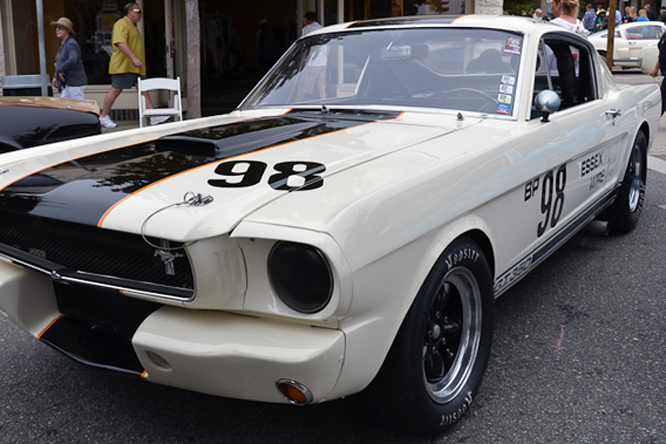
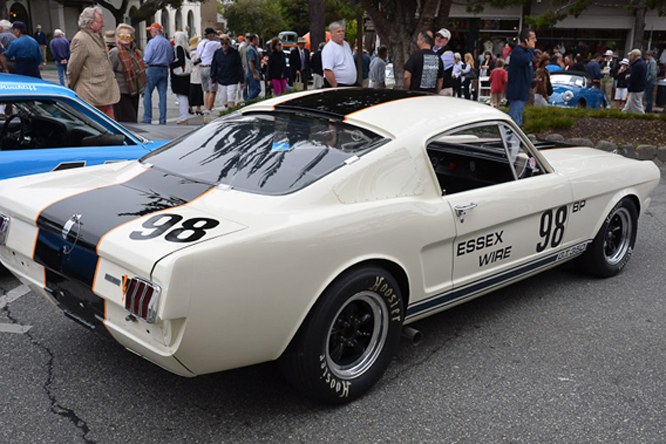
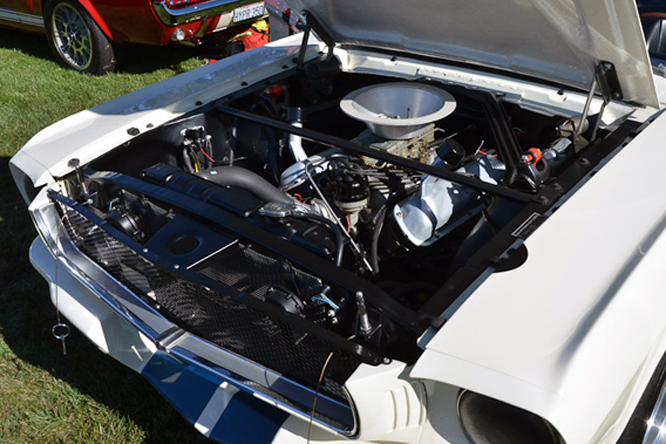
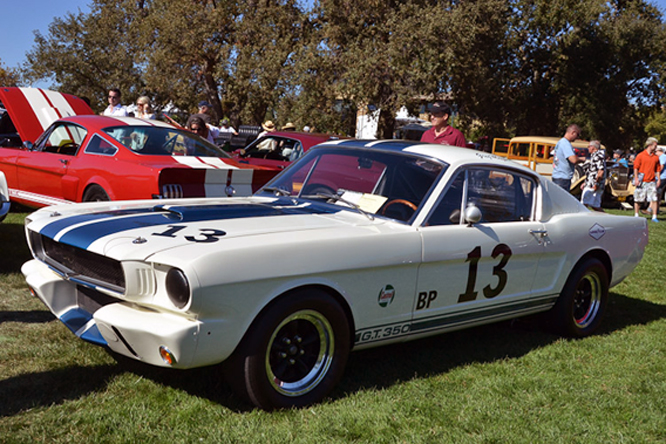
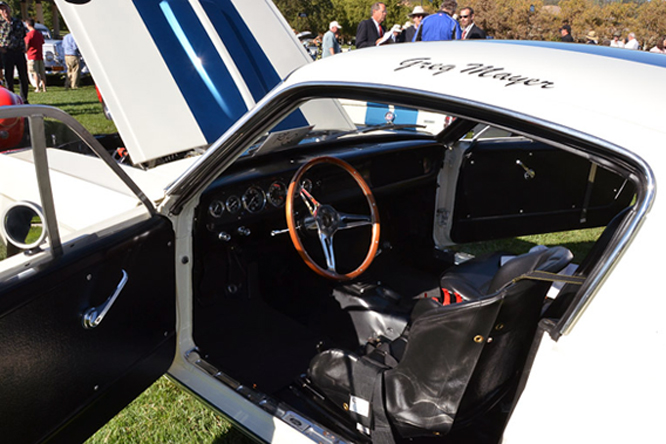
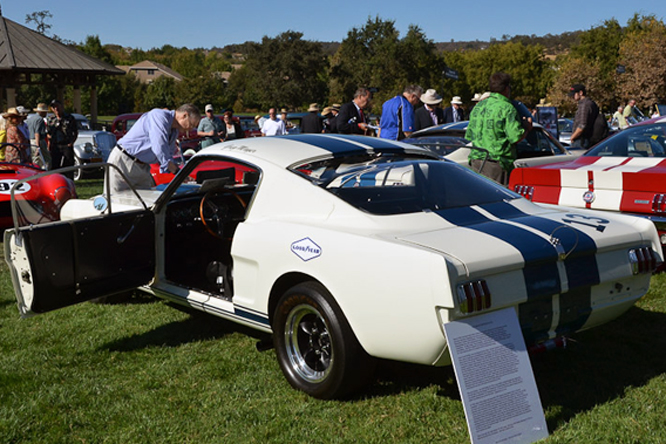
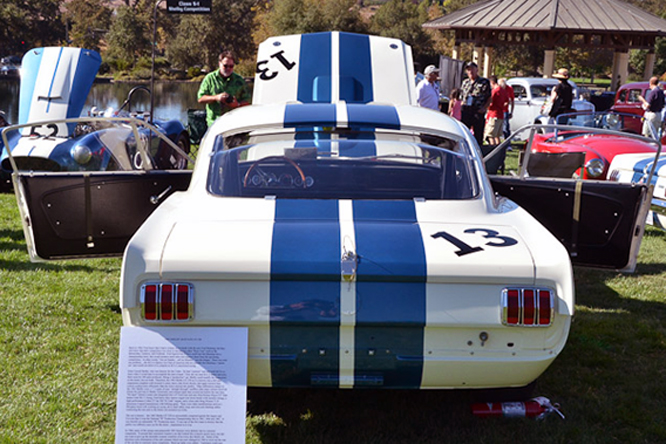
Allegedly when Carroll Shelby first saw a Ford Mustang his original description was of a mere “secretary’s car”, but that did not stop him building a run of over 500 2 seat 350 G.T.350 variants to meet the Sports Car Club of America’s requirements and a special run of 34 G.T.350 R turnkey racers like today’s featured chassis #SFM5R098.

The 34 G.T.350 R cars were fitted with blue printed motors that produced up to 360hp, weight saving plexiglass side and rear window’s and Goodyear Blue Dot tyres mounted on American Racing 15″ x 7″ wheels.

Shelby G.T. 350 R, Concours On The Avenue, Carmel By The Sea,

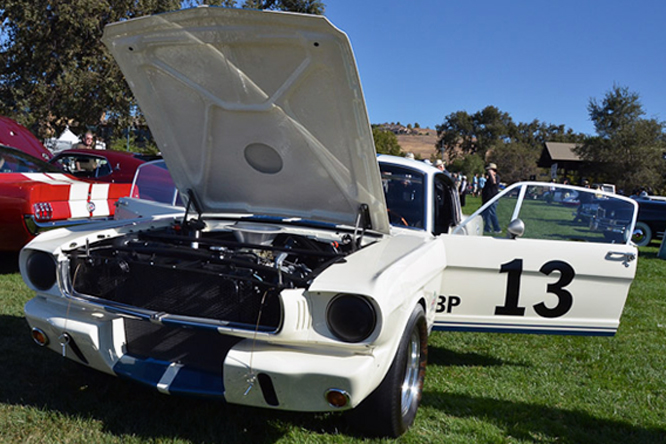
Today’s featured G.T. 350 R, photographed by Geoffrey Horton at Concours On The Avenue, Carmel by the Sea, a couple of years ago is the 7th to have been built and the fifth to have been delivered to a paying customer in the form of Ned Owen.

Ned raced this car, which featured an Essex Wire Black stripe with orange pin stripe in SCCA class B Production races from 1965 to 1967 with Ford drivers Skip Scott and Ken Miles also said to have had one off drives in the car.

Shelby G.T. 350 R, Concours On The Avenue, Carmel By The Sea,

In 1967 #SFM5R098 was purchased by a Canadian who crashed it in 1969 after which it remained in an Ontario barn until it was bought unseen by Shelby aficionado Rick Kopec of Connecticut for $5,000.

Rick had #SFM5R098 restored to the condition it was in when bought new by Ned Owen only changing the race number from Owen’s customary #92 to #98 in deference to the cars chassis number.

My thanks to Geoffrey Horton for sharing today’s photographs.

Thanks for joining me on this “Secretaries Turnkey Racer” edition of “Gettin’ a li’l psycho on tyres” I hope you will join me again tomorrow. Don’t forget to come back now !

Share

Five Classic Moments – Silverstone Classic

Continuing an ad hoc series celebrating Silverstone Classic’s Silver Jubilee this weeks post features five race highlights from the last three Silverstone Classic Super Saturdays.

Peter Arundell Trophy, Silverstone Classic,

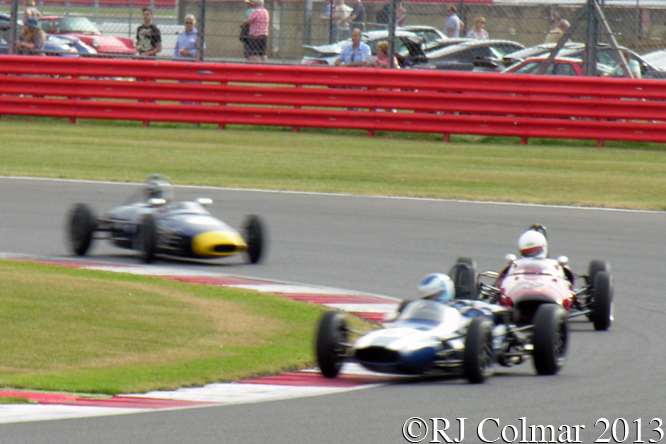
The Formula Junior cars vying to win the Peter Arundell Trophy traditionally are the opening act for Super Saturday above the #53 Lotus 20/22 of Sam Wilson and #79 Lotus 22 of Andrew Hibberd squabble behind the leading #1 Cooper T59 driven by Jon Melicevic in 2013 when Andrew won the trophy by just half a second.

Sir John Whitmore Trophy, Silverstone Classic

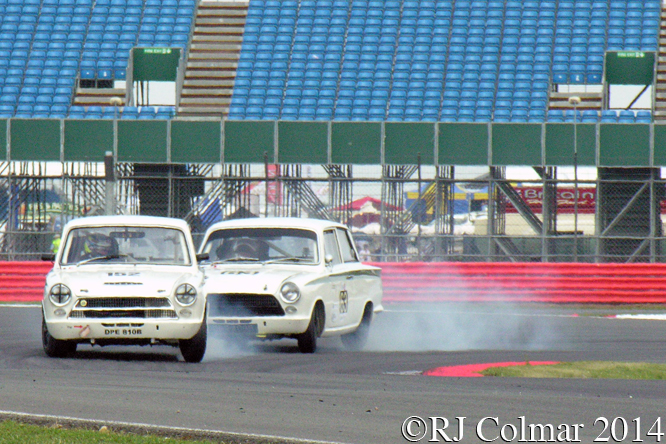
The Sir John Whitmore Trophy for under 2 litre / 122 cui touring cars always provides close racing down the field between the Ford Cortinas, above last year British Touring Car Championship (BTCC) regular Gordon Shedden and Richard Meaden kept us entertained with door handle to door handle racing for half an hour before the #157 retired with an overheating issue leaving Richard and Grant Tromans to win in the tyre smoking #63.

Peter Gethin Trophy, Silverstone Classic

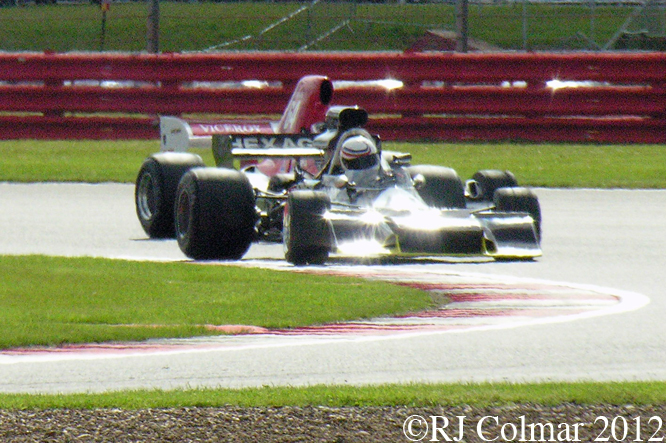
Simon Hadfield and Micheal Lyons provided the early entertainment in the Peter Gethin Trophy race for stock block open wheelers in 2012, unfortunately Simon spun the brown 1973 Trojan T101 to leave the win to Micheal in the red and white Lola T400 seen above hounding the Trojan.

Mustang Celebration Trophy proudly presented by Pure Michigan, Silverstone Classic

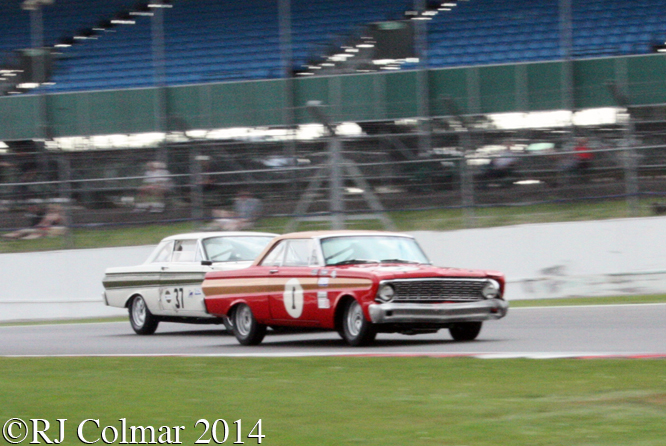
Ironically last years Mustang Celebration Trophy was dominated by the model the Ford Mustang was due to replace, Leo Voyazides driving the #1 Ford Falcon is seen above sweeping into a lead, past the #37 Falcon driven by Mike Gardiner, that he did not relinquish for the rest of the race.

Froilan Gonzalez Trophy, Silverstone Classic

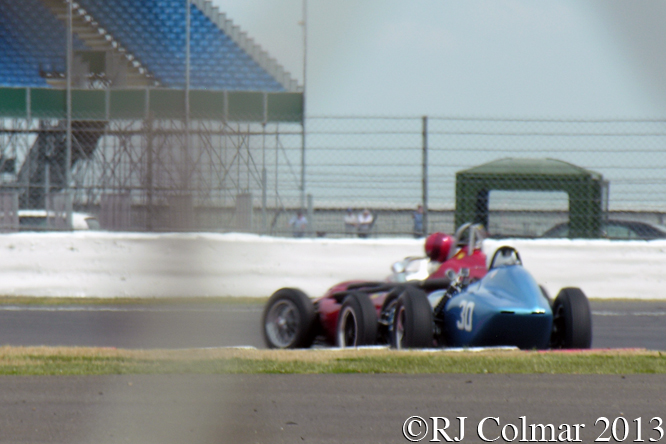
The Froilan Gonzalez Trophy for HGPCA Pre’61 Grand Prix Cars proved another thriller two years ago when Bristol’s Julian Bronson driving the blue Scarab #30 had a great to and fro battle with the Tec-Mec of Tony Wood and came out the winner to record the Scarab marques second ever open wheel victory.

Silverstone Classic is an advance ticket only event and the race cards are never the same two years running, for further details about this years Silver Jubilee event see this link.

Share

Cobra Hi Riser – Shelby Mustang GT 350

In order for Ford’s new 4 seat Mustang to compete in the SCCA’s B Production class Carroll Shelby set about building a series of Shelby Mustang G.T. 350’s to meet the series regulations which stipulated a requirement for a minimum 100 examples of a “2 seat sports car”.

Shelby Mustang G.T. 350, Niello Concours At Serrano

To power the new “sports car” Shelby used the K-Code 271 hp 4.7 litre / 289 cui V8 modified with the aid of the Cobra “hi riser” intake manifold fed by the scoop in the fibre glass bonnet / hood and dual side exhausts, to produce 306 hp.

Shelby Mustang G.T. 350, Niello Concours At Serrano

Having opted for limited engine modifications the SCCA permitted more radical race suspension options which in the G.T. 350’s case ran to lowered A arms, heavy duty shock absorbers and upper arms, a heavy duty Ford Galaxie rear axle and “over rider” traction bars fitted above the rear leaf springs.

Shelby Mustang G.T. 350, Niello Concours At Serrano

The space where the back seat had been was taken up by a full size spare wheel comprising Goodyear Blue Spot tyre on either a 15″ steel wheel or a 15″ cast magnesium Crager Shelby item.

Shelby Mustang G.T. 350, Niello Concours At Serrano

34 G.T.350 R race spec cars were built and between them they captured 3 consecutive B Production class SCCA titles from 1965 to 1967 with Mexican Freddy Van Buren winning the ’67 title along with the 1966 and 1967 Trans Am titles.

Shelby Mustang G.T. 350, Niello Concours At Serrano

The rest of the Shelby G.T. 350’s, including today’s featured car were built for road use though the owner of this one confesses that “Driving a 1965 Shelby Mustang G.T.350 is a blast for the first 20 to 30 minuets… after that it starts to hurt”.

Shelby Mustang G.T. 350, Niello Concours At Serrano

All 562 Shelby Mustang G.T. 350’s were painted Wimbledon white and had the Guardsman Blue rocker stripes with the G.T. 350 logo, only 28% had the full length Guardsman Blue Le Mans stripes from new, though now nearly all of them do.

My thanks to Geoffrey Horton for sharing his photographs taken at Niello Concours at Serrano a couple of years ago.

I hope you will join me again tomorrow when I’ll be looking at one of my all time favourate FIAT’s. Don’t forget to come back now !

Share

Coffee, Croissant & Cars 05/15 – Avenue Drivers Club

The second Sunday of the month at Queen Square in Bristol is maintaining it’s standing as one of the more extraordinary word of mouth gatherings for petrol heads in the country.

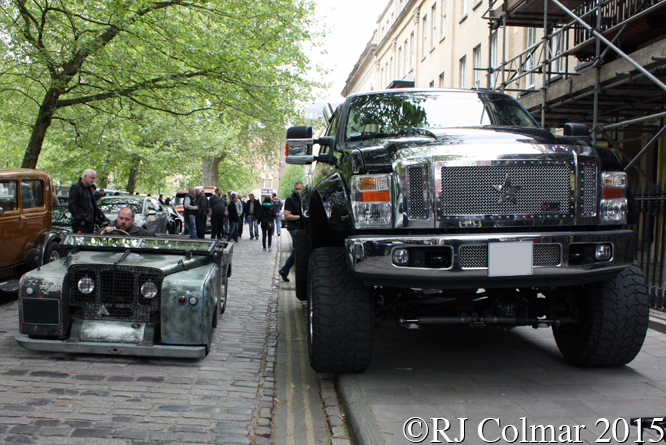
Land Rover, Ford, Avenue Drivers Club, Queen Square, Bristol,

At this month’s gathering I tried to pay a bit more attention to some of the low riders present including the 1960 Land Rover 80 fitted with a 4 litre / 244 cui version of the Buick derived Rover V8, which is dwarfed by the 2008 Ford RBP Super Duty that was imported into the UK in December last year.

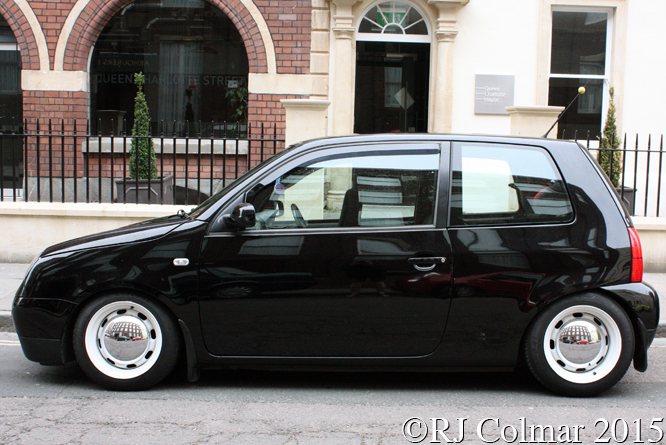
Volkswagen Lupo, Avenue Drivers Club, Queen Square, Bristol,

Among the smallest of the low riders present was this 2004 Volkswagen Lupo.

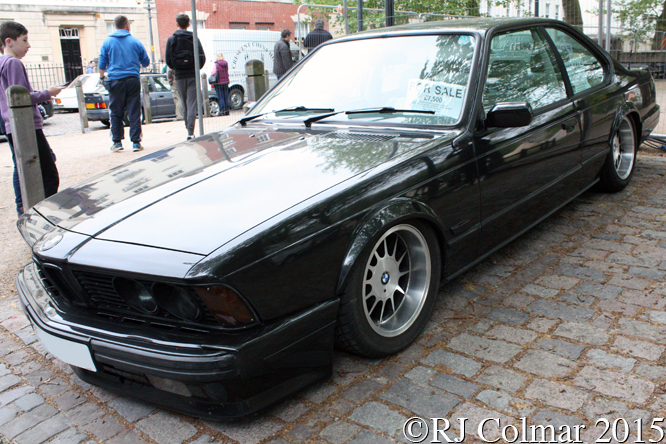
BMW 635i, Avenue Drivers Club, Queen Square, Bristol,

Low riding BMW’s are not that unusual but this is the first 1980’s E24 635 CSi I have seen so dramatically stanced.

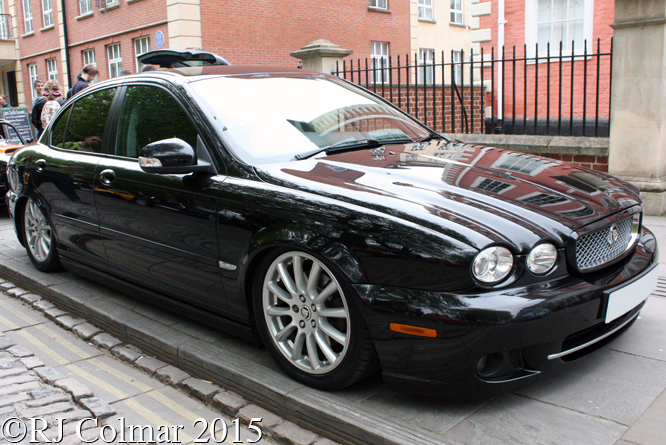
Avenue Drivers Club, Jaguar X Type S, Queen Square, Bristol,

Leaping forward back to 2008 is this stanced diesel powered Jaguar X Type S the like of which I have also never seen before in the flesh.

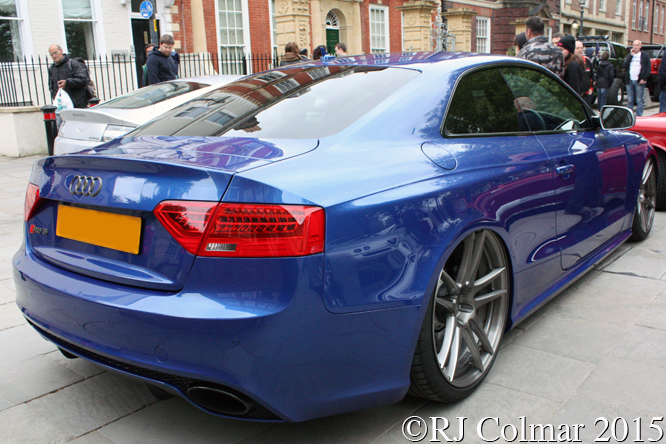
Audi RS5 Quattro, Avenue Drivers Club, Queen Square, Bristol,

Amazingly this Audi RS7 Quattro is a 2014 model first registered, given that car was fitted with 19″ wheels as standard one would have to conclude the wheels on this one are well over 20″.

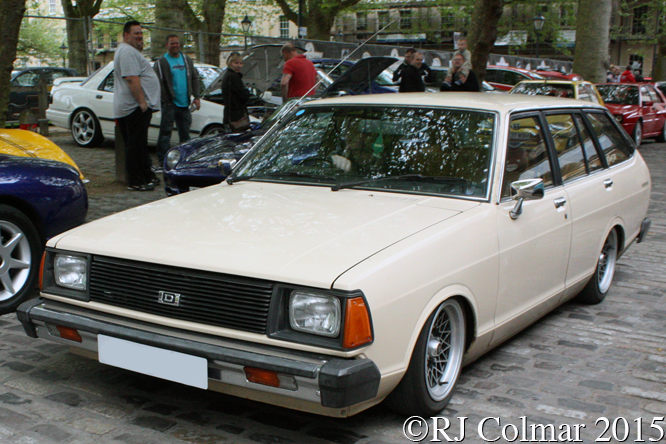
Datsun Sunny, Avenue Drivers Club, Queen Square, Bristol,

Back in the day when I used to deliver Datsuns new for a dealer in London I realised that they did exactly what they said on the tin and unless one was deliberately trying to break one they would run until the body rotted off, above is a stanced 1982 Datsun Sunny Estate with a well above average preserved body.

Thanks for joining me on this “Coffee, Croissant & Cars 05/15” edition of “Gettin’ a li’l psycho on tyres” I hope you will join me again tomorrow when I’ll be looking at another Pony. Don’t forget to come back now !

Share

DIY Bakkie – Ford P100

In 1971 Ford in South Africa built a version of the 2 door Ford Cortina Mk III with a pick up body on the back marketed as the Ford Cortina Pickup and known locally as the “Bakkie”.

The Bakkie utilised a modified Cortina floor pan with a ladder frame to carry the rear load carrying body and initially used Rover 5 stud hubs, post 1988 examples were fitted with Ford Granada front axles with 5 stud adaptors and 5 stud Ford Transit rear axles.

Ford P100, Classic Motor Show, NEC, Birmingham,

In 1977 the Bakkie was up graded with an adapted Cortina Mk IV body which used the shorter doors from the 4 door body and from 1980 adapted Cortina Mk V bodies were used.

Ford P100, Classic Motor Show, NEC, Birmingham,

From 1982 the Bakkie was rebranded as the P100 model and exported from South Africa to Europe and remained in production with the Cortina Mk V body until 1988.

In 1988 the P100 received a final upgrade utilising the Sierra body and production of the P100 for the European market switched to Portugal until 1993.

Ford P100, Classic Motor Show, NEC, Birmingham,

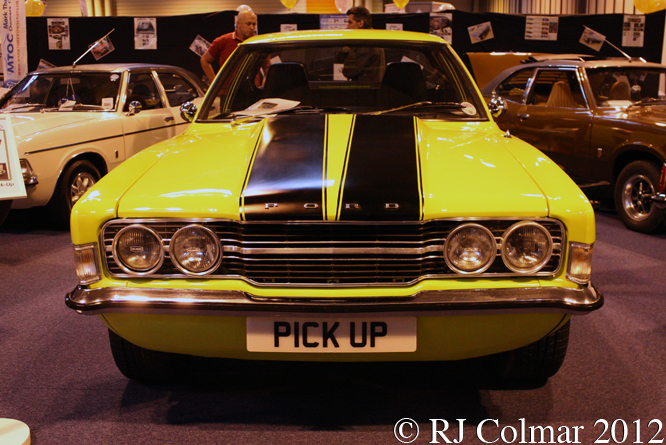
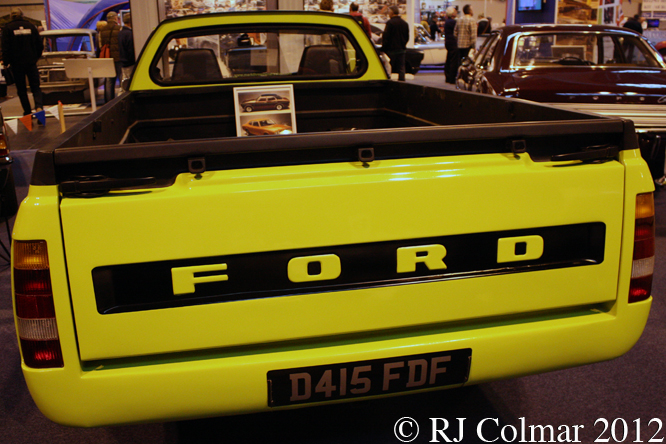
This particular 1987 Ford P100, seen at the Classic Motor Show a couple of years ago, originally carried a Ford Cortina Mk V front end, but it has been modified to carry older Cortina Mark III wings, bonnet and nose.

A newer Sierra P100 pick up body has been added to the back and it is powered by a Ford Cologne 2.9 litre / 176 cui V6 as used to power the later Ford Granada/Scopio models, the interior includes Porsche 944 seats.

Thanks for joining me on this “DIY Bakkie” edition of “Gettin’ a li’l psycho on tyres” I hope you will join me again tomorrow. Don’t forget to come back now !

Share