Tag Archives: Goodwood

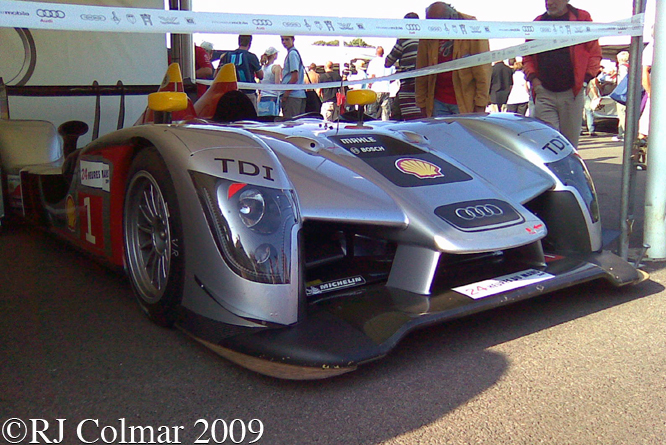
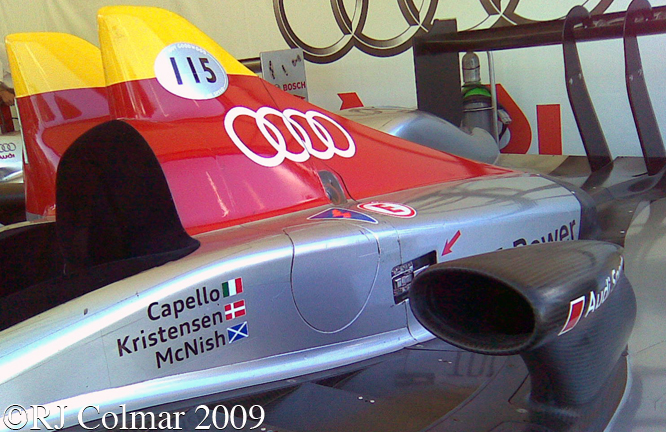
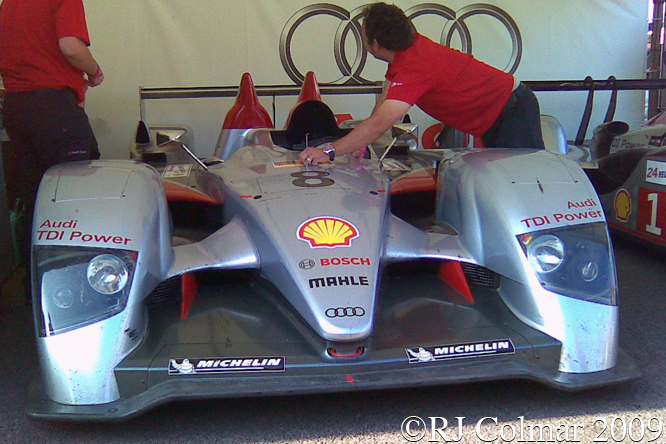
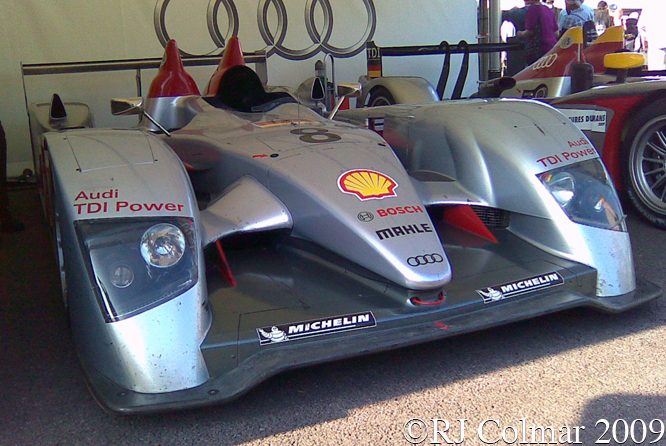
V10 Turbo Diesel – Audi R15 #105

After securing 3 consecutive wins with the Turbo Diesel R10 TDI and fifth win on the trot going back to 2004 when Audi R8 was still active Audi came up with a completely new design with a new motor for their 2009 Le Mans challenge.

The new design was precipitated by a change in regulations mandating reduced air consumption and reduced turbo boost pressure. Audi’s R15 featured a much slimmer monocoque and a lighter 600hp V10 turbo diesel replaced the 700hp V12 of the R10.

Audi R15 TDI, Goodwood Festival of Speed

Audi started their 2009 R15 programme with a win in the Sebring 12 hours where Allan McNish, Tom Kristensen and Rinaldo Capello beat the rival Peugeot 908 driven by Franck Montagny, Stéphane Sarrazin and Sébastien Bourdais by just over 22 seconds.

At Le Mans Allan, Tom and Rinaldo qualified today’s featured car chassis #105 2nd behind the Peugeot driven by Franck, Stéphan and Sébastian.

Audi R15 TDI, Goodwood Festival of Speed

During the race it became apparent that Peugeot had the faster cars and #105 eventually lost six laps on the winning 908 driven by David Brabham, Marc Gené and Alexander Wurz. Allan, Tom and Rinaldo eventually finished third in #105 5 laps down on the second place 908 driven by Franck, Stéphan and Sébastian.

The sister R15 driven by Mike Rockenfeller, Lucas Luhr and Marco Werner retired after an accident while the third R15 driven by Alexandre Prémat, Timo Bernhard and Romain Dumas finished a distant 17th.

Audi R15 TDI, Goodwood Festival of Speed

Chassis #105, seen at Goodwood Festival of Speed shortly after Le Mans in 2009, was upgraded to R15 Plus spec for 2010, but it only appeared once and then only as a T-Car driven in practice for the 2009 Petit Le Mans at Road Atlanta for Allan, Tom and Rinaldo.

Thanks for joining me on this “V10 Turbo Diesel” edition of “Gettin’ a li’l psycho on tyres” I hope you will join me again tomorrow when I’ll be looking at a 1962 Aston Martin Zagato. Don’t forget to come back now !

Share

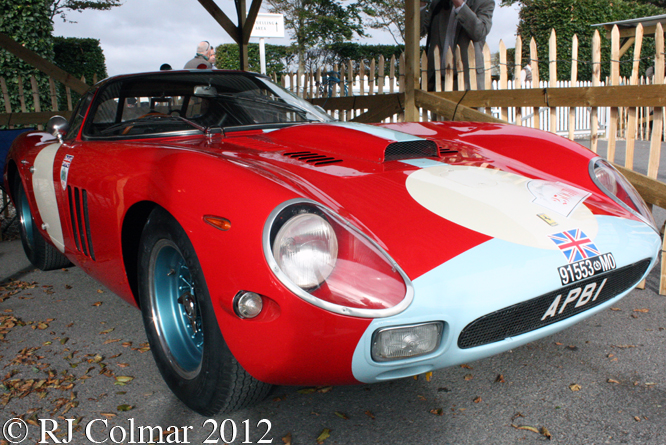
’64 Rebody By Scaglietti – Ferrari 250 GTO #4399GT

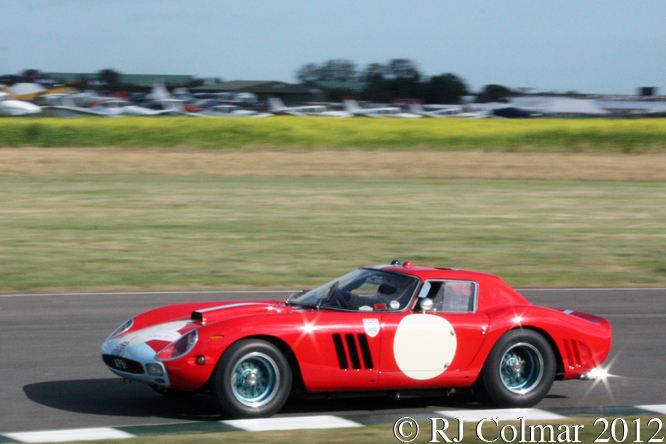
In May 1963 British Ferrari importer Col. Ronnie Hoare took delivery of a 250 GTO chassis number #4399GT and entered it for Mark Parkes to drive in the Whitsun Trophy at Goodwood and Martini Trophy at Silverstone and before the car was a month old it had visited victory lane, twice.

In July ’63 Jack Sears took a class victory with #4399GT at the British Grand Prix meeting, before Graham Hill won the RAC Tourist Trophy at Goodwood in August driving the same car.

Ferrari 250 GTO, Goodwood, Revival

In September 1963 Mike Parkes was back at the wheel at events in Monza and Snetterton finishing 2nd overall in both but with class victories.

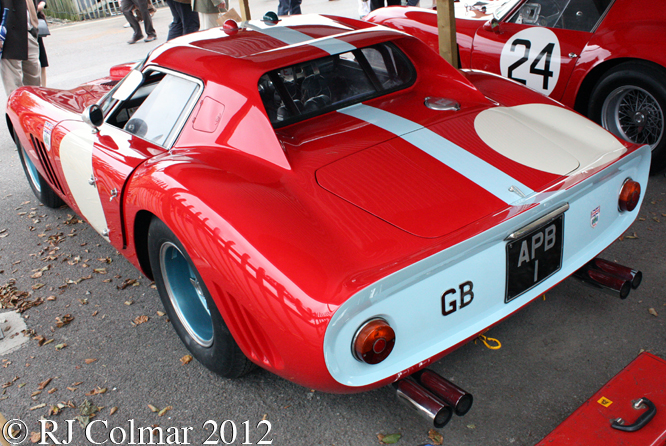
Over the winter of ’63/’64 the car was sent back to Scaglietti where the original body was removed and a new 250 GTO ’64 style
body was fitted.

Ferrari 250 GTO, Goodwood, Revival

Graham Hill drove the rebodied car to wins in the Sussex Trophy at Goodwood and the International Trophy at Silverstone, with Mike Parkes adding a third season victory in the 500km race at Spa.

The hood scoop was fitted in time for the ’64 Le Mans 24 Hours where Innes Ireland and Tony Maggs drove the car to a 6th place finish, 2nd in class to the GTO shared by Belgians Lucien Bianchi and “Jean Beurlys”.

Ferrari 250 GTO, Goodwood, Revival

Mike Parkes and Ludovico Scarfiotti drove #4399GT to a class victory in the Reims 12 hours and Viscount Rollo Fielding scored the cars final in period class victory at Mallory Park in October 1964.

Mike Salmon drove #4399GT for Dawnay racing in early 1965 with his best result being a 4th place from pole in the Sussex Trophy at Goodwood.

In 1969 Anthony Bamford, now Sir Anthony, acquired #4399GT and it has remained in his possession ever since.

Thanks for joining me on this ’64 Redody By Scaglietti edition of “Gettin’ a li’l psycho on tyres” I hope you will join me again tomorrow when I’ll be looking at a diesel Audi. Don’t forget to come back now !

Share

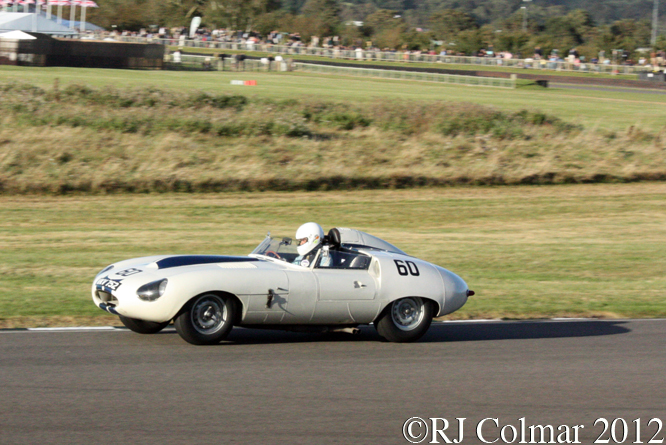
Prototype, Racer, Decoy – Jaguar #E2A

After Jaguars bitter sweet success at Le Mans in 1955, when the works D-Type driven by Mike Hawthorn and Ivor Bueb won the ill feted race following Mercedes Benz mid race withdrawal, Sir William Lyons concluded, as did the board of Mercedes Benz, that Jaguar’s resources would be better spent turning it’s racing success into commercial production success.

The Jaguar racing department became the Jaguar prototype department as all Jaguar works racing programmes were left to customer teams like Ecurie Eccose who promptly won Le Mans in 1956 and 1957 with their D-Types and Briggs Cunningham, who realised he did not have the resources to build and compete with an American sports car with the best Europe had to offer, but still had the resources to buy top line European cars to race.

Jaguar E2A, Ziegler, Goodwood Revival

The Jaguar prototype team’s first job was to build a production version of the D-Type using monocoque construction and replacing the D-type’s live rear axle with independent rear suspension.

This prototype, known as #E(Type)1A(Aluminium), was a 130 mph 2/3rds scale drivable vehicle built in 1957 which after much testing was broken up and scrapped somewhere between 1959 and 1960 without ever having been shown to the press or public.

Jaguar E2A, Ziegler, Goodwood Revival

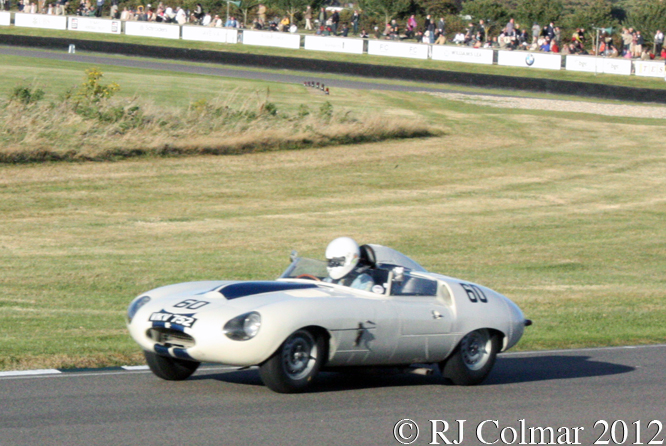
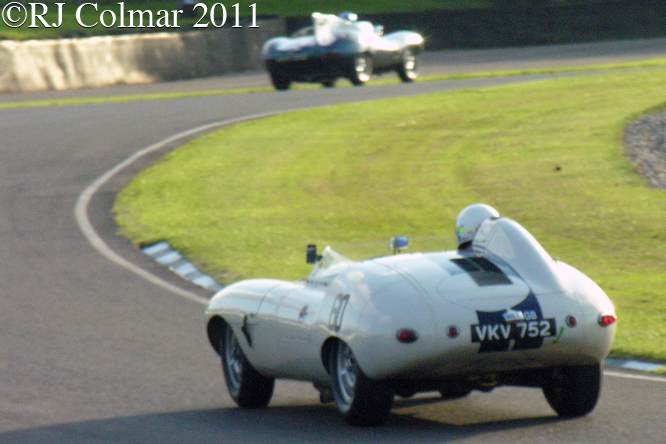
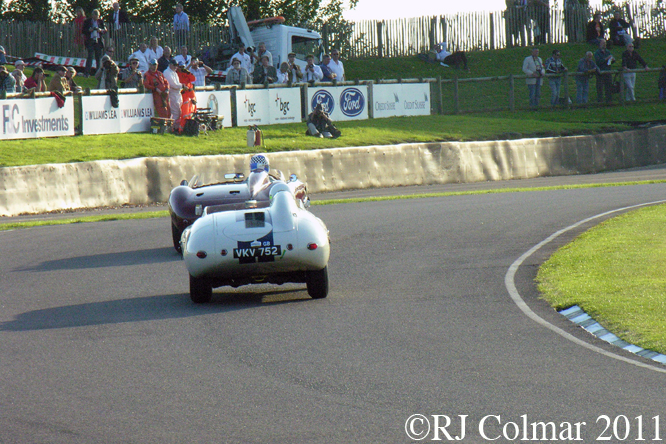
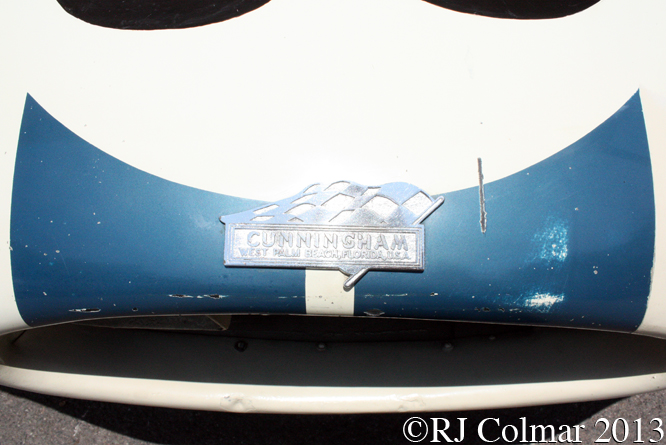
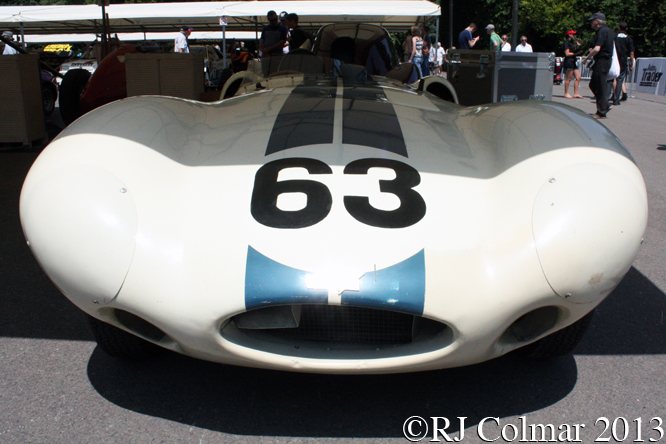
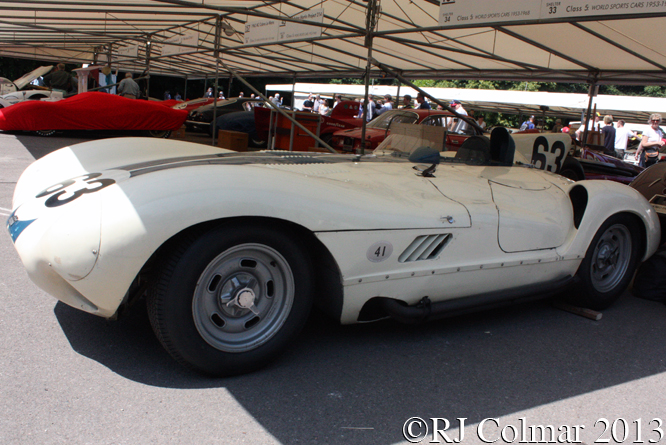
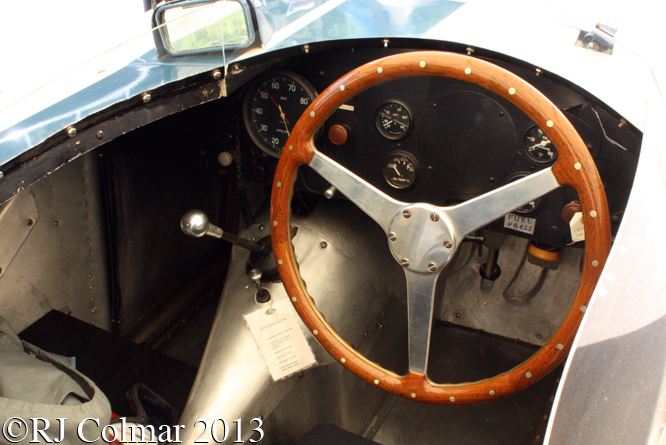
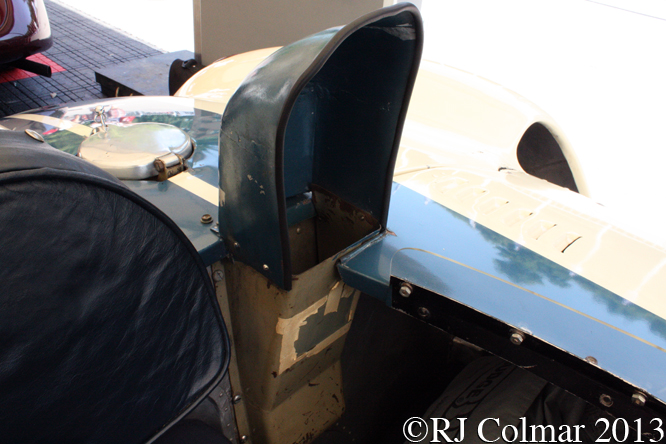
Today’s featured car #E2A was a full scale second prototype with a monocoque and aluminium body styled by Malcolm Sayer. The car was fitted with a 3 litre / 183 cui fuel injected aluminium straight 6 motor in order to meet the Le Mans prototype regulations. E2A was entrusted to Briggs Cunninghams team and painted in his teams white with two blue stripes colours.

Before going to Le Mans in 1960 E2A was tested at the oval MIRA test facility and the suspension was set up for this purpose when it arrived at Le Mans unknown to Dan Gurney and Walt Hangsen who were employed to drive it.

Jaguar E2A, Ziegler, Goodwood Revival

Dan and Walt found the car extremely twitchy and it was late before the race that the suspension settings were changed to something more suitable to a public road used as a race track rather than a steeply banked oval at MIRA.

#E2A completed the opening lap of the 1960 Le Mans 24 hours in third place, but after just 3 laps the car was in the pits with a broken injector pipe. This was replaced but a train of damage had been set in motion which resulted in E2A retiring after six hours with a failed head gasket and burned piston.

Jaguar E2A, Dron, Goodwood Revival

Back at the Jaguar factory the 3 litre #E2A engine was swapped for a 3.8 litre / 231 cui unit and the car was shipped to the USA Walt Hangsen drove it to a win in the 2nd Annual Inter-club Championship Bridgehampton and class win in the 500 mile Road America race.

Reigning double world champion “Black” Jack Brabham drove #E2A 10th place finish in the 200 mile Grand Prix Riverside, a twisty track to which E2A was as poorly suited as Laguna Seca where Bruce McLaren drove #E2A in two heats of the First Pacific Grand Prix to 12th and 17th place finishes.

Jaguar E2A, Dron, Goodwood Revival

Thereafter #E2A was returned to Jaguar for further testing which included an early anti lock braking system called ‘Wheel Slide Protector’ as used by the Ferguson P99.

#E2A was eventually put into storage, only to be pulled out and painted green in 1965 so that it could be used as a decoy while testing of the top secret XJ13 was carried out at MIRA.

In 1967 Jaguar customer car competition manager Roger Woodley managed to save E2A from the usual destruction for scrap prototype fate by mediating a deal for his father in law Guy Griffiths Camden Car Collection in the Cotswolds to take it with Jaguars insistence that #E2A should never be used in competition.

Jaguar kindly repainted #E2A in Briggs Cunninghams original racing colours and some time after handing it over manged to supply Guy with a 3 litre fuel injected motor.

In 2008 Roger’s wife sold the car for just short of US$5 million at Bonham’s, owner Stefan Ziegler has since had the car prepared to ‘weapons grade racer’ standard much to the chagrin of some old curmudgeons, myself included.

Stefan is seen at the wheel of the car at Goodwood in the photo’s dated 2012, while Tony Dron is seen driving the car in the older images.

Thanks for joining me on this “Prototype, Racer, Decoy” edition of “Gettin’ a li’l psycho on tyres” I hope you will join me again for Ferrari Friday tomorrow. Don’t forget to come back now !

Share

Birdcage Streamliner – Maserati Tipo 60 #2451

Despite winning the 1957 World Championship Drivers Title, there was no constructors title until 1958, with Juan Manuel Fangio, Maserati was in dire financial trouble at the end of the year and after four sports car were written off in South America the Italian Government had to step in as receiver to save the company.

Immediately all motor racing programmes run by the factory were cancelled, but just one year later the case was made for Maserati to resume building racing cars so long as they were paid for and raced by customers.

Engineer Gulio Alfieri was given a brief was to build a low cost, competitive, two seater racer, using existing parts stock where possible.
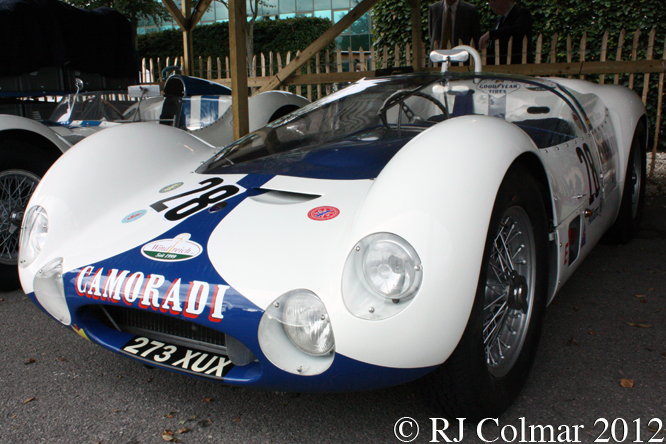
Maserati Tipo 60, Goodwood, Revival

In the absence of sufficient contacts to help him build a monocoque chassis Alfiei devised a space frame Tipo 60 chassis built up from thin tubes with a 2 litre / 122cui 4 cylinder motor that became known as the ‘Birdcage’.

Today’s featured chassis #2451 started life as the prototype Tipo 60 and on the 12th of July 1959 it was driven to a win in the Rouen Grand Prix by Stirling Moss.

Stirling Moss is said to have been impressed with the ‘rightness’ of the design, the light but precise steering, the totally neutral handling characteristics with the superb brakes also being singled out for praise.
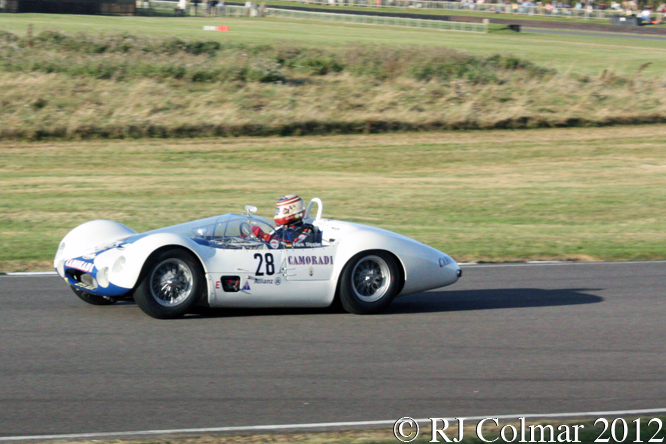
Maserati Tipo 60, Willi Balz, Goodwood, Revival

Italian hillclimb specialist Odoardo Govoni then drove #2451 to a win on the ‘Pontedecimo-Giovi’ hillclimb on the 20th September 1959, soundly beating the favourite Giorgio Scarlatti’s Ferrari Dino 196S.

Maserati chairman Omer Orsi authorised the production of six Tipo 60 chassis and it was not long before requests from the US came in for cars fitted with 3 litre / 183 cui motors.

Subsequently Alferi was asked to work on a 3 litre motor and he managed to squeeze one into a Tipo 60 which which then became the Tipo 61 to distinguish the larger engine size.
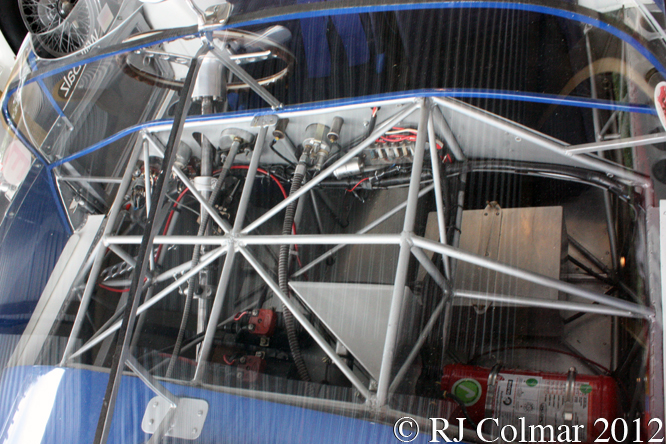
Maserati Tipo 60, Goodwood, Revival

In September 1959 Lloyd Perry ‘Lucky’ Crasner tested a Tipo 60 and immediately ordered two 3 litre cars for his CA-sner MO-tor RA-cinq DI-vision, better known as the Camoradi Racing Team.

A shortfall in manufacturing capacity left Maserati no alternative but to fit a 4 cylinder 3 litre / 193 cui motor to the prototype chassis #2451 which was then shipped out to Nassau in December 1959 for Dan Gurney, Carroll Shelby and Jo Bonnier to test in preparation for the Nassau Speedweek.

Dan claimed a class victory in the Preliminary Governor’s Trophy while Carrol retired from the Nassau Trophy Race after a puncture and then an accident.
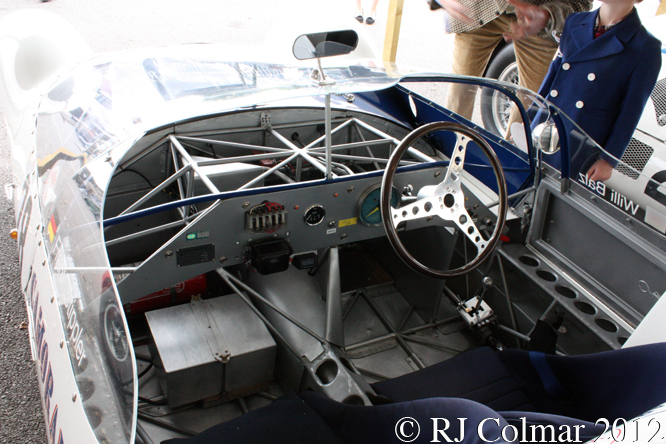
Maserati Tipo 60, Goodwood, Revival

Dan and Marsten Gregory qualified #2451 2nd for the 1960 1000kms at Buenos Aires but retired with a broken shock absorber mounting bolt after leading comfortably.

Carroll Shelby teamed up with Masten to drive #2451 in the Sebring 12 hours but retired with an engine issue.

At the Targa Florio #2451 was entered for Umberto Maglioli and Nino Vaccarella who led the race at 3/4 distance only to crash after a rock punctured the fuel tank.

During the subsequent repairs #2451 had a new streamline tail added along with the extreme screen which was designed to meet the Le Mans minimum height screen regulations and minimise the frontal area of the car. The other 2 Camoradi T61’s had the modified tail fitted for Le Mans, but not the low frontal area screen.
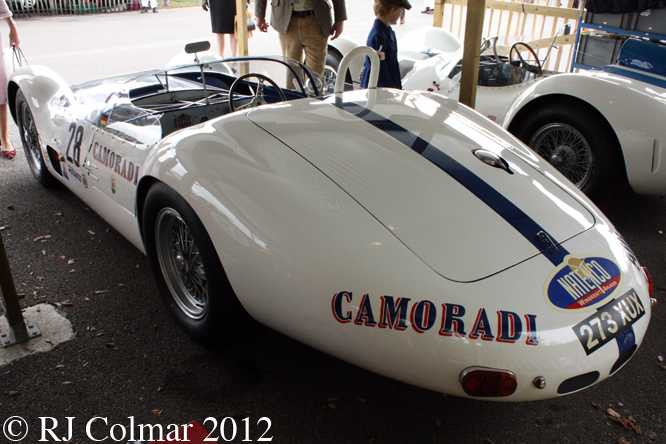
Maserati Tipo 60, Goodwood, Revival

#2451 was the fastest car at Le Mans in 1960, after a starting problem saw Marsten cross the start line in 24th place he had recovered the lead by the Mulsanne Corner on the opening lap overtaking 18 vehicles on the Mulsanne Straight.

After a couple of hours Marsten handed #2451 over to Chuck Daigh but the car lost an hour with another starter problem. Between the forth and eighth hours Marsten and Chuck had recovered two of their lost laps, but at midnight the car was retired either with a blown motor or an electrical issue depending on which sources one reads.

The Le Mans race was the last race of the 1960 World Sportscar Championship season and #2451 was chosen by Camoradi backer Frank Harrison as the car he was promised and wanted to run in the USA.
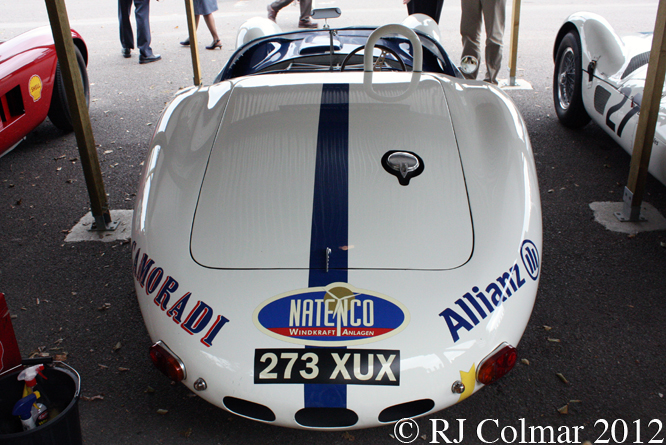
06 Maserati Tipo 60_1663sc

Harrison entered the car for Jim Jeffords who won with it at Road America on July 31st, 1960. In April 1961 Fred Gamble drove #2451 to a class victory at Marlboro .

Sources are not conclusive on #2451 being the car that William Kimberly drove to victory for Frank Harrison at Courtland in July 1961.

Frank sold #2451 to Don Skogmo, a regular winner aboard a Maserati Tipo 61, who is thought never to have raced #2451.

In 1971 #2451 found a new lease of life in the British ‘JCB’ historic championship where it was driven to a championship victory by Brian Joscelyne.

By 1980 #2451 was to be found in the Rosso Bianco collection belonging to Peter Kaus. Today the car, which was first registered for UK road use in 2010, is owned by Windpower magnate and Maserati Collector Willi Balz who is seen at the wheel at Goodwood a couple of years ago.

Thanks for joining me on this “Birdcage Streamliner” edition of “Gettin’ a li’l psycho on tyres”, I hope you will join me again tomorrow when I’ll be looking at a versatile Talbot that raced at Le Mans in 1939. Don’t forget to come back now !
Share

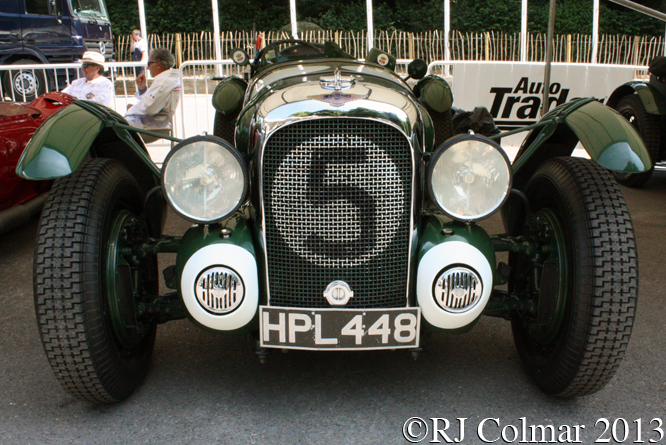
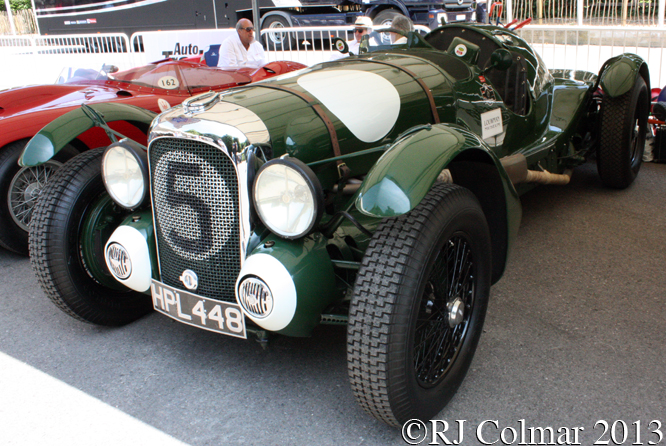
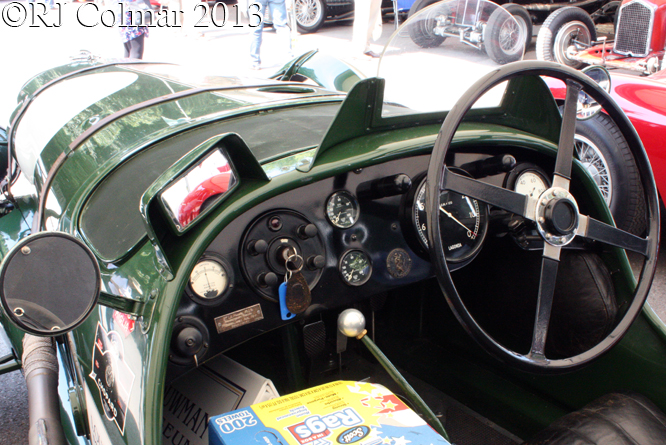
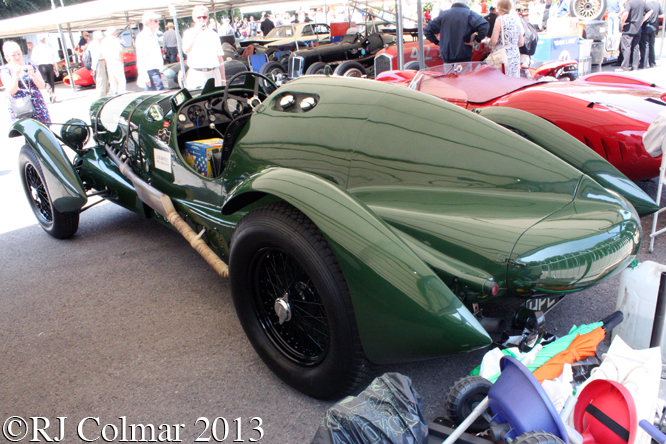
Old Number 5 – Lagonda V12 #14089

Despite winning Le Mans in 1935 Lagonda looked to be going the same way as Bentley financially until it was rescued with an injection of cash by it’s new chairman 30 year old Alan Good.

Good hired two former Rolls Royce employees to design today’s featured car, none other than W.O. Bentley himself was responsible for the chassis while his colleague Stuart Tresilian was responsible for the 4.5 litre / 274 cui single overhead cam V12 motor.

Lagonda V12, Goodwood Festival of Speed

In late 1938 early 1939 Good announced that he would like to enter a Lagonda V12 into the 1939 Le Mans 24 Hours race.

W.O. Bentley who was to be prepare the car, originally designed as a production vehicle and never intended for racing, was adamant that this should only be done to see if the cars would last the distance in anticipation of a full onslaught in 1940 to which Good agreed.

Lagonda V12, Goodwood Festival of Speed

A short V12 chassis was lightened by drilling out as much dead weight as possible from the chassis members and independent front suspension arms. The V12 aluminium block motor was fitted with four carburetors and produced over 200 hp.

Good had hoped that Mercedes Benz star Richard “Dick” Seaman would drive chassis #14089 but Mercedes objected and so leading ERA runner Arthur Dobson was joined by Brooklands regular Charles Brackenbury at the wheel of the car which would become known as Old Number 5.

Lagonda V12, Goodwood Festival of Speed

During the preparations Lord Selsdon came into a substantial inheritance and persuaded Alan Good to enter a second car which he was to share with Lord William Waleran.

Observing strict instructions from W.O. the drivers of the two Lagonda’s lapped at a pre arranged speed and they completed 239 laps and 238 laps respectively, four more than the 235 laps completed by the winning Delahaye in 1938, but short of the 248 laps recorded Jean-Pierre Wimille and Pierre Veyron in their winning supercharged Bugatti type 57C.

Lagonda V12, Goodwood Festival of Speed

The Lagondas finished third and forth behind the Ecurie Walter Watney Delage with Old Number 5 ahead of it’s sister to secure first and second in the over 5 litre / 302 cui class.

Dick Seaman tragically was killed at Spa after an accident in his Mercedes Benz the following week.

The beginning of hostilities in 1939 meant the 1940 Le Mans 24 hours would not take place and so the Lagonda V12’s never got the chance to prove their true potential although they did finish first and second in one of the last races run at Brooklands before war broke out.

Lord Selsdon would, briefly, share the winning 1949 Le Mans winning Ferrari 166MM with Luigi Chinetti.

While Old Number 5 seen here at last years Goodwood Festival of Speed would briefly end up in the hands of Fighter Pilot and Racing Driver Robert, later Roberta, Cowell.

After war Lagonda became part of David Brown’s portfolio which included Aston Martin and was merged to become Aston Martin Lagonda.

Thanks for joining me on this “Old Number 5” edition of “Gettin’ a li’l psycho on tyres” I hope you will join me again tomorrow for Maserati Monday when I’ll be looking at the prototype Maserati Tipo 60. Don’t forget to come back now !
Share

Diesel Über Alles – Audi R10 TDI #102

After winning Le Mans five times from six attempts between 2000 and 2005, interrupted only by Bentley with it’s Audi derived V8 motor, Audi entered the 2006 season with a real game changer.

The turbocharged 5.5 litre V12 335 cui motor used to power the Audi R10 TDI was to run on diesel, and thus reopen a frontier of development in top line motorsport not seriously looked at since the turbocharged Cummins Diesel Special appeared at Indianapolis Motor Speedway in 1952.

Audi R10 TDI, Goodwood Festival of Speed

Chassis #102 seen here at Goodwood Festival of Speed appeared in just six races in 2006, after being the fastest car in testing at the Sebring it disgraced it’s self by retiring with an overheating motor in the Sebring 12 hours with Frank Biela, Marco Werner and Emanuele Pirro at the wheel. It’s sister car chassis #101 driven by Rinaldo Capello, Tom Kristensen and Allan McNish became the first diesel powered vehicle to win an international sports car race.

The #102 was 4th fastest on it’s next appearance at the Le Mans test day and two weeks later qualified second for the 2006 Le Mans 24 Hour Race with the Frank, Marco and Emmanuel again sharing the driving.

Audi R10 TDI, Goodwood Festival of Speed

The 2006 Le Mans 24 Hours was won by today’s featured car which finished four laps ahead of the petrol powered Pescarolo Sport C60 Hybrid driven by Rally legend Sebastian Loeb with Eric Hélary and Franck Montagny.

After Le Mans #102 was sent back to the States to compete in the American Le Mans series where it competed in four more events with Emanuele Pirro and Frank Biela sharing the car for two second place finishes at Portland and Laguna Seca.

The R10 TDI claimed two further Le Mans victories in 2007 and 2008 and every Le Mans winner between 2006 and 2011 would be diesel powered with Peugeot interrupting the Audi juggernaut with it diesel powered 908 HDI in 2009. In 2012 and 2013 Audi continued winning Le Mans with it’s diesel electric hybrid R18 e-tron quattro model.

Thanks for joining me on this “Diesel Überalles” edition of “Gettin’ a li’l psycho on tyres”, I hope you will join me again tomorrow for another pre ’39/’45 war British Le Mans competitor designed by W.O.Bentley, that is not a Bentley. Don’t forget to come back now !
Share

Smaller, Lighter, RHD – Cunningham C6R

After experiencing less than outright success at Le Mans with the Cadillac Le Monstre Cunningham in 1950, Chrysler powered Cunningham C2R in 1951, similarly powered C4R in 1952 and C5R in 1953 Briggs Cunningham decided that three short comings of the previous designs had to be addressed.

His next new project the C6R, had to be smaller, lighter and right hand drive to optimise weight distribution on a circuit with predominantly right hand corners.

Cunningham C6R, Goodwood Festival of Speed

The C6R was also originally intended to be powered by a race bred 340 hp 4.5 litre / 274 cui Ferrari V12 motor of the type more commonly found in a Ferrari 375MM of the type he had run at Le Mans in 1954 for Phil Walters and John Fitch.

Cunningham C6R, Goodwood Festival of Speed

Responsibility of the design for the body of the C6R was handed over Herbert “Bud” Unger who had worked on the bodies of the Cunningham C4R and C5R Cunningham’s as a metal worker.

In correspondence with me, about the design, Mr Unger said; “The engineers wanted maximum air flow to the brakes front and rear…” These were 13 inch air cooled drum brakes, prone to fading when hot. “I made the front air intake as large as possible and also extra air intakes on both sides beside the main grille air intake.

Cunningham C6R, Goodwood Festival of Speed

Next, I tapered the side of the body in from the front fenders all the way back to the rear fenders and by large air scoops to get maximum ram air into both rear brakes.”

By the time the car appeared at Sebring in 1956 with it’s unpainted aluminium body, crafted by “a man form Europe that was an expert with the (English) wheel.

Cunningham C6R, Goodwood Festival of Speed

Briggs, for reasons unknown, compromised the original design criteria by fitting a modified 3 litre Indy 500 engine running on petrol instead of the usual alcohol brew.

Le Patron shared the driving at Sebring with John Gordon Bennett and they retired from the race on the 54th lap after the clutch disintegrated.

Cunningham C6R, Goodwood Festival of Speed

When the C6R appeared at Le Mans the body had some alterations including a single smaller front intake and a D-Type Jaguar like headrest and rear fin and the car ran over the weekend with the rear brake cooling intakes in open and blanked off configurations.

During the course of it’s second race Briggs and Sherwood Johnson found the C6R started loosing gears and it retired from 13th place after 18 hours after the engine had enough of pushing the car round in forth, top, gear only.

Cunningham C6R, Goodwood Festival of Speed

Briggs Cunningham raced the car one more time in 1955 at Road America where the Offy motor again expired for good.

The car did not run again until 1957 by which time a 3.8 litre 6 cylinder Jaguar six cylinder motor had been fitted.

Cunningham C6R, Goodwood Festival of Speed

Briggs raced the car on four occasions with a best known result of 9th at Lime Rock in June 1957.

The car was permanently retired to Briggs Cunningham’s collection thereafter which has since become part of the Collier Collection. It is seen here at recent Goodwood Festival of Speed meetings.

My thanks to Mr Unger, Cunningham Motorsport Historian Lawrence W. Berman, Paul Kierstein from the photo archive and Sondre Kvipt in Norway who facilitated my correspondence with Mr Unger. Thanks also to Herbert at The Nostalgia Forum who brought up the subject of the C6R’s blanked off rear air intakes.

Thanks for joining me on this “Smaller, Lighter, RHD” edition of “Gettin’ A L’il Psycho On Tyres” I hope you will join me for Ferrari Friday tomorrow. Don’t forget to come back now !
Share