Tag Archives: GT

Fibreglass Transformer – Austin Healey Sprite #ANJ/6378

Lenahm Sprite, Race Retro, Stoneleigh,

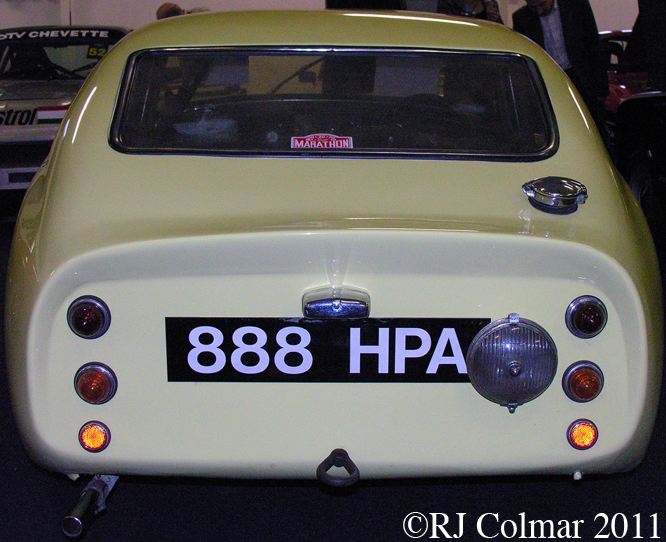
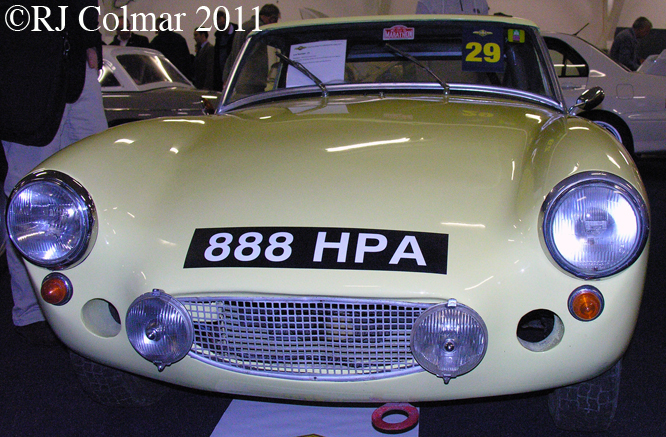
Today I am looking at this Austin Healey Sprite fitted with an Ashley nose and a Lenham Fastback, a body style also apparently known as a Lenham GT which found a new owner at last weekends Race Retro exhibition for £10,450 / $ 17,000 thanks to auctioneers H&H;.

Lenahm Sprite, Race Retro, Stoneleigh,

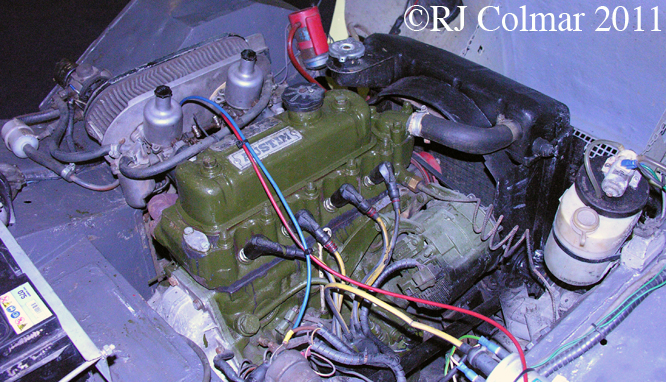
Sporting a twin carb 1,100cc / 67 cui A series motor up from the original 948 cc / 57 cui fitted to a four speed gearbox which all points to a competition history.

Ausitn Healey Sprite

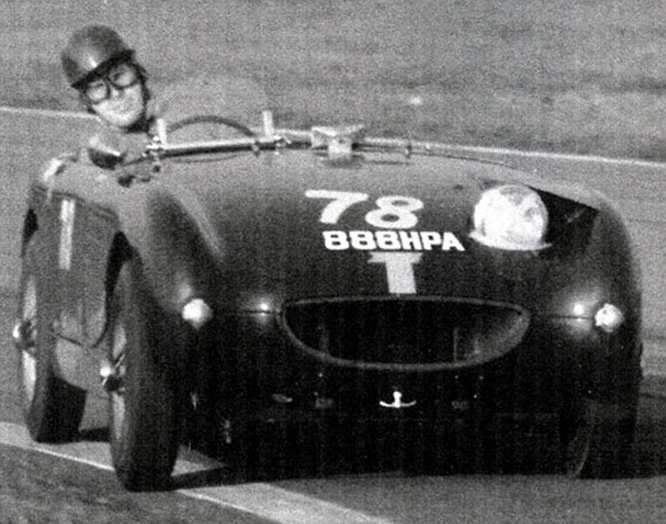
This undated and uncaptioned photo taken from the H&H; website of a vehicle bearing the same registration number (888 HPA) gives a tantalizing insight into an interesting race history that is said to have included preparation by the ‘Naylor Brothers’ and modification to Sebring Spec prior to the Lenham Fastback bodywork being fitted.

Lenahm Sprite, Race Retro, Stoneleigh,

More recently this vehicle was driven to 5th in class in the 20th Classic Marathon by Peter & Betty Banham along a route from Belgium to the Dolomite mountains of Italy.

I’d like to thank David Birchall over at The Nostalgia Forum who came up with additional information on the identity of the nose type. If you have any interesting info on this vehicle in either of the photographs please add your comments below.

Hope you have enjoyed today’s transformer edition of ‘Gettin’ a lil’ psycho on tyres and that you’ll join me again tomorrow for a look at another Great British sports car. Don’t forget to come back now !

Share

Forgotten Marque #1 – Warwick 350GT

It’s not everyday I stumble upon a vehicle manufacturer I have never heard of but at last weekends Race Retro I came across two such manufacturers the first the subject of today’s blog is Warwick.

The origins of the Warwick lie in Peerless Cars Ltd founded by John Gordon and James Byrnes, Peerless built approximately 325 fiberglass vehicles with tubular space frames designed by Bernie Rodger around Triumph TR3 running gear. A Peerless GT Coupe driven by Peter Jopp and Percy Crabb finished 16th in the 1958 Le Mans 24 hour race.

Peerless Cars Ltd failed in 1960 and Bernie Rodger upgraded his design with a stiffer chassis, one piece forward hingeing bonnet and marketed it under the Warwick name though the vehicles were actually built in Colnbrook, Berkshire. Around 40 Warwicks are thought to have been manufactured from 1960 to 1962.

Meantime Peerless founder John Gordon teamed up with Jim Keeble to carry on manufacturing vehicles based on the original Peerless chassis with Chevrolet motors and completely new bodywork designed by Guigiaro and built by Bertone marketed under the Gordon – Keeble brand.

In 1961 Warwick manufactured two prototypes with all aluminium 3.5 litre / 215 cui Buick (BOP) 215 engines, the four tail pipes on this vehicle are evidence that this is one of those two prototypes.

The Warwick appeared at Race Retro on the Central Scanning stand, a company that specialises in scanning old parts so that they can be reverse engineered, thus making it theoretically possible to remanufacture almost any part for any vehicle that has ever been built so long as an original copy exists to be scanned.

I hope you have enjoyed today’s Forgotten Marque edition of ‘Getting a lil’ psycho on tyres’ and that you will join me again tomorrow for another forgotten marque. Don’t forget to come back now !

05/09/11 Looking into the name of this model I have come to realise it is properly called a Warwick 350GT not 305GT as originally published. Apologies for any confusion.

Share

Double Bubble – FIAT Abarth 750 GT Zagato Coupé

Continuing the series of posts relating to Race 1 at Thompson CT on the 20th July 1958 captured on camera by Ed Arnaudin, today we are looking at the fascinating FIAT Abarth 750 Zagato driven by Paul Sagan to 6th place overall the only class H finisher.

After the 22 hp FIAT 600 was launched in 1955 Carlo Abarth set about maximising the potential of tuning the engine by increasing the size from 633 / 38.6 cui to 747 / 45.6 cui fitting a Nardi inlet manifold and increasing the compression ratio to produce 47 hp.

Meanwhile while Zagato set about building a Coupé based on the same car the 30 hp 600 TS, when Abarth saw the coupe he suggested to Zagato they work together to produce a vehicle for racing in the popular 750 cc 45.6 cui sports car class prevalent in national and international racing at the time.

Over 600 of these successful racing vehicles which won the SCCA class H in ’59 ’60 and ’61, are thought to have been built between 1956 and 1960 when the maximum permitted engine sizes for the various national racing classes were changed. The ‘double bubble’ name which is derived from the two humps in the roof stuck in America where a chewing gum brand bearing the same name was popular.

Paul Sagan is known to have been successful driving Porsche 550’s in 1956 and 1957 before he moved over to running the #27 FIAT Abarth 750 during and after which his record is sketchy though he seems to have returned to racing Porsches by 1961.

My thanks to Terry O’Neil for the race results and Steve Arnaudin for his Dad Ed’s pictures, wishing Ed all the best on his return home from hospital.

Hope you have enjoyed today’s double bubble edition of ‘Gettin’ a lil’ psycho on tyres and that you’ll join me again tomorrow for a look at the cool 2nd place Lotus IX of Race 1 at Thompson CT on the 20 July 1958. Don’t forget to come back know !

Share

Lennon’s on sale again, Lot No: 363 – Ferrari, 330 GT, #06781, 1964.

I’d like to thank Steve Arnaudin for sending me a link to the subjects of today’s Ferrari Friday.

Lot No: 363 is billed as the greatest “collision of universes” on one website, and it’s not hard to disagree, it is well known that John Lennon had a couple of Rolls-Royce Phantom V Limousine‘s one of which was famously painted by J.P. Fallon Limited to become known as the ‘psychedelic Rolls‘ though the design is actually based on traditional designs of gypsy caravans one of which John had purchased for his garden.

John said of his Rolls that it was for ‘relaxing’.

Less well known was that John also had a Mini for ‘pottering about in’, and by all accounts had a crash involving his Austin Maxi.

News to me thirty years after his death is that John also bought this Ferrari, his biography ‘John Lennon – A Life’ by Philip Norman tells us “In February 1965, John passed his driving test, an event that made headline news across the nation. Within hours, every luxury car dealership in the Weybridge area, hoping for business, jammed the road outside Kenwood’s security gates with Maseratis, Aston Martins, and Jaguar XK-E’. John strolled out to inspect this gleaming smorgasbord, eventually selecting a £2,000 light blue Ferrari.’ “

This is the car sold on 20th April 1965 registered with these DUL 4 C plates to John who was officially recorded as living in central London at the time.

The 330 engine featured 12 cylinders of 330 cc / 20 cui each, from which the 330 name stems, giving the Colombo V12 a total capacity of 3,960 cc / 241 cui capable of producing 300 hp. This engine would form the basis of several racing motors including that used by the Ferrari P4.

John’s Right Hand Drive US bodied 330 GT was fitted with electric windows, a Webasto Sunroof and is one of 508 equipped with the original 4 speed gearbox with overdrive.

Unfortunately John’s car is no longer it’s original Azzuro Light Blue VM 3015 colour, the current darker colour was applied during a restoration in the 1990’s after the car had been found ten years earlier painted red.

The 330 GT came with shiny Borrani wheels adjustable Koni shock absorbers, rear leaf springs assisted by coils, unusually the dual circuit servo assisted braking had one servo operating exclusively on the front and the other exclusively on the rear brakes.

John said of his Ferrari he bought it ‘for zoom’ on 12th of November 1965 six months later DUL 4 C was advertised for sale with 3,000 miles on the clock.

The car is for up for auction at Bonhams Grand Palais event in Paris tomorrow it will be interesting to see if it fetches the maximum estimated € 170,000 in these times of economic uncertainty, my guess is that this is an extremely conservative estimate designed to draw the punters in.

Hope you have enjoyed todays Ferrari Friday ‘zoom’ edition of Gettin’ a little psycho on tyres’ and that you’ll join me again tomorrow for a look at a Piccoli Ferrari. Don’t forget to come back now !

Share

Masking Tape Special – Ferrari LWB 250 GT California Spyder #0919

For Ferrari Friday today we have Steve Arnaudin to thank for sending his Dad Ed Arnaudins pictures for me to share, the vehicle we are looking at today is a Ferrari LWB 250 GT California Spyder at Lime Rock, Terry O’Neil’s book ‘Northeast American Sports Car Races 1950 – 1959‘ * suggests these photographs might have been taken on the 9th May 1959 from a meeting held over form the 24th April 1959.

Allegedly when it started raining during the second race on the original date Connecticut Law Enforcement officers moved in to cancel the rest of the days activities !

This 250 GT California Spyder LWB was powered by a 240 hp 2,953 cc /180 cui Colombo designed V12 similar to that in the 250 GT Ellena featured last week. The car is capable of in excess of 140 mph.
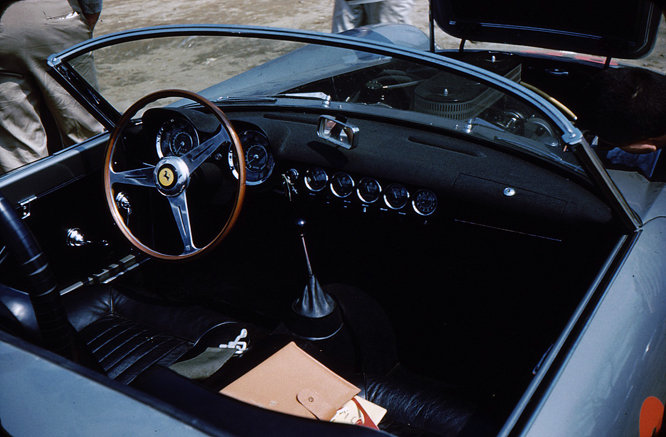
The California was the brain child of US importers Jon von Neuman and Luigi Chinetti who wanted a competition car for their biggest market from which the car derives it’s name, the interior is deliberately sparton with a ‘small’ heater the only concession to occupants comfort. Notice there is no seat harness.
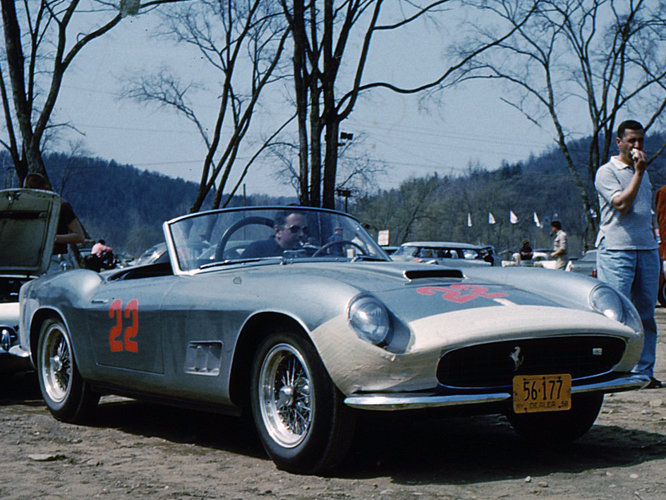
The bodywork by Scarglietti on this car was made from steel there were two body types available one with closed in headlights seen here the other with regular headlights lights on the front of the wings, this is particularly important because Bob Grossman the driver seen here drove both sorts of body style and both were painted silver. Seven competition versions of the California Spyder were built with aluminium alloy bodies again in both body styles.

Note despite the absence of a seat harness the car is fitted with a roll bar behind the drivers head. It is not clear why Bob added several rolls of masking tape to the front of his car, it may have been a cheap way to protect his paintwork from chips, scratches nicks and bugs.
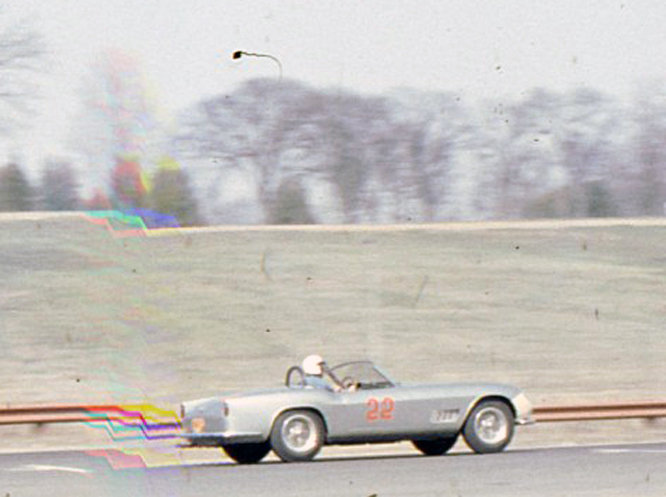
Originally finished in dark red this chassis #0919, one of just 45 examples, was built in 1958 and sold to Julio Batista Falla in Cuba before Bob Grossman turned up with it in silver and raced it within the USA, clocking up several wins and class victories in SCCA sanctioned events.

Bob more famously raced another silver 250 GT California in 1959, chassis #1451 one of the seven original competition spec vehicles featuring all aluminium bodies, but curiously without the headlight fairings.

#1451 was part of a three car attack on the 1959 Le Mans 24 hour race by the North American Racing Team, Bob and Fernand Tavano came in 5th overall and 3rd in class (not 1st in class as erroneously stated by an auction house recently). Bob also won the Nassau Memorial Trophy Race in #1451.

(Paragraph on subsequent history of #1451 removed 03/04/11)

My thanks again to Steve & Ed Arnaudin, hope you have enjoyed Ferrari Friday at Gettin’ a lil psycho on tyres, looking forward to seeing what tomorrow brings, don’t forget to come back now !

* Please note :- I do not in anyway endorse, or have any commercial interest in the products or distributors highlighted in today’s feature, I am merely passing information on as an enthusiast of all things motoring, I have no experience of handling these products nor have I used these vendors. I recommend anyone interested in these items or distributors do their own thorough investigation into suitability, reliability and particularly prices of both products and vendors before making any purchasing decisions.

26 11 10 Erratum Julio Batista’s son has informed me that today’s featured car was white when his father owned it in 1958, his Dad had never raced it, if he had he would have painted it yellow as he did with his TR # 0698. Apologies for any confusion.
Share

Superleggera ! A Q car to leave Mr Bond eating dust – Aston Martin DB4 GT

Anybody who thinks of them selves as any kind of a car enthusiast will have to admit a visit to a VSCC meeting at Prescott is worth it just to see the mouth watering vehicles in the car park.

The vehicle above is a case in point. When I first saw it I thought it was a DB5 or DB6 those faired in lights were a bit of a give away… but boy was I ever wrong ! The clue as to the identity of this vehicle is the ‘egg box grill’ which predates the horizontal bars of the grill of a DB5 or DB6, making this model a DB4 of series 3 or earlier.

The red and white badge in the centre of the grill indicates that the owner is a member of the Institute of Advanced Motorists.

The car bears the legendary Superleggera badge on the side of the bonnet indicating it is built using the light weight tubeframe duraluminium construction pioneered and licensed by Carrozeria Touring of Milan.

At 5 inches shorter than the 1110 regular DB4’s this car is one of only 75 DB4 GT’s sharing the same short wheel base chassis as the 20 original DB4 GT Zagato’s (plus 4 Sanction II’s and 2 Sanction III’s). The DB4 GT also has thinner body panels than the standard DB4 and an upgraded 302 hp 3750 cc / 228 cui in line 6 cylinder engine distinguishable by a twin spark plug head. It was capable of 153 mph (8 miles and hour faster than Mr Bonds DB5) and 0 – 60 in just 6.1 secs, not bad for 1959 !

The final give away that this model is a DB4 GT are the clearly visible bulky racing fuel filler caps. If like me you like your performance vehicles to be slightly understated, relative to say the DB4 GT Zagato then you’ll absolutely love this car.

Thanks for dropping by, don’t forget to come back now !

Share

Killed by British Leyland – Italia 2000 GT

The Italia 2000 GT was an attempt by Commendator Salvador Ruffino to fuse the proven ‘reliability’ of British engineering and the the artistry of Italian coach builders.

The Italia 2000 GT was built around knock down Triumph TR3A kits, featuring a 100 hp 1991cc 121 cui 4 cylinder engine, that has similarities to the engine Standard supplied to Ferguson for use in tractors in 1945.

The TR3 from which all the mechanical components are supplied was one of the earliest production vehicles to feature Disc brakes behind the Crosley Hotshot and Citroen DS.

As this, non original (?), plate show’s only 349 Italia 2000’s were built, the original agreement was for Carrozzeria Vignale to build 1500 of these sports cars however when British Leyland bought Triumph in 1960 the management decided to stop supplying the knock down kits and opted to build the TR4 instead.

The design of the Italia was by Giovanni Michelotti who designed the Triumph TR4 that superseded the Italia.

The production of the Italia 2000 GT in Turin ran from 1959 to 1962.

Thanks for popping by, don’t forget to come back now ! 🙂

Share