Tag Archives: Hill

Pride In Bourne – BRM Day

A 3:30 am start on Sunday saw me head over to my friend Tim’s to the lilt of early morning Drum ‘n’ Bass on Radio One and then off to what turned out to be the hillier than expected climbs of Bourne, Lincolnshire, where BRM Day was to celebrate the 50th Anniversary of Graham Hills and BRM’s 1962 World Championship victories with a stupendous parade of motor vehicles.
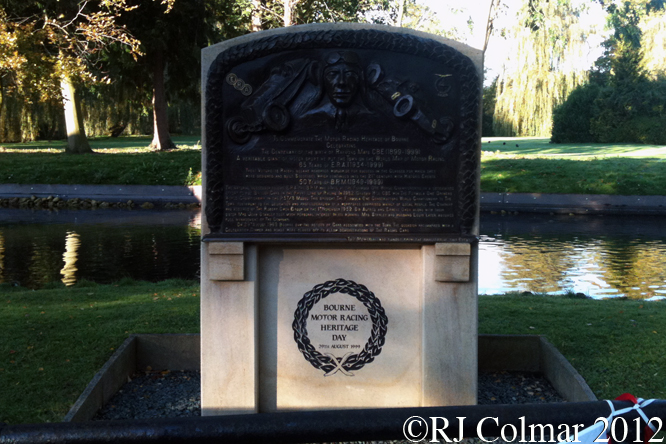
Raymond Mays Centenary Memorial, Bourne, Lincolnshire

Bourne was the home of Raymand Mays, a well respected hill climber, who founded English Racing Automobiles, ERA, with Humphrey Cook, and Peter Berthon in Bourne in 1933 with the aim of “upholding British prestige in Continental European racing”. With the German Mercedes Benz and Auto Union teams given almost unlimited resources to operate in the top echelon of the sport ERA focused on the second tier Voiturette class of open wheel racing. After the ’39 / ’45 war Raymond May’s persuaded numerous parties in the automotive industry to join him in a new collaborative (ad)venture called British Racing Motors, BRM, which like ERA was based in Bourne. Above is a memorial to the 100th anniversary of the birth of Mays which was marked in 1999 with a similar event to last weekends BRM Day.
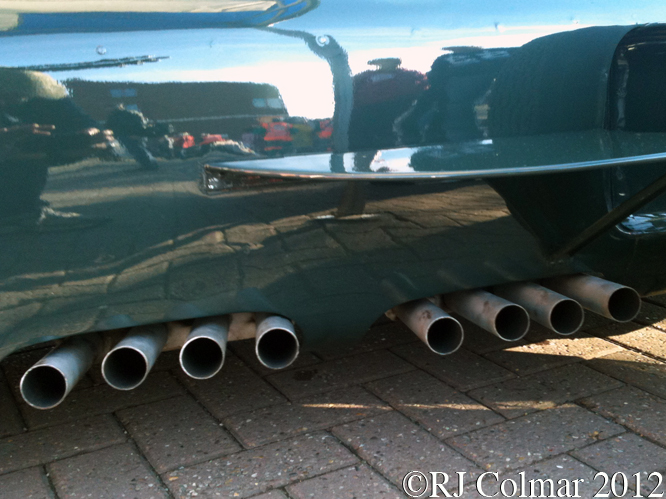
BRM P30 Mark II, BRM Day, Bourne, Lincolnshire

Before the start of the festivities I managed to wonder around the main paddock and to be honest I did not know where to look, there were so many storied cars on display. The Donington Collections 1954 BRM P30 Mark II was the second version of the 1.5 litre / 91.5 cui super charged V16 that had spectacularly failed an expectant nation in 1950. Back in those days these cars ran on strange mixtures of fuel that often included alcohol which meant the cars not only sounded great but smelt great too !
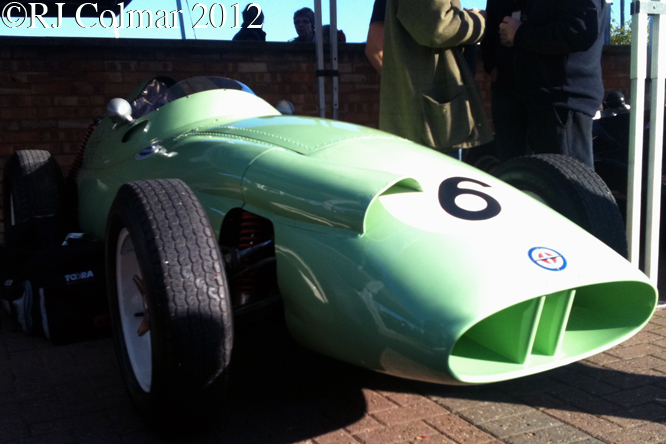
BRM P25, BRM Day, Bourne, Lincolnshire

Among the cars that did not run was the British Racing Partnership teams 1959 BRM Type 25 chassis #25/10 which Stirling Moss drove to a second place finish in the 1959 British Grand Prix while taking a two race sojourn from Rob Walkers fast if unreliable Cooper T51. At the next race, the German Grand Prix at Avus, Hans Hermann drove this car and was captured falling out of it in some of the most spectacular motor racing photographs of all time.
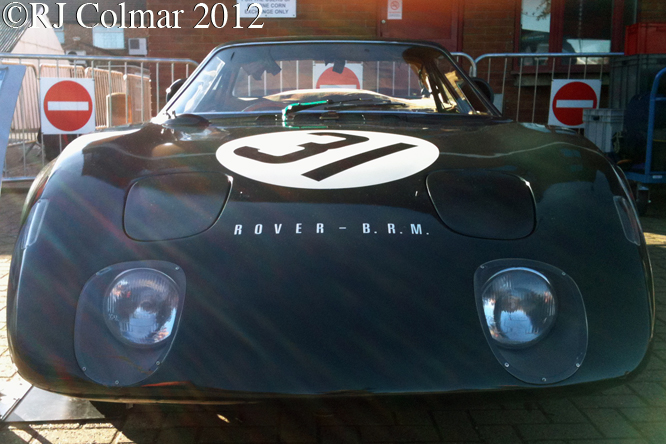
Rover BRM, BRM Day, Bourne, Lincolnshire

The Rover BRM Le Mans car started life as a BRM P57 Formula One car which Richie Ginther crashed at Monaco in 1962, when Rover and BRM discussed the idea of building a Rover gas turbine contender for Le Mans BRM rebuilt Ginthers wrecked car into a challenger for 1963 when it was driven to a 7th place finish by Ginther and Graham Hill. The car was subsequently rebodied for the 1965 race, as seen here when it finished in 10th place driven by Hill and Jackie Stewart. The gas turbine motor is being rebuilt and one day the car should be a runner again.
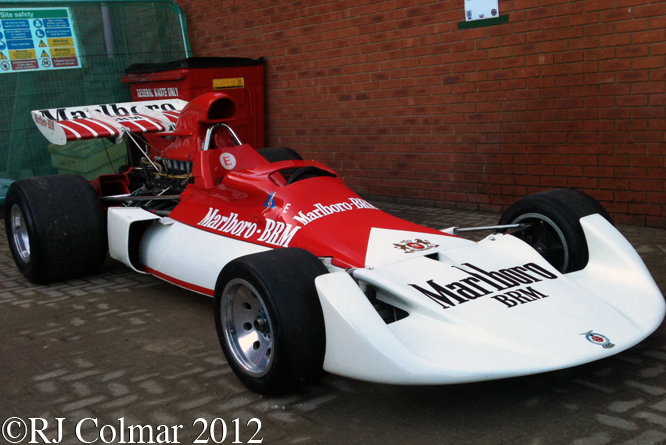
BRM P180, BRM Day, Bourne, Lincolnshire

For 1972 BRM attracted a new sponsor Marlboro that wanted to follow the brand awareness lead set by the successful partnership of John Player and Lotus Cars which had netted two championships and many victories with the Lotus 49 and Lotus 72 models. In an act of supreme folly BRM announced it would run an A team of three drivers with two more forming a B team. The cars used would be a mixture of older P153’s dating back to 1970, P160’s first seen in 1971 and a third new for ’72 P 180 design as seen above that proved to be difficult to handle. JP Beltoise drove a P 180 at Brands Hatch for the last time in a non championship race at Brands Hatch in October 1972 where a wise tyre choice led to the cars one and only victory in it’s last ever race.
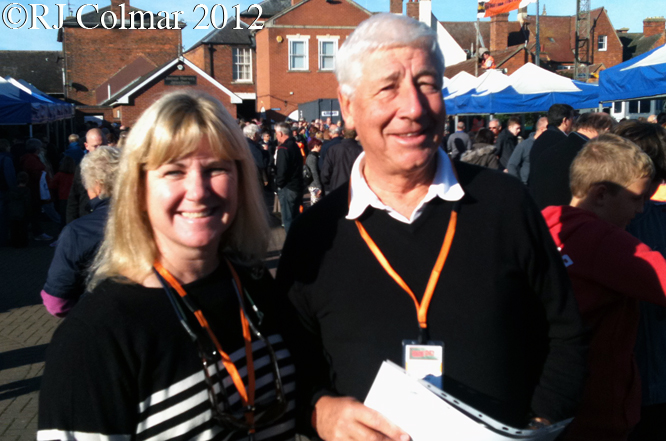
Howden Ganley, BRM Day, Bourne, Lincolnshire

New Zealander Howden Ganley seen above with his step daughter Erin drove for BRM in 1971 and 1972, after his driving career came to an end in 1974 Howden joined forces with Australian Tim Schenken to form Tiga a highly successful manufacturer of racing cars for Formula Ford/Formula Ford 2000 and Sports 2000 before going on to build a successful run of Group C2 sports cars. Today Howden is President of Ancien Pilotes a group of retired drivers. Howden is allegedly trying to get his unfinished Formula One car from the 1970’s completed.
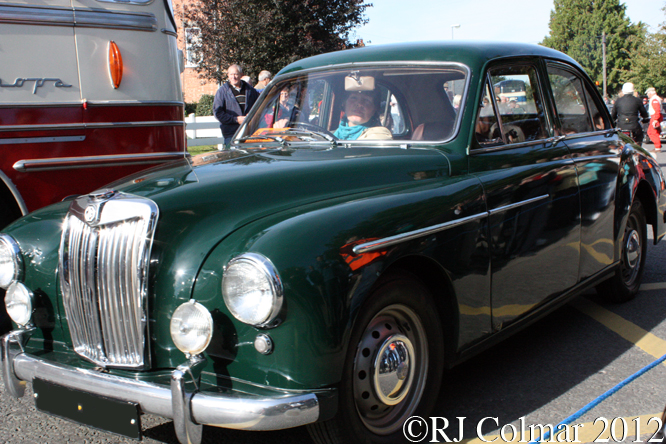
MG ZB, BRM Day, Bourne, Lincolnshire

Tim and I found a nice spot to relax at the end of Abbey Road from which to watch the proceedings, we liked it so much we stayed there for the whole parade which started in the morning with a large number of pre 1962 vehicles of all sorts which nearly came to a stand still as an assortment of private and commercial vehicles negotiated the narrow roads. Above the owner of a 1958 MG ZB Magnette carefully negotiates the narrow gap between my toes and a big bus opposite me.
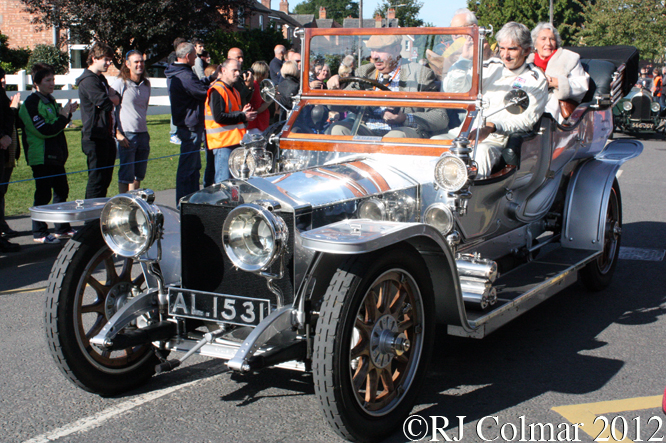
Rolls Royce Silver Ghost, BRM Day, Bourne, Lincolnshire

Guest family of honor at Bourne on Sunday naturally enough were the surviving Hills. Graham Hill’s widow Bette and son Damon, who followed his fathers career path to become 1996 World Drivers Champion are seen above on the passenger side of a 1910 Rolls Royce Silver Ghost.
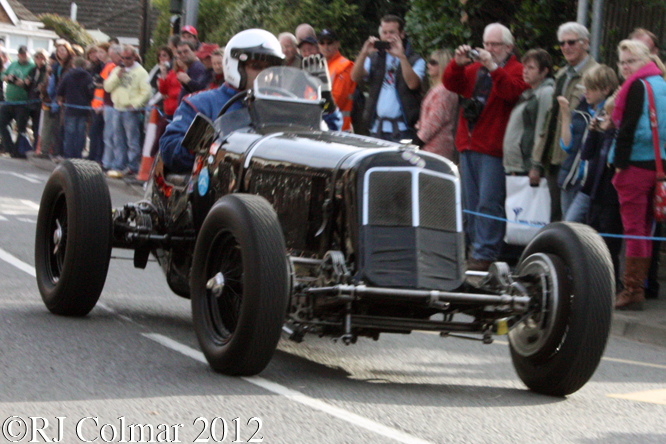
ERA 1B, BRM Day, Bourne, Lincolnshire

ERA 1B is the 5th ERA to be built, the first of the 2nd B series is seen above with Tim Cottam at the wheel. In 1935 the car was delivered new to Dick Seaman who impressed the ERA team so much they offered to prepare his car for him. Dick was not happy with the arrangement and eventually had the car prepared by Giulio Ramponi. Dick won races at Pescara, Italy, Berne, Switzerland and Brno, Czechoslovakia with R1B in 1935 before moving onto a Delage in 1936 and the works Mercedes Benz team in 1937.
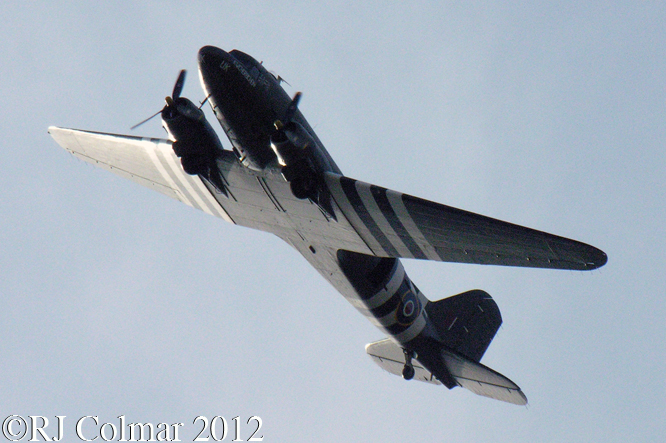
Douglas C 47, BRM Day, Bourne, Lincolnshire

During the 1939/45 war Raymond Mays hatched his plan for BRM and ERA passed into the hands of Leslie Johnson who relocated ERA to Dunstable when the company reopened for business in 1947. Less than ten miles north of Bourne RAF Folkingham was commissioned to serve as a decoy airbase in 1940, it attracted at least three German bombing raids before being upgraded to operational status in 1943. In January 1944 the 313th Troop Carrier Group arrived with it’s Douglas C47’s which were used to land troops in Normandy as part of Operation Overlord in June 1944 and again to land paratroops in Arnhem in September 1944 as part of Operation Market Garden, which made the flyover of the C47 last Sunday particularly poingnant. BRM would use the base to test it’s vehicles in the 50’s and 60’s when it was not required as a missile base in the run up to the Cuban Missile Crisis of 1962.
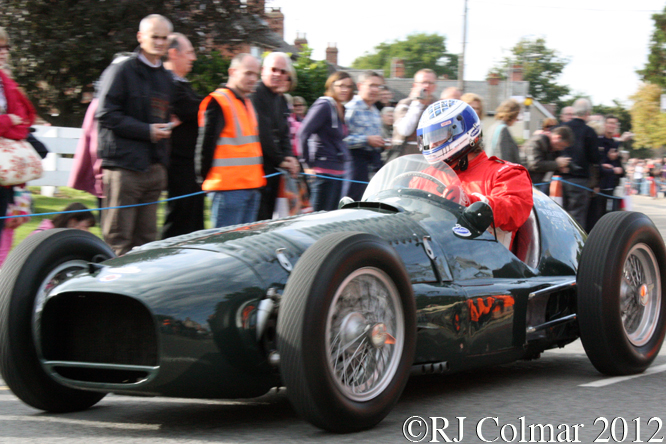
BRM P30 Mark II, BRM Day, Bourne, Lincolnshire

BRM’s first car the supercharged V16 Type 15 was a little on the recalcitrant side in the early days, but it was replaced by a shorter wheel base V16 P30 Mark II model in 1954 designed to take part in shorter non championship Formula One races. Kevin Wheatcroft is seen in the car above which I believe was used by Ken Wharton to win the five lap Chichester Cup at Goodwood first time out in April 1954. The sound and fumes from the 460 hp V16 at this range were thoroughly intoxicating !
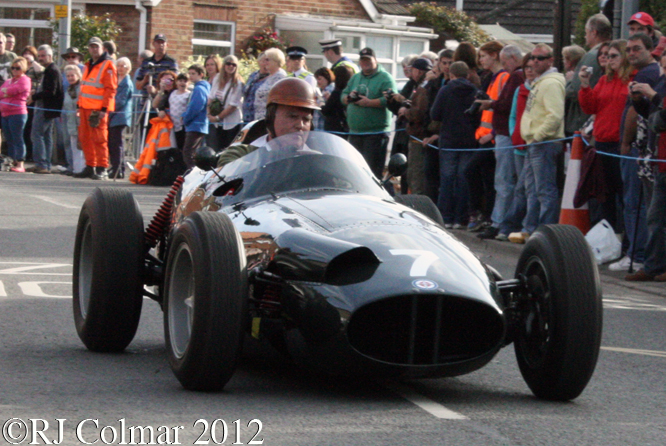
BRM P25, BRM Day, Bourne, Lincolnshire

If the V16’s were a little on the complex side the 2.5 litre / 152 cui 4 cylinder Type 25’s were much simpler reflecting a change in management from BRM’s original Trust Committee’s to BRM’s new owner Sir Alfred Owen who purchased the Trust assets in 1953. John Pearson is seen here at the wheel of the 1958 chassis 258, which originally had 27/3 stamped on the chassis, for chassis Project 27 3rd of, which is the car that Jo Bonnier drove to victory in the 1959 Dutch Grand Prix ending 10 years of under achievement for the Bourne based operation. Spencer Flack who owned the car from 2001 was killed when driving it at Philip Island, Australia in 2003. His widow insisted the car which had split in two and caught fire be rebuilt by Hall & Hall the respected restoration experts who are based in Bourne.

As an aside BRM chassis type and project numbers do not follow any particular numerical sequence for example the first five Type 25’s were given chassis numbers #251 – #255 the remaining cars with slightly different chassis construction were given chassis numbers 27/1 to 27/6, P27 was the project number given to both chassis variations of the the Type 25 cars while project number P25 was given to the 2.5 litre / 152 cui 4 cylinder motors for the Type 25 BRM’s. To further confuse the matter the later cars with the 27/1 to 27/6 numbers stamped on the chassis were referred to as continuations of the earlier 251 – 255 numbering system hence chassis 27/3 is ALSO known as 258 @-)
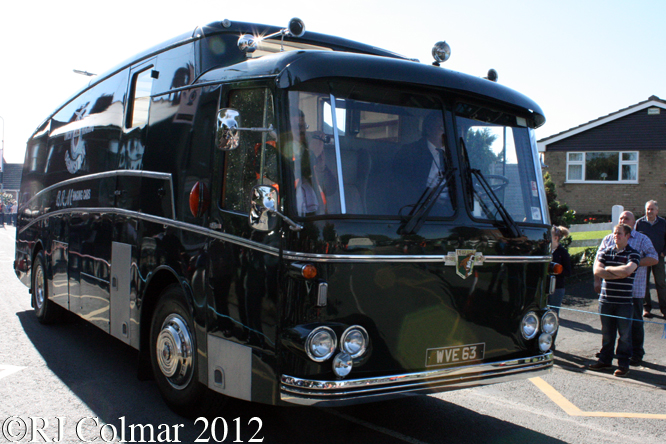
Leyland Royal Tiger, BRM Day, Bourne, Lincolnshire

For 1960 BRM got a new transporter based on a Leyland Royal Tiger Worldwide bus chassis, notice the vehicle is left hand drive in anticipation of it mostly being used to transport racing cars across Europe rather than around the United Kingdom which was, still is and probably always will remain a country that drives on the left hand side of the road.
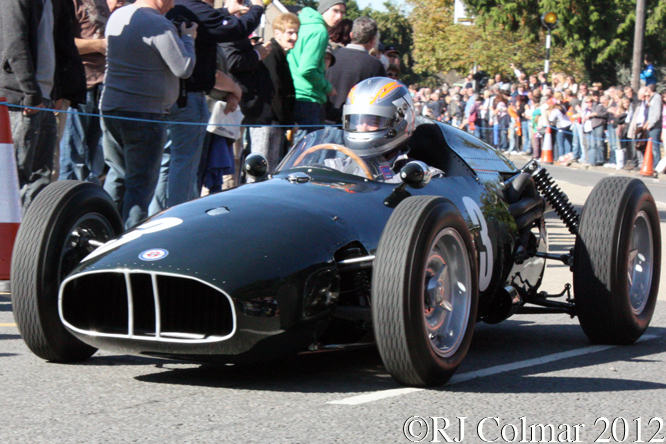
BRM P48, BRM Day, Bourne, Lincolnshire

Rick Hall was instrumental in the organisation of last Sunday’s BRM Day his son Rob is seen above driving the P48 Mk I which belongs to Bruce McCaw of Seattle. This car was originally driven by Graham Hill and Dan Gurney in 1960/61, it started life as a front engined Type 25 chassis 27/2 ALSO known as 257 and was converted to P48/2, the second rear engined BRM, for the 1960 season When Graham Hill and Dan Gurney drive it.
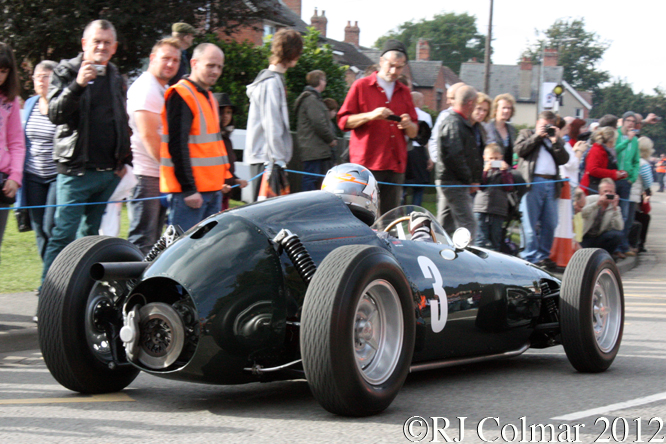
BRM P48, BRM Day, Bourne, Lincolnshire

As on the Type 25 the P48’s rear brake was a single disc attached to the back of the rear transaxle which acted on both rear wheels while saving on all up and unsprung weight of the car to the benefit of the handling. The P48’s were not particularly successful in 1960 recording many retirements and a best 3 rd place for Graham Hill. In the winter of 1960/61 two P48’s were sent to Australia for Hill and Gurney to drive and Gurney won his last race in a BRM at Ballarat, but only after his car had been crashed the night before the race by some hooligans !
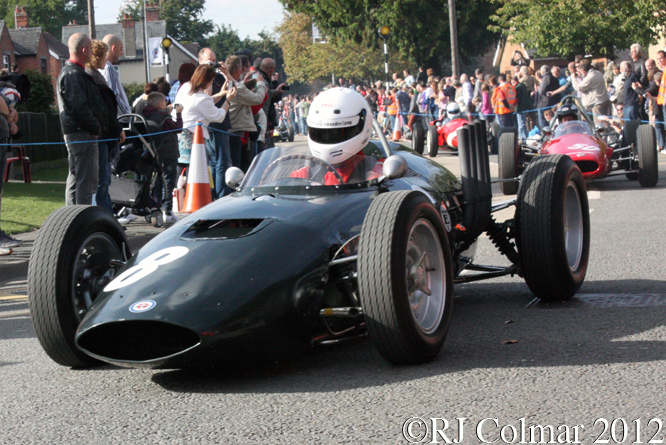
BRM P57, BRM Day, Bourne, Lincolnshire

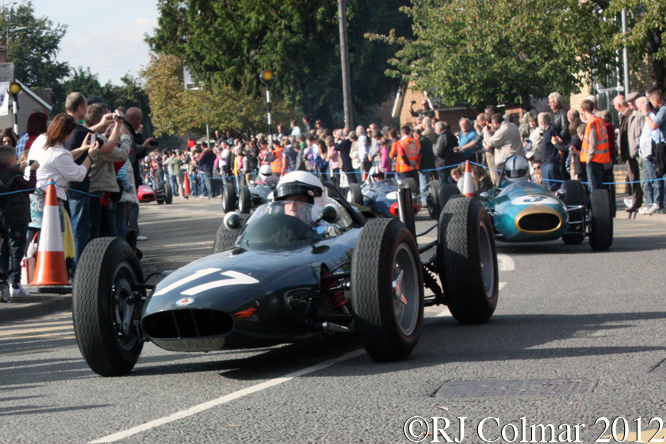
New Formula One regulations were introduced for 1961 requiring 1.5 litre / 91.5 cui motors. BRM started the season with proprietary Coventry Climax four cylinders before switching to their own V8’s which proved to be real gems. Initially the V8’s were fitted with stacked exhausts, but despite making a great howling noise they had a propensity to fall of and were replaced with conventional horizontal exhausts in 1962. Above the stacked exhausts on BRM P57 #57/3 are clearly visible. This car was driven by Graham Hill and Tony Brooks for the works while multiple British Hill Climb Champion Tony Marsh privately entered it into four non championship events before returning it to Bourne.
BRM P578, BRM Day, Bourne, Lincolnshire

For 1962 the BRM teams new P57’s were numbered P578’s built to accept only the BRM V8 having the digit 8 added to the P57 project number. Graham Hill drove these cars to championship race victories in the Dutch, German, Italian and South African Grand Prix and clinched his first and BRM’s only World Championship’s. Above is P578 #578/2 in early 1962 spec with stacked exhaust pipes.
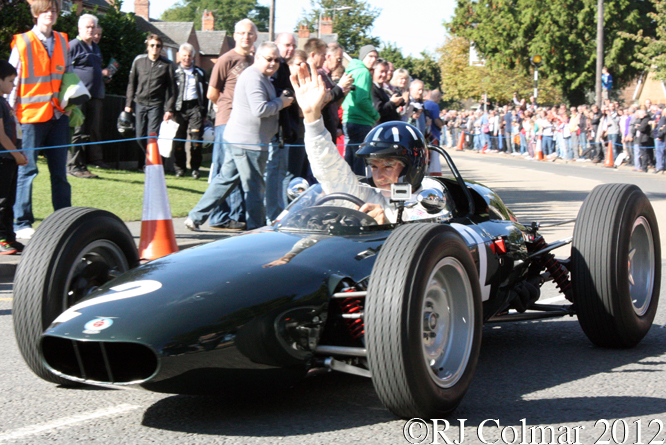
BRM P578, BRM Day, Bourne, Lincolnshire

P578 #578/1 also known as ‘Old Faithful’ with the late ’62 horizontal exhausts was kindly sent over from the Collier Collection in Florida for Grahams son Damon Hill who can be seen at the wheel above.
Lotus BRM 24, BRM Day, Bourne, Lincolnshire

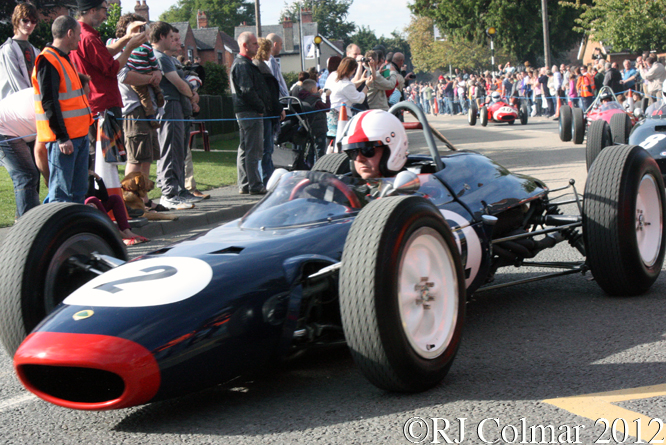
Such was the demand for 1.5 litre / 91.5 cui Formula One motors BRM had no trouble selling copies of their motor for privateers to use from 1962 onwards. Above Nigel Williams is at the wheel of the Parnell Team 1963 Lotus BRM 24, chassis #P1, fitted with Lola Mk 4A bodywork as raced by Peter Revson in the 1964 British Grand Prix from which he retired.
BRM P261, BRM Day, Bourne, Lincolnshire

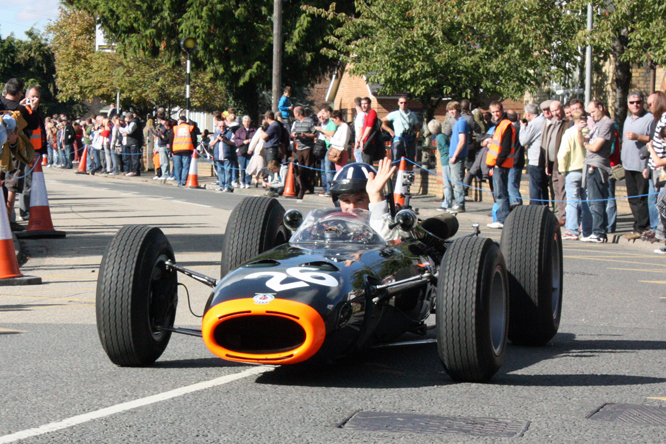
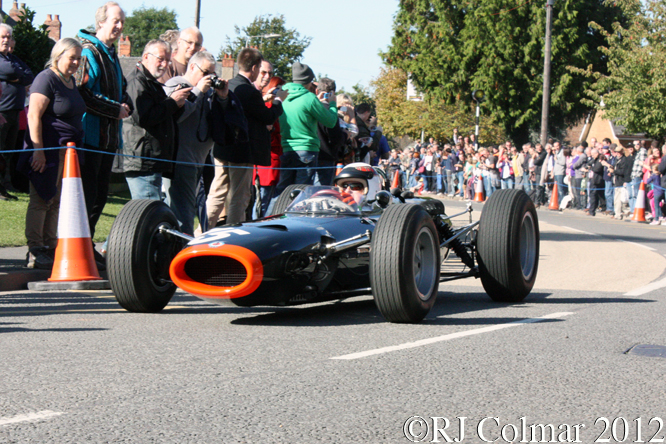
Graham Hill went into the last race of the 1964 season as leader of the World Championship 5 points ahead of Surtees in his Ferrari and 9 points ahead of reigning champion Jim Clark in his Lotus. During the Mexican Grand Prix the final race Hill was knocked out of contention by Surtees team mate Lorenzo Bandini, Clark led the race comfortably, a win would have handed Clark the championship on a more race wins tie breaker, until the last lap when an oil leak caused his Climax V8 to seize. Going into the last lap Surtees was lying third behind Bandini and eventual winner Dan Guerney. Fortunately Surtees team mate, Bandini, let Big John pass and claim six points for his second place finish enough to claim the championship from Hill by a single point. Above Damon Hill is seen at the wheel of a 1964 BRM P261 #P2615. The 2 stems from Mark 2 of the 1961 P61 chassis to give P261 !
BRM P261, BRM Day, Bourne, Lincolnshire

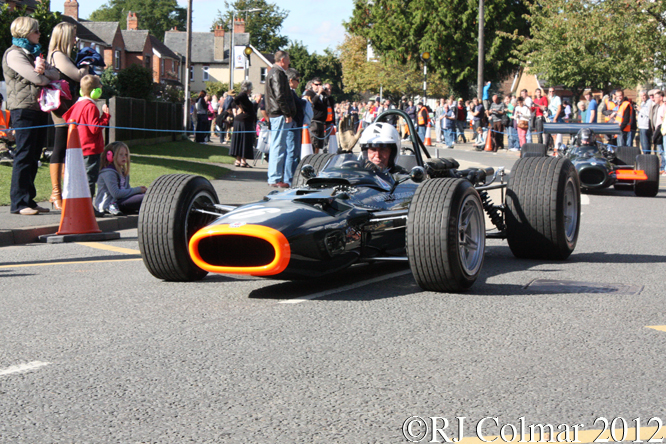
In 1965 rookie Jackie Stewart was signed up to partner Graham Hill at BRM and he did not disappoint, scoring three seconds and a win at the 1965 Italian Grand Prix to finish third in the championship behind Jim Clark and Graham Hill who finished second in the championship for the second year in a row. Sir Jackie is seen above driving #P2617 one of the cars he raced in the 1965 season.
BRM P126, BRM Day, Bourne, Lincolnshire

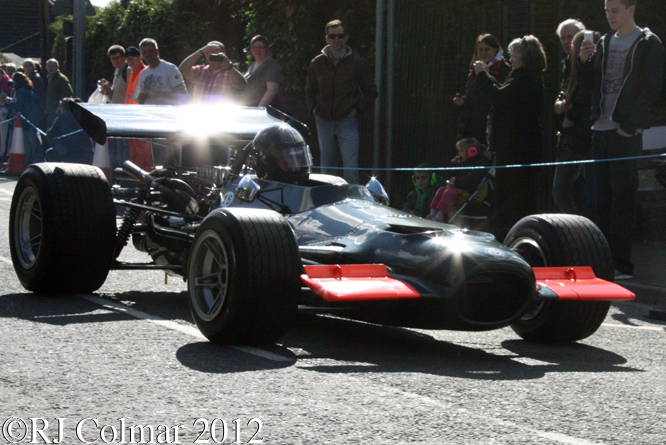
For 1966 the Formula One regulations changed mandating 3 litre / 183 cui motors, BRM initially ran 2 litre / 122 cui versions of the P261 cars before introducing a hideously complex 3 litre H16 which produced plenty of power and probably the best noise ever heard at any race track but was predictably unreliable. Unfortunately none of the BRM H16’s are running at the moment and a Lotus 43 fitted with one is also presently hors d’combat. So the BRM Parade skipped to 1968 when a parallel 3 litre V12 engine programme came on stream to power the one off BRM P126 seen above with Richard Attward at the wheel. Richard scored the cars best result a second place finish at Monaco in 1968.
BRM P139, BRM Day, Bourne, Lincolnshire

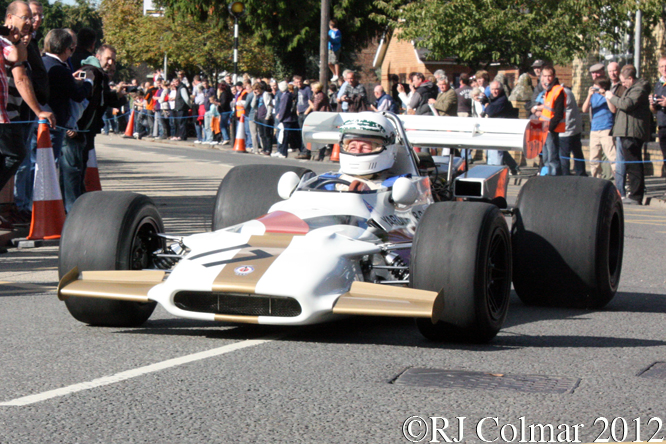
For 1969 John Surtees and Jackie Oliver were employed to drive for the BRM team which introduced the V12 powered P139 half way through the season. John scored the cars best result a 3rd place finish at the 1969 US Grand Prix.
BRM P153, BRM Day, Bourne, Lincolnshire

For 1970 Jackie Oliver was joined by Pedro Rodriguez at the now Yardley sponsored BRM and it was Pedro who scored the teams only win of the season with the BRM P153. For 1971 Howden Ganley, who is seen at the wheel of #153/4 here, joined the team which included a roster of a total of eight drivers.
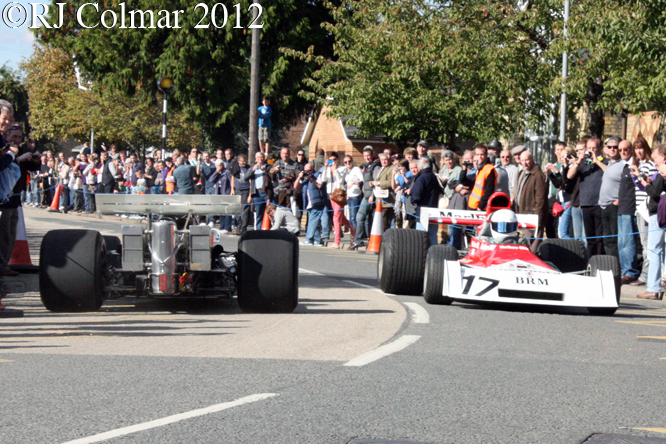
BRM P153 & P160, BRM Day, Bourne, Lincolnshire

The P160 replaced the P153 part way through 1971 and Peter Gethin used one to win the close fought 1971 Italian Grand Prix. In 1972 Marlboro replaced Yardley as the teams sponsor and Jean Pierre Beltoise scored the BRM teams final championship victory at Monaco in 1972. Above the 1973 spec P160 chassis P160/7 of J Burt has an interesting moment as he passes S Burt in the older P153, luckily neither driver was on the racing line at the time.

Another little aside, in 1973 I attended the non championship Race of Champions at Brands Hatch, the first time I ever saw Formula One cars in action, the BRM P160’s of Beltoise, Niki Lauda and Vern Schuppan qualified 1st to 3rd on the grid. Amazingly Beltoise, Lauda and Ronnie Peterson driving a Lotus 72, were credited with fastest lap of the race at 1.23 secs dead. Of the three only Beltoise finished in a distant 6th place.
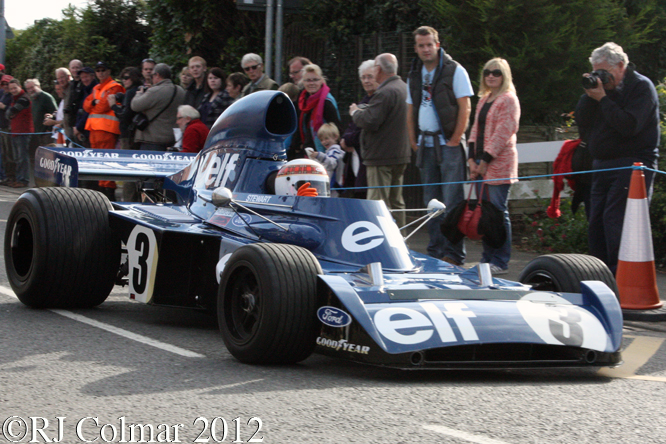
Tyrrell Ford 006, BRM Day, Bourne, Lincolnshire

In 1973 BRM old boy Jackie Stewart won his third and final World Championship driving for the Tyrrell team, it was a real treat to see Sir Jackie driving a 1973 006 model through the streets of Bourne, not quite the Monaco Grand Prix, but without the crash barriers and safety fences of the Principalities street circuit, no less exciting.
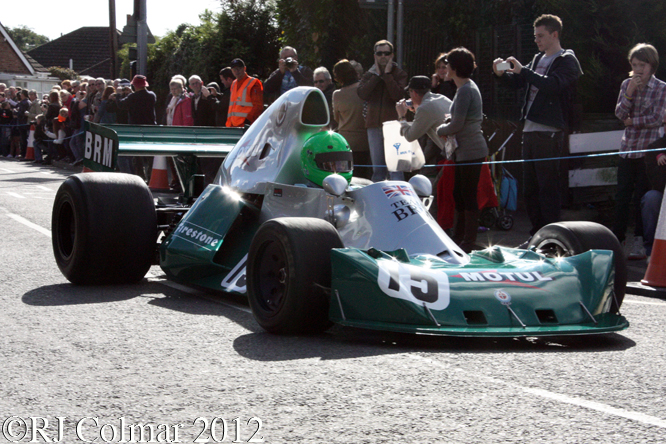
BRM 201, BRM Day, Bourne, Lincolnshire

Probably my favorite BRM of all time is the P201 designed by Mike Pilbeam, featuring the 48 valve version of the V12 launched in 1968 the car appeared with sponsorship from Motul in 1974 when the team employed Beltoise, Le Mans Winner Henri Pescarolo and former Connew refugee Francois Migault at the wheel with Chris Amon drafted in to replace Pescarolo at the last two races of the year. The P201’s best result was a second place finish on its debut in South Africa with Beltoise at the wheel. Sir Alfred Owen passed away in 1974 and former team manager and Owen’s son in law Louis Stanley took over the team renaming it Stanley BRM in 1975. With no sponsorship to speak of, an out of date car and uncompetitive motor the team spiraled into a terminal decline the P207 was introduced in 1977 but started only one race in the hands of Larry Perkins. Perkins made BRM’s last Grand Prix start in South Africa this time with a much modified and hopelessly out dated P201. He finished 15th and there after Teddy Pilette, Conny Anderson and Guy Edwards all tried their hand at qualifying the P207 with out any success. J Fenning wearing a helmet just like the won worn by Henri Pescarolo is seen at the wheel of #P201/5 here, a car that was driven in the 1975 season under the Stanley-BRM banner by Bob Evans who’s best result was a 6th place finish in the non championship Race of Champions at Brands Hatch.
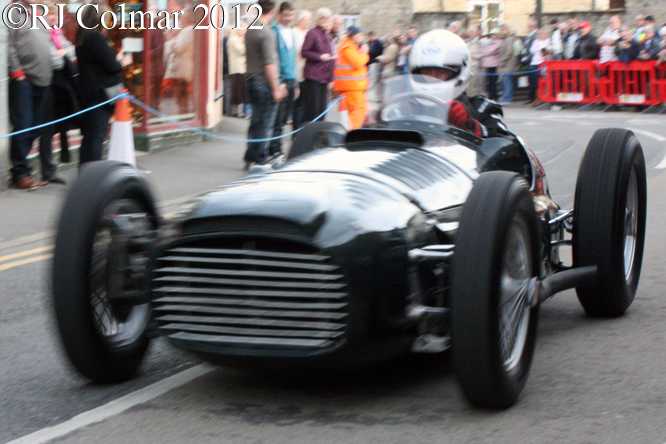
BRM V12 P15 Mark I, BRM Day, Bourne, Lincolnshire

As the parade came to a conclusion the V16’s were given a second run, the sound of the very first V16 P15 driven by the National Motor Museums Doug Hill still reverberates round my head as I bring this “Pride In Bourne” edition of “Gettin’ a li’l psycho on tyres” to a close.

My thanks to everyone involved in organising and putting on this magnificent event which is without doubt the highlight of my motoring year.

On this link you will find a short film of the days activity that I have made.

Thanks for help with identifying the cars to The Nostalgia Forum in particular Tim Murray an Doug Nye. If you spot any errors please accept my apologies and chime in below with any corrections.

Thanks for joining me, I hope you will join me again tomorrow. Don’t forget to come back now !

Share

Racin’ ‘n’ Climbin’ – Ferrari 212 Export Touring Barchetta

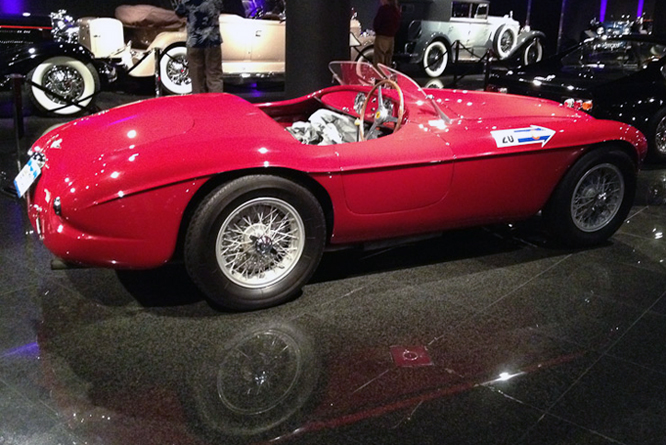
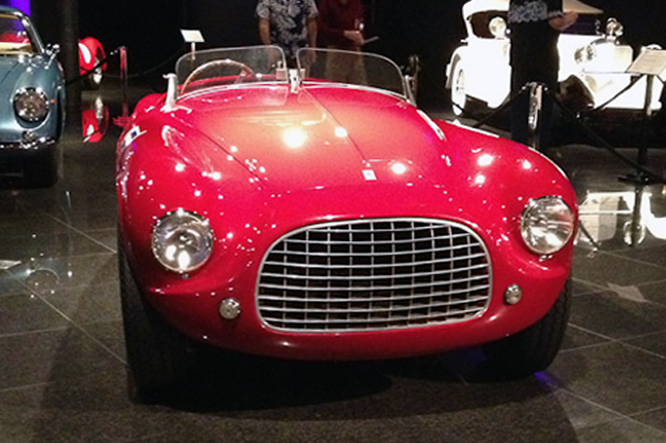
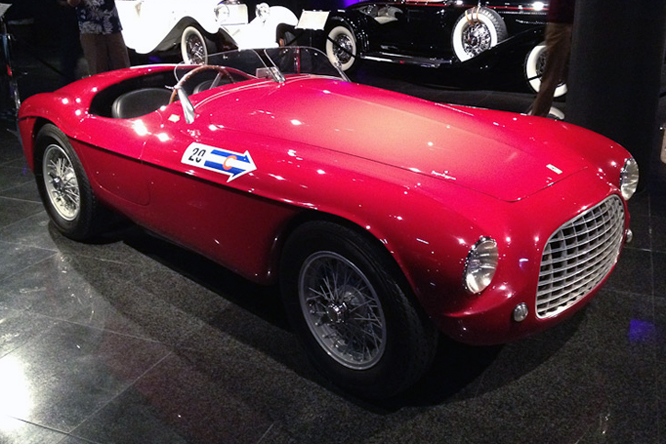
In 1951 Ferrari produced two 212 models the Grand Touring Inter with either a 150 or a 165 hp and the competition orientated Export with 170 hp from it’s high compression V12 which was mounted on a shorter chassis than the Inter.

212 Export Touring Barchetta, Danville Concours d'Elegance

The 212 Export was quick right out of the box, Vittorio Marzotto and Paolo Fontana won the 1951 Giro di Sicilia in chassis #0086E while “Pagnibon” and Alfred Barraquet led home a 212 Export 1,2,3 finish in the 1951 Tour de France. Among 212 Export winners in the States were Phil Hill, who won at Torrey Pines in 1952 driving chassis #0078E and Ernie McAfee at Palm Springs in 1953, driving chassis #0092E with a coupé body by Vignale.

Kirk Douglas drove a specially rebodied 212 Export chassis #0102 to a fictitious victory in the the 1955 film “The Racers“.

212 Export Touring Barchetta, Danville Concours d'Elegance

Chassis #0158ED, seen here at the Danville Concours d’Elegance dinner, was supplied new to Luigi Bordonaro di Chiaramonte of Palermo, Italy for the 1952 season. He used it to good effect scoring at least 7 overall wins in both race and hillclimb competition between 1952 and 1955.

Swiss driver Edouard Margairaz continued to compete with the car until 1956 when he came 1st in class at the Verbois hillclimb.

212 Export Touring Barchetta, Danville Concours d'Elegance

In all 28 212 Export models were built and chassis #0158 is thought to be the last of the seven built with Barchetta bodywork by Carrozzeria Touring in Milan.

My thanks to Geoffrey Horton for sharing todays photographs from Danville Concours d’Elegance.

Thanks for joining me on this “Racin”n’ Climbin'” edition of “Gettin’ a li’l psycho on tyres” I hope you will join me again tomorrow when I’ll be looking at a multipurpose open wheel racer from Lotus. Don’t forget to come back now !

Share

Cut and Bury – Lotus Ford 64

After coming close to winning the 1968 Indianapolis 500 with the Pratt & Whitney gas turbine powered Lotus 56 driven by Joe Leonard the powers at Indianapolis decided to ban gas turbine power and all wheel drive for the 1969 season, but eventually relented and allowed all wheel drive vehicles that had wheels no more than 9″ wide all round. Rear wheel drive vehicles were allowed to go to 14″ wide wheels at the rear.

Lotus Ford 64, Goodwood Festival Of Speed

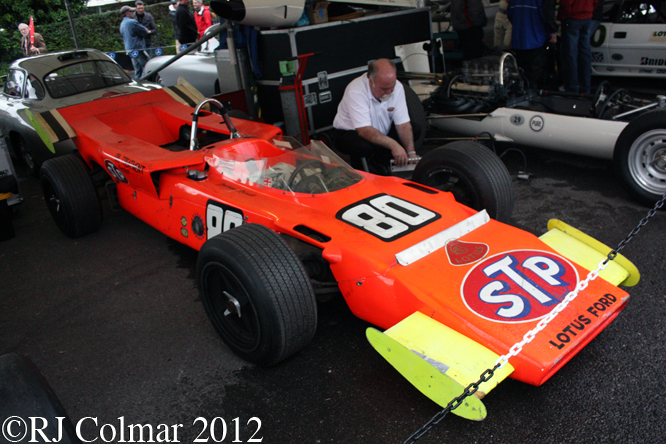
Colin Chapman rose to the challenge of building a car to the new regulations with the financial encouragement from Andy Granatelli’s STP Oil Treatment. The Lotus 64 was a new chassis which was powered by a 700hp turbocharged double overhead cam Ford V8 motor driving an all wheel drive system that was lifted from the Lotus 56 as indeed was much of the rest of the chassis.

In order to connect the motor to the mid mounted gearbox the motor had to be mounted backwards so the drive came from the front, as on the ill feted Lotus Ford 63 all wheel drive Grand Prix car.

Mario Andretti, Graham Hill and Jochen Rindt were lined up to drive the three team cars and a spare was built just in case of unforeseeable eventualities. Straight out of the box the cars were on the pace of the gas turbine Lotus 56 from the year before setting record speeds. However Mario Andretti’s car had a rear hub failure which sent him into the wall. Mario was lucky to get away with superficial burns to his face and after it was determined the failure was due to a design fault that could not be rectified in the available time frame the three Lotus 64’s were withdrawn from the race.

Mario jumped into the #2 Hawk Ford belonging to Granatelli and promptly qualified 2nd to AJ Foyt and then won the race after Lloyd Ruby was knocked out of contention by leaving the pits with his refueling hose still attached.

Andy Granatelli wanted to buy one of the remaining 64’s but when negotiations broke down Colin Chapman is alleged to have ordered the now engineless cars be returned to Hethel, Lotus home base, where he promised to take a hack saw to them personally cut them up and dig a whole and personally bury them. As it turned out all three cars were put in a shed.

Jochen Rindt’s #80 is seen above sans motor, this is the second of the three remaining 64’s to have emerged in recent years the other one has a correct Ford motor installed.

Thanks for joining me on this “Cut and Bury” edition of “Gettin’ a li’l psycho on tyres, I hope you will join me again tomorrow when I’ll be looking at the first car to record a 200 mph average closed circuit lap during a race. Don’t forget to come back now !

Share

Oblique Mounted Engine – Lotus 16

The Lotus 16 was Colin Chapmans second single seat / open wheel design built for the 1958 season with lessons learned from the Lotus 12.

Lotus 16, Silverstone Classic

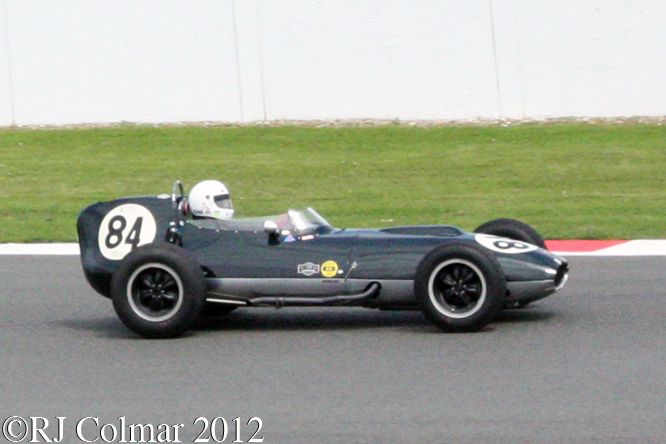
Unlike the 12 which had an offset motor fitted so that the driver could sit next to instead of on top of the prop shaft running to the rear of the car, the Lotus 16 has an obliquely mounted motor running right side front to left side rear which made a big difference to the way the car handled.

Above Eddie McGuire is seen at Silverstone in the remains of the very first Lotus 16 chassis #362.

Lotus 16, Goodwood Revival

The Lotus 16 did not prove particularly successful with Graham Hill scoring a best 6th place in the 1958 Italian Grand Prix. Though it should be noted the cars motors were giving away 500cc / 30.5 cui to their rivals. Lotus persevered with the 16 the following season, now with full size 2.5 litre / 152.5 cui Coventry Climax motors with Innes Ireland scoring 4th and 5th place finishes in the Dutch and Portugese Grand Prix respectively.

For 1960 the Lotus 18, with it’s motor in the back replaced the 16 but the 16’s were used on four further occasions with out any further success. Bruce Halford who made an ill feted start in the 1958 Monaco Grand Prix driving a private John Fisher entered Lotus 16, bought a similar model in the mid 1970’s and turned it into a regular winner of historic events.

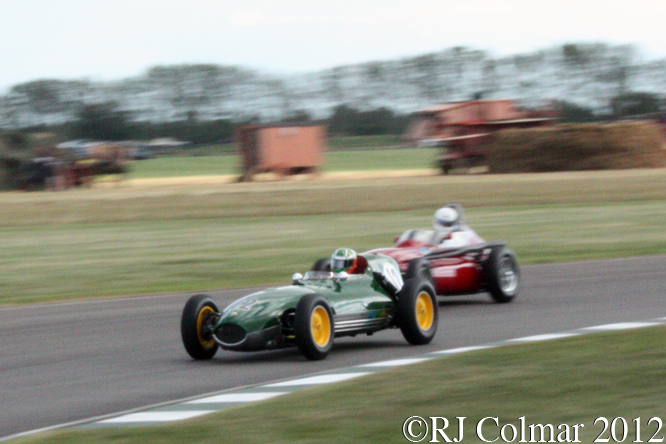
Jochuln Folch-Rusinol can be seen in the #12 above overtaking the 1959 Technica Mechanica Maserati of Tony Wood at the Goodwood Revival. These two cars along with the 1959 Ferrari 246 Dino represented the pinnacle of front engined Grand Prix racing cars that were comprehensively beaten and superseded by the rear engined Coopers in 1959 and 1960 when Lotus joined the rear engined revolution with the Lotus 18.

Thanks for joining me on this ‘Oblique Mounted Engine’ edition of “Gettin’ a li’l psycho on tyres”, I hope you will join me again tomorrow when I’ll be looking at a 6 cylinder V8 star of the small screen ! Don’t forget to come back now !

Share

Goodwood 2012 – #5 Ferrari Friday

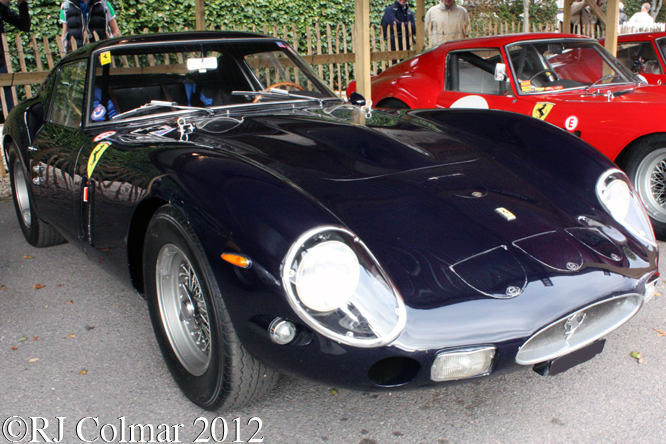
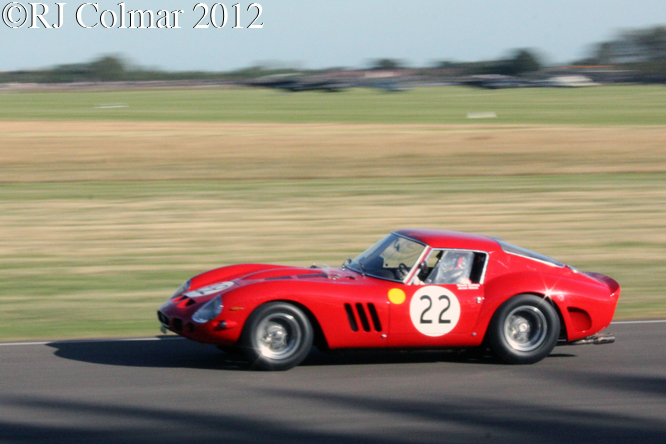
If I heard the commentary on Goodwood Radio correctly then there were over $300 million dollars worth of cars at Goodwood last Friday with 11 Ferrari 250 GTO’s present that would make up the first $120 million very quickly !

Ferrari 250 GTO, Goodwood Revival

Among the 250 GTO’s I had not seen before was chassis #4219GT a car which Pedro Rodriguez drove to victory in the second Daytona 3 Hour race held in 1963. This car is reputed to have changed hands for just over $12,000 in 1964 and between $3 and 3.5 million in 1993 !

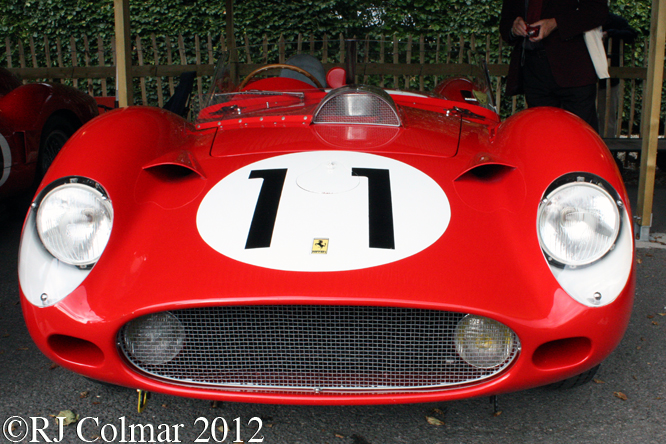
Ferrari 250 TR 59/60, Goodwood Revival

The role call of drivers of this Ferrari 250 TR #0774TR includes Jean Behra and Dan Gurney who did not finish the 1959 Le Mans 24 hours in it, Phil Hill and Cliff Allison who won the 1960 1000kms at Buenos Aires before it returned to Le Mans where it won the 1960 24 hours with Olivier Gendebien and Paul Frere at the wheel.

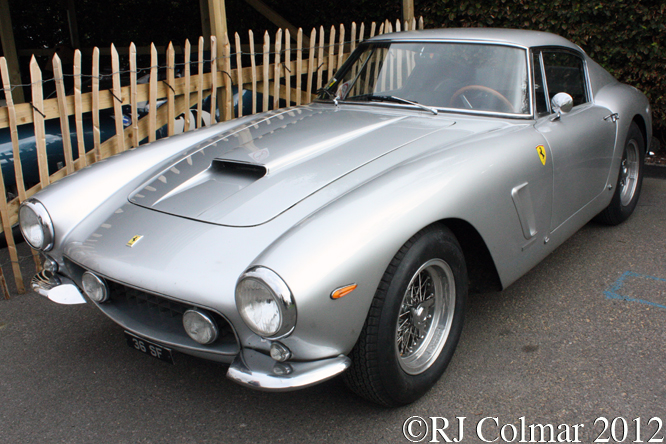
Ferrari 250 GT SWB, Goodwood Revival

I am not sure of the chassis number of this 250 GT SWB Berlinetta so I’m not sure wether or not it’s a Competizione model or not, if you know your 250 GT SWB’s and no the identity of this one please chip in with a reference or two below.

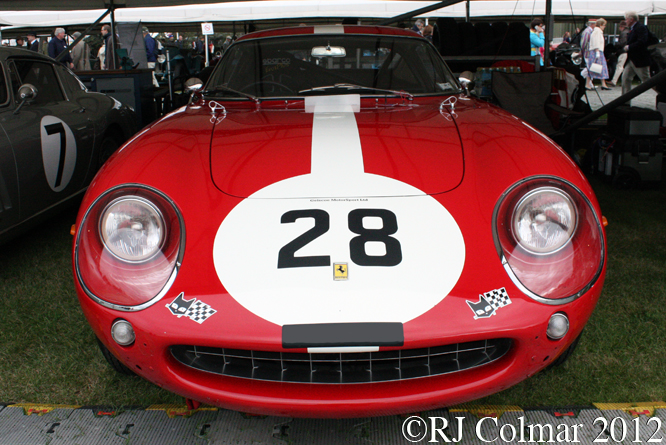
Ferrari 275 GTB/C SWB, Goodwood Revival

A class win at Le Mans in 1967 for drivers Dietter Sporey and Rico Steinemann followed by another in the 1000 kms at Spa in 1969 with Jaques Rey and Edgar Berney at the wheel did not do much to help the value of this car in 1969 when it changed ownership for just $6,000. By 1983 the value had leapt to $150,000 two years later it was fire damaged and the wreck changed hands for $46,000.
The restored car then went to Japan for a reputed $800,000 in 1988, since then it has come to reside in the UK via the USA for undisclosed sums.

250 MM PF Berlinetta, Goodwood Revival

My personal pick for Ferrari of the day is this 250 MM Pinifarina Berlinetta with a longer than standard nose. The car has little racing history from it’s heyday and lost 1 million Italian Lira in value, just under 1/3rd, between 1953 and 1955. By all accounts it was used for to chauffeur movie stars in 1954.

Ferrari 250 GTE, Goodwood Revival

If you can’t have the Ferrari 250 of your choice there are plenty of less valuable 250 GTE’s like the 1963 example above that can be acquired and transformed into the Ferrari of your dreams at a fraction of the price of the real thing.

Ferrari 250 GTO, Goodwood Revival

For one reason or another this Ferrari 250 GTO #3757 has come up for discussion on GALPOT numerous times, I make no apology for showing yet another photo of it again because this time former Ferrari Grand Prix driver and would be Indy rookie Jean Alesi can be seen at the wheel.

Ferrari 250 GT SWB Berlinetta, Goodwood Revival

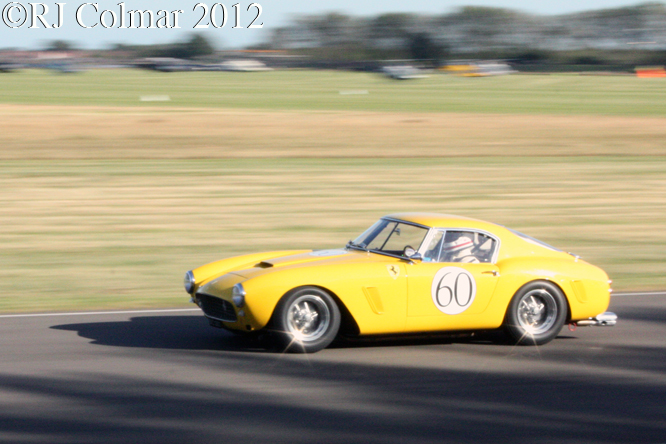
Christian Horner is best known as team principle of the multiple championship winning Red Bull racing, he was also a dab hand behind the wheel making it all the way to the second tier Formula 3000 open wheel series before the money ran out and he opted for team management in 1998. Christian is seen here in the Ferrari 250 GT SWB Berlinetta chassis 1953GT another car that has been mentioned before in connection with the motor from 250 GT SWB Berlinetta #2025 that has been fitted to the #60 seen here.

Ferrari 290 MM, Goodwood Revival

The car above driven by Mike Malone looks like a 1958 Ferrari 250 TR however it actually started life as 1956 290 MM Scaglietti Spyder #0606 with Right Hand Drive. After Maurice Trintignant and Phil Hill won first time out in Sweden car was upgraded to 1959 250 TR specs at the factory and ended up in Brazil where Rio Negri was killed after probably mistaking the central pedal for the brakes when it was actually the accelerator. The remains of the fire damaged car were eventually fitted with a Ford V8. Much later it was discovered and mistaken and built up again as the Left Hand Drive ’59 250 TR 0726. Many years later it came to light that the car was actually #0606. Finding Ferrari’s can be difficult identifying them correctly even more so !

Ferrari 860 Monza, Goodwood Revival

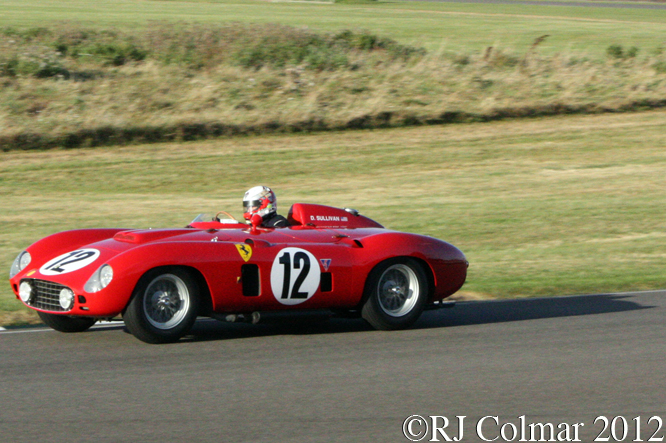
Last year I saw 1985 Indy winner Danny Sullivan at my local track Castle Combe, this year I have now seen him race a Ferrari at Goodwood, above he is driving a 1956 Ferrari 850 Monza chassis 0604M, as we saw in a previous post Danny is following in the footsteps of one five time Juan Manuel Fangio and America’s first world champion Phil Hill ! Danny qualified 15th but did not finish the Sussex Trophy Race.

Ferrari 750 Monza, Goodwood Revival

Finally the Freddie March Memorial Trophy race included this 1955 Ferrari 750 Monza Scaglietti Spider S1 chassis #0504M which appears to have been raced by Frenchman Michael Poberejsky under the pseudonym Mike Sparken. Michael won a race in Morocco before sharing the car with Marsten Gregory at Le Mans in 1955 where they failed to finish. R and A Frankel retired with less than half an hour to go in the Freddie March Memorial Trophy too !

Thanks for joining me on this ‘#5 Ferrari Friday’ edition of “Gettin’ a li’l psycho on tyres” I hope you will join me again tomorrow when I’ll be looking at some of the Lotus racing cars that were present at Goodwood. Don’t forget to come back now !

PS 12 09 21 Condolences to family and friends of Michael Poberejsky who died this morning at his home in Beaulieu sur Mer.

Share

OK, But Not Very Fast – Lotus 58

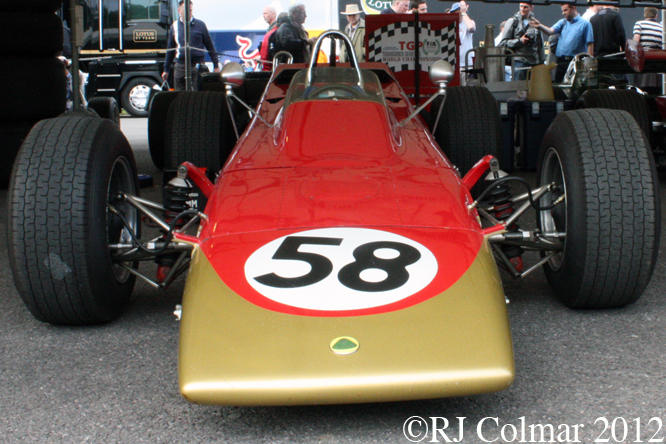
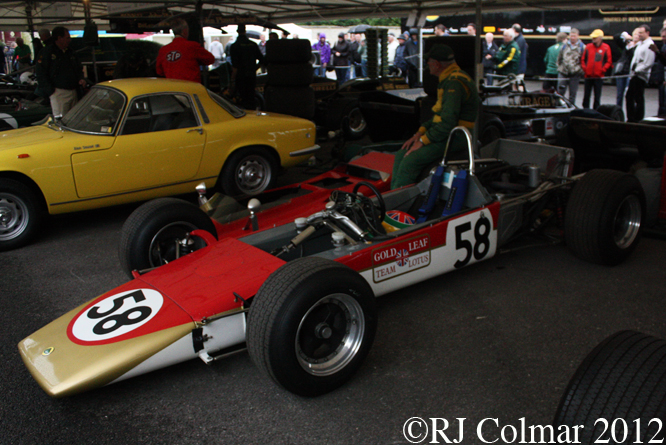
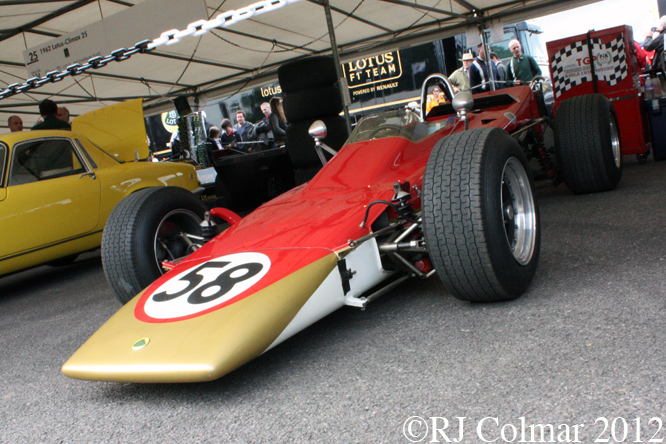
The Lotus 58 was designed with de Dion suspension front and rear, in Colin Chapman’s eternal quest for more grip, to take part in Formula 2 races for the 1968 season.

Lotus 58, Goodwood Festival of Speed

Chapman’s original intention was for the 58 to be used as a development vehicle for the Lotus 57 Grand Prix car which was to have used a similar chassis but fitted with a larger Ford Cosworth 3 litre / 183 cui that powered the various iterations of the Lotus 49.

The Lotus 58 chassis and wedge shaped body closely resembles that of the Lotus 56 Indy challenger but is powered by a 225 hp four cylinder 1598 cc / 97.5 cui Ford Cosworth FVA motor which met the requirements of the second tier open wheel Formula 2 regulations.

Lotus 58, Goodwood Festival of Speed

The one and only Lotus 58 chassis was completed the day Jim Clark was killed at Hockenheim, his death along with that of Jim’s replacement Mike Spence at Indy in a Lotus 56 along with numerous crashes that befell Jackie Oliver in his Lotus 49’s meant that development of the Lotus 58 was pushed back until the end of 1968 when Lotus had to decide which cars to take to the Antipodes for the Tasman Series.

Graham Hill thoroughly tested the car with a Tasman Spec 2.5 litre / 152.5 cui Cosworth DFW motor and came to the conclusion that it was “OK, but not very fast”. It would appear the advantages of the de Dion suspension which keep the wheels vertical in the corners and thereby keep a larger tyre footprint on the ground were not obvious enough to pursue. The Lotus 58 was pushed aside never having raced in Formula 2 as originally intended, or in the Tasman series, while the similar Cosworth DFV powered Lotus 57 never even left the drawing board.

Lotus 58, Goodwood Festival of Speed

In 1998 two enthusiasts persuaded Colin’s son Clive Chapman to restore the Lotus 58 and he gave the task to former Hill and Clark engineer at Lotus Eddie Dennis. After some 1500 hours of work Dennis ran the car at the former works Lotus test track at Hethel before handing it over to the new owners Malcolm Ricketts and Don Hands.

Thanks for joining me on this “OK, But Not Very Fast” edition of “Gettin’ a li’l psycho on tyres” I hope you will join me again tomorrow. Don’t forget to come back now !
Share

Fourth Season Swan Song – Lotus 49C #R6/2 & #R10

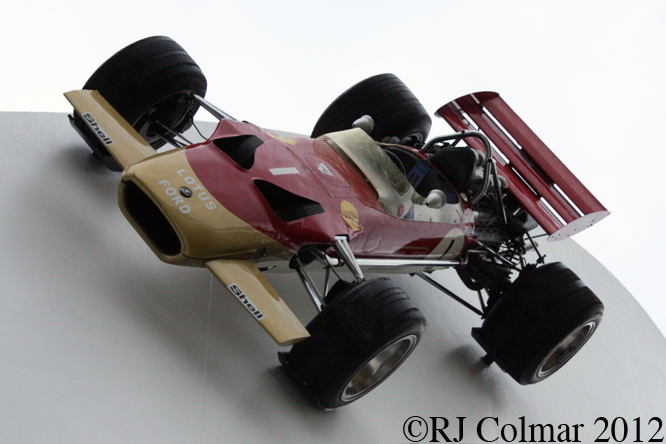
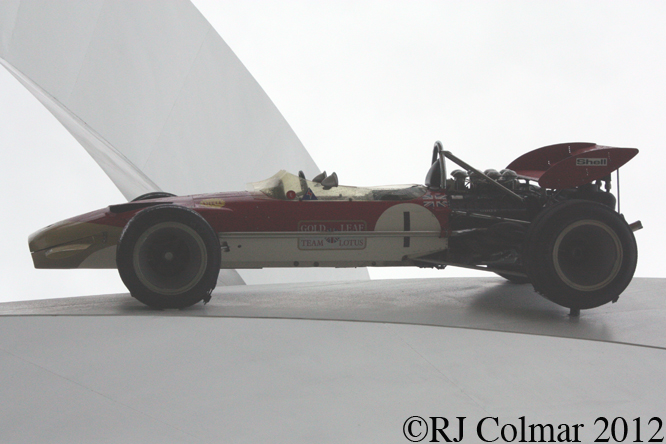
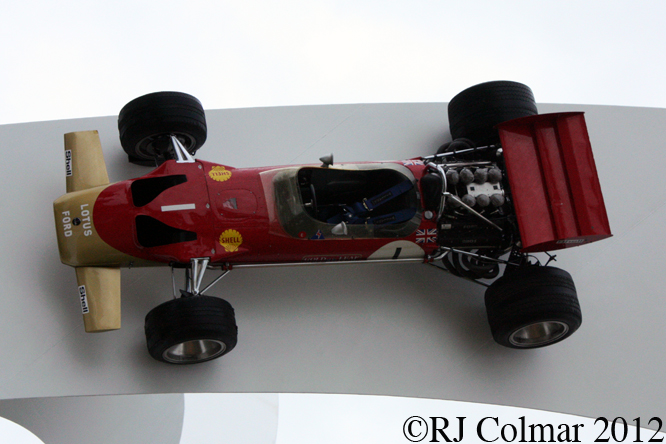
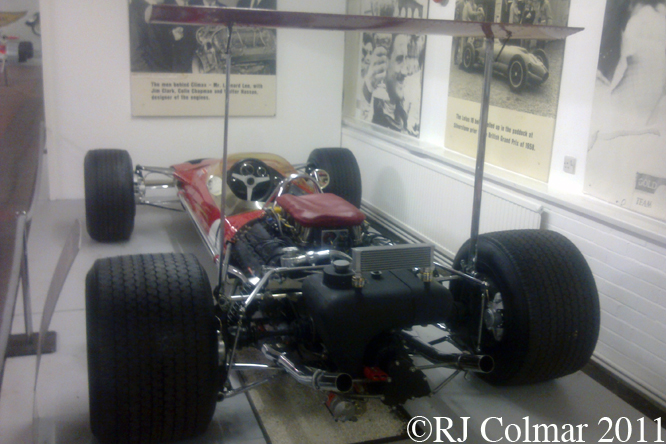
For 1970 Lotus had planned to have the 4 Wheel Drive Lotus 63 ready to challenge for championship honours however even Mario Andretti could not capitalise on any of the cars supposed advantages during 1969 and so the Lotus 49 was updated for a fourth season of competition with 13 inch front wheels to make use of the latest Firestone Tyres as a stop gap while the design and build of the Lotus 72 was finalised.

Lotus 49C, Goodwood Festival Of Speed

The car seen above is Lotus #R6/2 the second car to carry the #R6 chassis plate. The first incarnation of #R6 was the first 49 to be built to ‘B’ spec. Unfortunately it was written off by Jackie Oliver during practice for the 1968 French Grand Prix, and in order to make use of existing travel documents the eighth Lotus 49 to be built was given the #R6 chassis plate and is known as #R6/2. Some parts of #R6/1 damaged beyond repair by Oliver are thought to have been used in the replacement #R6/2 seen here, Rob Walkers privately entered 49 #R7, and the #R12 show car built for Ford which was donated to the Donington Museum.

In it’s second incarnation #R6/2 still in high wing ‘B’ spec was used by Graham Hill to win the 1968 Mexican Grand Prix which clinched the 1968 World Championships for Graham and Team Lotus. Graham continued to use #R6/2 in 1969 before the car was given to Jochen Rindt to drive. Jochen scored his first two Grand Prix victories with R6/2 the 1968 US Grand Prix with the car in ‘B’ spec and the 1970 Monaco Grand Prix with the car ‘C’ spec with the low triple plane rear wing that was designed for the Lotus 72. Jochens win at Monaco would be the third consecutive win in the Principality and also the 12th and final Grand Prix win for the Lotus 49 type.

Lotus 49C, Goodwood Festival Of Speed

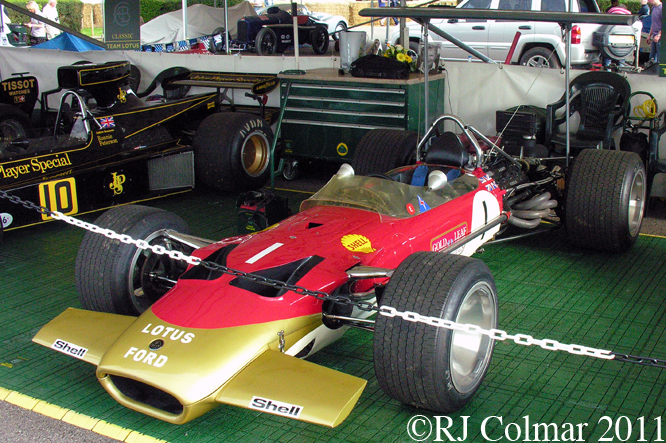
The second Lotus 49C featured today appears to be chassis #R10 which has given me a bit of a mental run around. This car appeared at Goodwood last year in high wing ‘B’ spec.

Lotus 49C, Goodwood Festival Of Speed

As you can see from my heavily revised Lotus 49B blog the car started life as Lotus 49 #R5 and for reasons that are not clear the car was renumbered #R10 and sent to the Antipodes for Jochen Rindt to use in the Tasman Series.

Lotus 49C, Goodwood Festival Of Speed

Graham Hill used #R10 to win the 1969 Monaco Grand Prix as he had done in 1968 when the car carried the chassis #R5. In 1970 Graham drove #R10 in the 1970 Monaco Grand Prix to fifth place when it was loaned out to the Rob Walker team for whom he was driving.

Emerson Fittipaldi made his first three Grand Prix starts in #R10 towards the end of 1970 scoring a best 4th place finish second time out in the 1970 German Grand Prix at Hockenheim.

Thanks for joining me on this “Forth Season Swan Song” edition of “Gettin’ a li’l psycho on tyres” I hope you will join me again tomorrow. Don’t forget to come back now !
Share