Tag Archives: Jaguar

Americana – San Marino Motor Classic

San Marino Motor Classic, Horton/ McNabb

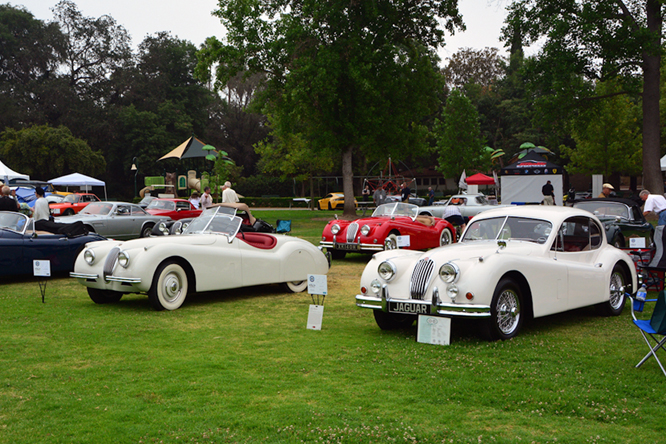
The first weekend of June saw Geoffrey Horton take his Jaguar XK140 FHC seen above to the San Marino Motor Classic.

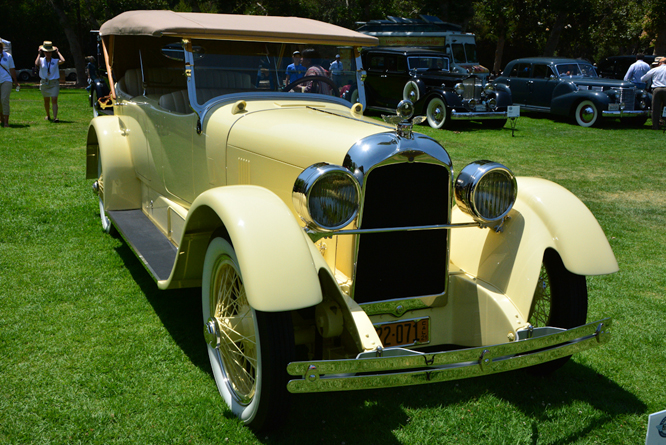
Duesenberg Model A, San Marino Motor Classic, Horton/ McNabb

Among the US vehicles on display was this 1921 Duesenberg Straight Eight also known as the Model A first seen in 1920 but which did not go into production until 1921 by which time the motor had been fitted with an overhead camshaft.

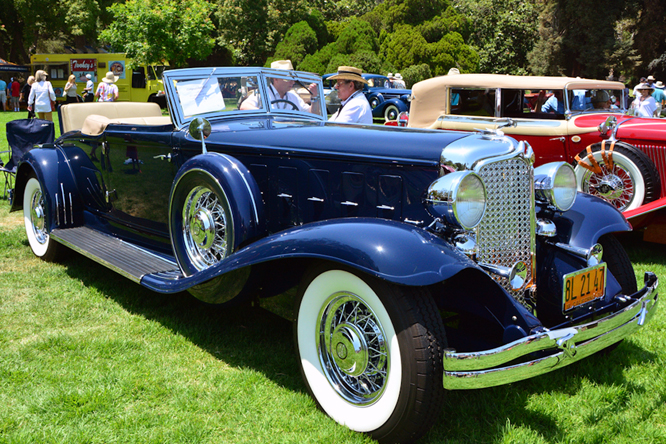
Chrysler Imperial, San Marino Motor Classic, Horton/ McNabb

Powered by a 6.3 litre / 384 cui L head straight 8 the 1932 Chrysler Imperial was also marketed as the ‘Imperial 8’.

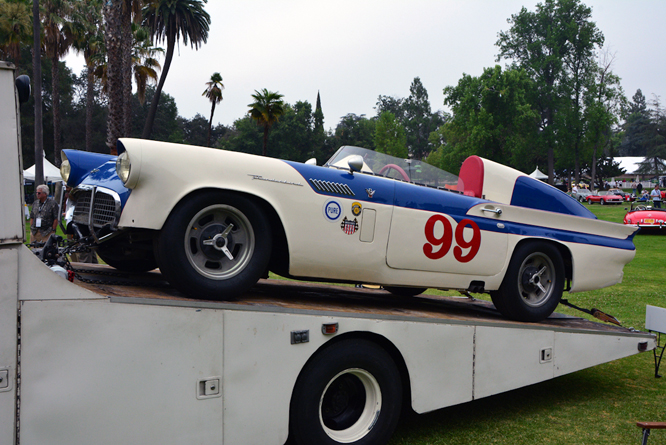
Ford Thunderbird, San Marino Motor Classic, Horton/ McNabb

In 1957 Ford built two competition Thunderbirds with supercharged Lincoln motors and Jaguar transmissions, of which I believe only one original, the #98, still exists. The car above appears to be a copy of the #99 which was dubbed the Battlebird by the media back in the day.

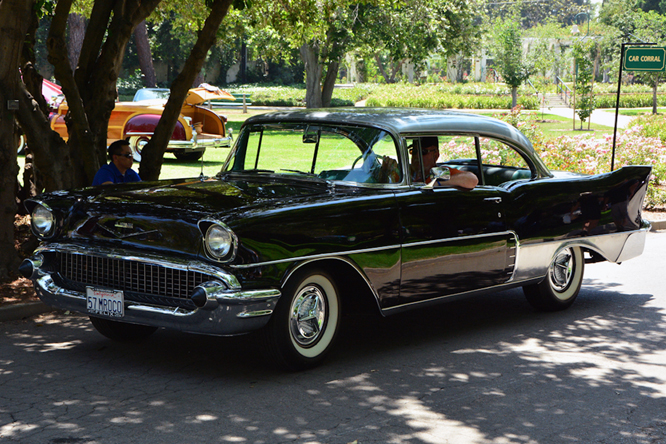
Chevrolet El Morocco, San Marino Motor Classic, Horton, McNabb

I had great fun trying to figure out if the vehicle above was either a 57′ Chevrolet or a Cadillac and it turns out to be a bit of both. Cadillac owner Ruben Allender came up with the idea of offering a $1,000 conversion to turn a Chevrolet into a Cadillac in 1956. It is thought 20 examples were built in the first year and possibly 16 more in 1957 when production ceased.

Watson Offy, San Marino Motor Classic, Horton/ McNabb

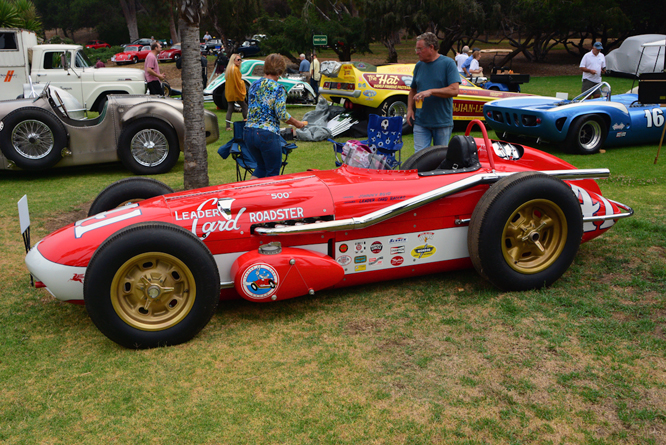
Finally for today I’ll leave you with this delicious vehicle labelled as a “1961 Indy Roadster”. The #41 was carried by Johnny Boyd’s Leader Card 500 Roadster sponsored Watson Offy in the 1961 Indy 500. Johnny qualified 20th and retired at just over half distance with a broken clutch.

My thanks to Geoffrey Horton and Paul McNabb for sharing today’s photographs more of which will appear on Tuesday and Friday next week.

Thanks for joining me on this “Americana” edition of “Gettin’ a li’l psycho on tyres” I hope you will join me again for Ferrari Friday tomorrow. Don’t forget to come back now !

Share

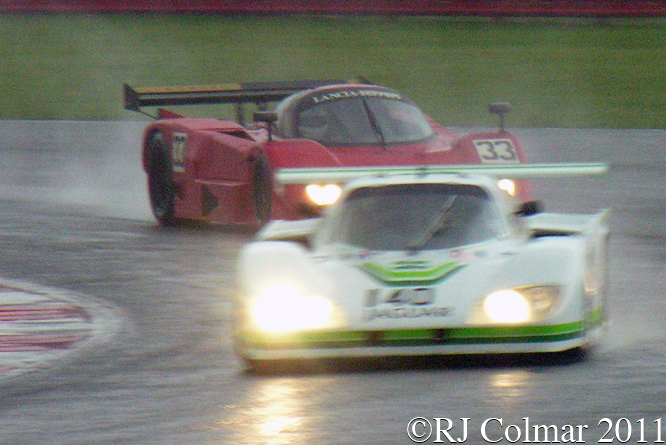
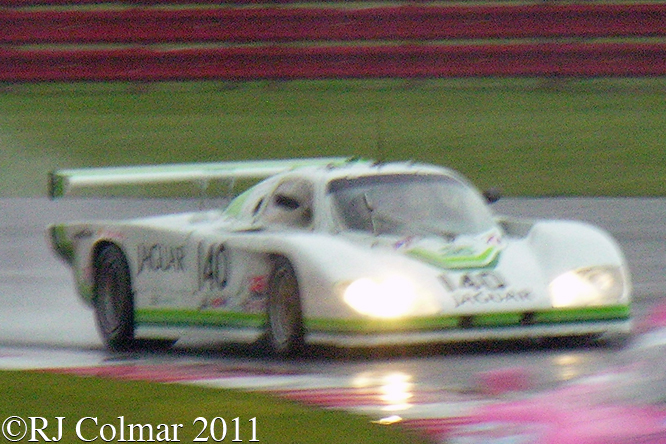
Hot In Miami – Jaguar XJR5 #006

If one foreigner deserves a knighthood for trying to keep the British Motor industry alive while it was in self destruct mode twixt the early 1960’s and late 1980’s my nomination without question would go to Bob Tullis who prepared and raced a succession of British sports cars from Triumph and Jaguar to numerous victories over the 30 years in question.

Perhaps most remarkably of all having been a successful driver for 20 years, which included driving a few non British vehicles like the Dodge Dart, AMC Javelin,Bruce Jennings Porsche 911 and a one off drive in a works Oldsmobile Cutlass, Bob and Group 44 Inc business partner Brian Feurstenau managed to persuade Mike Dale of Jaguar Cars Inc, New Jersey, to fund an IMSA GT Prototype project which would see Jaguar return to Le Mans nearly 30 years after their last official appearance at the circuit in 1955.

Tullis who’s diverse endurance experience included driving the Triumph Spitfire Coupé and Howmett gas turbine car at Le Mans employed Lee Dykstra to design the new Jaguar XJR5 IMSA GTP challenger.

Jaguar XJR5, Miles, Silverstone Classic

The XJR5 was to be powered by a variant of the 2 valve per cylinder 5.34 litre / 326 cui Jaguar V12 which Bob had successfully campaigned in his Trans Am Quaker State Group 44 Inc Jaguar E-Type and later XJS models since the mid 1970’s.

In August 1982 Bob and long time co driver Canadian Bill Adam drove the XJR5 to a debut 3rd place finish behind two of the outgoing Porsche 935’s at Road America to score a debut class victory.

Bob and Bill scored the teams first overall victory at Road Atlanta in April 1983, two more followed at Lime Rock and Mosport, Doc Bundy then shared the final XJR5 victory in 1983 at Pocono with Bob.

Jaguar XJR5, Miles, Silverstone Classic

Today’s featured chassis #006 first appeared at the 1984 Daytona 24 Hours where Bill Adam, Pat Bedard and Brian Redman qualified 6th and were classified a disappointing 24th, the sister car driven by Doc Bundy, David Hobbs and Bob Tullius qualified and finished 3rd.

Next time out at Miami with Brian and Doc at the wheel chassis #006 qualified 4th but more importantly crossed the line first when the chequered flag fell. Despite the team increasing the capacity of it’s V12 motors to a full 6 litres / 366 cui a couple of months later this would prove be their only overall victory in 1984.

After Porsche’s top driver Derek Bell had been suitably impressed with the XJR5 after testing it in 1983 Jaguar gave the green light to Bob and Group 44 to take the cars, one of which would be #006 driven by Tony Adamowicz, John Watson and Claude Ballot-Léna to Le Mans in 1984.

Jaguar XJR5, Miles, Silverstone Classic

Tony, John and Claude qualified 19th and retired after an accident on lap 212 while the sister car driven by Brian, Doc and Bob qualified 14th and made it to lap 291 before the gearbox gave up.

Chassis #006 returned to the States and finished the season with a 2nd place finish in the Daytona 3 Hours with Brian and Hurley Haywood at the wheel.

For 1985, by which time Lee Dykstra reckoned he had redesigned 99% of the XJR5, #006 was prepared for the Le Mans 24 hours.

Jaguar XJR5, Miles, Silverstone Classic

Jim Adams joined Brian and Hurley in chassis #006 where the car was qualified 17th and retired after only 151 laps with a constant velocity joint failure.

The sister car driven by Bob, Chip Robinson and Claude qualified 16th and finished 13th overall and first in the GTP class.

The cars final two races were back in the States where Chip Robinson joined Hurley to score a best 2nd place finish at Pocono in September 1985 on it’s final in period race appearance.

At Daytona in December 1985 the XJR5 model appeared for the last time, before it was replaced by the all new XJR7 in 1986, Brian and Hurley sent the model into retirement with a fine second place less than 8.5 seconds behind the winning Hobert Racing Porsche 962 driven by Al’s Holbert and Unser.

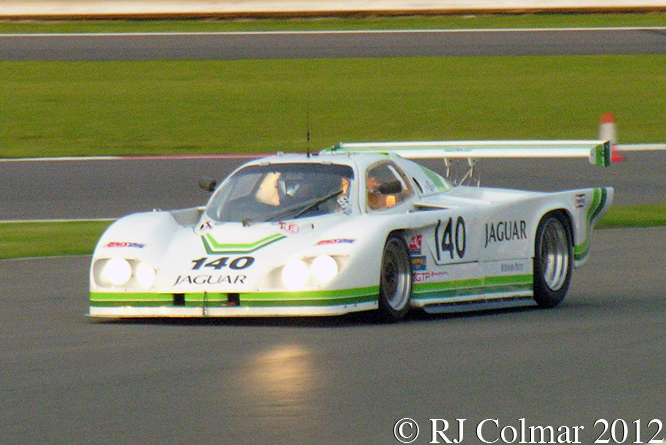
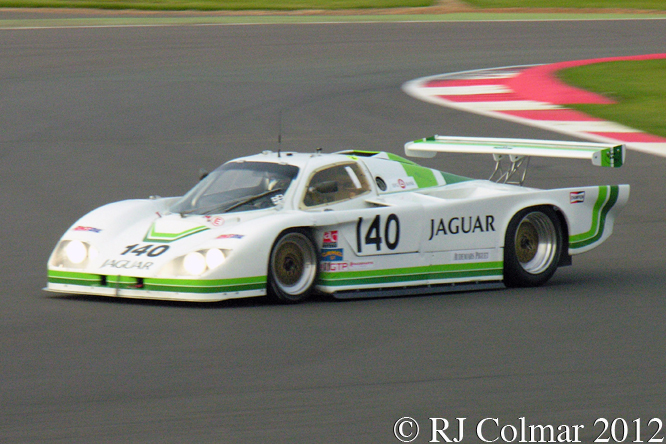
Today #006 is owned by Don Miles who can be seen driving the car at Silverstone Classic events in these photographs.

Thanks for joining me on this “Hot In Miami” edition of “Gettin’ a li’l psycho on tyres” I hope you will join me again for Ferrari Friday tomorrow. Don’t forget to come back now !

Share

Weight Saving Pussycat – Jaguar E-Type Lightweight #S850659

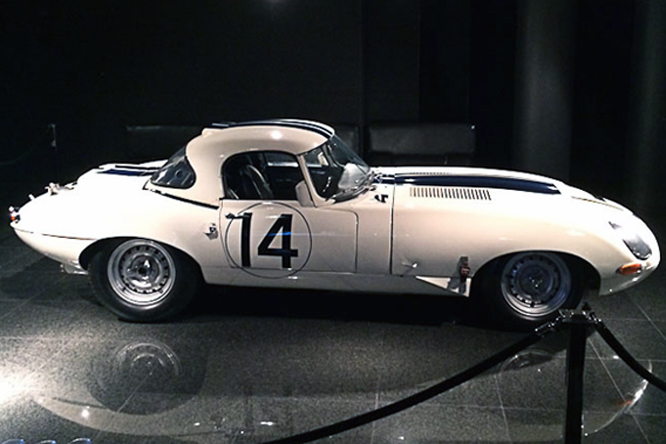
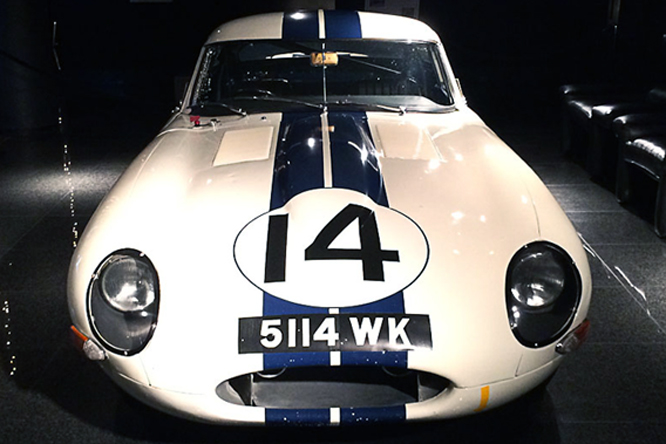
Between 1963 and 1964 Jaguar built 12 Lightweight E-Type Jaguars with six cylinder engine blocks, monocoques and bodies all made from aluminium which saved 250 lbs / 114 kgs over the standard E-Type.

Today’s featured Ligthweight E-Type, chassis #S850659, is the seventh of the 12 to be built and was delivered to Briggs Cummingham in time for him to enter it into the Sebring 12 hours for Bruce McLaren and Walt Hansgen to drive.

Jaguar, XK-E, Lightweight, Blackhawk Museum

Bruce and Walt finished the race in 8th place one place and one lap down on the class winning Kjell Qvalle lightweight E-Type #S850660 driven by Ed Leslie and Frank Morrill.

The cars next appearance was at Le Mans in 1963, where Walt Augie Pabst replaced Bruce McLaren to share driving the #14 with Walt. By this time Briggs has acquired two more lightweight E-Types to make up an impressive 3 car team.

Jaguar, XK-E, Lightweight, Blackhawk Museum

After just 8 laps Walt retired the #14 with a broken four speed gearbox, the sister #16 manged just 40 laps before Paul Richards and Roy Salvadori retired with fire damage after an accident. Team Patron Briggs and Bob Grossman also had to pit after loosing it’s bonnet in an accident, but rejoined the race to finish 9th overall and second in class to the AC Cobra driven by Peter Bolton and Ninan Sanderson.

After Le Mans #S850659 was fitted with a 5 speed ZF gearbox by the factory and driven to a third place finish by Walt Hangsen in the 1963 Bridgehampton 500 kms.

The car seen in these photographs, by Geoffrey Horton at the Blackhawk Museum, last year was tested by Simon Taylor in 1996 when he described it as a “pussycat” to drive, a racing car one “could go shopping in”.

Thanks for joining me on this “Weight Saving Pussycat” edition of “Gettin’ a li’l psycho on tyres” I hope you will join me again for “Ferrari Friday” tomorrow. Don’t forget to come back now !

Share

Prototype, Racer, Decoy – Jaguar #E2A

After Jaguars bitter sweet success at Le Mans in 1955, when the works D-Type driven by Mike Hawthorn and Ivor Bueb won the ill feted race following Mercedes Benz mid race withdrawal, Sir William Lyons concluded, as did the board of Mercedes Benz, that Jaguar’s resources would be better spent turning it’s racing success into commercial production success.

The Jaguar racing department became the Jaguar prototype department as all Jaguar works racing programmes were left to customer teams like Ecurie Eccose who promptly won Le Mans in 1956 and 1957 with their D-Types and Briggs Cunningham, who realised he did not have the resources to build and compete with an American sports car with the best Europe had to offer, but still had the resources to buy top line European cars to race.

Jaguar E2A, Ziegler, Goodwood Revival

The Jaguar prototype team’s first job was to build a production version of the D-Type using monocoque construction and replacing the D-type’s live rear axle with independent rear suspension.

This prototype, known as #E(Type)1A(Aluminium), was a 130 mph 2/3rds scale drivable vehicle built in 1957 which after much testing was broken up and scrapped somewhere between 1959 and 1960 without ever having been shown to the press or public.

Jaguar E2A, Ziegler, Goodwood Revival

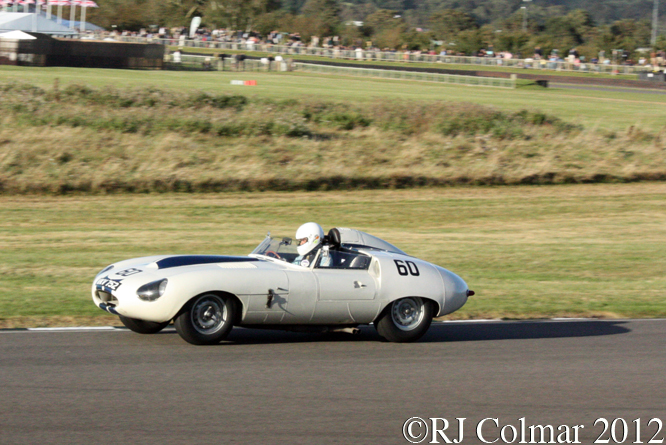
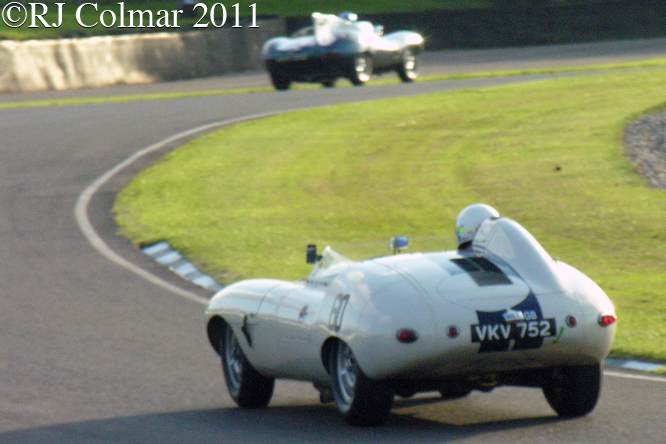
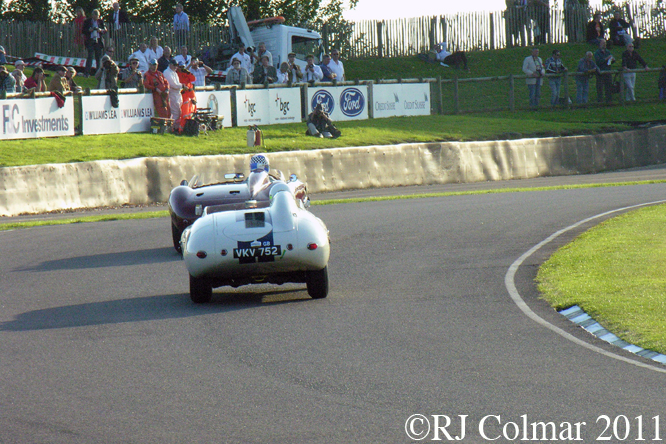
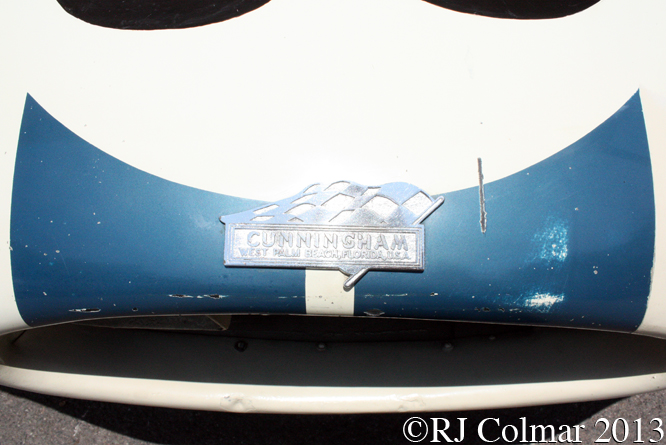
Today’s featured car #E2A was a full scale second prototype with a monocoque and aluminium body styled by Malcolm Sayer. The car was fitted with a 3 litre / 183 cui fuel injected aluminium straight 6 motor in order to meet the Le Mans prototype regulations. E2A was entrusted to Briggs Cunninghams team and painted in his teams white with two blue stripes colours.

Before going to Le Mans in 1960 E2A was tested at the oval MIRA test facility and the suspension was set up for this purpose when it arrived at Le Mans unknown to Dan Gurney and Walt Hangsen who were employed to drive it.

Jaguar E2A, Ziegler, Goodwood Revival

Dan and Walt found the car extremely twitchy and it was late before the race that the suspension settings were changed to something more suitable to a public road used as a race track rather than a steeply banked oval at MIRA.

#E2A completed the opening lap of the 1960 Le Mans 24 hours in third place, but after just 3 laps the car was in the pits with a broken injector pipe. This was replaced but a train of damage had been set in motion which resulted in E2A retiring after six hours with a failed head gasket and burned piston.

Jaguar E2A, Dron, Goodwood Revival

Back at the Jaguar factory the 3 litre #E2A engine was swapped for a 3.8 litre / 231 cui unit and the car was shipped to the USA Walt Hangsen drove it to a win in the 2nd Annual Inter-club Championship Bridgehampton and class win in the 500 mile Road America race.

Reigning double world champion “Black” Jack Brabham drove #E2A 10th place finish in the 200 mile Grand Prix Riverside, a twisty track to which E2A was as poorly suited as Laguna Seca where Bruce McLaren drove #E2A in two heats of the First Pacific Grand Prix to 12th and 17th place finishes.

Jaguar E2A, Dron, Goodwood Revival

Thereafter #E2A was returned to Jaguar for further testing which included an early anti lock braking system called ‘Wheel Slide Protector’ as used by the Ferguson P99.

#E2A was eventually put into storage, only to be pulled out and painted green in 1965 so that it could be used as a decoy while testing of the top secret XJ13 was carried out at MIRA.

In 1967 Jaguar customer car competition manager Roger Woodley managed to save E2A from the usual destruction for scrap prototype fate by mediating a deal for his father in law Guy Griffiths Camden Car Collection in the Cotswolds to take it with Jaguars insistence that #E2A should never be used in competition.

Jaguar kindly repainted #E2A in Briggs Cunninghams original racing colours and some time after handing it over manged to supply Guy with a 3 litre fuel injected motor.

In 2008 Roger’s wife sold the car for just short of US$5 million at Bonham’s, owner Stefan Ziegler has since had the car prepared to ‘weapons grade racer’ standard much to the chagrin of some old curmudgeons, myself included.

Stefan is seen at the wheel of the car at Goodwood in the photo’s dated 2012, while Tony Dron is seen driving the car in the older images.

Thanks for joining me on this “Prototype, Racer, Decoy” edition of “Gettin’ a li’l psycho on tyres” I hope you will join me again for Ferrari Friday tomorrow. Don’t forget to come back now !

Share

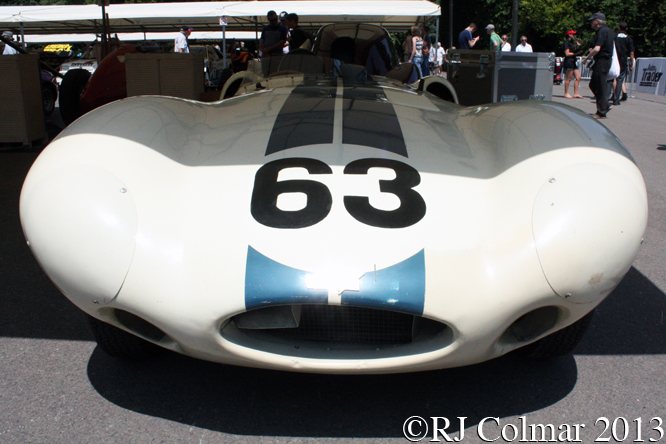
Smaller, Lighter, RHD – Cunningham C6R

After experiencing less than outright success at Le Mans with the Cadillac Le Monstre Cunningham in 1950, Chrysler powered Cunningham C2R in 1951, similarly powered C4R in 1952 and C5R in 1953 Briggs Cunningham decided that three short comings of the previous designs had to be addressed.

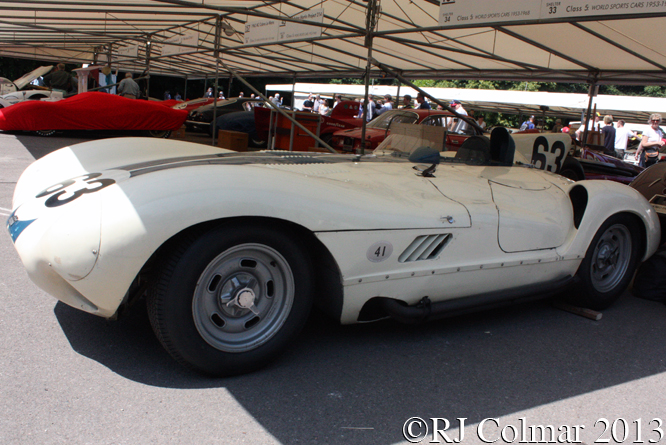
His next new project the C6R, had to be smaller, lighter and right hand drive to optimise weight distribution on a circuit with predominantly right hand corners.

Cunningham C6R, Goodwood Festival of Speed

The C6R was also originally intended to be powered by a race bred 340 hp 4.5 litre / 274 cui Ferrari V12 motor of the type more commonly found in a Ferrari 375MM of the type he had run at Le Mans in 1954 for Phil Walters and John Fitch.

Cunningham C6R, Goodwood Festival of Speed

Responsibility of the design for the body of the C6R was handed over Herbert “Bud” Unger who had worked on the bodies of the Cunningham C4R and C5R Cunningham’s as a metal worker.

In correspondence with me, about the design, Mr Unger said; “The engineers wanted maximum air flow to the brakes front and rear…” These were 13 inch air cooled drum brakes, prone to fading when hot. “I made the front air intake as large as possible and also extra air intakes on both sides beside the main grille air intake.

Cunningham C6R, Goodwood Festival of Speed

Next, I tapered the side of the body in from the front fenders all the way back to the rear fenders and by large air scoops to get maximum ram air into both rear brakes.”

By the time the car appeared at Sebring in 1956 with it’s unpainted aluminium body, crafted by “a man form Europe that was an expert with the (English) wheel.

Cunningham C6R, Goodwood Festival of Speed

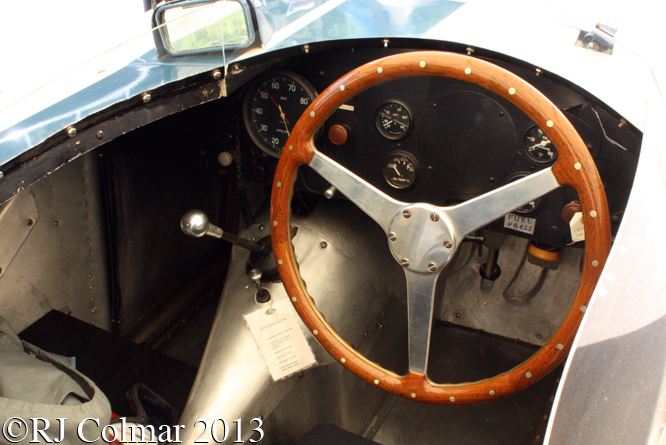
Briggs, for reasons unknown, compromised the original design criteria by fitting a modified 3 litre Indy 500 engine running on petrol instead of the usual alcohol brew.

Le Patron shared the driving at Sebring with John Gordon Bennett and they retired from the race on the 54th lap after the clutch disintegrated.

Cunningham C6R, Goodwood Festival of Speed

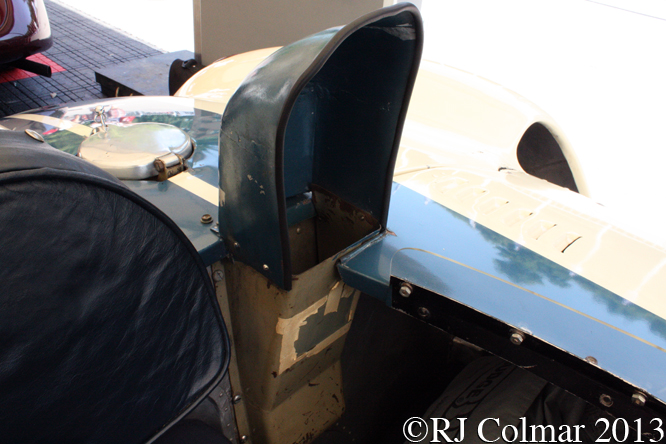
When the C6R appeared at Le Mans the body had some alterations including a single smaller front intake and a D-Type Jaguar like headrest and rear fin and the car ran over the weekend with the rear brake cooling intakes in open and blanked off configurations.

During the course of it’s second race Briggs and Sherwood Johnson found the C6R started loosing gears and it retired from 13th place after 18 hours after the engine had enough of pushing the car round in forth, top, gear only.

Cunningham C6R, Goodwood Festival of Speed

Briggs Cunningham raced the car one more time in 1955 at Road America where the Offy motor again expired for good.

The car did not run again until 1957 by which time a 3.8 litre 6 cylinder Jaguar six cylinder motor had been fitted.

Cunningham C6R, Goodwood Festival of Speed

Briggs raced the car on four occasions with a best known result of 9th at Lime Rock in June 1957.

The car was permanently retired to Briggs Cunningham’s collection thereafter which has since become part of the Collier Collection. It is seen here at recent Goodwood Festival of Speed meetings.

My thanks to Mr Unger, Cunningham Motorsport Historian Lawrence W. Berman, Paul Kierstein from the photo archive and Sondre Kvipt in Norway who facilitated my correspondence with Mr Unger. Thanks also to Herbert at The Nostalgia Forum who brought up the subject of the C6R’s blanked off rear air intakes.

Thanks for joining me on this “Smaller, Lighter, RHD” edition of “Gettin’ A L’il Psycho On Tyres” I hope you will join me for Ferrari Friday tomorrow. Don’t forget to come back now !

Share

Unfinished Business – Lister Coupe #

After building a successful range of open top sports racing cars powered by MG, Bristol, Jaguar and Chevrolet motors between 1953 and 1958 Brian Lister turned to Frank Costin to build an all new spaceframe chassis with an open body to be powered by a 3 litre six cylinder Jaguar XK motor for a crack at Le Mans which he considered “unfinished business”.
01 Lister Coupé_7625sc

However after the death of his lead driver Archie Scott-Brown at Spa driving a Lister in 1958 and the fatal accident which killed his 1959 leading driver Ivor Bueb, driving a Cooper open wheeler in 1959, Brian Lister was prompted to retire from building racing cars bearing his name leaving the 3 litre spaceframe project which had never been given a chassis number unfinished.
Lister Coupé, HGPCA Test Day, Silverstone

Rhostyllen, North Wales, garage proprietor Syd Diggory finished the open bodied spaceframe car off fitting a 3.8 litre Jaguar motor in 1960. Syd entered the car in several events for Bruce Halford, who won one race at Brands Hatch with it.
Lister Coupé, HGPCA Test Day, Silverstone

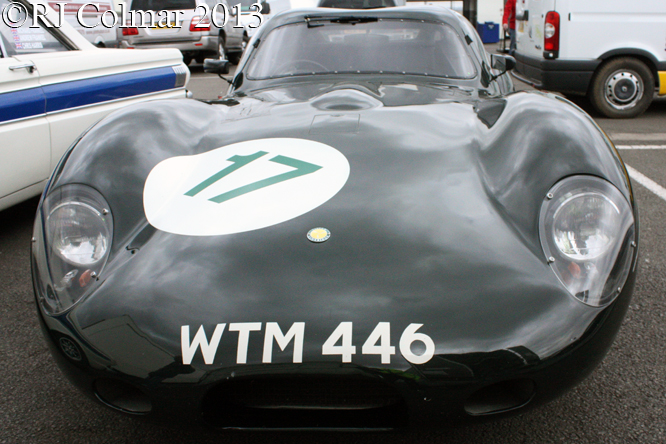
John Coundley acquired it in 1961 after his own Lister chassis #126 with the registration WTM446 had been damaged by Stephen Ouvaroff on the set of the film “The Green Helmet”.

Lister Coupé, Goodwood Revival

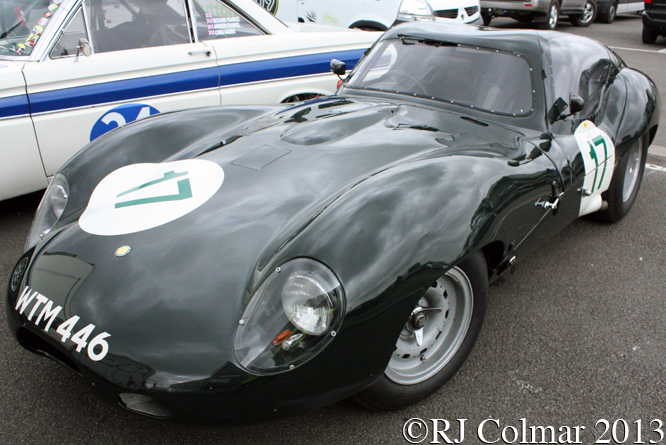
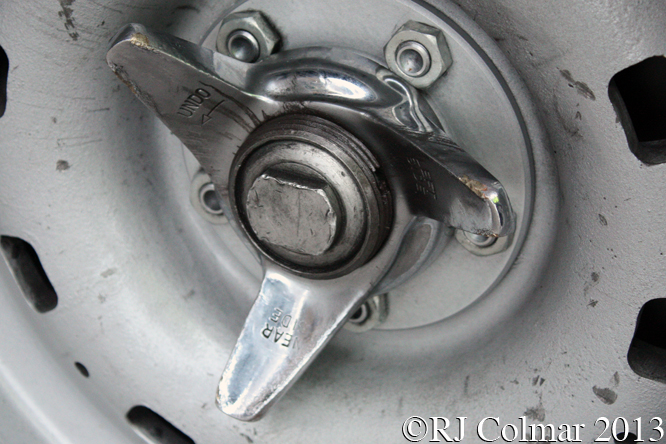
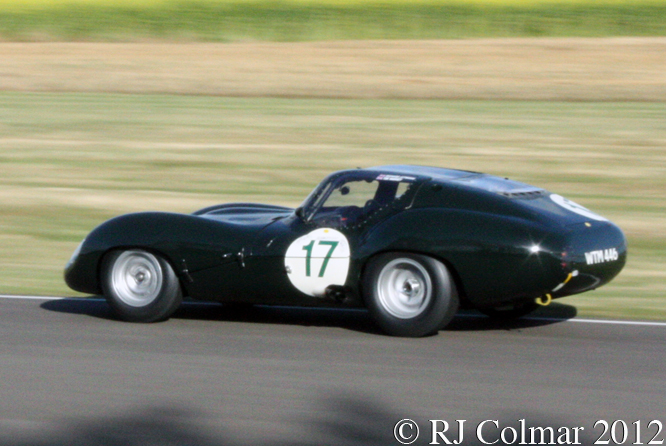
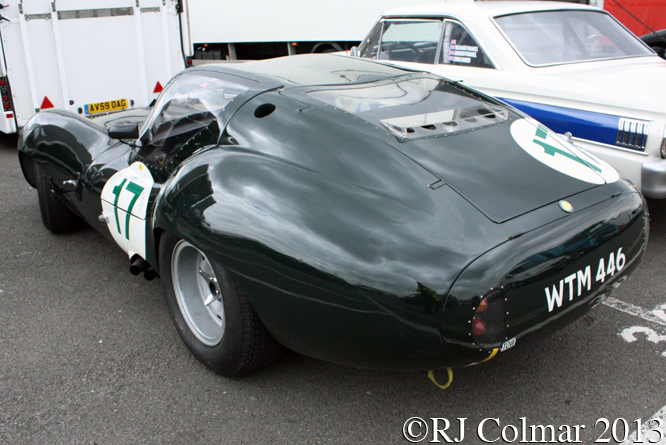
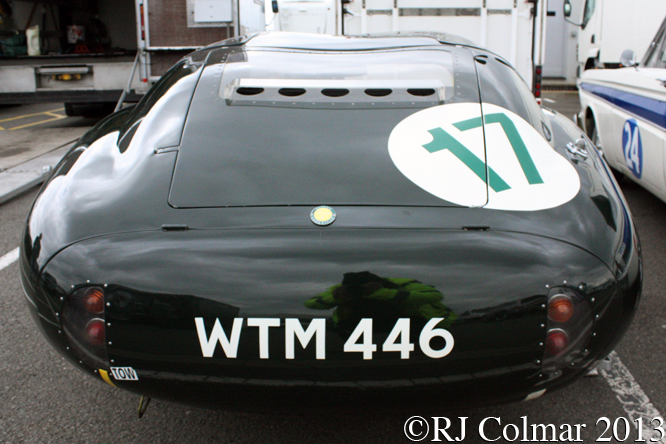
12 months later Le Mans racer Peter Sargent bought both the space frame Lister and the damaged, in former owner John Coundley’s eyes ‘written off’ tube framed #BHL126 registered WTM446. Peter commissioned the space framed car’s designer Frank Costin to design the double bubble closed coupé body fabricated from aluminium which is seen on the car today. Frank also made various chassis and suspension modifications to accommodate rising rate front suspension and 15″ Dunlop wheels.
Lister Coupé, HGPCA Test Day, Silverstone

Peter Sargent was joined by Peter Lumsden at the 1963 Le Mans test weekend to drive the barely finished unpainted rebodied car, bearing the registration number WTM446 from the older #BHL126 Lister and temporarily fitted with Webber carburetors.
Lister Coupé, Goodwood Revival

The Coupé proved to be quicker than the E-Type Jaguar the two Peters had shared at Le Mans in 1962 but was in need of further development which continued right up until the day before the race when it was found that a subframe was allowing the front wheels to toe out like a ‘barn door’.
Lister Coupé, HGPCA Test Day, Silverstone

With a fix for the suspension the Lister went to the grid with a fuel injected motor rebuilt by Jaguar fitted with oval exhausts in place of the round ones to raise the ground clearance. The Lister reached 16th place by the third hour of the event when it’s retirement was brought about by clutch failure.
Lister Coupé, HGPCA Test Day, Silverstone

Peters Lumsden and Seargeant continued developing and racing the Lister Coupé with some success in club meetings through 1963.

In 1964 John Coundley and Jack Fairman shared the car in the 1000 kms race at the Nurburgring where they qualified a lowly 68th and retired with rear suspension failure on the Coupé’s final international appearance.

David Harvey, now Jaguar owners club chairman become the next owner of the unique Lister and had it fitted with a D-Type motor and gearbox. David and his wife drove it competitively in sprints and hillclimbs, earning a class record at Gurston Down, and when his usual road car was off the road the Coupé was also used as a daily driver since it was registered and taxed with it’s WTM 446 registration.

The known chain of ownership of the Coupé includes historic owner and collector Neil Corner before it was acquired by Hexagon of Highgate who had the roof chopped off to return the car to the open top specification as it was raced from 1960 to 1962. In 1972 Gerry Marshall won the last ever motor race run at Crystal Palace in the open top space frame Lister. Some years later Gerry drove the car again under new ownership to win the 1980 Lloyds and Scottish Championship historic series.

The Coupé GT bodywork was returned to the car by Maurice Gomm for Dr Philippe Renault a private museum owner from Le Mans in the mid 1980’s.

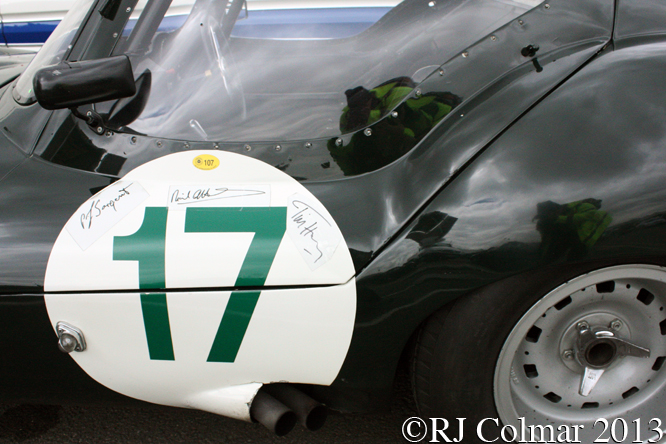
More recently the Lister Coupé has become a regular competitor at Goodwood Revival where it survived major damage in 2006 and 2010. In 2012 the Lister Coupé was shared by 1970 Le Mans winner Richard Attwood and 1992 British Touring Car Champion Tim Harvey.

The two entities that have born the registration WTM446 became the subject of a court battle after the Lister #BHL126, which former owner John Coundley had considered a “write off”, was brought back to life.

The new owner of the rebuilt #BH126 took the owner of the spaceframe Lister Coupé and the Driver and Vehicle Licensing Agency (DVLA) to court in a dispute over who owned the WTM446 registration. The Court appears to have found that no car should have that number and has not issued it to either vehicle since.

Thanks for joining me on this “Unfinished Business” edition of “Gettin’ a li’l psycho on tyres” I hope you will join me again tomorrow for a look at a Cunningham. Don’t forget to come back now !
Share

Early Morning Risers – Avenue Drivers Club

I have not been posting any irregular blogs from the Avenue Drivers Club meetings this year, this is because most of my Sunday mornings have been dedicated to relearning to drive the Institute of Advanced motoring way, however I have managed to get to a couple of ADC meetings at 8am and stayed long enough to grab a Coffee Croissant and enjoy the company off fellow early risers for an hour or so before my driving lessons.

Talbot Matra Murena, Avenue Drivers Club, Queen Square, Bristol

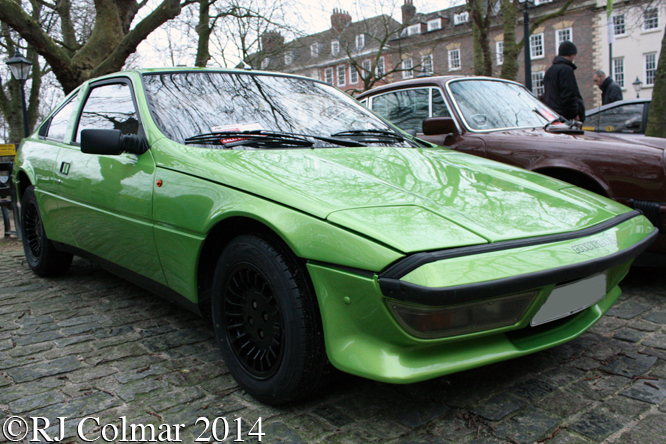
Among the cars that turned up in January was this recently preserved 1981 Talbot Matra Murena with a galvanised steel chassis and 3 abreast seating which represented the zenith of the Talbot Matra partnership.

Ford Escort RS Van, Avenue Drivers Club, Queen Square, Bristol

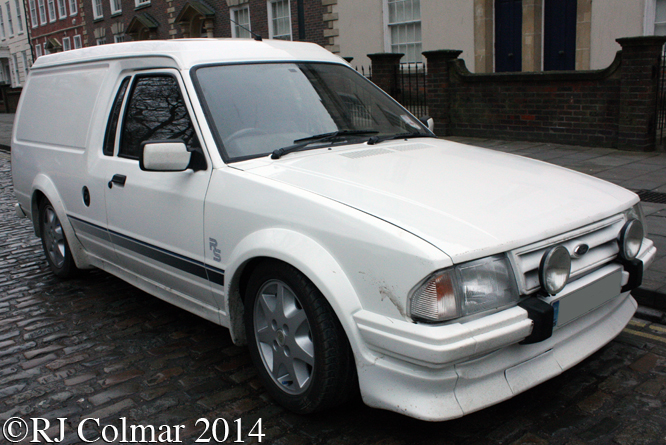
When I first came to Bristol in the late 80’s and early 90’s the lads vehicle of choice for a Saturday night in the city center was a white Escort 35 Van with either an RS, like the 1989 example seen here or RS Turbo power train and styling features including the RS alloy wheels and decals which would normally be seen on hot hatch versions of the Escort.

FIAT GMC, Avenue Drivers Club, Queen Square, Bristol

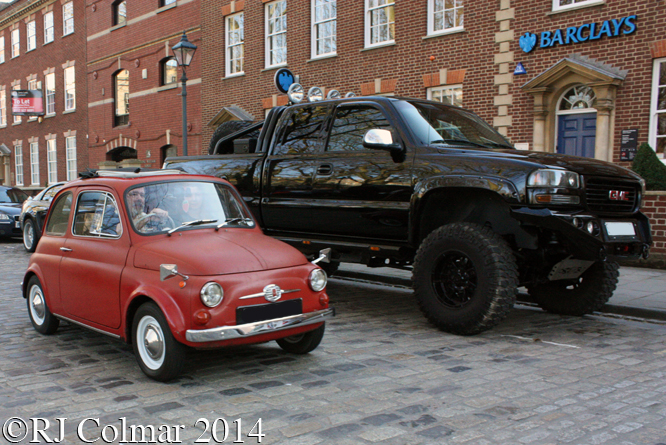
Two contrasting early risers at the March Avenue drivers meeting were this 1969 FIAT 500D and 1999 dual fuel GMC Sierra Pickup.

Opel GT Roadster, Avenue Drivers Club, Queen Square, Bristol

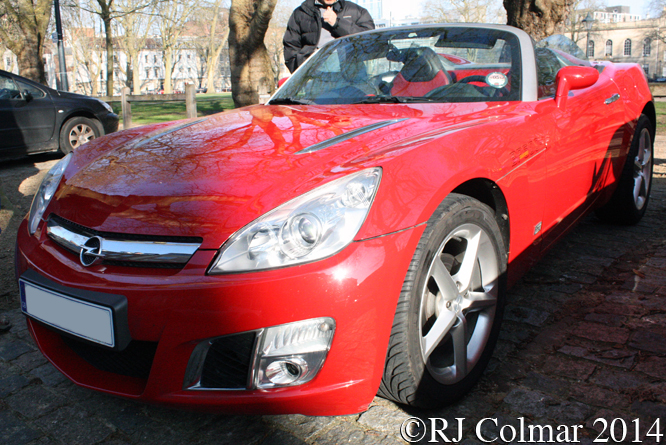
This 2008 Left Hand Drive Opel GT Roadster is a rebadged version of the Saturn Sky for the European Market, they were never sold in the UK because they were never manufactured with right hand drive.

Jaguar XK150, Avenue Drivers Club, Queen Square, Bristol

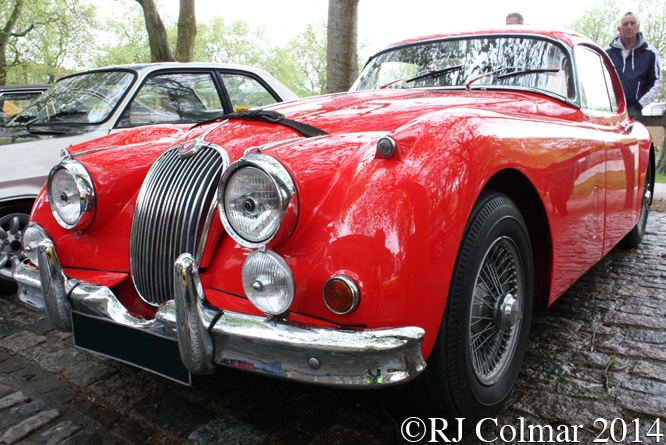
This magnificent 1959 Jaguar XK 150 was amongst the stars of this months Avenue Drivers Club meeting.

06 IMG_7543sc

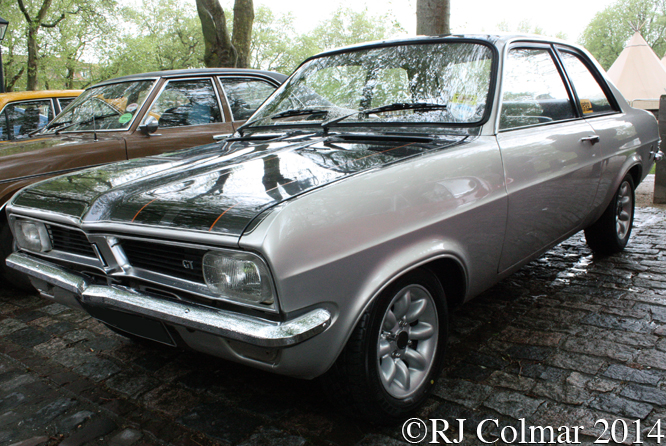
When Vauxhall introduced the HC version of the Vauxhall Viva in 1970 they dropped the 2 liter twin carburetor version except for the Canadian market where the car was sold without Vauxhall Branding as the Frienza by Pontiac/Buick dealers. This particular car has is a 1971 Viva Deluxe that has been upgraded with a 2 litre / 122 cui motor and an unusual paint job.

Thanks for joining me on this Early Risers edition of “Gettin’ a li’l psycho on tyres” I hope you will join me again tomorrow for a look at a ’69 Mustang. Don’t forget to come back now !
Share