Tag Archives: Le Mans

Testing The Beat – McLaren F1 GTR #10R

For several years before his untimely death Bruce McLaren toyed with the idea of building a road car once his racing operations had become firmly established. In 1970 he had a Can Am McLaren M6 fitted with a GT body that both he and Gordon Coppock had worked on to perfect. After Bruces death the directors of McLaren decided to shelve the road car project although to further copies of the M6GT were built by Trojan who were responsible for building McLaren’s customer racing cars.

Twenty years later McLaren designer Gordon Murray convinced Ron Dennis to back his concept for the ultimate road car which Peter Stevens was engaged to complete the exterior styling. The McLaren F1 road car was launched in 1992 and in 1998 it set road car speed records of 231 mph with the rev limiter switched on and 243 with the limiter switched off.

At around the same time as the launch of the F1 a movement for racing GT cars was gathering pace and for the 1995 Season McLaren built 9 F1 GTR variants the first of which #01R, modified road car chassis #019 was loaned to Lanzante Motorsport who entered Yannick Dalmas, Masanori Sekiya and JJ Lehto into the 1995 Le Mans 24 hours under the Kokusai Kaihatsu Racing banner and improbably won as a result of superior reliability over the much faster Courage Porsche C34 prototype driven by “Brilliant” Bob Wolleck, Eric Hélary and Mario Andretti. The race winners covered just 298 laps the last time a Le Mans 24 hours had been won with less than 300 laps completed was 1952 to when Hermann Lang and Fritz Reiss drove their Mercedes Benz 300SL to victory with 277 laps completed.
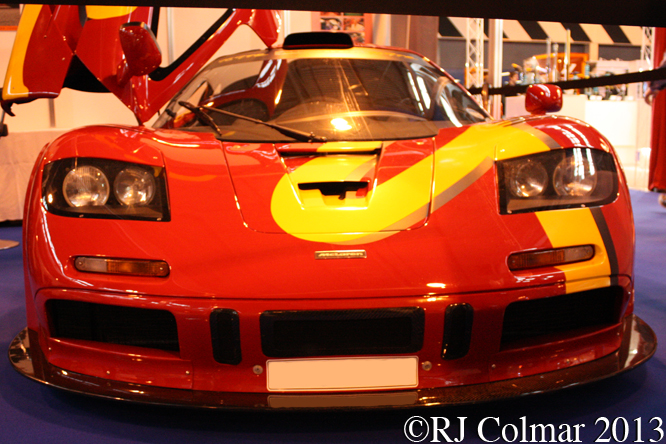
McLaren F1 GTR, Autosport International, NEC, Birmingham

For the 1996 season Mclaren built a further batch of nine cars with extended front and rear bodywork which was easier to remove than on the original ’95 F1 GTR, magnesium gearbox housing with stronger internals which resulted in a lighter car. Two of the ’95 Spec F1 GTR’s were similarly upgraded.

Today’s featured vehicle is the first of the ’96 F1 GTR’s chassis #10R which was used as a test development vehicle to replace the Le Mans winning #01R which had immediately been retired from competition for publicity purposes.

David Brabham used the car for a test session at Le Mans in 1996 where he recorded the 20th fastest time, but the car has never been raced.

When pop drummer Nick Mason bought #10R he had McLaren convert the car for road use as were several F1 GTR’s once their competition careers were over.

Mark Hales tested the 600hp BMW V12 powered #10R for Evo magazine and recorded a 0-60mph time of 3.2 seconds and a top speed of 240.1 mph.

In 1997 a further development of the F1 GTR featuring an even longer body, 10 examples of which were built. An over view of the racing results of the F1 GTR from 1995 to 2007 can be seen on this link.

Thanks for joining me on this “Testing The Beat” edition of “Gettin’ a li’l psycho on tyres”, I hope you will join me again tomorrow. Don’t forget to come back now !

Share

Biting The Hand – Ferrari 250 Testa Rossa 59/60 #0774

After attracting the attention of US Ferrari importer Luigi Chinetti in 1957 Dan Gurney found himself at the wheel of a North American Racing Team Ferrari 250 Testa Rossa, owned by Chinetti at Le Mans in 1958 and drove the car up to 5th place before handing over to his team mate Bruce Kessler who got caught up in someone elses accident before the car retired. That drive impressed Ferrari sufficiently to earn Dan a drive with the works Ferrari team.

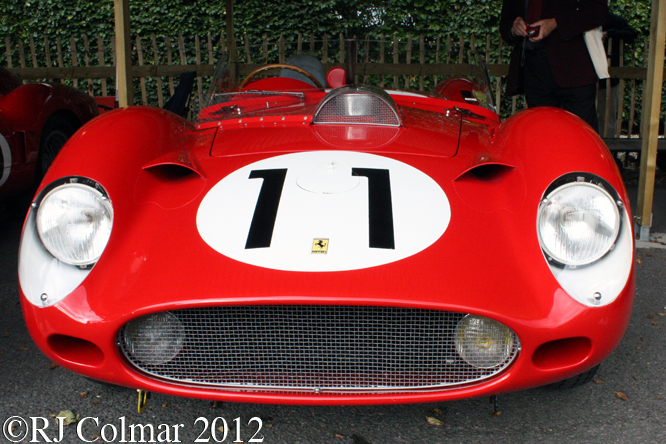
Ferrari 250 TR, Goodwood Revival

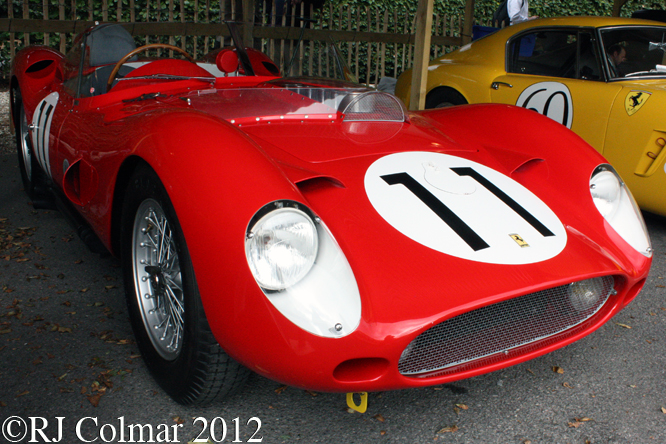
For their 1959 Le Mans effort Ferrari built today’s featured Ferrari 250 TR chassis #0774 for Gurney to share with Jean Behra the car managed twice as many laps as Dan’s first attempt but still fell way short of a result.

Next time out Phil Hill and Olivier Gendebien drove the car at Goodwood in the TT Race where they also failed to score a result both the 1959 Le Mans and Goodwood TT had been won by Aston Martin in what turned out to be a championship winning season for them.

Ferrari 250 TR, Goodwood Revival

1960 would see a return of fortune for the Ferrari sports car team and chassis #0744 played an important role winning two championship races first Phil Hill and Cliff Alison won the 1000 kms at Buenos Aires and then Olivier Gendebien and Paul Frére won the Le Mans 24 hours scoring Ferrari’s third win in the Endurance Classic and helping Ferrari to their sixth World Sports Car title.

Ferrari 250 TR, Goodwood Revival

Between these successes #0774 was loaned to Chinetti’s NART team for Ritchie Ginther and Chuck Daigh to drive in the Sebring 12 hours but they failed to finish and after Le Mans the car was sold to Eleanor von Neumann who entered it for Phil Hill to drive in the 1960 LA Times Grand Prix at Riverside where he finished 7th overall.

Ferrari 250 TR, Goodwood Revival

In 1963 Tom O’Connor bought the car for his Rose Bud racing team which promptly stripped the motor out and fitted it to their Lotus 19 chassis 952 that featured here on GALPOT a couple of years ago.

Ferrari 250 TR, Goodwood Revival

Under the ownership of Paul Pappalardo #0774 was reunited with it’s original motor in the 1980’s and the car won two class Concours d’Elegance awards at Palm Beach and Pebble Beach in 1993.

Ferrari 250 TR, Goodwood Revival

In a twist of biting the hand that feeds irony Dan Gurney eventually won the 24 Hours of Le Mans in 1967 with co driver AJ Foyt driving for Ferrari’s sworn enemy Ford in a Mk IV.

After 26 years in Paul’s custody ownership of #0774 passed to Hong Kong sourcing and logistics magnate William E ‘Chip’ Connor who kindly took it to the 2012 Gooodwood Revival for the Tribute to Dan Gurney Parade.

Thanks for joining me on this “Biting The Hand” edition of “Gettin’ a li’l psycho on tyres”, I hope you will join me again tomorrow. Don’t for get to come back now !

Share

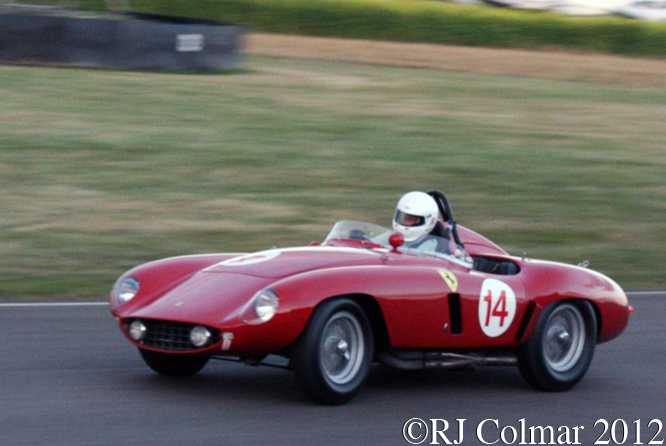
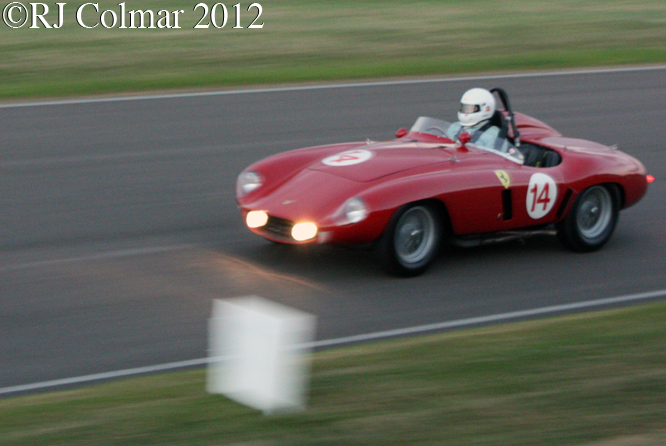
Ferrari For Hire – Ferrari 750 Monza Scaglietti Spider S1 #0504M

Today’s featured Ferrari 750 Monza chassis #0504M was purchased new in 1955 by S.A.I.P.A. Srl in Modena Italy in February 1955 and nine days latter it was rented out to Frenchman Michel Poberejsky who entered and won the Agadir Grand Prix for sport cars entered under the pseudonym “Mike Sparken”.

Ferrari 750 Monza, Goodwood Revival

After retiring, having started from pole, from the 1955 British Empire Trophy and then coming second, from pole again in the Easter meeting at Goodwood, Sparken was joined by Marsten Gregory at Le Mans where the pair retired with engine problems. Marsten Gregory then drove #0504M in two races in Portugal and one in Brazil scoring 2 2nd plce finished and a win at the Portuguese Monsanto track.

Ferrari 750 Monza, Goodwood Revival

The last known races for the car were in the United States with Donald Johnson driving to a 3rd and 2nd place finishes at Lawrenceville and Greenwood in 1963, Donaldson is credited with a final race appearance in 1964 at Mid America Raceway where he is believed to have started but his finishing result is unknown. Dudley Cunningham drove the car in the 1969 Mt Equinox Vintage hillclimb where he set a record time.

Ferrari 750 Monza, Goodwood Revival

In 1970’s the car returned to Europe and has been with its current owner Richard Frankel since 2000, #0504M is seen in these photographs competing in the Freddie March Memorial Trophy at the Goodwood Revival meeting last year where it’s owner retired with less than half an hour to go.

Thanks for joining me on this “Ferrari For Hire” edition of ‘Gettin’ a li’l psycho on tyres’, I hope you will join me again tomorrow. Don’t forget to come back now !
Share

Restructuring Fallout – Singer B37 Sports

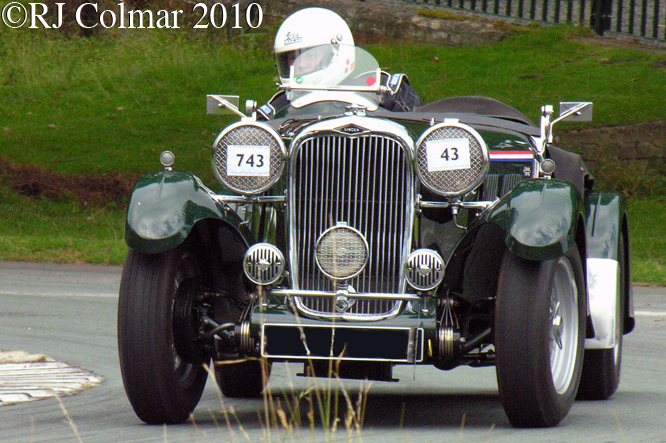
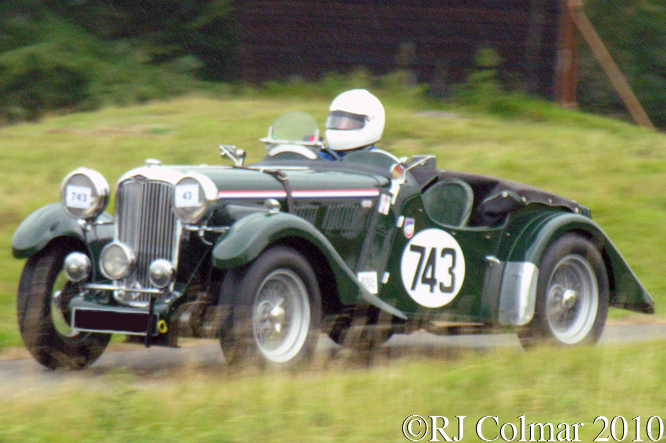
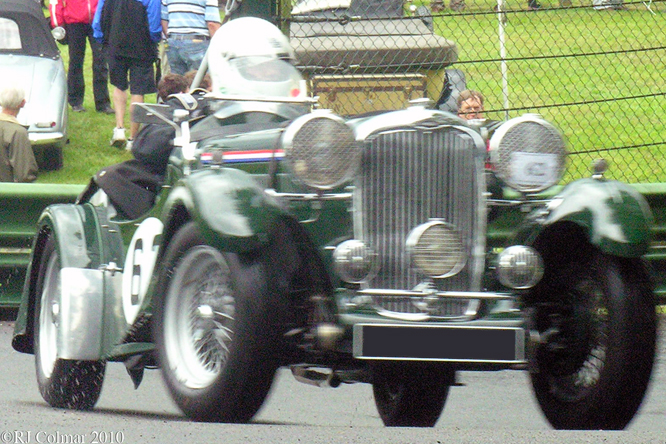
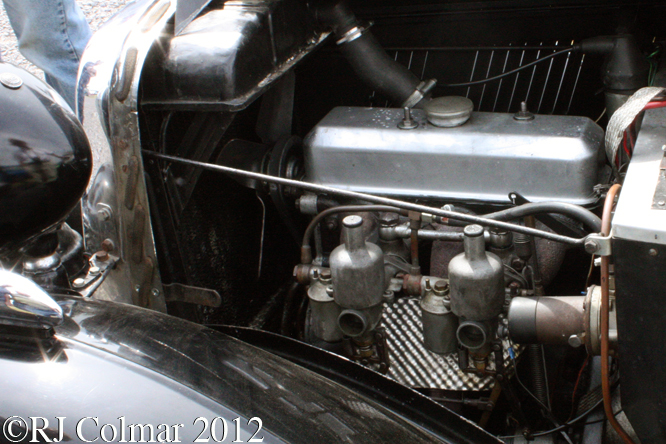
In 1934 Singer built a 48 hp six cylinder 1 1/2 litre / 91 cui version of the Singer Le Mans with the aim of challenging the big hitters in the class, Aston Martin and Riley at Le Mans. The two team cars came home 7th and 8th overall behind the class winning Rileys which finished 2nd and 3rd overall and ahead of the Aston Martin’s which finished 10th and 11th.

01 DSCN9599sc

71 six cylinder Le Mans cars were built and they proved competitive especially in trials where they were noted for their restart capabilities on steep slippery surfaces. In 1937 a new six cylinder model known as the B37 was introduced powered by a 59 hp motor.

Singer B37, VSCC, Loton Park

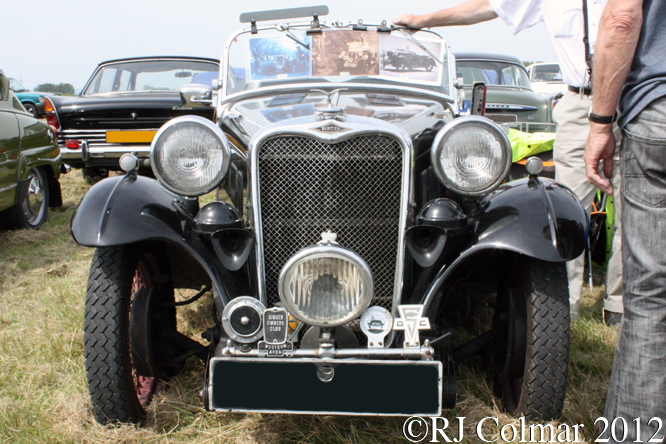
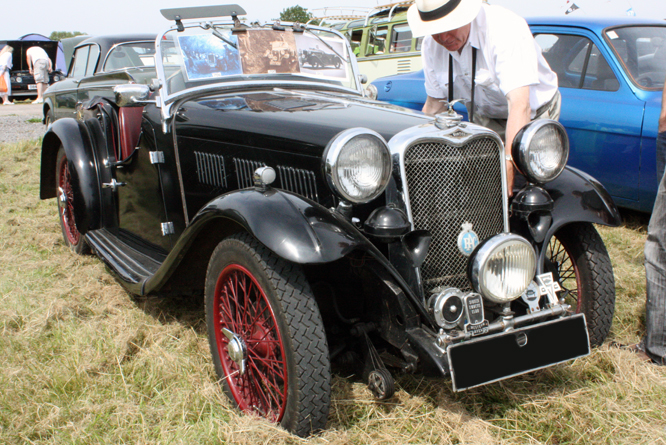
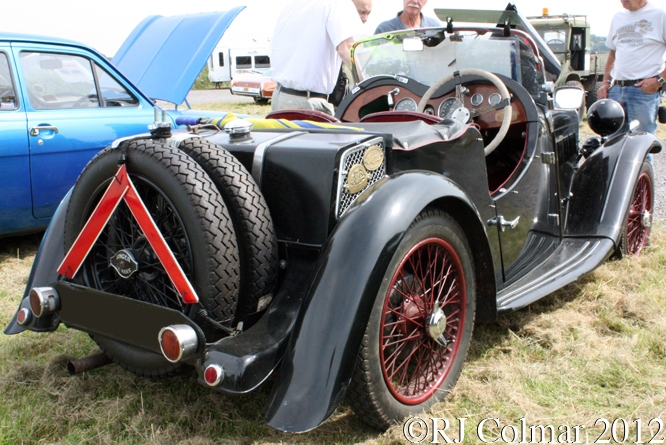
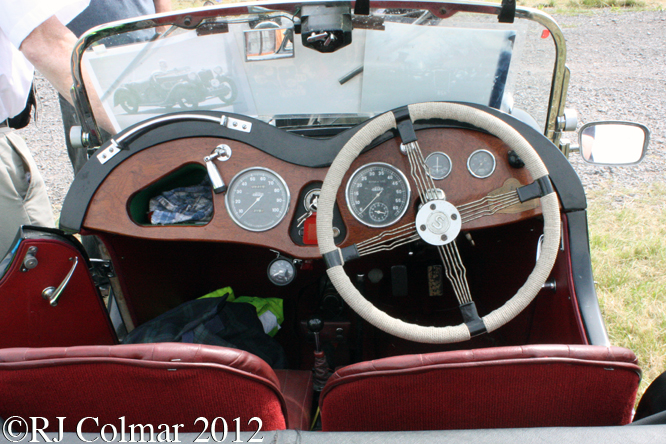
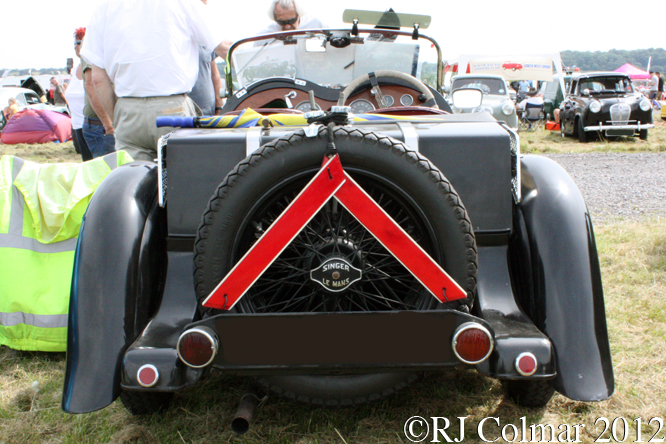
The B37 was built on a new chassis and fitted with a competition “fly off” handbrake; twin spare wheels, offering added traction in trials events and a “Hill Holder” grab handle for passengers to hang onto when bouncing the car up slippery trials hills.

Singer B37, VSCC, Prescott

Thanks to the financial restructuring going on at Singer the B37 was cut from the Singer range after just 12 cars had been built. The car belonging to John Gibson seen at Loton Park, top two and Prescott Hill Climbs is one of three that are thought to have survived.

Thanks for joining me on this “Restructuring Fallout” edition of “Gettin’ a li’l psycho on tyres” I hope you will join me again tomorrow. Don’t forget to come back now !
Share

Last On Sunday – Singer 9 Special Speed

At the very first Le Mans 24 Hours race in 1923 Maurice Boutmy and France Jérôme Marcandanti covered 89 laps to finish 18th to become the first 1 litre / 61 cui normally aspirated car to finish the race in an Amilcar CV. Remarkably it was not until 1933 that Singer Competition Manager FS Barnes and Alf Langley were to finish the classic endurance race in a similar sized British built car a Singer 9 Sports which completed 140 laps came 13th and last overall and second in class 21 laps behind a French built Tracta driven by Félix Quinault and Pierre Padrault.

Singer 9 Special Speed, Summer Classics, Easter Compton

The achievement of simply finishing the 1933 Le Mans 24 Hour race at an average speed of 49.4 miles per hour was enough to encourage Singer to build a two seat version of the Singer 9 Sports, nominally the Singer 9 Sports was a 4 seater however the car used at Le Mans had a large fuel tank that occupied the space for the rear seats, called the Singer Le Mans. In 1934 Norman Black and J.R.H. Baker finish fifteenth overall 7th in class in a Singer Le Mans covering 163 laps.

Singer 9 Special Speed, Summer Classics, Easter Compton

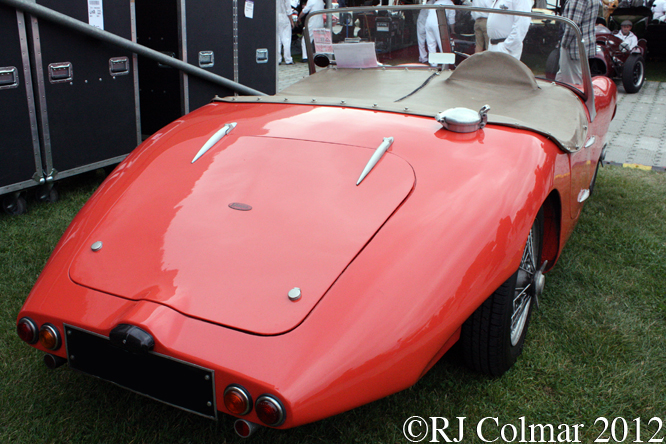
The popular Singer Le Mans is not to be confused with either the six cylinder 1 1/2 litre Singer Le Mans, or the four Singer Le Mans Replica’s built in 1939 which were out and out 2 seat racing cars. In 1935 a Special Speed version of the Singer Le Mans was introduced, distinguished by the running boards between the front and rear wings and it is this model that is seen here at last years Summer Classics Meeting at Easter Compton.

Singer 9 Special Speed, Summer Classics, Easter Compton

Power for the Singer Super Speed comes from a 38 hp 972 cc / 59 cui 4 cylinder overhead cam motor still running on a two bearing crank as did the Singer 8 I looked at last week.

Singer 9 Special Speed, Summer Classics, Easter Compton

This particular car was delivered in December 1935 to HD Acres who a few weeks later used it to compete on the Exeter Trials in January 1936. Acres car can be seen being helped out of a little difficulty on the Simms test by those very nice men from the Automobile Association on this link.

Singer 9 Special Speed, Summer Classics, Easter Compton

By 1939 this Singer 9 Special Speed had passed into the ownership of RJW Appleton who is known to have driven the car on the Lands End Trial the same year. RJW Appleton was responsible for building the Riley powered Maserati called the Appleton Special which achieved and 1100cc / 67 cui standing mile record of 91.3 mph in 1937.

Singer 9 Special Speed, Summer Classics, Easter Compton

The current owner of today’s featured car acquired it as a large box of ‘bits’ and has spent many years returning it to it’s present condition.

Thanks for joining me on this “Last On Sunday” edition of “Gettin’ a li’l psycho on tyres” I hope you will join me again tomorrow. Don’t forget to come back now !
Share

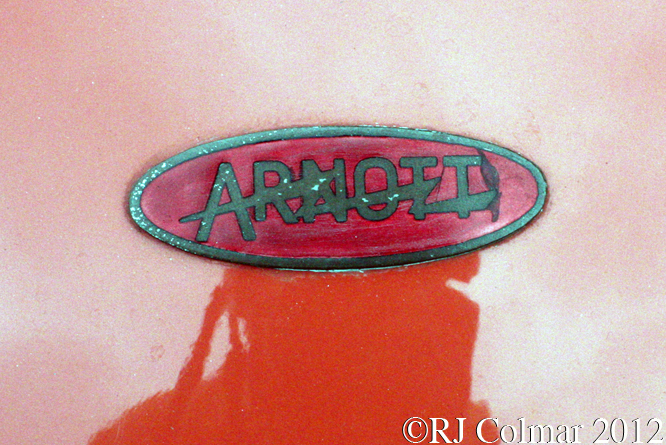
Racer and Runabout – Arnott Sports #AT112

Daphne Arnott was born into a mechanical world in 1926, her Grandfather appears to have been captain and secretary of the Bath Road Club and ‘in control of’ MMC built Werner Motorcylces and her father was responsible for the Arnott Superchargers sold through Carburetors Ltd in North West London.

Daphne spent many childhood hours spectating at Brooklands and in her early teens she became competent mechanic. During the ’39-’45 war she was employed by the Hawker Aircraft company.

Arnott Climax Sports, Goodwood Revival

In 1948 Daphne joined the family business Carburetors Ltd and by 1951 she had created a department within it to design and manufacture 500 cc / 45.5 cui Formula 3 cars with assistance from the works manager George Thornton.

After Bob Brown of Bromley won first time out in the Arnott, Daphne built 8 copies, one of which became a streamliner in which John Brise set 500km average speed record of 108mph at Montlhery in 1953 which still stands.

Arnott Climax Sports, Goodwood Revival

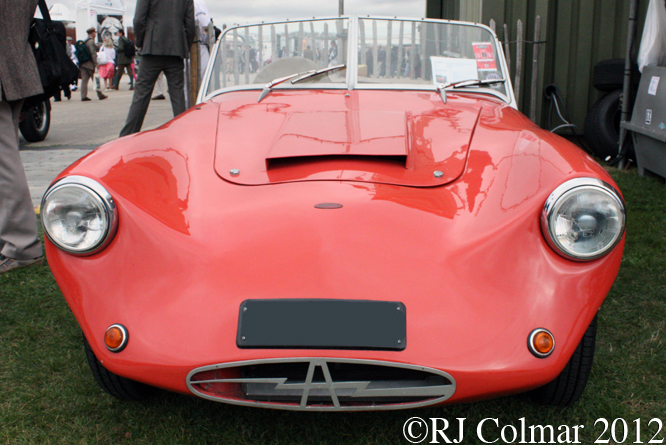
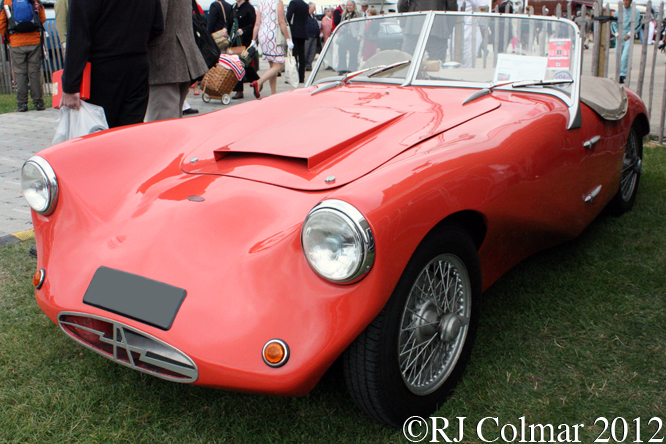
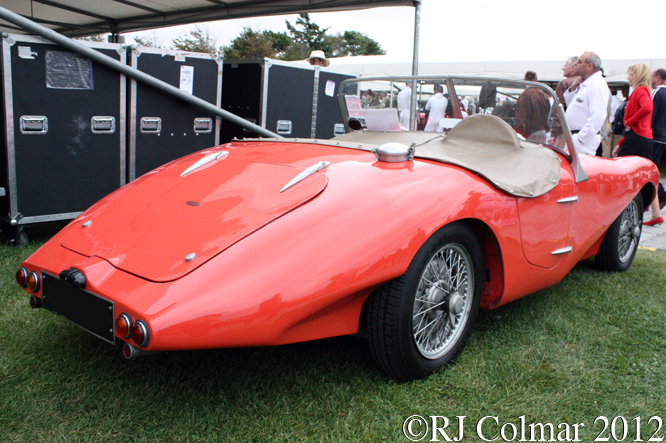
For 1955 Daphne came up with the 1100 Sports model seen here, complete with wishbone independent suspension, which was entered into the Le Mans 24 hours.

It is a measure of the esteem in which she was held that her Arnott, one Lotus and one Kieft were each given a new Coventry Climax motor with which to compete in the 24 hour classic.

Arnott Climax Sports, Goodwood Revival

Jim Russell, of racing school fame and Peter Taylor were the drivers but they crashed during practice after which Daphene had an Arnott supercharger fitted and used the car as her daily driver for 20 years.

A second attempt was made at Le Mans with another Coventry Climax powered Arnott Sports in 1957, this time Jim Russell and Peter Taylor qualified but retired with ignition problems after completing 46 laps and that seems to be the end of the Arnott story as a manufacturer.

Arnott Climax Sports, Goodwood Revival

In all 25 Arnott Sports are thought to have been built with fibre glass bodies. The current owner bought today’s featured vehicle from Daphne Arnott after it had spent some time disintegrating in a barn in 1998.

Arnott Climax Sports, Goodwood Revival

In 2003 this Arnott Sports still fitted with it’s original Coventry Climax motor #FWA400/3.6264, Arnott supercharger, MG TC gearbox and ENV back axle was given a £30,000 plus overhall by Sigma Engineering in Dorset.

When I saw this remarkable testimony to the grit and courage of a little remembered British entrepreneur Daphne Arnott at Goodwood Revival last year it was being offered for sale, if you are interested I have contact details for the owner. Usual disclaimers apply.

Thanks for joining me on this “Racer and Runabout” edition of “Gettin’ a li’l psycho on tyres” I hope you will join me again tomorrow. Don’t forget to come back now !
Share

Forty Inches Tall But Not A Ford – Elva GT 160 #70/GT/3

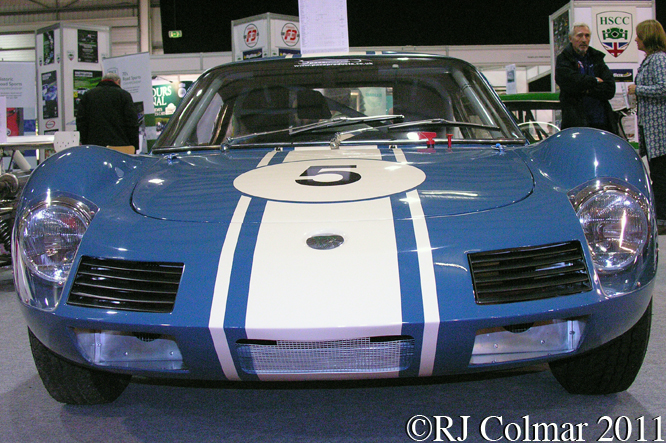
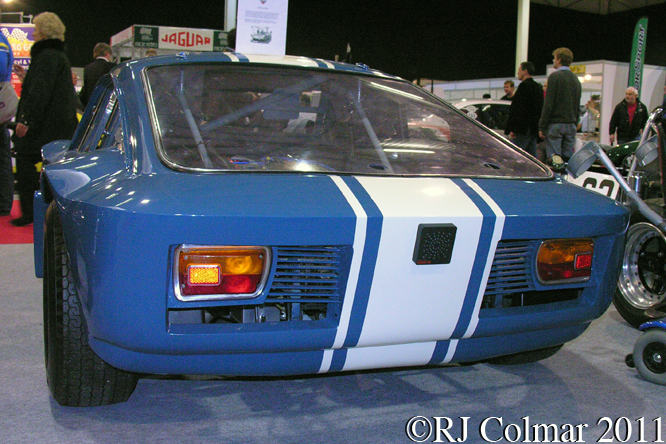
For 1964 a plan was hatched for Elva to build 100 2 litre / 122 cui GT cars capable of 160 mph, after the unexpected death of David Ogle, who had originally intended to design the car, Trevor Fiore was commissioned to design the bodywork which ended up with a roof line just 40 inches off the ground much like the Ford GT40 announced the same year.

Elva GT160, Race Retro, Stoneleigh

The two GT 160’s displayed at the London Racing Car Show and Turin Motor show caused a sensation, but even before either car had turned a wheel in anger there were many problems, the GT 160 did not have sufficient ground clearance to meet the regulations and the cars were well over the targeted weight of 600 kgs.

Elva GT160, Race Retro, Stoneleigh

Additionally the aluminium bodies manufactured by Fissore in Italy attracted an unexpected 15% tax railing the cost of manufacture and sales price, furthermore Elva was in the process of being swallowed up by Trojan who at the same time were doing a deal with Bruce McLaren to manufacture McLaren sports racing cars for customers.

Elva GT160, Race Retro, Stoneleigh

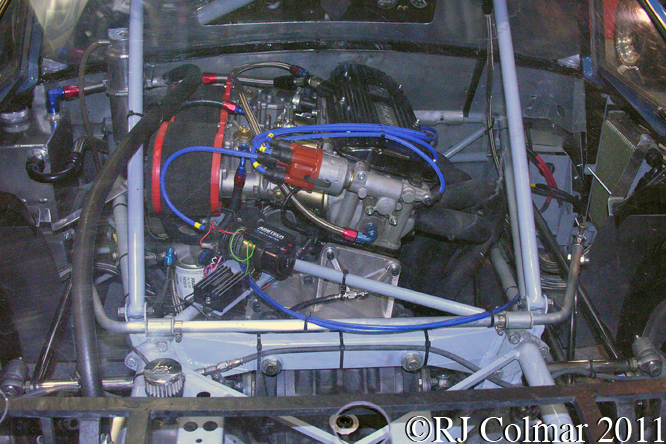
So the GT 160 was eventually shelved after just three cars had been completed, all of which still exist today, two them being seen in historic racing circles including what I believe to be the third and final BMW powered chassis featured today which was seen at Race Retro a couple of years ago.

Elva GT160, Race Retro, Stoneleigh

In 1965 Sir Richard Wrottesley raced the first GT 160 chassis as a prototype at the Le Mans test weekend, the Nurburgring 1000 kms and Le Mans 24 hours.

Elva GT160, Race Retro, Stoneleigh

Sir Richard recorded the cars only finish, 17th place, in the Le Mans test and though the car was not a strong competitor against its intended Porsche 904 and ALFA Romeo TZ rivals in the GT class it did record a top speed of 165 mph on the Mulsanne Straight at Le Mans.

Thanks for joining me on this “Forty Inches High But Not A Ford” edition of “Gettin’ a li’l psycho on tyres” I hope you will join me again tomorrow. Don’t forget to come back now !
Share