Tag Archives: Le

Carroll’s Cat faster than a 250 F – Lister Jaguar BHL 128

Moving on 20 years from yesterdays blog but staying with the Lister Jaguar cars of the late 50’s, this one has a proud boast thanks Bobby Bell who is seen here standing in the fire suit, behind the car, at the British Grand Prix meeting where he was competing in the Lloyds & Scottish championship.

Bobby Bell, who kindly shared the details about today’s story is one half of Bell & Covill purveyors of fine, approximately 25,000 at last count, motor cars which have been sold to customers from Twickenham to Tobago.

One might imagine from the BRG and yellow paint job that this vehicle had been raced by Archie Scott Brown to some of the many Lister Jaguar victories, however it transpires that nothing could be further from the truth.

According to Doug Nye’s 2nd edition, reasonably priced, ‘Powered by Jaguar‘ the 1959 Lister Jaguar BHL 128 was originally supplied to Carroll Shelby Sports Cars Inc, Dallas Texas as a rolling chassis built to accept an American made body and Chevrolet V8 engine.

BHL 128 also known as ‘the Boeing Car’ is said to have been part of a Land Speed Record project with input from Boeing and master minded by John Fitch, Doug’s research categorically states John Fitch the former Mercedes Driver and Safety Engineer had absolutely no involvement in such a project.

What ever the outcome of the Boeing project the vehicle has no identifiable ‘in period’ racing history and was recovered to England around 1969 and acquired by Peter Sargent around 1970. Between 1970 and the mid 70’s BHL 128 was fitted with both a 3.8 / 231 cui XK Jaguar motor and a, retrospective, 1958 low frontal area ‘Knobbly’ body in preference to the historically more accurate, but less successful, 1959 Costin body.

Bobby tells me that he acquired BHL 128 in the mid 70’s and raced it to many historic race victories and a Lloyds & Scottish Championship.

However one of his favourite memories was the day he put BHL 128 on pole for the 1978 historic race at Le Mans, with a time that would easily have qualified for the 24 hours race proper, ahead of Stirling Moss and Willie Green one of the best if not the best historic racer of all time.

Bobby tells me that on that day BHL 128 was fitted with a 2.9 high ratio back axle which allowed him to hit approximately 175 mph on the 4 mile Mulsanne straight at 6000 rpm.

Both Willie Green in his D-type Jaguar and Moss driving a far superior handling open wheel Grand Prix Maserati 250 F made up ground on the Lister in the corners but could not keep pace with the Lister on La Sarthe’s long straights.

Unfortunately on the third lap of the race, the crankshaft broke and as Bobby says, ‘that was that’. Stirling might have added “Better to lose honorably in a British car than win in a foreign one”, though if he did, it was not recorded on this particular occasion.

Bobby sold the car in the mid ’80’s and it has since undergone restoration and now belongs to a lucky Steven Gibbs.

My thanks to Bobby Bell for sharing today’s story and to Doug Nye, David Mckinney, Belmondo, Dutchy, Julian Bronson, and Robert Barker at The Nostalgia Forum for additional comments going back to May last year.

Thanks for joining me for a week of Big Cat history, I hope you’ll join me again tomorrow for everyone’s favourite ‘Ferrari Friday’ when I’ll be looking at one of a series of 387 Ferrari’s none of which were sold as new in the United States. Don’t forget to come back now !


Share

Two Cats in Hollywood – D-type XKD 531 & C -type XKC 007

Thanks again go to Steve & Ed Arnaudin for providing today’s unusual photograph which Ed purchased somewhere around 1958/59.

Jaguar D and C types

Photo by Carlyle Blackwell, Publised Courtesy Blackwell Archive, for sales enquiry’s please e-mail infoATpsychoontyres.co.uk and your contact details will be forwarded to the Blackwell Archive.

Extensive research on The Nostalgia Forum has revealed that not only the cars but also the lead driver AND the photograph itself all have stories to tell.

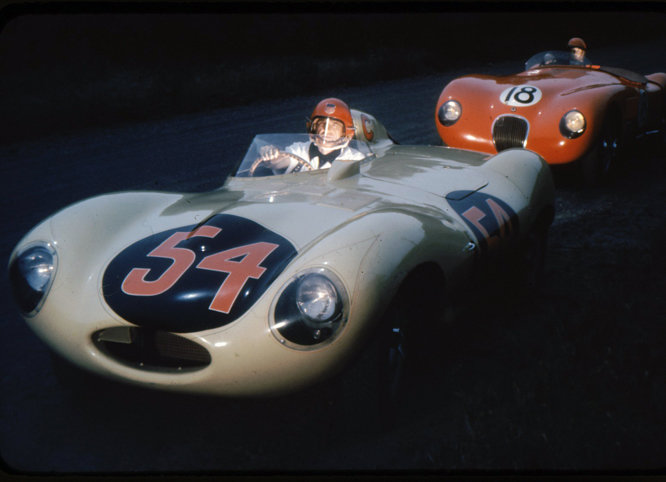
This photograph appears to have been taken in the studio by Carlyle Blackwell around 1956/57, when he was the owner of the red #18 C-Type XKC 007 which he raced between 1955 and 1957. The #54 D-type is thought to be XKD 531 owned and raced by J Douglas.

It should be noted that this blog is a research project in progress and the identification of the chassis numbers is still not definitive. I have tried to reach the copyright holders but so far in vain so it is possible I might have to withdraw this blog at some point.

The D-type Jaguar like the C-Type was a factory built racing car powered by a variation of the same XK engine design as the XK 120, XK 140 and C-type.

Like the late C-Type the D-Type was fitted with efficient disc brakes. It’s debut at Le Mans in 1954 was thwarted by sand in the fuel, once it was removed Duncan Hamilton & Tony Rolt took their D-type back up the field to second place 1 lap down on the winning Ferrari of Jóse Frolián González and Maurice ‘Racing Is Life’ Trintignant.

The following year Mike Hawthorn and Ivor Beub driving a D-Type won a hollow Le Mans Victory after the Mercedes Benz team withdrew following the horrendous crash in which an estimated 83 spectators lost their lives and a further 120 were injured.

D-types entered by the private Ecurie Ecosse team took two further victories in ’56 and ’57.

The #54 XKD 531, which I believe we are looking at here, is one of 53 customer D-types, this one was raced from 1956 to 1957 by J Douglas and then from 1958 to at least 1959 by Ray Seher.

The red #18 C-type XKC 007 was originally owned by Charles H Hornburg Jnr who had future US World Champion Grand Prix driver Phil Hill drive it to two victories in 1952, Phil said of XKC 007 ” It was the first car I ever drove that had a really precise feel about it – it really felt like a racing car.”

Carlyle Blackwell acquired the car in 1955 and raced it through to the end of 1957 before acquiring the D-type XKD 528.

Jaguar D Type

Photo by Carlyle Blackwell, Publised Courtesy Blackwell Archive, for sales enquiry’s please e-mail infoATpsychoontyres.co.uk and your contact details will be forwarded to the Blackwell Archive.

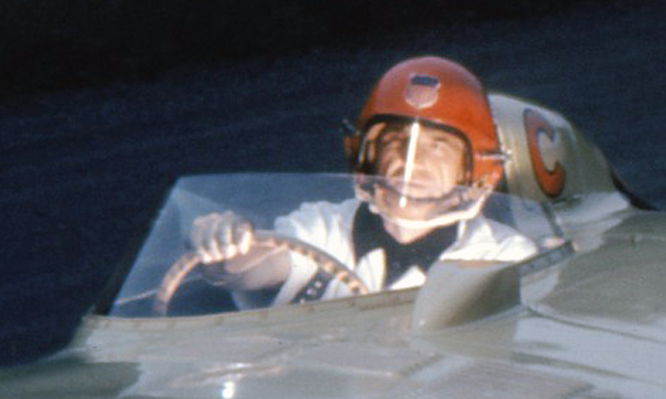
The story of this photo does not stop with the cars however, look closely at the driver of the #54 and some of you might recognise the face as none other than that of Emmy winning writer Jack Douglas.

A detail of this photograph appeared on the cover of Sports Car Graphic in March 1963 the masthead reads “If the face on this month’s cover looks familiar, it should be. It belongs to Jack Douglas, writer, author of among other things, “My brother was an only child”, and sometime race driver. The photo was shot by his friend, Hollywood photographer Carlyle Blackwell.”

Jaguar D Type

Photo by Carlyle Blackwell, Publised Courtesy Blackwell Archive, for sales enquiry’s please e-mail infoATpsychoontyres.co.uk and your contact details will be forwarded to the Blackwell Archive.

The whole photograph as seen at the top of the blog first appeared on the cover of Sports Car Illustrated in February 1957 with a masthead that reads “Carlyle Blackwell shot this Ektachrome of a pair of competition Jaguars booming through the night.”
As can be seen studio lights are used to illuminate both drivers and the front of the #18.

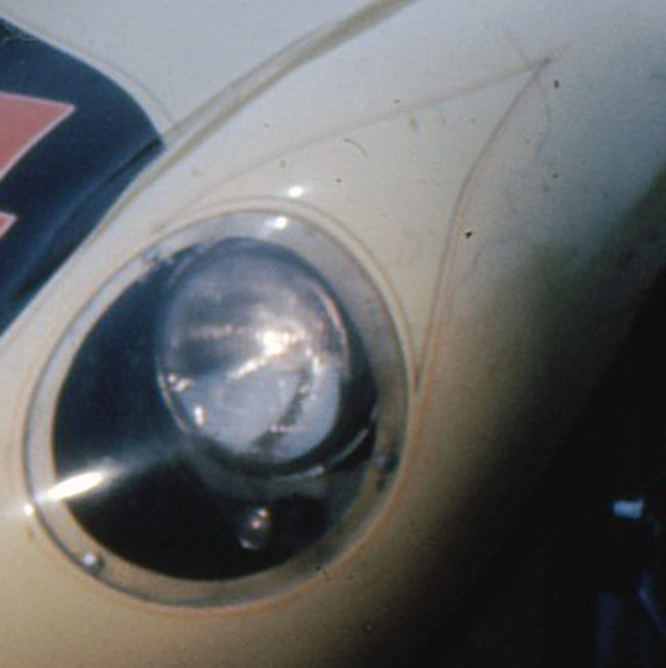
Note how the colour from Ed’s purchased slide has darkened around an apparently ivory car, while the colour of the car as it appears on the cover of Sports Car Illustrated appears yellowish, the colour of Jacks car at the time has been described as ‘mustard yellow’ which only goes to show how unreliable photographs can be when trying to identify vehicles back in the day.

To date this is without doubt one of the most fascinating photographs I have ever come across. My thanks to Steve and particularly Ed Arnaudin who first purchased the photograph. Thanks also to everyone on the Auto Slides by Blackwell thread on The Nostalgia Forum for their invaluable contributions including, RA Historian Tom, Frank Barrett, Jean L, Jerry Entin, Frank Sheffield, Frank Hill, JB Miltonian, and raceanouncer 2003 Vince H.

I hope anyone believing they can improve on the accuracy of my hypothesis about this photo or with contacts leading to the Blackwell estate will chime in below.

Hope you have enjoyed this ‘Carceology’ edition of “Getting a lil’ psycho on tyres’ and that you will join me again tomorrow to see a ‘mystery’ vehicle with a Cat under the hood. Don’t forget to come back now !

28 07 12 PS My thanks to Pamela Blackwell who has kindly retrospectively given me permission to post the photo’s her father took.

Pamela tells me that her brother is seen at the wheel of the #18 Jaguar C-type in the photograph and that the photo was taken in Carlyle Blackwell’s driveway.

Share

Gordon MacKenzie’s Cockpit – #52 C-type Jaguar XKC 030

It’s a great pleasure to share another of Ed Arnaudin’s photographs on ‘Gettin’ a lil pyscho on tyres’ sticking with this weeks Jaguar theme today we have Gordon Mackenzie’s C-type Jaguar in the paddock at Lime Rock in April 1959.

The C-type is the competition version of the XK 120 with a lightweight aerodynamic aluminium body built around a tubular frame. 52 C-types were built powered by a 205 hp version of the XK engine one of which driven by Peters Whitehead & Walker won Le Mans in 1951.

In 1953 with an engine tuned to 220 hp, thanks to a switch from triple SU carburettors to Webbers and a chassis fitted with disc brakes Duncan Hamilton & Tony Rolt drove their C-type to Jaguars second Le Mans win.

XKC 030 had been raced by amongst others by David Hirsch and both Virginia and Loyal Katsee, when after rolling his XK 120 in 1957 Gordon McKenzie acquired it and subsequently used it with varying degrees of success all the way through to 1962.

Gordon MacKenzie came home 5th behind the #25 Ferrari TRC of G Andrey and 2 spots ahead of Bob Grossman’s 250 GT California on this particular day.

John Aibel informs me that Gordon McKenzie was a well known racing instructor in the North East States and is still active in Vintage SCCA events.

My thanks to Ed & Steve Arnaudin for the photograph, John Aibel and Terry O’Neil for background information.

Hope you have enjoyed to today’s lightweight edition of ‘Gettin’ a lil’ psycho on tyres’ and that you’ll join me again tomorrow for two cats in a Hollywood studio. Don’t forget to come back now !

Share

Black Jack & Le Car – Renault 5

The Renault 5 was a versatile super mini launched in 1972, in Europe many countries ran a one make virtually stock Renault 5 Championship which brought many drivers their first taste of semi professional competition including Austrian Formula One driver Gerhard Berger.

In the States this vehicle known as Le Car dominated the 1977 SCCA Showroom Stock class C division and gained added notoriety when La Conner Washington police department traded in one of its full size cruisers for three Le Cars.

In 1980 three time world champion Sir Jack Brabham was persuaded to come out retirement for the first time in 10 years to take part in a British Saloon Car Championship race at Brands Hatch which took place on the same day as the British Grand Prix.

Though the car was giving away 200 cc 12 cui to the class leading Toyotas VWs and Audi 80’s prepared by GTi Engineering, one of which was driven by the equally recently out of retirement Stirling Moss, it must be assumed that Black Jack was game for a laugh with his old sparing partner from the late 50’s early 60’s.

The Renault was woefully uncompetitive having neither the power or the handling to keep up with the class leading Audis but come race day Sir Jack Brabham had an ace up his sleeve, falling further and further behind the pack on the long Brands Grand Prix Circuit much to the amusement and in full view of 80,000 spectators Jack decided to take a 1 mile short cut by using the club circuit link road and so finished ahead of Stirling Moss on the road even though he was of course obviously disqualified.

Hope you have enjoyed today’s Black Jack edition of ‘Gettin a lil’ psycho on tyres and that you will join me tomorrow for a 6 cylinder edition tomorrow. Don’t forget to come back now !

Share

Honeymoon Racer – Crosley Hotshot Sport

My heartfelt thanks once again go out to John Aibel for sharing with us some photo’s of his 1951 Crosley Hotshot Sport, a vehicle that in 1951 competed in my favourite race the Le Mans 24 hours.

Twelve months after Briggs Cunningham took a shot at top honours at Le Mans with his Cadillac Le Mans special ‘Le Monstre’ and more conventional 61 Series ‘Petit Pataud’ two Florida enthusiasts made a low budget attack on the Le Mans 24 hours ‘Index of Performance award’ which sought to calculate the best performance for vehicles completing the race based on engine size and distance covered with this cute little Crosley Hotshot Sport.

Crosley was an American manufacturer that went against the grain in the US automotive industry by building small and light vehicles from 1939 to 1952. Indiana industrialist Powel Crosley Jr came to prominence manufacturing auto accessories, cheap radio’s and other household electrical goods distributed by independent retailers and backed by a then pioneering ‘money back guarantee’ .

The legend behind the Crosley Le Mans entry is that Phil Stiles and George Schrafft inspired by the success of the stock Hotshot in the Sam Collier Memorial 6 Hours at Sebring in December 1950, were discussing the potential of the Hotshot over the odd libation when they decided to write to the FIA stating they had a Crosley to race in the Le Mans 24 hours, and to Powel Crosley saying they had an entry to Le Mans and were in need of a chassis ! The returning correspondence confirmed both an entry for Le Mans and the supply of a chassis !

The Hotshot / Super Sport VC chassis was prepared for the race by Pappy Dwyers race shop in Indianapolis with a one off aluminium body and sent back to Crosley where a specially developed 726 cc engine was installed.

The cast iron over head cam engine was probably the strongest part of the package having a 5 bearing crank so that it could run all day at full power in order to power military generators which was its original application, as a race engine it was frequently modified Bandini even had a twin over head cam version. The stock engine gave around 26.5 hp the development engine for Le Mans on the #59 seen here around 42hp.

Once ready at the Crosley factory Phil and George went to pick it up from Ohio in George’s Aston Martin DB2, they then borrowed Mr Crosley’s boat trailer and converted it to take the Le Mans challenger to the docks in New York for eventual shipping. On the way to NY Phil and George took the Crosley off the trailer fitted the trailer plates to the car and then ran the motor in on the Pennsylvania Turnpike.

In practice at Le Mans it was discovered the lights were not up to racing at night and more powerful Marchal units were fitted along with a Marchal generator while a new Prestolite generator was ordered from the States.

During the race the car was an immediate success, despite using only top gear so as not to risk damage to the standard non synchromesh Hotshot / Super Sport three speed gearbox, George was able to turn in 73 mph average laps and easily lead his class however 2 hours into the race the roller bearings in the new Marchal generator proved unequal to its task, with Phil at the wheel the unit seized and tore off its mounts, damaging the ignition loom and the water pump mounted on the back of the generator.

After bye passing the water pump and relying on thermosiphon cooling, like an old Model T Ford, the car was prepared to run using only the battery, however once it became dark and the lights were required the battery was inevitably run flat and after 40 gallant laps the devastatingly quick in its class Crosley was out for good.

The next day the team pooled funds to release the Presolite generator from customs in Paris and fitted it to the Crosley so that Phil and his newly wed wife could tour Europe, in Switzerland the local authorities mistook them for and favourably treated them as entrants in the Monte Carlo Rally.

The Crosely was returned to George Schrafft who replaced the standard Hotshot gearbox designed for 26.5 hp motors with a more robust 4 speed FIAT gearbox. This change without any modifications to the rest of the drive train resulted in the rear axle being pushed back one inch, which does not appear to have adversely affected either the performance or reliability of Le Biplane Torpedo as John sometimes refers to his unique Crosley.

The story of how John came to own this splendid Honeymoon Racer is one of 15 years perseverance, in the late 60’s John read an article about the car written by Phil Stiles in a 1958 issue of Road & Track. John decided to trace the car with a letter published in R&T; and got so many responses he founded the Crosley Auto Club.

Becoming friends with the owner of Le Biplane Torpedo through the club John expressed his interest in purchasing it over many years at the AACA Hershey Annual Fall meeting. He was disappointed one year to find the owner had sold it on to buy a motorhome in the 1970’s, in the early 80’s Johns brother established the Crosley was for sale after the owner had decided to sell his entire collection of racers.

John reluctantly had the roll bar fitted after surviving a slow roll in another vehicle at Dellow without one, and has raced the Crosley and remembers having many entertaining races with Bob Duell in his Panhard Jr and with two other chaps one in a pre war Morgan and a Renault Special.

He says of his car “On my first track run with it, I was going as fast in the corners as the Lotus 7’s. They of course were much faster out of the turns! ” Look out for a book to be published on US Le Mans challengers by Tim Considine which will feature this Crosley in the near future.

I’d like to thank John once again for taking the time and trouble to share these photo’s of his wonderful Crosley and particularly for taking the time to tell me the romantic story behind it. I have always had a strong conviction that there is something quite noble abo
ut taking what is essentially a road vehicle racing it and then returning it to road use, highly impractical in this day and age with all the safety requirements for racing but as Johns “Le Petite Pataud” Replica and Le Biplane Torpedo show once upon a time this was not an unusual practice.

Special thanks to Chief 187 for putting me in touch with John and thanks to everyone for popping by this bumper edition of Getting a lil’ psycho on tyres, I hope you’ll join me tomorrow for a slightly shorter edition, don’t forget to come back now !

Share

The conspicuous underdog – ‘Petit Pataud’ Replica 2/2

Today I’ll be sharing some details about John Aibels fabulous ‘Petit Pataud’ Replica 1950 Series 61 Cadillac Coupe, if you missed the story about the original here is a link to yesterdays post.

John found his bottom of the range Series 61 Cadillac with the correct Petit Pataud 121″ wheel base in Iowa, it did not have the optional power windows, amazing I had no idea they had even been thought of in 1950, but Johns car was originally fitted with a Hydra – Matic automatic transmission and he went to considerable trouble to locate a correct manual one as used at Le Mans, an item difficult to find because it is also the transmission of choice amongst hot rodders.

Being a volunteer at CAM (The Collier Collection) John was given access to the original and correctly identified the Marchal driving lights, GI two way radio among many other parts, and noted how and where they were correctly installed. It took around a year to meticulously hunt down these items on E-Bay and to collect all the bits and pieces prior to the car being sent to a restoration shop for a three year restoration.

The car is fitted with a roll bar and five point harness though John is a little sceptical about the capability of the drum brakes to handle serious competition, I am not sure he has the Alfin drums and additional brake ducting
Cunningham had fitted to the original.

Apparently the Cunnigham ‘Petit Pataud’ was used as both a tow car and shop vehicle after its sturdy service at Le Mans, evidence of this can be seen in this link to a photo of the restored original where a chrome tow hitch cover is plain to see under the bumper, also the original no longer has the 35 gallon long range fuel tank and filler as can be clearly seen on the passenger side of Johns car just behind the C pillar.

He says of his car “You are right everytime we drive the car we get the thumbs up and smiles from a lot of people. It also drives great, it is very comfortable, it just soaks up the bumbs on the roads. She rolls like a ship in the turns, but holds very well.”

I’d like to thank John for sharing his photo’s and thoughts on his marvellous motor car, a reminder of a golden age of optimism, a time when with a few good connections a showroom car fitted with a double barrel carburettor, some French springs, a long range fuel tank and GI two way radio you could compete in one of, if not the most romantic race in the world.

Thanks also again to Chief 187 who so thoughtfully set these last two blogs up for me.

Hope you have enjoyed this weekends extraordinary vehicle, new followers and comments are always appreciated and a useful tool to help me source more for you in future, thanks for dropping by don’t forget to come back now !

Slightly off topic, today is a big day for all three contenders in the post season NASCAR Chase for the Cup, covered by less than 40 points the only strategy to win the cup now has to be to win the next three races, looking forward to seeing if Kevin Harvick can step up to the plate and pull it off. Go Harvick ! Go #29 ! Go Happy !

10/11/10 Erratum, I got the model types a bit mixed up and have removed all ‘de Ville’ references from the text above, the Series 61 shown here is the shorter model known as Type 61 Coupe, not Coupe de Ville which was the Type 62. Apologies for any confusion.

Share

The conspicuous underdog – ‘Petit Pataud’ Replica 1/2

It’s a great honour to feature on ‘Gettin’ a lil’ psycho on tyres’ a ‘Petit Pataud’ replica belonging to John Aibel. This will be another two part blog starting today with the history of the real ‘Petit Pataud’ finishing tomorrow with some of the fascinating details about this faithful replica.

The ‘Petit Pataud’ legend starts with an invitation from 1949 Le Mans winner Luigi Chinnetti to facilitate an entry in the 1950 Le Mans entry for Briggs Cunningham.

Seeking advice from a well respected mechanic Bill Frick, Cunningham made a false start building a hot rod like device by dropping a Cadillac V8 into a Ford body and dubbed a Fordillac. If any one knows of any pics of this ‘device’ please leave a message below.

The Le Mans organisers deemed the Fordillac ineligible so Briggs bought two showroom 1950 Series 61 Cadillac Coupes one was given an open aluminium body devised by employees of the Grumman aircraft manufacturer and dubbed ‘Le Monstre’ by the French press, the other was more modestly prepared for endurance racing by Frick – Tappett Motors and dubbed with typical French irony ‘Petit Pataud’ ‘little clumsy’ a name I believe usually referring to new born pups.

The Cunningham team were surprised to find ‘Petit Pataud’ the more or less stock underdog of the stable driven by Miles and Sam Collier proved quicker than the heavily modified ‘Le Monstre’ straight out of the box. Though this was rectified during the course of practice for the race.

The 24 hours of Le Mans had an unusual start procedure, drivers stood on the opposite side of the track from the car and at the drop of the flag sprinted across the track and jumped in to their cars fired them up and drove off, in a piece of comedy reminiscent of a ‘Herbie’ film ‘Petit Pataud’s’ doors were found to be locked after it’s driver sprinted across the track at the start, fortunately the window was open so he reached inside to unlock the door from the inside !

Miles Collier who raced in the 1939 Le Mans race advised Briggs to equip his cars with fold away shovels in case either car found itself buried in the famously unforgiving artificial sand banks installed to prevent the more wayward vehicles from venturing too far from the notoriously fast and dangerous circuit.

Briggs rejected the advice and paid the price on lap 2 of the race when he found himself trapped in the sand bank at the end of the 4 mile long Mulsanne straight, Briggs probably wasted several minuets borrowing a shovel from a spectator and wasting half an hour successfully digging his car out and resuming the race.

‘Petit Pataud’ meanwhile as to be expected from a land yacht was sailing along at a nice and steady pace reaching 120 mph on the Mulsanne and running 1,956 miles to average 81.5 mph for 24 hours and finish in a commendable 10th place overall, 2nd in class behind a Cadillac powered Allard.

Briggs and Phil Walters brought ‘Le Monstre’ in one lap down, about the time it would have taken to borrow a shovel, on ‘Petit Pataud’, a small victory for the clumsy team underdog perhaps but just the stuff of legends that makes Le Mans such a fascinating race.

Tomorrow I’ll continue with details about Johns fabulous replica and some surprising differences with the restored original which make Johns car today arguably closer to the original Le Mans spec as raced in 1950.

Thanks to Chief 187 who set up my connection with John Aibel, and thanks to John, unfortunately I was not able to visit Florida to take these magnificent pics which he kindly sent to me.

Thanks for stopping by wishing everyone a wonderful weekend, don’t forget to come back now !

10/11/10 Erratum, I got the model types a bit mixed up and have removed all ‘de Ville’ references from the text above, the Series 61 shown here is the shorter model known as Type 61 Coupe, not Coupe de Ville which was the Type 62. Apologies for any confusion.

Share