Tag Archives: Lotus

Pushing The Backbone – Lotus 30

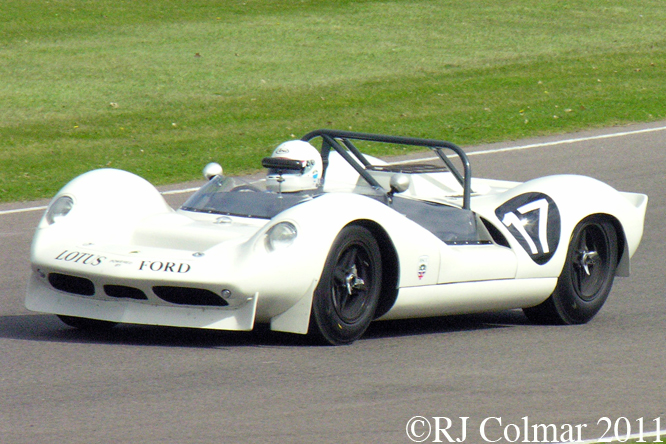
Allegedly Colin Chapman was a little upset about losing the contract to develop the Ford GT40 to Lola and set out to build a sports racing car in 1964 that would show Ford that they had made the wrong choice.

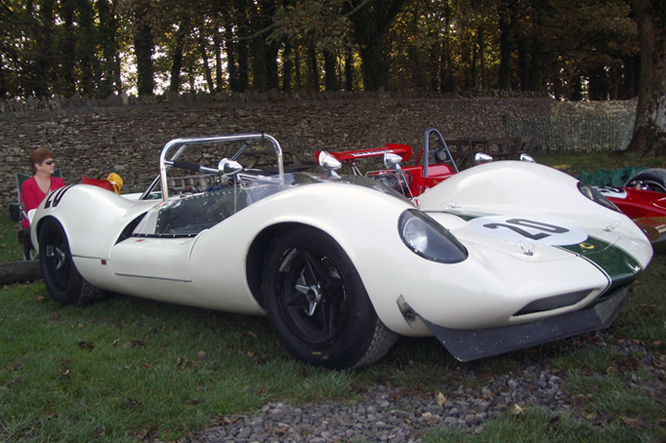
Colin’s idea was to use a back bone chassis similar to the one used in his successful Lotus Elan but stronger to accommodate a 4.7 litre / 286 cui Ford Fairlane motor in the rear. It is said that Colin stubbornly over ruled his designer Len Terry when the latter advised against such an idea and went ahead and built the car with a sleek curvacious body measuring just 26.5″ high.

Lotus 30 #30-L-12, Dyrham Park

Photo Courtesy of Tim Murray above, shows Andrew Bradshaw’s Lotus 30 at Dyrham Park.

The original Lotus 30 clothed in a fibre glass body that made regular maintenance exceedingly difficult weighed less than 700 kgs / 1600 lbs and had 350 hp which was transmitted to the ground by 13″ wheels and was stopped by solid disc brakes all round. Unfortunately while the car won a few races, notably in the hands of Jim Clark the chassis, as predicted by Len Terry proved insufficiently strong which resulted in the backbone flexing, and on at least one occasion a chassis is recorded as having snapped in half. It is thought 18 Lotus 30’s were built with an additional 2 replacement chassis being supplied for damaged cars.

Lotus 30, Goodwood Revival

Matthew Watts example seen here at last years Goodwood Revival has been fitted with an interpretation of the period body modifications developed by JCB research to over come overheating problems caused by the spare wheel, required by the Group 7 rules, being placed behind the radiator in the nose.

For 1965 the model was updated; with a stronger chassis backbone, spoilers, larger wheels and ventilated disc brakes, was built, though not solving all of the problems 9 examples of the S2 were built and sold. Towards the end of 1965 Colin Chapman uprated this chassis again calling the new model the Lotus 40, dubbed by Richie Ginther as ‘like the Lotus 30 but with ten extra problems’ but the three Lotus 40 chassis were no match for the Group 7 cars produced by either Lola or McLaren.

Despite the lack of success against the Lola’s and McLarens the Lotus 30 was still being raced in British club events until the early 1970’s by John Markey.

My thanks to Lotus30.com for the chassis information Woulter Melisson at Ultimatecarpage.com and Martin Krejci at racingsportscars.com for additional information and results. Thanks also to Graham Gauld, pete53, Roger Lund, Tony Gallagher and Ted Walker at The Nostalgia Forum for additional information regarding today’s featured vehicle.

Thanks for joining me on this ‘Pushing The Backbone’ edition of ‘Gettin’ a li’l psycho on tyres’, I hope you will join me again tomorrow. Don’t forget to come back now !

PS I hope you will join me in wishing best wishes to GALPOT Concours d’Elegance Correspondent and Birthday Boy Geoffrey Horton ! 🙂

Share

Fatal Firebird – Lotus Ford 29 #29/3

In May 1961 a piece of successful Formula One technology percolated into the environs of Indianapolis which started a whole sale revolution in the layout of the cars that would dominate the Indy 500 hence forth in the form of the Kimberly Cooper Special driven by Jack Brabham.

The Kimberly Cooper Special was the smallest car in the field and possibly with the least powerful motor, but what everyone present learned from the car that started 19th and came in 9th was that the li’l funny car with the engine in the back could handle the corners so much better than the hitherto dominant front engine Roadster machines that the lack of 150 hp made little or no difference.

Lotus 29 Ford, Indianapolis

Imagine just putting the engine in the back of your car giving a 150 hp advantage ! It was a no brainer, but in 1962 only the Californian Speed King Micky Thompson and ’55 & ’56 Indy winning owner John Zink had rear engined cars prepared for the Indy 500.

Rookie Dan Gurney who passed his Rookie test in a Roadster was keen to drive either of the rear engined cars in the race in an effort to impress Lotus boss Colin Chapman whom he had invited over from Europe at his own expense in an effort to entice Colin into building Lotus indy cars for 1963. Dan gave up on the turbine powered John Zink Track Burner but did manage to qualify 8th in the under powered Thompson Buick and come home in 20th.

Lotus 29 Ford, Indianapolis

Chapman was sufficiently impressed with the Indy 500 and it’s potential rewards to build the Lotus 29 seen here for the 1963 race. The Lotus 29 featured a monocoque chassis, as campaigned in Chapman’s successful 1962 Lotus 25 Grand Prix car, in place of the usual tube space frame and it had a powerful version of a Ford stock block V8 in place of the almost ubiquitous 4 cylinder Offy that had been winning at Indy since the mid 1930’s and could trace their ancestry back to the Millers of the 1920’s.

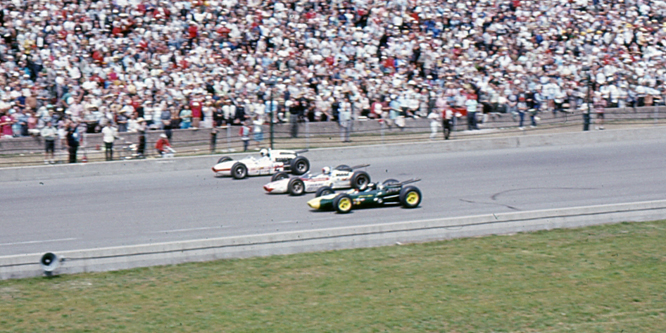
Jim Clark and Dan Gurney were to race the Lotus challengers Clark qualified chassis 29/3 5th and Gurney chassis 29/1 12th. Towards the end of the race Clark was challenging Parnelli Jones for the lead when Jones Watson developed an oil leak, but the USAC officials managed to refrain from black flagging Jones before the oil stopped leaking which allowed Parnelli to take his one and only Indy 500 victory ahead of the Rookie Clark. Dan came in 7th also completing the full 200 laps. Dan’s chassis #29/1 today sits in the IMS museum painted in the green and yellow colours of Jim Clark’s #92 chassis 29/3.

Indy 1964, Ed Arnaudin

The following year Bob Marshman put #29/2 now known as the Pure Firebird Special on the middle of the front row for 1964 Indy 500 right next to pole sitter Jim Clark in his newer Lotus Ford 34, see above. Bob lost an oil plug going low on the apron while in the lead on lap 37 trying to avoid the slower Johnny White, Bob was eventually classified 25th.

Bob crashed #29/2 at Milwaukee and his owner Lindsey Hopkins bought Clark’s #29/3 as a replacement which Bob drove with no more success than he had with #29/2.

Despite the fireball at Indy in 1964 Bob tested chassis 29/3 at the seasons end wearing nothing but the usual, for the period, t-shirt and jeans at Phoenix. During the session Bob’s car was involved in an accident which ruptured the fuel tank, a week later Bob died of the burns he subsequently sustained.

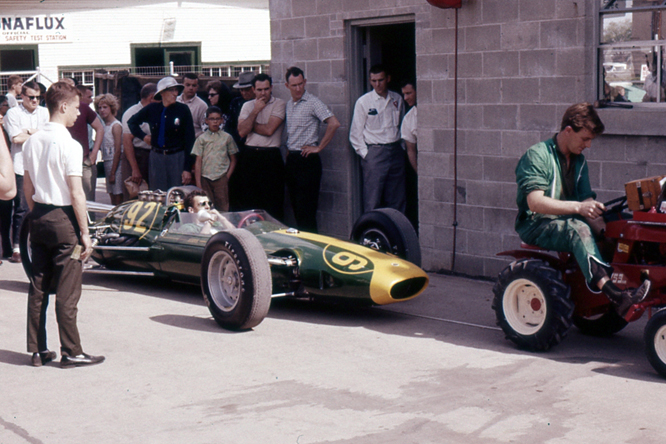
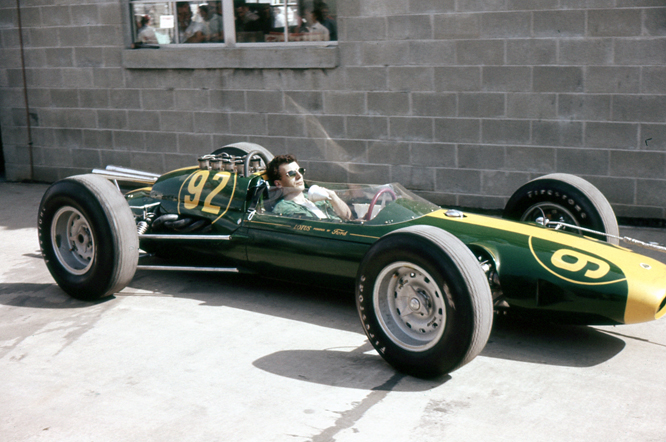
Ed Arnudins photo’s show Lotus Mechanic Colin Riley at the wheel of Jim Clarks of #92 Lotus 29 Ford being towed through the Indianapolis garage area by another Team Lotus mechanic Dave Lazenby who is at the wheel of the dinky li’l towing tractor in the top photograph.

My thanks to Ed and Steve Arnaudin for the photo’s, Tim and B Squared at The Nostalgia Forum informing me of which chassis is featured in today’s post for identifying Colin and Dave in the photo’s.

Thanks for joining me on this ‘Oil Leak ? What Oil Leak ?’ edition of ‘Getting’ a li’l psycho on tyres’ I hope you will join me again tomorrow. Don’t forget to come back now !

05 02 12 ps Thanks to Brian for pointing out the now corrected Bobby Marshman spelling error and pointing out that Bob did not spin out of the 1964 Indy 500.

12 05 14 Since writing this piece it has come to my attention that Bobby Marshman signed his autographs ‘Bob Marshman’ and it seems fitting and respectful to have removed the references to “Bobby”.

It has also come to my attention that Bob drove #29/2 on the paved surfaces of USAC’s Champ Car Series up until Milwaukee in ’64 and not #29/3 as originally suggested. He also appears to have lost an oil plug rather than damaged an oil line at Indy as originally suggested.

I hope you’ll accept my sincerest apologies for any unintentional confusion caused.

Share

Too Much Added Lightness – Lotus 27 27-JM-22 & 27-JM-2

The design of the 1963 Lotus 27 Formula Junior car followed the principles of the 1963 Lotus 25 Formula One car featuring a monocoque. Keen to save weight, cost and promote the use of fibre glass which Colin Chapman used extensively in the Lotus Elite and Elan models the 27 monocoque initially differed from the bigger, aluminium skinned, Lotus 25 monocoque by having a fibre glass outer skin.

Former motor cycle racer and film distributor Ron Harris ran the works Lotus Formula Junior team in 1963 for 1962 Formula Junior champion Peter Arundell, Mike Spence and John Fenning. With only one car available for Peter first time out at Oulton Park the team scored a lucky victory after the faster Brabhams including that of Denny Hulme retired with engine problems. The victory was lucky because the monocoque was so weak it badly affected the handling of the Lotus 27.

5 or 6 Lotus 27 chassis are thought to have been constructed with fibre glass outer skins and nearly 4 months past before Peter returned to his winning ways by which time the fibre glass outer skin of his Lotus 27’s monocoque had been replaced by rolled aluminium which stiffened the monocoque and improved the 27’s handling.

With 6 successive late season wins Peter Arundell secured his second successive British Formula Junior title by one point over Denny Hulme.

Lotus 27, Goodwood Revival

Chris Locke is seen above at the Goodwood Revival in his Lotus chassis 27-JM-22. This car was sold originally to one C Haas, better known these days as the racing impresario the multi championship winning Newman/Hass/Lanigan Indycar team.

According to San Anselmo CA resident Lotus aficionado Chris Locke’s website, Carl sold the car to General Motors who wanted to study the monocoque engineering and design, some years later General Motors donated the Lotus to the auto shop department of a Detroit high school. Teacher Pat Nelson liberated the car by substituting a more practical vehicle for his students to learn from before the racer had been dismantled.

Pat raced 27-JM-22 from the late 60’s to mid 70’s before Jim Lloyd took over the car in 1977 and raced it some more. Jim was photographed with his 27 – JM – 22 parked next to Mario Andretti’s championship winning Lotus 79 at the US Grand Prix in 1978. Six successive owners owned and raced the car the last of which had a the tub replaced after an accident in 1999. Chris became the owner in 2001 and has the car looked after John Anderson Racing in the States and Historic Team Lotus in Europe.

Lotus 27, Goodwood Revival

The second Lotus 27, 27-JM-2, featured today driven by Nick Fennell above was acquired for Jean Vinatier by Ecurie Ford France on the 28th May 1963, The team were running tragic future Grand Prix driver Jo Schlesser in a rival Brabham BT6 at the same time.

Of the two Jo scored better and consistent results until the August 18th 1963 when Jean recorded fastest lap on his way to two heat wins and win on aggregate in a French Formula Junior Championship at Nogaro. Jean recorded a further 3rd place at Montlhéry near Paris before the seasons end.

Jean went on to become French National Rally Champion in an Alpine Renault in 1969 and represented the same team at Le Mans a track at which he recorded 15 24 hour race starts between 1950 and 1973.

Thanks to Peter, Pete, willga, and Ron at The Nostalgia Forum for their comments on the 27’s construction.

Thanks for joining me on this ‘Too Much Added Lightness’ edition of ‘Gettin’ a li’l psycho on tyres’, I hope you will join me again tomorrow. Don’t forget to come back now !

Share

Tuning Options – Lotus 26R #26-R-20

The Lotus 26, designed by Ron Hickman of Black and Decker Workmate fame, was first shown to the public in October 1962 with the more familiar Elan name. The Elan was Lotus second attempt at making a primarily road vehicle after the all fiberglass unitary bodied Elite, which had proved too expensive for Lotus to manufacture and make a financial return.

Unlike the unitary bodied Elite the Elan’s fiberglass body was mounted on a ‘steel backbone chassis’ a variation on an idea which can be traced back at least to Rover in 1903 and was subsequently examined and or used by among others Morgan (1910), Tatra (1923) who still use the idea on their contemporary heavy military vehicles, Joseph Ganze’s Adler MaiKaefër (1931), Porsche Type 12 (1931) that with Tatra patents and under Ganzes influence became the VW Type 1 (1938), Skoda 420 Popular (1934), Mercedes Benz 170V (1935) and 170 H (1936), MG R-Type (1935), the Polish PZInz 403 Lux-Sport (1937), Clisby Special (1952), fiberglass bodied TVR MK1 / Grantura (1958), Alpine A108 (1959) that evolved into the fiberglass bodied Alpine A110 (1961) and Triumph Herald (1959), a design which was used to form the basic Vitesse (1962), Spitfire (1962) and GT6 (1966) backbone chassis.

Mounted in the, fabricated from sheet steel, back bone chassis was a 1558cc / 96 cui 4 cylinder iron block aluminium head Lotus Twin cam engine, which was matched with independent suspension and disc brakes on all for wheels. The Elan was sold with either soft or removable hard tops. Soon after becoming available racing teams turned their attentions to preparing the nimble Elan for racing with the likes of Lotus works driver Jim Clark, Graham Hill and Jackie Stewart all competing in privately entered Lotus Elan’s.

Lotus 26R

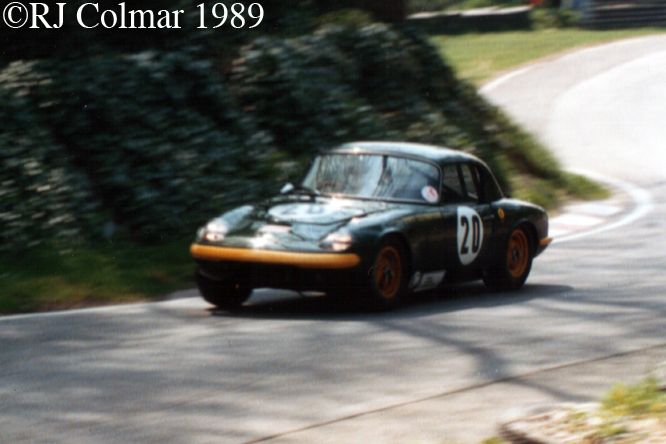
For 1964 Colin Chapman incorporated many of the ideas learned from the Elan privateers into the 26R built specially for racing, such as the example of Tony Thompson seen at Cadwell Park back in 1989 above, of which 97 were built in 2 distinct series between 1964 and 1966.

The hard top roadster only 26R was around 200lbs lighter that the original Elan, had revised suspension and could be ordered with either Cosworth or BRM tuning package for the Lotus Twin Cam motor, whose 116E block can be traced back to the Ford Consul Capri. Legend has it that the best tuning option was the Cosworth block matched with a BRM head, though I cannot rationalize why this might be the case nor have I substantiated this, if you know please do not hesitate to chime in below.

John Miles is credited with being the most successful 26R driver ‘in period’ clocking up 15 wins for the Willment team to secure the 1966 Autosport Championship. It is thought that 97 26R’s were built and supplied either complete or in tax saving kit form between 1964 and 1966.

Race preparation expert and Lotus aficionado Tony Thompson was in the middle of forth and final HSCC Classic & Sports Car championship wining season when I took these photo’s at Cadwell Park where he dominated the race. Tony possibly lays claim to being the most successful R26 exponent in historic events having used this same #26-R-20 chassis to win the HSCC championship from ’85-’87 and finished runner up in ’88/’90/’91 and 1993 before turning his attentions to racing a Formula Junior Lotus 27 in which he won the FIA Formula Junior championships 1996 to 1998 inclusive !

Thanks to Ray Bell, Pete Taylor, Tim Murray, Steve Holter, Roger Lund, David McKinney, willga, AAGR, David Birchall, JtP1, cheapracer, Greg Mackie, Geoff Butcher, Lee Nicole, johnny yuma, Catlina Park, 312f1, and Karl Ludwigsen who kindly responses to the ‘Backbone’ thread at The Nostalgia Forum and helped identify some of the vehicles with backbone chassis prior to the advent of the Elan.

Further thanks to David Birchall, Edward Fitzgerald, Pete Taylor and ‘the Oracle’ for identifying Tony’s chassis number and clearing up a few other aspects of Elan identification.

Thanks on this ‘Tuning Options’ edition of ‘Gettin’ a li’l psycho on tyres’, I hope you will join me again tomorrow when I’ll be looking at a unique Bristol. Don’t forget to come back now !

Share

Monocoque Revolution – Lotus 25 #R4 & #R5

There are some ideas that have to wait until just the right time in order to have an impact, one such case in point is the idea of using a monocoque shell to build a racing car chassis / body rather than the oft used couple of helfty rails or beams welded together or a more intricate space frame built up of small tubes welded together with a body thrown over the top.

The idea of using a monocoque shell made of fabricated sheets of metal to build a racing car can be traced back to 1912 when Howard Blood built a prototype cyclecar called a Cornelian which in 1915 was prepared by the Chevrolet brothers Louis and Albert for an attempt at the Indy 500. The Cornelian reached 12th place before it’s 33hp Sterling motor dropped a valve causing retirement. Around 100 monocoque chassis Cornelian cyclecars are thought to have been built before production came to a halt.

In 1923 aviation pioneer Gabriel Voisin built a team of four extraordinarily underpowered monocoque racing cars to take part in the French Grand Prix at Tours, giving away over 15 mph in top speed just one car survived to finish fifth and last over 1 and a quarter hours behind the winner over the 496 mile race distance.
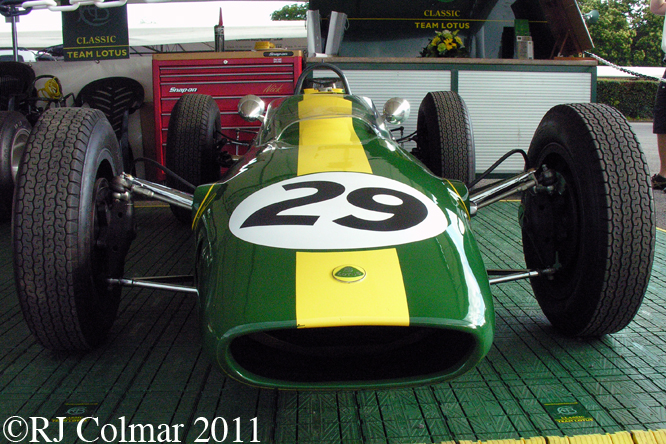
Lotus 25 R5, Goodwood FoS

Despite the success of the D-Type Jaguars at Le Mans in the mid 1950’s which featured a half monocoque design with the engine mounted on a sub frame it was not until 1962 that Colin Chapman revisited the monocoque idea for use in a Grand Prix Car and started to make the advantages of structural rigidity, thanks to the use of innovative steel bulkheads, weight saving and reduced frontal area work in the Lotus 25 design which shares identical suspension and running gear with the 1962 space frame Lotus 24.

The Lotus 25 chassis #R5 was one of seven such vehicles used for Grand Prix Racing from 1962 until models eventual swansong in 1967. The #R5 chassis was completed late in 1962 just in time for Jim Clark to attempt to clinch his first World Drivers title at the South African Grand Prix, unfortunately after starting from pole a tuppenny oil plug came lose and ended Jim’s race twenty laps early allowing Graham Hill to win both the race and the World Championship.

Jim used the car again in 1963 but Trevor Taylor was given #R5 to race at the second event of the season Belgian Grand Prix at Spa Francochamps. During practice for this event #R5’s suspension collapsed and the subsequent damage meant Trevor continued participating in the spare car #R3. Thanks to Roger, Rob of The Nostalgia Forum it has emerged that Trevor retired from the 1963 Belgian GP after 5 laps as the result of a severed thigh muscle.
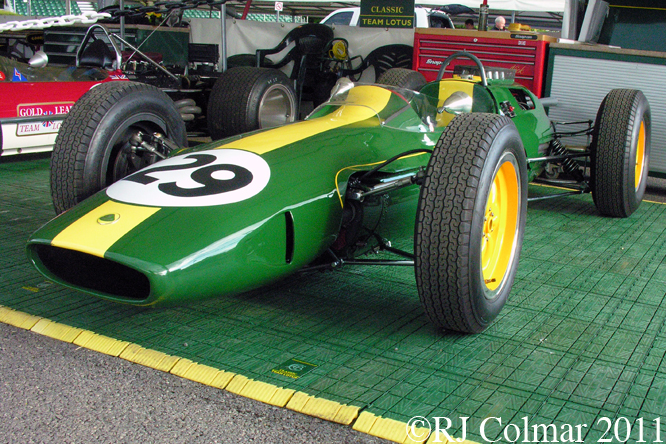
Chassis #R5 was taken back to the Team Lotus Factory and stripped down to the bear monocoque which was put aside awaiting recycling when Lotus mechanic Cedric Selzer was given permission to take the wrecked monocoque, along with some redundant parts, home.

Over the next twenty years Cedric collected enough parts including a correct Coventry Climax V8 engine to ‘recreate’ the written off #R5 in 1984.

With the full knowledge of the story of #R5 being in the public domain this rare vehicle sold for just short of a million US$ at auction in 2007.

This second Lotus 25, chassis #R4 seen above with Andy Middlehurst at the wheel during the Goodwood Revival meeting has an even more amazing tail to tell, it is the remains of the very car which Jim Clark drove to a, for the period, record setting seven Grand Prix victories on his way to securing the 1963 World Drivers Championship and the World Manufacturers Championship for Lotus.

In 1964 #R4 was driven by Formula Junior sensation Peter Arundell who started his first full season in Grand Prix racing with two third place finishes in the opening two races at Monaco and Zandvoort (Holland) and came home 4th in the French Grand Prix which proved to be his last of the 1964 season thanks to an accident in an open wheel Formula 2 race which effectively ended Peter’s career although he did unsuccessfully return to the wheel in 1965.

#R4 was then sold to Reg Parnell who replaced the Coventry Climax V8 with a BRM V8 and then given first to South African Tony Maggs and then Richard Atwood to drive. Richard crashed the car in the Belgian Grand Prix after which the repaired chassis was given the #R13 chassis number by the Parnnel Team in what might be considered a slight of hand to make the car look like it had a later Lotus 33 type chassis number, the #R13 chasssis number having been passed over by Team Lotus. #R13 also acquired the nickname Percy at this time.

Innes Ireland and Bob Bondurant competed in one further race each with ‘Percy’ towards the end of 1965 and in 1966 Mike Spence took over the driving duties scoring 2 season best 5th place finishes in Percy which was now fitted with a larger BRM P60 V8 motor.

Piers Courage and Chris Irwin both took a championship Grand Prix start each in Percy during 1967 Chris recording a 7th place finish in the cars final Grand Prix in Holland.

Peter Yock became the owner of #R13 in 1968 and he raced the car in the Antipodes passing it on to fellow Kiwi Peter Hughes for 1970, Hughes replaced the by now damaged BRM V8 with a dry sumped V8 sourced from a Daimler and when that proved recalcitrant had a Twin Cam 4 cylinder Ford motor fitted.

#R13 then disappeared until Lotus aficionado John Dawson Damer tracked it down for his Lotus Collection in Australia, when John had the car restored it was discovered that #R13 was not a similar later Lotus 33 spec monocoque at all but that it still had all the identifying monocoque features associated with the Lotus 25 and in particular chassis #R4. Like Cedric John also acquired the correct Coventry Climax V8 type motor to restore #R4 to it’s original splendor and in 1997 #R4 returned to Gooodwood for the first time.

Again with all of the details of this car in the public domain this car sold at an Australian Auction for just short of a million US$ in 2008.

It’s a sobering thought that Jim Clark was entered to drive a Lotus 25 in 30 championship Grand Prix races, he won 14 of them, won one world championship (1963) and but for some cheap engine parts might have won two more (1962 & ’64). One thing was for sure, after the advent of the Lotus 25 the writing on the wall was written large that the days of the space frame racing car particularly in open wheel racing was effectively over.

Finally a well known resource states that Lotus driver Trevor Taylor is credited with ‘inventing’ the yellow stripe that ran the length of some Team Lotus racing cars from May 1963 until the Lotus sponsorship deal with Players Gold Leaf Tobacco came into effect in 1968. There is to the best of my knowledge no evidence to support this myth, it would appear the yellow stripe was first used on Jim Clark’s #92 Lotus 29 Indy Car in May 1963 and next appeared on his, and only his, Lotus 25 at the British Grand Prix in July 1963.

My thanks to Barry, Davids McKinie and Lawson, Vicuna, Roger and Rob at The Nostalgia Forum for their help dispelling the Trevor Taylor myth.

Thanks for joining me on this Monocoque Revolution edition of ‘Gettin’ a li’l psycho on tyres’, I hope you will join me again tomorrow. Don’t forget to come back now !

14/01/12 Amendment it has come to light thanks to Roger Clark that Trevor Taylor had his mishap with #R5 during practice for the Belgian GP at Spa not during the race as originally stated in the text above.

Share

Customer Grand Prix Car – Lotus Climax 24 #947

GALPOT Saturday’s will be returning to a potted history of Lotus Cars for the foreseeable future. Picking up the story with the Lotus 24, which although was similar to look at as the preceding Lotus 21, was a fresh space frame design for the 1962 Grand Prix season.

Lotus Climax 24, David Coplowe, Goodwood Revival

The Lotus 24 was primarily designed as a customer Grand Prix car using many of the same suspension components as the 1962 monocoque chassis Lotus 25 Grand Prix car which was reserved exclusively for use by the works Team Lotus.

Team Lotus entered a Lotus 24 for Jim Clark in five pre season non championship races in which he qualified on pole three times and took two victories, Team Lotus also entered a Lotus 24 for Trevor Taylor in several championship races and he scored a best 2nd place finish in the season opening Dutch Grand Prix.

In all 12 Lotus 24’s were built seven with Coventry Climax V8’s like the example above seen with David Coplowe at the wheel at last years Goodwood Revival, and a further five with BRM V8’s.

Of the customer cars Jack Brabham and Innes Ireland scored a couple of points paying 5th places in 1962 as did Jim Hall in a BRM powered example in 1963. The last appearance of a Lotus 24 in a Championship Grand Prix was in 1964 when Peter Revson drove a BRM powered car in the Italian Grand Prix to a 13th place finish.

The Lotus 24 was the last design that Lotus built specifically for customers, among the customers were Rob Walker who entered his Lotus 24 chassis ‘941’ in the 1962 non championship Mexican Grand Prix for 20 year old Ricardo Rodriguez who met his untimely demise in the car after the rear suspension collapsed causing a fatal accident during practice.

Dupont Team Zerex also entered a Lotus 24 ‘The Captain’ Roger Penske in the earlier 1962 US Grand Prix he came home 9th in his second and final Grand Prix appearance.

David Coplowe’s car shown above is chassis #947 which appears to have been originally purchased by then two time World Champion Jack Brabham who used it while he was completing his first Grand Prix car bearing his own name.

South African National Champion Syd van der Vyver acquired the car from Brabham and he rolled it in the 1962 non championship Natal Grand Prix. After repairing it Syd won several local South African races with the car before it was damaged in a garage fire.

Syd rebuilt the car but retired from the sport and the rebuilt 947 passed through several South African owners before being shipped to the USA in the 1980’s where former Lotus mechanic Cedric Selzer saw this car at Laguna Seca in 1984 when it belonged to Monte Shalett.

By the beginning of the millenium the 947 reappeared in Europe in the ownership of Martin Stretton.

My thanks to Wouter Mellissen of the Ultimatecarage.com who kindly identified the chassis number and to Cedric Selzer at The Nostalgia Forum who filled me in with a significant part of the #947’s history.

Thanks for joining me on this Customer Grand Prix Car edition of ‘Gettin’ a li’l psycho on tyres’, I hope you will join me again tomorrow when I’ll be celebrating Elvis’s birthday. Don’t forget to come back now !

PS Don’t forget …

Automobiliart GALPOT Seasonal Quiz

Automobiliart, Paul Chenard

December 26th – January 2nd

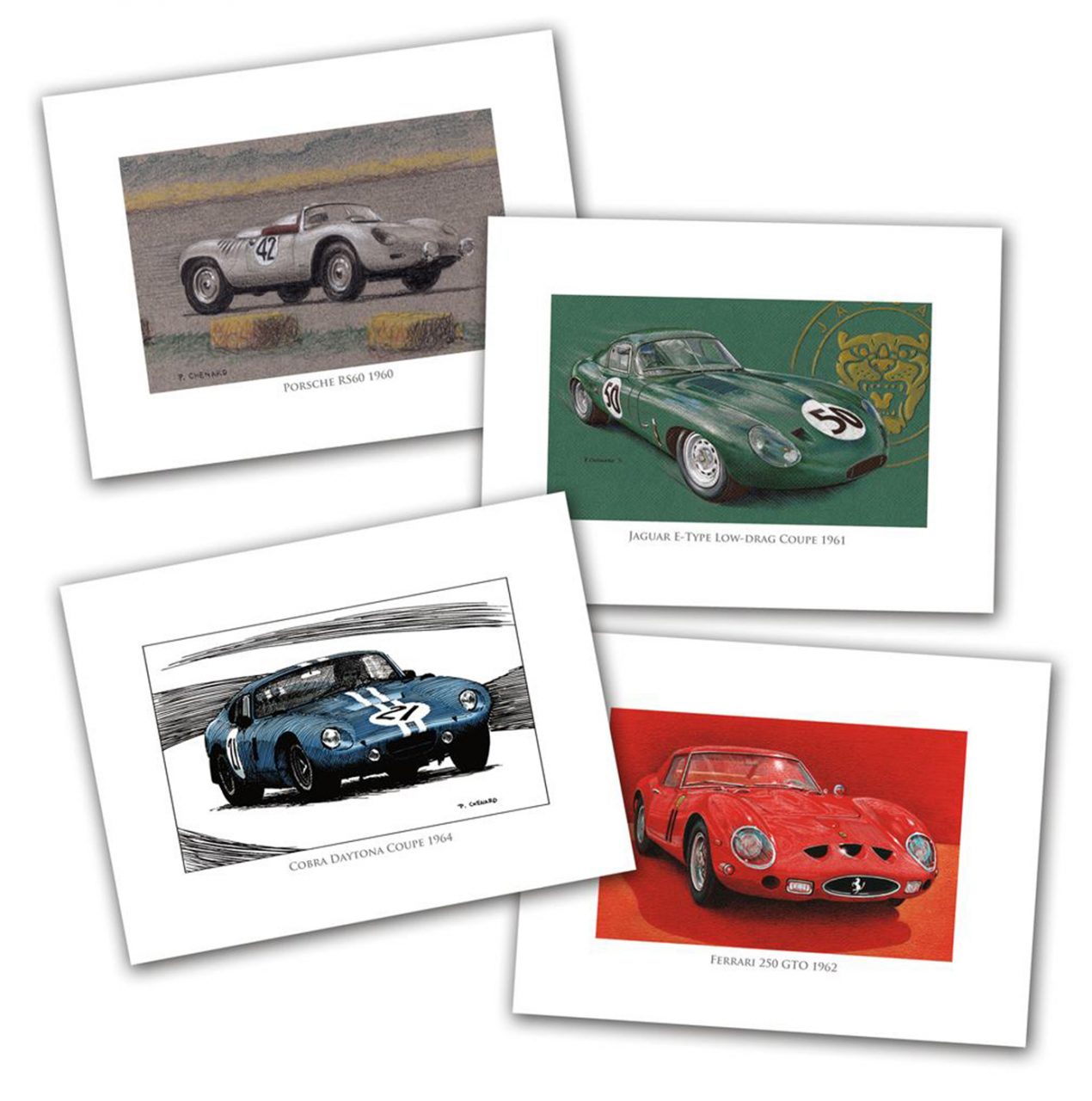
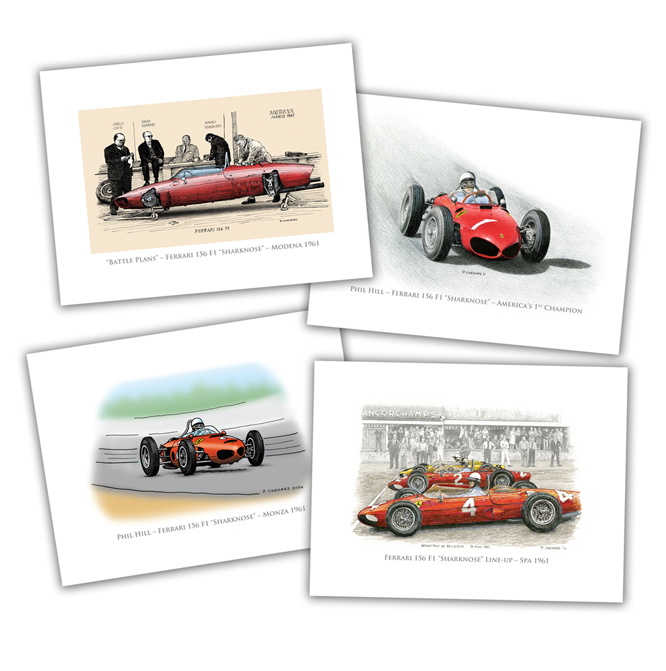
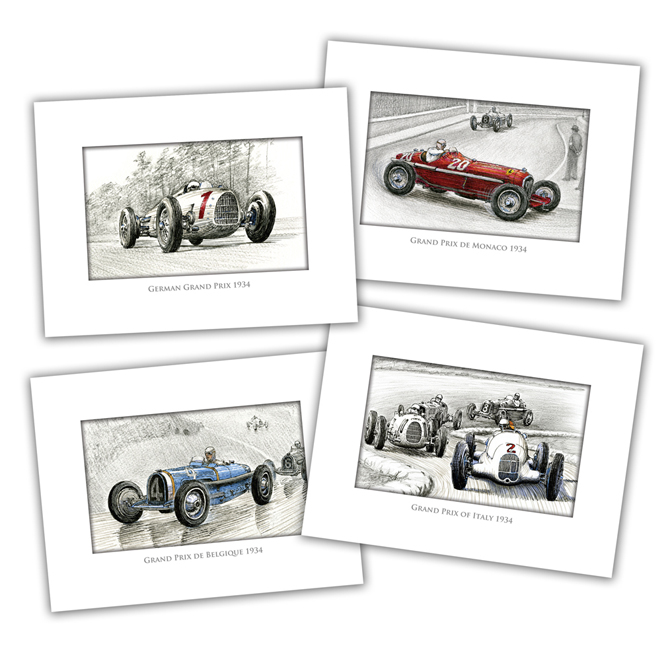
Win a set of Paul Chenard Greetings Cards

Sports-GT cars set, Paul Chenard

Set 1 Sports & GT Cars

Phil Hill, Sharknose Ferrari Set, Paul Chenard

Set 2 Phil Hill World Drivers Championship 50th Anniversary Edition

1934 GP Season Card set, Paul Chenard

Set 3 1934 Season

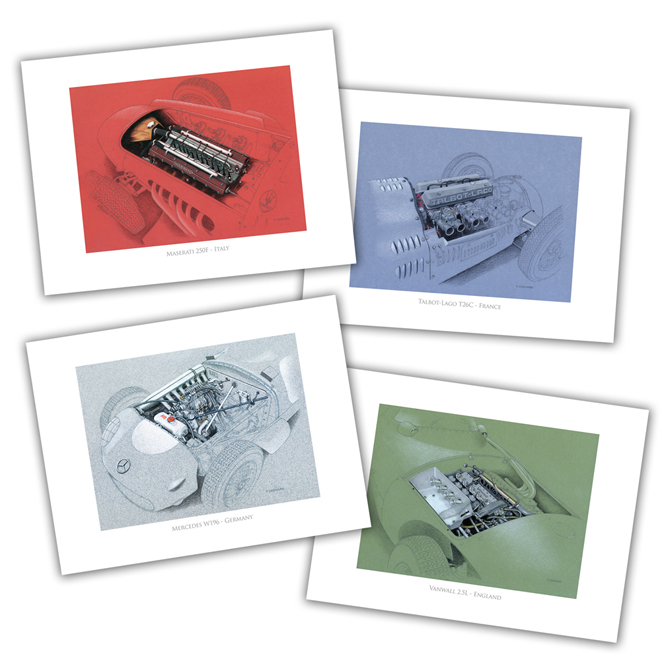
1950s Grand Prix Engines

Set 4 Grand Prix Engines of the 1950’s

or

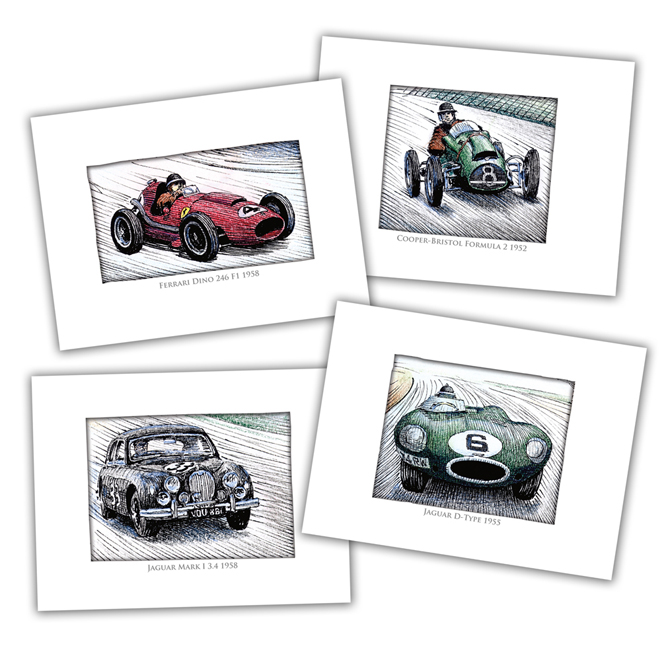
Mike Hawtorns racecars Card set, Paul Chenard

Set 5 Mike Hawthorn’s Race Cars

The Automobiliart GALPOT Seasonal Quiz will comprise 8 categories.

Overall winner chooses one set of Paul Chenard Greetings Cards from the five sets shown above.

The cards measure 15.24cm x 11.43cm, come in packs of 12 with 3 copies of 4 designs in each set, plus A6 envelopes.

Which set will you choose ?

The free to enter Automobiliart GALPOT Seasonal Quiz will run from December 26th – January 2nd Entries close January 8th 2012, Winner announced January 16th 2012.

Full details on December 26th at GALPOT.

Share

New Cortina is more Cortina – Ford Cortina Mk2

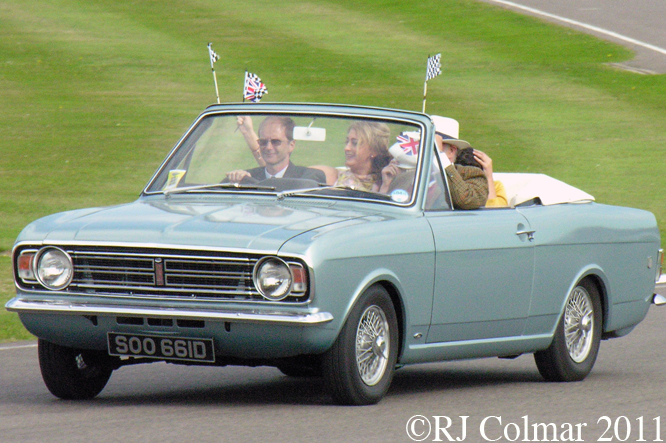
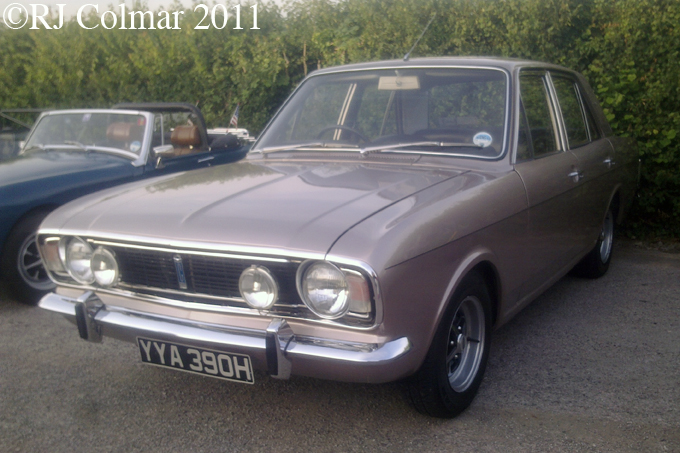
The Roy Haynes designed second incarnation of the Ford Cortina MK2 was launched in 1966 with a range of 4 cylinder ‘Kent’ motors ranging 1.2 litres / 73 cui to 1.5 litres 91 cui.

Ford Cortina MK2, Goodwood Revival

Above is a 1966 1500GT with a Crayford Cabriolet Conversion seen last year at the Goodwood Revival.

Ford Cortina MK2, Goodwood Revival

The 1300 cc / 79 cui Cortina above was acquired as a used model by London based Australian Dental Surgeon ‘Doc’ Merfield who raced under the Team Boomerang banner. The ‘Doc’ fitted one of the five prototype Coventry Climax V8 ‘Godiva’ FPE Formula One motors and raced it from 1969 and 1973. In 1979 the car was discovered in East London without the engine and has been restored with a Donovan V8.

Cortina Lotus, Goodwood Revival

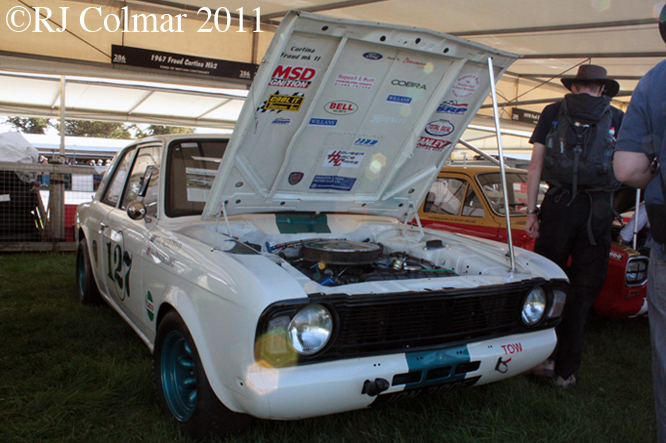
In 1967 Ford marketed a performance version of the Mk2 Cortina known as the Cortina Lotus, the reversal of the Mk1’s Lotus Cortina branding signifying that these cars were wholly manufactured by Ford where as manufacture of Mk1 Lotus Cortina was completed on the Lotus premises. The 108 mph Cortina Lotus like the one used the same Lotus developed motor as the Mk1 and the Lotus Elan. Later Cortina Lotus models were rebranded as Cortina Twin Cams. The Cortina Lotus was widely used in racing and rally competition until it was replaced by the smaller Ford Escort competition models in in 1968.

Blown Hell, Ford Cortina 1600 GT, Shakespeare County Raceway

For those not interested in competing with their Cortina’s the 1600 GT powered by a ‘Kent’ motor was the performance Cortina of choice, Blown Hell above started life as a 1600 GT but has since been fitted with a supercharged 3.5 litre / 215 cui Rover V8 for drag racing.

Ford Cortina Super, Shakespeare County Raceway

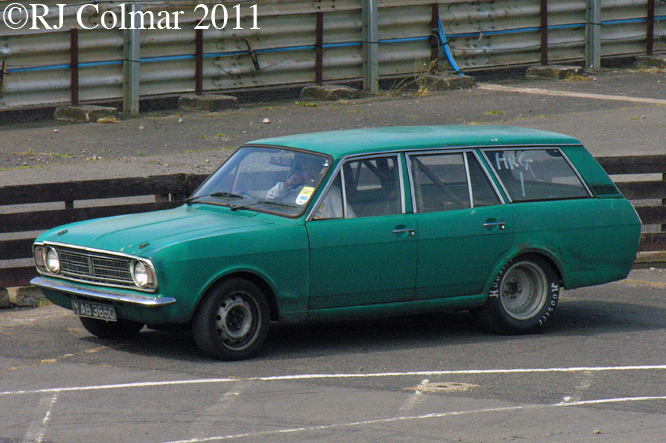
The Cortina Estate / Station Wagon above was highly rated for it’s then unparalleled load space the car seen above at Shakespeare County Raceway started life as a Cortina ‘Super’ but has since also been fitted with a 3.5 litre / 215 cui Rover V8.

Ford Cortina 1600E

The most refined of the New Cortina models was 1600E launched in October 1967, this featured a 1600 GT Kent motor, Rostyle wheels, twin fog lights, bucket seats, sports steering wheel and instrumentation, along with luxury walnut woodgrain trim. I remember when my neighbor’s Dad showed up with a 1600E in 1968 every kid on the block including me could not wait to be taken for a ride in it !

Thanks for joining me on this New Cortina edition of ‘Gettin’ a li’l psycho on tyres’ I hope you will join me again tomorrow. Don’t forget to come back now !

PS Don’t forget …

Automobiliart GALPOT Seasonal Quiz

Automobiliart, Paul Chenard

December 26th – January 2nd

Win a set of Paul Chenard Greetings Cards

Sports-GT cars set, Paul Chenard

Set 1 Sports & GT Cars

Phil Hill, Sharknose Ferrari Set, Paul Chenard

Set 2 Phil Hill World Drivers Championship 50th Anniversary Edition

1934 GP Season Card set, Paul Chenard

Set 3 1934 Season

1950s Grand Prix Engines

Set 4 Grand Prix Engines of the 1950’s

or

Mike Hawtorns racecars Card set, Paul Chenard

Set 5 Mike Hawthorn’s Race Cars

The Automobiliart GALPOT Seasonal Quiz will comprise 8 categories.

Overall winner chooses one set of Paul Chenard Greetings Cards from the five sets shown above.

The cards measure 15.24cm x 11.43cm, come in packs of 12 with 3 copies of 4 designs in each set, plus A6 envelopes.

Which set will you choose ?

The free to enter Automobiliart GALPOT Seasonal Quiz will run from December 26th – January 2nd Entries close January 8th 2012, Winner announced January 16th 2012.

Full details on December 26th at GALPOT.

Share