Tag Archives: Lotus

Testing ! Testing ! – Mallory Park

I managed to make a second pilgrimage to Mallory Park for a test session with my friend Tim, of the Bristol Pegasus MC, last week.
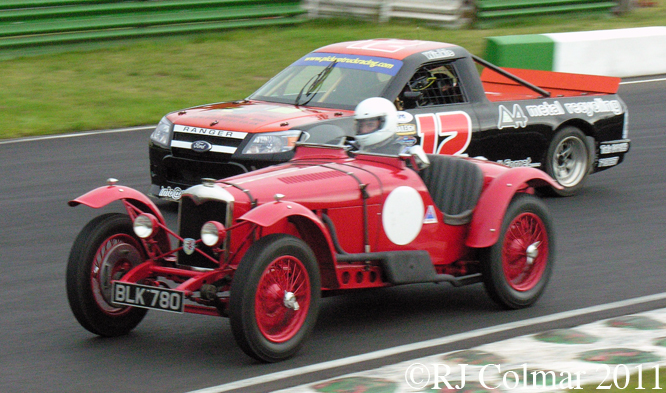
Riley, Ford Ranger, Mallory Park

Among the many delights was the sight of a Vintage Riley driven in anger alongside a Ford Ranger from the Pickup Truck Racing Series.
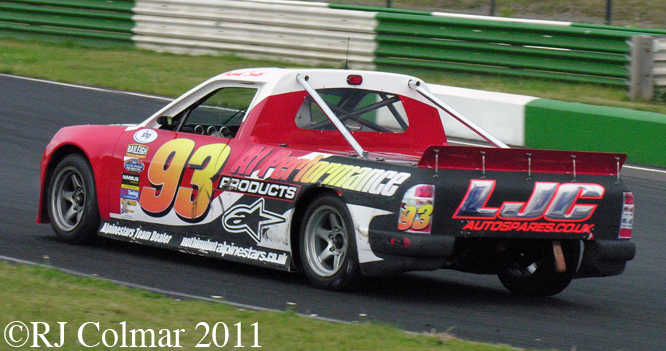
Ford Ranger, Mallory Park

Micheal Smith from Hartlepool puts his nominal #93 Ford Ranger, featuring a space frame with a spec motor based on the, GM (!), Vauxhall 16 Valve engine, through it’s paces prior to last weekends PTR races at Thruxton.
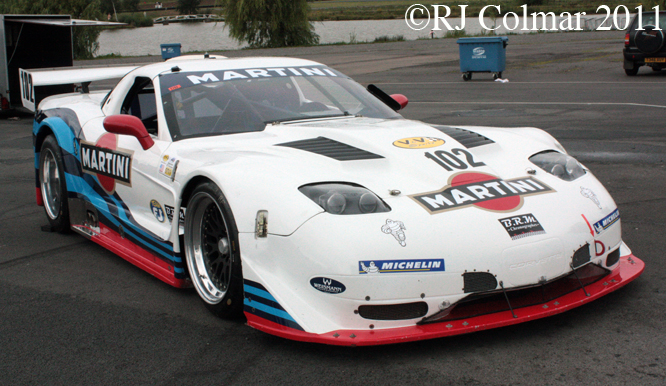
Chevrolet Corvette, Mallory Park

Castle Combe outright lap record holder Nigel Greensall was testing a new paddle shift gear selector in this 2008 Trans Am Spec Corvette which is due to appear in the French VdeV GT series at Paul Ricard Circuit in September.
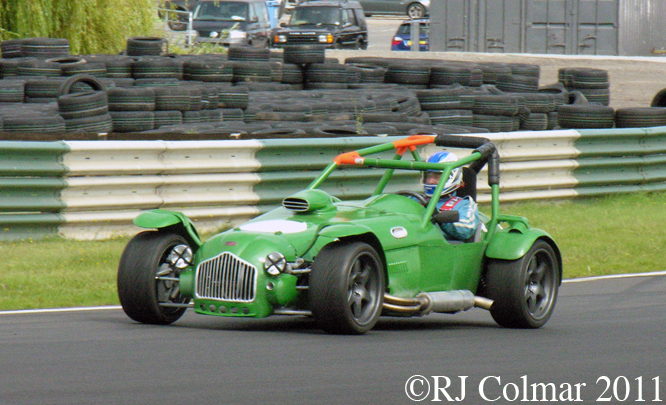
Allard, Cougar, Chevrolet, Mallory Park

Best sounds of the day came from this 427 Chevy Big block powered Allard J2 Replica about which very little appears to be known.
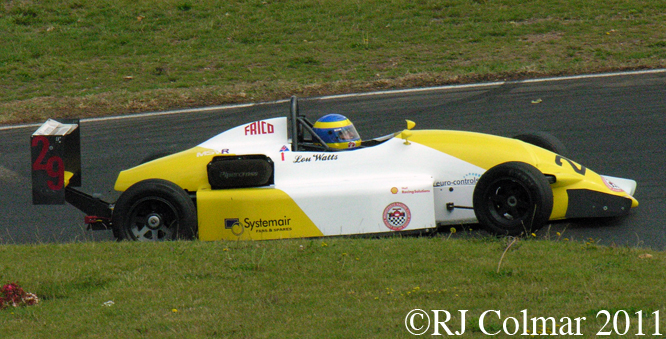
Formula Vauxhall Lotus S2, Mallory Park

Lou Watts was out in this Series 2 Spec Formula Lotus Vauxhall easily distinguished by the high frontal cockpit, these spec vehicles were in use from the late 80’s to early 90’s in a series that rivalled Formula Ford 1600 and Formula Ford 2000. Lou races this car in Monoposto Racing Club Series.
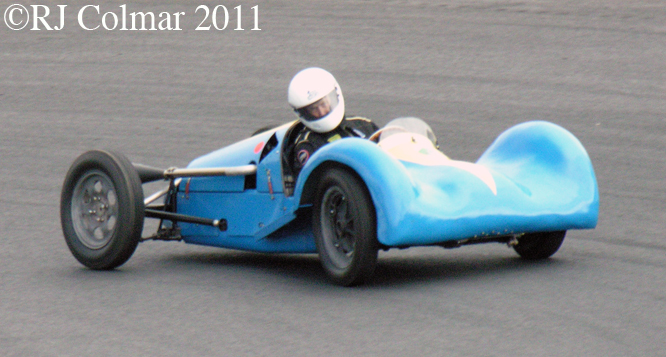
Revis, Mallory Park

Harking back to the junior open wheel series of the 1950’s was this chain driven Revis Formula 3 car powered by a Jap single cylinder 500 cc / 30.5 cui motorcycle engine connected to a Norton gearbox. Richard Bishop Miller traced the previous owner of this car to Canada where he eventually purchased it before restoring it.
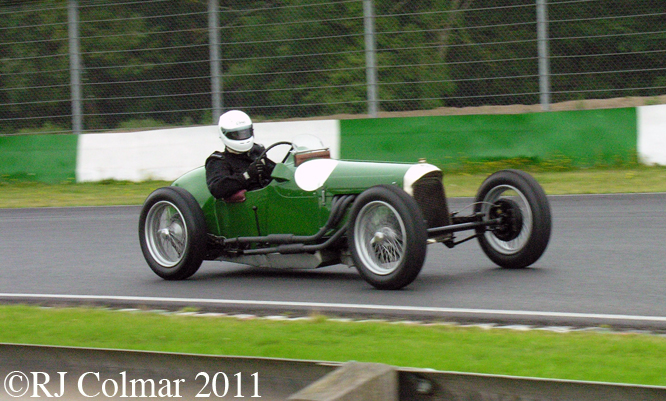
GN CoGNac, Mallory Park

Finally another fascinating special, from the 30 odd cars that appeared at Mallory last week, was this 1930’s GN CoGNac powered by a straight six AC motor. This car has recently been acquired by Tony Lees who was driving it for the first time.

My thanks to Dutchy, mikeC, David McKinney and Alan Cox at The Nostalgia Forum for additional information on the CoGNac.

Thanks for joining me on this ‘testing’ edition of ‘Gettin’ a lil’ psycho on tyres’, I hope you will join me tomorrow for a visit to the Bugatti Trust at Prescott. Don’t forget to come back now !

Share

Developed by Lotus – Ford Consul Cortina Lotus

It never ceases to amaze me how little I know about motor vehicles despite a lifetimes interest, for example when I took the photo’s featured today, I was sure I was taking pictures of a Lotus Cortina, the clues being the Green Stripe and Lotus badges.

Lotus Ford Consul, Castle Combe C&SCAD

However when I got home I was surprised to find the name plate on the front of the car read ‘Consul’. Thanks to Brian C at the Official Lotus Cortina Register Forum I have found out that the original Lotus Cortinas were badged as Consuls and indeed the car was marketed as the Consul Cortina – Developed by Lotus.

The original Lotus 28, Consul Cortina package based on the 2 door Consul Cortina body launched in 1962, included a 105hp 1558cc / 95 cui twin cam version of the Ford Kent ohv engine as used in the Lotus 23 racing car and Elan production car with a close ratio gearbox also from the Elan.

A unique A frame rear suspension was developed for the Consul Cortina by Lotus that proved so fragile that it was dropped in favour of the Cortina GT semi eliptic rear suspension when the model was upgraded in 1964 and rebadged as the ‘Cortina’ by Lotus.

The boot, bonnet and doors were made in light weight alloy with additional dash gauges, tachometer, oil pressure and water temperature included with a wood-rimmed steering wheel to complete this highly desirable 100 mph saloon car.

The thinking behind this model was that it should be used for racing and works Lotus driver Jim Clark was one of many to drive a Consul Cortina Lotus to victory lane.

All bar one of the original Consul Cortinas designed by Lotus were painted white with a green stripe, one suspicious customer had a dark blue stripe and Ford built several cars for racing painted red. The Consul Cortina by Lotus was not the most reliable of vehicles, the perceived performance bonuses were credited in the publics mind to Lotus while the unreliability problems were credited to Ford much to the latters annoyance.

My thanks to David Roots for his invitation to attend the recent Classic and Sports Car Action Day at Castle Combe and to Brian C at the Lotus Cortina Register Forum for his help identifying today’s featured car.

Thanks for joining me on today’s Consul edition of ‘Gettin’ a lil’ psycho on tyres’ I hope you will join me again tomorrow for Ferrari Friday. Don’t forget to come back now !

Share

West Coast Detailing – Lotus XI

A couple of weeks ago I looked at Ed Arnaudin’s photo of Floyd Aaskov’s Lotus XI at Thompson CT taken in 1958, where you will find details about the Lotus XI model.

Lotus XI, Paramount Ranch, Carlyle Blackwell

Photo Carlyle Blackwell, Publised Courtesy Blackwell Archive, for sales enquiry’s please e-mail infoATpsychoontyres.co.uk and your contact details will be forwarded to the Blackwell Archive.

Today we are looking Carlyle Blackwell’s photograph of Jack Nethercutt’s Lotus XI at Paramount Ranch in 1956/57.

It would appear that Jacks Lotus XI ran a similar 4 cylinder 1098 cc /67 cui Coventry Climax engine to Floyd Aaskov. One thing that stands out about Jacks car is how amazingly clean it looks, it looks as well detailed in many other photographs I have seen of this vehicle.

Records indicate that Jack Nethercutt started racing in 1956 with a Mercedes Benz 300 SL, oddly records indicate Floyd Aaskov started racing in a similar model 12 months later on the east coast. In 1957 Jack started notching up regular GM class wins on the West Coast and in 1958 he acquired a Ferrari 500 TRC with which he started winning in the 2 litre / 122 cui EM class.

In 1959 Jack upgraded his 500 TR by fitting a 2.5 litre motor in and running in the 152 cui DM class in which he continued his record of accumulating class wins.

For 1960 Jack took delivery of a Ferrari 250 TR 59 with which he again took class wins in the 187 cui S1 division including a third overall in the Sebring 12 Hours. Half way through 1961 Jack swapped his Ferrari for a Lotus 19 and again running in the DM class continued his winning ways until 1964, taking a class win at the ’62 Riverside 6 hours with a one off drive in a Morgan plus 4 along the way.

Records show that Jacks career ended in 1965 driving a Mirage Oldsmobile in the over 5 litre / 305 cui class still carrying the #102 but without much in the way of success.

Jack appears to have settled for running a Mirage Chevrolet for Scooter Patrick in the first Can Am championship in 1967.

A similar photograph by Carlyle Blackwell to photograph above appeared on the cover of Road & Track in March 1957.

Lotus XI, Paramount Ranch, Carlyle Blackwell

The caption read “It was dry and hot at Paramount Ranch, near Los Angeles, the day Carlyle Blackwell shot our March cover – but no hotter than the Lotus Eleven, driven here by its owner, Jack Nethercutt.”

My thanks to Ed Arnaudin who purchased the photograph in the 1950’s and to his son Steve for sending me the scan, thanks also to Jean L and JB Miltonian at the TNF Forum for their help in identifying the track and coming up with the R&T; details.

I hope you have enjoyed today’s West Coast detailed edition of “Gettin’ a lil’ psycho on tyres” and that you will join me again tomorrow. Don’t forget to come back now !

28 07 12 PS My thanks to Pamela Blackwell who has kindly retrospectively given me permission to post the photo’s her father took.

Share

Colin’s Eleven – Lotus XI

Today’s photographs by Ed Arnaudin conclude our coverage of Race 1 at Thompson, CT on July 20th 1958 with a look at the winning Lotus XI of Floyd Aaskov.

Approximately 270 Lotus XI’s were produced from 1956 to 1958 including the Series 2, often unofficially referred to as the XIII. the Lotus Eleven Register believes around 200 have survived.

The XI could be built to accept a variety of engines most like Floyd Aaskov’s seen here were fitted with a 4 cylinder 1098 cc /67 cui Coventry Climax engine. Like the Lotus IX we looked at yesterday the bodywork was penned by Frank Costain and crafted by Lotus neighbours in Hornsey, Williams & Pritchard.

It is believed the Lotus XI model was driven to over 148 victories in 1956, additionally Stirling Moss set a class G closed circuit lap record at Monza of over 143 mph in a 67 cui XI with a special cockpit fairing and Peter Jopp and Reg Bicknell took class G honours and 7th overall at Le Mans although the boss, Colin Chapman, driving the larger engine Class E XI having survived a miserably wet night was disappointed to retire while running second in the 1500 cc 91.5 cui class to a Porsche with engine failure.

Legend has it that the XI was so close to Colin Chapman’s affections that early Lotus road models were given names evocative of the number Eleven,hence the Elite, Elise, Elan.

Floyd Aaskov, in the #12 Lotus XI seen taking the starting flag in second place here is known to have raced from at least 1957 to 1968, records indicate he may have started racing in a ’57 Mercedes 300 SL which seems a tad fanciful though no doubt stranger things have happened. Running competitively in the GM class Lotus XI until 1962 he then moved on to the pre Can Am USRRC series with larger sports cars. Records indicate Floyds last season was 1968 when he drove a Camaro in the Trans Am series, this may not be the complete picture on his career, if you know different please chime in below !

The cars I and others have been able to discern on the grid thus far are :-

Row 1 #15 R Nerney, Abarth 207A Spider, #12 Floyd Aaskov, Lotus X1
Row 2 #92 Nick Fallone Jomar MK 2 #28 Ray Saidel, Jomar
Row 3 #113 Paul Bleustein, Cooper, #26 Len Bastrup, Lotus IX
Row 4 # ????? #27 P Sagan, Fiat Abarth 750 GT Zagato
Row 5 #95 J Iglehart, Nardi MD4 Spyder #46 J Mull D B Panhard # ?????? #?????

Interestingly one source has a #150 Lotus XI anchoring the entry list for this meeting scheduled to be driven by one and only ‘Walter Cronkite‘.

Thanks as always to Ed and Steve Arnaudin for the fascinating photographs, to Terry O’Neil for the results to everyone on the Fuzzy Longshot Identity thread at TNF including Vitesse2 and raceanouncer2003 for their contributions. I believe that is the way it was.

Hope you have enjoyed today’s eleventh hour edition of ‘Gettin’ a lil’ psycho on tyres’ and that you’ll join me again tomorrow for a look at a seriously old timer at Bridgehampton in 1957. Don’t forget to come back now !

Share

The father of BMW, Jaguar, Bristol and Lotus cars – Austin 7 Part 2/2.

Today I’ll be looking at the legacy left by the humble little Austin 7 on the European Automotive industry, if you missed my introduction to the Austin 7 here is a link to yesterdays post.

The Austin 7 deserves it’s place in British automotive history simply for being it’s first mass produced car, but it’s real standing becomes clear when one considers the Austin 7 was manufactured under licence by the Automobilwerk Eisenbach car factory.

Above Joe Tisdall, 1930, Austin 7 Ulster, VSCC Prescott,

Their Dixi variant of the Austin 7 supplied in kit form initially in 1927 was so successful that within a year BMW bought the company after its own primogenitor vehicles proved less than viable. So the Ausitn 7 saved BMW from ruin as its aeroplane engine manufacturing business began to fail after shady dealings with the USSR came to light.

Above Mark Groves, 1930, Austin 7 Ulster, VSCC Loton Park.

This next bit traces the development of engines if you stick with it you’ll see the blood line from Austin 7 through BMW to Bristol.

In 1932 BMW used the 4 cylinder 747 cc / 45 cui Austin 7/ Dixi engine as the starting point for their own 4 cylinder 788cc / 48 cui motor used in their first all in house designed BMW 3/20

By 1933 BMW built a 1182 cc / 72 cui six cylinder version of the 3/20 engine called the M78 for their 303 model.

In 1934 a larger 1,490 cc 90.9 CUI six cylinder engine was developed from the M78 for use in the BMW 315/319 series of vehicles, which was superseded in 1936 by the hemi head 1971 cc / 120.3 cui six cylinder engine for the 328 model of 1936.

Above Miss Katherine Everett, 1930, Austin 7 Ulster, Prescott.

The plans for the 328’s engine first built in 1936 were appropriated as war reparations by HJ Adlington who was both in the British Army and Managing director of BAC Cars in 1947. The 328 engines designer Fritz Fiedler was also persuaded to move to England where he continued to develop the engine for the Bristol Aeroplane Company cars sold under the new ‘Bristol’ brand, thus the Austin 7 747 cc / 45 cui engine can be seen to be of the great, great, grand father of the Bristol marque which used hemi head 6 cylinder engines derived from the 1936 BMW 328 from 1947 to 1961.

I hope that wasn’t too convoluted or painful.

Above Edward Williams, 1930 Austin 7 Rolt Ulster, Supercharged, VSCC Prescott.

Rewinding back to 1927, Sir William Lyons took the basic Austin 7 and made a high end body for it which sold as the Austin Seven Swallow, moving the Swallow Sidecar Company from side car manufacture into motor car manufacture. In 1945 the Swallow Sidecar Company was renamed the Jaguar Car Company.

Mark Lance, 1930 Austin 7 Ulster TT Replica, VSCC Loton Park.

After WW2 many Austin 7’s were converted into specials as there were not enough new cars to meet demand in England. One of those converting an Austin 7 into a special was Colin Chapman who gave his special a now popular and familiar name Lotus Mk1.

Above Ms Penny Jones, 1931, Austin 7 Ulster Replica, VSCC Loton Park.

The Austin 7 leant it’s name to another influential vehicle the original Austin Mini in 1959 which was originally marketed as the ‘Austin Seven’ and ‘Morris Mini Minor’.

Above Benjamin MARCHANT, 1928 Austin 7 Chummy, supercharged, VSCC Loton Park.

I respectfully suggest that the humble little Austin Seven, which the Austin board only reluctantly agreed to back, became, through it’s role in the development of four prestige automotive manufacturers, one of the most influential vehicles of all time.

Thanks to Roger French and Julian Hunt at TNF for their help identifying a couple of these vehicles, to Tim Murray for his assistance identifying the Chummy and to everyone else for their time and patience, tomorrow I have the first instalment of another two part blog about an absolutely stunning replica of a vehicle which shines in one of my favourite stories about Le Mans, debutantes & underdogs, wishing everyone a fabulous Friday, don’t forget to come back now ! Class Dismissed 🙂

Share

The father of BMW, Jaguar, Bristol and Lotus cars – Austin 7 Part 1/2.

The father of BMW, Jaguar, Bristol and Lotus cars – Austin 7 Part 1/2.

Above, Chris Smith, 1925 Austin Brooklands Replica, Loton Park.

Today I’d like to introduce a very special little vehicle, the Austin 7 in my humble opinion the influence of this vehicle is so far reaching that I am going to make this my very first two part blog, I hope you’ll bear with me and consider the time and space I have dedicated to this model well spent. I’ll start today by introducing the model and tomorrow I’ll consider it’s bewilderingly far reaching legacy on European automotive history

Above, Ms Hannah Enticknap, 1928, Austin 7 Ulster Special, Loton Park.

The truth is so much stranger than fiction. Consider the humble little Austin 7 with a 6’ft 3″ wheel base and track of 3’6″ powered by a 10hp 747 cc / 45 cui sidevalve engine that complete weighed less than half that of a Model T Ford when it hit the streets in 1922 with rear brakes operated by foot and front brakes operated by hand !

Above, Frank Hernandez, 1928 Austin 7 Brooklands Streamline, Loton Park.

Sir Herbert Austin acting against the wishes of his own board threatened to take the ‘7’ concept to rivals Wolseley before putting his own money into the development of the ‘7’ which was completed with draughts man Stanley Edge at Sir Herberts home Lickey Grange.

Above Matt Johnson, 1928, Austin 7 Ulster Supercharged Special, Loton Park, 2010.

Investment repayments and royalties on Sir Austin’s patents arising from the Austin 7’s innovations amounted to £ 2.10 on every vehicle sold on what emerged to be Britain’s first mass production car.

Above Doug Bukin, 1929 – 1932, Austin 7 Ulster Special, Prescott, 2010.

Over the 14 years the Austin 7 was in production 40 different body styles were introduced including 2 and 4 seaters using aluminium, fabric and steel in tourer, saloon, cabriolet. sports, vans and a Coupe style.

Above Tom Hardman, 1929, Austin 7 Ulster B & Q Special, Loton Park, 2010.

In 1923 2500 Austin 7’s were built, small fry in terms of the numbers of Model T’s built and when production ceased in 1939 the 290,000 units built was hardly hot potatoes in terms of numbers against Detroit’s finest yet the Austin 7 deserves it’s place in British motoring history for being Britain’s first mass production car.

Above Gary Bishop, 1929, Austin 7, Blaue Maus Special, Prescott, 2010.

Thanks for popping by, look forward to sharing Part 2 on the Austin 7’s legacy and it’s tomorrow, don’t forget to come back now !

Share

Adding Lightness 50 years on – Caterham 7 Superlight

The Caterham 7 Superlight comes in two sizes regular S3 as the original Lotus 7 and the SV which is 4.3″ wider to accomodate those of us who were not born with jockey size hips.

Colin Chapman’s guiding principle when conceiving his vehicles including the Lotus 7 of which the Caterham 7 is the direct descendent was to add lightness, which in his day meant extensive use of aluminium and on the Superlight shown here means extensive use of carbon fibre including the mudguards and dashboard.

Engine options for the Superlight are 150 hp Ford Sigma, 210 hp or 263 hp Ford Cosworth Duratec. The latter option should be able to propel you from 0 – 60 in 2.88 seconds and if your head is still attached to the rest of your body on to 150 mph.

I’d like to finish by wishing my fellow ‘The Prisoner‘ fan and ‘Rowdy‘ buddy from Brevard, North Carolina, Steve Arnaudin a very Happy Birthday.

Thanks for dropping by, don’t forget to come back now ! BSY !

Share