Tag Archives: McLaren

Coffee, Croissant & Cars #09/13 – Avenue Drivers Club

On second Sunday’s of the week in Bristol there is nowhere quite like Queen Square in Bristol for car enthusiasts to go for the monthly gathering of the Avenue Drivers Club.

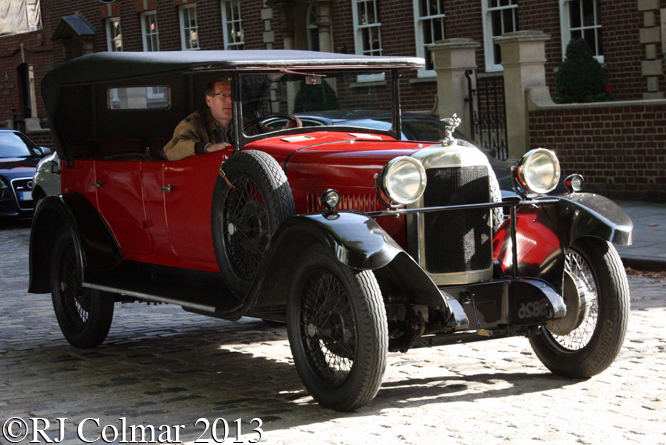
Sunbeam 14/40, Avenue Drivers Club, Queen Sq, Bristol

I managed to get down there at 8:30 am for the last meeting and already enthusiasts were coming in thick and fast. Around 2850 Sunbeam 14/40’s like the example above were built between 1924 and 1926, among novelties for the period were standard front brakes.

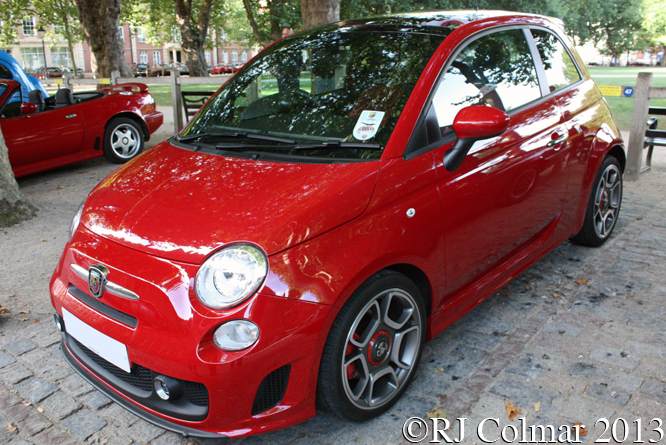
Abarth, 500, Avenue Drivers Club, Queen Sq, Bristol

Amongst those I met on the day was regular GALPOT reader Colin who owns this 2010 Abarth 500 one of the earliest imported examples of the type that did not spend it’s early life on the Hertz Rental fleet.

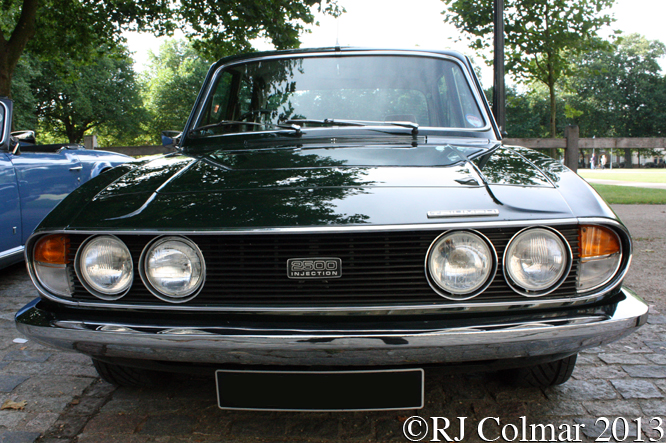
Triumph 2500 PI Mk2, Avenue Drivers Club, Queen Sq, Bristol

Readers of last Tuesdays blog might remember that Brian Culcheth and Johnstone Syer drove a Triumph 2500 PI Mk2 like the 1970 example seen here to a second place on the London to Mexico World Cup Rally.

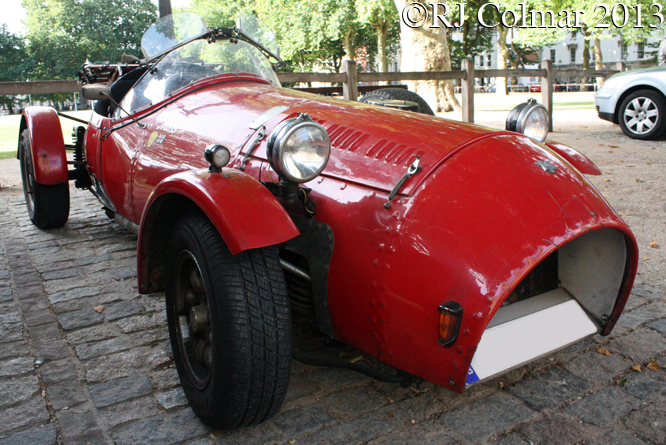
Moss Monaco, Avenue Drivers Club, Queen Sq, Bristol

John Cowperthwaite designed and built the first Moss Kit Car in Sheffield around 1981, it is thought 70 Moss Monaco‘s have been built, mostly using either Triumph Herald or Ford Escort motors and running gear.

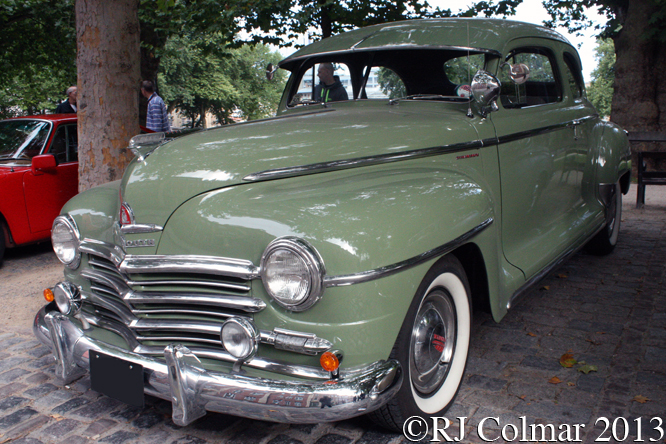
Plymouth Special De Luxe Coupe, Avenue Drivers Club, Queen Sq, Bristol

Plymouth’s first new model after the 1939/45 was was the Deluxe, introduced in 1946, which came with a push button on the dash to start the 95 hp straight six motor. The example above appears to be a 1948 Special De Luxe Coupé.

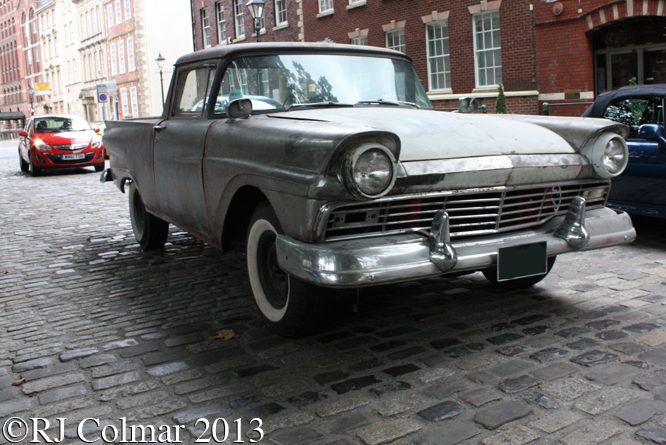
Ford Ranchero, Avenue Drivers Club, Queen Sq, Bristol

Looking like it came out of the Twighlight B&W TV series was this 1957 Ford Ranchero, which circulated the Square once before seemingly vanishing into thin air.

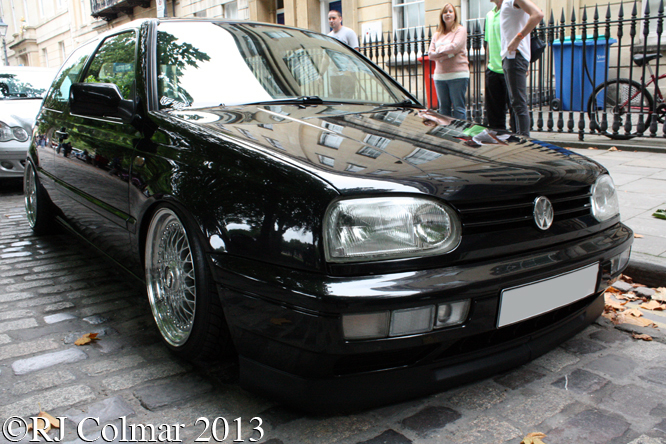
VW Golf VR6 MkIII, Avenue Drivers Club, Queen Sq, Bristol

The secret of low riding is air suspension, this two owner Golf VR6 MkIII rides on air suspension sourced from a Heavy Goods Vehicle (HGV) trailer.

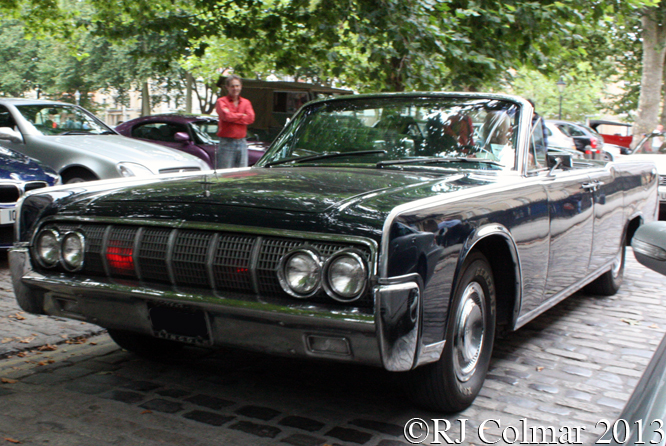
Lincoln Continental, Avenue Drivers Club, Queen Sq, Bristol

Looking suitably presidential with it’s red flashing lights mounted behind the grill and suicide rear doors was this 1964 Lincoln Continental which was imported into this country in 1991.

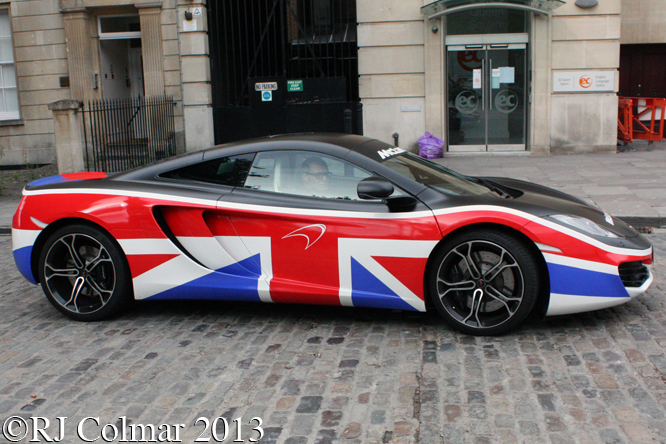
McLaren 12C Great , Avenue Drivers Club, Queen Sq, Bristol

Embarrassingly when I saw this Mclaren Great 12C I half expected Austin Powers to step out. It turns out that McLaren have been supporting an innovation initiative with these Union Jack liveried cars with the strap line, Innovation Is Great Britain.

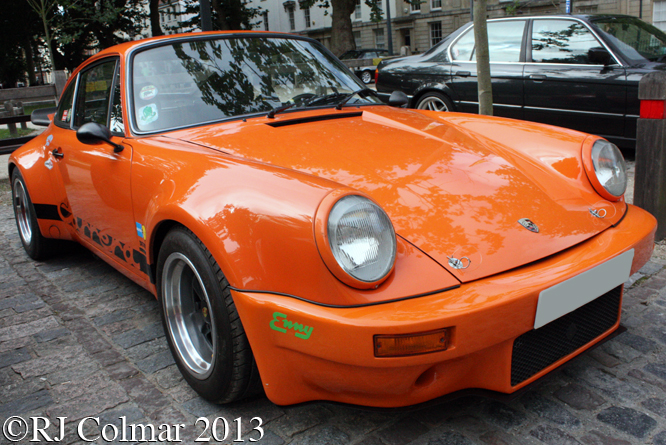
Porsche 911 RS, Avenue Drivers Club, Queen Sq, Bristol

Finally rumour had it that the owner of this Porsche RS had to break out a pick axe to remove some rubber sleeping policeman his ex wife had installed in a shared drive way, just to get the RSR bodied Porsche onto the road !

Thanks for joining me on this “Coffee, Croissant & Cars #09/13” edition of “Gettin’ a li’l psycho on tyres”, I hope you will join me for Americana Thursday tomorrow when I’ll be looking at a racing Corvette C2. Don’t forget to come back now !

Share

Wheelbase Balance – McLaren Chevrolet M8F #10-72

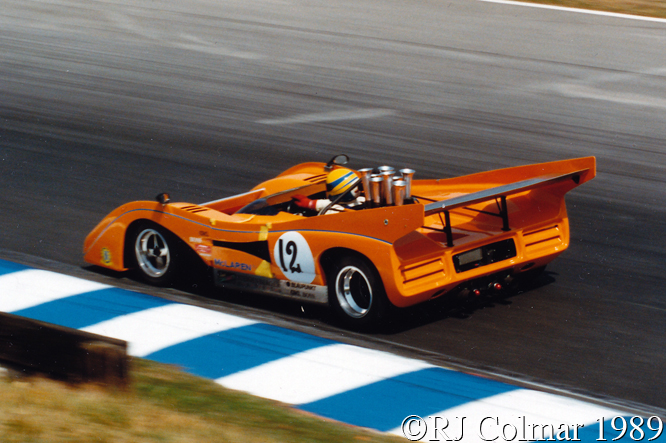
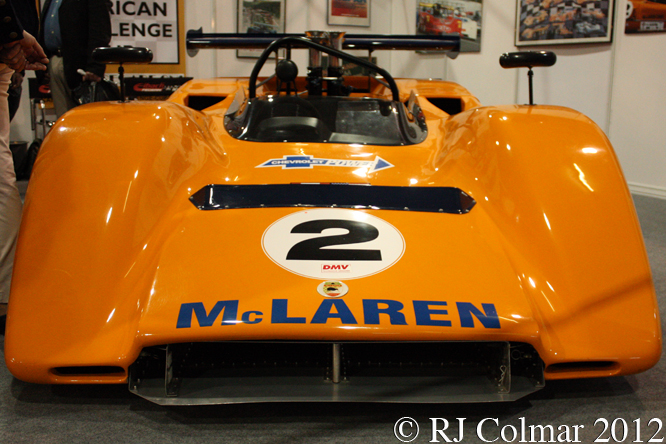
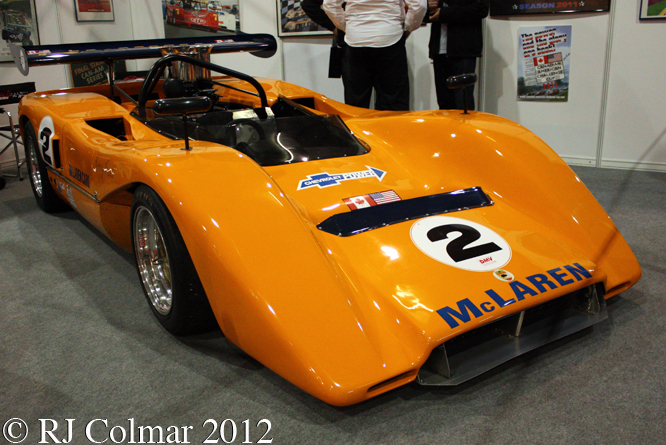
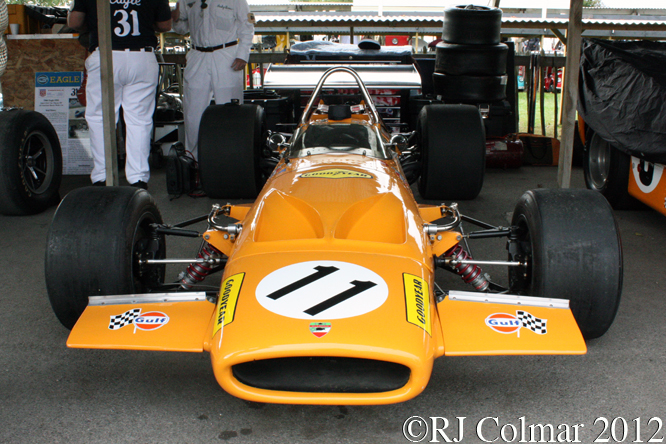
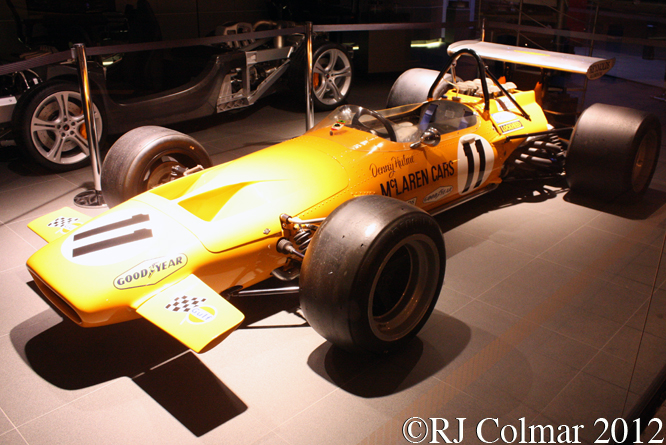
There were three race winners in the 1971 Can Am Challenge Jackie Stewart won two races in his L&M Lola T260 while the rest all fell to Denny Hulme who won three races and eventual champion Peter Revson who won the remaining five in the fifth and final year of domination by the Traffic Yellow McLaren M8F cars.

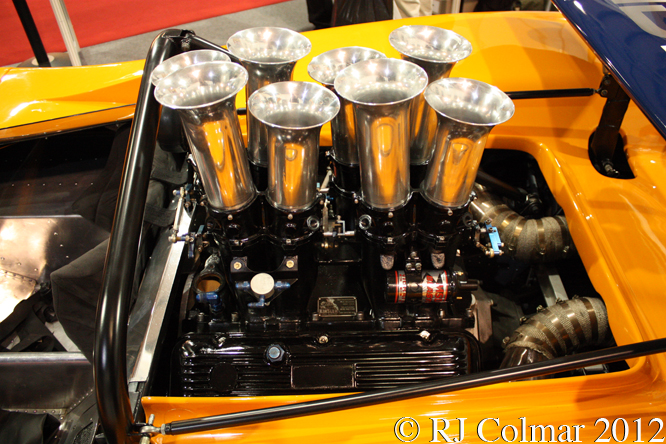
The McLaren M8F was similar to the M8D raced in 1970 but had been upgraded by Gordon Coppuck with a 3″ longer wheel base, wider track, inboard rear brakes, sturdier gearbox to improve the handling and balance of the cars which had a choice of either 740hp 8.1 litre / 494 cui or just under 800 hp 8.4 litre / 512 cui Gary Knutson tuned alloy Chevrolet V8’s.

Agg, McLaren Chevrolet M8F, Brands Hatch

For 1972 the works McLaren team moved onto the M20 and sold on it’s M8F’s to the Young American Racing Team, one of which was driven to victory at Donnybrooke by rising French star François Cevert, while Trojan built up a number of M8F spec cars known as M8FP’s for customers to run.

The most successful M8FP customer in the 1972 Can Am Challenge was German Hans Weidmer who finished 8th from 21st on the grid at Edmonton driving chassis #07-72.

Agg, McLaren Chevrolet M8F, Brands Hatch

Helmut Kelleners sold his March 707/717 and raced a Trojan built M8FP #02-72 in various events through 1972 winning the Martini International at Mainz Finthen. In December ’72 Georg Loos won the Copa Brasil at Interlagos driving chassis #03-72.

By 1975 Peter Hoffmann had acquired #07-72 for racing in Europe and in 1976 returned the car to victory lane at Kassel Calden, Mainz Finthen and Ulm. Peter drove the car to three more victories at the Nurburgring in 1979 and 1981 and Hockenheim in 1980.

Today’s featured car #10-72 is seen with Charlie Agg at the wheel during practice for a classic race at Brands Hatch, #10-72 was never raced in period. Charlie Agg is the son of Peter Agg who revived the fortunes of Trojan and then Elva in the 1960’s.

Thanks for joining me on this “Wheelbase Balance” edition of “Gettin’ a li’l psycho on tyres” I hope you will join me again tomorrow. Don’t forget to come back now !

Share

Traffic Yellow Customer Racer – McLaren Chevrolet M8 C

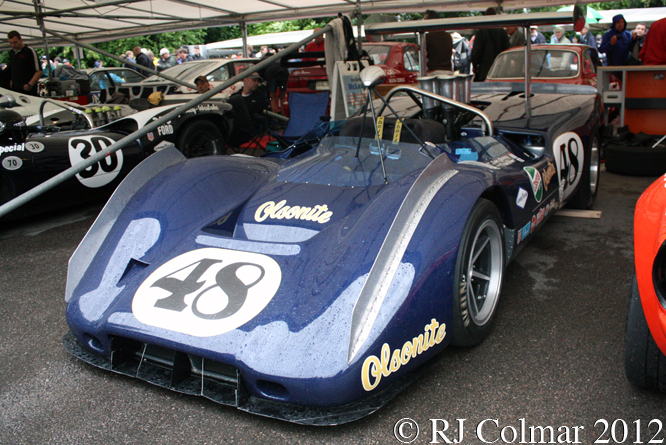
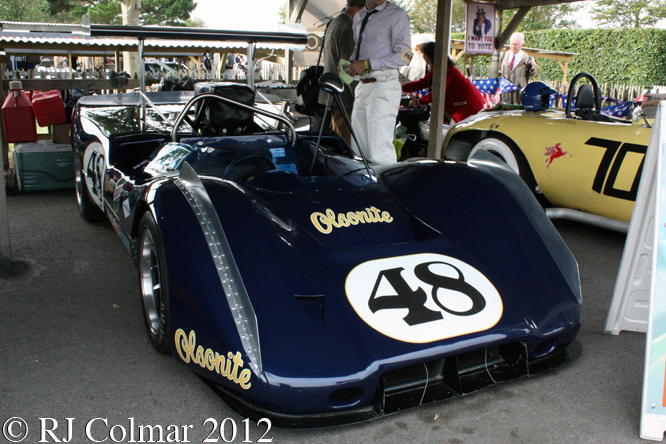
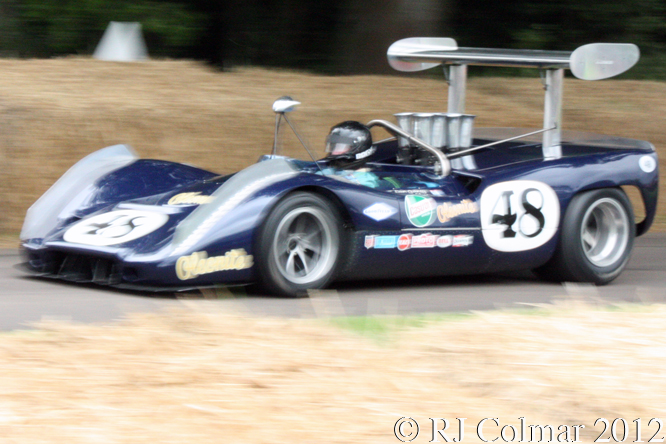
The 1969 season saw the Canadian American Challenge expand to an eleven race series, the most run in any year of the challenge, but only the McLaren Cars Team cars with New Zealanders Bruce McLaren and Denny Hulme recorded wins. Bruce won six of the races driving his McLaren M8B and with Denny recording the remaining five.

McLaren M8C/D, Race Retro

For 1970 McLaren Cars updated the M8B to a design known as the M8D while offering a production version of the M8B built by Trojan known as the M8C, of the type featured today. Confusingly Trojan also built 15 McLaren M12’s featuring updated M6 chassis running with M8 size wheels and adapted M8 bodywork in 1969. The most successful exponent of the customer M8C in the 1970 Can Am Challenge was Canadian Roger McCaig who recorded 3 5th place finishes and an eventual 10th place in the 1970 Challenge standings.

Lothar Motschenbacher who drove one of the 1969 Mclaren M8B’s, a 1969 McLaren M12 and an M8C during the 1970 Can Am Challenge recorded one 5th place in his M8C at the last race of the season to finish a distant 2nd in the 1970 Can Am Challenge, to Denny Hulme who won 6 of the ten 1970 Can Am races in his M8D to secure his second Can Am Championship.

McLaren M8C/D, Race Retro

According to the Bruce McLaren Trust website Trojan built 15 M8C’s which were also raced in Europe and South American series. The Ford Cosworth DFV powered M8C driven by Chris Craft won the 1970 Swedish Grand Prix run for sports cars including a couple of Porsche 917K’s.

The most successful McLaren M8C appears to have been chassis #70-08 which was driven to three victories in Argentina by; Nasif Estéfano at Buenos Aeries in April 1971, Carlos Pairetti at Buenos Aeries in August 1971 and Osvaldo López at San Martin in March 1973. The car was listed on each occasion as being powered by a Ford motor.

McLaren M8C/D, Race Retro

The only other in period victory recorded for an M8C is the Chevrolet example driven by Siegfried Rieger at Hockenheim in November 1971, his car featured an M12 chassis with M8C bodywork.

The last ‘in period’ race recorded for any M8C, thought to be for today’s featured car M8C #30-25, was driven by Richard Dotkins at an Interserie event run at Zolder in August 1992, where the car finished 6th in Heat 2. Since then #30-25, which would never have run in the works McLaren Traffic Yellow colour scheme as seen here, is thought to have recorded at least 5 race victories in sundry (primarily classic/historic) events through the 1990’s; 2 by Richard Dotkins, 2 by Richard Eyre and 1 by Geoff Farmer.

McLaren M8C/D, Race Retro

The #30 series chassis number of the car would more normally be associated with a space/tube frame Trojan built McLaren M1B. The history of McLaren M1B #30-25 is, like the history of M8C/D #30-25 prior to 1992, also unknown at the time of writing.

The car featured to day was seen at Race Retro and is raced by Harry Reed.

My thanks to raceanouncer2003, Belmondo, David McKinney and Duncan Fox at The Nostalgia Forum for their help in identifying today’s car and it’s history.

Thanks for joining me on this “Traffic Light Yellow Customer Racer” edition of “Gettin’ a li’l psycho on tyres” I hope you will join me again tomorrow when I’ll be looking at a Can Am BRM. Don’t forget to come back now !

Share

Dan’s McLeagle – McLaren Chevrolet M6B # 50-10 (Trojan)

The inaugural Can Am Challenge run in 1966 had been a huge successes with four different drivers winning the six races, two of them world champions, and Lola winning 5 of the races with Chaparral winning the other. For 1967 the complexion of the series would change completely as what became known as the Bruce and Denny steamroller gathered momentum with the Traffic Yellow McLaren M6’s.

Denny Hulme won the opening 3 races of the series leading team owner Bruce McLaren home in the second and third. Bruce then won the forth and fifth rounds by which time Bruce and Denny had secured first and second places in the championship. At the last race of the 1967 Can Am season the Traffic Yellow steam roller came to a temporary if grinding halt when Bruce and Denny both retired to leave 1966 Can Am champ John Surtees to take a consolation victory in his one year old Lola T70 MkII.

For 1968 Bruce McLaren stepped his team up another gear with the McLaren M8, while offering a production version of the previous years winner known as the M6B which was manufactured by Trojan, the same company that had once built bubble cars under licence from Heinkel and taken over the Elva racing car business, prior to building production versions of the Mclaren M1.

McLaren Chevrolet M6B, Goodwood Festival of Speed

Dan Gurney, who won the second race in the inaugural 1966 Can Am Challenge with his Ford Powered Lola T70 MkII, decided to replace the aging car with a McLaren M6B for himself and a Lola T160 for his team mate Swede Savage, both cars remained Ford small block (under) powered running with Westlake heads for the 1968 season.

To try and beat both the works Chevrolet powered McLaren M8’s and the customer M6B’s run by Penske for Mark Donohue with Chevrolet Power and the Ford 427 cui big block powered Shelby McLaren M6B of Peter Revson and the Motschenbacher Racing Enterprises example driven by Lothar Motschenbacher Dan’s All American Racers (AAR) team embarked on a continuous programme of development centered mostly on the M6B #50-10 featured today.

As well as lightening the M6B with exotic materials as used in the Eagle Formula One programme they continually upgraded the body work.

McLaren Chevrolet M6B, Goodwood Festival of Speed

AAR missed the opening round of the 1968 Can Am challenge where 1967 World Champion Denny Hulme led his countryman and team mate Bruce McLaren home in yet another Traffic Light Yellow walk over. At the following race run at Bridgehampton Denny and Bruce both retired with broken motors having started 1st and 2nd on the grid leaving Mark Donohue to win in his Chevrolet powered Penske M6B from Jim Hall in his Chaparral 2G.

Motschenbacher came home third in his Ford powered M6B ahead of Swede Savage in the small block Ford powered AAR Lola T160 which had started just 17th. Dan qualified 6th and finished 6th on his debut in the M6B. The Bridgehampton result would remain the teams best finish of the season as AAR experienced a variety of ills including chronic unreliability from the underpowered Gurney Westlake developed motors for the remainder of the 1968 season, Gurney and Savage even swapped cars for the last two races of the 1968 season with no appreciable difference in the results.

Denny and Bruce McLaren again topped the points standings this time Denny was Champion with three wins to the single win for Bruce. Mark Donohue finished the season third with one win. Canadian John Cannon won at Laguna Seca to score the only Can Am win in the now three year old McLaren M1B model at Laguna Seca.

McLaren Chevrolet M6B, Goodwood Revival

For 1969 Dan persevered with just the #M6B-50-10 which was by now so heavily modified it became known as the McLeagle, the reliability of his motors did not improve and midway through the season he missed a couple of races in order to install a big block Traco Chevrolet. Ironically when Dan returned to the fold with his M6B at Michigan his Bow Tie power developed an oil leak in practice and he ended up taking Jack Brabham’s intended drive in a third works McLaren M8B alongside Denny and Bruce.

Having failed to set a time in practice Dan started from the back of the field and finished third behind Bruce and Denny in a 1-2-3 finish for the McLaren team. At Laguna Seca Dan was back in his own car in which he qualified 4th but retired with a blown piston. Dan’s best ever result driving #50-10 after nearly two seasons of trying came at Riverside where he qualified fifth and came home 4th.

Dan skipped the last round of the 1969 Challenge at Texas motor speedway and ended the season equal 11th in the standings with Mario Andretti who had driven a Holman Moody entered M6B powered by a big block 427 Ford. The Challenge title went to Bruce McLaren who won six races of the expanded 11 race series with team mate Denny Hulme winning the remaining five races in what had been another Traffic Yellow wash for McLaren.

McLaren Chevrolet M6B, Goodwood Festival of Speed

Dan sold the #50-10 to Bob Brown for the 1970 Can Am Challenge, Bob also scored a couple of 4th place finishes which with 3 other minor points finishes in the further modified car was enough to secure 9th in the Challenge table.

With the death of Bruce McLaren in a testing accident at Goodwood, before the 1970 Can Am challenge got under way, Dan was drafted into replace the McLaren team founder and ended up winning the first two races of the season while Denny Hulme was driving with severely burned hands received while practicing for the Indy 500. Denny went on to win six of the remaining 1970 Can Am races to secure his second Can Am title and Mclaren’s third consecutive title.

By 1971 Dan had retired from race car driving, while Bob Brown soldiered on in #50-10 scoring a season high 6th place finish at Mosport. Bob sold the car onto RS Enterprises for the 1972 season during which Frank Riemann and Dave Causey were entered into at least three events Causey finishing a best 16th in the Can Am round held at Donnybrooke.

#50-10 is known to have been driven by Jigger Sirois in the Can Am race at Road America in 1973 and by Bob Svast at Road Atlanta in a US Champions event in 1974, from which the car was retired on both occasions. The car has been restored to it’s high wing 1969 spec as seen in these photo’s, taken at Goodwood last year, with owner Andy Boone at the wheel.

My thanks to TNF’ers raceanouncer2003 Vince H, for enlightening me about the development of today’s M6B and Gurney’s Lola T160 and to kayemod Rob for showing me a tin of the Traffic Yellow 11040 LR Rylands Polyester Colour Paste used to pigment the works McLaren fiber glass body work.

Thanks for joining me on this “Dan’s McLeagle” edition of “Gettin’ a li’l psycho on tyres” I hope you will join me again tomorrow for a look at a McLaren M8 C/D. Don’t forget to come back now !

Share

Forward With Fragrance – McLaren Cosworth M19C

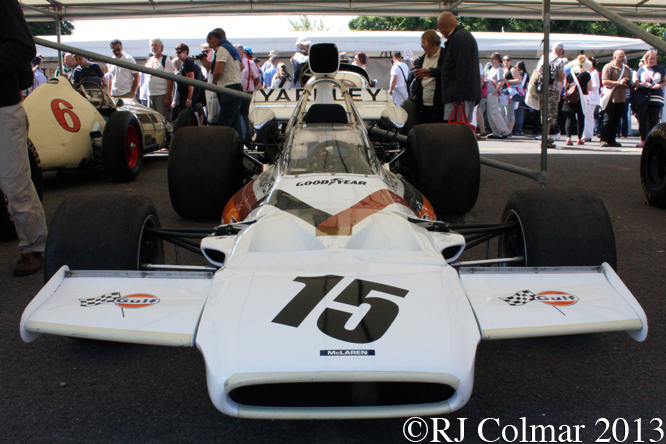
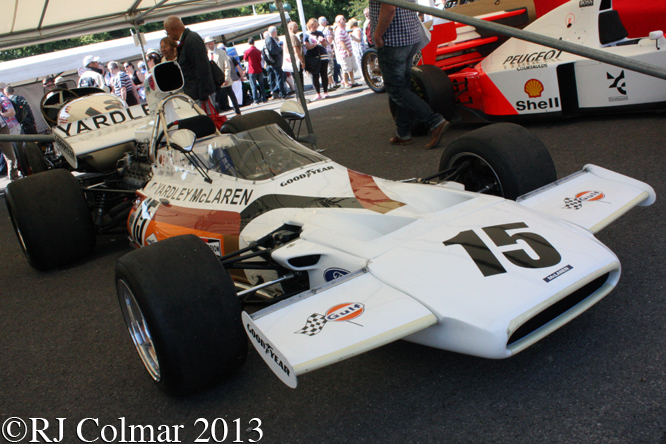
Mimicing the general out line of the 1969 Championship Matra MS80, as did many others including the Tyrrell’s 001-004, the McLaren M19A was designed by Ralph Bellamy for the 1971 season. It’s original rising rate suspension was soon abandoned in favour of the conventional McLaren M14A suspension.

After coming within a few laps of winning the 1971 South African Grand Prix with Denny Hulme at the wheel the cars best championship result came at the 1971 Canadian Grand Prix where Mark Donohue finished third in a privately entered example entered by Roger Penske.

McLaren Cosworth M19C, Goodwood Festival Of Speed

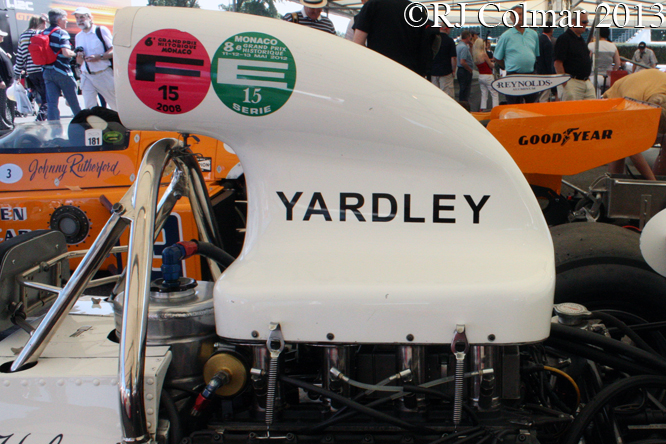
For 1972 McLaren found sponsorship from Yardley cosmetics who were less than impressed with the way BRM, whom they sponsored in 1970 and 1971, went about their business. On only their second world championship appearance in 1972 Denny Hulme won the South African Grand prix from 5th on the grid.

The M19 was given a diet in time for the 1972 Monaco Grand Prix where one car appeared in C spec with lightened front chassis bulkhead fabrication and numerous other weight saving modifications.

McLaren Cosworth M19C, Goodwood Festival Of Speed

Denny Hulme finished second in the 1972 Austrian Grand Prix ahead of team mate Peter Revson both driving M19C’s a seasons best for the ‘C’ spec cars that was matched at the 1972 Canadian Grand Prix where Revson finished ahead of Denny.

McLaren Cosworth M19C, Goodwood Festival Of Speed

In early 1973 Peter Revson finished second in the South African Grand Prix driving a Ford Cosworth DFV powered M19C on the models last championship appearance.

McLaren Cosworth M19C, Goodwood Festival Of Speed

The M19C’s were replaced by the McLaren M23 model, one of which Denny drove on it’s debut in the 1973 South African recording pole position and a fifth place finish.

Thanks for joining me on this “Forward With Fragrance” edition of “Gettin’ a li’l psycho on tyres”, I hope you will join me again tomorrow. Don’t forget to come back now !

PS My thanks to Tim Murray for pointing out Denny’s 1972 South African Grand Prix victory which I omitted from the original text.

Share

More Fuel – McLaren Ford M14A #M14/2

Going into 1970 things were looking up as McLaren Cars entered their seventh year. The team had won three consecutive Can Am Championships, 2 for Bruce McLaren and one for Denny Hulme, the inaugural European Formula F5000 championship with Peter Gethin and four championship Formula One races one for Bruce McLaren and three, including the last race of 1969, for Denny Hulme.

In addition to these racing programs for 1970 McLaren were to embark on an Indy program with the new turbocharged McLaren Offy M15 and were contracted to run an Alfa Romeo V8 powered car alongside their new Ford powered M14A Formula One car.

McLaren Ford M14A, Goodwood Revival

The new M14A was an improvement of the 1969 McLaren M7C, itself based on a Formula F5000 M10A chassis with McLaren M7A Grand Prix winning suspension.

The main feature of the new car was the narrower internal dimensions of the monocoque which were necessary to accommodate larger fuel tanks required by the ever more powerful and thirsty Ford Cosworth DFV V8’s.

McLaren Ford M14A, McLaren Manchester, Knutsford

The McLaren M14A was used in all but one race in the 1970 Formula One championship season. It’s best result was on it’s debut in South Africa where Denny Hulme finished second, driving I believe today’s featured car. Bruce McLaren matched that in Spain where he also finished second. After the Monaco Grand Prix where Denny finished forth disaster struck as first Denny was badly burned after his car caught fire in testing at Indianapolis and then a couple of weeks later Bruce was killed while testing the M8D Can Am car at Goodwood.

The team consequently missed the Belgian GP and reappeared at the Dutch Grand Prix with Dan Gurney driving the lead car #M14/1 and 1969 European Formula 5000 champion Peter Gethin making his Formula One championship debut driving today’s featured chassis, both cars retired. Denny Hulme still suffering from burned hands was back in time for the French Grand Prix alongside Dan Gurney and the pair came in 4th and 6th respectively.

#M14/2 is seen at the McLaren Manchester show room in Knutsford above.

McLaren Ford M14A, Goodwood Festival Of Speed

Dan Gurney retired from Formula One after retiring from the British Grand Prix where Hulme finished a remarkable 3rd. Peter Gethin was back in the team for the German Grand Prix where Denny again finished 3rd. Denny retired from the Austrian GP but at Monza for the Italian Grand Prix he came home 4th. Peter Gethin scored his first World Championship point at the Canadian Grand Prix where he finished 6th and Denny rounded out a painful year with a third in the Mexican Grand Prix finishing 4th in the Formula One Championship points table.

Incredibly despite his injuries Denny had also won 6 of the 10 Can Am Championship rounds enough to win the 1970 Chamionship his second Can Am Crown and McLaren Cars 4th consecutive championship aided by a further win from Peter Gethin who also won a second consecutive European Formula 5000 title driving a McLaren. The US, New Zealand and South African Formula 5000 thousand championships were won by John Cannon, Graham McRae and Bob Olthof respectively all also driving McLarens.

McLaren Ford M14A, Goodwood Festival Of Speed

For 1971 #M14/2 was driven by Peter Gethin to two second place finishes in non championship races at Oulton Park and Brands Hatch, the best championship result Peter had from 3 championship start in the car was 8th in the 1971 Spanish Grand Prix.

Jackie Oliver joined McLaren for the British Grand Prix where he qualified #M14/2 22nd but a bungled flag drop saw Jackie crash into Graham Hill at the start causing instant retirement for both and a £50 fine for Jackie. The cars final works appearance was at the 1971 Italian Grand Prix where Jackie qualified 13th and finished 7th in a close fought race won by Peter Gethin now driving a BRM.

McLaren Ford M14A, Goodwood Festival Of Speed

#M14/2 next appeared with a Formula 5000 Chevy stock block V8 motor in the hands of Tony Dean who’s best result was a 10th place finish in his first start in the car at Mondello Park. On his seventh and final attempt, which included retirements from races at Elkhart Lake and Brainerd, to race the car Tony failed to qualify for the non championship 1972 John Player Challenge Trophy at Brands Hatch.

In 1973 at the same venue Willie Wood failed to qualify #M14/2 for the Formula F5000 race or non championship Race of Champions and was not classified in a further appearance at Oulton Park. Allan Kayes then bought #M14/2 was also unclassified at Brands Hatch, finished 11th at Oulton Park and then retired, failed to qualify or failed to start in 12 further races most of which were rounds of the 1974 European Formula 5000 championship.

Thanks for joining me on this “More Fuel” edition of “Gettin’ a li’l psycho on tyres” I hope you will join me again tomorrow. Don’t forget to come back now !

Share

Balena Close, Poole, Dorset – Penske PC1 #001

After he had finished fabricating the Len Terry designed Eagle monocoques for All American Racers (AAR) in California, John Lambert returned to the Untied Kingdom and started a new business which was located on a small industrial estate outside Poole in Dorset where the rent was cheap. When Len Terry fell out with Frank Nichols they wound up Transatlantic Automotive Consultants based in Hastings where they had designed the AAR Eagle and Terry went to join Lambert, with whom he had worked at Lotus and AAR, in Poole starting a new business together called Design Auto.

In 1969 Len Terry started to design a series of stock block Formula 5000 open wheel cars called Leda’s, John Lambert looked after the construction of them in a facility off Balena Close on the Creekmore Industrial Estate on the outskirts of Poole, Dorset. When Leda Cars ran into financial difficulty they merged into the Malaya Garage Group in 1970. Three years later Malaya Garage Group did a deal with New Zealand racer Graham McRae selling the Leda Cars premises “lock, stock and barrel” with the cars manufactured now rebranded as McRae’s.

At around this time Roger “The Captain” Penske and Mark “Captain Nice” Donohue were experiencing many successes on the US racing scene which included three Trans Am championships, then only for manufacturers, driving the Captains Chevrolet Camaro in 1969 and AMC Javelins in 1970 and ’71.

In 1972 Mark won the Indy 500 in Roger Penske’s McLaren M16 and at the end of the year drove Penske’s McLaren M19 in the Canadian and US Grand Prix finishing a more than credible 3rd in his debut Grand Prix. The following year Mark and Roger won the Can Am championship with the “Turbo Panzer” Porsche 917/30. Having achieved pretty much everything in the US, including a NASCAR Winston Cup win at Riverside driving a Penske AMC Matador to become the last ‘road ringer’ to win a non oval race in that series back in 1973 Mark announced he would hang up his helmet at the end of the season.

Roger Penske made plans for a Formula One team in 1974 and sent Heinz Hofer to look at Graham McRae’s ‘low profile’ premises on the Creekmore Industrial Estate in Poole, Dorset UK as a possible base and concluded a deal for the premises. The Ford Cosworth DFV powered Penske PC1 was built to a design by Geoff Ferris and Mark Donohue was persuaded to come out of retirement to drive the car on it’s debut in the 1974 Canadian Grand Prix where he qualified 24th and finished 12th 2 laps down.
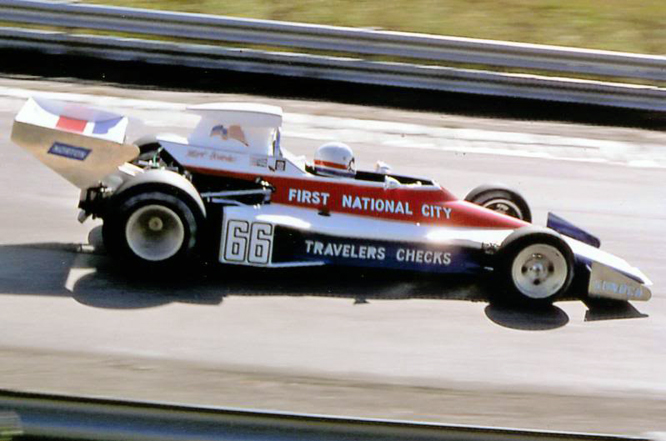
Penske Ford PC1, US Grand Prix, Watkins Glen

At the US Grand Prix, where Mark Donohue and Roger Penske fan, Brian Brown took today’s photograph of Mark in the PC1 at Watkins Glen the car started 14th on the grid, but retired after 27 laps with rear suspension problems. Brian recalls his first visit to a Grand Prix thus :-

“I was of course very excited to be seeing Mark race again, but being that it was my first live Formula One event, I was equally excited to be seeing Mario’s effort with Vel’s Parnelli Jones and the rest of the grid in person. We owned a Ferrari 365 GTB/4 Daytona and a 246 GT Dino at the time, so were very supportive of the Ferrari effort too.

My brother, friends and I spent a great deal of down time in the Kendall Garage watching the teams go about their business of working on the cars. One thing that was apparent was the absolutely professional presentation of the Penske team. Everything was spotless, just like their successful Indy Car counterpart that I’d observed in person since 1969 at Indianapolis. I was then, as now, a huge fan of Mark Donohue and Team Penske, but that aside, I always felt that they had too many positive resources not to be successful in Formula One.

I knew racing well enough to understand how tall the task Mark and the Penske team had ahead of them, but I also had the highest faith in their collective talents that I felt, given time, they would come right. I look back now and remember how I’d call in to our local ABC news tv affiliate to get the results of the races in 1975, always asking about the top six finishers along with Mark and Mario’s results.

Then came Austria and it was over for Mark and eventually Penske stopped the project – I was always appreciative that they carried on to get the victory with John Watson in Austria a year after Mark’s accident, something of a vindication for the mighty challenges that Team Penske faced in their Formula One foray. Watkins Glen 1974 was the last I ever saw Mark in person and despite the nearly 40 years that have passed, it seems like yesterday.”

Penske ended up building 3 chassis to the PC1 design chassis #001 seen here achieved a best 5th place finish, from 16th on the grid in the 1975 Swedish Grand Prix. Three races later Penske ditched the PC1 in favour of a March 751 which was raced until a new challenger until the new Penske PC3 was ready. As Brian alluded to above Mark Donohue was killed during practice for the 1975 Austrian Grand Prix after a tyre deflated pitching him off the track in to an accident which killed a marshal. Although Mark initially survived the incident he died the next day from a cerebral hemorrhage.

The debut of the Penske PC3 was delayed until the 1975 US Grand Prix where John Watson drove it in practice. Due to a misfire with the motor in the new car the team elected to wheel out today’s featured chassis one more time, John qualified 12th, finishing the race in 9th.

The following season Penske entered John in the PC3 and later PC4 models. With the latter the team won the 1976 Austrian Grand Prix, despite this success The Captain closed the Formula One program down at the end of 1976, deciding his future lay in the US racing seen where he would become the dominant force in Indy Car racing, with many of his winning cars being built in Poole, Dorset. Penske maintained facilities in Poole Dorset up until 2006. When the factory was closed one employee, Ivor, remained who had been part of the story going back to the Leda days, through the McRae years and into the Penske era.

In 2012 Brad Keslowski won his first NASCAR Championship driving a Penske entered Dodge a hitherto elusive goal on ‘The Captains’ to do list.

My thanks to Brian ‘ B² ‘ Brown for kindly agreeing to share his photograph; to kayemod, Nigel Beresford, Tim Murray, Tony Matthews, Dogearred and Doug Nye at The Nostalgia Forum for their help in piecing together the story behind Roger Penske’s presence in Poole, Dorset and a tenuous connection in the form of Lambert & Terry and their Leda Cars premises between the AAR Eagle and Penske Formula One efforts.

Thanks for joining me on this “Balena Close, Poole, Dorset” edition of “Gettin’ a li’l psycho on tyres”, I hope you will join me again tomorrow. Don’t forget to come back now !

PS Shortly before this blog was posted some confusion has come to light about which buildings in Poole Penske and McRae occupied and when, local resident kayemod and Nigel Beresford who worked for Penske have confirmed that Penske took over the Balena premises from McRae, while artist Tony Matthews is sure he visited a second facility a couple of miles away on Factory Road to do cutaway drawings for McRae and Penske is not so sure the Balena Close address is correct. If any further developments come forth I shall post them below, and if you know the answer to the riddle please do not hesitate to chime in.

PPS Nigel Beresford has kindly confirmed with another former Penske employee Nick Goozée that the Balena Close facility is the only one Penske purchased from Graham McRae. My thanks to Nigel and Nick for settling the matter so promptly.

PPPS
Balena Close, Poole, Dorset

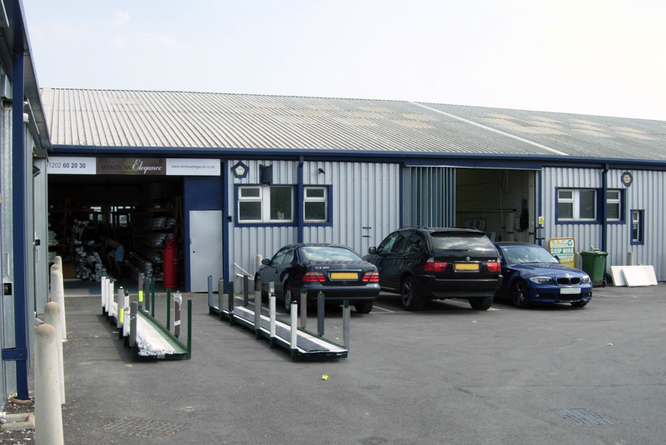
Kayemod Rob from the Nostalgia Forum has kindly sent me this photo showing “how that corner of Balena Close looks today, the small unit to the right is the original Penske UK base, formerly McRae Cars. The three parked cars more or less cover the width of the premises. The ‘Elegance’ unit to the left of Penske was once FKS Fibreglass, later Griffin Design. My ex-Specialised Mouldings chum stylist Jim Clark worked at FKS, and as well as Penske’s stuff, they also did almost everything for the Gulf GT40s and Mirages among others, their unit extended leftwards to fill the corner of the block. Penske later rented an identical unit to the right of the pic, which doubled their floor area, after some of the dividing wall was removed, they used to run their F1 operation out of that.”

Thanks Rob.
Share