Tag Archives: Motor

5th Rare Breeds Show – Haynes International Motor Museum

Last Sunday I managed to pop out for a couple of hours to catch the 5th Rare Breeds Show at the Haynes International Motor Museum.
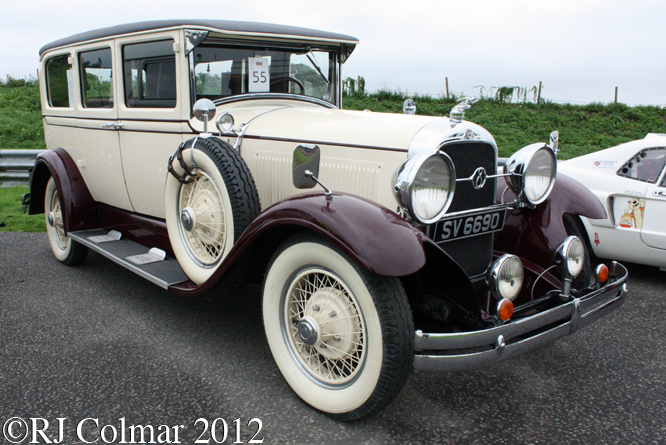
Studebaker President 8 Limousine (FA), Rare Breeds, Haynes International Motor Museum

Back in 1928 $2,450 could get you this Studebaker President 8 Limousine powered by a 100 hp 5121 cc / 313 cui straight 8 motor. This car which competed on price with Chrysler and Buick but in interior finish with Packard and Duesenburg, was built in Walkerville Canada and is believed to be the only one of 2450 built still on the road. It is operated as a wedding car by vintage-wheels.co.uk.
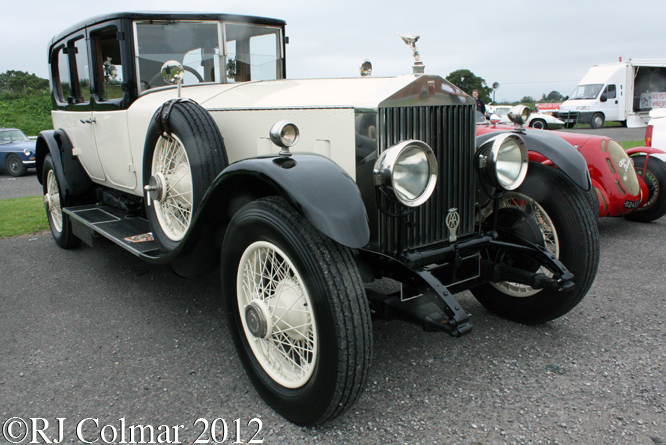
Rolls Royce Phantom I, Rare Breeds, Haynes International Motor Museum

Rolls Royce New Phantoms, built from 1925 to 1929 replaced the Rolls Royce Silver Ghost series, with a new overhead valve six cylinder motor replacing the side valve motors of the earlier models. These cars were built in Derby England and Springfield Massachusetts. This 1929 model would be one of the last New Phantoms built, they were replaced in 1929 by the Phantom II at which point New Phantoms became retrospectively known as Phantom I’s. I hope you are paying attention in the back there, this car was one of several at the rare breeds show operated by rrelite.co.uk.
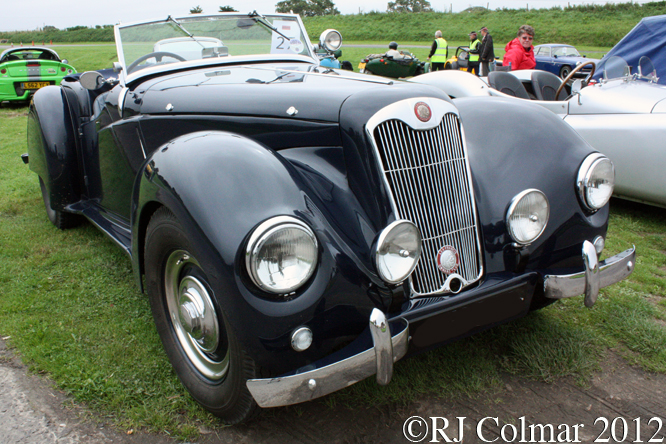
Lea Francis 14HP Sports, Rare Breeds, Haynes International Motor Museum

Weighing a ton but armed with a 87 hp motor a Lea Francis 14(taxable)hp Sports could reach 87 mph with steering and, rod operated, brakes to match. Unfortunately it’s price meant just 111 of these car were built between 1947 and 1949. This 1948 example is one of over 40 known survivor’s.
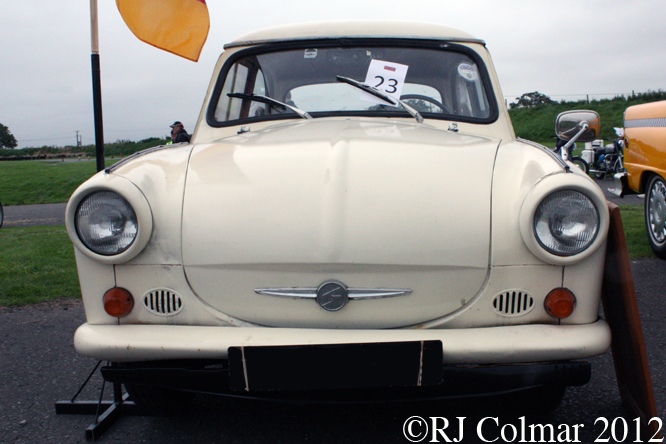
Trabant P60, Rare Breeds, Haynes International Motor Museum

With a name that translates from German to Russian into Sputnik the East German Trabant P50 was launched in 1958 with two cylinder 18 hp 500 cc / 30.5 cui aircooled two stroke motor derived from a pre war DKW. The body made extensive use of Duroplast made from recycled cotton waste from the Soviet Union and local phenol resigns from the dye industry. This 1962 P60 is fitted with the more power powerful 23 hp 600cc / 36.6 cui motor that would remain in production, from 1964 in the ‘updated’ 601 series bodies, until the collapse of the Berlin wall 1989.
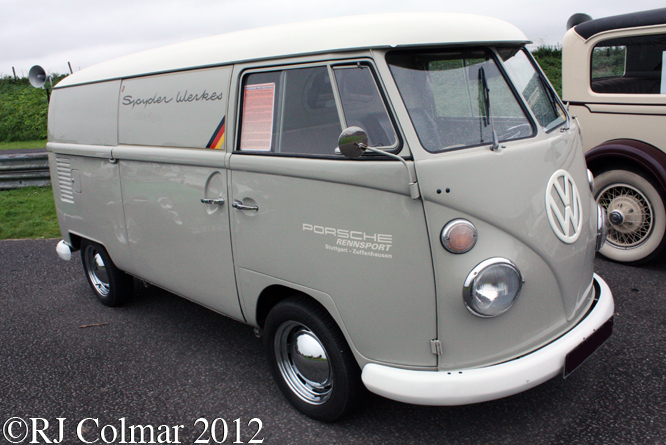
Volkswagen Type 2, Rare Breeds, Haynes International Motor Museum

Despite having only 27,000 miles on the clock this 1966 Volkswagen Type 2 has many stories to tell, it started out like as a fire truck at Zurich Airport, it has rare for the period sliding doors on both sides to facilitate access to the fire pump that used to be inside. It then served as a fire truck in a Swiss Village, with 15,000 miles on the clock it came to the UK in 2003 and was bought and returned to it’s original factory supplied colours by Ross Gammie who discovered that it’s 53 hp was not really enough to pull his Porsche 908 race car. Since it’s redesignation as a race support vehicle the van with it’s period correct Porsche 356 wheels has since changed hands again.
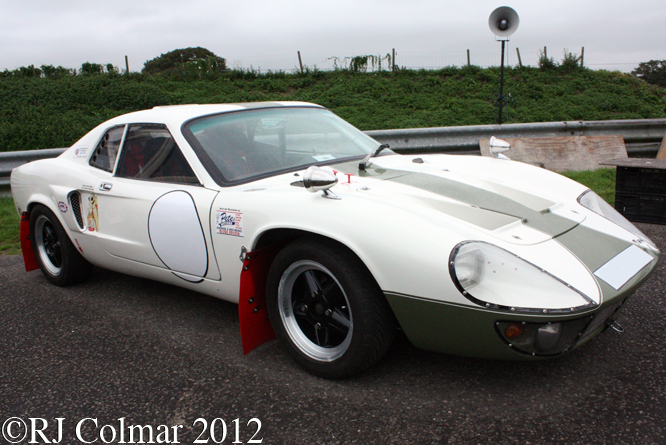
FT Bonito Special, Rare Breeds, Haynes International Motor Museum

Amazingly the FT Bonito Special above also started life as a Volkswagen, a 1967 Beetle, before a conversion was started in 1986 to turn the bug into an FT Bonito, a kit car from a company called Fibrefab. The current owner found it unfinished in a garden in 1999 and has since brought it too life with a VW Golf motor. This is thought to be the only competition version of an FT Bonito ever to have been built.
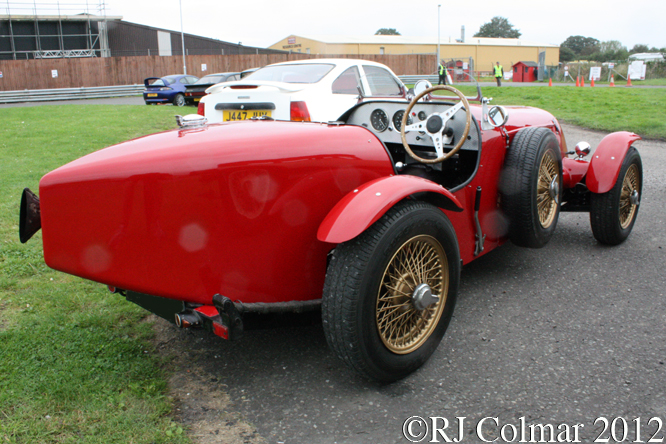
Lenham ALFA Romeo, Rare Breeds, Haynes International Motor Museum

David Roots Lenham ALFA Romeo special was looking resplendent, even on a dull day, as usual.
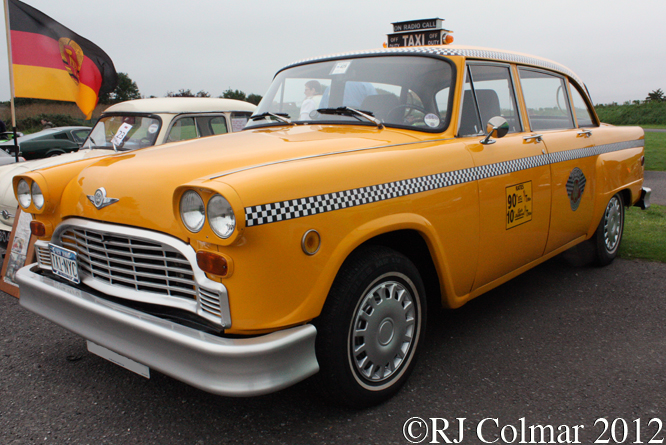
Checker Marathon, Rare Breeds, Haynes International Motor Museum

The New York ‘cab’ above is a 1978 Checker Marathon with a 160 hp 5735 cc / 350 cui V8 motor. The car is also operated for weddings and filming by rrelite.co.uk . Among it’s credits is an appearance in the 2008 Boyzone number Love You Anyway.
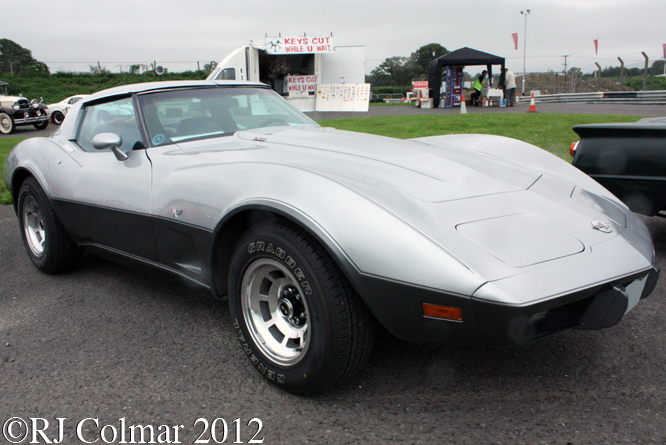
Chevrolet Corvette, C3 B2Z, Rare Breeds, Haynes International Motor Museum

I looked in detail at a Chevrolet Corvette C3 some weeks ago the 1978 model seen here has the $399 B2Z 25th Anniversary option two tone paintwork along with the 25th Anniversary mandatory $380 option aluminium wheels and sport door mirrors.
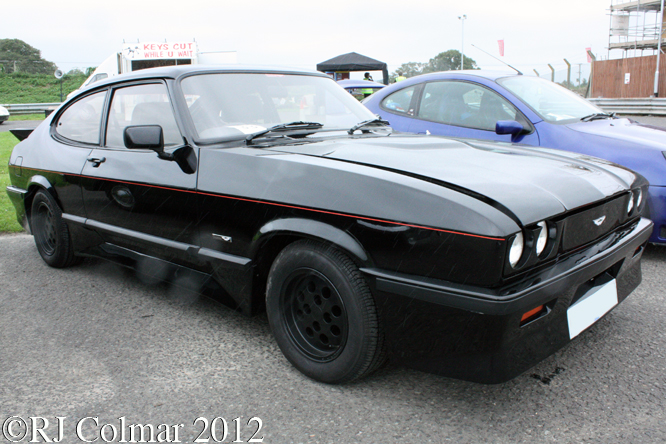
Tickford Turbo, Rare Breeds, Haynes International Motor Museum

The Tickford Capri is a Ford sanctioned hand built Ford Capri with a 205 hp turbocharged motor that cost double the price of a standard 170 hp Ford Capri 2.8i. This 1984 example #002 was the first type approved version, ordered by someone desperately keen to have one built as close to the prototype show car before Tickfords had even moved into the planned production facility for the series.
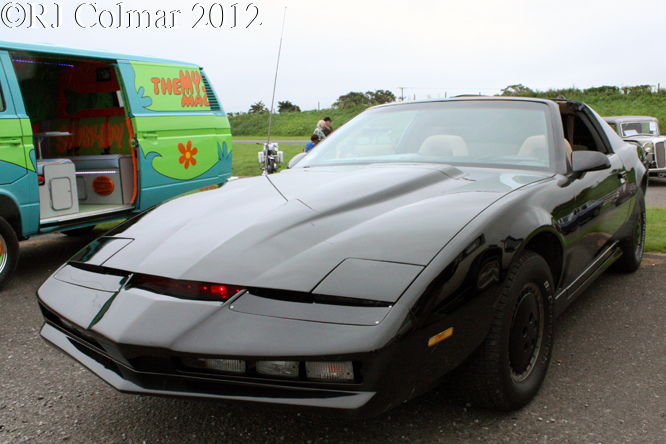
Knight Industries Two Thousand, Rare Breeds, Haynes International Motor Museum

The 1984 Pontiac Trans Am based Knight Industries Two Thousand (K.I.T.T) was developed for the Foundation for Law and Government (FLAG) by Wilton Knight and was essentially an artificially intelligent electronic computer module installed in an advanced, mobile, robotic automobile.

The original 1982 K.I.T.T was a hard top, but no doubt in danger of getting a hot head due to his crime fighting success, it was deemed that Micheal Knight be given a Targa Top for the 1985 crime wave. This particular K.I.T.T thought to be one of thirty built is operated by rrelite.co.uk.
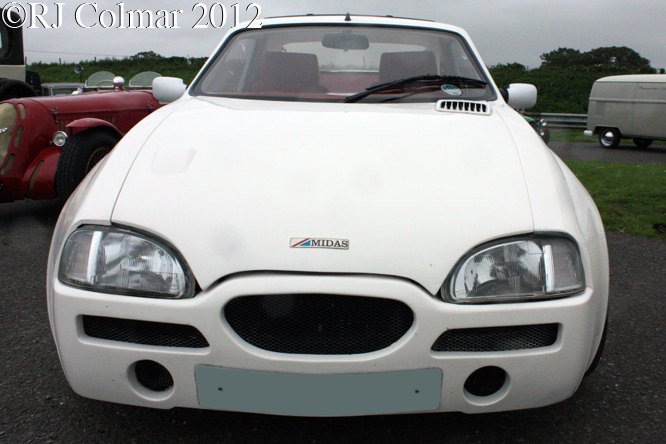
Midas Cortez, Rare Breeds, Haynes International Motor Museum

This 1991 Midas Cortez is the spiritual ancestor of the Mini Marcos with Rover Metro running gear.

Thanks for joining me on this “5th Rare Breeds Show” edition of “Gettin’ a li’l psycho on tyres” I hope you will join me again tomorrow. Don’t forget to come back now !

Share

What’s In A Tooth ? – Lotus Ford 49 #R2 & #R3

The Lotus 49 consolidated the principle of using the motor that as an integral structural component of the design that was first seen on the BRM P83 and Lotus 43 which were both powered by the novel BRM H16 motor in 1966. The 49, designed by Maurice Phillipe however was powered by the then brand new, and much simpler Ford sponsored 3 litre / 183 cui 8 cylinder Cosworth DFV that was the brainchild of Keith Duckworth and Mike Costin.

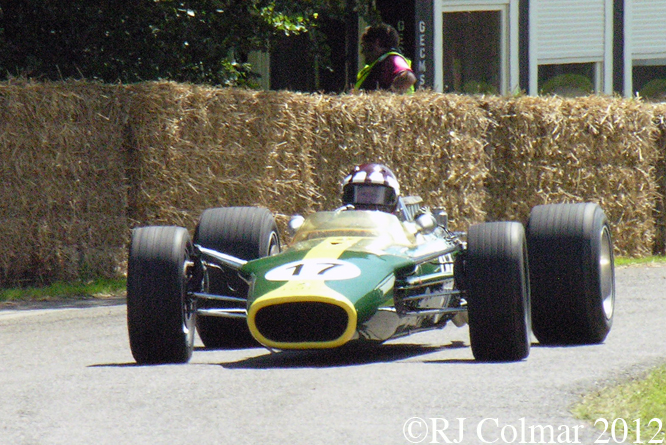
Lotus 49, Goodwood Festival of Speed

Despite many faults that would surface and be ironed out over the ensuing seasons the Lotus 49’s made a dream debut at Zandvoort for the 1967 Dutch Grand Prix with Graham Hill qualifying on pole and Jim Clark who had never so much as sat in the car before the first practice qualifying 8th. During the race Clark driving chassis #R2, seen above with Jackie Oliver at the wheel at Goodwood, used his legendary speed and mechanical sympathy to well judged victory while Hill experienced timing gear failure with two teeth next to each other on the timing gear breaking. After the race it was discovered Clark’s car had experienced a similar failure however a single tooth remained between the two broken teeth on Clarks timing gear ensuring just enough drive to make it to the finish.

Clark used Chassis #R2 to win both the 1967 British and US Grand Prix before being converted to 49T spec for the Tasman Series of races in Australasia which required an engine capacity of 2.5 litres / 152.5 cui which was achieved by fitting a different crankshaft with a shorter stroke to the DFV motors making them DFW spec. Jim won 4 races in the 8 race Series with the 49T spec chassis #R2 which combined with a couple of points paying places was enough to win the Championship from Chris Amon in his Ferrari 246 Dino.

Chassis #R2 was then loaned to Rob Walker racing during 1968 to replace chassis #R4 which driver Jo Siffert had crashed on his debut in a non championship race at Brands Hatch. Although #R4 was not damaged beyond repair by that accident it was subsequently destroyed in a workshop fire at Rob Walkers premises necessitating the loan of #R2. Once Walkers team had built up a new car, chassis #R7 now in B spec with the tall rear wing, which Siffert used to win the 1968 British GP.

Once chassis #R2 was returned by Rob Walker to Lotus it was immediately pressed into service again after Jackie Oliver had a comprehensive accident in #R6 at the 1968 French GP. For the British Grand Prix #R2 was repainted in Gold Leaf Team Lotus colours and fitted with the winged 49B spec nose cone and high rear wing. The car received further B spec upgrades for the German Grand Prix. Oliver would use chassis #R2 for the remainder of the 1968 season scoring a best 3rd place finish at the season finale in Mexico.

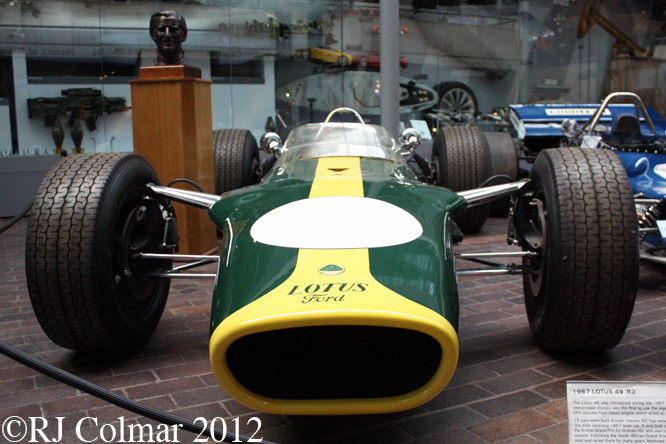
Lotus 49, National Motor Museum Beaulieu

The car seen above at Beaulieu National Motor Museum is chassis #R3 which featured subtle differences to chassis #R1 and #R2 to aid the distribution of loads under braking at the front and to aid access to the brake balance adjuster which had previously only been possible by two mechanics picking up a third smaller mechanic and lowering him into the cockpit upside down ! Note the sculpture of Graham Hill on the plinth to the left of the car in this photo.

Lotus 49, National Motor Museum Beaulieu

Chassis #R3 first appeared at the 1967 British Grand Prix with Graham Hill at the wheel, he qualified 2nd behind Clark but while leading the race first an allen screw dropped off the rear suspension and after it was replaced the engine failed while he was making up good time. Chassis #R3 has the second longest track record of the 12 Lotus 49’s built.

After Hill scored a season best 2nd place in the 1967 US Grand Prix, behind Clark, and opened his championship winning 1968 season with another second place, again behind Clark at Kyalami chassis #R3 was sold to Rhodesian John Love who used the car to win the last two of six consecutive South African Formula One titles in 1968 and 1969, his successor Dave Carlton won the 1970 South African Championship driving the Lotus 49 chassis #R8 which was built to the final C spec.

Lotus 49, National Motor Museum Beaulieu

The 400 hp Ford Cosworth DFV was to become the mainstay of Formula One right through the 1970’s, it was far in advance of the Lotus 49 chassis and would only be toppled by the hugely more expensive turbocharged motors in the early 1980’s after 155 Grand Prix Victories. One of the triangular aluminium top engine mountings can be seen bolted with three bolts on the leading edge of the cam cover tapering into the back of the monocoque to which it was attached by a single bolt. Three further such mountings were all that were required to integrate the motor into the structure of the car.

Lotus 49, National Motor Museum Beaulieu

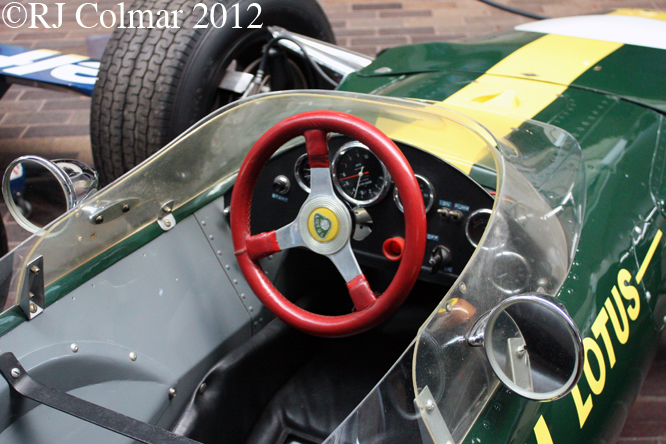
The rear suspension and drive shafts and gearbox would repeatedly prove trouble some for team Lotus as they got to grips with having such a powerful motor. The ZF gearbox in it’s original form was not strong enough and required additional strengthening which can be seen in the form of the thick vertical plate into which the drive shaft disappears. The ZF gearboxes were replaced on the 1968 B spec cars with Hewland units which were much easier to maintain trackside.

Lotus 49, National Motor Museum Beaulieu

The vestigal nudge bar was added to the back of the ZF gearboxes after the 1967 Dutch Grand Prix win in order to comply with a regulation about the dimensions between the end of the exhaust pipe and the back of the car. In other words when Jim Clark won the 1967 Dutch Grand Prix his Lotus 49 did not comply fully to the letter of the existing regulations.

Chassis #R3 is the only one of the Lotus 49’s never to run in B or C spec. Since it has been in the care of the National Motor Museum it has been involved in two serious accidents. The first, on a demonstration run, involved a tree in the Beaulieu grounds where it is kept in 1999 further details of the accident damage can be seen on this link. The second accident with the same driver occurred at a Silverstone Press Day in 2009 fortunately the damage was restricted ‘only’ to the left side suspension as can be seen in these linked photo’s.

Thanks for joining me on this “What Is In A Tooth ?” edition of “Gettin’ a li’l psycho on tyres”, I hope you will join me again tomorrow when I will be looking at a GSM Delta. Don’t forget to come back now !

Share

Champagne Super Nova – Bristol Motor Club Family Clubs Day

Last weekend I had just enough time to visit Castle Combe for a second time on Sunday afternoon to catch the end of the busy Bristol MC Family Clubs Day which saw a gathering of nearly 200 vehicles, dating from 1933 to present, enter a best in show by popular vote competition along with numerous parade laps for the participants.

Veranti, BMC Family Clubs Day, Castle Combe

Kit cars were very much in evidence, turns out the Veranti above is a 21 panel soft top rebody of a 1991 Toyota MR2. around 80 of these kits were sold between 2004 and 2007.

FFR Type 65 Coupé, BMC Family Clubs Day, Castle Combe

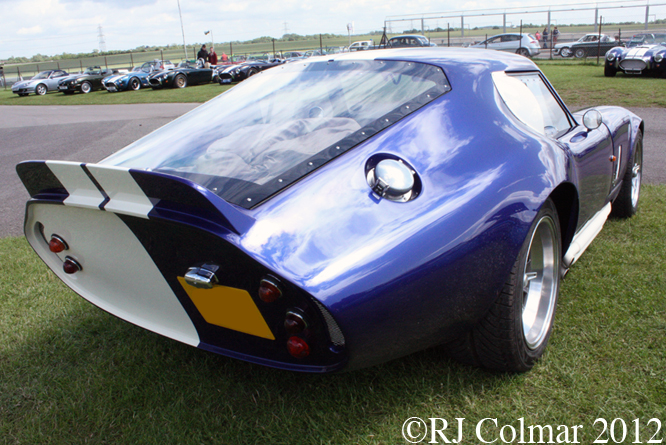
There were plenty of Cobra replica’s in attendance but the stand out example was this Factory Five Racing (FFR) Series 65 Coupé, which I understand are built around 4th generation (1994 – 2004) Ford Mustang running gear. FFR President Dave Smith claims driving his own example makes him “feel like Dan Gurney when I drive it” !

Buckler DD2, BMC Family Clubs Day, Castle Combe

Regular GALPOT readers may remember a blog about the Buckler Mk V some months ago the vehicle above is a 1958 Buckler DD2, originally this car was fitted with a Morris engine but it is now fitted with a Daimler V8 as evidenced by the two opposing carburetors peaking through the bonnet / hood.

Porsche 997 GT3 4.0, BMC Family Clubs Day, Castle Combe

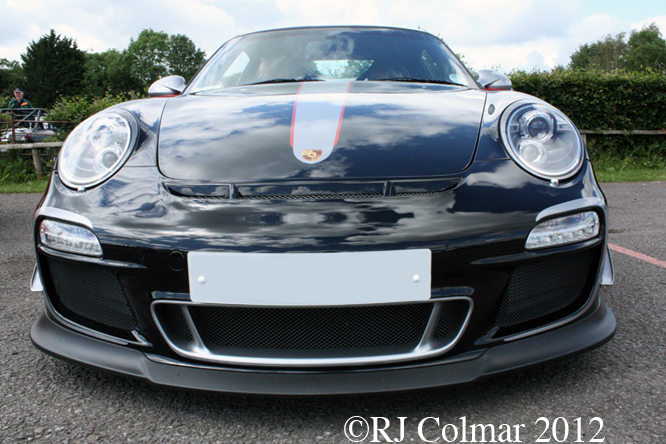
Embarrassingly I asked the owner of this Porsche 997 GT3 RS 4.0 if this was a factory spec car as until then I had only known about the GT3 RS turns out that this 500 hp GT3 RS 4.0 is one of just 600 cars that cost well in excess of a six figure sum.

Bond Bug 700 ES, BMC Family Clubs Day, Castle Combe

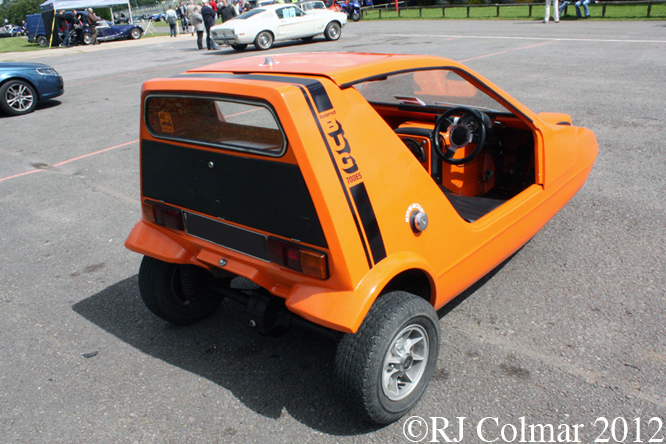
When Reliant took over Bond Cars Ltd they commissioned Tom Karen of Ogle Design to design a “fun car”. The resultant Bond Bug cost £9.00 more than a Mini when new.

Nova, BMC Family Clubs Day, Castle Combe

Winner of the popular vote and the bottle of champagne was Mick Poat who’s 1965 VW Beetle based Nova features a show stopping cool hydraulic hatch through which to effect an entry.

Thanks for joining me on this “Champagne Super Nova” edition of “Gettin’ a li’l psycho on tyres” I hope you will join me again tomorrow, when if all goes according to plan I’ll be reviewing the Goodwood Festival Of Speed. Don’t forget to come back now !

Share

Dick Mayo Sprint – Castle Combe

Another weekend another hectic schedule, on Saturday I spent the day marshaling at Castle Combe for the Dick Mayo Sprint run by the Bristol Motor Club (BMC), returning a favour when Zoe Tooth of the BMC kindly sat took the passenger seat when I tried to defend my Cross Trophy some months ago.

I was paired up with Richard, a new BMC member, to look after the marshals post on the inside of Old Paddock Bend on what turned out to be a windy but mercifully mostly dry day. Since I was the senior marshal on the post with a novice and there was only two of us, there was no opportunity to ‘stand down’ and take any photo’s of the on track action. During the lunch break, after a delicious sweet and sour pork with rice and chips, I managed to make a quick tour of the paddock to take a few snaps with my mobile phone.

RAY GR095, Dick Mayo Sprint, Castle Combe

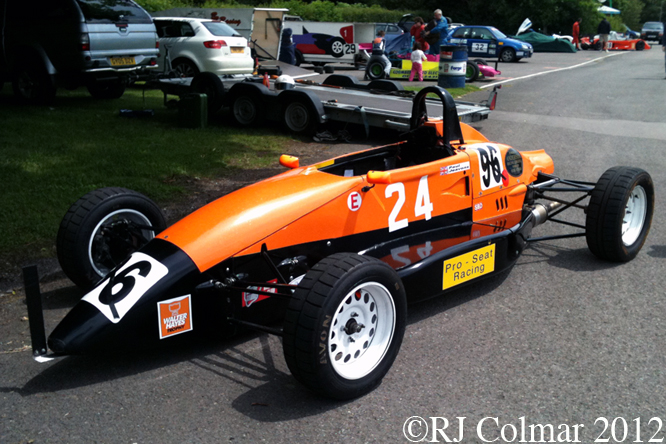
Of the open wheelers only the Formula Ford spec #24 RAY GR095 of Paul Jevons was not covered against the elements, given that Pauls Ray was the only open wheeler running on treaded tyres, without any aerodynamic down force and probably the least horsepower it is perhaps not surprising he finished last in the F2 Racing Car Class.

Porsche 914/6, Dick Mayo Sprint, Castle Combe

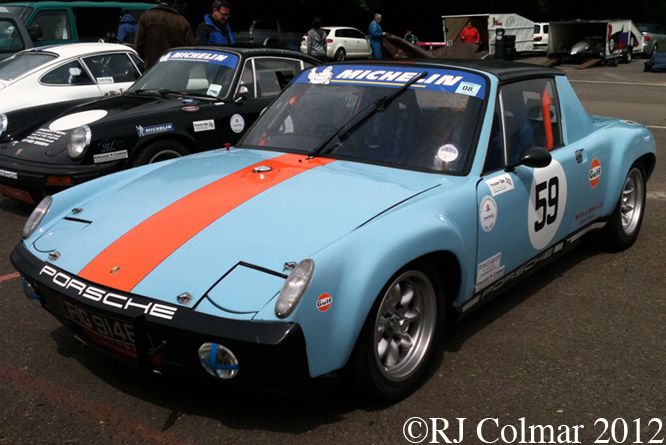
Porsche Club GB were present in force at the Dick Mayo Sprint the stand out example of the marque being the #59 Porsche 914/6 belonging to Wayne Eason running a 3 litre / 183 cui flat 6 in the 161 to 205 bhp class, despite what ought to be superior handling of it’s mid engine layout Wayne’s 914/6 was beaten by the two rear engine 911 variants running in his class.

Lotus 2-Eleven, Dick Mayo Sprint, Castle Combe

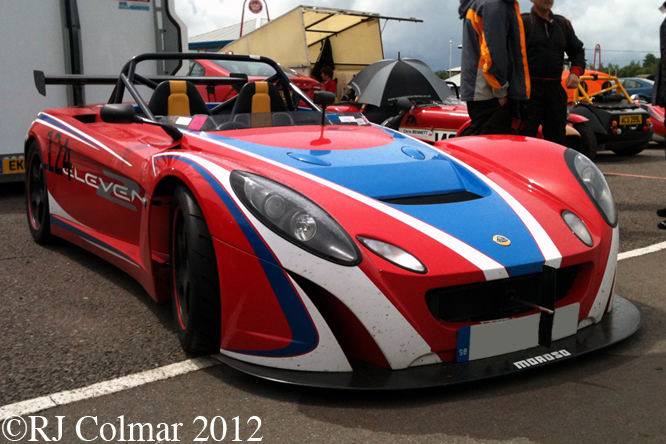
Amongst many Caterham 7’s and Lotus Elise variations the whistling supercharged, Lotus 2-Eleven track day car of fellow Bristol Pegasus Motor Club (BPMC) member James Spear stood out out as a novelty, James came third in the 12 strong Road Going Specialist Production Cars Class behind a Noble and a Westfield (Caterhan 7 look a like).

GTD, Dick Mayo Sprint, Castle Combe

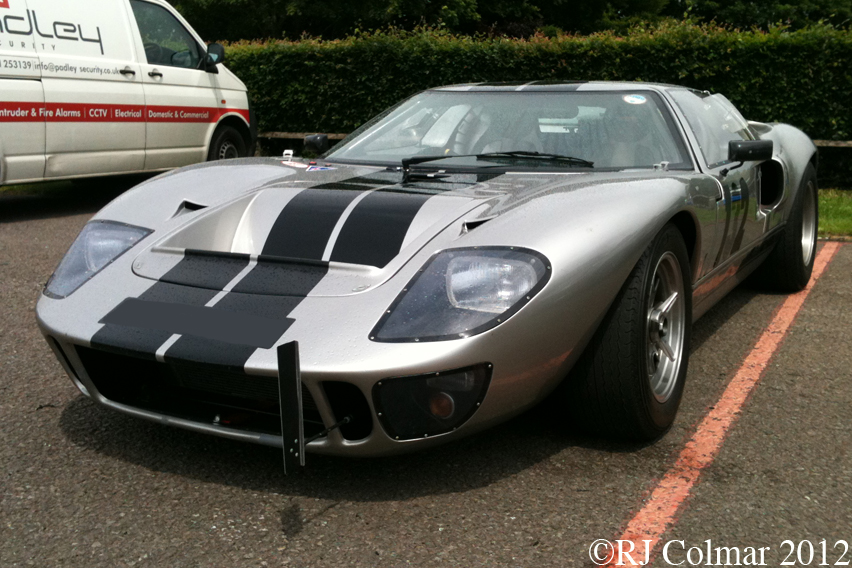
Running in the same class and coming 5th, as James, was yet another fellow BPMC member Julian West in his #132 GTD manufactured by GT Developments in Poole Dorset and not to be confused with the Tornado TSC GT40 replicas which are built in Kidderminster.

Caterham Roadsport, Dick Mayo Sprint, Castle Combe

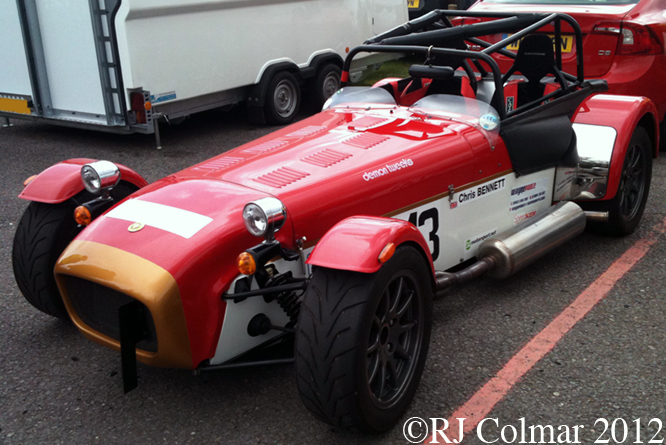
The Gold Leaf Team Lotus tribute liveried #143 Caterham 7 Roadsport, above, of Chris Bennet came in 5th in the smaller capacity Road Going Specialist Production Cars Class.

Jaguar E-Type, Dick Mayo Sprint, Castle Combe

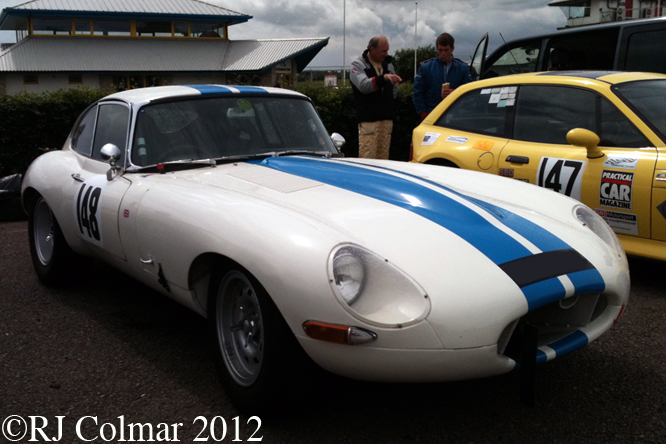
Porsche Club GB member Paul Kenelly ran his 1962 #148 Jaguar E-type coupé in the largest engine capacity class of the four Roadgoing Series Production classes finishing with the 9th best time from 10 in his class.

Morgan 3 Wheeler, Dick Mayo Sprint, Castle Combe

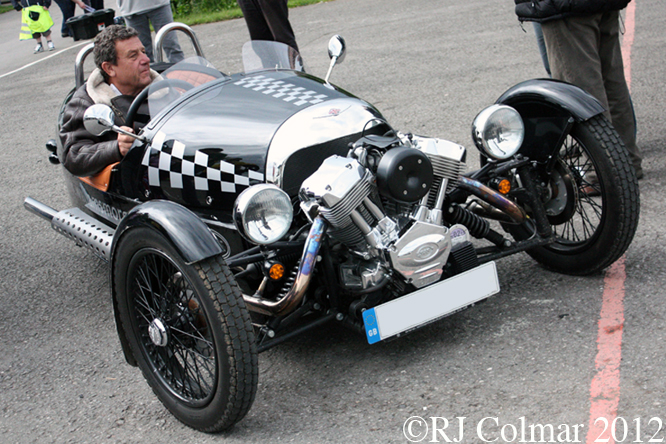
Terry Graves driving a Gould managed to record fastest time of the day, as the final runners came out rain made the track so damp the last competitor manged a time that was a full minute and more slower than the best time of the day, ironically by the time Richard and I had put our extinguishers out on the track ready for collection and jumped in his Subaru and returned to the paddock the sun was out and the track was dry ! Above the Morgan 3 wheeler drew a lot of attention in the paddock as it arrived to be put on show for the following days BMC Family Clubs Day, which I will feature next Sunday.

Thanks for joining me on this “Dick Mayo Sprint” edition of “Gettin’ a li’l psycho on tyres” I hope you will join me again tomorrow. Don’t forget to come back now !
Share

Original Wing Car – Lotus Ford 78 #78/R2

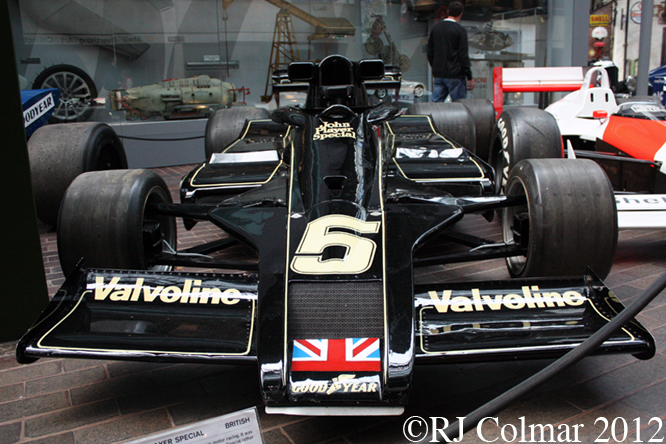
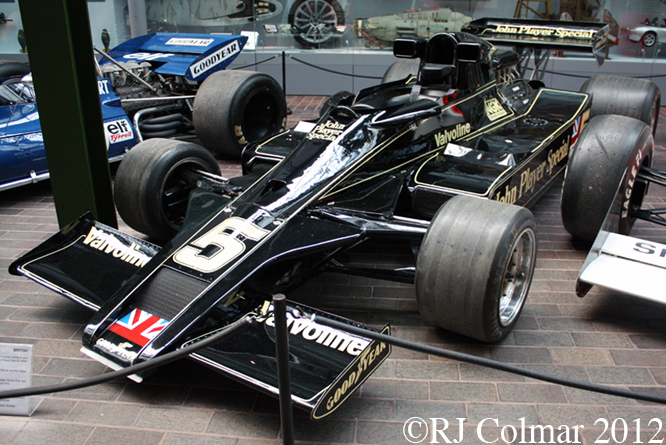
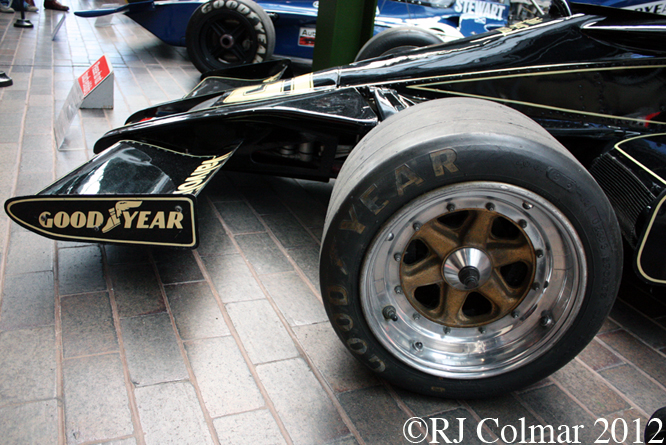
After the mixed fortunes of the Lotus 76 with it’s twin wings and electric clutch and the Lotus 77 with it’s fully adjustable suspension Colin Chapman introduced an aerodynamic innovation for the Lotus 78 featured today.

Lotus Ford 78, National Motor Museum, Beaulieu

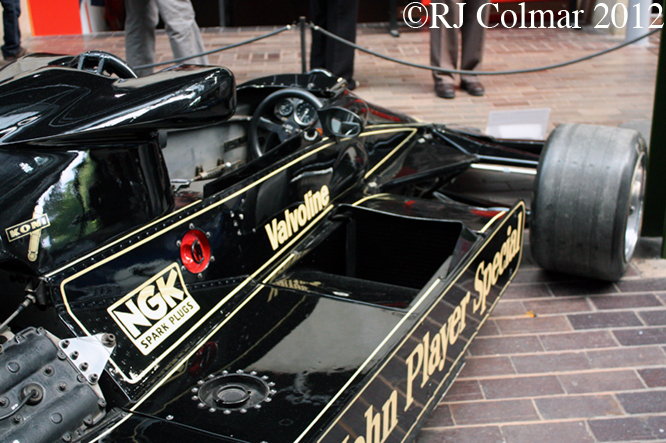
Like the ’77 the Lotus 78 was built around a narrow monocoque with an oil radiator in the nose,

Lotus Ford 78, National Motor Museum, Beaulieu

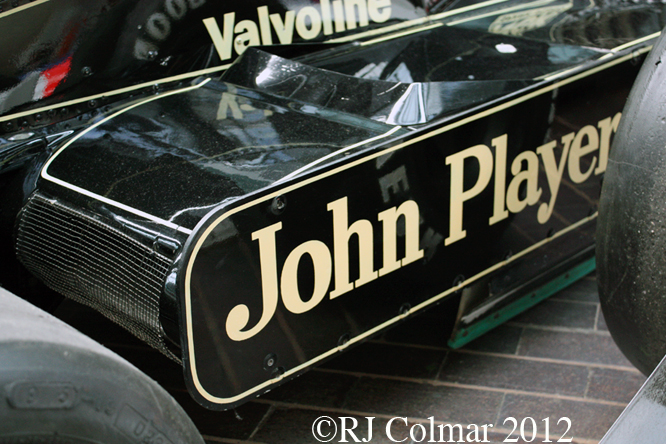
but with much larger sidepods than any Grand Prix car seen before.

Lotus Ford 78, National Motor Museum, Beaulieu

The front wings were used, in conjunction with the rear wing, to trim the aerodynamic balance of the car.

Lotus Ford 78, National Motor Museum, Beaulieu

Using an idea first modeled at BRM by Tony Rudd and Peter Wright the side pods closely resembled the upturned inner wing of a de Havilland Mosquito which Chapman had studied and written a detailed account of.

Lotus Ford 78, National Motor Museum, Beaulieu

Tony Rudd and Peter Wright joined Ralph Bellamy and Martin Ogilvie at Lotus to design the car and its side pods which produced prodigious down force to increase the speed at which it could go around corners without loosing grip.

While conducting wind tunnel tests for the Lotus 78 design at Imperial College London Peter Wright found that as predicted by Bernoulli’s principle of fluid dynamics which states that the flow speed of an ideal fluid with no friction will increase simultaneously with a decrease in pressure. Meaning in the case of the Lotus 78 the faster it went the more down force was generated by the side pods and so the better the car stuck to the road.

Lotus Ford 78, National Motor Museum, Beaulieu

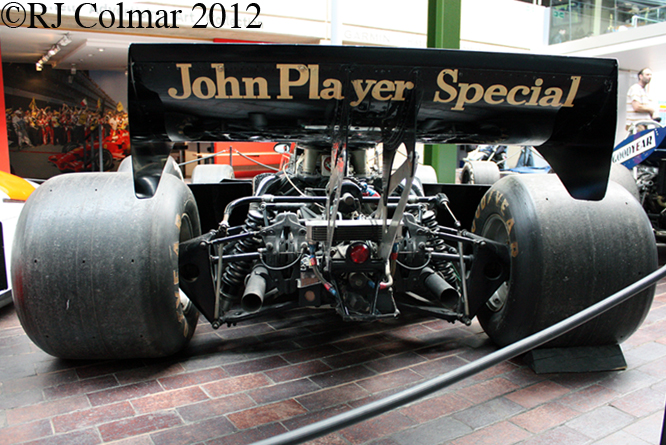
The Lotus 78’s, known as John Player Special III’s by Lotus and their sponsors, were ready to race midway through 1976, but Chapman wisely vetoed their use until 1977 so as not to give rival teams the chance to figure out what Chapman and his team had come up with and copy during the off season.

Lotus Ford 78, National Motor Museum, Beaulieu

Starting the 1977 season Lotus had a huge advantage with the 78’s affording Mario Andretti 5 victories and his team mate Gunnar Nilsson with one more. However the unreliability of the Nicholson McLaren built motors played into the hands of Niki Lauda who, having more or less fully recovered from his near fatal accident in 1976, took only three victories and a string of podium places to claim the championship.

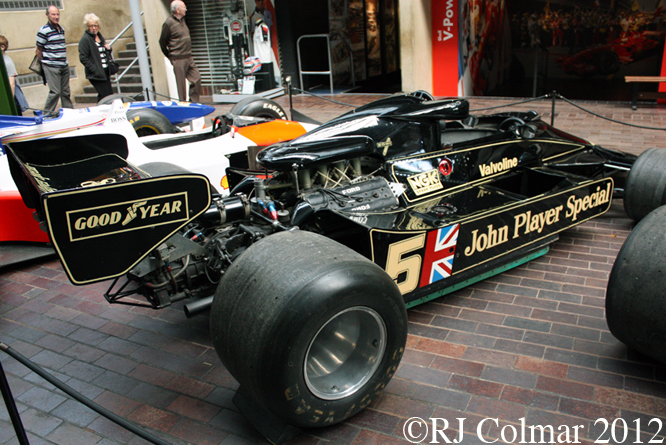
The car seen here at the National Motor Museum, Beaulieu is chassis #78/R2 which Mario Andretti used to start the 1977 season before it was entrusted to Gunnar Nilsson who won the Belgian Grand Prix driving it. In 1978 before the even more radical Lotus 79 was introduced, Lotus returnee, Ronnie Peterson drove the car and snatched a thrilling victory with one lap to go in South Africa.

Mexican Hector Rebaque acquired the car at the end of 1978 season and used it along Lotus 78/R1 which he had been using since the beginning of the 1978 season.

Sadly Ronnie Peterson lost his life after an accident at the start of the 1978 Italian GP where he was driving the back up Lotus #78/R3.

Thanks for joining me on this “Original Wing Car” edition of “Gettin’ a li’l psycho on tyres”, I hope you will join me again tomorrow when, thanks to some photographs from Geoffrey Horton, I’ll be looking at some of the vehicles in attendance at the Marin Samoma Concour’s d’Elegance. Don’t forget to come back now !

Share

Choices Choices – Simply Italian National Motor Museum Beaulieu

In the interests of keeping my regular Friday readers happy I needed little convincing by GALPOT regular David Roots to forgoe the delights of the Avenue Drivers Club monthly meeting at Queens Square, in order to take a trip to the National Motor Museum at Beaulieu for the third Simply Italian parade on Sunday.

Ferrari F40, Simply Italian, NMM Beaulieu

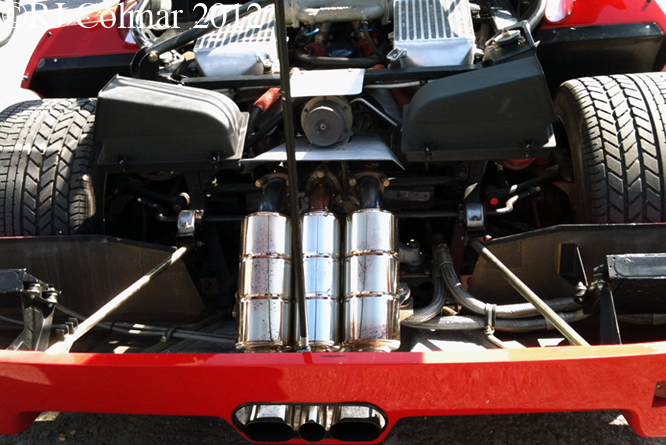
On the way down I passed at several cars making their way to Queens Square, a magnificent Alvis and several other vintage cars taking part in a Vintage Rally, and a number of classic sports cars taking part in a Classic Rally before stumbling accross this F40 as it slowly made it’s way through the achingly picturesque village of Beaulieu, pronounced ‘Bewley’.

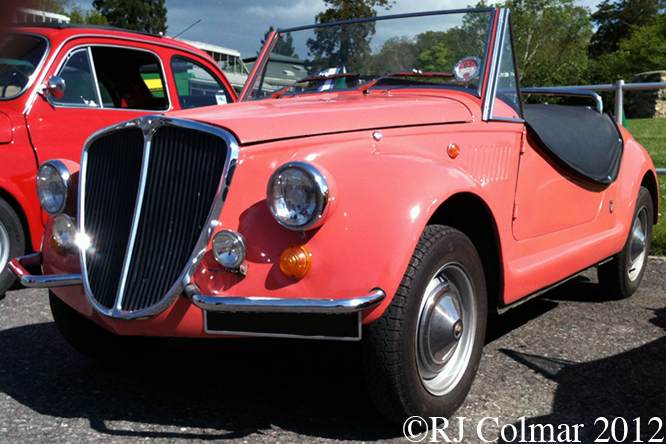
Vignale Gamine, Simply Italian, NMM Beaulieu

In the never seen one before category was the Vignale Gamine, one of just 300 vehicles, based on a FIAT 500 platform with a 21 hp 2 cylinder motor. This slow selling Alfredo Vignale pet project led to Carrozeria Vignale going out of business and the production facility being acquired by de Tomaso for their Pantera models.

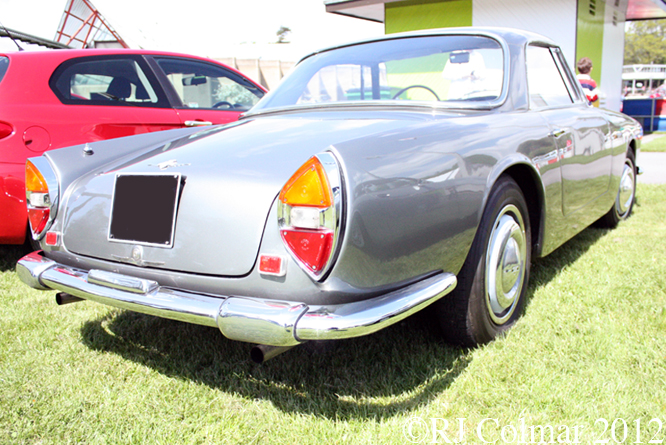
Lancia Flamina, Simply Italian, NMM Beaulieu

One of my favourite toys when I was not yet six was a Lancia Flamina similar to the 1962 Coupé seen here which had yellow jeweled headlights.

De Tomaso Pantera, Simply Italian, NMM Beaulieu

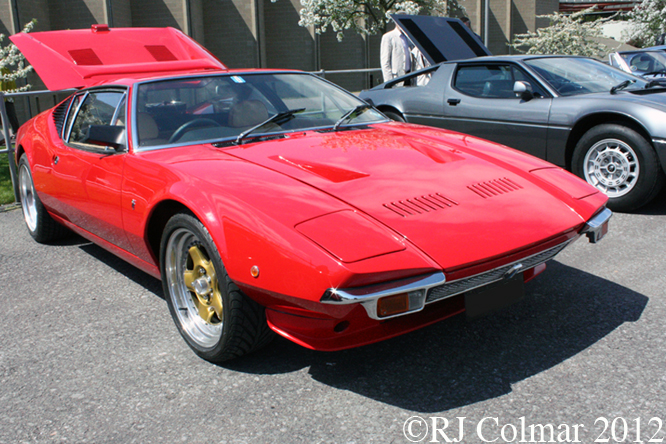
Appropriately on the other side of the car park to the Vignale Gamine was this de Tomaso Pantera which with it’s Ford motor and running gear has to be one of the most practical and affordable ways of running a genuine Italian super car.

Lamborghini Gallardo LP 550-2 Balboni, Simply Italian, NMM Beaulieu

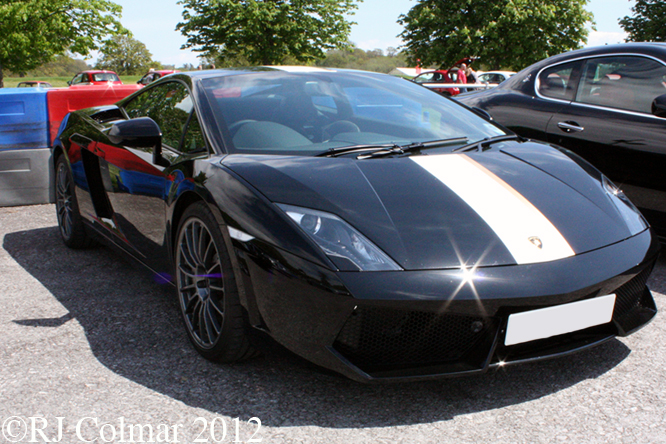
Speaking of practical this 2010 Lamborghini Gallardo LP 550-2 Baldoni, one of just 250 550 hp 200 mph 2 wheel drive super cars with a distinctive white and gold stripe was carrying a child seat on the passenger side. The owner told me he has had the car just nine weeks and in that time has driven it 5000 miles at 25 mpg on the road and as little as 5 mpg on track days. He has also had to replace a set of tyres !

HMS Sultan Field Gun, Simply Italian, NMM Beaulieu

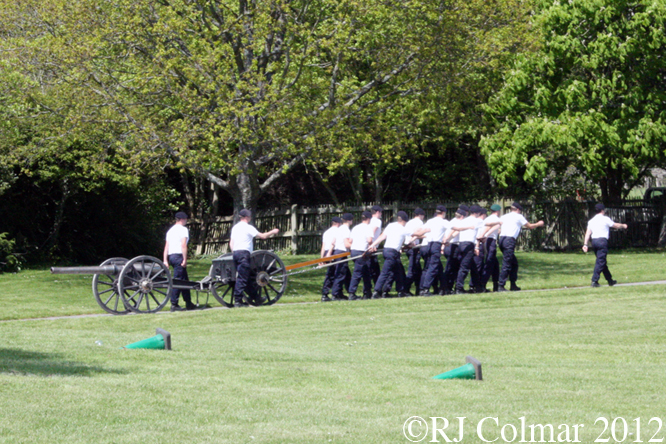
Around lunch time the grounds of the National Motor Museum echoed to the sound of LEFT ! RIGHT ! LEFT ! RIGHT ! LEFT ! RIGHT ! LEFT ! as a squad of 13 field gunners from HMS Sultan ended a 56 mile weekend yomp with a limber and 12 pounder field gun, of the type used during the Boer War, in tow. The gun and breach alone weighs some 400 kgs, nearly 900 lbs ! All of this was to honour the men of 40 Commando in the Falklands Conflict who covered the same distance in 1982 to retake Port Stanley and to raise funds the Royal Navy & Royal Marines Charity, follow this link to find out more and make a donation.

FIAT Panda 4x4, Simply Italian, NMM Beaulieu

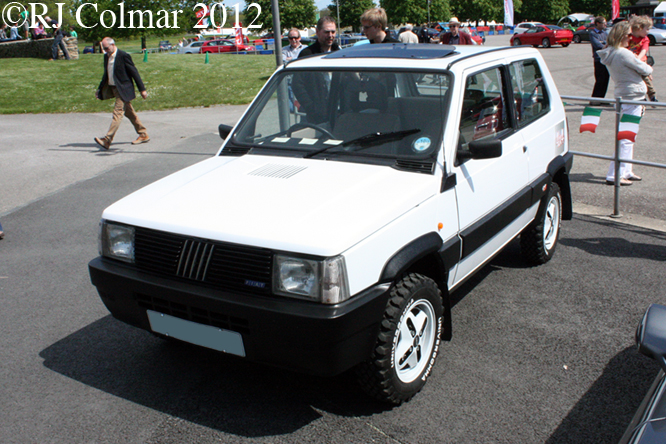
After lunch the results of a public vote for the most popular vehicle present was announced, the 1988 FIAT Panda 4×4 above, which came complete with a fitted tent was awarded a bottle of Beaulieu Bubbly, a local sparkling wine.

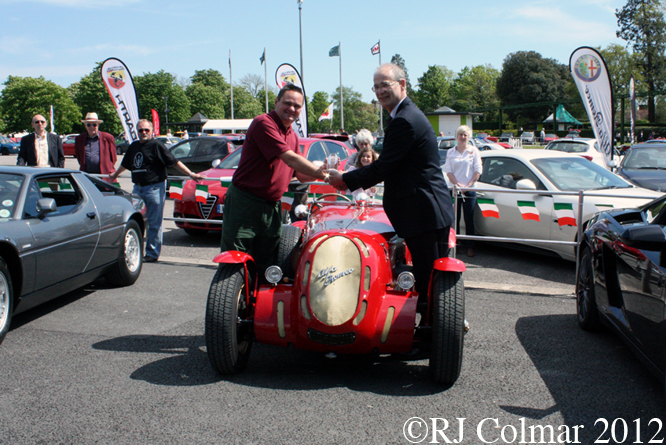
Lenham Healey ALFA Romeo Special, Simply Italian, NMM Beaulieu

A well deserved second went to GALPOT regular David Roots and his Lenham based ALFA Romeo 4C Special,

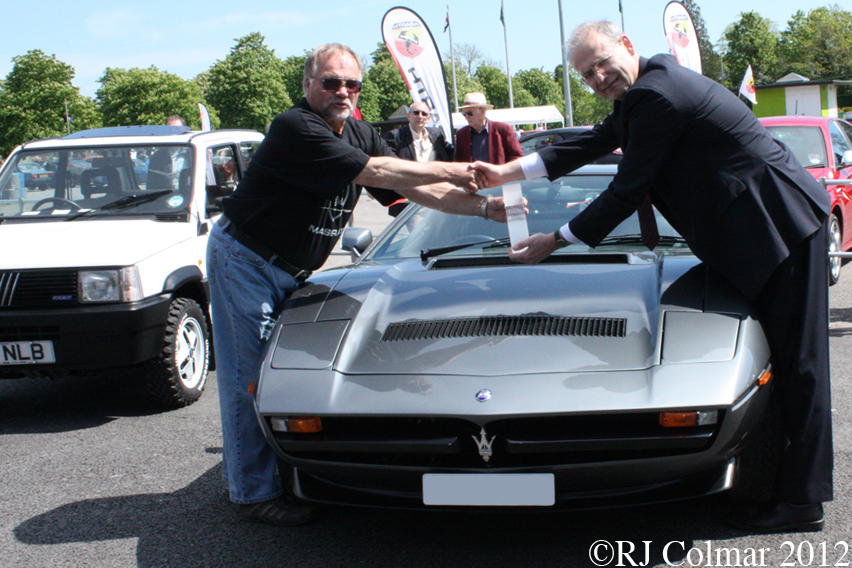
Maserati Merak, Simply Italian, NMM Beaulieu

while most visitors votes went to this Maserati Merak.

My thanks and congratulations to David for telling me about this fabulous event which was interspersed with visits into the National Motor Museum which I shall cover in greater detail on Sunday.

Thanks for joining me on this ‘Choices Choices’ edition of “Gettin’ a li’l psycho on tyres”, I hope you will join me again tomorrow. Don’t forget to come back now !
Share

The Misfit – MG C GT Sebring Replica

During the endless mergers that took place in the British motor industry after 1945 many models like today’s MG C GT owe more to merged corporate parts bins than to fresh from the ground up planning.

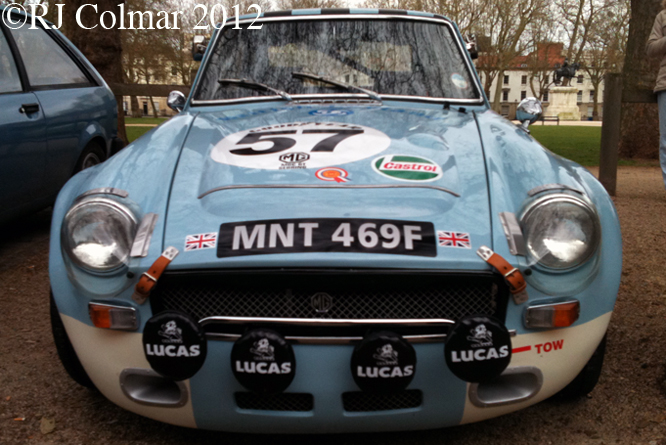
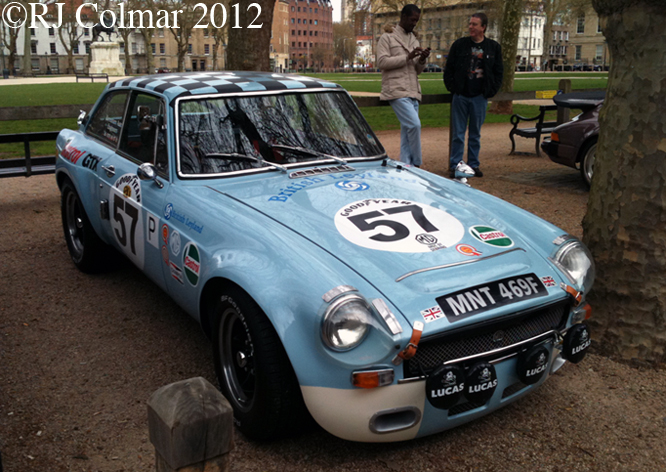
MG C GT, Sebring Replica, Avenue Drivers Club, Queens Sq, Bristol

The rational behind the MG C roadster and GT models was too build a vehicle to replace the six cylinder Austin Healey 3000 whose ancestry can be traced back to the Austin Healey 100-Six launched in 1956.

MG C GT, Sebring Replica, Avenue Drivers Club, Queens Sq, Bristol

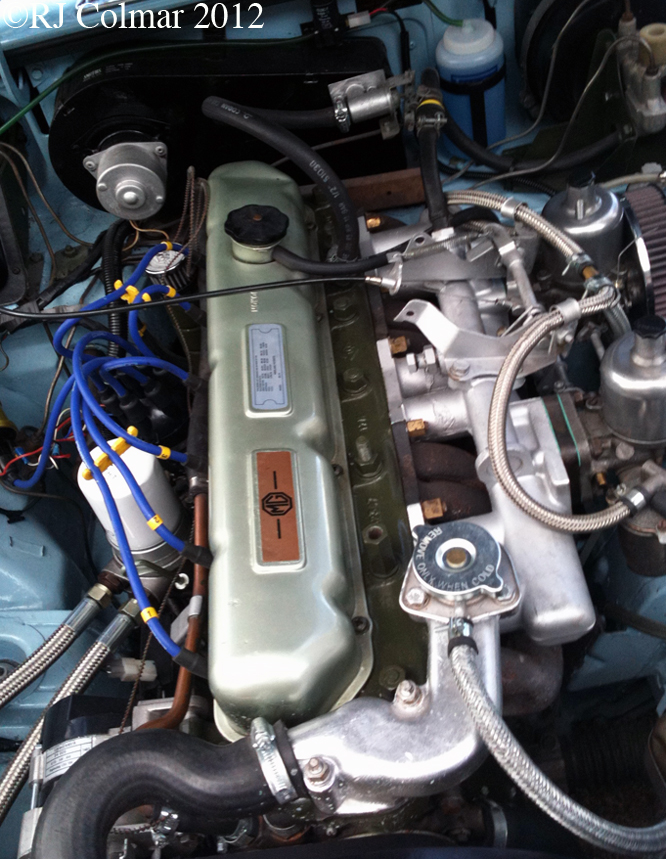
The recipe for the new MG-C was to use the MG B body shell first seen in 1962 and fit it with the 3 litre / 183 cui six cylinder Austin C series motor that was more commonly found in the Austin Healey 3000 sports car and Austin Westminster saloon/sedan.

MG C GT, Sebring Replica, Avenue Drivers Club, Queens Sq, Bristol

Unfortunately the cast iron block C series motor has 2 cylinders more than the motor around which the MG B was designed around and the C series motor was a good deal taller than the MG B 4 cylinder. This meant the chassis cross member that held the 4 cylinder motor had to be replaced, the front suspension strut suspension replaced with torsion bar suspension, the front bulkhead had to be modified and when all was said and done to accommodate an automatic transmission option the engine was not placed as far back as the engineers would have liked to achieve a 50/50 front rear weight balance.

MG C GT, Sebring Replica, Avenue Drivers Club, Queens Sq, Bristol

The new MG C also had to run on 15″ wheels in order to keep the oil sump off the ground, but all in all the engineers were pleased with their 120 mph creation which had a respectable 53/47% front to rear weight balance.

MG C GT, Sebring Replica, Avenue Drivers Club, Queens Sq, Bristol

Unfortunately the press panned the car in essence for not being different enough from the MG B but also because they found the handling tended towards understeer / push. It has been noted in some circles this characteristic may well have been exacerbated by the fact that the MG C was so much smoother than the MG B that journalists might not have been aware of the speeds they were traveling when experiencing the understeer push phenomenon.

MG C GT, Sebring Replica, Avenue Drivers Club, Queens Sq, Bristol

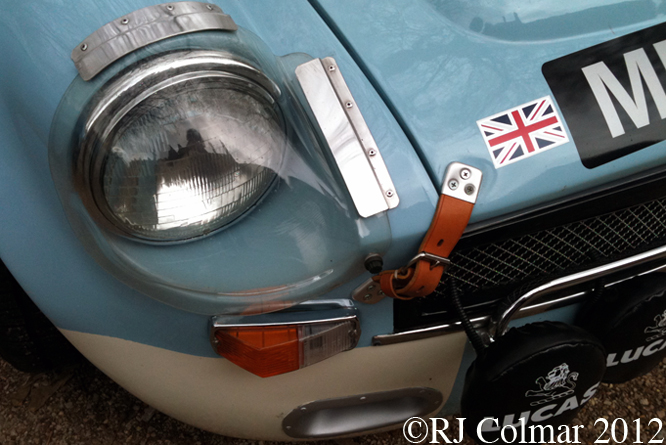
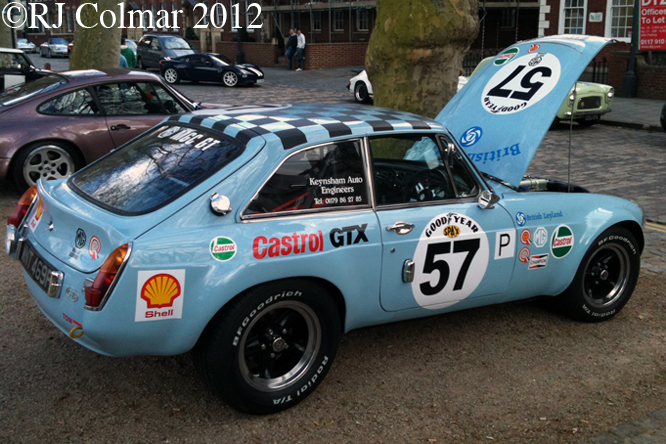
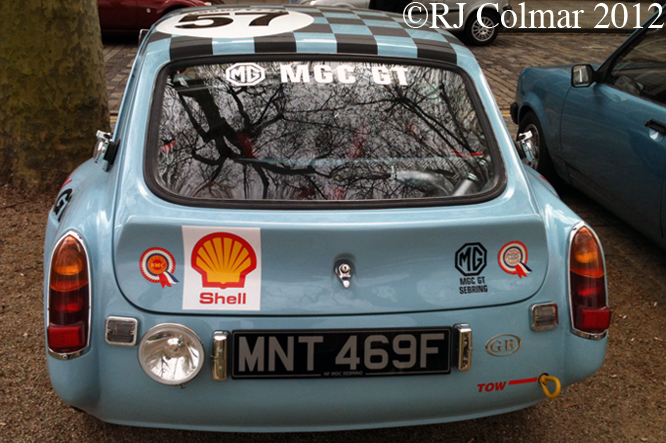
Completely oblivious to the handling criticisms Prince Charles took delivery of an MG C in 1967 and this car has apparently been passed onto Prince William. The car seen here has been turned into a replica of the triple carburetor MG C’s raced at Sebring in 1968 and 1969, though the tailgate spoiler was not used by the works cars of 1968 and 1969 which were racing in the same class as full blown racing cars like the Porsche 907 and 908 models.

MG C GT, Sebring Replica, Avenue Drivers Club, Queens Sq, Bristol

Of the 9002 MG C’s manufactured between 1967 and 1969 4458 were hard top GT’s. With the merger of British Motor Holdings with Leyland owners of the Triumph brand in 1968 the Triumph TR 6 was chosen as the newly merged corporations 6 cylinder sports car of choice and so the MG C died an early death, though in 1973 an even larger, but much lighter, engined MGB GT V8 would appear.

Thanks for joining me on ‘The Misfit’ edition of ‘Gettin’ a li’l psycho on tyres’, I hope you will join me again tomorrow. Don’t forget to come back now !

Share