Tag Archives: Park

Thinwall Special #4 – Ferrari 375 #010

Having failed to become a regular Grand Prix contender with his first attempt at building the Ferrari 125 F1, Ferrari’s second attempt at building a Grand Prix car was based around a 4.5 litre / 274 cui normally aspirated V12 motor designed by Aurelio Lampredi.
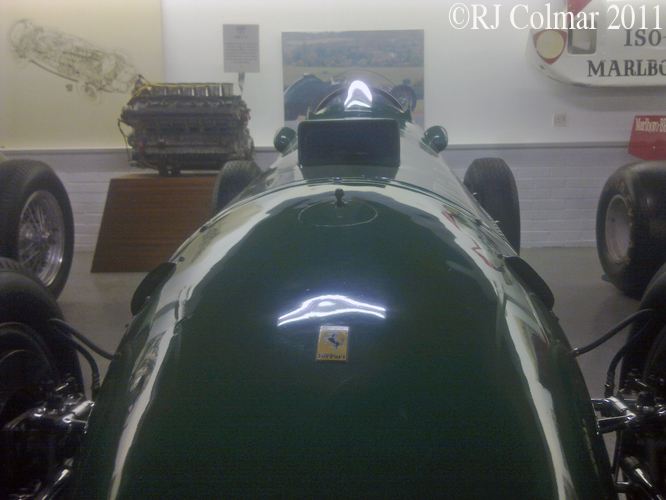
Ferrari 375, Donington Collection

The 375 proved a more competitive proposition against the 1.5 litre / 91 cui supercharged pre war designs of Alfa Romeo that were the class of post WW2 Grand Prix fields. Jose Froilan Gonzalez was at the wheel of a 375 when he won the 1951 British Grand Prix, claiming the marques first victory in a World Championship Grand Prix Race.
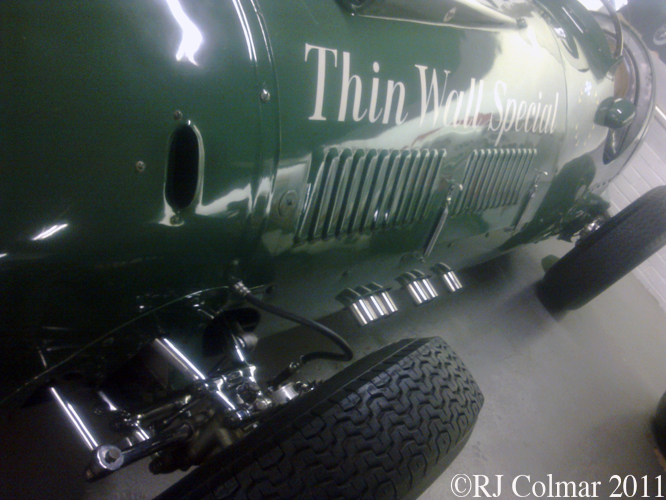
Ferrari 375, Donington Collection

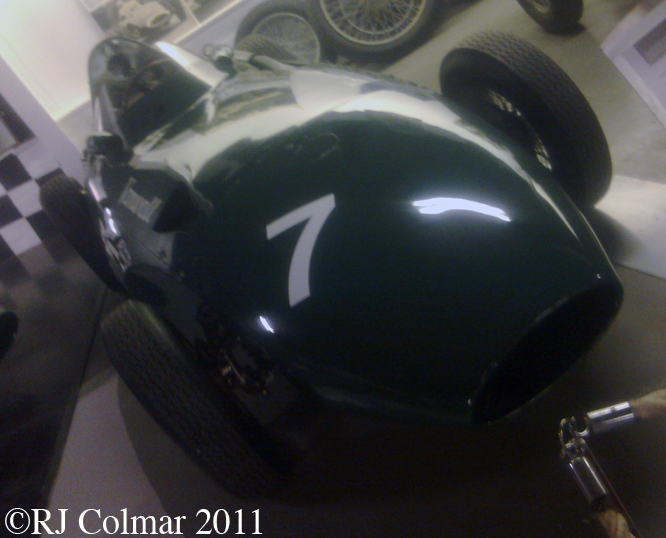
The fourth and final 1952 Thinwall Special seen here at the Donington Collection, shares the same, long Indianapolis chassis design as the Grant Piston Ring Special. This car should not be confused with the third Thinwall Special which comprised the Ferrari 125 chassis I looked at last week fitted with a 375 type motor that scored a famous victory in the rain shortened International Trophy at Silverstone in 1951.
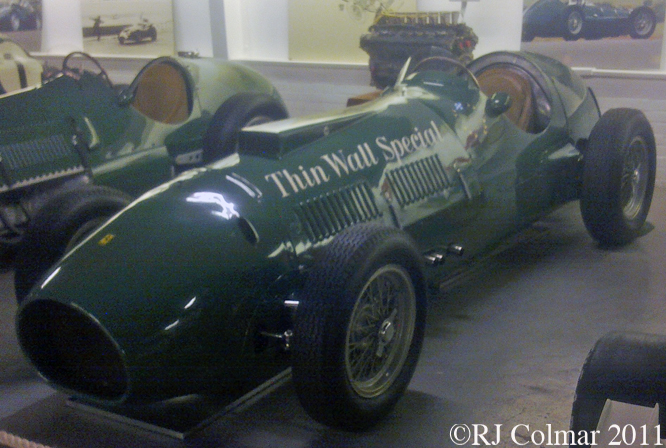
Ferrari 375, Donington Collection

Piero Taruffi won the first and second of 8 victories recorded for this car at Dundrod and Silverstone in 1952. Mike Hawthorn and Nino Farina were also engaged to drive the car in 1952 and 1953. Peter Collins appears to have been the last driver to race this car, owned by Tony Vandervell, in 1954.

Many thanks to Don Capps for clarifying the distinctions between the four Thinwall Specials.

Thanks for joining me on this Ferrari Friday edition of ‘Gettin a lil’ psycho on tyres’ I hope you will join me again tomorrow for some banger racing. Don’t forget to come back now !


Share

Testing ! Testing ! – Mallory Park

I managed to make a second pilgrimage to Mallory Park for a test session with my friend Tim, of the Bristol Pegasus MC, last week.

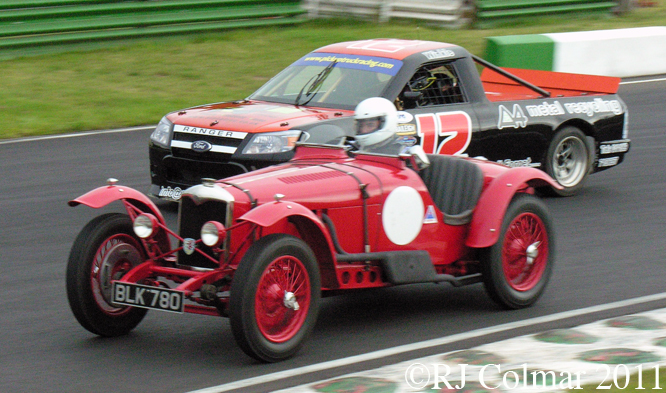
Riley, Ford Ranger, Mallory Park

Among the many delights was the sight of a Vintage Riley driven in anger alongside a Ford Ranger from the Pickup Truck Racing Series.

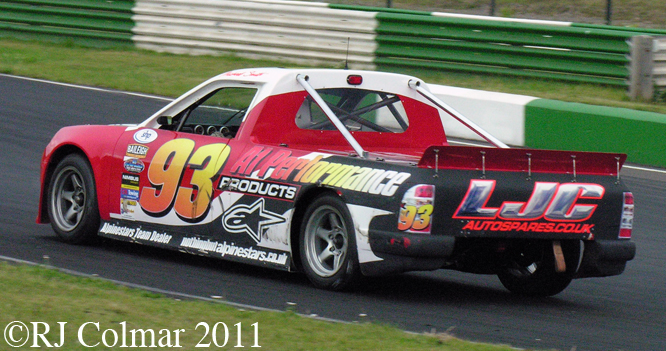
Ford Ranger, Mallory Park

Micheal Smith from Hartlepool puts his nominal #93 Ford Ranger, featuring a space frame with a spec motor based on the, GM (!), Vauxhall 16 Valve engine, through it’s paces prior to last weekends PTR races at Thruxton.

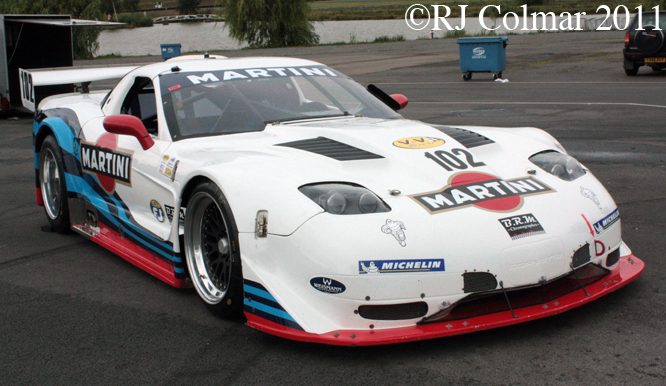
Chevrolet Corvette, Mallory Park

Castle Combe outright lap record holder Nigel Greensall was testing a new paddle shift gear selector in this 2008 Trans Am Spec Corvette which is due to appear in the French VdeV GT series at Paul Ricard Circuit in September.

Allard, Cougar, Chevrolet, Mallory Park

Best sounds of the day came from this 427 Chevy Big block powered Allard J2 Replica about which very little appears to be known.

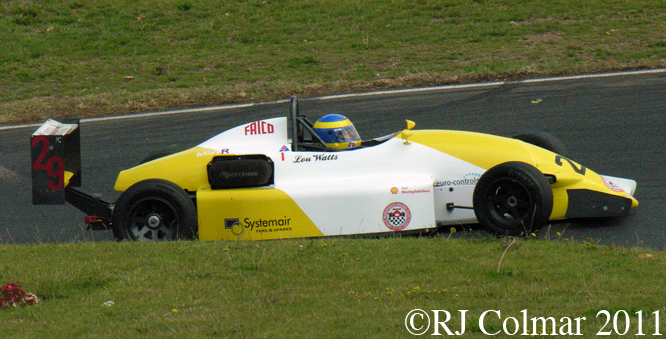
Formula Vauxhall Lotus S2, Mallory Park

Lou Watts was out in this Series 2 Spec Formula Lotus Vauxhall easily distinguished by the high frontal cockpit, these spec vehicles were in use from the late 80’s to early 90’s in a series that rivalled Formula Ford 1600 and Formula Ford 2000. Lou races this car in Monoposto Racing Club Series.

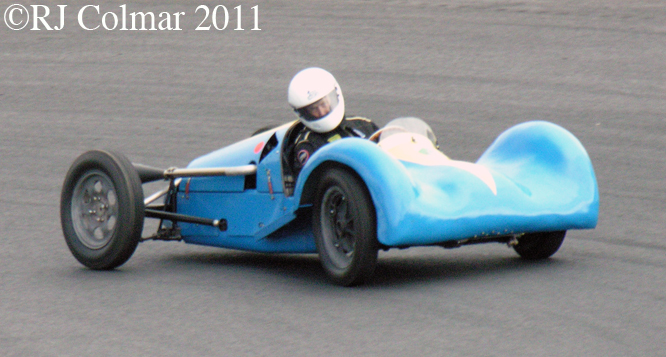
Revis, Mallory Park

Harking back to the junior open wheel series of the 1950’s was this chain driven Revis Formula 3 car powered by a Jap single cylinder 500 cc / 30.5 cui motorcycle engine connected to a Norton gearbox. Richard Bishop Miller traced the previous owner of this car to Canada where he eventually purchased it before restoring it.

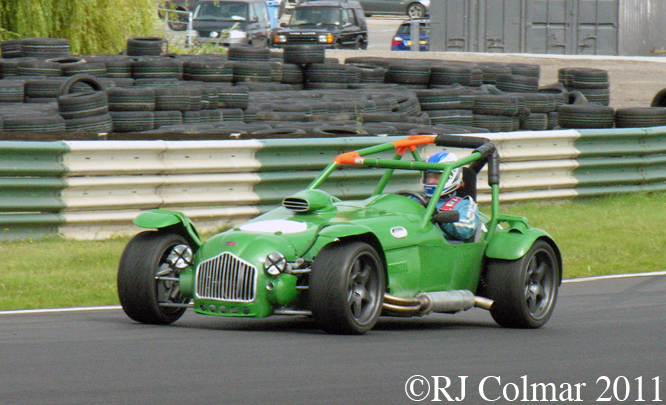
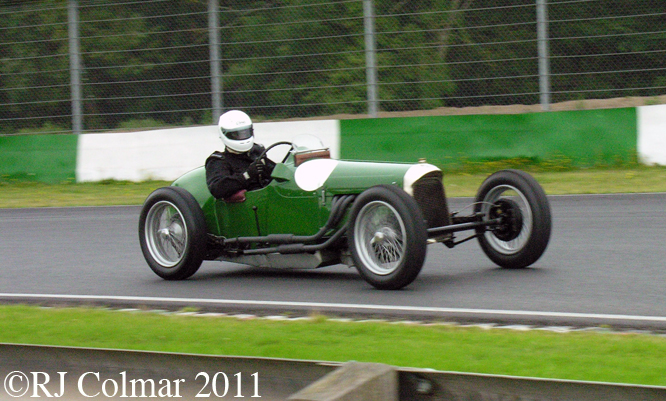
GN CoGNac, Mallory Park

Finally another fascinating special, from the 30 odd cars that appeared at Mallory last week, was this 1930’s GN CoGNac powered by a straight six AC motor. This car has recently been acquired by Tony Lees who was driving it for the first time.

My thanks to Dutchy, mikeC, David McKinney and Alan Cox at The Nostalgia Forum for additional information on the CoGNac.

Thanks for joining me on this ‘testing’ edition of ‘Gettin’ a lil’ psycho on tyres’, I hope you will join me tomorrow for a visit to the Bugatti Trust at Prescott. Don’t forget to come back now !
Share

Grand Prix City – Donington Park Museum

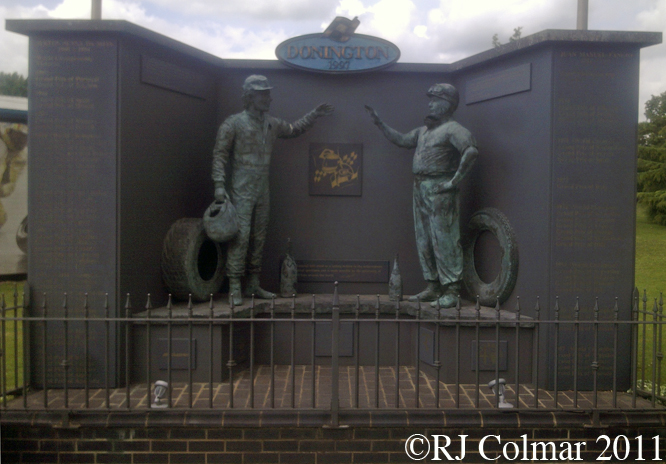
Donington Park Museum

(Ayrton Senna & Juan Manuel Fangio)

A couple of weeks ago I had the opportunity to drop in to the Donington Park Museum, home to the Donington Park Grand Prix Collection. Donington Park dates back to at least the Doomesday Book compiled in 1086 and is one of the longest established deer parks in the UK.

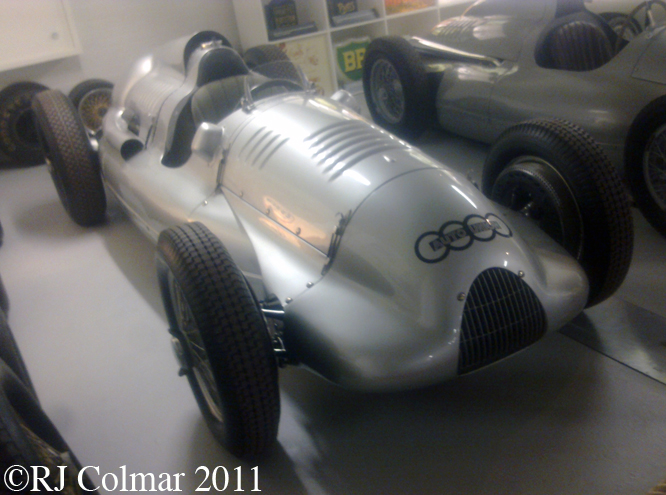
Auto Union Type D, Donington Park Museum

(1939 Auto Union Type D)

After serving as a Prisoner Of War camp for German officers in World War 1, a race track was built in 1931 for £12,000. The track played host to Grand Prix races featuring the Mercedes and Auto Union ‘Silver Arrows’ Grand Prix cars, Tazio Nuvolari driving an Auto Union during practice for the 1938 British Grand Prix fatally struck a stray deer.

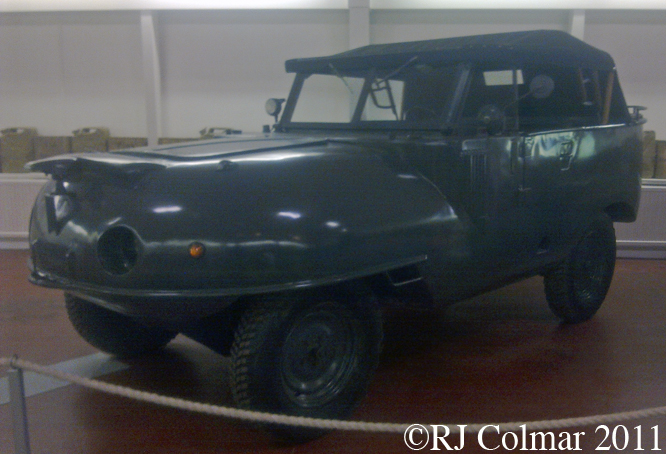
Trippel SG6, Donington Park Museum

(1942 Trippel SG 6)

During World War 2 Donington Park became home to 50,000 vehicles as the largest military transport depot in Europe. In 1971 local building magnate Tom Wheatcroft took over the Donington Park circuit and 8 years later racing was resumed after a nearly 40 year break. The highlight of the resumption of racing at Donington was almost certainly the 1993 European Grand Prix.

Vanwall VW9, Donington Park Museum

(1958 Vanwall VW9)

Tom Wheatcroft alongside his property developing business had a passion for racing, collecting vehicles associated with the circuits pre war history, vehicles used in WW2, during which Tom served in a tank regiment and British built Grand Prix cars.

March BMW 732, Donington Park Museum

(1973 March BMW 732)

He also sponsored and entered talented drivers, including Derek Bell, Richard Morgan and in particular Roger Williamson whom Wheatcroft financed in Formula 3 and 2 and an ill fated Grand Prix drive in which Roger met his untimely demise in a horrific accident during the 1973 Dutch Grand Prix.

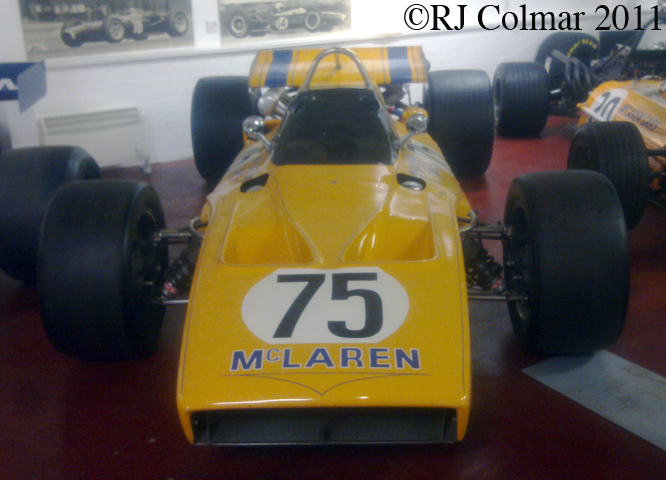
McLaren M15, Donington Park Museum

(1970 McLaren Offy M15)

The Donington Park Museum houses the largest collection of McLaren

Williams FW02, Donington Park Museum

(1973 Williams – Cosworth FX3B)

and Williams vehicles outside of these two prestigious manufacturers own collections.

Hill GH2, Donington Park Museum

(1975 Hill – Ford GH2)

I spent several memorable hours going round the museum housing a veritable feast of some of the highs and low’s of British Grand Prix endeavour. Situated just of the M1 near Nottingham, at just £8 a visit, I’ll look forward to dropping in again when the opportunity next presents it’s self.

Slightly off topic, wishing all GALPOT readers in the USA and US readers abroad Happy Independence day.

Thanks for dropping today’s Donington Park edition of ‘Gettin’ a lil psycho on tyres’ i hope you’ll join me again tomorrow for a look an Independence day cruise in the UK. Don’t forget to come back now !
Share

Original Lightweight – Jaguar Lightweight E – Type 9/12

In 1962 Jaguar built a Low Drag Coupé E-type, with a steel inner tub but aluminium outer pannels, that was more in the spirit of the D-Type from which the E-Type styling and design had evolved. The car was not any more competitive than it’s all steel namesake despite it’s higher performance and the prototype was sold.

90 Image2607sc

From 1963 – 1964 12 Lightweight E- Types were built that evolved from the Low Drag Coupé, again making extensive use of aluminium body panels and other components.

91 Image2610sc

The standard 265 hp iron block straight six engines were upgraded to 300hp aluminium block XK6 specs fitted with fuel injection.

92 Image2608sc

The cars failed to emulate the international success of earlier ‘C’ and ‘D’ types at Le Mans or Sebring but they were moderately successful in club racing.

93 Image2609sc

Of the 12 Lightweights built and two additional bodies it is thought ‘at least one’ was a Coupé some of the open top cars were converted to Low Drag Coupes with even more powerful 340 hp motors.

94 Image2617sc

The vehicle featured in these photographs was the 9th of the 12 originals and carries the chassis number 850666.

95 Image2606sc

The car was purchased and raced by Peter Sutcliffe from 1963 to 1965.

96 Image2620sc

This was the most successful Lightweight E-type in the 1964 season scoring victories at Mallory Park, Zolder and Montlhery out side Paris, France.

Hope you have enjoyed another Lightweight edition of ‘Gettin’ a lil’ psycho on tyres’, and that you’ll join me again, for Ferrari Friday, tomorrow. Don’t forget to come back now !
Share

Replica Rallysprint – Triumph TR7

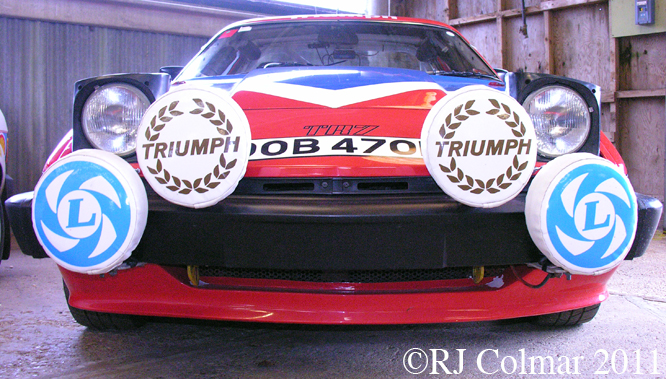
01 DSCN0175sc

The Triumph TR7 was manufactured from 1974 to 1981.

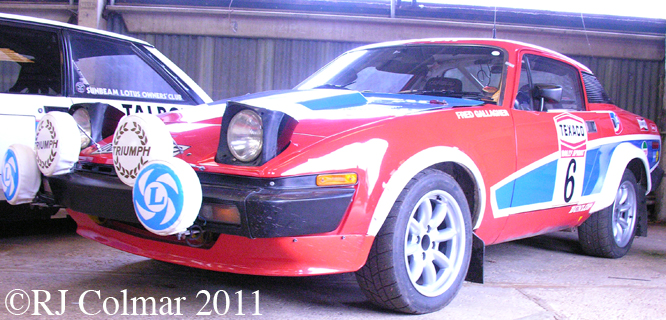
02 DSCN0176sc

Works competition versions of the TR7 run by British Leyland from 1976 to 1978 were initially powered by the Dolomite Sprint 16 valve engine and later switched to the ubiquitous (in the UK) aluminium Buick derived Rover V8.

03 DSCN0177sc

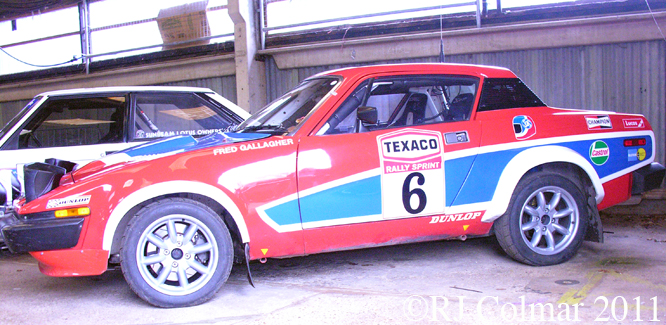
This is vehicle has replica paintwork of a Triumph works rally car registered OOM512M which was used in the 1978 Texaco Rally Sprint a staged for TV event run at at Esgair Dafydd, in Wales, won by Per Eklund in a later Triumph TR7 with Tony Pond coming second in the #6.

04 DSCN0178sc

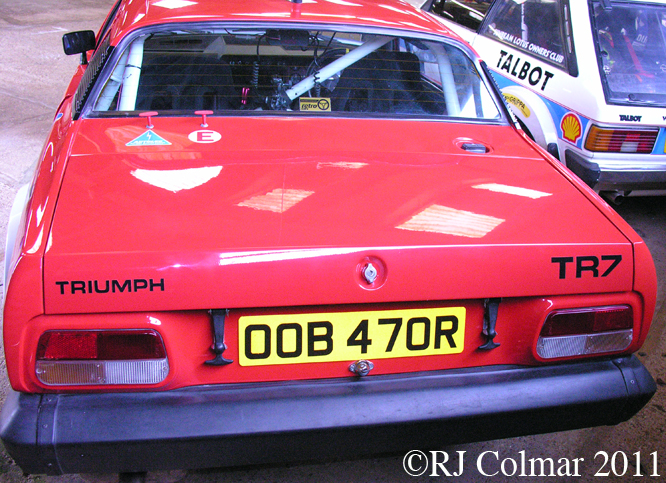
If the registration plates on this particular are original then this TR7 was first registered in Birmingham in 1976 and it is fitted with the later Rover V8 engine according to the records made available to me.

My thanks to Tim Murray and RS2000 at The Nostalgia Forum for their help identifying the event in which OOM512M ran.

Hope you have enjoyed todays Rallysprint edition of ‘Gettin’ a lil’ psycho on tyres’ and that you will join me again tomorrow. Don’t forget to come back now !
Share

Going it alone – Bristol 407

Just 88 Bristol 407’s were built between 1961 and 1963.

The 407 was the first Bristol model launched after ownership of the Bristol Car Company had been taken over by the Bristol Aeroplane Company founders grandson Sir George White 3rd Bt in partnership with Bristol’s preeminent retailer Tony Crook in September 1960.

The exterior of the Bristol 407 is distinguished from its predecessor the 406, which I have yet to write a blog about, by a horizontal bar across the radiator grill at the front and twin exhaust pipes at the rear.

Underneath the car could not be more different, the 407 is powered by a Canadian built 5130 cc / 313 cui Chrysler V8 connected to a push button operated Torqueflight transmission, a combination which first came to the attention of of Sir Reginald Verdon Smith the Bristol Aeroplane Company director in the 1950’s on a private visit to Canada.

Bristol attempted to develop it’s own aluminium block V8 in the 1950’s but, insufficient experience casting aluminium and lack of capital thanks to the spiralling cost of aircraft development elsewhere in the Bristol group of companies meant that the V8 never got beyond an underdeveloped prototype stage at which crankshaft main bearing housing distortion presented an obstacle to production.

Changing to the Canadian V8 from the hitherto BMW inspired straight 6 necessitated replacing the former transverse leaf front suspension with a pair of coil springs and replacing the highly praised rack and pinion steering with Marles worm driven steering.

The chassis was fitted with Dunlop disc brakes all round and the aluminium body production was moved from Jones Brothers to Park Royal Vehicles in London.

The 407 chassis set out the basic architectural features for all Bristol’s with many incremental modifications right through to the introduction of the Bristol Fighter in 2004.

This particular model photographed at a Loton Park VSCC meeting is registered in Sweden, notice that it is a Right Hand Drive model, Sweden switched to Left Hand Drive in September 1967 to bring it into line with it’s Scandinavian neighbours.

My thanks to Christopher Balfour who’s book ‘Bristol Cars a very British story‘ provided many of the insights in today’s blog.

Hope you have enjoyed today’s Marles worm driven steering edition of ‘Getting a lil’ psycho on tyres and that you’ll join me again tomorrow for a look at the even rarer Bristol 410. Don’t forget to come back now !
Share

Brotherly love – Riley 9

The chassis of the Riley 9 was designed by Stanley Riley while the hemi head 1087 cc 66 cui was designed by his brother Percy. Riley 9s were produced from 1926 – 1938 with a variety of body styles.

The twin cam engine with short push rods operating the 45 degree inclined valves proved particularly suitable for tuning and Riley 9s were raced with great success into the mid 1950’s. This version, seen at Prescott top and Loton Park bottom, is owned by B Wildsmith and driven in VSCC events by Tim Hopkinson is a Special dating from 1929/34.

Hope you have enjoyed today’s brotherly love edition of Getting a lil’ psycho on tyres and that you’ll join me tomorrow for a look at another quintessentially British motor car. Don’t forget to come back now !
Share