Tag Archives: Porsche

Françoise Hardy & The BMW Powered MOPAR – GALPOT Automobilia

I’ve been having a bit of a clear out whilst reorganising my library and the time has come to dispose of a number of items which may be of interest through my lightpress account on e-bay.

First up is an eclectic collection of some 40 odd car advertisements from the French magazine Connaissance des arts from the late 60’s to early 70’s, which I’ll be posting over the coming weeks, below is a small selection of the ads I posted over the weekend.

François Hardy, Uniroyal,  Advertisement, Connaissance des arts

François Hardy is probably best known amongst petrol heads as one of the stars of John Frankenheimer’s 1966 film Grand Prix in which she plays the role of Lisa girlfriend of the hot Italian rookie Nino Barlini played by Antonio Sabàto. As well as being an actress François is also a popular singer and model. Above she appears in an undated 1969 ad for Uniroyal tyres. The strap line translates as “Farnçoise Hardy has big feet”.

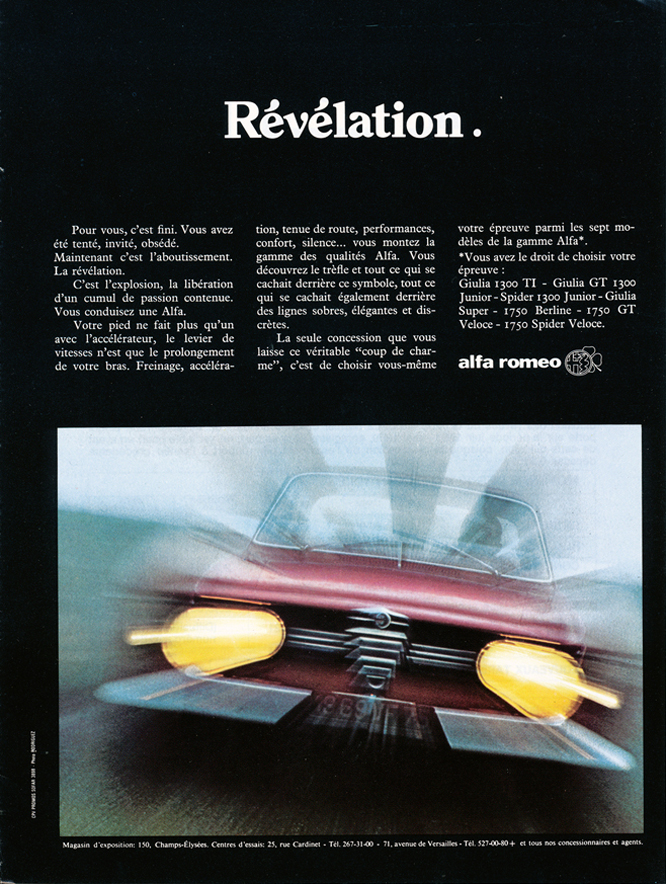
ALFA Romeo, Giulia 105, Rodriguez, Advertisement, Connaissance des arts

Regular readers will know that I have an abstract photography practice based on images of blurry light, one of many antecedents in this area of practice was the French commercial photographer who I only know as “Rodriguez” who took the photo of the 105 series Alfa Romeo Giulia appearing in this advertisement which is dated October 1969 on the reverse.

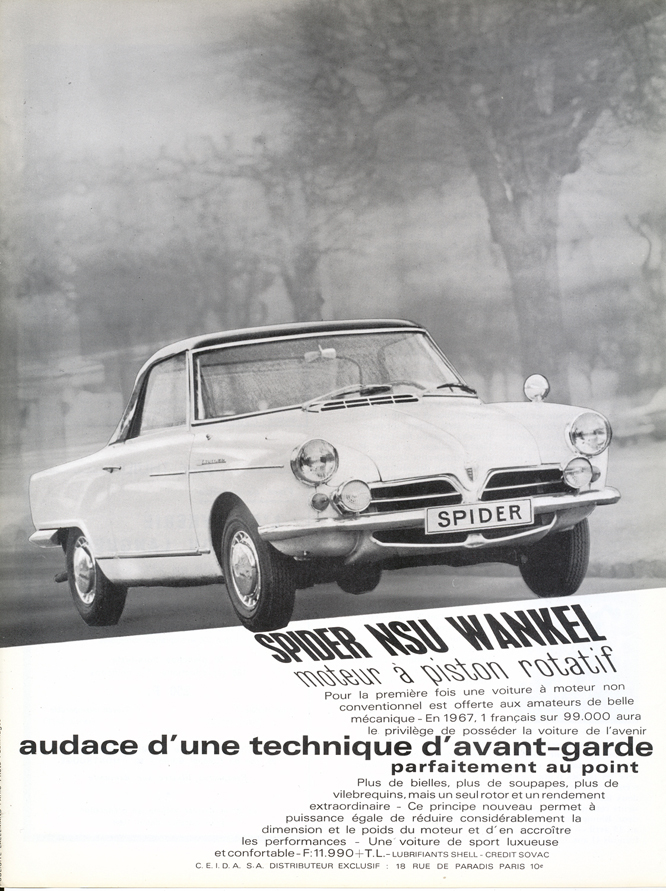
NSU, Spider, Wankel  Advertisement, Connaissance des arts

The worlds first production car powered by a rotary Wankel motor was the 1964 NSU Spider seen in the advertisement dated March 1967 above. In all just over 2,000 of these 50 hp machines were built between 1964 and 1967. Jay Leno is a current owner of one of them about which he made this linked short film.

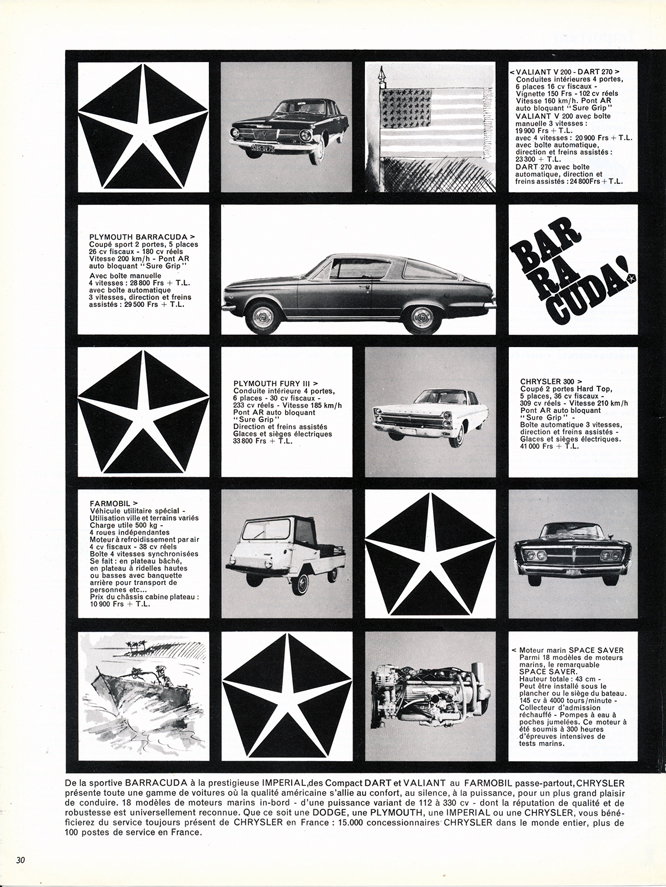
Chrysler, Advertisement, Connaissance des arts

Finally for this week there is this undated Chrysler ad which was published somewhere between 1965 and 1966. What is particularly interesting is that alongside a Valiant V200/Dart 270, a Plymouth Barracuda, Plymouth Fury III, Chrysler 300 Coupé and 145 hp Space Saver Parmi marine motor there appears a curiosity built in Thessalonika, Greece called the Farmobile.

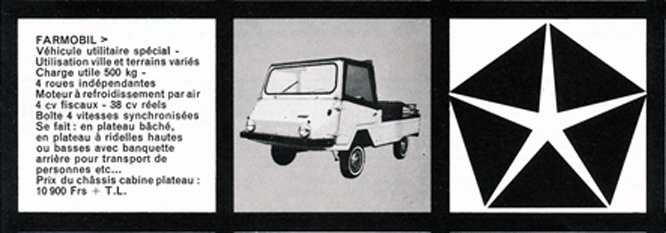
Chrysler, Farmobile, Advertisement, Connaissance des arts

The Farmobile holds the disitinction of being the only MOPAR vehicle to be powered by a BMW motorcycle engine, found in the back, which transmits drive to the rear wheels through a Porsche designed 4 speed gearbox. It is thought less than 1000 of these vehicles were built by Farco which was thought to have been acquired by Chrysler in order to gain access to the West German market.

For the rest of the month I’ll be posting further updates of my e-bay listings on Tuesdays to test the water.

Thanks for joining me on this “Françoise Hardy and French Car Advertisements” edition on “Gettin’ a li’l psycho on tyres”, I hope you will join me again tomorrow. Don’t forget to come back now !

Share

Balena Close, Poole, Dorset – Penske PC1 #001

After he had finished fabricating the Len Terry designed Eagle monocoques for All American Racers (AAR) in California, John Lambert returned to the Untied Kingdom and started a new business which was located on a small industrial estate outside Poole in Dorset where the rent was cheap. When Len Terry fell out with Frank Nichols they wound up Transatlantic Automotive Consultants based in Hastings where they had designed the AAR Eagle and Terry went to join Lambert, with whom he had worked at Lotus and AAR, in Poole starting a new business together called Design Auto.

In 1969 Len Terry started to design a series of stock block Formula 5000 open wheel cars called Leda’s, John Lambert looked after the construction of them in a facility off Balena Close on the Creekmore Industrial Estate on the outskirts of Poole, Dorset. When Leda Cars ran into financial difficulty they merged into the Malaya Garage Group in 1970. Three years later Malaya Garage Group did a deal with New Zealand racer Graham McRae selling the Leda Cars premises “lock, stock and barrel” with the cars manufactured now rebranded as McRae’s.

At around this time Roger “The Captain” Penske and Mark “Captain Nice” Donohue were experiencing many successes on the US racing scene which included three Trans Am championships, then only for manufacturers, driving the Captains Chevrolet Camaro in 1969 and AMC Javelins in 1970 and ’71.

In 1972 Mark won the Indy 500 in Roger Penske’s McLaren M16 and at the end of the year drove Penske’s McLaren M19 in the Canadian and US Grand Prix finishing a more than credible 3rd in his debut Grand Prix. The following year Mark and Roger won the Can Am championship with the “Turbo Panzer” Porsche 917/30. Having achieved pretty much everything in the US, including a NASCAR Winston Cup win at Riverside driving a Penske AMC Matador to become the last ‘road ringer’ to win a non oval race in that series back in 1973 Mark announced he would hang up his helmet at the end of the season.

Roger Penske made plans for a Formula One team in 1974 and sent Heinz Hofer to look at Graham McRae’s ‘low profile’ premises on the Creekmore Industrial Estate in Poole, Dorset UK as a possible base and concluded a deal for the premises. The Ford Cosworth DFV powered Penske PC1 was built to a design by Geoff Ferris and Mark Donohue was persuaded to come out of retirement to drive the car on it’s debut in the 1974 Canadian Grand Prix where he qualified 24th and finished 12th 2 laps down.
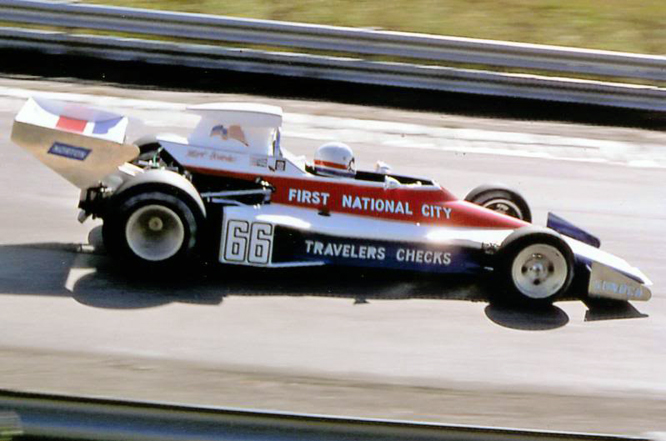
Penske Ford PC1, US Grand Prix, Watkins Glen

At the US Grand Prix, where Mark Donohue and Roger Penske fan, Brian Brown took today’s photograph of Mark in the PC1 at Watkins Glen the car started 14th on the grid, but retired after 27 laps with rear suspension problems. Brian recalls his first visit to a Grand Prix thus :-

“I was of course very excited to be seeing Mark race again, but being that it was my first live Formula One event, I was equally excited to be seeing Mario’s effort with Vel’s Parnelli Jones and the rest of the grid in person. We owned a Ferrari 365 GTB/4 Daytona and a 246 GT Dino at the time, so were very supportive of the Ferrari effort too.

My brother, friends and I spent a great deal of down time in the Kendall Garage watching the teams go about their business of working on the cars. One thing that was apparent was the absolutely professional presentation of the Penske team. Everything was spotless, just like their successful Indy Car counterpart that I’d observed in person since 1969 at Indianapolis. I was then, as now, a huge fan of Mark Donohue and Team Penske, but that aside, I always felt that they had too many positive resources not to be successful in Formula One.

I knew racing well enough to understand how tall the task Mark and the Penske team had ahead of them, but I also had the highest faith in their collective talents that I felt, given time, they would come right. I look back now and remember how I’d call in to our local ABC news tv affiliate to get the results of the races in 1975, always asking about the top six finishers along with Mark and Mario’s results.

Then came Austria and it was over for Mark and eventually Penske stopped the project – I was always appreciative that they carried on to get the victory with John Watson in Austria a year after Mark’s accident, something of a vindication for the mighty challenges that Team Penske faced in their Formula One foray. Watkins Glen 1974 was the last I ever saw Mark in person and despite the nearly 40 years that have passed, it seems like yesterday.”

Penske ended up building 3 chassis to the PC1 design chassis #001 seen here achieved a best 5th place finish, from 16th on the grid in the 1975 Swedish Grand Prix. Three races later Penske ditched the PC1 in favour of a March 751 which was raced until a new challenger until the new Penske PC3 was ready. As Brian alluded to above Mark Donohue was killed during practice for the 1975 Austrian Grand Prix after a tyre deflated pitching him off the track in to an accident which killed a marshal. Although Mark initially survived the incident he died the next day from a cerebral hemorrhage.

The debut of the Penske PC3 was delayed until the 1975 US Grand Prix where John Watson drove it in practice. Due to a misfire with the motor in the new car the team elected to wheel out today’s featured chassis one more time, John qualified 12th, finishing the race in 9th.

The following season Penske entered John in the PC3 and later PC4 models. With the latter the team won the 1976 Austrian Grand Prix, despite this success The Captain closed the Formula One program down at the end of 1976, deciding his future lay in the US racing seen where he would become the dominant force in Indy Car racing, with many of his winning cars being built in Poole, Dorset. Penske maintained facilities in Poole Dorset up until 2006. When the factory was closed one employee, Ivor, remained who had been part of the story going back to the Leda days, through the McRae years and into the Penske era.

In 2012 Brad Keslowski won his first NASCAR Championship driving a Penske entered Dodge a hitherto elusive goal on ‘The Captains’ to do list.

My thanks to Brian ‘ B² ‘ Brown for kindly agreeing to share his photograph; to kayemod, Nigel Beresford, Tim Murray, Tony Matthews, Dogearred and Doug Nye at The Nostalgia Forum for their help in piecing together the story behind Roger Penske’s presence in Poole, Dorset and a tenuous connection in the form of Lambert & Terry and their Leda Cars premises between the AAR Eagle and Penske Formula One efforts.

Thanks for joining me on this “Balena Close, Poole, Dorset” edition of “Gettin’ a li’l psycho on tyres”, I hope you will join me again tomorrow. Don’t forget to come back now !

PS Shortly before this blog was posted some confusion has come to light about which buildings in Poole Penske and McRae occupied and when, local resident kayemod and Nigel Beresford who worked for Penske have confirmed that Penske took over the Balena premises from McRae, while artist Tony Matthews is sure he visited a second facility a couple of miles away on Factory Road to do cutaway drawings for McRae and Penske is not so sure the Balena Close address is correct. If any further developments come forth I shall post them below, and if you know the answer to the riddle please do not hesitate to chime in.

PPS Nigel Beresford has kindly confirmed with another former Penske employee Nick Goozée that the Balena Close facility is the only one Penske purchased from Graham McRae. My thanks to Nigel and Nick for settling the matter so promptly.

PPPS
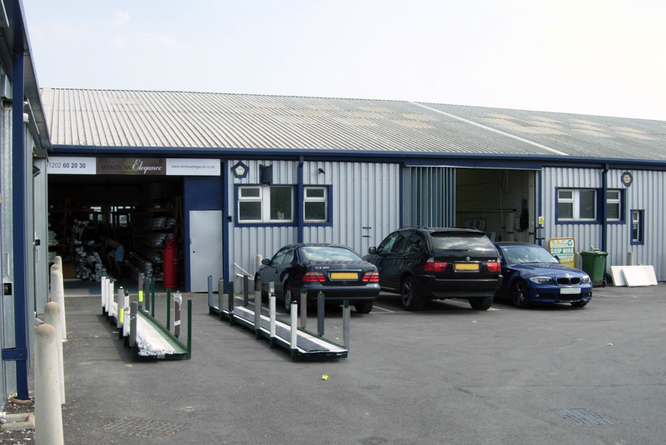
Balena Close, Poole, Dorset

Kayemod Rob from the Nostalgia Forum has kindly sent me this photo showing “how that corner of Balena Close looks today, the small unit to the right is the original Penske UK base, formerly McRae Cars. The three parked cars more or less cover the width of the premises. The ‘Elegance’ unit to the left of Penske was once FKS Fibreglass, later Griffin Design. My ex-Specialised Mouldings chum stylist Jim Clark worked at FKS, and as well as Penske’s stuff, they also did almost everything for the Gulf GT40s and Mirages among others, their unit extended leftwards to fill the corner of the block. Penske later rented an identical unit to the right of the pic, which doubled their floor area, after some of the dividing wall was removed, they used to run their F1 operation out of that.”

Thanks Rob.
Share

20th Anniversary – Goodwood Festival Of Speed

Last weekend saw the 20th Anniversary celebrations of the Goodwood Festival of Speed. According to tea total journalist Doug Nye the event only got off the ground because he was present at a rather drunken evening at which Lord March and some friends were fantasising about an event which might attract a few thousand motor enthusiasts. Next morning when Doug reminded the Lord of what had been said they decided to act and so was born the Goodwood Festival Of Speed which has become one of the highlights of the British Motoring Season.

Goodwood, Festival Of Speed

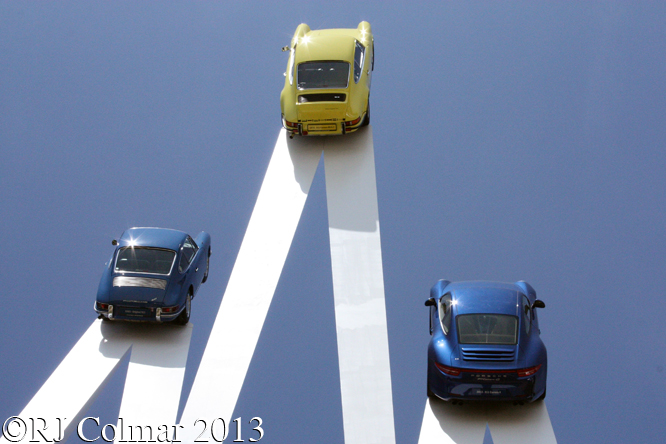
The event has become so big that it sells out on both the Saturday and Sunday and an extra day has been added on the Thursday, called the “Moving Motor Show” on which the hill climb track is turned over to corporate sponsors who entertain their guests with rides up the hill. It was on the Thursday that I went with my parents after my Dad found a free ticket offer in the “Daily Telegraph“. Many anniversaries besides Goodwood’s 20th were being celebrated, the three Porsche’s above formed the tip of a sculpture by Gerry Judah celebrating the 50th Anniversary of the Porsche 911 featuring a 1963 911 on the left, a ’73 Carrera RS in the middle and a 2013 Carrera 4 on the right.

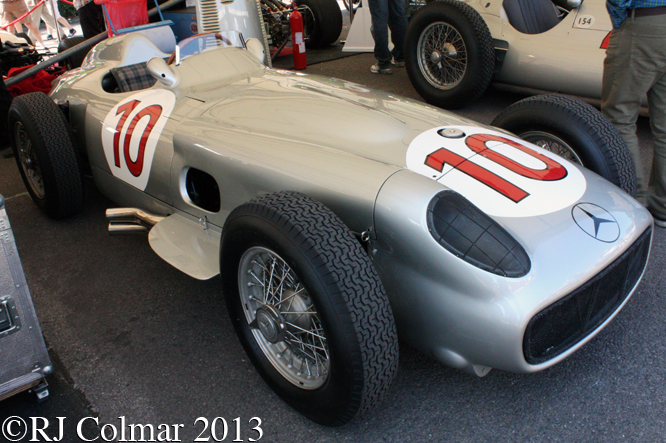
Mercedes W196, Goodwood, Festival Of Speed

On the Friday a 1954 Mercedes Benz W196 similar to the one pictured here was sold at the Bonham’s Festival of Speed Auction for US$ 29.6 million to become the most expensive car ever sold at auction. John Lennon’s Blue ’64 Ferrari 330GT fetched US$ 543,750 setting a new record for the 330 GT 2+2 model.

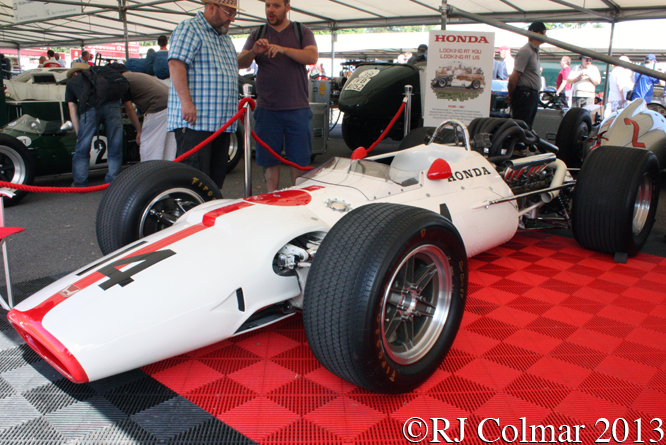
Honda RA300, Goodwood, Festival Of Speed

In the autumn of 1967 my folks purchased their first television, a black and white model, one of my earliest memories of it was a news cast featuring the 1967 Italian Grand Prix which was won by John Surtees driving this very V12 Honda RA300, a car that was very easy to distinguish from the rest of the field because it was white and all the others were various shades of grey.

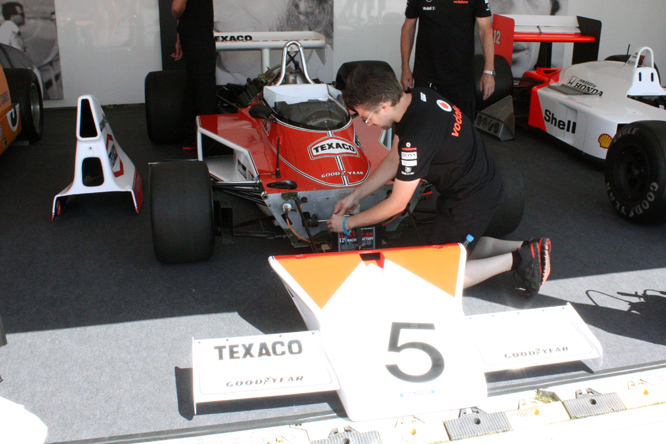
McLaren M23, Goodwood, Festival Of Speed

Emerson Fittipaldi moved from Lotus to join the McLaren team which had relieved BRM of Marlboro sponsorship and Lotus of Texaco sponsorship for the 1974 season. Emerson driving a Marlboro Team Texaco McLaren M23 ended up winning a very open World Drivers Championship by just 3 points from Clay Regazzoni driving a Ferrari 312 B3.

Renault RS01, Goodwood, Festival Of Speed

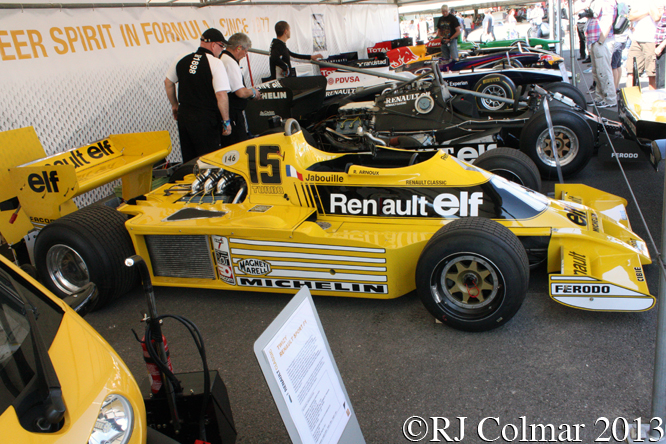
Having won Le Mans in 1978 Renault put all of it’s effort into winning the Formula One Drivers and Constructors championships with the first turbocharged Formula One car. Above is the 1978 RS01 which proved fast on occasion, particularly at altitude, but fragile.

Audi R18 E-tron Quattro, Goodwood, Festival Of Speed

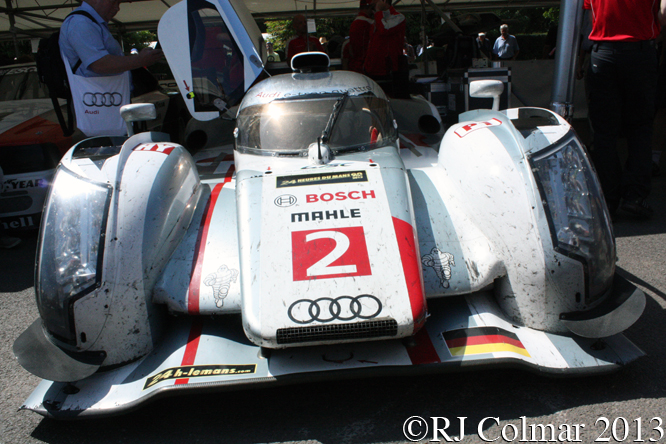
Fresh from victory lane, and looking several thousand miles the worse for wear, in the 90th Anniversary edition of the Le Mans 24 hours was the Audi R18 E-tron Quattro driven by Tom Kristensen, Alan McNish and Loic Duval.

Campbell-Railton Blue Bird, Goodwood Festival Of Speed

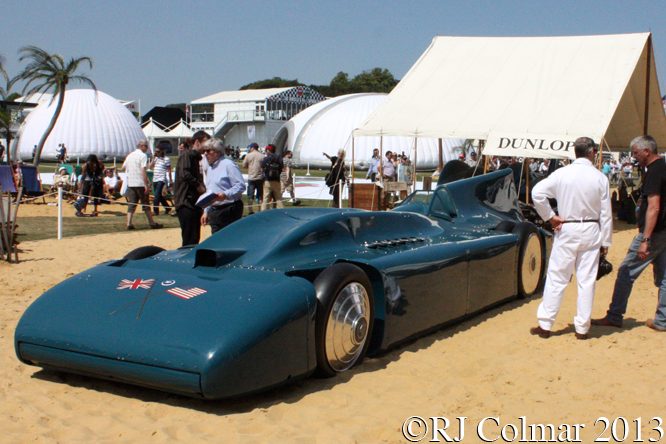
Sir Malcom Campbell became the first man on four wheels to exceed 300 mph when he set a new Land Speed Record at Bonneville of 301mph on September 3rd 1935 when driving the 2300 hp supercharged Rolls Royce V12 powered Campbell-Railton Blue Bird. The piece of land on which Blue Bird was displayed normally serves as Lord Marches cricket pitch.

Lotus Ford 29, Goodwood Festival Of Speed

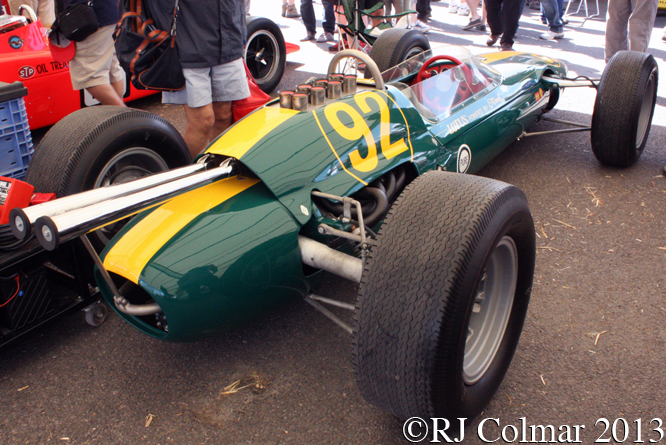
Regular readers will remember that the #92 Lotus Ford 29 driven by Jim Clark at Indianapolis in 1963 was destroyed in a fatal accident with Bobby Marshman at the wheel during a gruesome testing accident at Phoenix at the end of 1964. The car seen above is chassis #29/1 actually driven with a white and blue paint job by Dan Gurney to a seventh place finish at Indy in 1963. The car has been seen at the Indy Museum for many years (decades ?) bearing Jim Clark’s livery. The spare ’63 Lotus 29 chassis #29/2 currently carries the #91 white and blue livery used by Gurney.

Ford Galaxie 500, Goodwood Festival Of Speed

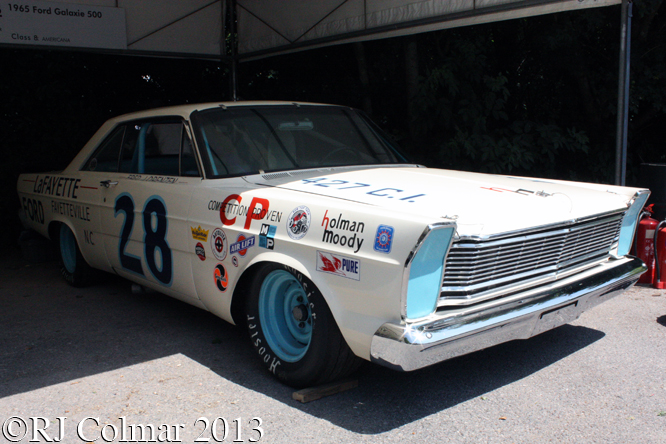
“According to the programme” the Ford Galaxie 500 above was driven to victory in the 1965 Daytona 500 by Fred Lorenzen and then given a ’66 body for testing at Daytona the following year, however a search on the internet show’s that this might not be the only car sharing the story.

Peugeot 208 T16, Goodwood Festival Of Speed

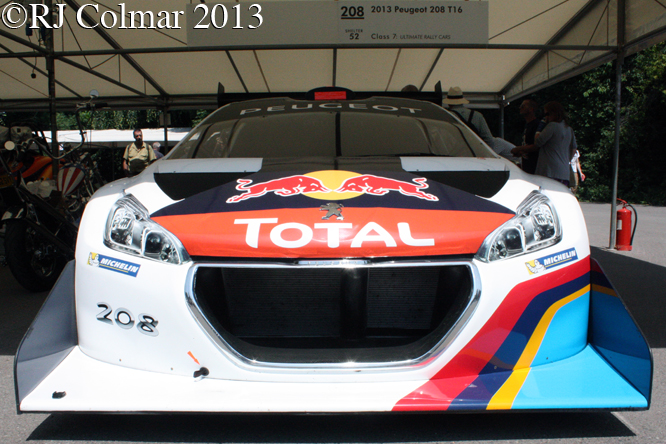
Another car to arrive at Goodwood from victory lane was the 875 hp twin turbo V6 Peugeot 208 T16 with which Alsatian 9 (nine) time World Rally Champion Sebastian Loeb won this years Pikes Peak race to the clouds hill climb in a mind bending 8m 13.8 seconds an astonishing 95 seconds faster than Rhys Millens 2012 full 12.42 mile course record of 9m 46.1s. Tighten your reality belts to see how Mr Loeb set the record in the film linked here.

Mercedes 60hp, Goodwood Festival Of Speed

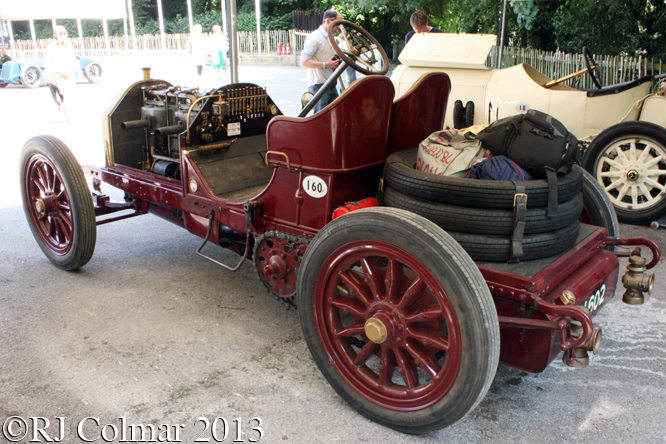
Any one who was reading GALPOT back in January might remember I spent a night and a day on the Exeter Trial being chased by a 4×4 Panda and following this 1903 Mercedes 60 hp Simplex crewed by Ben and Roger Collings, my appreciation of what these vehicles can do rose sharply as a result of the experience.

Porsche 911SC, Goodwood Festival Of Speed

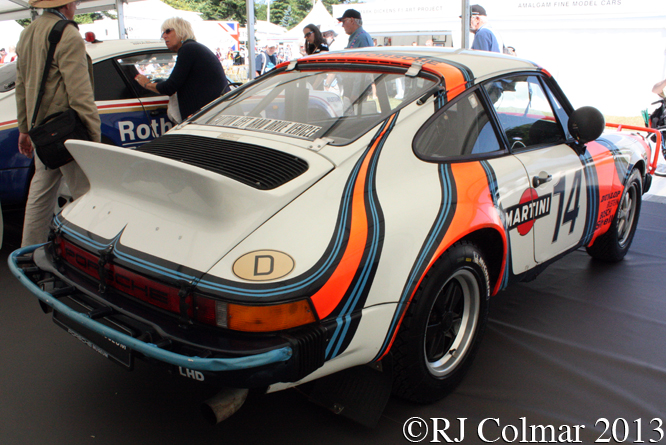
Car of the show for me was this 1978 Porsche 911 SC driven by Kenyan Vic Preston Jnr with co driver John Lyall to second place in the 1978 Safari Rally. I always thought if I was going to have a 911 for the road I may as well have one that could survive the rigours of Africa where I learned to drive and this one has a particularly cool paint job.
Over the coming months some of these vehicles will be featured in more depth.

Thanks for joining me on this “20th Anniversary Festival Of Speed” edition of “Gettin’ a li’l psycho on tyres”, I hope you will join me again tomorrow. Don’t forget to come back now !

Check out the latest from the Formula One silly season at Motorsports Unplugged on this link.

Share

99 Le Mans Class Wins – Porsche 991 RSR

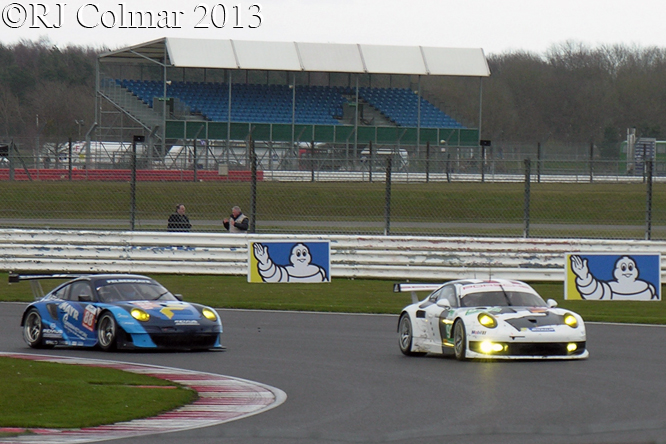
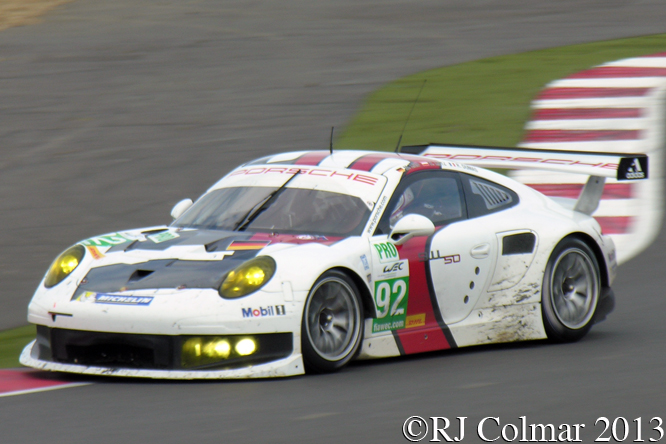
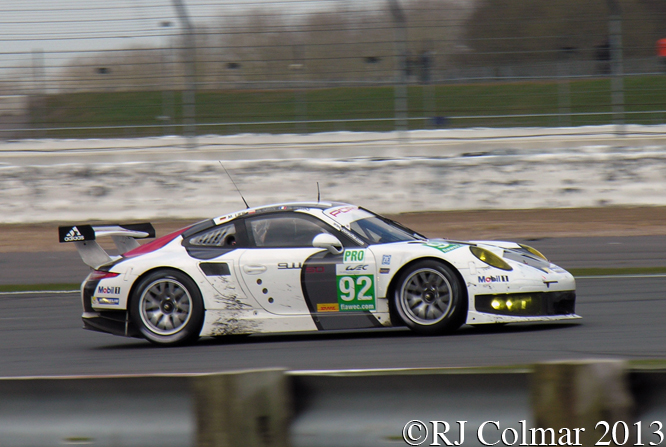
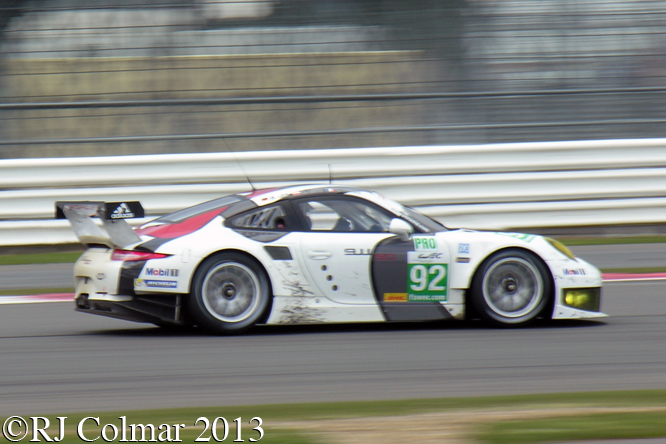
The Porsche 991 RSR is the latest Porsche GT2 racer which replaces the Porsche 997 GT3 RSR.

Lieb, Lietz, Dumas, Porsche, 991 RSR, 6 Hours of Silverstone

With the extensive use of carbon fiber for the quick release body work panels, polycarbonate windows and a lithium battery the center of gravity of the 991 RSR is considerably lower than on the 997 GT3 RSR.

Lieb, Lietz, Dumas, Porsche, 991 RSR, 6 Hours of Silverstone

The wheel base is a little longer than the older model thanks to a new six speed transmission operated from the steering wheel by paddle shift. The air restricted flat six 4 litre / 244 cui motor produces 460 hp which is comparable to both the Aston Martin V8 Vantage GTE and Ferrari 458 Italia GT2 cars against which it competes.

Lieb, Lietz, Dumas, Porsche, 991 RSR, 6 Hours of Silverstone

For 2013 Porsche AG have teamed up with 1990 Porsche Super Cup Champion Olaf Manthey who’s team Manthey Racing won it’s class first time out at Le Mans with a Porsche 911 GT3R in 1999.

Lieb, Lietz, Dumas, Porsche, 991 RSR, 6 Hours of Silverstone

Jörg Bergmeister, Patrick Pilet and Timo Bernhard are the drivers of the #91 Porshe AG Team Manthey entry while, Marc Lieb, Richard Lietz and Romain Dumas drive the #92.

Lieb, Lietz, Dumas, Porsche, 991 RSR, 6 Hours of Silverstone

At Silverstone where the cars are seen here they finished 17 and 20th overall and 4th and 6th in the GTE Pro class in reverse order on their debut. At Spa the #92 finished 19th overall and 15th in class while the #91 retired.

Bergmeister, Pilet, Bernhard Porsche, 991 RSR, 6 Hours of Silverstone

At Le Mans Aston Martin out qualified both Porshe AG Team Manthey cars but in the race Marc Lieb, Richard Lietz and Romain Dumas finished 16th overall and first in class to secure Porsche’s 99th class win in the endurance classic. They were followed by the #91 which was on the same lap to make it a Porsche 1-2 in the GTE Pro class.

I hope you have enjoyed my potted history of Le Mans over the past month, I am intending to continue it next June. Tomorrow I’ll be starting a month long potted history of Formula One cars, thanks for joining me, liking and linking my blogs on fb and else where. I hope you will join me again tomorrow. Don’t forget to come back now !

Share

5th Tony Marsh Memorial Weekend – Gurston Down

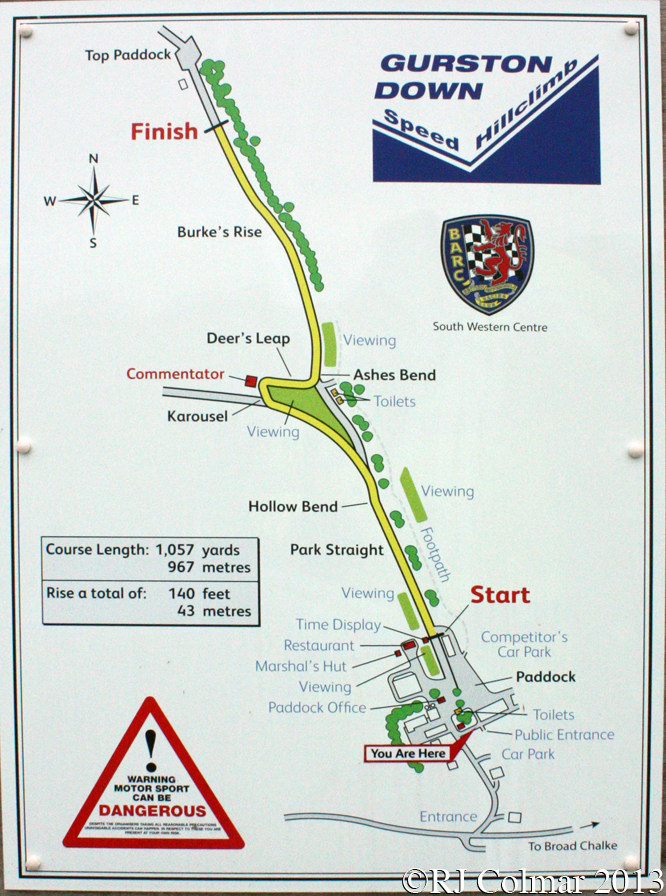
On Sunday I made the first of what I hope will be many visits to Gurston Down for the 5th Tony Marsh Memorial Weekend hillclimb. Gurston Down just west of Salisbury is set on a working farm and was devised by six time British Hillclimb champion Tony Marsh in 1965.
Gurston Down, Wiltshire

The course is just over a half a mile long and rises a total 140 feet, it is also the only Hillclimb in the UK that starts on a downward slope. As I found out on Sunday the facilities and viewing areas are excellent and it is no surprise to hear that Gurston Down has won the Norrie Galbraith Memorial Trophy for best organised British Hillclimb Championship event a record eight times.

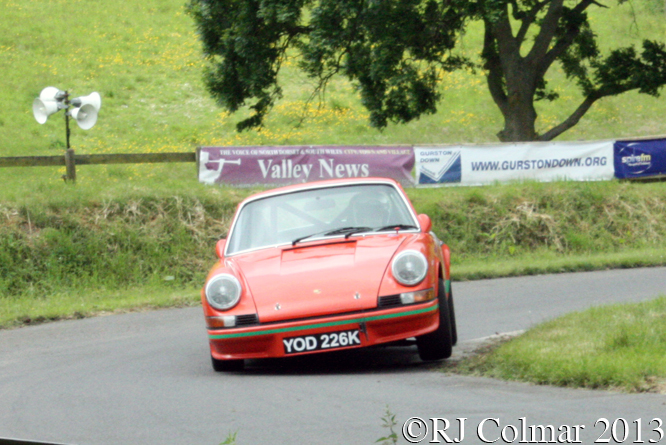
Mortimer, Porsche 911, Gurston Down, Wiltshire

After a cup of tea and obligatory bacon and egg roll in the excellent restaurant on arrival I made my way up to the Ashes Bend towards the top of the hill during the opening practice runs arriving in time to observe the second practice runs. Above Bob Mortimer lifts an inside front wheel in his Porsche 911 at the apex of Ashes.

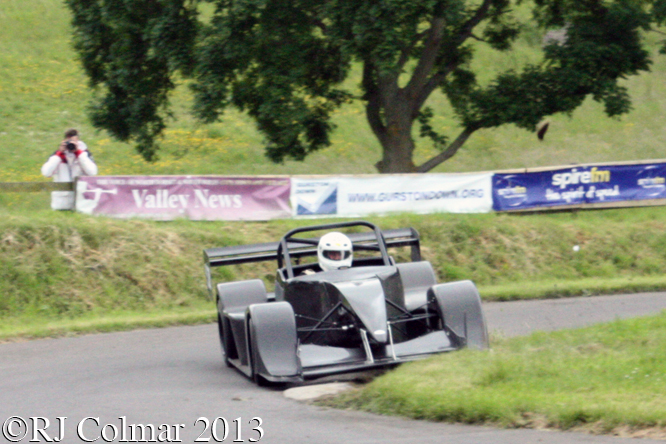
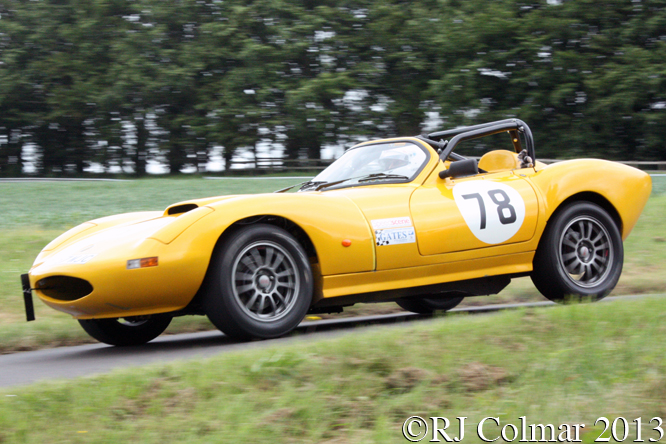
Gates, Force LM, Gurston Down, Wiltshire

On his second practice run Johnathon Gates was forced into a bit of lawn mowing at Ashes bend as the back of his car stepped out unexpectedly under braking. No damage was done and he ended the day with 8th fastest time.

Rudge, Westfield SEi, Gurston Down, Wiltshire

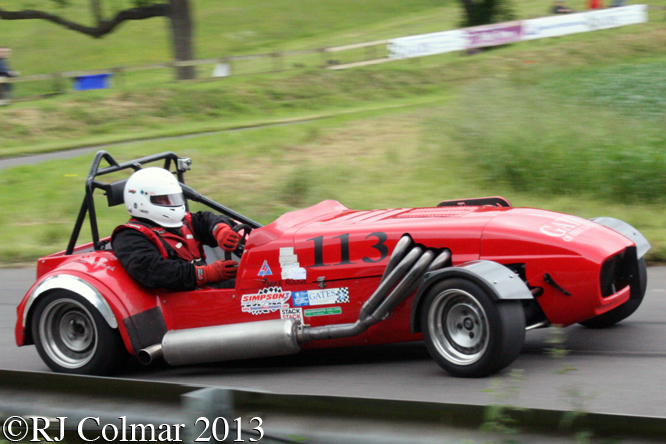
Mike Rudge is seen correcting oversteer / push coming out of Ashes in his Westfield SEi, he easily won his class by seven seconds more surprisingly to me he finished with 9th fastest time of the day beating a number of single seat open wheel cars in the process.

Stapely-Bealing, Formula 1300, Gurston Down, Wiltshire

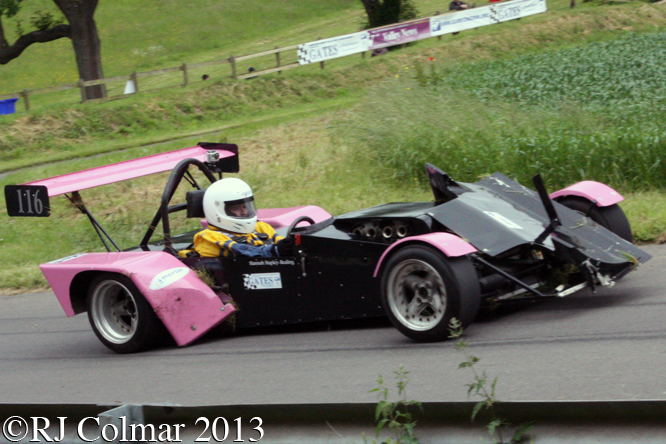
During her second practice run Hannah Stapely-Bealing came by showing signs of contact with the Wiltshire scenery however the car was repaired and put in two timed runs, however the motor of her Formula 1300 Clubmans car was no longer running cleanly and she was around a second off her first practice run.

Bloody Mary, Gurston Down, Wiltshire

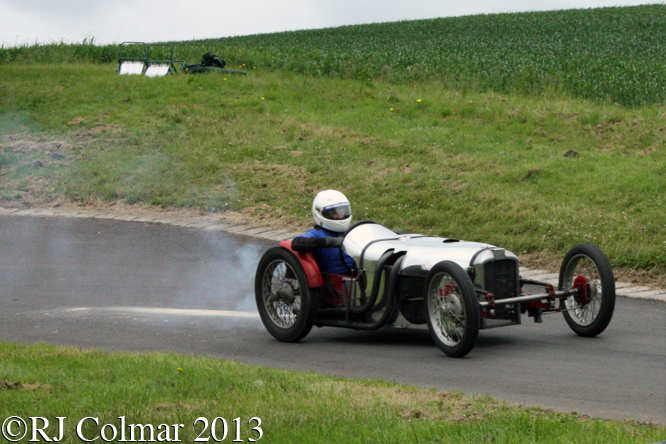
National Motor Museum Beaulieu kindly sent along former Autosport Technical Editor John Bolsters “Bloody Mary” Special for a welcome demonstration. The special started as a project for two teenagers to scare the cow’s in a nearby field and became a successful if by all accounts rather terrifying Brough Superior powered hill climb winner.

Penfound, Lester MG, Gurston Down, Wiltshire

I was introduced to another new, to me, manufacturer at Gurston namely Lester who built MG powered cars in the 1950’s. Stewart Penfound navigates the steep and tight Karousel in his example above.

Pamplin, MG XPAG Special, Gurston Down, Wiltshire

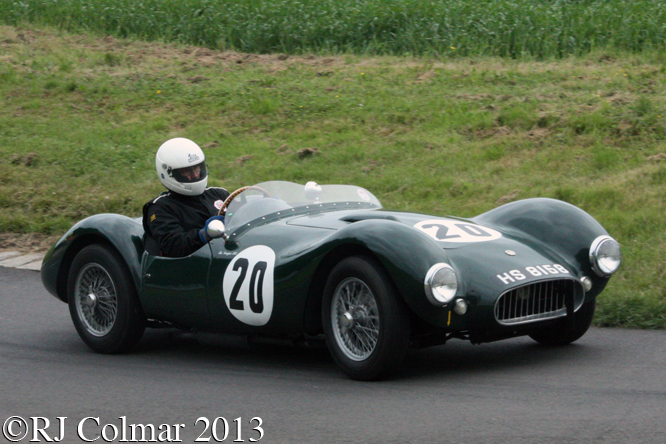
Another interesting MG was Chris Pamplin’s MG XPAG Special as listed in the programme and 1935 MG Magnette according to the registration plate.

Spicer, Ferrari 328 GTB, Gurston Down, Wiltshire

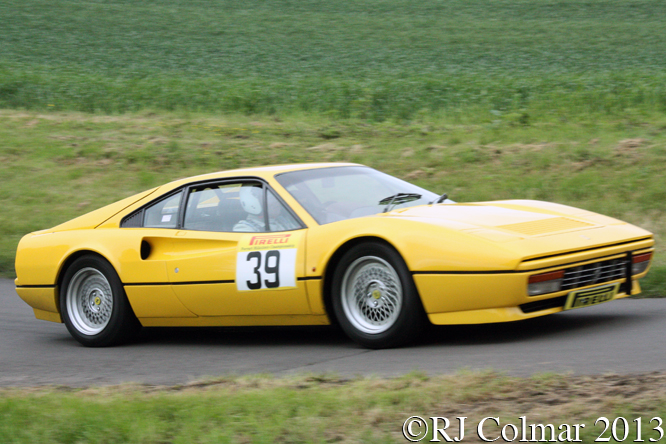
Standing out from an otherwise mostly red crowd of Ferrari’s was Mike Spicers Modena Yellow 328 GTB seen approaching Deer Leap which recorded 2nd fastest Ferrari time of the day.

Fanner, Subaru Impreza, Gurston Down, Wiltshire

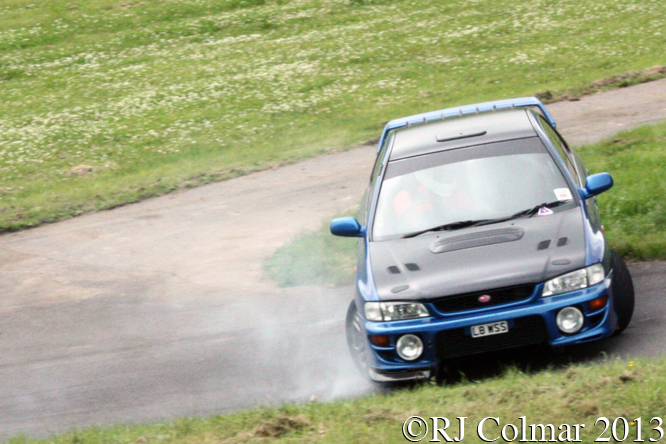
Lewis Fanner will have given his wife with whom he shares their Subaru Impreza a scare as he spun the car going into Karousel. Fortunately he did not hit anything and returned to the paddock for his one remaining run.

Hadfield, Lotus 22, Gurston Down, Wiltshire

Simon Hadfield and Geoff Hunt shared this Lotus 22, originally designed for Formula Junior competition, and finished the faster of the two albiet second in class to the more modern Ensign LNF3 driven by Fyrth Crosse.

Beale, Ginetta G33, Gurston Down, Wiltshire

Over the past couple of months the lines of Graham Beales class winning Ginetta G33 have really grown on me, apparently the idea for the Rover V8 powered car was conceived on a table cloth in a pizzeria by Mark Warklett and Noel Palmer.

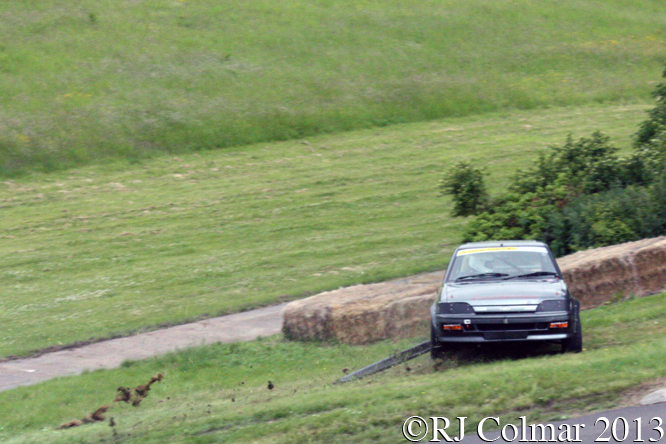
Street, Ford Escort XR31, Gurston Down, Wiltshire

Darren Street was another who found the entry to Karousel a bit tricky in his Ford Escort XR3i, here he is seen on his way to an appointment with the hay bales. Fortunately he suffered no injuries and he eventually drove to the top of the hill under his own steam.

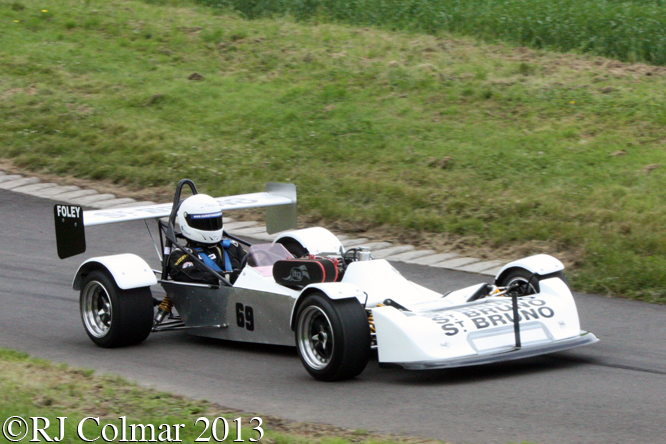
Lewis, St Bruno Roughcutter,  Gurston Down, Wiltshire

Like the Bloody Mary Special Adrian Lewis’s St Bruno Roughcutter Clubman’s car has an Autosport connection it being the creation of Barry Foley, best known as Autosports ‘Catchpole’ cartoonist. Barry built the car in the early 1970’s crediting help from a variety of sources including design input from Maurice Phillipe himself a part time Clubmans racer when not busy designing Formula One cars.

Dent, Hornet F3,  Gurston Down, Wiltshire

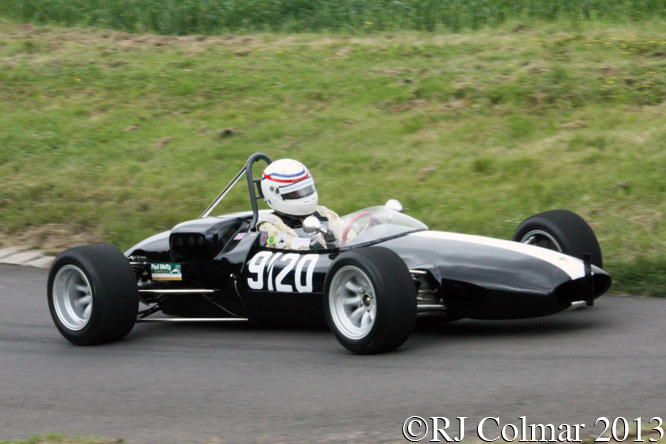
On both of his timed runs Alistair Dent lost time when his tail got onto the grass on the exit of Karousel, which had the benefit of at least entertaining those of us watching, above Alistair is seen on his first run in the Hornet JAP powered 500 F3 car.

Chard, Mazda MX5, Gurston Down, Wiltshire

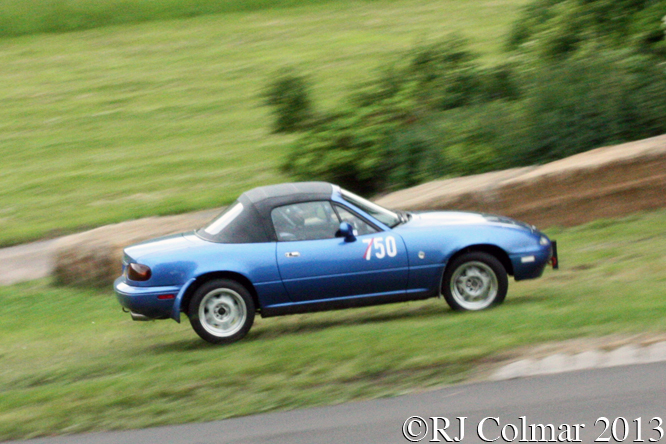
By for the most serious incident of the day was when Karl Chard left the road at Karousel and ended up going straight into the hay bales. Fortunately again Karl was unhurt which is more than can be said for the Mazda MX 5 which he shares with his brother Ian. At least all the wheels were still attached.

Flagg, Subaru Impreza STi, Gurston Down, Wiltshire

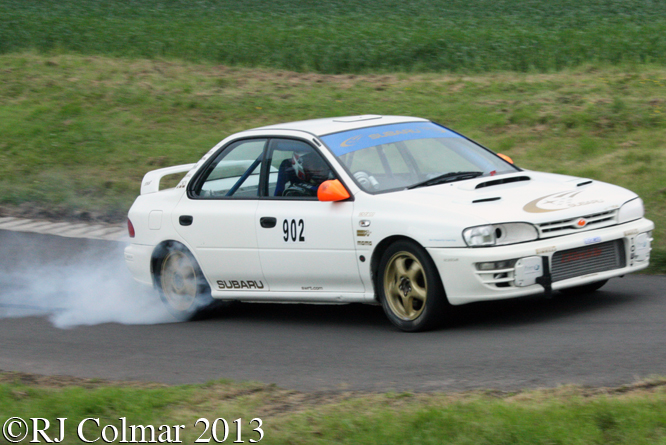
David Flagg lost 3/10ths of a second on his second timed run this display of wheel spin from his Subaru on the run to Deer Leap probably did not help his cause.

Hollier, Pilbeam MP62, Gurston Down, Wiltshire

Edward Hollier set best time of the day (BTD) running the course in 29.19 seconds in his Pilbeam MP62, both of his runs were quicker than the next fastest competitor Peter Smith who was driving a Force in the same class as Edward. Coincidentally Ed won last time that I saw him running at Wiscombe Park last month.

Another great day out at yet another great venue, if you have never been I doubt you will be disappointed.

Thanks for joining me on this “5th Tony Marsh Memorial Weekend” I hope you will join me again tomorrow. Don’t forget to come back now !

PS Shameless plug my British Grand Preview can be found at Motorsports Unplugged on this link.

Share

Endurance Survivor – Porsche 911 GT1-98 #003

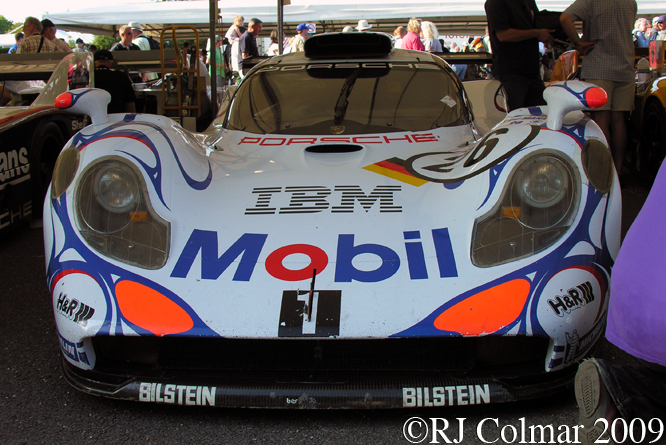
The Porsche 911 GT1-98 was the second evolution GT1 racer that Porsche contested the 1998 FIA GT1 championship with.

Porsche 911 GT1-98, Goodwood Festival of Speed

While the front of the new car bears a passing resemblance to the Generation 2 996 version of the Porsche 911 the rest of the car was essentially a prototype fitted with a 600hp twin turbo Group C type 24 valve twin cam water cooled flat 6 of the same type as used by the Porsche 962C with the addition of a sequential gearbox.

Porsche 911 GT1-98, Goodwood Festival of Speed

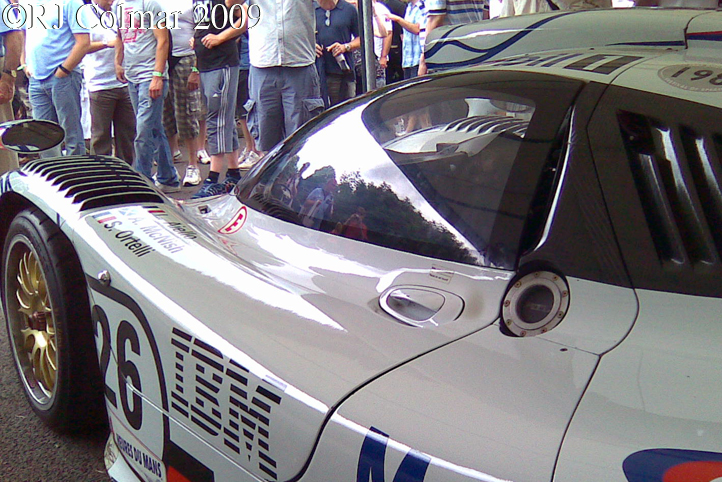
The 911 GT-98 was built around a tube frame and with carbon fibre bodywork. One road going example of the GT1-98 was built to meet the GT1 regulations.

Porsche 911 GT1-98, Goodwood Festival of Speed

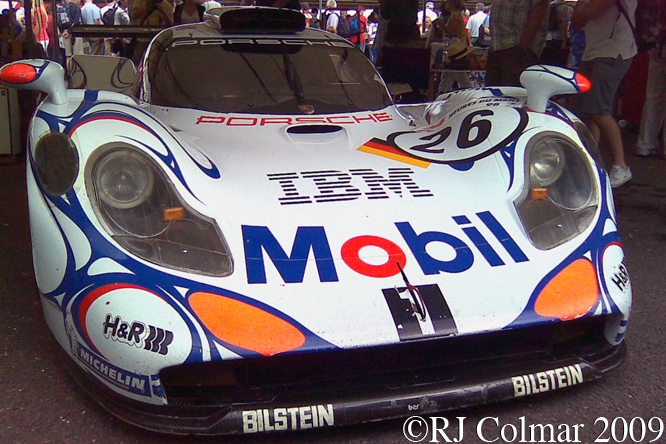
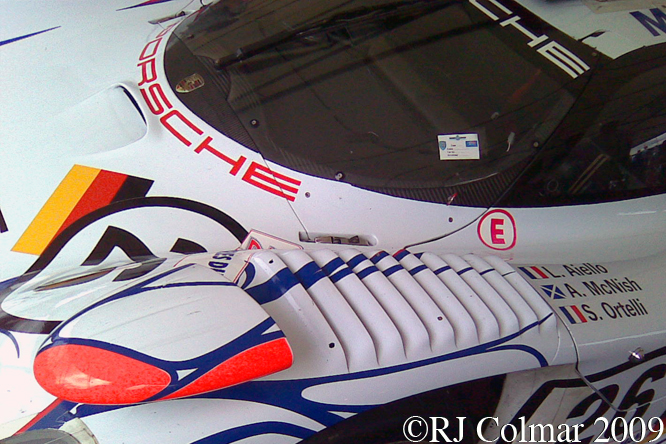
Going into the 1998 Le Mans 24 Hours race two normally aspirated 6 litre / 370 cui V8 Mercedes Benz CLK LM’s prepared especially for the endurance classic qualified 1st and 3rd. The fastest of three turbocharged Toyota GT-One qualified second with the Porsche 911 GT1’s 4th and 5th, the later car being chassis #003 driven by Allan McNish, Stéphane Ortelli and Laurent Aiello.

Porsche 911 GT1-98, Goodwood Festival of Speed

During the race the specially prepared Mercedes Benz CLK LM’s both retired by lap 31 with engine failures while the fastest of the Toyota GT-One’s retired after half distance after an accident which left the two works Porsches at the head of the field.

Porsche 911 GT1-98, Goodwood Festival of Speed

The #26 shared by NcNish, Ortelli and Aiello crossed the line a lap ahead of the sister car driven by Jörg Müller, Uwe Alzen and Brilliant Bob Wollek.

As had occured many times in the past the Le Mans winners did not win the championship which was dominated by Mercedes Benz who clocked up six 1-2 finishes, but it is Porsche who is best remembered from the GT1 championship for surviving to win an unlikely 1-2 at Le Mans.

Thanks for joining me on this “Endurance Survivor” edition of “Gettin’ a li’l psycho on tyres” I hope you will join me again tomorrow when I’ll be looking at a car that is ‘not a green Audi’. Don’t forget to come back now !

Share

Musical Spares – Porsche 962C #006

The Porsche 962 was built in two specs, the original was the 1984 IMSA GTP spec which was a variation of the dominant Group C Porsche 956 sports car first seen in 1982. The 962 differed in two important aspects from it’s Group C cousin. First the 962 had a longer wheel base so that the drivers feet were behind the center line of the front axle and second IMSA mandated a single turbo while the Group C 956 ran more powerful twin turbo’s.

Porsche 962C, Le Mans, France

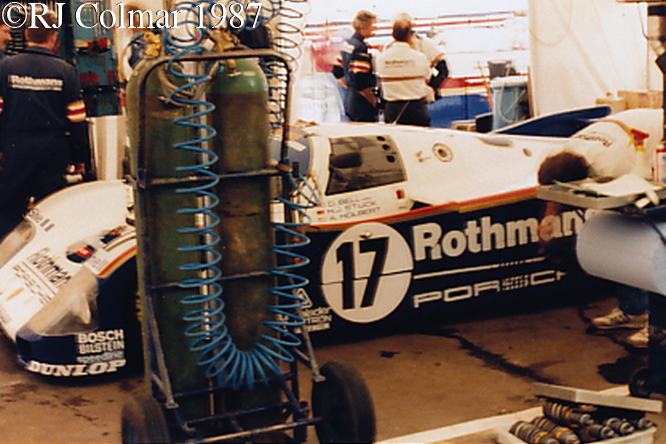
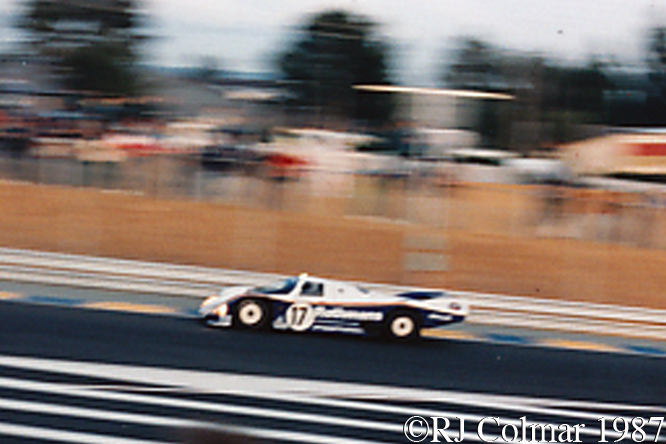
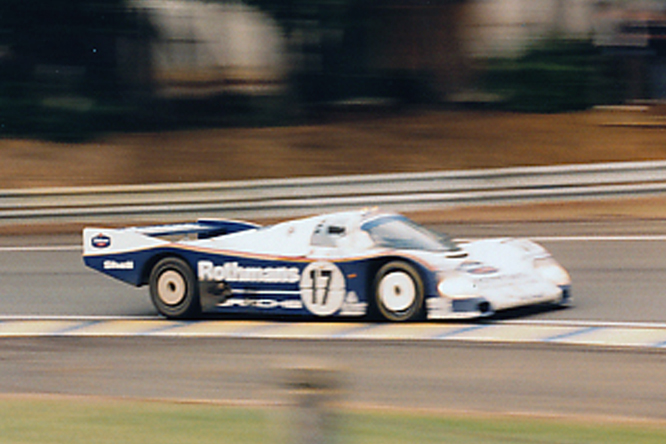
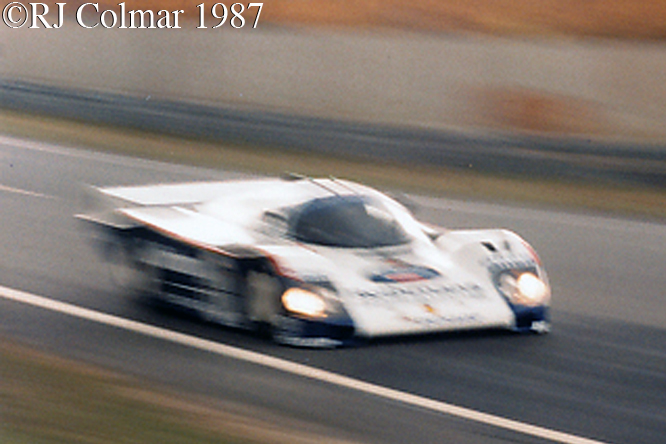
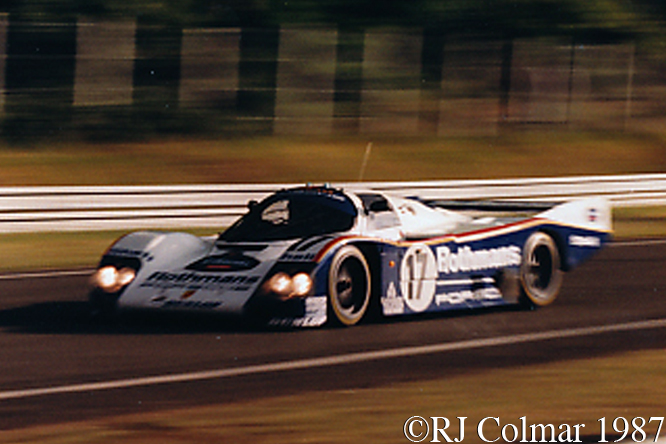
For 1986 the FIA mandated that Group C cars should follow the lead set by IMSA and have the drivers feet behind the the center line of the front axle line while making no changes to the engine regulations so the more powerful Porsche 962C came into being sweeping all before it much as the 956 and 956B had done. Derek Bell became the first driver to successfully defend his World Sports Car Drivers Championship won driving a 956B in ’85 and 962C in ’86. In 1986 Derek also won the Le Mans 24 hours for the forth time sharing his 962C with Hans Joachim Stuck and Al Holbert, Derek was also awarded the MBE for services to motorsport, a Royal honour which even Porsche AG noted on the door of Dereks #17 car as seen above at Le Mans in 1987.

Porsche 962C, Le Mans, France

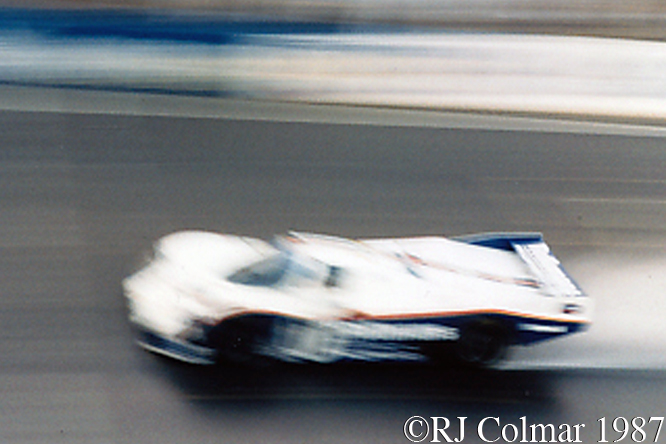
Going into Le Mans 1987 Derek Bell and Al Holbert were on a roll of three consecutive 24 hour race wins going back to Daytona ’86 where they shared an IMSA GTP 962 with Al Unser Jr. As mentioned above Bell and Holbert followed that up at Le Mans winning with Hans Stuck and made it a three peat of 24 hour victories at Daytona sharing Holberts Löwenbrau Porsche 962 with Unser Jr and Chip Robinson. Only a complete idiot would have bet against Bell, Stuck and Holbert claiming victory at Le Mans in 1987. The #17 chassis #006 seen in the rain above qualified 2nd on the grid by Hans Stuck next to the #18 chassis #008 which Bob Wollek qualified on pole.

Derek Bell, Hans Joachim Stuck, Le Mans, France

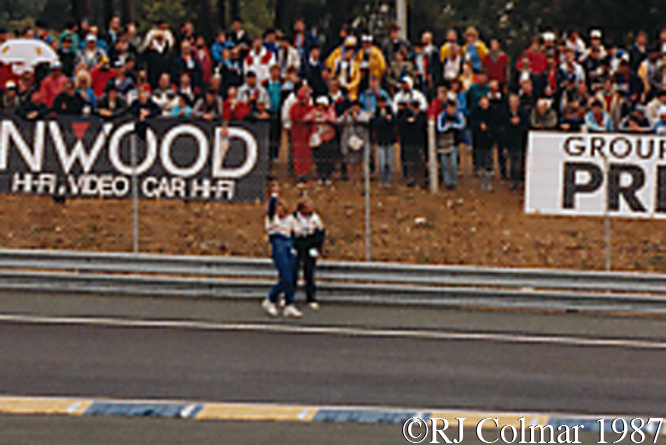
But the fourpeat of consecutive 24 hour victories very nearly did not happen, things started to go wrong for the works Porsche team a week before the race when Hans Stuck tested all the Le Mans cars at Porsche’s Weisach test facility. Stuck experienced a puncture while driving the car designated for his team mates Jochen Mass and Brilliant Bob Wollek. As a consequence Mass and Wollek were given the car designated as the race car for Stuck, Bell and Holbert chassis #008 while the ’86 winning trio took over the car designated for Vern Schuppan, Kees Nierop and Price Cobb chassis #006, today’s featured car, and the Schuppan, Nierop, Cobb combination were given the older chassis #002 which had been designated as a spare. Bell and Stuck are seen above returning from the new chicane an hour before the start of the race.

Porsche 962C, Le Mans, France

The next problem for the Porsche team occurred in practice when Price Cobb had an accident which wrote chassis #002 off during the first day of practice so that there were now only two works entered cars to challenge for the win, but as designer Norbert Singer observed ‘only one of them can win’. Schuppan, Nierop and Cobb all found rides in other cars.

Porsche 962C, Le Mans, France

An hour into the 1987 race it looked as if Jaguar who were at least 3 seconds slower than the lead Porsche in practice might pull off a remarkable win as they held first third and fifth. The Porsche cars were falling like a chain of domino’s with engine failures, something in the fuel was causing the latest in Bosch (ECU) electronic management systems to run the Porsche engines much too lean which resulted in engine failures for the pole sitting works car; 2 Joest Porsche 962C’s and a Kremer 962C.

Porsche 962C, Le Mans, France

Fortunately the #17 had managed to get into the pits to change to an older ECU before any permanent damage was done and 2nd placed Bell, Stuck and Holbert proceeded to pursue the lead Jaguar at break neck speed until midnight when it took the lead for the final time as the four 7 litre / 427 cui V12 Jaguar XJR 8LM’s started to fall by the wayside with a puncture, an accident, a cracked cylinder head and a missed gear change respectively.

Porsche 962C, Le Mans, France

The punctured #5 Jaguar driven by Win Percy had required an 80 minuet safety car period to clear up the debris in the dead of night as the Jaguar had been pitched at 200 mph into the barriers of the Mulasanne straight ripping off the gearbox and engine, Win Percy unlike his helmet was completely unscratched. The relentless pace at which the #17 Porsche had been chasing the Jaguars meant that Bell, Stuck and Holbert were way over their fuel allowance as the safety car period started but right back on schedule once the mess created by the Jaguar had been cleaned up.

By the end of the race Bell, Stuck and Holbert were 20 laps to the good; from the private Primagaz Competition 962C of Juergen Lässig, Pierre Yver and Bernard de Dryver; as they recorded their fifth, second and third Le Mans wins respectively, their second consecutively as a winning Le Mans trio and Bell and Holberts 4th consecutive 24 Hour race win. Porsche also recorded their seventh consecutive Le Mans win in 1987.

The following year things would not be so easy as Jaguar, who won the 1987 World Sports Car Championship and who’s driver Raul Bosel won the 1987 World Sports Car Drivers Championship took the fight even more convincingly to Porsche at Le Mans.

Chassis #006 was driven at Spa in 1986 by Jochen Mass and Bob Wollek on it’s debut where it was qualified third and finished 7th it’s only other race start was at Fuji where Holbert and Pescarolo started from 12th and retired with transmission problems. Prior to the Le Mans 24 hours #006 had primarily been used as a spare car at Jarama, Jerez, Monza and Silverstone in 1987. #006 was driven by Bob Wollek and Canadian Kees Nierop for the ’87 Le Mans test weekend where carrying the #17 it recorded the 2nd fastest time. After the 24 hour win in ’87 #006 returned to Le Mans in 1988 as a spare that was briefly used by Micheal Andretti in practice before it was retired for good.

Thanks for joining me on this “Musical Spares” edition of “Gettin’ a li’l psycho on tyres” I hope you will join me again tomorrow. Don’t forget to come back now !

Share