Tag Archives: Prescott

Race Winning Body – MG K3 #K3001/K3003

In October 1932 MG launched the K-Type Magnette at the London Motor Show, featuring a 48″ track and either a 94″ or 108″ wheel base the chassis was powered by a 6 cylinder 39 hp 1087cc / 66 cui motor with a cross flow cylinder head that originated from the 1930 Wolseley Hornet.The K1 Magnet was fitted with a saloon body on the 109″ wheel base and in all 181 were manufactured up to 1934 in KA, KB and lastly KD specifications which reflected a series of motor upgrades during the production run.

In 1933 the K2 a two seater on the 94″ chassis was launched, 16 were built with KB spec motors and 4 more with KD motors and pre selector gear boxes.

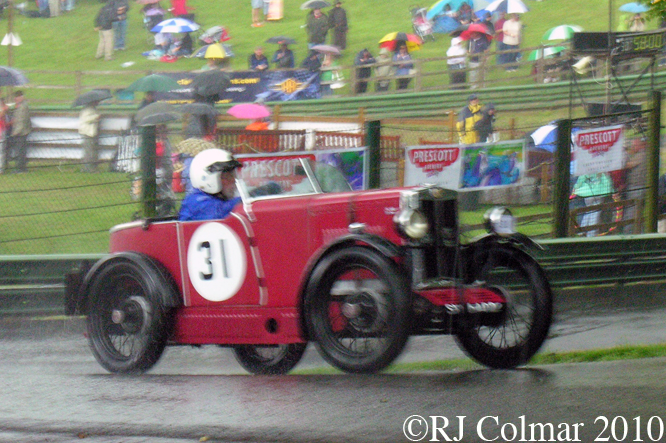
MG K3 K3001, Prescott

The princely sum of £795 could secure a supercharged K3 racing variant, as seen driven above at Prescott by Brandon Smith – Hillard, at first, as above, fitted with Powerplus superchargers just below the radiator and later with Marshall units. Fitted with pre selector gearboxes three K3’s including #K3001 above were entered into the 1933 where George Eyston and Giovanni Lurani driving chassis #K3003 came in 21st behind Tazio Nuvolari in an ALFA Romeo but took a class victory with Earl Howe and Hugh Hamilton coming in 22nd overall and 2nd in class in #K3001.

Subsequently #K3001 was raced at Brooklands, shared for the Shelsley Walsh by Land Speed Record holder and Mille Miglia class winner George Eyston with MM team mate Giovanni Lurani, raced throughout Europe by Bobby Kolrusche in 1934.

The Mille Miglia chassis #K3003 meantime had been given to the great Tazio Nuvolari to drive in the 1933 Ulster TT which he promptly won outright beating two 8 cylinder ALFA Romeo’s running in the 3 liter 183 cui class.

At some point after 1934 and before the commencement of the 2nd World War the body from the Mille Miglia and Tourist Trophy winning #K3003 replaced that on #K3001 which is how #K3001 appears in the photo above one of just 33 K3’s to have been built from 1933 to 1934.

My thanks to Ed of the Wessex MG Club Newsletter for details about this chassis.

Thanks for joining me on this ‘Race Winning Body’ edition of ‘Gettin’ a li’l psycho on tyres’, I hope you will join me again tomorrow, don’t forget to come back now !

Share

Irish Grand Prix Winner – 8/33 MG Midget

Cecil Kimber’s Morris Garages blossomed into the car manufacturer when it began producing sports versions of the 4 seat Morris Oxford in 1924. After building around 1100 such vehicles by 1929 the MG Car Company found a new market niche for small engined two seat performance sports cars.

MG M-Type, Prescott

The first such car was the M-Type similar to Alex Peacops 1930/31 example seen at Prescott above which was marketed as the 8/33 M.G. Midget which was based on the Morris Minor chassis featuring lowered suspension with a wheel base of 78″ / 1980 mm and track of 42″ / 1067 mm.

MG M-Type, Prescott

The power for the Midget was provided by a 20 hp overhead cam 4 cylinder motor derived from the Morris Minor and Wolseley 10 cars. In 1930 the Midget design, like all those featured today, was upgraded with the Morris rod braking system replaced with a cable operated system and the 20 hp motor being replaced by a 27 hp version. Roger Glister is seen at Prescott driving his 1931 Midget above.

MG M-Type, Loton Park

Competition success with Midgets in 1930 included a Gold Star on the Lands Ends Trial, class victories in the Double 12 (hour) race at Brooklands, and Irish Grand Prix, success which were unashamedly used in subsequent advertising campaigns for the MG Midget.

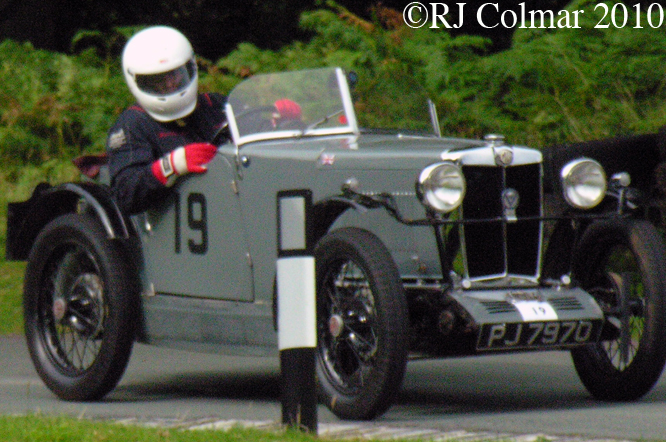
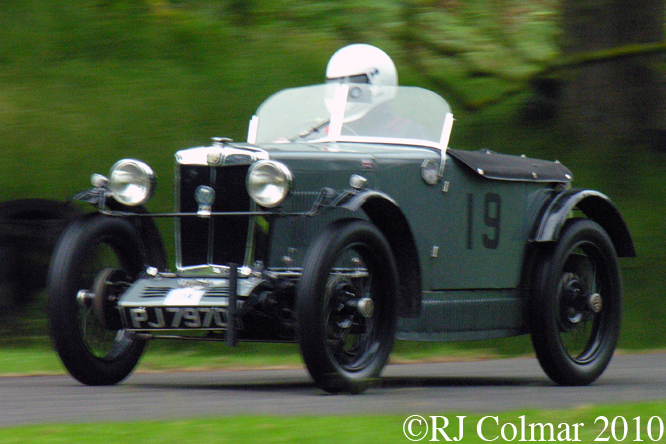
MG M-Type, Loton Park

In standard form, like the 1932 #19 above driven by David Rushton at Loton Park, the Midget was capable of 65 mph and 40 mpg. The popularity of the Midget significantly boosted MG production numbers, by 1932, when production ceased, 3,235 Midgets had been produced which included coupé, supercharged and a one off service van variant.

Thanks for joining me on this M-Type edition of ‘Gettin’ a li’l psycho on tyres’, I hope you will join me again for a look at “The Car You Always Promised Yourself”. Don’t forget to come back now !

Share

Vauxhall Bearcat Special

In 1922 Vauxhall introduced the 2.3 litre / cui 14/40 M-type to complement the 4 litre / 244 cui D-type and the 4.5 litre / 275 cui 30/98 E-type in it’s model range. The 14/40 featured a detachable cylinder head, 3 speed gearbox and rear wheel brakes, solid wheels were standard with wire spoke wheels an option.

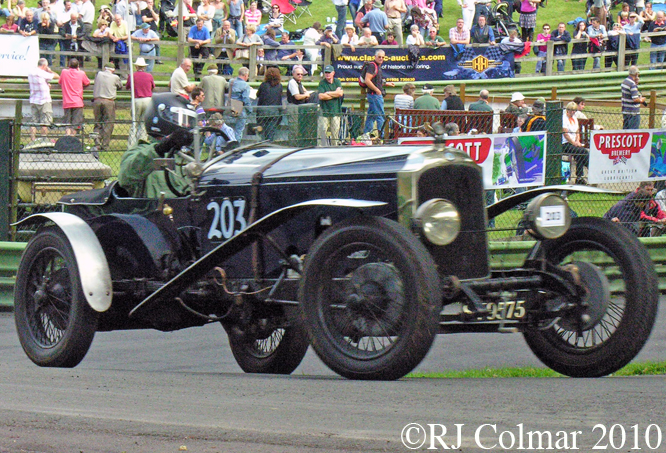
Ian Ferguson, Vauxhall Bearcat Special, Prescott

The 1926 Vauxhall 14/40 chassis driven by regular hill climb competitor Ian Ferguson at Prescott above has been fitted with a 4 cylinder 366 cui / 6 litre motor normally found in a Stutz Bearcat.

Thanks for joining me on today’s edition of ‘Gettin’ a li’l psycho on tyres’ I hope you will join me again tomorrow. Don’t forget to come back now !

Share

E-Type – Vauxhall 30-98 Velox Tourer

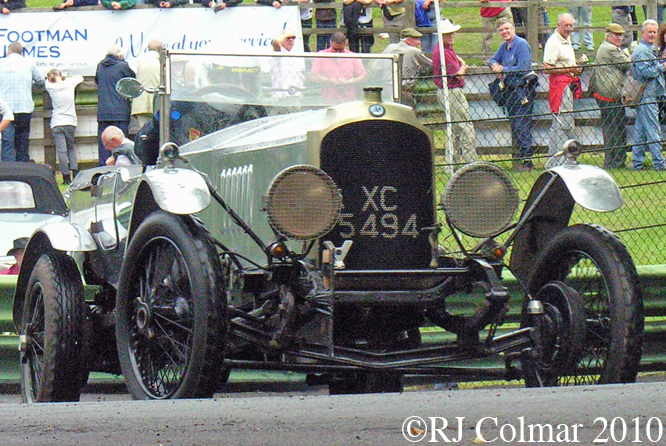
In 1913 Vauxhall announced their replacement for the Vauxhall D-Type known officially as the 30-98 or E-Type. 13 chassis were built before the Great War of 1914 – 1918, during which period Vauxhall fulfilled orders from the War Department to build the older D-type models for the use of nobility and Generals alike.

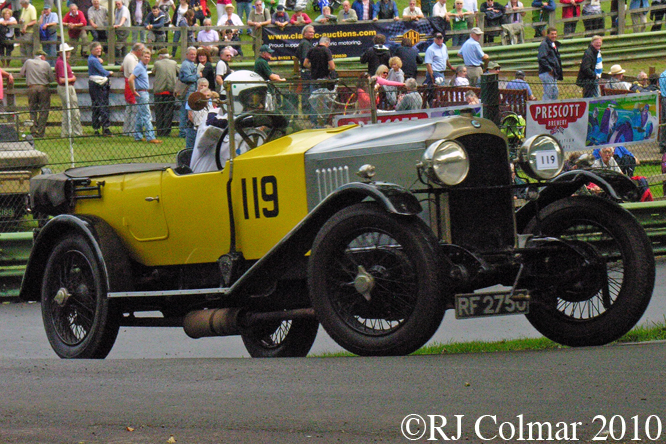
Mark Butterworth, Vauxhall 30/98, Prescott

Between the cessation of hostilities and 1922 it is thought around 270 further 30-98 E-types were built with 90 hp 4,525 cc / 276 cui four cylinder side valve engines which gave the car when striped down a 100 mph capability. Above Mark Butterworth negotiates the Pardon Hainpin at Prescott in his 1921 model. Unlike the equally fast contemporary Bentleys, Vauxhall 30-98 models only acquired front brakes during the production span of the model.

Phil Dobbin, Vauxhall 30/98 OE, Loton Park

The 30-98 E type was fitted with an improved 115 hp overhead valve engine in 1922, known as the OE to distinguish it from its older side valve engined siblings. Above Phil Dobbin can be seen lining up his 1924 30-98 OE for the start of a run up the hill at Loton Park.

Nicola Quartermaine , Vauxhall 30/98, Loton Park

1924 was the most successful year for the 30/98 E-type when 111 examples were built. Nicola Quartermaine’s 30-98 seen above negotiating the Triangle at Loton Park above comprises an older 1921 pre OE chassis and a 1924 4224 cc / 258 cui OE motor.

Roger Thorpe , Vauxhall 30/98, Prescott

Around 60% of all 30-98 E-types, like the 1924 chassis OE 102 driven by Roger Thorpe at Prescott above were exported to Australia, some have since made their way back to the mother land.

Adam Jones , Vauxhall 30/98, Prescott

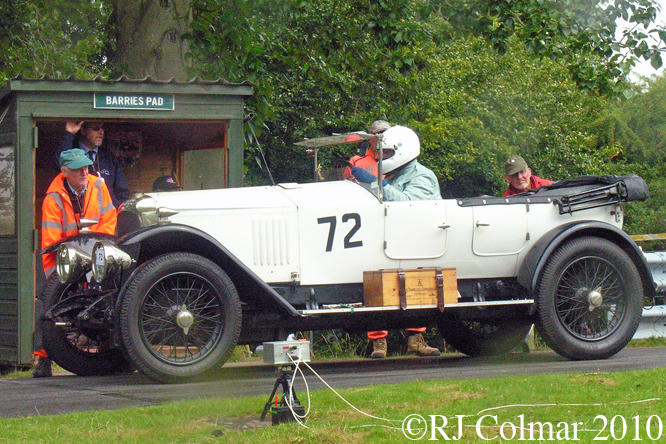
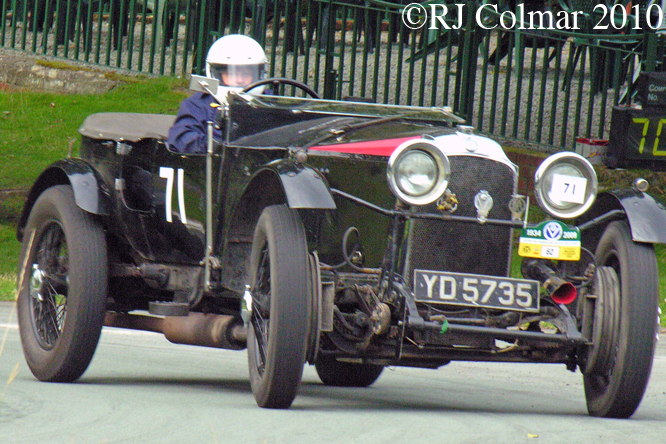
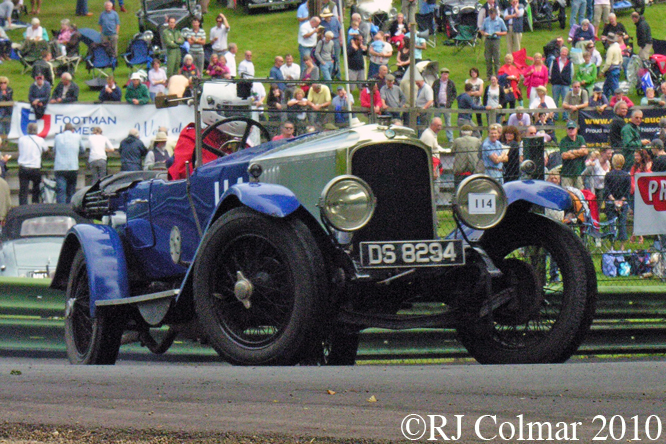
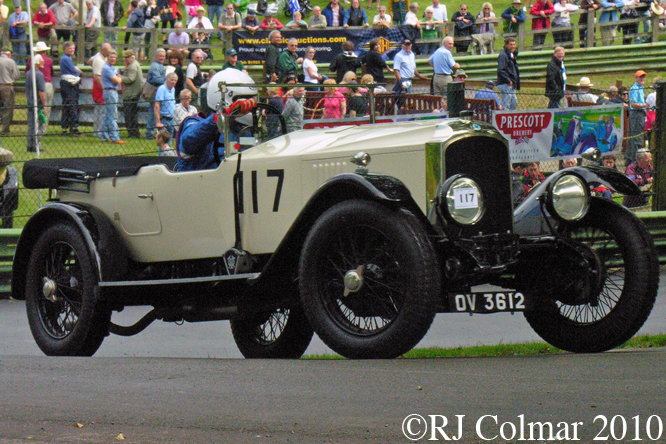
Vauxhall 30-98 E-types were available with either 4 seater tourer or 2 seater ‘Wesum’ boat tail body work with a ‘dicky’ (fold out) seat in the boat tail from the factory, alternatively a chassis could be ordered and sent to a coachworks for a bespoke body. Grosvenor Carriage Company for example, part of the Vauxhall dealer Shaw & Kilburn empire, built bodies for Vauxhalls exclusively during the production life of the 30-98. Above Adam Jones drives a 1925 4 seater with a tourer body, similar to all the vehicle bodies featured in today’s post. Note the absence of a drivers door on all of the vehicles featured in today’s post !

Dr Nick Bell, Vauxhall 30/98, Prescott

The class leading speed and later 4 wheel braking of the 30-98 was not enough to deliver consistent earnings for Vauxhall and in 1925 the company was sold for US$ 2.5 million to General Motors who set about challenging Ford at a lower end of the UK market than Vauxhall had hitherto catered for. Above Dr Nick Bell above drives a 1927 30-98 OE tourer, chassis OE 304, one of the last of the in total 312 OE’s built since 1922.

Thanks for joining me on this E-Type edition of ‘Gettin’ a li’l psycho on tyres’ I hope you will join me again tomorrow. Don’t forget to come back now !

Share

Brotherly love – Riley 9

The chassis of the Riley 9 was designed by Stanley Riley while the hemi head 1087 cc 66 cui was designed by his brother Percy. Riley 9s were produced from 1926 – 1938 with a variety of body styles.

The twin cam engine with short push rods operating the 45 degree inclined valves proved particularly suitable for tuning and Riley 9s were raced with great success into the mid 1950’s. This version, seen at Prescott top and Loton Park bottom, is owned by B Wildsmith and driven in VSCC events by Tim Hopkinson is a Special dating from 1929/34.

Hope you have enjoyed today’s brotherly love edition of Getting a lil’ psycho on tyres and that you’ll join me tomorrow for a look at another quintessentially British motor car. Don’t forget to come back now !

Share

Special Drophead – Bristol 401 Cabriolet

Continuing the Centenary Celebration of the Bristol Aeroplane Company out of which Bristol Cars was born, today we are looking at another unique car a Bristol 401 Drophead.

Between 1948 and 1953 Bristol Cars built 611 401 coupes and 23 mechanically identical 402’s cabriolets.

Sources close to the Bristol Owners Club assure me that this vehicle, seen at a VSCC meeting at Prescott, is a one off special 401 coupe converted into a cabriolet.

Hope you have enjoyed today’s special drophead edition of ‘Gettin’ a lil’ psycho on tyres’ and will join me again tomorrow for some Bristol disambiguation. Don’t forget to come back now !

Share

Halloween Special – Fafnir Machtigen Werke Special

To put you into the mood for the weekends festivities here is Oliver Way driving BR Thompsons Fafnir Machtigen Werke Special with a non automobile 10 litre / 610 CUI engine seen here at Loton Park.

The car does does always appear with the scary radiator cover, as can be seen here at Prescott.

Fafnirs in production from 1908 – 1927 had in line 4 cylinder engines no bigger than 3990 cc 243 cui.
I am wondering if anyone knows where the huge engine came from, or what type of circa 1918 chassis, with only rear wheel brakes this is?

Thanking you in anticipation of your responses.

Thanks for dropping by, wishing everyone a scary Halloween weekend, don’t forget to come back now !
Share