Tag Archives: Prix

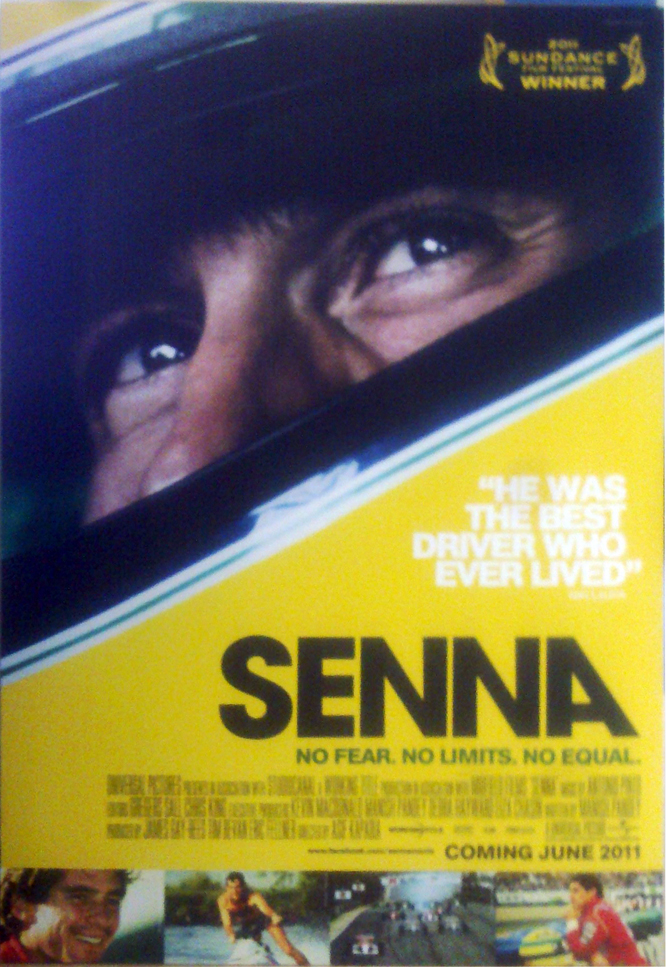
Sundance Winner – Senna

Senna Movie

Last night I was taken to the cinema at Watershed in Bristol by a non racing fan Fiona with a professional interest in documentary films to go and see ‘Senna’ a 90 min documentary about three time Formula 1 World Champion Ayrton Senna.

Directed by Asif Kapadia the film is apparently unusual in being the first such documentary which is made entirely of archive footage for its visuals, with a handful of contemporary voiceovers by persons who knew and were involved with Ayrton during his 34 year life.

The film focuses on Senna’s Formula One career from 1984 to 1994 using some excellent TV highlights of his driving prowess mixed with interviews, many of the best conducted in his native Portuguese language, along with drivers meetings which took place before crucial races in Ayrton’s career.

I have to confess, perhaps as a result of having become aware of Grand Prix racing at a time when racing drivers were killed at an alarming rate, I was never the biggest of Senna fans. I always respected his achievements but found the aggression, which I saw him display racing wheel to wheel first hand, in the lower formula before he reached Formula One just a little too foolhardy for my tastes.

However this documentary did leave me with a useful reminder and insight into just how exciting Brazilian Ayrton Senna was to watch at the wheel and just how focused he was with the job at hand.

I loved the relatively low fi 80’s TV picture quality on the giant cinema screen, and could have easily enjoyed this film if it had been an hour longer in the same vane. Much to my surprise Fiona and her partner Caroline both announced they had also enjoyed it !

This cross gender appeal of the drama of Senna’s life no doubt contributed to ‘Senna’ wining the World Cinema Audience Award at the Sundance Film Festival earlier this year.

No matter how little you know or even like Formula One racing this is a seriously engaging documentary, definitely one not to miss.

My thanks to Fiona for taking me out last night.

Thanks for joining me on today’s ‘Sundance award winning’ edition of ‘Gettin’ a lil’ psycho on tyres’, I hope you’ll join me again tomorrow. Don’t forget to come back now !

Share

A Big Red Cadillac – Ferrari 126 CK

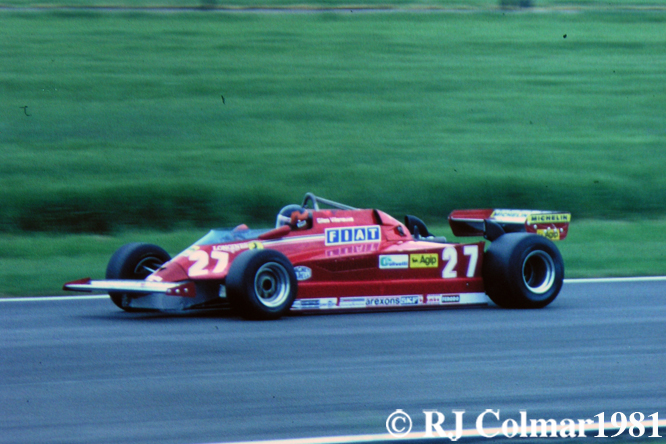
Taking a one day break from GALPOT’s Indy 500 celebrations, for Ferrari Friday today we are celebrating the life of Gilles Villeneuve, father of 1995 Indy 500 winner and 1998 World Champion Jaques Villeneuve, and Gilles Ferrari 126 CK seen here during practice for the 1981 British GP at Silverstone.

81 07 17 #27 126 CK 054 01sc

The Ferrari 126 CK was a development of Ferrari’s first turbocharged Grand Prix car which was launched in 1980. Featuring a fire breathing 600 hp 1,496 cc / 91 cui 120º V6 twin turbo charged motor and six speed gearbox Villeneuve described this car as a ‘big red Cadillac’ because the chronic turbo lag, ferocious power curve combined with ground effect aerodynamics made this car a real handful to keep under control.

Despite it’s wayward characteristics Gilles pulled off two of the most entertaining victories this writer has ever seen on TV, the first at Monaco (apologies commentary in German) came after Champion elect Nelson Piquet spun off after leading for 51 laps and reigning Champion Alan Jones experienced a fuel feed problem which allowed Gilles to steal a late victory on the one circuit least suited to his cars few strengths.

Two weeks later Gilles pulled off an even more unlikely victory at the equally tight and unsuited Jarama Circuit this time Villeneuve took the lead after 14 laps when reigning Champion Jones spun off. Gilles kept a four car train behind him for the rest of this exciting race by using the Ferrari’s brutal power on the straights to pull away out of the corners, going round the corners his pursuers bunched up time after time but did not have the brute strength to get an edge on the straights.

The finish of the 1981 Spanish Grand Prix was one of the closest in history with the first five cars being separated by 1.24 seconds. Sadly this would be the last time Gilles would take the checkered flag.

By the time Ferrari arrived in Britain they were developing a way to minimise turbo lag by injecting fuel into the red hot turbo exhaust pipe when the throttle was off, as the fuel ignited in the turbo exhaust pipe the pressure difference created between the burning fuel in the exhaust and the turbine wheel mounted upstream caused the turbine wheel to spin faster which in turn increased the turbo boost to the motor so that when the throttle was depressed more power was readily available. In this form whenever the 126 CK was off throttle a lick of flame would appear out of the exhausts.

At some point this system was banned, it being successfully argued by teams using naturally aspirated motors that the turbo afterburner constituted a second engine, when the rules clearly stated only one motor was allowed.

At the British Grand Prix, apologies Austrian commnetary, Gilles qualified 8th and made up five places on the opening lap before loosing it on the apex of the last corner of the first lap. Notice in the clip that despite his totaled car Gilles somehow manages to squeeze another 1/4 lap out of the car before retiring, this guy just did not know how to stop when the chips were down.

Another memorable performance that emphasised Gilles never say die attitude came at the 1981 Canadian Grand Prix where despite his damaged front wing obscuring his vision and adversely affecting the already poor handing of his Ferrari for numerous laps, Gilles kept his car on the black stuff to record an amazing third place finish.

Gilles was killed in an accident during practice for the Belgian Grand Prix, May 8th 1982

Salute Gilles RIP.

Hope you will join me for another edition of ‘Gettin’ a lil’ psycho on tyres’ tomorrow. Don’t forget to come back now !

Share

Sweet dreams are made of this – Connew PC1 02

Imagine a recently graduated 24 year old industrial designer, who knows nothing about motor sport, but with a passing interest in large American chromed land yachts sitting in an office designing record players in East London, i pods if your not sure of what a record player is, and the phone rings. His friends are calling to see if he would like to join them on holiday with the intention of taking in the 1969 Italian Grand Prix.

When his boss tells our hero that it is not okay to take the time of work to go on holiday our hero offers his resignation, and joins his friends anyway.

At the Italian GP our hero falls in love with the sound of V12 engines as they accelerate between the corners of the Monza track.

Upon returning to England he finds out about a vacancy in the drawing office of a newly established Grand Prix team owned by a former multiple World Motor Cycle champion and one time World Grand Prix champion.

Our hero’s attitude ‘that there was no problem in this world that common sense and application with half an ounce of intelligence can not overcome’ wins him the job, starting out knowing absolutely zero about the design of racing cars within months he is working on the design of a Grand Prix car.

When our hero sees the red car his new design is going to replace wheeled out into the sunshine for the first time, in that very instant he decides he is going to build a Grand Prix vehicle of his very own.

Our hero starts working from home, his parents home that is, on his own Grand Prix challenger, a friend tells our hero he may use a spare bedroom and lock up to start building his car, other friends chip in with time, suppliers ‘lend’ him various bits and pieces to be getting on with. As the design our hero is paid for near completion he then takes a job with an engineering company where he uses his and colleagues lunch hours to fabricate parts he cannot otherwise afford for his own Grand Prix challenger.

12 months after deciding to build his very own Grand Prix car our hero completes his chassis and he shows it to his cousin, a wood work teacher, who agrees to to join the team to make the bodywork using materials he has never used before.

Using only our heros own wages, friends time, goodwill and what can be scrounged including a dummy engine, once used by Jochen Rindt to win the 1969 US Grand Prix, gearbox and wheels our heros team push their improbably completed Grand Prix car one Sunday night out of it’s lock up, down the London Rd in Chadwell Heath to the only place with enough light to take a photo of their pride and joy, the forecourt of their local petrol station.

If this story sounds incredible then I’d like to welcome you to the incredible story of Peter Connew who in 36 months made the transition from record player designer to Formula One designer and constructor of the Connew PC1 02 Grand Prix car seen here in late 1971. To be continued….

With thanks to Peters cousin Barry Boor for the photographs if you’d like to read the whole story of how the Connew team came together over a period of two years and it’s trials and tribulations the year after please read Barry’s account of his part in this ‘Boys Own‘ adventure here.

Hope you enjoyed part one of my all time favourate Formula One story which will be continued at some future date, and that you’ll join me tomorrow for a look at some teutonic efficiency at ‘Gettin’ a lil’ psycho on tyres’. Don’t forget to come back now !

Share

Keep turning right – 2010 Somerset Grand Prix

Yesterday I took a couple of hours off to visit Oak Tree Arena home of Somerset Raceway. Finding it was none to easy as the track, which opened in 2008 has yet to be photographed for Google Earth, however it’s off Junction 22 of the M5 on the A38 heading for Bridgewater, a tad south of Burnham Without.

I didn’t spot the signage first time but a local resident kindly pointed me in the right direction.

Above Dan Lewis Class 5 Mini.

This weekends event was billed as the Somerset Grand Prix, a round of the 2010 National Autograss Championship, hosted by the South Somerset Auto Grass Club under the National Autograss Sport Associations governance.

Above Otis Williams, Class 1 (Junior), Mini.

NASA promotes Autograss as a family sport catering for Juniors aged 12

Above, Paul, Fackerells, Class 10, Special.

with Seniors starting at 16 and allegedly running up to and over 70 !

Above, John Gays Class 7 Suzuki SC100.

Cars run in 10 classes which split into bodied

Above open wheel Specials.

and space frame open wheel specials.

Above Peugeot 205 & Vauxhall Nova.

NASA Autograss racing is a non contact sport run professionally for amateurs, the racing is close, and atmosphere friendly. I look forward to watching how the the Oak Tree Arena develops as a venue in the future. One things for sure I’ll certainly be going back.

Further NASA fixtures can be seen here. Information about the South Somerset Autograss Club can be found here.

Don’t forget to come back now ! Hear ?

Share