Tag Archives: Racing

Fiberglass Body – Ferrari 250 LM #8165

This November sees the 50th anniversary of the unveiling of the Ferrari 250 LM which to date was the last Ferrari to cross the finishing line first at Le Mans in 1965.

Today’s featured car chassis #8165, the last 250 LM to be built, was sold new to Scuderia Filipentti and entered by them in the 1966 1000kms race at the Nurburgring for Willy Mairesse and Herbert Mueller who finished 9th.

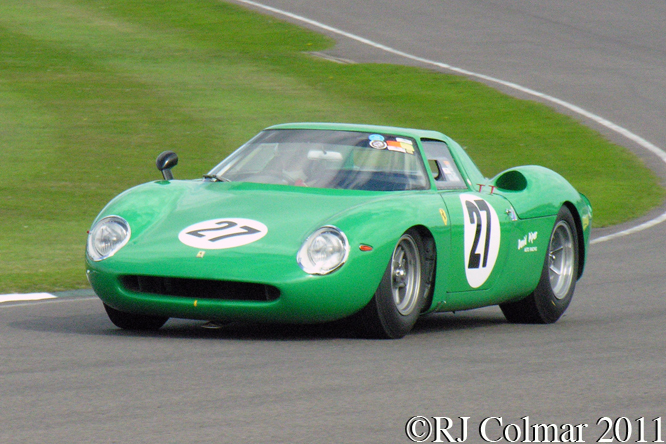
Ferrari 250LM, Goodwood Revival

The car was then sold to David Piper and in June 1966 David fitted fiber glass body panels front and rear and painted #8165 BP Green. Subsequently David is known to have driven the car to victories at Brands Hatch, Oulton Park and the 1000kms Paris at Monthlery in 1966 sharing the car with Mike Parkes in the latter.

In 1967 David won at Silverstone and entered the #8165 for Hugh Dibley and Roy Pierpoint for the 1000kms at Brands Hatch where they finished 10th overall and first in class. At Monthlery Richard Attwood and Brian Redman came 6th overall and first in class.

Ferrari 250LM, Goodwood Revival

In 1968 Pedro Rodriguez joined Roy Pierpoint in #8165 for the 1000 kms at Brands Hatch where they finished 5th but only 3rd in class. #8165’s last ‘in period’ appearance was in the 1968 Le Mans 24 hours where Piper and Attwood qualified 28th and came through to a seventh place finish.

David Piper is seen driving #8165 in these photo’s in practice for the Whitsun Trophy at the Goodwood Revival a couple of years ago. David finished the race in 27th place.

My thanks to Athanase and Miurasv for clarifying the early ownership of this car over at FerrariChat.com.

Thanks for joining me on this “Fiberglass Body” edition of “Gettin’ a li’l psycho on tyres” I hope you will join me again tomorrow. Don’t forget to come back now !

Share

It’s Not A Pick Up Truck – Ferrari 150° Italia

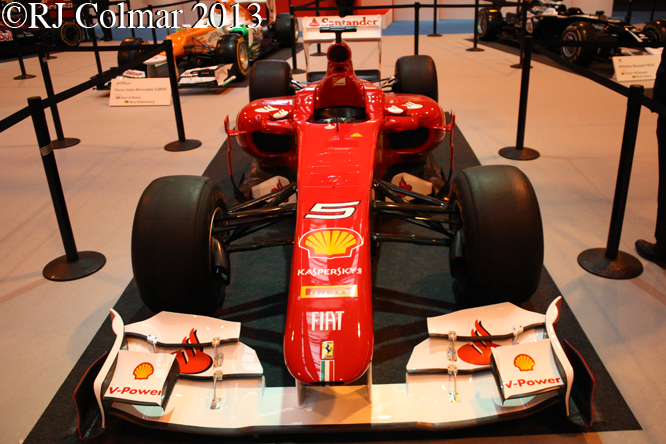
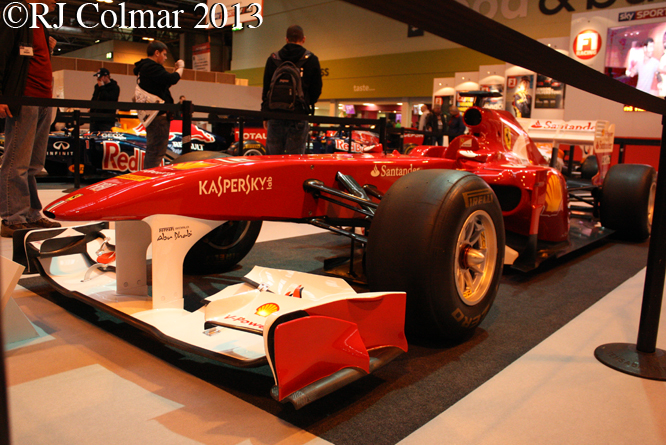
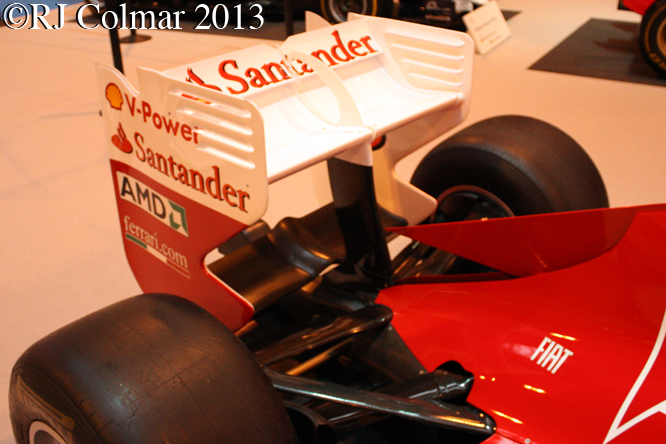
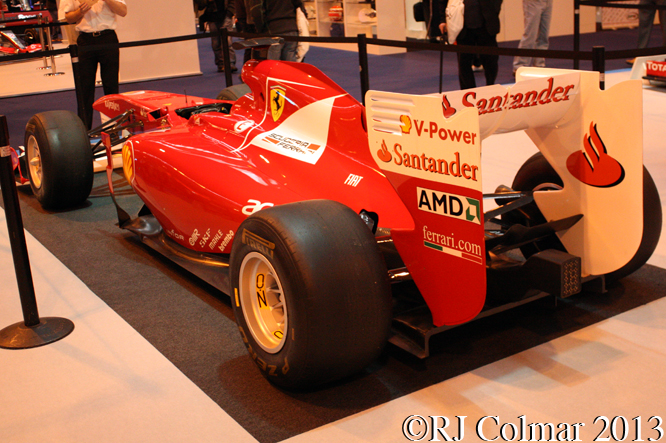
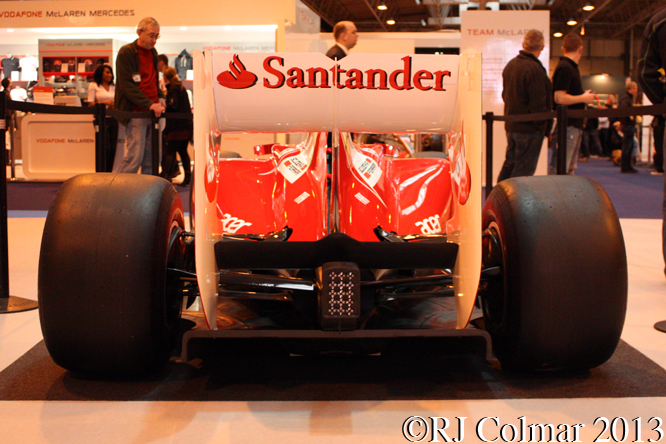
Having snatched World Drivers Championship defeat from the jaws of Victory at the Abu Dahbi Grand Prix in 2010, where Fernando Alonso went into the last race of the season with a 15 point lead over third placed Sebastian Vettel but left 4 points in arrears to the German in the final Championship standings, Ferrari regrouped for 2011 building a new vehicle with the design credited to Aldo Costa and Nicholas Tombazis which was known at its launch as the F150 in celebration of Italy’s 150th unification anniversary.

Ferrari 150° Italia, Autosport International, NEC, Birmingham

Formula One attracts controversy like flies to jam and a large number of jokes by even the most technical minded Formula One anoraks aside it was not long before Ford objected to Ferrari’s use of the trade marked F150 name and eventually Ferrari settled on the 150° Italia in which the ‘°’ stands for the ordinal cento cinquantesimo or one hundred and fiftieth in English.

Ferrari 150° Italia, Autosport International, NEC, Birmingham

Technically Ferrari’s 2011 2.4 litre/146 cui V8 powered challenger was caught on the hop having failed to spot the potential handling benefits of off throttle blown diffusers, a failure which echoed Enzo Ferrari’s assertion that aerodynamics are for teams that cannot build engines.

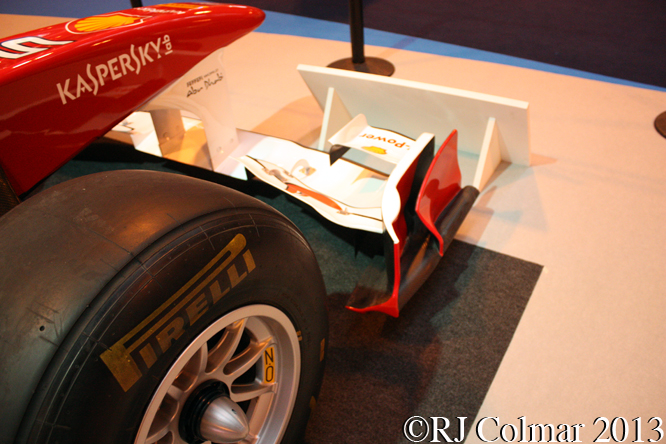
Ferrari 150° Italia, Autosport International, NEC, Birmingham

As a consequence Alonso was rarely in contention for podium finishes as Red Bull and McLaren who had refined their off throttle blown diffusers, won the opening 8 races of the 2011 season with Sebastian Vettel in the Red Bull winning 6 and Lewis Hamilton and Jenson Button driving McLarens winning the remaining two.

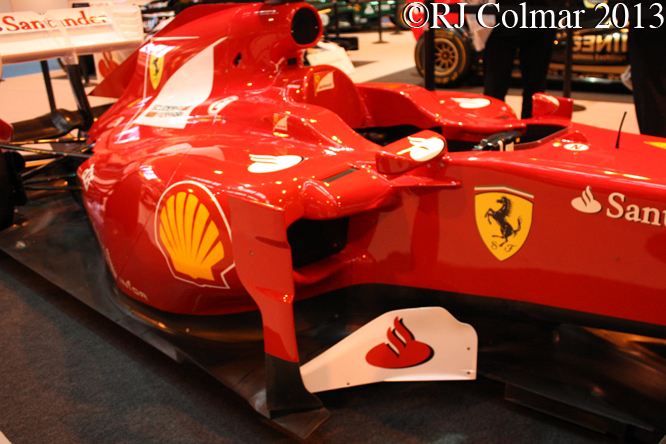
Ferrari 150° Italia, Autosport International, NEC, Birmingham

For the ninth race of the season the British Grand Prix Ferrari had managed to persuade all the teams that they should run without off throttle blown diffusers, which basically hooked up an electronic engine programme to wind up the engine speed when the driver was off throttle to force hot air through the exhaust into the diffusers which produced additional downforce when running off throttle through the corners.

Ferrari 150° Italia, Autosport International, NEC, Birmingham

In the prevalent wet conditions which dried through the race Alonso, starting third, managed to beat the Lewis Hamilton driving a McLaren and Sebastian Vettel in his Red Bull to score the Ferrari teams only victory in 2011.

Ferrari 150° Italia, Autosport International, NEC, Birmingham

By the next race the teams despite objections from Ferrari and the Ferrari powered Sauber team reverted to running off throttle blown diffusers in anticipation of a ban on these devices for 2012.

Ferrari 150° Italia, Autosport International, NEC, Birmingham

Ferrari ended up a distant third in the manufactures championship behind Red Bull who scored six further victories to take their 2011 total to 12 and McLaren who scored four further victories in the 19 race season.

Fernando finished the 2011 championship 4th behind Vettel, Jenson Button and Mark Webber who scored just one point ahead of the Spaniard. De facto Ferrari number 2 driver Felipe Massa was lucky to keep his Ferrari seat for 2012 after he finished 6th in the championship 99 points behind Lewis Hamilton having failed finish any higher the 5th all season.

Thanks for joining me on this “It’s Not A Pick Up Truck” edition of “Gettin’ a li’l psycho on tyres” I hope you will join me again tomorrow. Don’t forget to come back now !

Share

Testing The Beat – McLaren F1 GTR #10R

For several years before his untimely death Bruce McLaren toyed with the idea of building a road car once his racing operations had become firmly established. In 1970 he had a Can Am McLaren M6 fitted with a GT body that both he and Gordon Coppock had worked on to perfect. After Bruces death the directors of McLaren decided to shelve the road car project although to further copies of the M6GT were built by Trojan who were responsible for building McLaren’s customer racing cars.

Twenty years later McLaren designer Gordon Murray convinced Ron Dennis to back his concept for the ultimate road car which Peter Stevens was engaged to complete the exterior styling. The McLaren F1 road car was launched in 1992 and in 1998 it set road car speed records of 231 mph with the rev limiter switched on and 243 with the limiter switched off.

At around the same time as the launch of the F1 a movement for racing GT cars was gathering pace and for the 1995 Season McLaren built 9 F1 GTR variants the first of which #01R, modified road car chassis #019 was loaned to Lanzante Motorsport who entered Yannick Dalmas, Masanori Sekiya and JJ Lehto into the 1995 Le Mans 24 hours under the Kokusai Kaihatsu Racing banner and improbably won as a result of superior reliability over the much faster Courage Porsche C34 prototype driven by “Brilliant” Bob Wolleck, Eric Hélary and Mario Andretti. The race winners covered just 298 laps the last time a Le Mans 24 hours had been won with less than 300 laps completed was 1952 to when Hermann Lang and Fritz Reiss drove their Mercedes Benz 300SL to victory with 277 laps completed.

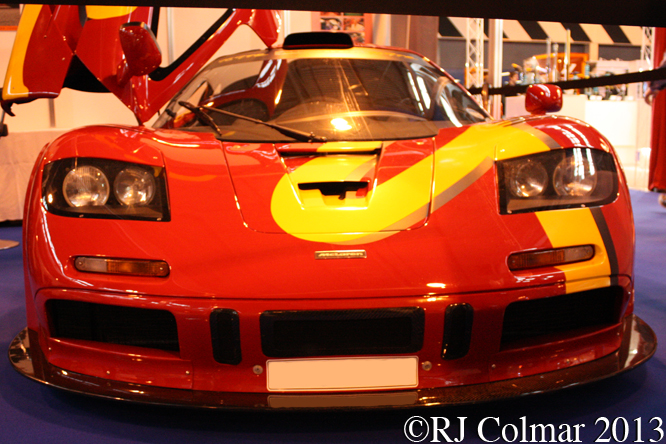
McLaren F1 GTR, Autosport International, NEC, Birmingham

For the 1996 season Mclaren built a further batch of nine cars with extended front and rear bodywork which was easier to remove than on the original ’95 F1 GTR, magnesium gearbox housing with stronger internals which resulted in a lighter car. Two of the ’95 Spec F1 GTR’s were similarly upgraded.

Today’s featured vehicle is the first of the ’96 F1 GTR’s chassis #10R which was used as a test development vehicle to replace the Le Mans winning #01R which had immediately been retired from competition for publicity purposes.

David Brabham used the car for a test session at Le Mans in 1996 where he recorded the 20th fastest time, but the car has never been raced.

When pop drummer Nick Mason bought #10R he had McLaren convert the car for road use as were several F1 GTR’s once their competition careers were over.

Mark Hales tested the 600hp BMW V12 powered #10R for Evo magazine and recorded a 0-60mph time of 3.2 seconds and a top speed of 240.1 mph.

In 1997 a further development of the F1 GTR featuring an even longer body, 10 examples of which were built. An over view of the racing results of the F1 GTR from 1995 to 2007 can be seen on this link.

Thanks for joining me on this “Testing The Beat” edition of “Gettin’ a li’l psycho on tyres”, I hope you will join me again tomorrow. Don’t forget to come back now !

Share

Racing Transformer – McLaren Elva Mark I #M1A-20-15

In 1952 aged just 14 years old Bruce McLaren entered his first competition driving event a hillclimb in New Zealand with an Austin A7 Ulster which hois Dad Les had restored. by 1957 he was driving a Cooper Climax which he also modified sufficiently to become runnner up in the 1957 and 1958 New Zealand Formula 2 series.

By the end of 1958 Bruce made his Grand Prix debut in the German Grand Prix driving a works Formula 2 Cooper Climax where he finished fifth but was not awarded any World Championship points which were only awarded to drivers of Formula One cars. Bruce stayed with Cooper for seven years becoming the then youngest Grand Prix winner aged just 22 in the 1959 US Grand Prix at which his team mate Jack Brabham won his clinched his World Championship.

In 1963 Bruce founded Bruce McLaren Motor Racing Ltd and his first car was the Zerex Special a car that had been transformed from a 1.5 litre / 91.5 cui Cooper Climax single seater Formula one car to a two seater sports car powered by an Oldsmobile V8 featuring a tube frame of Bruces own devising, the rechassisied car painted garden gate green was distinguished by eight stub exhausts angled to the rear, won first time out at Mosport in Canada in 1964 and again at Brands Hatch the same year. This car was last seen in Venezuela at the end of the 20th Century.

For 1964 Bruce built 3 Oldsmobible powered M1A sports racing cars which were the first first to bear his name, of which the first Bruce raced, the second was used for testing and the third was a show car. Bruce entered into an agreement with Trojan who were also owners of Elva Cars to build a production run of customer M1A’s under license for the 1965 season.
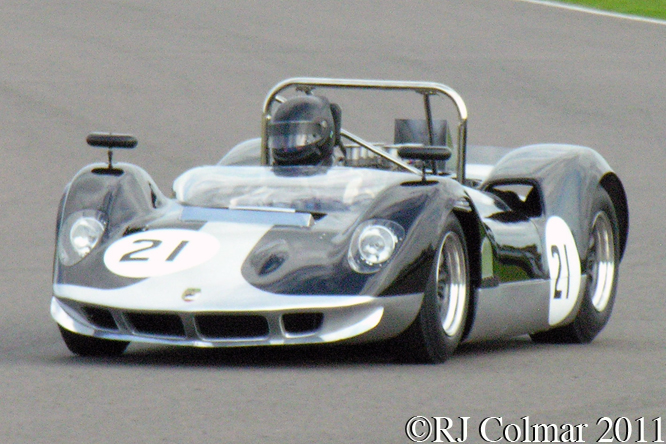
McLaren Elva Mark I, Goodwood Revival

Today’s featured car is one of the 24 M1A’s built under license and was marketed in the USA as the McLaren Elva Mark 1 which could be fitted with Chevrolet, Ford or Oldsmobile V8’s. This particular chassis #M1A-20-15 was originally supplied to Joe Starkey who is recorded as having won seven events in McLaren Elva Mark 1 chassis in 1965 and 1966, although at the time of writing these achievements have not been specifically ascribed to the chassis featured today. If you believe this car is the one Joe won those races in, as seen winning at Green Valley in 1966 in this linked photo by Jerry Melton please do not hesitate to chime in below.

In 1968 having failed to attract much interest in it’s 3 litre / 183 cui Formula A open wheel series the SCCA opened up it’s premier category to 5 litre / 302 cui stock block motors which over the ensuing 6 years proved extremely popular in the US, UK South Africa and particularly Australia where the F5000 series, as Formula A was known outside the USA, remained a premier category until 1982.

For the new 5 litre / 302 cui regulations Joe Starkey had his M1A transformed into an offset single seater open wheel car running a 500 cc / 30 cui undersized Oldsmobile motor. Starkey’s McLaren in open wheel form can be seen in this grainy linked photo. Joe was not alone converting a McLaren 2 seater into an open wheeler for Formula A.

Since the featured photograph of the car restored to it’s original closed wheel form was taken, with current owner John Bladon driving at Goodwood, the large chrome safety cage has been replaced with a black one of more modest proportions in time for a winter trip to Australia.

I’ll be celebrating McLaren’s first 50 years by featuring 3 more McLarens on Sunday’s for the rest of April.

My thanks to owner John Bladon, David McKinney and RA Historian from The Nostalgia Forum for their help identifying today’s featured car.

Thanks for joining me on this “Racing Transformer” edition of “Gettin’ a li’l psycho on tyres” I hope you will join me again tomorrow. Don’t forget to come back now !
Share

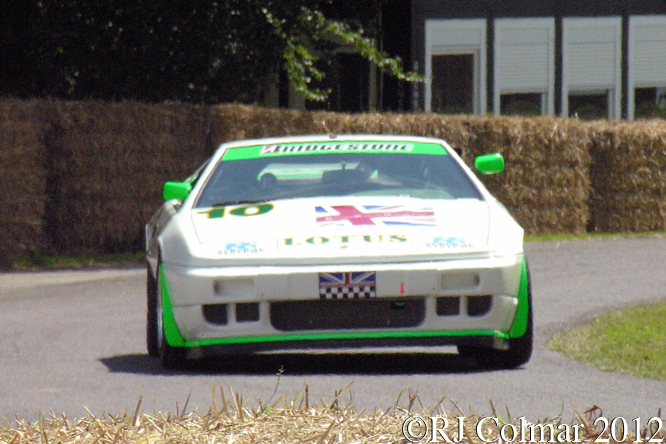
Which Type ? – Lotus Esprit X180R

In 1990 Lotus built 2 racing cars based on the Peter Stevens designed Esprit Turbo SE X180 which became known as the X180R and everyone appears to agree that the car was given the Lotus Type 105 number. These cars were built to be raced in the Sports Car Club of America (SCCA) Escort World Challenge by Doc Bundy and Scott Lagasse and won 4 times in 8 races.

Lotus  Esprit X180R, Goodwood Festival of Speed

Flush with success Lotus then built three new 300hp versions of the X180R’s the following season for the IMSA Bridgestone Super Car Championship in 1991 which Doc Bundy duly won in 1992.

There is some disagreement amongst internet sources about the type numbers of the 3 cars built in 1991 which some sources suggest were given the Type 106 number while others have it that all five race cars built in 1990 and 1991 are Type 105’s and that 20 road going versions of the X180R racer were given the Lotus Type 106 type number. Other sources suggest the 20 road going versions of the X180R are actually Type 105’s.

To confuse the identification issue further it would appear the 2 1990 race cars were updated to 1991 spec so technically these might be Type 105/106’s.

If you are a Lotus historian and can definitively put the record straight on the type 105’s and 106’s please do not hesitate to chime in below. I’d be most grateful.

The car seen above driven by Doc Bundy at Goodwood Festival of Speed carries the later 1991 spec body work differentiated by the splitter (green) that runs into extended lower front wheel arches (also green)

Thanks for joining me on this “Which Type ?’ edition of “Getting a li’l psycho on tyres” I hope you will join me again tomorrow. Don’t forget to come back now.

Share

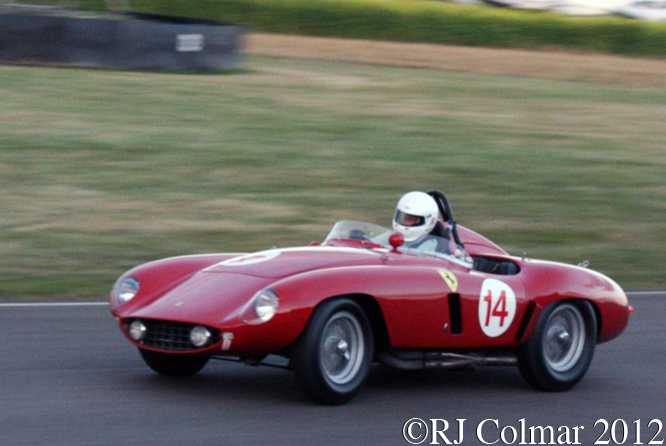
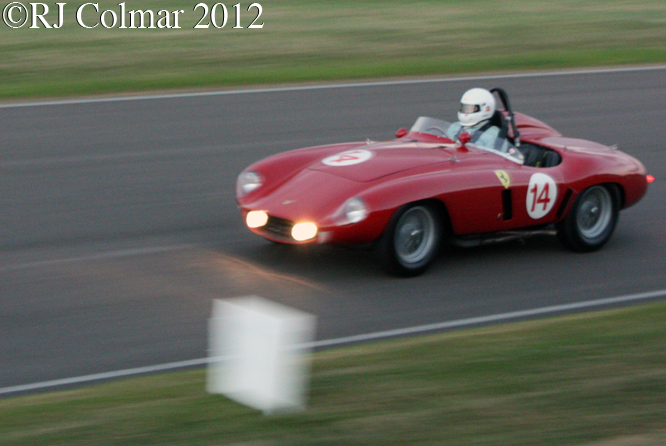
Ferrari For Hire – Ferrari 750 Monza Scaglietti Spider S1 #0504M

Today’s featured Ferrari 750 Monza chassis #0504M was purchased new in 1955 by S.A.I.P.A. Srl in Modena Italy in February 1955 and nine days latter it was rented out to Frenchman Michel Poberejsky who entered and won the Agadir Grand Prix for sport cars entered under the pseudonym “Mike Sparken”.

Ferrari 750 Monza, Goodwood Revival

After retiring, having started from pole, from the 1955 British Empire Trophy and then coming second, from pole again in the Easter meeting at Goodwood, Sparken was joined by Marsten Gregory at Le Mans where the pair retired with engine problems. Marsten Gregory then drove #0504M in two races in Portugal and one in Brazil scoring 2 2nd plce finished and a win at the Portuguese Monsanto track.

Ferrari 750 Monza, Goodwood Revival

The last known races for the car were in the United States with Donald Johnson driving to a 3rd and 2nd place finishes at Lawrenceville and Greenwood in 1963, Donaldson is credited with a final race appearance in 1964 at Mid America Raceway where he is believed to have started but his finishing result is unknown. Dudley Cunningham drove the car in the 1969 Mt Equinox Vintage hillclimb where he set a record time.

Ferrari 750 Monza, Goodwood Revival

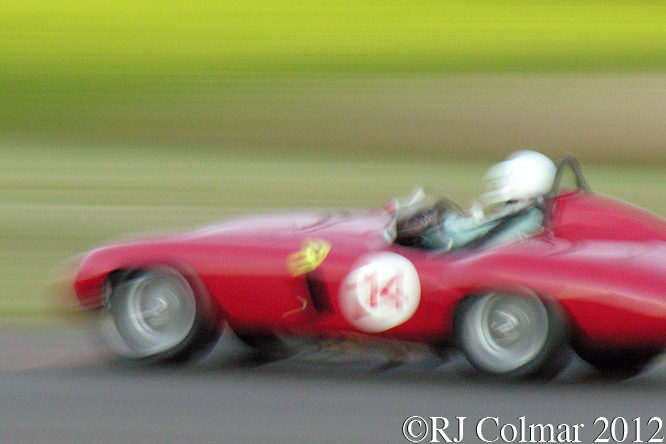
In 1970’s the car returned to Europe and has been with its current owner Richard Frankel since 2000, #0504M is seen in these photographs competing in the Freddie March Memorial Trophy at the Goodwood Revival meeting last year where it’s owner retired with less than half an hour to go.

Thanks for joining me on this “Ferrari For Hire” edition of ‘Gettin’ a li’l psycho on tyres’, I hope you will join me again tomorrow. Don’t forget to come back now !

Share

Field Filler – Ferrari 512 S #1006

17 Ferrari 512 S’s and parts for 8 others were built in late 1969 in response to the 25 917’s Porsche had built in early 1969 in order to be allowed to race in the World Sports Car Championship which allowed up to 5 litre / 305 cui engines. These rules were introduced so that a few old Ford GT 40’s could continue racing, it was never imagined that Porsche and then Ferrari would build 25 cars each to take part in the series which was intended to be for new 3 litre / 183 cui cars like the Ferrari 312P and Porsche 908.

Unlike Porsche who planned on using private works supported teams to run and develop the 917’s on it’s behalf, Ferrari planned on using a single works team to build and develop the 512 S, supplying the rest of the 512 S models to private entrants to whom Ferrari gave little by way of support effectively treating it’s privateer teams as little more than field fillers.

Ferrari 512 S, Goodwood Festival of Speed

Ferrari had to sell his road car operation to FIAT in order finance the production to the 512 S model, and as it turned out Porsche’s private partners had snapped up most of the best drivers.

Nonetheless Ferrari took the fight to Porsche with a single championship victory at the 1970 Sebring 12 hours courtesy of Mario Andretti, Nino Vaccarella and Ignazio Guinti driving a 512 S who beat Peter Revson and actor Steve McQueen in their Porsche 908 after Mario famously drove the last 90 mins of the race and chased down an exhausted Peter Revson in what Mario once described as the race of his life.

For most of the rest of the 1970 season the Ferrari 512 S was out classed every where, except at the non championship race run at Kyalami in South Africa, by the Porsche 917’s, particularly those of the JW Automotive team. Ferrari had difficulty selling all of it’s 512 S models, where as Porsche had to build a second run of 25 917’s to meet demand.

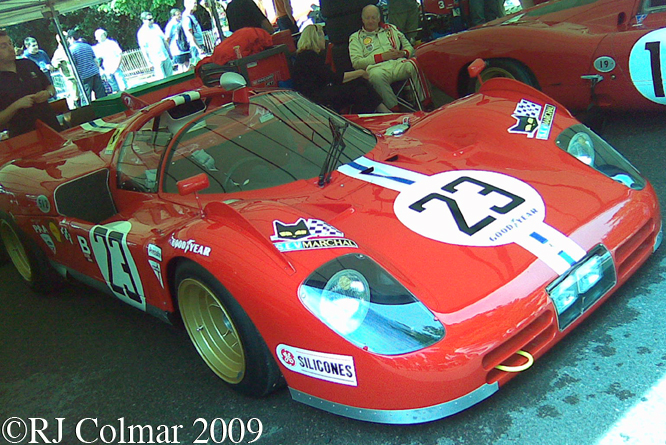
Ferrari 512 S, Goodwood Festival of Speed

This 512 S spyder, chassis #1006, was developed in order to save 25 kgs by the factory and sold to Luigi Chinetti’s N.A.R.T. team. Ronnie Buchnum and Tony Adamowicz drove it into second place at the 1971 24 hours of Daytona.

#1006 had to have both front and rear bodywork replaced during the course of the race, the body work is as it appeared on #1006 when it started the 1971 Daytona 24 hours with aerodynamic lips on the nose, which were not on the second nose fitted when it finished the race.

Thanks for joining me on this “Field Filler” edition of “Gettin a li’l psycho on tyres” I hope you will join me again tomorrow for a look at a one off Formula One Lotus that never raced. Don’t forget to come back now.

Share