Tag Archives: Sports

2ZZ-GE – Lotus Exige Series 2

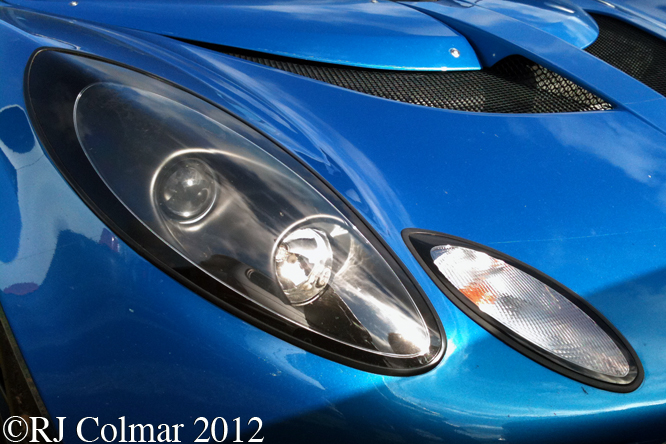
While the Lotus Elise had to be updated to Series 2 spec to meet in order to safety requirements in 2000, the Lotus Exige Series 2 was not updated until 2004.

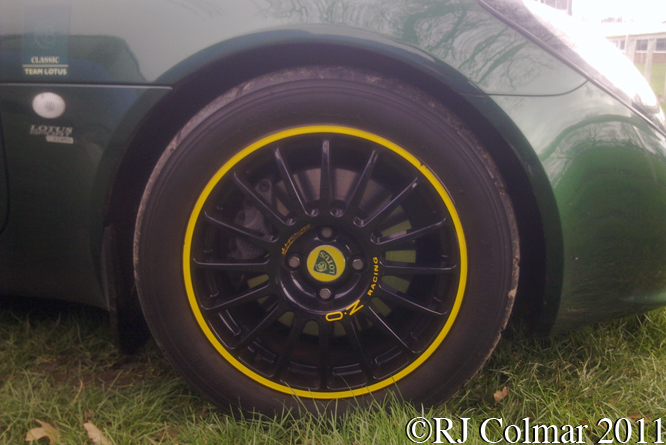
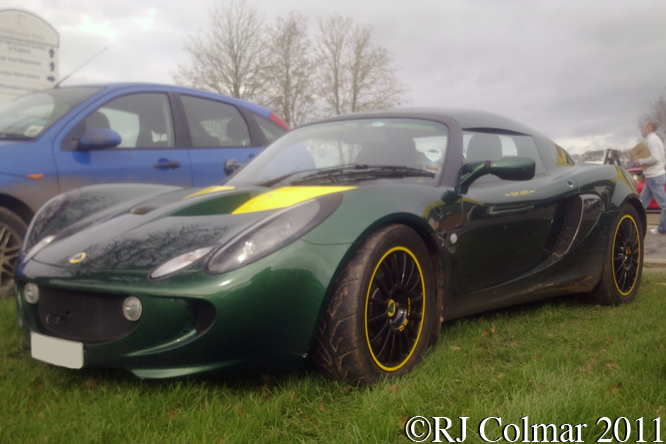
Lotus Exige Series 2, Race Retro, Stoneleigh

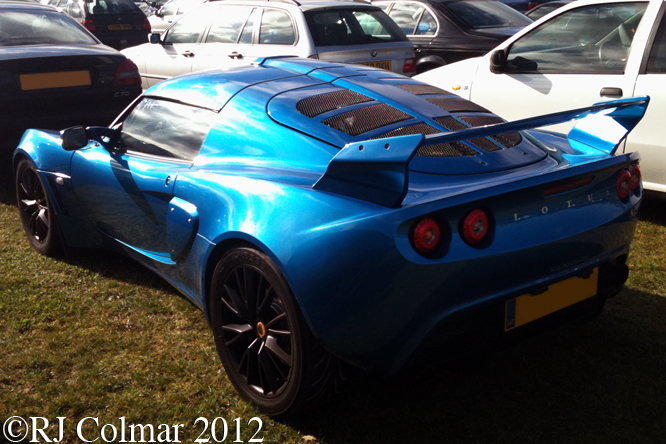
The Exige Series 2’s combination of air splitter, hard (fibreglass) top, engine cover and rear spoiler are enough to give the car 100lbs of aerodynamic down force when travelling at 100 mph as opposed to just 13lbs of aerodynamic down force for the soft top Elise Series 2 at the same speed.

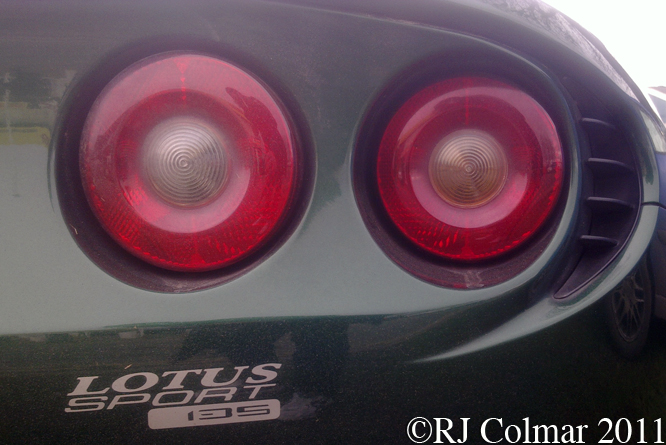
Lotus Exige Series 2, Race Retro, Stoneleigh

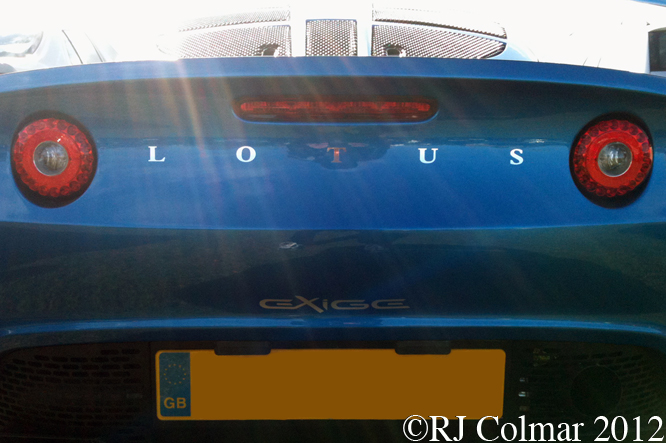
The big mechanical difference between the Exige Series 1 and Series 2 is that the Rover K Series motor has been replaced by a 190 hp 2ZZ-GE motor designed by Yamaha and built by Toyota which provides power for the rear wheels through a close ratio 6 speed gearbox.

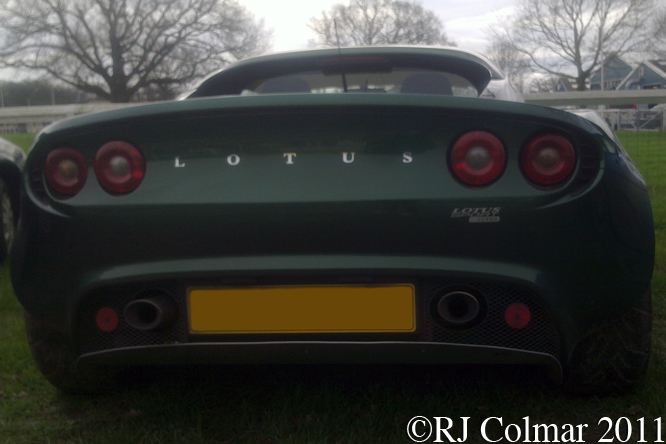
 Lotus Exige Series 2, Race Retro, Stoneleigh

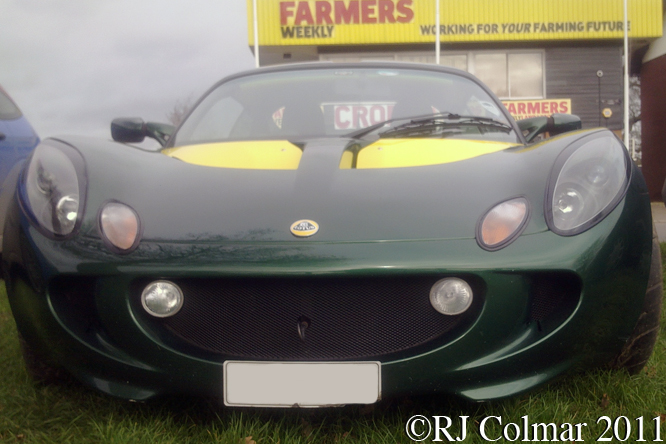
From rest an Exige like the 2006 example seen here at last years Race Retro will accelerate to 60 mph in 4.7 seconds, reach 100 mph in 12.9 seconds and has a top spedd of 147 mph.

Lotus Exige Series 2, Race Retro, Stoneleigh

Since 2006 several supercharged variants of the Exige S2 have been manufactured topped by the 158 mph 265E which has an engine mapped to run on 85% ethanol.

Thanks for joining me on this “2ZZ-GE” edition of “Gettin’ a li’l psycho on tyres” I hope you will join me again tomorrow. Don’t forget to come back now !

Share

Uncompromising Acquired Taste – Lotus Elise Sport 135R

The second series Lotus Elise shares the same 111 type number as the original Elise despite sharing the same up dated Elise chassis as the Vauxhall VX220 (Lotus Type 116) which I looked at last week.

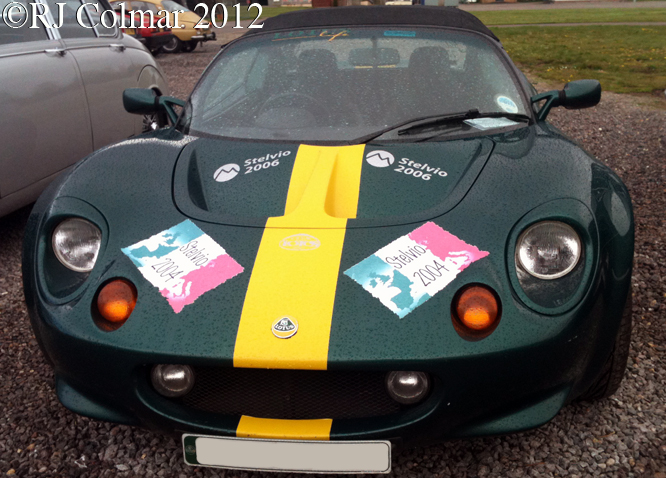
Lotus Elise Sport 135R, Race Retro

To meet new safety regulations Series 2 Elises goined over 100 kgs in weight but they were also more powerful which made up for some of the in creased weight.

Lotus Elise Sport 135R, Race Retro

One of the major differences between the VX220 and second Series Elise is that the Lotus has 16 inch front wheels and 17 inch rears where as the Vauxhall has marginally compromised the handling of the VX220 by having 17 inches wheels all round.

Lotus Elise Sport 135R, Race Retro

For those who can master the technique of getting into an Elise the handling and acceleration are said to go kart like as is the absence of any carpets, fuel gauge engine temperature gauge or central locking.

Lotus Elise Sport 135R, Race Retro

This 2002 Sport 135R version comes with sports suspension, for ever closer to go kart like handling and a Rover K series motor tuned to produce 135 hp.

Lotus Elise Sport 135R, Race Retro

In this trim an Elise is said to be able to accelerate from rest to 62mph in 5.4 seconds and on up to a top speed of 129 mph.

Thanks for joining me on this “Uncompromising Acquired Taste” edition of “Gettin’ a li’l psycho on tyres” I hope you will join me again tomorrow. Don’t forget to come back now !

Share

Vauxhall VX220 – Lotus 116

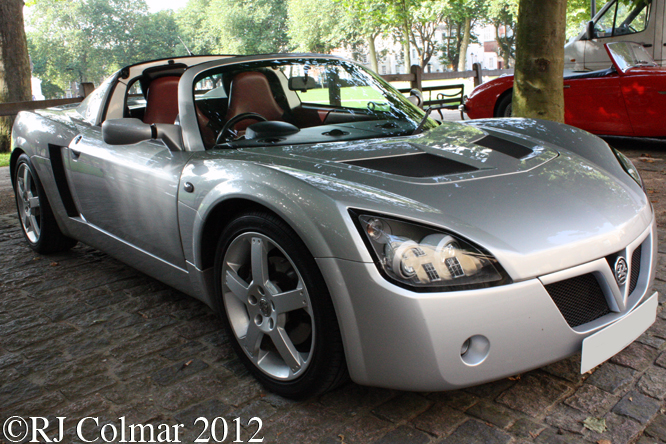
In 2000 Lotus needed to upgrade the Lotus Elise Series 1 to meet new European Crash Protection regulations. At the same time former Lotus owners General Motors were looking to build a new sports car for their Vauxhall (UK), Opel (Europe) and Daewoo (Asia) brands that would eventually also be restyled for the Saturn brand in the US.

Vauxhall VX220, Avenue Drivers Club, Queen Square, Bristol

General Motors employed Lotus to design and build the new Vauxhall VX220, Opel GT and Daewoo Speedster models which are powered by mid mounted motors giving 145 hp normally aspirated or 197 hp in turbocharged form. Exterior design is credited to Niels Loeb and Martin Smith and interior to Steven Crijns.

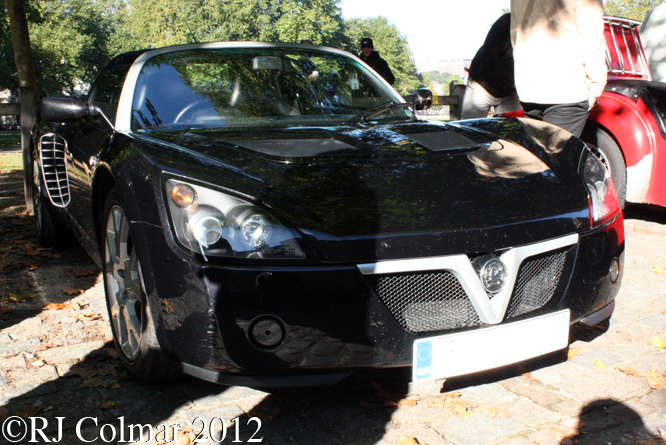
Vauxhall VX220, Avenue Drivers Club, Queen Square, Bristol

Since the Type 116 is powered by variants of motors that were originally designed for Opel by Lotus while the similar Lotus Elise Series 2 are powered by Rover K series and later Toyota sourced motors arguably the Type 116 has more Lotus input than the Lotus Elise S2 with which it shares the same chassis design.

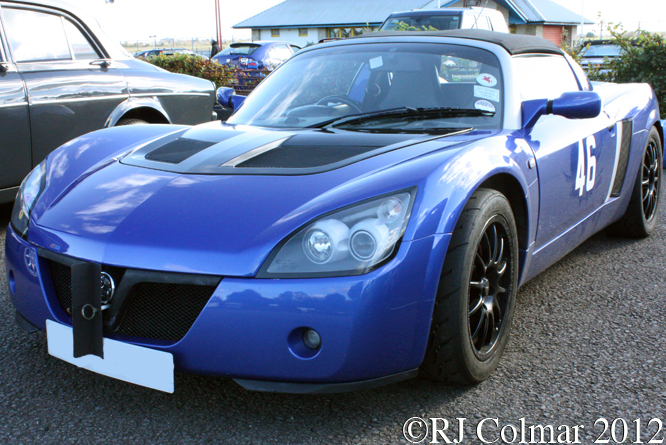
Vauxhall VX220, Pegasus Sprint, Castle Combe

The turbocharged version of the 116 seen in these photos as the Vauxhall branded VX220 was capable of reaching 62 mph in just 4,0 seconds with a top speed of 150 mph.

Vauxhall VX220, Bristol

Production of the 116 in all it’s forms except the Saturn ran from 2000 to 2005 at Lotus’s Hethel factory in Norfolk.

Thanks for joining me on this “Vauxhall VX220” edition of “Gettin’ a li’l psycho on tyres” I hope you will join me again tomorrow. Don’t forget to come back now !

Share

Testing The Beat – McLaren F1 GTR #10R

For several years before his untimely death Bruce McLaren toyed with the idea of building a road car once his racing operations had become firmly established. In 1970 he had a Can Am McLaren M6 fitted with a GT body that both he and Gordon Coppock had worked on to perfect. After Bruces death the directors of McLaren decided to shelve the road car project although to further copies of the M6GT were built by Trojan who were responsible for building McLaren’s customer racing cars.

Twenty years later McLaren designer Gordon Murray convinced Ron Dennis to back his concept for the ultimate road car which Peter Stevens was engaged to complete the exterior styling. The McLaren F1 road car was launched in 1992 and in 1998 it set road car speed records of 231 mph with the rev limiter switched on and 243 with the limiter switched off.

At around the same time as the launch of the F1 a movement for racing GT cars was gathering pace and for the 1995 Season McLaren built 9 F1 GTR variants the first of which #01R, modified road car chassis #019 was loaned to Lanzante Motorsport who entered Yannick Dalmas, Masanori Sekiya and JJ Lehto into the 1995 Le Mans 24 hours under the Kokusai Kaihatsu Racing banner and improbably won as a result of superior reliability over the much faster Courage Porsche C34 prototype driven by “Brilliant” Bob Wolleck, Eric Hélary and Mario Andretti. The race winners covered just 298 laps the last time a Le Mans 24 hours had been won with less than 300 laps completed was 1952 to when Hermann Lang and Fritz Reiss drove their Mercedes Benz 300SL to victory with 277 laps completed.

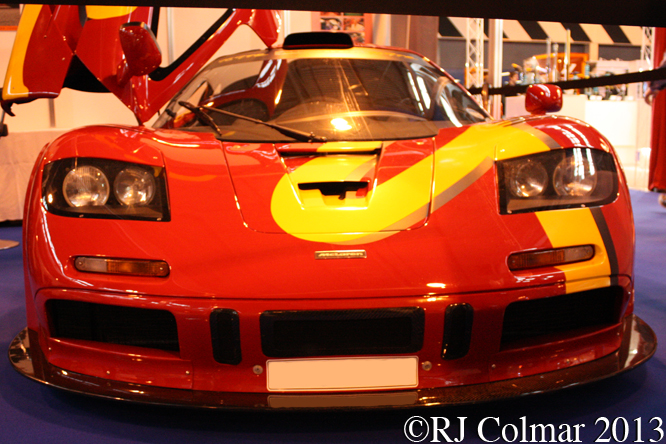
McLaren F1 GTR, Autosport International, NEC, Birmingham

For the 1996 season Mclaren built a further batch of nine cars with extended front and rear bodywork which was easier to remove than on the original ’95 F1 GTR, magnesium gearbox housing with stronger internals which resulted in a lighter car. Two of the ’95 Spec F1 GTR’s were similarly upgraded.

Today’s featured vehicle is the first of the ’96 F1 GTR’s chassis #10R which was used as a test development vehicle to replace the Le Mans winning #01R which had immediately been retired from competition for publicity purposes.

David Brabham used the car for a test session at Le Mans in 1996 where he recorded the 20th fastest time, but the car has never been raced.

When pop drummer Nick Mason bought #10R he had McLaren convert the car for road use as were several F1 GTR’s once their competition careers were over.

Mark Hales tested the 600hp BMW V12 powered #10R for Evo magazine and recorded a 0-60mph time of 3.2 seconds and a top speed of 240.1 mph.

In 1997 a further development of the F1 GTR featuring an even longer body, 10 examples of which were built. An over view of the racing results of the F1 GTR from 1995 to 2007 can be seen on this link.

Thanks for joining me on this “Testing The Beat” edition of “Gettin’ a li’l psycho on tyres”, I hope you will join me again tomorrow. Don’t forget to come back now !

Share

Romano’s Granddaughter – Lotus Elise Series I

In 1993 Lotus was purchased from GM by Romano Artioli chairman of the revived Bugatti manufacturer, and the following year the Type 111 was conceived by Julian Thompson with Richard Rackman and given the Elise name after Romano’s Granddaughter Elisa.

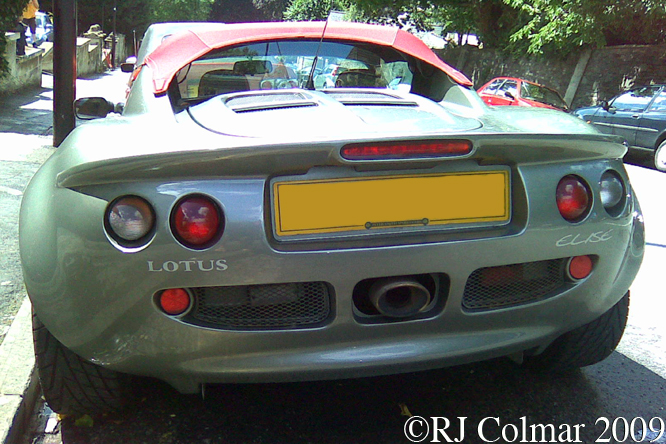
Lotus Elise Series 1, Bristol Classic Car Show, Shepton Mallet

The Series 1 Elise was launched in 1996 powered by a mid mounted 4 cylinder Rover K Series motor that produced just 118 hp, however thanks to the fiberglass body and bonded aluminium chassis the Elise only weighed 725 kg / 1,600 lbs so the car could accelerate from rest to 60 mph in just 5.8 seconds with a top speed of 124 mph.

Lotus Elise Series 1, Bristol Pegasus Motor Club, BAWA

Getting in and out of a Lotus Elise are probably the most difficult features of the car, the ergonomics are secondary to track day performance, but apart from that the Elise is said to be great fun to drive and economical to run thanks to the light weight and virtually non existent load capacity beside the passengers.

Lotus Elise Series 1, Bristol

In 1996 Romano had sold Lotus on to current owners Proton in order to fund the losses that had accumulated due to the insolvency of Bugatti.

Thanks to changes in crash sustainability regulations the Series 1 Elise was replaced in 2000 after more than 8600 had been built by the more sustainable and consequently slightly heavier Elise Series 2.

The top and bottom cars featured today are standard ’98 and ’97 1.8i models while the middle one is a later ’99 111S which came with variable valve timing 143 hp and a 130 mph top speed.

Thanks for joining me on this “Romano’s Granddaughter” edition of “Gettin’ a li’l psycho on tyres”, I hope you will join me again tomorrow. Don’t forget to come back now !

Share

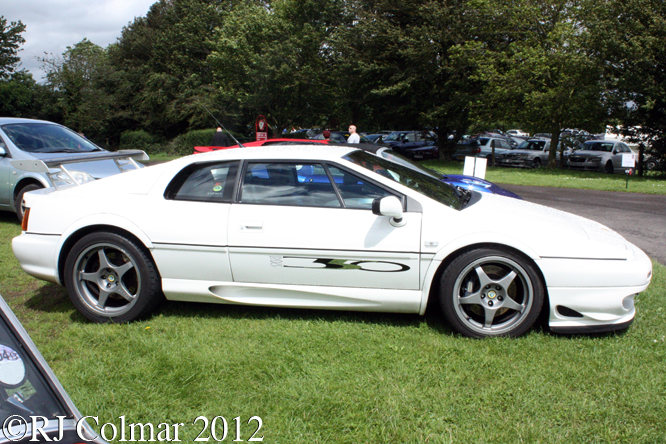
Project Sport 500 – Lotus Esprit Sport 350 No.26

When the Lotus Type 82 Esprit Turbo was introduced in April 1981 it had a new chassis which was built to accommodate a V8 or the hitherto ubiquitous 4 cylinder type 907/910 motors. It was not until two complete body restyles later that the V8 type 918 would finally see the light of day in the back of a Julian Thompson styled Esprit in 1996.

Lotus Esprit, Sport 350, Classic and Sports Car Action Day, Castle Combe

The Julian Thompson styled Esprit replaced the Peter Stevenson styled Esprit in 1993 alongside the new body came a redesigned interior and for the first time on an Esprit power steering.

Lotus Esprit, Sport 350, Classic and Sports Car Action Day, Castle Combe

The twin turbocharged all aluminium 918 V8 Esprits were restricted to 350 hp which was deemed the most that the Renault derived transmission and drive train could handle. In 1998 V8 Esprits were built to either luxury SE or sporty GT specification.

Lotus Esprit, Sport 350, Classic and Sports Car Action Day, Castle Combe

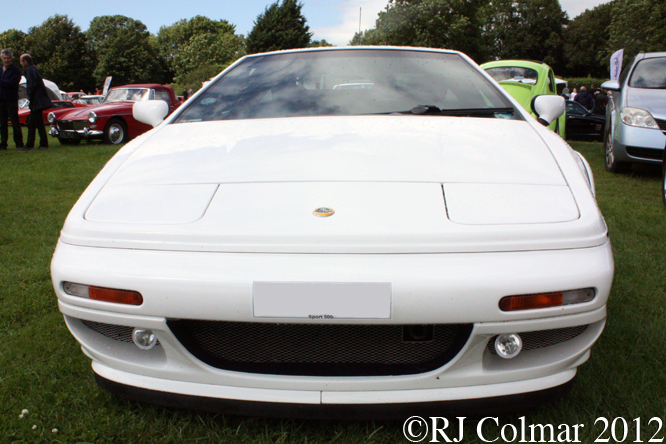
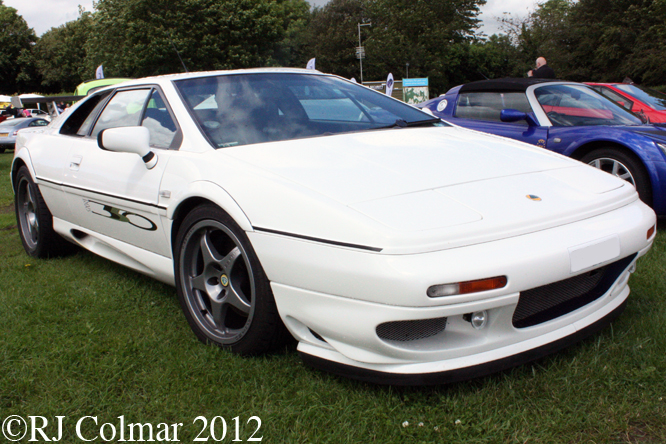
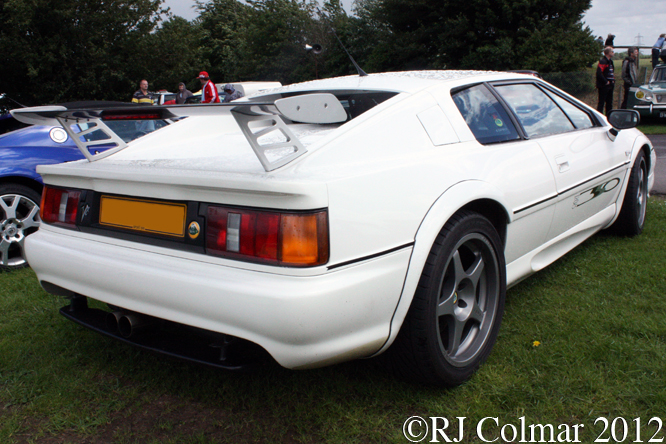
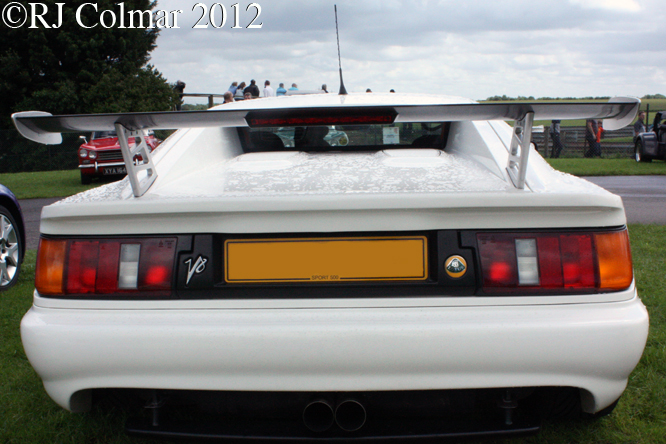
The ultimate incarnation of the Esprit was the Sport 350, such as the one seen here during last years Classic and Sports Car Action Day at Castle Combe. These models were built with AP racing brakes, stiffer suspension, revised electronic control unit (ECU) for the motor and a carbon fibre rear wing mounted on aluminium uprights. With 350 hp these cars can reach 100 mph from rest in just under 10 seconds.

Lotus Esprit, Sport 350, Classic and Sports Car Action Day, Castle Combe

Only 55 of an intended production run of 50 Esprit Sport 350’s were built between 1999 and 2001, all bar 48 of them were painted silver, four were black, two white and one ice blue.
Lotus Esprit, Sport 350, Classic and Sports Car Action Day, Castle Combe

Rob the owner of Sport 350 No.26, also known as Project Sport 500, has upgraded this particular vehicle to produce 500 hp and “run right past 60 mph in (the) first of it’s six gears”. You can see some of the work Rob has undertaken to achieve this performance on this linked page.

Only 15 Sport 350’s remain in the UK according to Rob one of them is a right off in a salvage yard.

My thanks to Rob for his help with today’s post.

Thanks for joining me on this “Project Sport 500” edition of “Gettin’ a li’l psycho on tyres”, I hope you will join me again tomorrow. Don’t forget to come back now !

Share

Four Pot Revisited – Ferrari 860 Monza #0604M

A couple of years ago Steve Arnaudin sent me a photo of todays featured 1956 Ferrari 860 Monza, chassis #0604, purchased by his father from the Californian photographer and racing driver Carlyle Blackwell. I wrote a blog which summarised the 1956 World Sports Car Championship which is linked here.
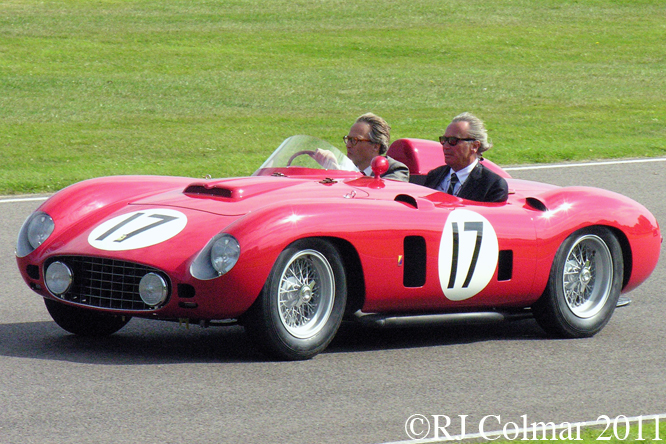
Ferrari 860 Monza. Goodwood Revival

Today’s blog will focus on the story of this particular chassis which is seen above with Lord March at the wheel in the Juan Manuel Fangio Celebration parade at the Goodwood Revival in 2011. The car is seen above carrying the same #17 as when Fangio and Eugenio Castellotti drove it to a debut victory in the Sebring 12 Hours Race in March 1956.

Ferrari 860 Monza. Goodwood Revival

#0604M was subsequently sold to Californian John von Neuman and the following month he entered it for Phil Hill to drive at Pebble Beech where he finished second overall and first in class behind Carrol Shelby who was driving 1955 Ferrari 750 Monza #0510M.
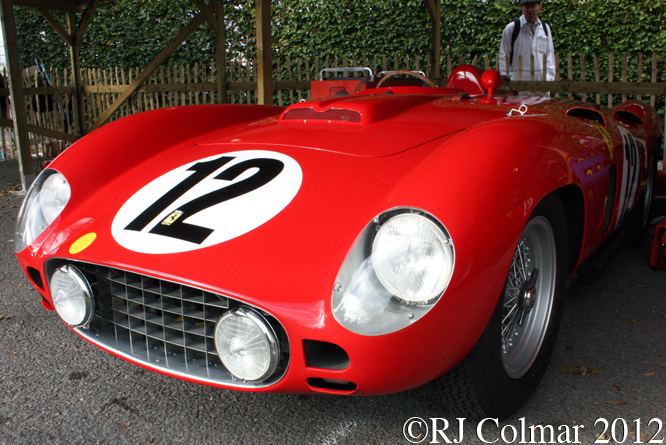
Ferrari 860 Monza. Goodwood Revival

John Von Neuman took over the driving duties in #0604M for the rest of the 1956 season and through 1957 until he put Ritchie Ginther in the car at Laguna Secca at the end of 1957 and at Riverside at the beginning of 1958. Ginther scored a class win and 5th overall first time out and 2nd overall at Riverside. Up to that point von Neumans best results had been a couple of 2nd place finishes in ’56
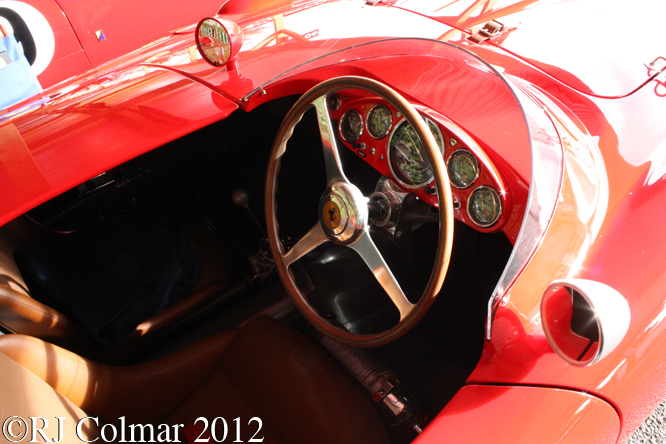
Ferrari 860 Monza. Goodwood Revival

Jerry Barker bought the car for the 1959 season and on every occasion it finished it was either 1st or 2nd driven by Lew Florence, Barker took the wheel at the Maryhill Lops Hillclimb and also won setting a new record.
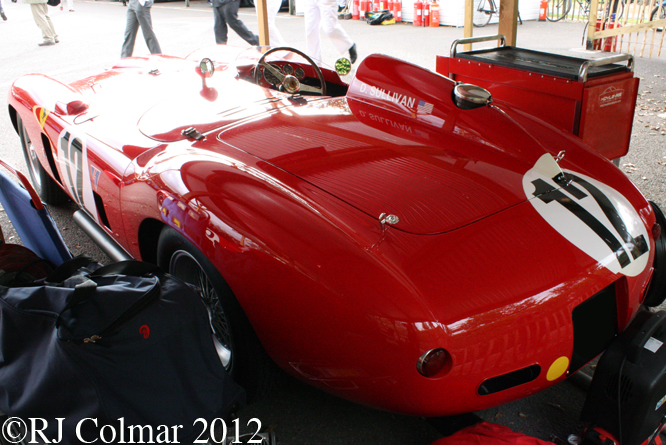
Ferrari 860 Monza. Goodwood Revival

Charles Caverns was the owner of 0604M in 1960 and he also recorded a win in the Novice Race at Shelton in April 1960 which is the car last recorded contemporary race appearance.
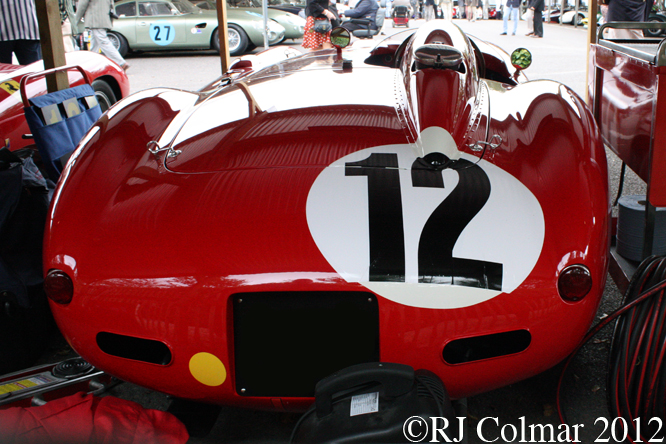
Ferrari 860 Monza. Goodwood Revival

Amongst the owners of #0604M since 1960 was Jean Sage former Sporting Director of the Renault Formula One team from it’s inception in 1977 and eventual, temporary closure, in 1987. Not long before the top photo was taken #0604M was bought by the current owner a DJ by the name of Chris Evans.
Ferrari 860 Monza. Goodwood Revival

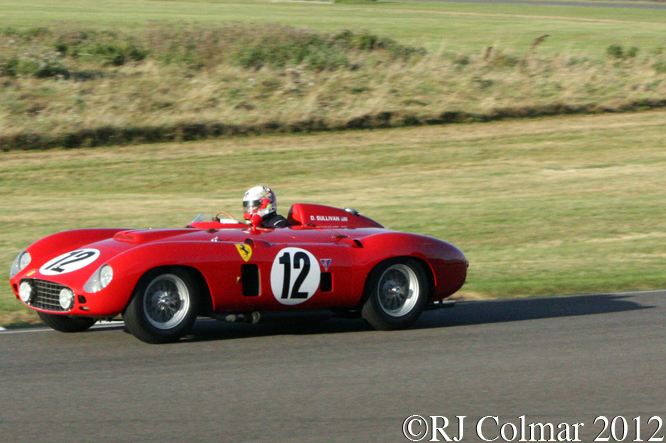
At last years Goodwood Revival meeting Danny Sullivan became the fifth Grand Prix driver to sit at the wheel, after Fangio, Castellotti Hill and Ginther, and only Indy 500 winner to race the car powered by a Lampredi designed 4 cylinder motor. He qualified 15th for the Sussex Trophy Race but did not finish.

Thanks for joining me one this ‘Four Pot Revisited’ edition of “Gettin’ a li’l psycho on tyres”, I hope you will join me again tomorrow. Don’t forget to come back now !
Share