Tag Archives: Tidesco

Triple 500 Crown – Lola T500

01 DSCN8489sc

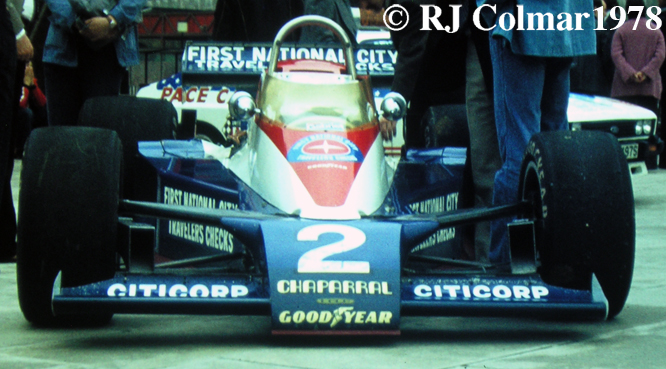
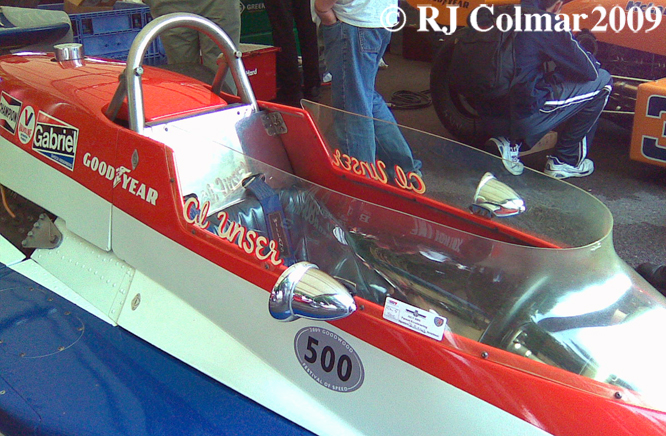
During a run of success that included winning the US Formula 5000 championships from 1974 – ’76 with Brian Redman and Can Am 2 Championships with Patrick Tambay ’77 and ’80, Alan Jones ’78 and Jacky Ickx ’79, Jim Hall turned his attentions to the USAC champ car series in 1977. Hall and partner Carl Hass commisioned Lola to build the T500 a fresh design that was to be driven by Al Unser Snr in 1978.
02 09 07 03 028sc

The design was an instant success at Indianapolis Al qualified 2nd and led 121 laps to go to Victory Lane for the third time. Despite Al bending a front wing in the pit lane 20 laps from home pole sitter Tom Sneva in a Penske ran out of laps to catch the Lola which finished just 8 seconds ahead of Tom.
03 Image349sc

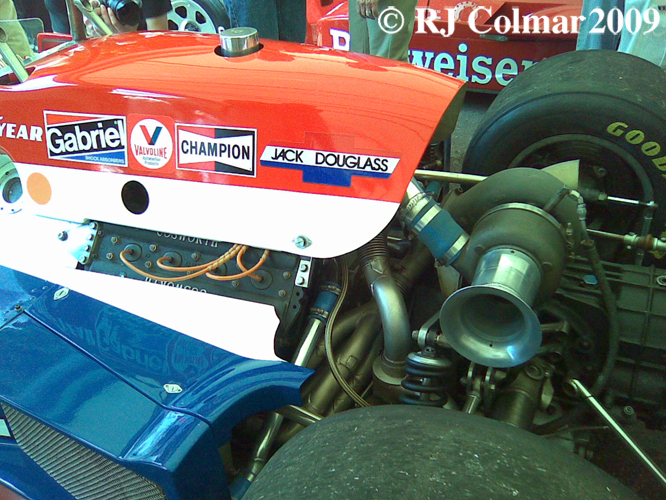
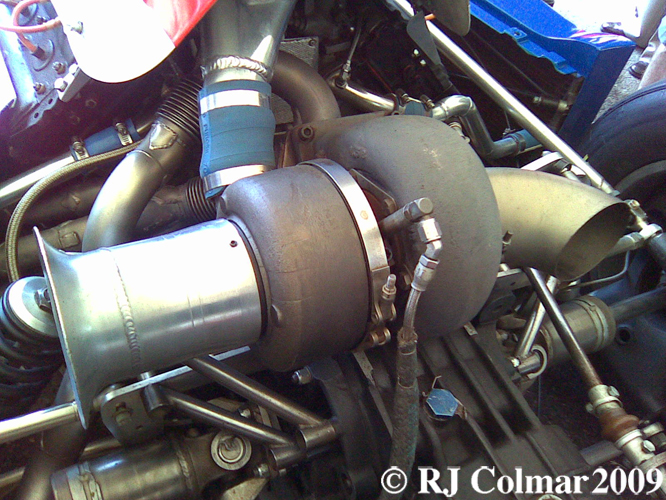
The ’78 Indy 500 was the first of ten that was won by a car powered by a turbocharged development of the 3 litre / 183 cui Cosworth DFV that dominated in Formula One from it’s introduction in 1966 to 1981. To meet the USAC regulations the DFV was downsized to 2650 cc / 161 cui and fitted with a Garrett turbo charger.
04 Image351sc

Engine designer Keith Duckworth described these motors as being like ‘hand grenades with the in pulled’. By the end of the DFX development programme the motors were producing 840 hp. Al Unser was also at the wheel of the last DFX powered car, a Penske, to enter victory lane at Indianapolis in 1987.
05 DSCN8500sc

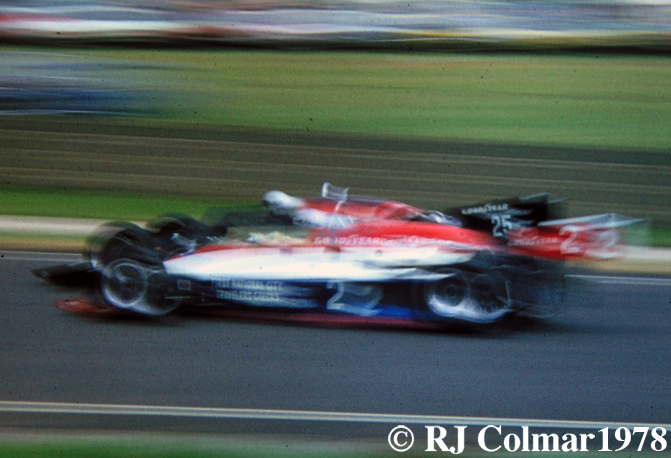
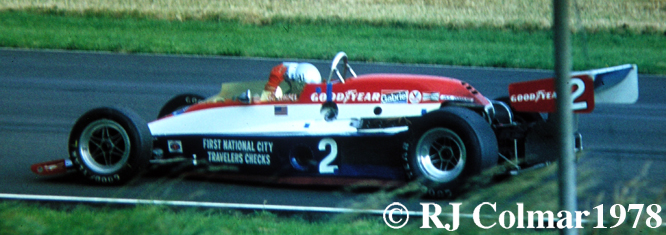
Having won the 1978 Indy 500 Al Unser also won the two other 500 mile races in the USAC series at Pocono and Ontario becoming the first winner of the ‘Triple 500 Crown’. Al is seen driving the car above in the Daily Express 200 at Silverstone, England battling for the lead with Danny Ongias.
06 DSCN8507sc

Unfortunately the battle only lasted 4 laps, Ongias broke a drive shaft, Al led a good deal of the race but ran out of fuel right in front of me.
07 Indy80 027s

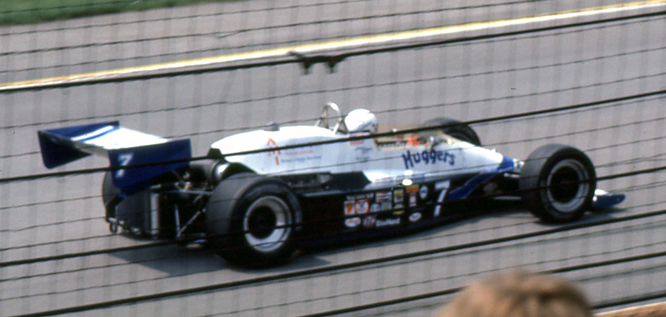
The T500 was used in Penzoil colours in early 1979 before Jim Halls Chaparral 2K was ready. In 1980 Jerry Sneva, seen in this photo by Ed Arnaudin, qualified 5th in this T500 and finished 17th in the Indy 500 two further T500’s were raced in this event driven by Tom Bigelow Q 31st F 8th and Gregg Leffler Q 23rd and F 10th.

My thanks to Steve Arnaudin for the scan of his Dad’s photo.

Hope you have enjoyed Triple 500 Crown edition of ‘Gettin’ a lil’ psycho on tyres’ and that you will join me again tomorrow. Don’t forget to come back now !


Share

Outlaw Racer – Ferrari 365 GTB/4

01 Image3178sc

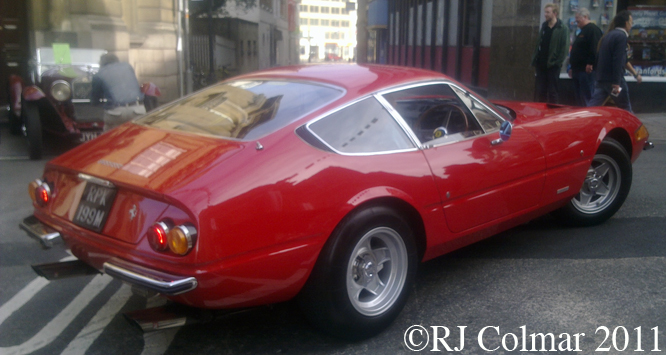
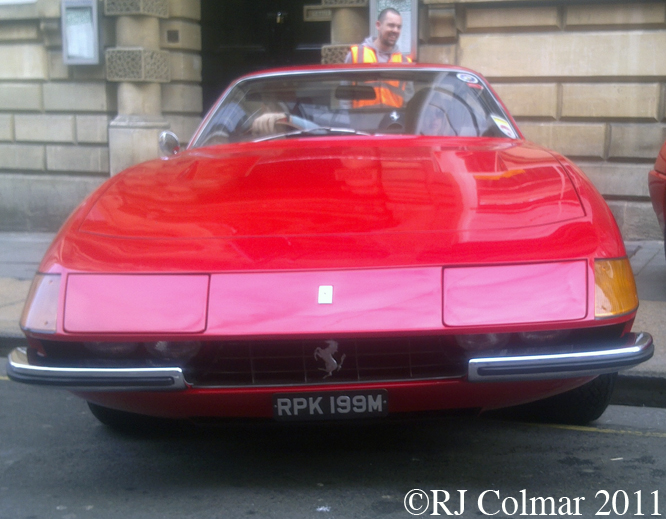
Launched in 1968 the Ferrari 365 GTB/4 replaced the Ferrari 275 GTB/4 and to this writers mind represents the pinnacle of front engine rear wheel drive fastback GT cars. Until outlawed by US legislation in 1971 the 365 GTB/4 came with headlights mounted behind acrylic glass covers.

02 Image3126sc

This most stylish of vehicles is powered by a 347 hp Lamperdi inspired twin overhead cam 60º V12 stretched to 4390 cc / 268 cui motor, each cylinder with a volume of 365 cc from which the model gets its name.

03 Image3128sc

To optimise the weight balance and handling the gearbox is mounted as part of a transaxle just in front of the rear wheels.

04 Image3127sc

As one would of expect of a vehicle this cool to look at it has performance to match being capable of reaching 60 mph from rest in 5.4 seconds with a top speed of 174 mph.

05 Image3129sc

Competition versions of the 365 GTB/4 run by privateers with up to 450 hp counted amongst their successes a GT class winning 5th overall at Le Mans in 1971 along with GT Class wins in the same race in ’72, ’73, and ’74 scoring 1st to 5th in class in ’72, and five years after production of the model had ceased an amazing 2nd overall in the Daytona 24 hour race.

Dan Gurney and Brock Yates also drove a 365 GTB/4 2,876 miles from New York to Los Angeles averaging 80.1 mph to win the inaugural Cannonball Baker Sea-To-Shining-Sea Memorial Trophy Dash in 1971.

06 Image3130sc

It is thought just 1,406 of these cars designed by Leonardo Fiorvanti of Pininfarina and built by Scaglietti including 122 Spiders and 15 lightweight competition vehicles. The high desirability of the rare Spiders has led to several Berlinetta models being converted and several companies have made Spider replicas with a variety of engines.

The 365GTB/4 was replaced by the rear engined 365 GT4 Berlinetta Boxer.

I hope you have enjoyed today’s Outlaw Racer edition of ‘Gettin’ a lil’ psycho on tyres’ and that you will join me again tomorrow. Don’t forget to come back now !
Share

Rained Off – Eagle Offenhauser 7400

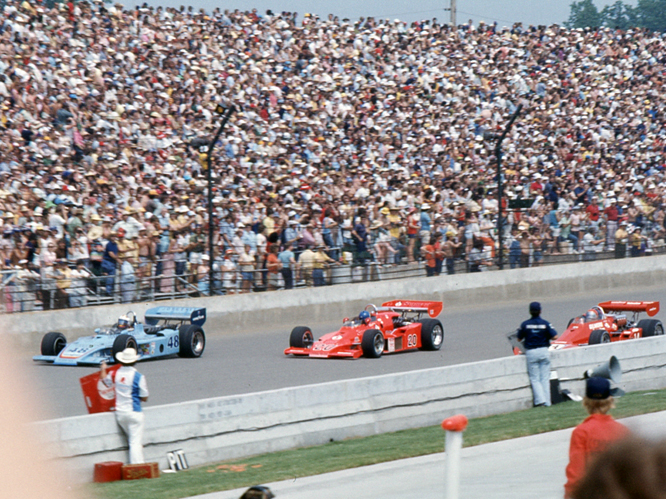
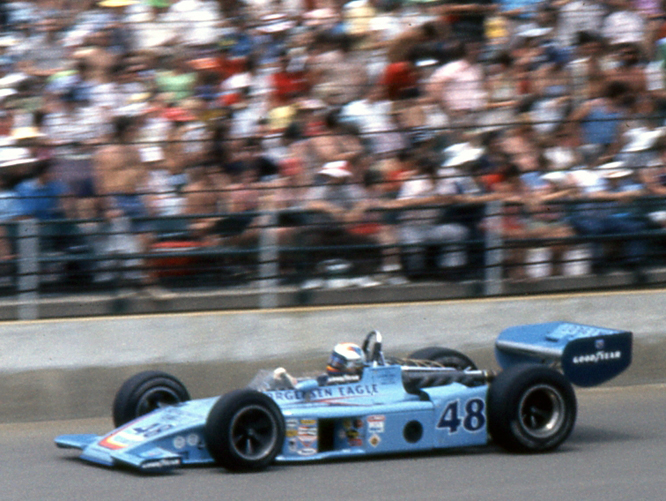
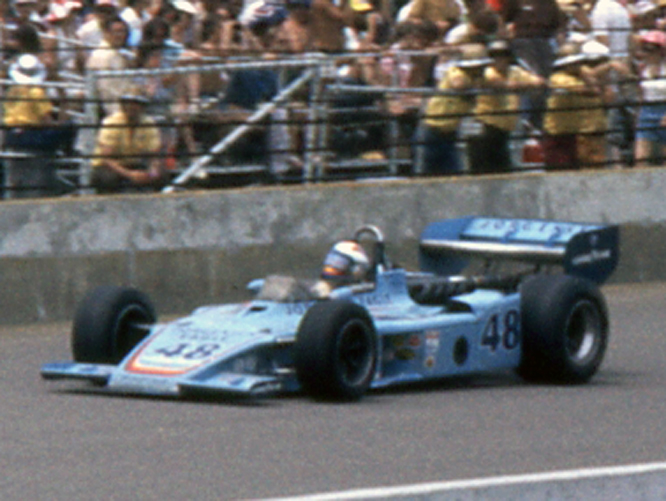
As I mentioned yesterday the 1975 Indianapolis was won by Bobby Unser and today thanks to photo’s by Ed Arnaudin we can have a look at the #48 Eagle Offy 7400 driven by Bobby Unser, seen starting on the outside of the front row with #20 Gordon Johncock and #14 AJ Foyt on pole, that was declared the winner after 174 of the scheduled 200 laps.

1975 Indy 500

All American Racers which manufactured Eagle racing cars was set up initially by Dan Gurney and Carroll Shelby to tackle the World Championship Grand Prix circuit and the US Champ Car and Sportscar circuits in 1964.

In 1967 Dan Gurney won the Belgian Grand Prix in an Eagle Weslake Mk 1, also known as T1G, run by the firms UK based satellite team known as Anglo American Racers. The following year Bobby Unser won the Indy 500 in an Eagle chassis.

Upon retiring from the cockpit Dan Gurney bought Shelby out and in 1973 Gordon Johncock in an Eagle run by Pat Patrick was declared winner of the tragic rain shortened race, in which his team mate Swede Savage suffered injuries from which he would later die and a member of his pit crew was fatally struck in pit road by a fire truck going the wrong way down pit road to attend to the Savage incident.

Eagle Offenhaser 7400, Indy 500

By 1975 McLaren also with two Indy 500 wins were regularly challenging Eagle for overall supremacy on the USAC Champcar Circuit and this would prove to be the third and final Indy 500 victory for the Eagle marque.

It transpires that the Eagle chassis type numbering system is worthy of a large dense volume all of it’s own, however to the best of my knowledge the winning car that Bobby Unser car drove is a type 7400, if a chassis number becomes known to me I’ll add it below.

Bobby Unser is part of one US Racing’s elite families, he and his younger brother Al Snr competed on the Champ Car circuit in the 1960’s, 70’s and 80’s.

Bobby known as the ‘undisputed King of Pikes Peak’, counts among his many success 13 Pikes Peak hill climb victories, 8 of them in a ten year period, the ’68 and ’74 USAC Champ Car championships, along with his Indy 500 wins of ’68, ’75 and ’81.

In 1968 Bobby participated in two Grand Prix for BRM, after qualifying for the Italian Grand Prix he flew back to the United States and took part in the Hoosier 100 at Indianapolis, upon his return to Monza with fellow Italian GP qualifier Andretti, they were told that the rules forbade drivers to participate in 2 races less than 24 hours apart.

Eagle Offenhaser 7400, Indy 500

In 1975 Bobby also won the IROC championship to confirm his all round versatility.

Hope you have enjoyed today’s All American Racers edition of getting a lil’ psycho on tyres, and that you will join me again tomorrow. Don’t forget to come back now !

Share

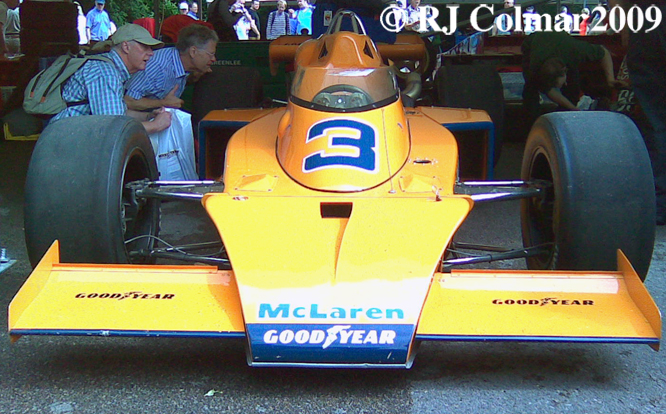
Three Time Winner – McLaren Offy M16

09 07 03 022sc

The McLaren M16 was designed by Gordon Coppuck in 1970 and took essential design queues from the Lotus 72, that was dominant in Formula One, including the chisel nose and side mounted radiators.

09 07 03 023sc

On it’s Indy debut in 1971 M16’s of Revson, Donohue and Hulme qualified 1st, 2nd and 4th for the 500, the race was won by repeat winner Al Unser with Peter Revson coming home a career best 2nd. Mark Donohue driving for the private Penske team said of the M16 that it “…obsoleted every other car on track…” and proved it with a win in 1972.

Image343sc

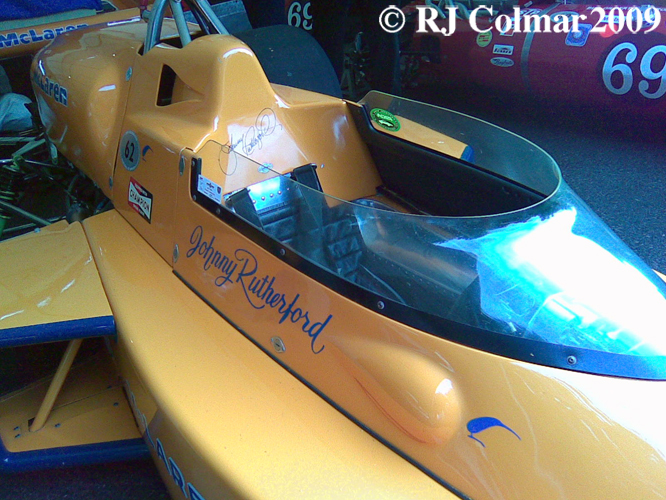
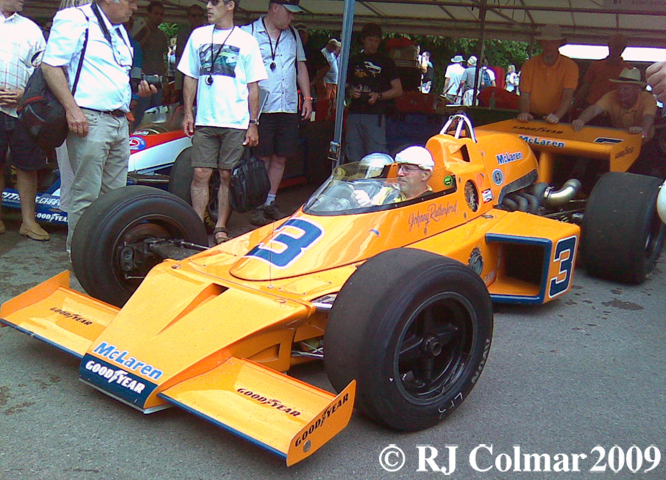
In 1973 Johnny Rutherford, seen driving the M16C/5 here at Goodwood Festival of Speed, took pole position again in his works M16 though the Eagles of Johncock and Vukovich Jr took first and second in the race that was called early due to rain. The following season driving the same car Rutherford started 25th on the grid and went on to win the first of his three Indy 500’s.

Indy75 022s

Photo Ed Arnaudin

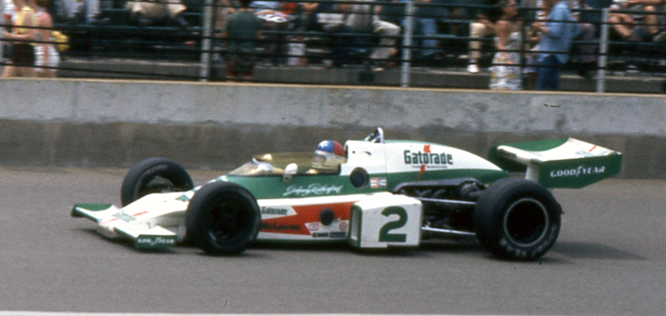
In 1975 Rutherford drove the #2 Gatorade M16E/1 qualifying 7th and coming in second.

Indy75 005s

Photo Ed Arnaudin

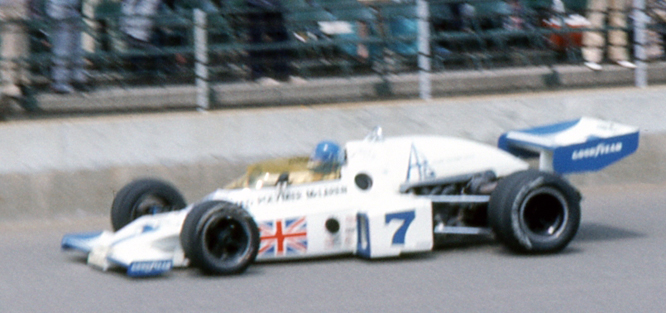
Lloyd Ruby drove the #7 Allied Polymer Group M16E/2 qualifying 6th and finishing 32nd in 1975 and in 1976 Rutherford dominated the Indy 500 with a victory from pole in this ex Ruby chassis. Cliff Hucul raced this same car at Indy from ’77 – ’79 qualifying a best 18th in ’79 and finishing a best 22nd in ’77.

Indy75 009s

Photo Ed Arnaudin

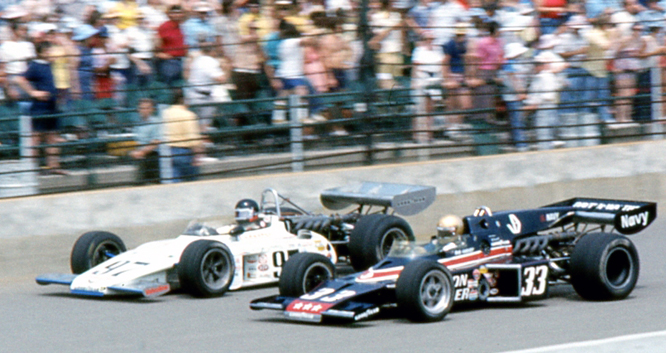
Bob Harkey seen in the #33 Dayton Walther M16C/2 here in 1975 qualified 23rd for the Indy 500 and after 18 laps handed the car over to Salt Walther who’s own M16 had experienced turbo failure after 2 laps. Salt was flagged in 10th at the conclusion of the rain affected race. In 1976 David Hobbs nade his fourth and final Indy start in this car starting 31st and finishing 29th.

In 1978 Jerry Karl modified M16C/2 fitting a Chevrolet stock block motor, Karl made three starts in ’78, ’80 and ’81 recording best start positions of 28th in ’78 and ’80 and a best finish of 14th in ’78. This car still fitted with a Chevy stock block but now with orange #15 bodywork as used by Peter Revson resides in the Matthew Collection.

My thanks to Steve Arnaudin for scanning his Dad’s photographs and to everyone who contributed to the M16 thread on The Nostalgia Forum for providing the chassis details.

Hope you have enjoyed today’s chisel nose edition of ‘Gettin’ a lil’ psycho on tyres’ and that you will join me again tomorrow. Don’t forget to come back now !
Share

The Kiwi Bear – McLaren Offy M15

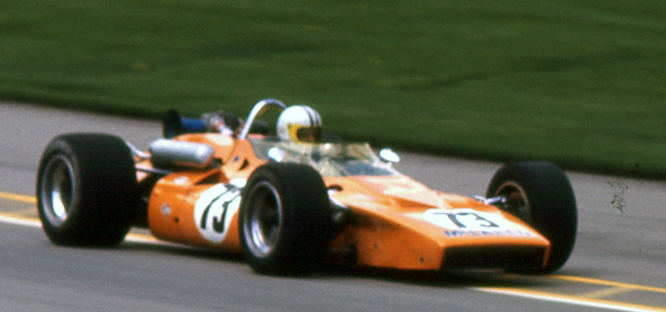
This is the only photo to have so far surfaced by Ed Arnaudin at Indianapolis from 1970.

Indy70 001s

The car is a McLaren M15, based loosely on the Can Am dominating M8 chassis, Gordon Coppuck incorporated numerous parts from the M8 Can Am car into the design of the M15. The stressed aluminium monocoque chassis was held together with 3 steel bulkheads with the 4 cylinder Offy turbocharged engine bolted directly to the rear most and supported by two a frame running form the bulkhead to the bell housing.

The drivers of the cars were originally scheduled to be 1967 world champion Denny Hulme known as ‘The Bear’ in the #73 and Chris Amon in the #75, though team founder, Bruce McLaren also turned a few laps in the #79 spare car on the first day of practice running in a three car line astern McLaren train with fellow New Zealanders Denny and Chris. Bruce however never had any intention of taking the start.

The #73 of Denny caught fire during practice as a result of a fuel leak from a quick release breather cap that had not been properly secured. As Denny slowed the car down the intensity of the largely unseen methanol flames increased forcing him to jump from his car while it was still moving at an estimated 70 mph !

Denny was to miss the 500 due to the burns his hands received, meanwhile Chris Amon was not happy about the Indianapolis track set up, his speed was 3 mph slower than Bobby Unser who tested the #75 and the extent of the injuries received by Denny convinced him to withdraw from the race.

Teddy Meyer team manager drafted Carl Williams into the #75, he qualified 19th and finished 8th, while Peter Revson was drafted into the #73 qualifying 16th he retired from the race with a broken magneto classified 22nd.

2 days after the 1970 Indy 500 McLaren founder Bruce McLaren was killed testing the latest incarnation of the McLaren M8 Can Am car leaving Denny Hulme and Peter Revson to become the back bone of the McLaren team in Formula One, USAC and Can Am series until 1974.

Thank you for joining me on this Team Kiwi edition of ‘Gettin’ a lil psycho on tyres’ I hope you will join me again tomorrow. Don’t forget to come back now !
07 12 12 PS Jerry Entin has kindly informed me that the original plan was for Denny Hulme to drive the #73 but that he burned his hands shaking down the #79 McLaren. As a consequence Peter Revson was drafted in to drive the #73. I’ll be writing a full follow up blog with some interesting new photographs during the month of May.

Share

Taxi Driver – Jim Robbins Eagle Ford T/C Mk 2

Continuing GALPOTS potted history of the Indianapolis 500 Ed’s photos shown here today were taken in 1969, when Ed Arnaudin took the opportunity to get good and close to the Jim Robbins team again.

Indy69 001s

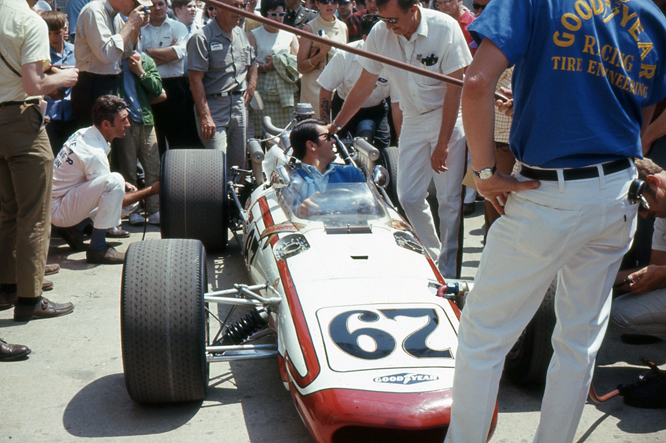
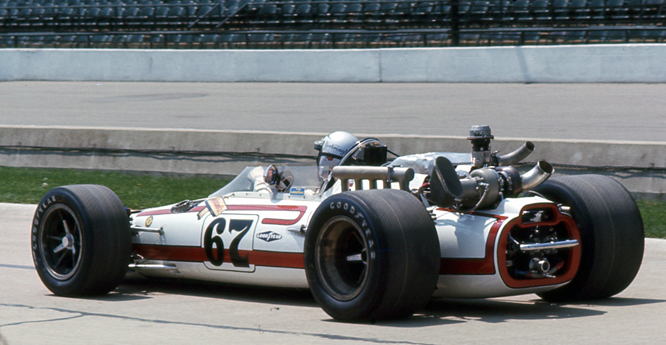
The driver of the #67 Eagle Ford is Lee Roy Yarbrough, not related to Cale Yarborough, from Jacksonville, Florida.

Lee Roy is said to have won his first race at 19 at a local dirt track and progressed through the NASCAR Sportsman Division with 11 wins and onto Modifieds where he won 83 features in 3 years.

On reaching the top Grand National Division, today called Sprint Cup he won 14 races from 198 starts over 12 years. His best season was 1969 7 wins, including Darlington, Charlotte and both races at Daytona, from 31 starts in the seasons 54 races. Many retirements due to engine failure kept him out of the title hunt won by David Pearson.

Lee Roy made just three starts in the ‘Indy 500’ in ’67 ’69 and ’70 his best finish was in 1970 when he completed 107 laps and retired with turbo failure and was classified in 19th place.

His career, as were several others,was adversely affected by the withdrawal of Ford from competition and Yabrough disappeared from NASCAR after failing to secure a ride for the Daytona 500 in 1973, he was eventually admitted to a mental hospital where a fall inflicted a fatal traumatic brain injury aged 46.

#67 Lee Roy Yarbrough 1969s

Jim Robbins turned up at the Brickyard in 1969 with three vehicles the #10 and #27 Vollstedts and the #67 Eagle Ford Mk 2, seen here, a design inspired by UK free lance design consultant Len Terry. This vehicle appears to be one of several built in 1968, though at this stage I do not know it’s exact history prior to the 1969 race.

After Denny Zimmerman failed to get the #67 up to speed in 1969 Lee Roy Yarbrough moved over from his ride in the #27 Vollstedt to qualify 8th for the Indy 500, during the race a turbo pipe broke sending him into retirement and a final classification of 23rd.

Indy69 008s

All of Jim Robbins 1969 entries were powered by turbocharged Ford engines, a turbocharger had first been used at Indy in 1952 on the Cummins Diesel.

With the arrival of the normally aspirated 4,195 cc / 255 cui Ford V8’s in 1963, several Offenhauser powered teams turned to supercharging smaller 2,752 cc / 168 cui motors to remain competitive in 1965, following the lead set by Novi some years earlier.

A couple of Offenhauser powered vehicles had mechanically more efficient turbochargers fitted to these smaller motors in place of the superchargers in 1966. Bobby Unser drove his Eagle Offy to the first turbocharged victory at Indianapolis in 1968.

In 1969 Ford also went the smaller capacity turbocharged route and only three cars in the 33 car field of ’69 did not have smaller 168 cui engines with turbochargers fitted.

Note how the large turbocharger air intake on the left rear of the #67 is rearward facing so as to avoid the problems experienced by the Cummins Diesel turbocharger in 1952 which sucked up so much debris from its front facing turbo air intake that the turbines terminally failed on lap 40.

I’d like to thank Steve Arnaudin for scanning today’s photographs and Amphicar at The Nostalgia Forum for his help in identifying the car.

Hope you have enjoyed today’s Len Terry inspired edition of ‘Gettin’ a lil’ psycho on tyres’ and that you’ll join me again tomorrow. Don’t forget to come back now !
Share

Stock Block – Thompson Buick/Chevrolet

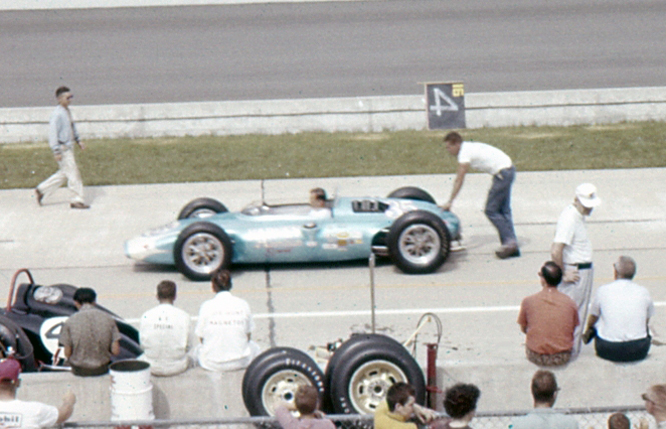
In 1961 legendary American speed king Mickey Thompson employed british Dolphin Engineering designer John Crosthwaite to design and build three challengers for the 1962 Indianapolis 500.

Aided by Fritz Voigt and his crew the challengers were transformed from blank sheet of paper into drawings and three complete cars in just 120 days.

Indy62 002s

(Photo by Ed Arnaudin)

Dan Gurney, possibly seen sitting in the vehicle above, had a lot riding on the 1962 Indy 500, at his own expense he invited Colin Chapman the genius behind Lotus Cars over to see the 1962 Indy 500 with a view to getting a deal done for Lotus to hook up with Ford and himself for a proper shot at the 500 in 1963.

Whatever else happened in 1962 Dan had to look good. Dan had originally agreed to drive the gas turbine powered #52 John Zink Trackburner, however the characteristics of the power plant did not sit comfortably with Dan who was racing on an oval for the first time, so he switched to drive Mickey Thompsons all aluminium Buick V8 stock block powered #34 Thompson instead.

Dan made a wise move, qualifying 8th and retiring with a seized rear end in 20th, the move looked doubly good for Dan when one of two drivers who drove the #52 John Zink Trackburner after Dan had left, veteran Bill Cheesbourg, followed Dan and drove the #35 Harvey Aluminium Special also a Thompson – Buick.

Cheesbourg like the previous incumbent Chuck Daigh failed to qualify the #35.

A third #33 Thompson Buick, belonging to Jim Kimberly, who the year earlier had owned and run the Kimberly Cooper Climax, was driven by Porky Rachwitz, Jack Fairman who both failed to qualify.

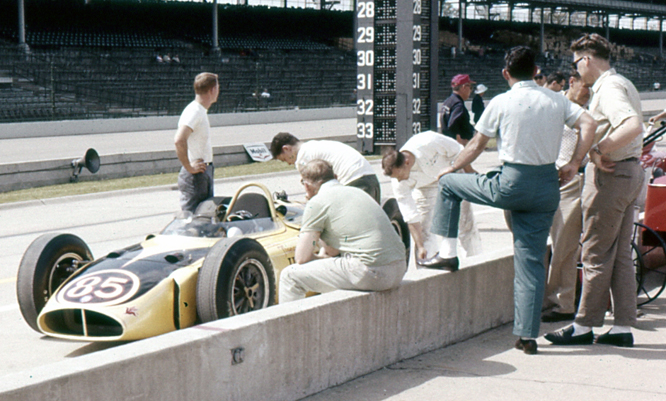
Indy63 001s

(Photo by Ed Arnaudin)

For 1963 Thompson took four cars to Indianapolis all now powered by Chevrolet stock blocks, the # 85 shown here with, possibly Micky Thompson standing on the extreme right behind the pit wall, is one of the original 1962 cars, driven in 1963 by Bill Cheesbourg until he wrecked the car in practice before qualifying had even started.

Cheesbourg who seems to have made a career out of driving novel designs at Indy failed to qualify a conventional #27 Watson for the race in 1963 while the #85 is not recorded as having taken any further part in the ’63 race after it was wrecked.

My thanks to Steve Arnaudin who kindly scanned his Dad’s photo’s for me to share and to Tom, FB84, Michael, Jim, EB, Amphicar, Tim and Tom G over at TNF who have helped me identify the cars and stories attached to them.

Hope you have enjoyed today’s Stock Block edition of ‘Gettin’ a lil psyco on tyres’ and that you will join me again tomorrow. Don’t forget to come back now !
Share