Tag Archives: Turner

Turbo Toni – Ford Sierra RS Cosworth

On the 22nd September 1982 Ford of Britain launched it’s replacement for the much loved conservative Ford Cortina to an unsuspecting public. Project Toni, designed by Uwe Bahnsen, Robert Lutz and Patrick le Quément, was unveiled as the Ford Sierra to a fair amount of public myrth and ridicule in the absence of much acclaim except in Ireland where the Sierra won the 1983 Semperit Irish Car of the Year award.
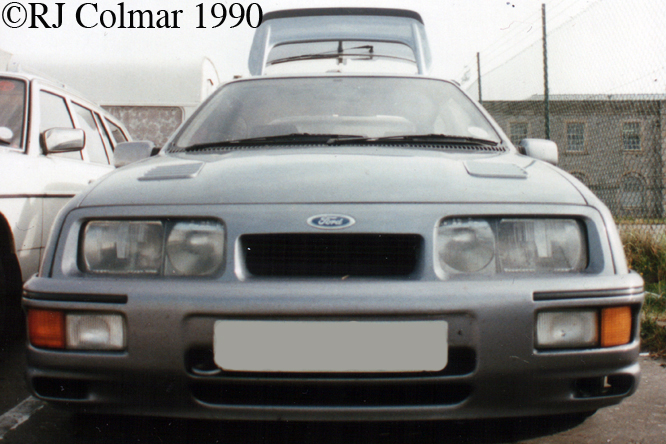
Ford Sierra RS Cosworth, Fishguard, Wales

While there was nothing fundamentally wrong with the mechanical operation of the car much of which was inherited from the final incarnation of the Ford Cortina Mk 5, the styling, which was similar to the well received US Ford Probe, had been pushed a bit too far in the quest for aerodynamic efficiency leading to nick names for the Sierra like ‘the blob’ and ‘Salesmans Spaceship’.
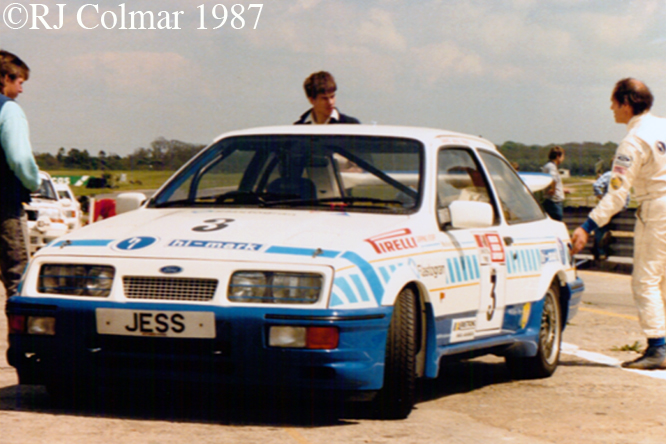
Ford Sierra RS Cosworth, Snetterton

Fortunately it was the salesmans fleet market which saved the model from sinking faster than the Edsel. The #3 above was an early leader in the 1987 Willhire 24 Hour race at Snetterton driven by Graham Scarbrough and David ‘Jess’ Yates who is standing with his back to the camera on the right.
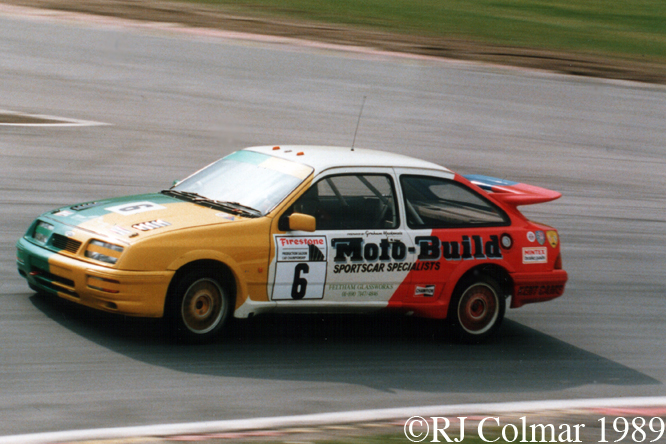
Ford Sierra RS Cosworth, Brands Hatch

In the spring of 1983 Stuart Turner head of Ford Motorsport Europe devised a plan to put Ford at the top of the new Group A saloon car championships which were run nationally and internationally in Europe. Above the #6 is driven by Graham Davis at Brands Hatch.
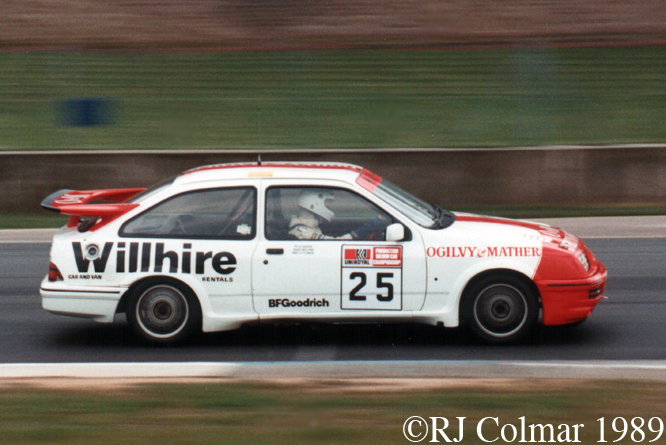
Ford Sierra RS Cosworth, Donington

In the spring of 1983 Stuart Turner head of Ford Motorsport Europe devised a plan to put Ford at the top of the new Group A saloon car championships which were run nationally and internationally in Europe. Above the #24 is driven by Peter Sugden at Donington and shared with Roger ‘Willhire’ Williams in the 1989 Willhire 25 hours at Snetterton.
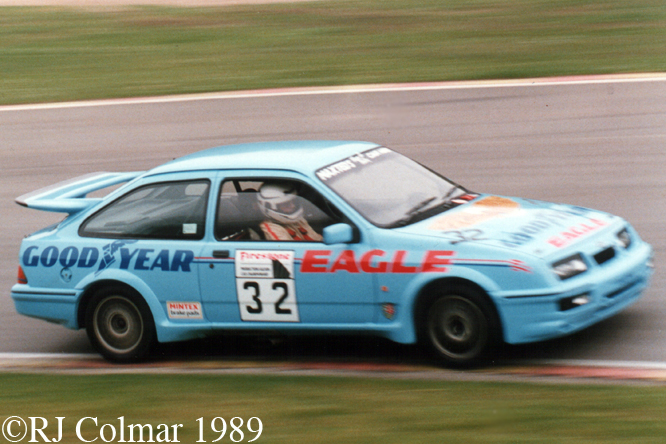
Ford Sierra RS Cosworth, Brands Hatch

Lessons learned from Roush Racing in the USA and Andy Rouse in Britain with XR4Ti racing programmes were incorporated into the suspension while a reworked Sierra 3 door body designed by Lother Pinske was developed which featured a distinctive ‘tea tray’ rear wing deemed necessary to keep the rear wheels on the ground at speeds in excess of 186 mph.

5045 Ford Sierra Cosworths were manufactured in 1986, enough to qualify for International Group A and national Group N racing, in only three colours, all with a grey interior and with the only options being central locking and or electric windows. The racers seen here were all prepared to the lower state of tune Group N spec for the national Uniroyal and Firestone production car championships.

Keith Maxted is thought to be the driver of the #32 Goodyear Sierra RS Cosworth seen at Brands Hatch on April 23rd 1989, if you know different please chime in below.

My thanks to Alan Cox & Gregor Marshall at The Nostalgia Forum for their help identifying the drivers of the four racers.

Thanks for joining me on this ‘Turbo Toni’ edition of ‘Gettin’ a li’l psycho on tyres’, I hope you will join me again tomorrow. Don’t forget to come back now !

Share

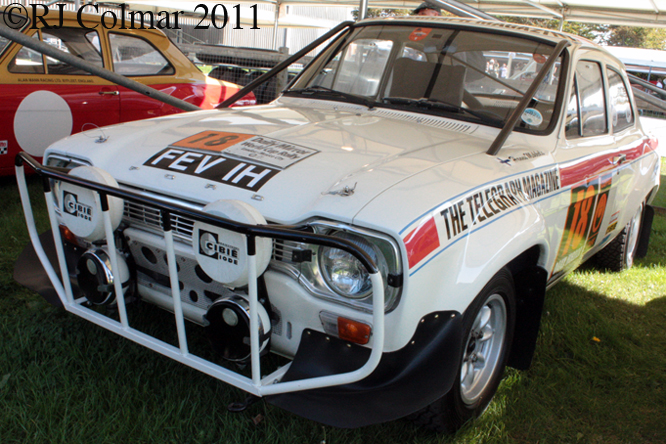
Bombproof Escort – Ford Escort 1850GT FEV 1H

Motorsport owe’s much of it’s history to the publishers of Newspapers keen create events which would resonate and engage their readers, indeed the very first recorded motorsport events emanated from the minds of the editors of ‘Le Vélocipède’, who in 1887 attracted a single car entry for a 1.2 mile race across Paris and ‘Le Petit Journal’, who in 1897 69 entries for a 79 mile ‘race’ from Paris to Rouen. By 1908 individual events took on global challenges such as the 12,000 mile 169 day New York west to Paris race which was co sponsored by The New York Times and Le Martin.

Ford Escort 1850 GT, Goodwood Revival

Possibly inspired by another 10,000 mile ten day event the London to Sydney Rally of 1968, Australian advertising sage Wylton Dickson came up with the idea of organizing a 1970 World Cup Rally to link London which had played host to the 1966 World (Soccer) Cup to Mexico which was to play host to the 1970 World (Soccer) Cup at a party in London over a glass of wine while chatting to Irish Rally Champion Paddy Hopkirk.

Ford Escort 1850 GT, Goodwood Revival

Wylton, who had never so much as seen a rally before approached Stuart Turner Ford competitions manager who gave him the thumbs up and the Daily Mirror who provided the sponsorship for the event. British Rally Champion John Sprinzel was allowed to set up an HQ at the Royal Automobile Clubs Belgrave offices from which to run the whole 16,000 mile event which crossed 26 countries on three continents in 25 days.

Ford Escort 1850 GT, Goodwood Revival

Good to his word when the 1970 World Cup Rally was announced Stuart Turner entered 6 Ford Escorts into the event for Poles Sobieslaw Zasada / Marek Wachowsk, Finns Hannu Mikkola / Gunnar Palm, England soccer star Jimmy Greaves with pro co driver Tony Fall, Monte Carlo Rally winners Raunno Aaltonen / Henry Liddon, British rally stars Roger Clark / Alec Poole and Finish rally legend Timo Makinen co driven by Frenchman Gilbert Staepelaere. Other entries in the 96 car field included a VW Beach Buggy a five car factory Moskivitch team from the USSR and two privately entered Rolls Royce’s a Silver Cloud and a Silver Shadow !

Ford Escort 1850 GT, Goodwood Revival

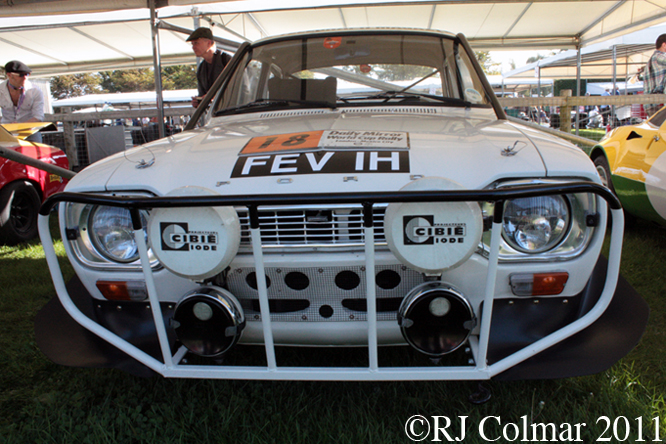
Ford’s official reason for fitting these bars in front of the windscreen was that they were to protect the drivers from Condors in the Andes mountains of South America, but it has been noted that these bars connect the top of the front suspension towers to the top of the A pillars which coincidentally helps transfer suspension shock to the roof diverting them away from some of the weaker welds in the bodywork.

Ford Escort 1850 GT, Goodwood Revival

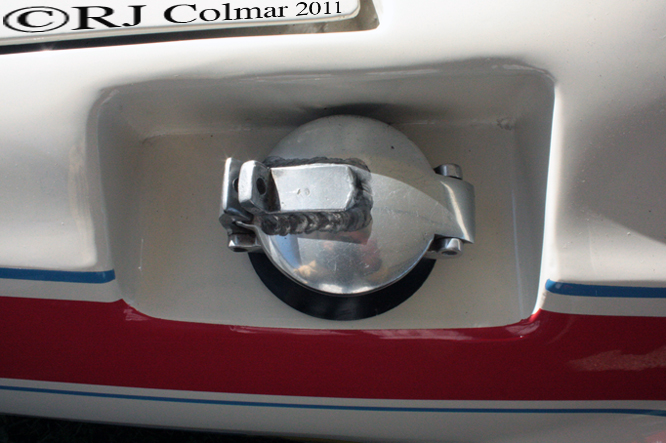
It is thought enough parts were produced for just 8 of the 1970 World Cup spec 1850 GT Escorts, which after the disappointment of easily leading the 1968 London to Sydney Marathon only for the Lotus Twin Cam engine in Roger Clark’s Cortina Lotus to fail, meaning these cars were built to be bomb proof against all foreseeable eventualities. Instead of using Lotus Twin Cam motors Ford Kent 1600cc / 97 cui pushrod motors were bored out to 1850cc / 112 cui fitted with a single Weber carburetor and dry sump lubrication which aids ground clearance. These motors were simple, durable and above all easily repairable, they were tuned to run on the low octane fuel that was to be found in the high altitude andean mountains on the South American legs of the route where stages of 500 plus miles were not uncommon and average speeds in excess of 90 mph were expected in order not to attract penalty points.

Ford Escort 1850 GT, Goodwood Revival

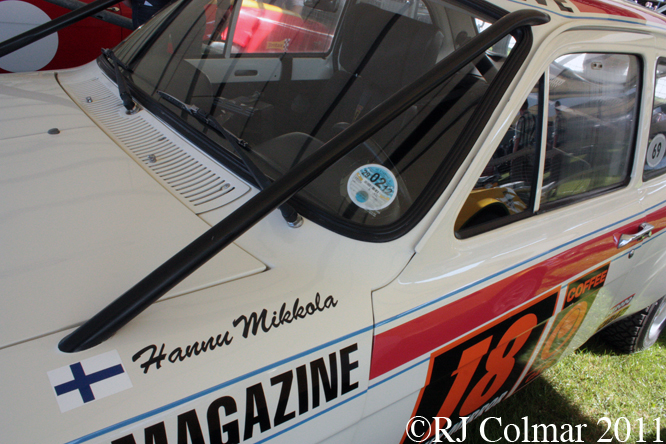
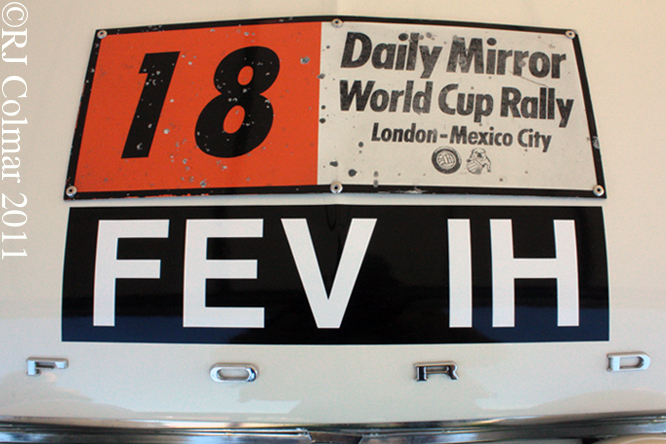
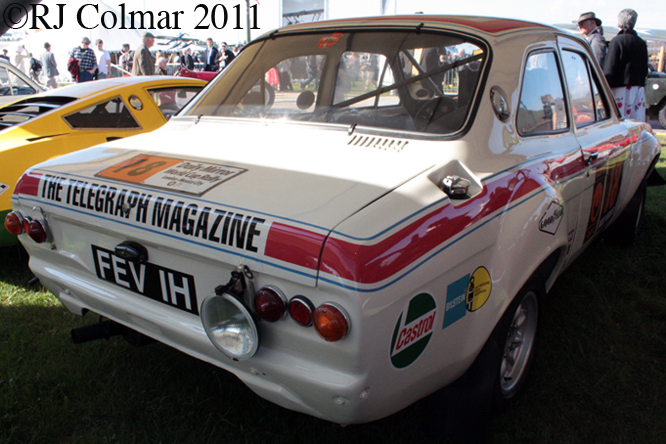
Hannu Mikkola had a relatively trouble free run dropping just 9 hours in penalty points over the course of the 25 day marathon, 4 of the other Escorts in the top 6 of the 23 finishers. During the course of the event FEV 1H became one of the most famous of Rally Vehicles of all time and is still among the most loved. As a result of the 1970 World Cup Rally win Ford launched a new sporty version of the Escort called the Ford Mexico with the 1600 / 97 cui Kent pushrod motor fitted to an Advanced Vehicle Operations strengthened “Type 49” body shell.

In 1995 there was a 25th Anniversary re run of the 1970 World Cup Rally, miraculously Ford ‘found’ a new unused Escort shell and built a new car to the same specifications as FEV 1H. Hannu Mikkola came out of retirement with Gunnar Palm to win the rerun as well, the new cars registration is H1 FEV.

Thanks for joining me on this Bombproof Escort edition of ‘Gettin’ a li’l psycho on tyres’, I hope you will join me again tomorrow. Don’t forget to come back now !
Share

Unlimited Grass Track Racer – #SS11 Xtreme Chevrolet

It is a great privilege to get down and dirty on the 11th Day of Christmas with Adrian Turners eye popping Unlimited Class 10 #SS11 Xtreme Chevrolet grass track racer built in 2009.

State of the art Xtreme Race Car chassis have been built in Somerset by South Somerset Autograss Club founder members and regular race winners John Gay and Russ Shepherd since 2006.

Adrian Turner a building contractor started racing in 1984 and qualified for the 2010 Nationals with this car.

The National Autograss Sport Association (NASA) Class 10 is for open wheel vehicles with motors over 2065 cc / 126 cui with no limits on the tuning. Adrian’s car is fitted with an all aluminium (US pronunciation) 5,665 cc / 345.7 cui LS6 engine more usually found at home in the front of a Chevrolet Corvette.

Lighter than a Formula One car at 600 kgs / 1323 lb and with around 480 hp at the rear wheels transmitted by a two speed gear box the #SS11 Xtreme Chevrolet is capable of over 100 miles an hour on 1/4 mile muddy grass tracks thanks to the grip afforded by 15 inches of rear suspension travel.

Sadly soon after I took my photographs of the #SS11 Xtreme Chevrolet it was badly damaged by crash barriers after a roll while in the hands of one of Adrian’s friends, thankfully no one was hurt. Adrian plans to rebuild the chassis around a smaller engine with a FIAT Seicento body.

I’d like to thank Tim Street of Rebel Racers for his assistance and the last photo in this blog and Adrian for his time, I am sure you will join me in wishing them both the best of luck for the season ahead, I look forward to catching Tim and Adrian at the first grass track meeting of the year at Oak Tree Arena on the 20th of March.

Hope you have enjoyed today’s grass roots edition of ‘Getting a lil’ psycho on tyres’ and that you’ll hop aboard with me tomorrow on the 12th and final day of Christmas for a ride on an icon from London. Don’t forget to come back now !
Share

The end of the Edward Turners hemi head V8 – Daimler V8 250

The British Daimler Motor Company was the brainchild of Frederick Simms who bought the UK patent rights to Gottlieb Daimlers engines in 1891. Under the ownership of Harry Lawson the company produced the first Daimler with a Panhard engine and then went on to produce Daimler powered machines in 1897 becoming Britain’s second company to serially produce motorcars after Humber.

From 1898 Daimler supplied official transportation for the Royal Household until 1950 when an recalcitrant transmission led the Royal Family to chose Rolls Royce as it’s transport of choice. From 1910 to 1960 Daimler was owned by by the Birmingham Small Arms Company leading Daimler into various military markets alongside it’s treasured roll as preferred purveyor of motorised transport to the Royal Family.

In 1960 Daimler was sold to Jaguar who needed additional production facilities for it’s growing marque. The Daimler V8 250 was the second series based on the MK II Jaguar powered by Daimlers hemi head V8 engine it was 50 kg lighter and more compact than the competition bred six cylinder Jaguar XK engines. The V8 250 was in production from 1967 – 1969 the vehicle in the photo appears to be a 1969 model and as such represents the end of the line of hemi head Daimler V8 production. From that point on all Daimlers were badge engineered Jaguars.

Wishing Racer 187 a Happy Birthday and plenty of Chief 187’s toasted pumpkin seeds.

Slightly off topic congrats to Kyle Busch on his thrilling Talladega truck victory, glad Ron Hornaday was walked away from his wrecked KHI truck. Condolences to friends and family of Jim Hunter NASCAR’s snr vice president of corporate communications.

Here is hoping Kevin ‘Happy’ Harvick finally gets one over Dangerous Denny Hamlin and goody two shoes Jimmy Johnson in a good clean race at one of my all time favourite tracks.

Thanks for popping by, don’t forget to come back now !

Share