Tag Archives: Hill

The White RHD One – Ferrari 250 GTO #3729GT

Blacksmiths, wheelwrights and coachbuilders Coombs of Guildford was founded in the 19th Century. Descendant of the founders John Coombs was taken to Brooklands before the 1939-45 was and on completion of his apprenticeship in 1949 began motor racing in open wheelers and sportscars with some success. He retired from race driving, after winning two races in a day at Mallory Park, because his business commitments no longer gave him the necessary time to compete, so he made the switch to becoming an entrant.

Teaming up with some of the best drivers of the day including his former Connaught team mate Roy Salvadori, BRM driver Ron Flockhart, John built up an excellent reputation with Coopers and Jaguar’s as Coombs of Guildford grew to become a major Jaguar dealership. When he was told Lotus founder Colin Chapman was interested in buying a Jaguar John had no hesitation in putting Colin, against whom he used to race, in one of his cars for a race at Silverstone which Colin promptly won and suitably impressed Colin duly placed his order.
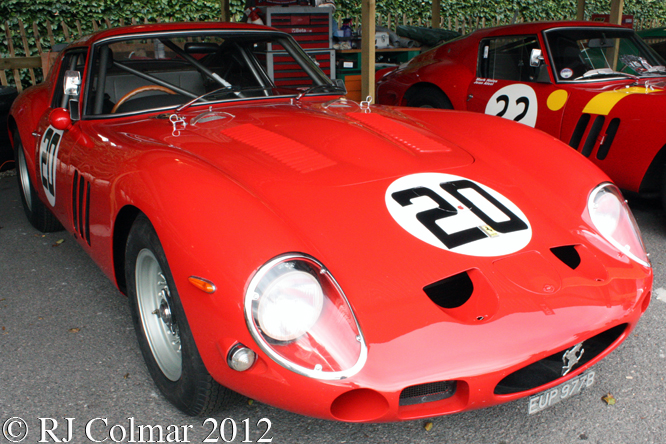
Ferrari 250 GTO, Goodwood Revival

In July 1962 John took delivery of a white right hand drive Ferrari 250 GTO chassis #3729GT after it became clear that the Jaguar E-Type was too heavy to compete against Maranello’s finest. Despite being driven by the likes of Salvadori, Graham Hill and Mike Parkes, all of whom were or went on to compete in Formula One, the car did not record any victories in 1963 but it did record a string of second places.

John also sent the car to Coventry where Jaguar made a close inspection of it before building John the first of 11 lightweight E-types with aluminium mononcoques and engine blocks.
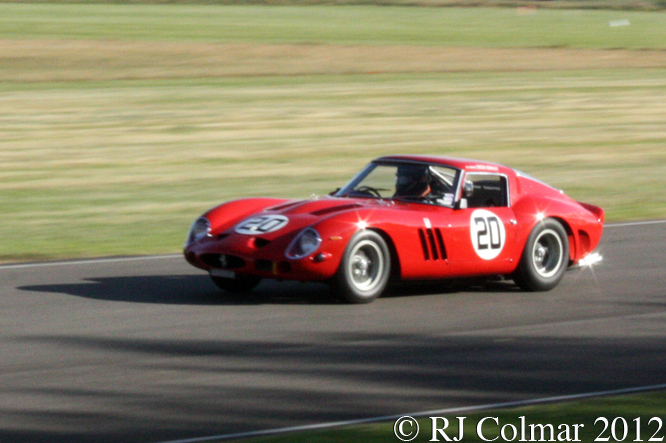
Ferrari 250 GTO, Goodwood Revival

In 1964 Viscount Eddie Portman took over ownership of #3729GT who added another second place result before it was entered for Ritchie Ginther to drive in the Tourist Trophy run at Goodwood where he finished 9th.

JA Pearce of JA Pearce Engineering then used #3729 in a couple of sprints run at Brighton and Blackbushe airport in late 1964 and early 1965.

Ferrari 250 GTO, Goodwood Revival

John also known as Jack Pearce spotted the opportunity for building a formula one car for the new 3 litre / 183 cui regulations which became effective from the beginning of 1966 using a 250 GTO motor. For many years it was believed that the motor from #3729 found it’s way into the back of the JA Pearce 1964 Cooper T73 built originally for the older 1.5 litre / 91.5 cui formula.

In fact Chris Lawrence, who drove and co owned the Cooper Ferrari, many years later discovered that instead of having a Ferrari 250 GTO motor the Cooper was actually fitted with a on older less powerful motor that came out of Rob Walkers 1961 Ferrari 250 SWB #2735GT which had been driven by Stirling Moss to a string of five race victories. Unfortunately the unique Cooper Ferrari T73 was destroyed in a transporter fire at Silverstone in 1967, although the charred remains of both the motor and car are known to still exist.
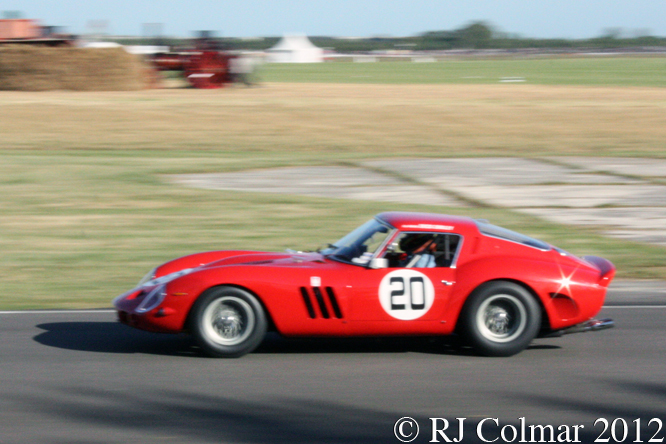
Ferrari 250 GTO, Goodwood Revival

After #3729 had been sold on to noted historic racer Neil Corner in 1966 it was painted red and from 1970 to 1999 it belonged to 1958 and ’63 British Saloon Car Champion Jack Sears, who had raced the #3729 for John Coombs at Brands Hatch and Snetterton in 1963.

1n 1999 current owner Jon Shirley bought the car and had a new engine block installed by Ferrari Classiche nine years later.

Thanks for joining me on this “The White RHD One” edition of “Gettin’ a li’l psycho on tyres” I hope you will join me again tomorrow. Don’t forget to come back now !

Share

What Goes Around (Slight Reprise) – Ferrari 250 MM Vignale #0260MM

I first looked at today’s featured Vignale bodied Ferrari 250 MM #0260MM in June 2011, but since Geoffrey Horton was kind enough to send me some more recent photo’s of it I can indulge you with a few snippets of additional information that have come to light.

Ferrari 250 MM Vignale, Blackhawk Museum

Phil Hill sold the car after he had raced it 5 times from new to Charles Brown of Monroe Los Angeles. While the car was in Charlies care he entered it for William Jarnigan to drive in a couple of races run at Bergstrom Air Force Base (AFB) in March 1954, William repaid his owners faith with 2 class wins coming 4th overall on both occasions.

Ferrari 250 MM Vignale, Blackhawk Museum

In July 1954 Charles finished 3rd in class at Offutt AFB coming home 8th overall. In October 1954 the motor was recorded as having been rebuilt at the Ferrari factory.

Ferrari 250 MM Vignale, Blackhawk Museum

The next recorded owner is Ernie Miller of New Orleans, Los Angeles who is known to have raced the car on at least one occasion in the Hammond Grand Prix where Ernie is recorded as having finished 3rd overall in what is thought to be #0260MM’s last in period competitive appearance.

Ferrari 250 MM Vignale, Blackhawk Museum

Allen S Bishop is credited with restoring #0260MM between 1972 and 1975, after which original owner Phil Hill was reunited with the car for a classic race at Monterey in 1984 from which he car was retired.

Ferrari 250 MM Vignale, Blackhawk Museum

It is believed that #0260MM fetched US$ 1.2 million from an anonymous purchaser in 1995. Phil Hill was reunited again with the car at Monterey in August 2001, though no race results for that particular reunion appear to have been recorded.

My thanks to Geoffrey Horton for sharing these photographs taken at the Blackhawk Museum late last year.

Thanks for joining me on this “What Goes Around (Slight Reprise)” edition of “Gettin’ a li’l psycho on tyres”, I hope you will join me again tomorrow for a look at a Crusader built in Washington…. Co Durham. Don’t forget to come back now !

Share

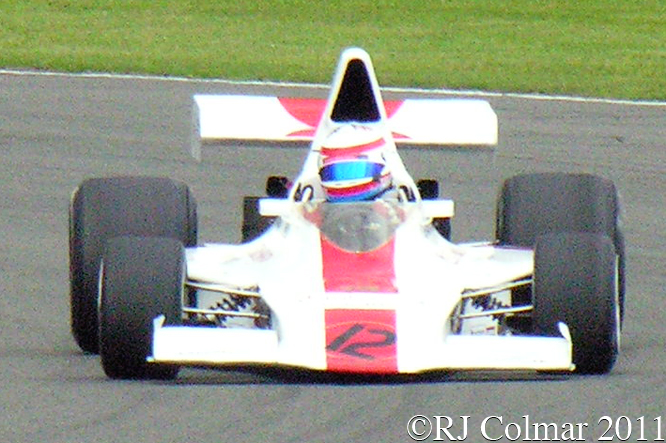
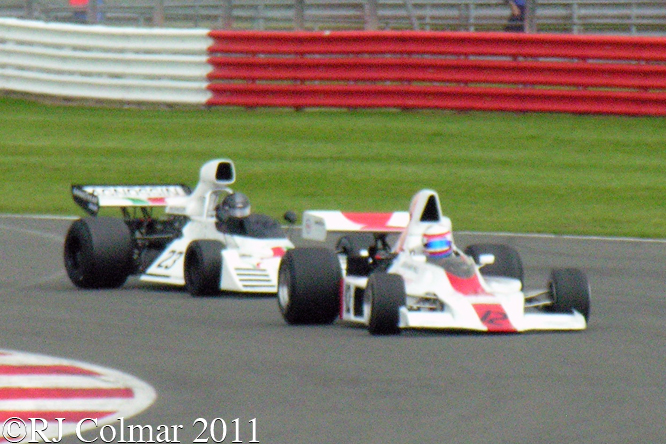
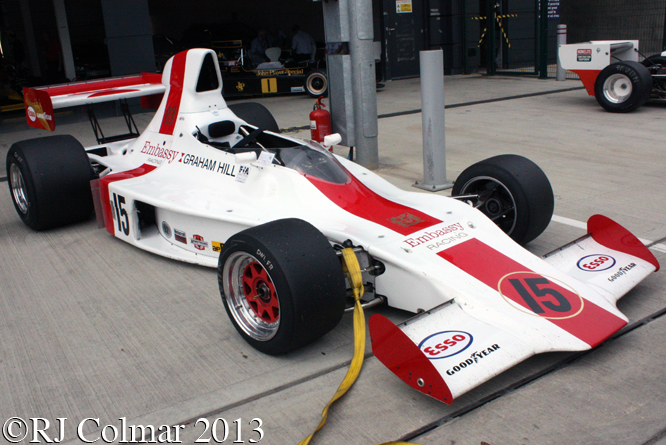
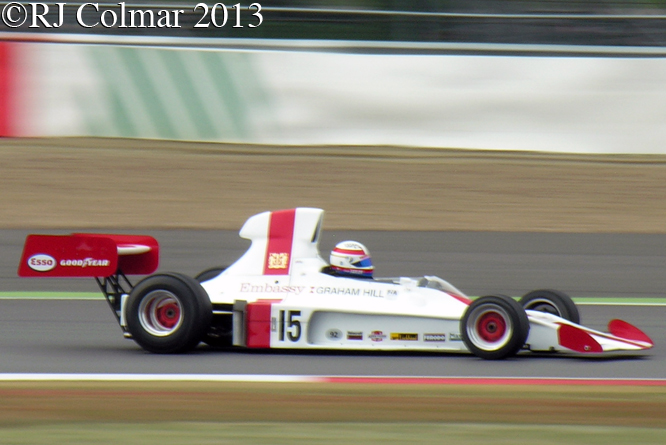
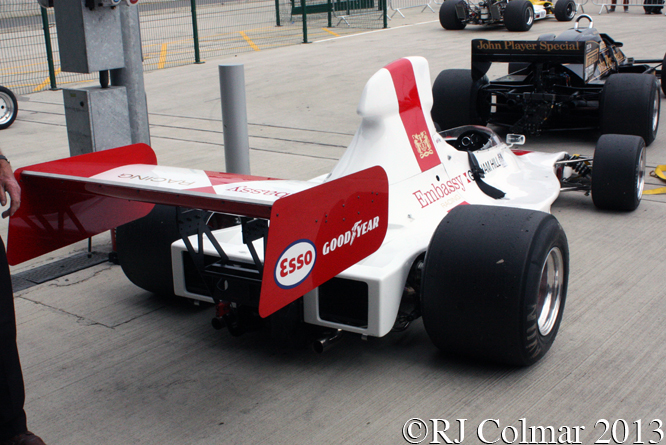
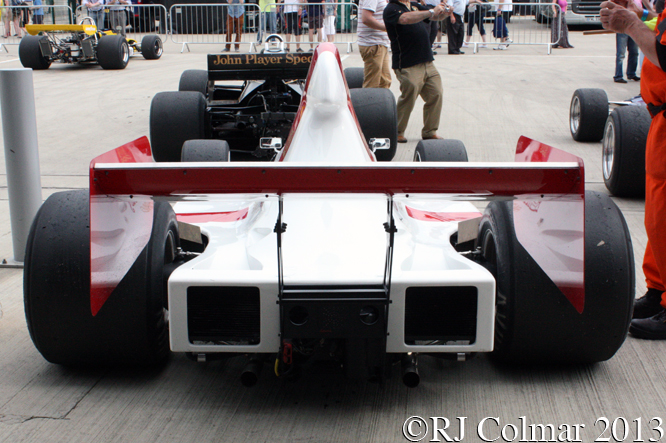
The Ambassador’s Embassy – Shadow Cosworth DN1 #DN1-3A

Ten years after winning his first World Championship driving for BRM, in 1963, and five years after winning his second World Championship driving for Lotus, in 1968 (Norman) Graham Hill had become the senior citizen of the sport with wins at Indianapolis in 1966 and at Le Mans in 1972 to make a unique triple crown of victories which only he has achieved, making him arguably the most versatile driver in the history of the sport. Graham was also the first man to win the Monaco Grand Prix five times a record that was not equaled until 1992 and beaten until 1993 when Ayrton Senna won his fifth and sixth Monaco Grand Prix victories.

Shadow Cosworth DN1, Silverstone Classic

As the wise cracking head of Embassy, UK brand cigarettes, quipped in 1973 at the launch of Graham Hills Embassy sponsored Formula One Team every ambassador needs an Embassy. Graham’s was built by, the then relatively unknown in Europe, Shadow a team that had cut it’s teeth in Can Am primarily with Graham Hill’s former Lotus Team mate Jackie Oliver.

Shadow Cosworth DN1, Silverstone Classic

The Shadow DN1 was designed by Tony Southgate who’s CV includes designing the last two BRM’s to win major races the P160, an example of which Jackie Oliver had driven in 1972, and P180 which bears a familial resemblance to today’s featured DN1 apart from the fact that the latter is powered by a by 1973 ubiquitous Ford sponsored Cosworth V8 which Graham Hill had been instrumental in testing back in 1967.

Shadow Cosworth DN1, Silverstone Classic

Under the umbrella of Mr Shadow, Don Nichols, sponsored by UOP Lead Free fuel the Shadow team ran two black works cars for Jackie Oliver and 1972 Can Am Champion George Follmer and sold a third car #DN1-3A to Graham Hill for him to run as a privateer. Not for the first, or the last, time none of the Shadow cars were ready for the start of the season the works team missed two races before making their debut in South Africa where George starting 21st came through to finish 6th and score a single world championship point on his Grand Prix debut.

Shadow Cosworth DN1, Silverstone Classic

Graham’s car was ready at the next race the Spanish Grand Prix where Graham qualified 22nd but failed to finish after experiencing problems with his brakes, while George Follmer came through to a seasons equal best 3rd place finish in his second championship Grand Prix. At the Belgian Grand Prix Graham qualified 23rd and came through to finish ninth which would prove to be his best result in an otherwise totally frustrating year for his fledgling Embassy Racing Team.

Shadow Cosworth DN1, Silverstone Classic

The works UOP Shadow teams debut season was similarly also fraught with disappointment until the Canadian Grand Prix where Jackie Oliver scored his a career equaling best third place finish, five years after he had finished 3rd in the 1968 Mexican Grand Prix. For the 1974 season Graham Hill took his Embassy sponsorship to Lola while Jackie Oliver and George Follmer returned to the Can Am series where they finished 1st and 2nd respectively when the series finally stopped one race short of the scheduled season.

Shadow Cosworth DN1, Silverstone Classic

Jackie Oliver became increasingly involved in the management of the Shadow team while keeping his hand in driving the mighty Dodge powered Shadow DN6 Formula 5000 cars and put in a one off final Formula One appearance at the 1977 Swedish GP where he finished 9th.

Daryl Taylor is seen at the wheel of #DN1-3A at recent Silverstone Classic events.

Thanks for joining me on this “The Ambassador’s Embassy” edition of “Gettin’ a li’l psycho on tyres” I hope you will join me again tomorrow. Don’t forget to come back now !
Share

Sixties Ferrari Covers – GALPOT Automobilia

Continuing to clear some of the motor racing stuff I have collected over the years today’s post features a couple of MotorSport covers that are currently on line on my “lightpress” e-bay account.

MotorSport, Goodwood, April 1966

First up from April 1966 the staff at MotorSport believed that the idea of an apparently arbitrary 3 liter / 183 cui limit on the size of forth coming GT regulations was not either in the interest of the sport, or the British motor industry who’s GT cars from Jaguar and Aston Martin with motors over the new limit would be rendered obsolete despite not being particularly quicker than their competition with smaller motors. The photo shows the start of the 1963 Goodwood Tourist Trophy race featuring four Ferrari 250 GTO’s, 2 Aston Martins and 2 E-type Jaguars which was won by Graham Hill in the #11 250 GTO.

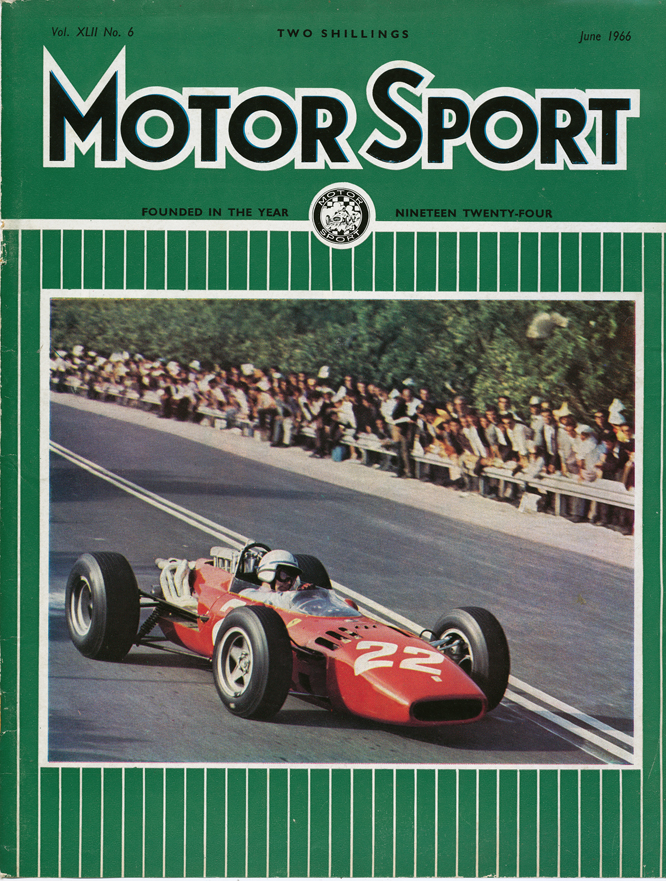
MotorSport, Surtess, Ferrari 312, Siracusa, June 1966

By June 1966 the Ferrari V12 3 litre 183 cui Formula One car was looking a good bet to win the championship with 1964 champion John Surtees at the wheel. John is seen guiding his Ferrari 312 fitted with a downsized sports car V12 motor through the streets of Siracusa on his way to an easy non championship victory. Note how Sicilian spectators are clearly seen ligning the inside of the crash barriers which were presumably installed to protect them. By the end of June John Surtees quit the Ferrari team after a disagreement with Ferrari management which deprived him and Ferrari of Championships which up until then had been theirs for the taking.

MotorSport, Bandini, Ferrari P3/4, Daytona, March 1967

Finally after a humiliating defeat to Ford at Le Mans in 1966 in February 1967 Ferrari stole a little Ford thunder by claiming victory in the Daytona 24 hour race. Seen on the cover of the March 1967 edition of MotorSport is Lorenzo Bandini at the wheel of the #23 Ferrari P3/4 he shared on his way to victory with Chris Amon. The #26 North American Racing Team Ferrari P4 driven by Pedro Rodriguez and Jean Guichet finished second.

Thanks for joining me on this “Sixties Ferrari Covers” edition of “Gettin’ a li’l psycho on tyres” I hope you will join me again tomorrow. Don’t forget to come back now !
Share

Claudes Concept – Aston Martin Atom

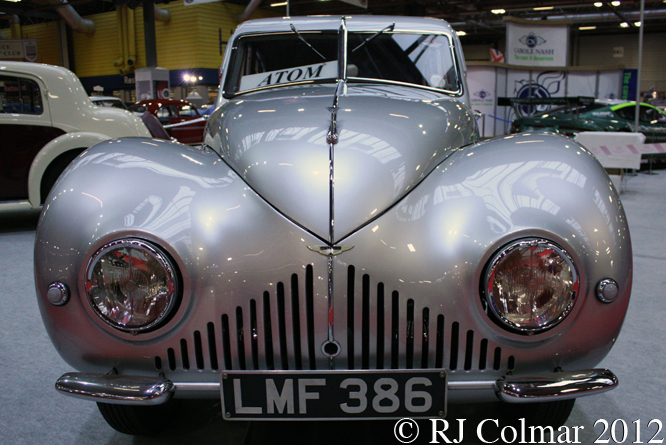
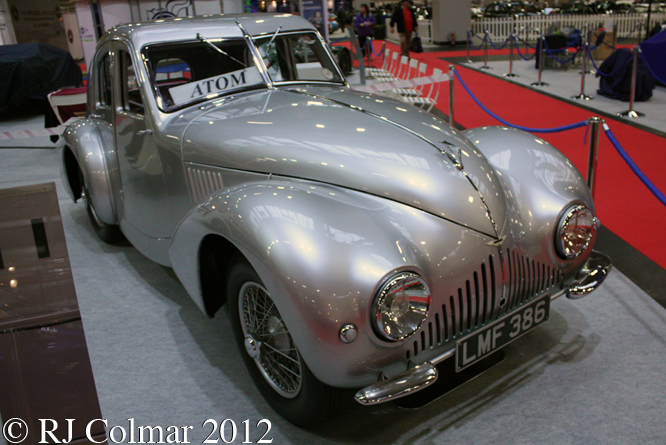
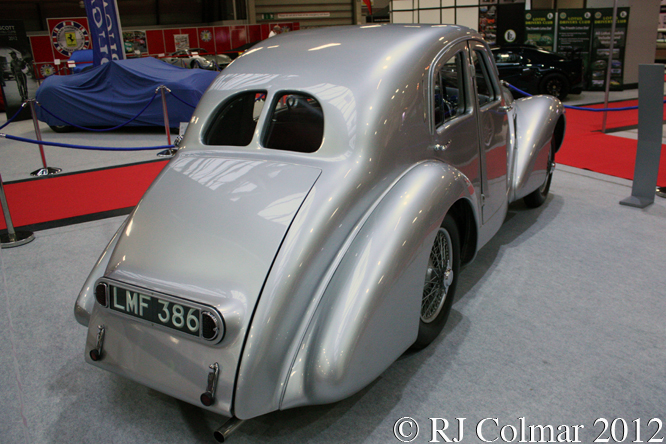
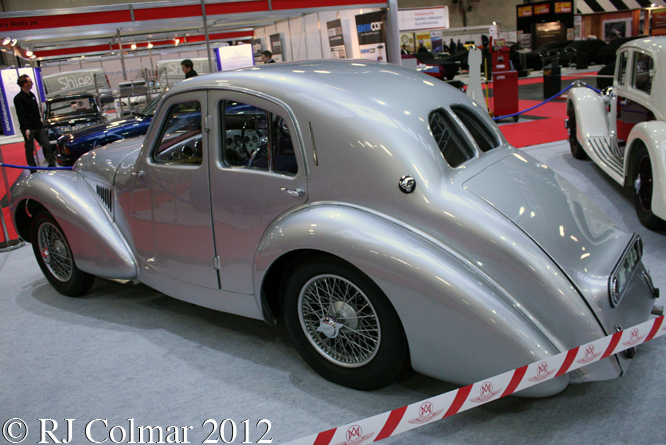
In 1939 Aston Martin constructed a working concept called the Atom designed by Claude Hill which is seen here at last years Classic Motor Show at the National Exhibition Centre in Birmingham.

Aston Martin, Atom, Classic Motor Show, NEC Birmingham

The car was built around a spaceframe superstructure of square section tubes with an aluminium paneled body.

Aston Martin, Atom, Classic Motor Show, NEC Birmingham

The Atom was originally powered by a 15/98 2 litre motor, but in 1944 this was replaced by a new 2 litre pushrod motor designed by Hill.

Aston Martin, Atom, Classic Motor Show, NEC Birmingham

Apparently the futuristic Atom was tested extensively during the course of the war, the chassis formed the basis of most subsequent Aston Martins up to the DB Mark III in 1957.

Aston Martin, Atom, Classic Motor Show, NEC Birmingham

When Sir Arthur Sutherland offered his “High Class Motor Business” for sale in 1947 the companies future owner, David Brown tested the Atom and afterwards decided to purchase Aston Martin which would remain in his hands until 1972.

Thanks for joining me on this “Claudes Concept” edition of “Gettin’ a li’l psycho on tyres” I hope you will join me again tomorrow. Don’t forget to come back now !
Share

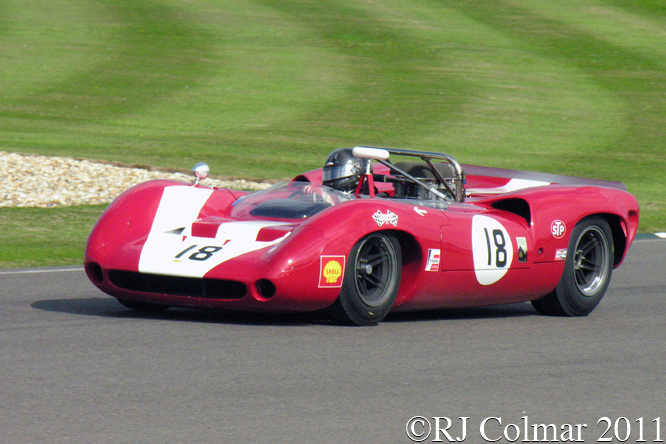
The Surtees Hill Lola – Lola Chevrolet T70 Mk II Spyder SL71/43

Team Surtees started running Lola T70’s in sports car races in 1965, for 1966 the teams proprietor, 1964 World Champion, John Surtees ran a Chevrolet Mk II spyder variant, chassis #SL71/17, in the Canadian American (Can Am) Challenge winning the inaugural Can Am race at St Jovite from pole with the car.

Surtees retired from the next couple of Can Am races with a broken oil pipe and then after a start line accident at Bridgehampton and Mosport respectively. At Laguna Seca the team had a new chassis #SL71/43, today’s featured car, which he qualified 7th but retired for a third time after 92 laps with suspension damage.

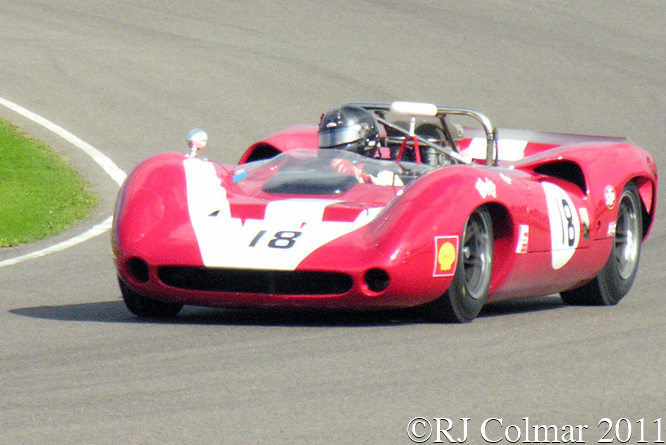
Knapfield, Lola T70, Goodwood Revival

John Surtees returned to chassis #SL71/17 at Riverside where he qualified second and won, 1962 World Champion and 1966 Indy 500 Winner Graham Hill was drafted into chassis #SL71/43 and came home third from 5th on the grid in the cars final appearance for Team Surtees.

Knapfield, Lola T70, Goodwood Revival

Surtees went into the final round of the 1966 Can Am Challenge at Stardust International Raceway in Las Vegas sharing the series lead with 1961 World Champion Phil Hill who was driving a Chaparral 2E.

Despite qualifying 4th behind Jim Hall on pole with his Chaparral team mate Phil Hill beside him and Chris Amon in a McLaren Elva in third, John Surtees forced his way through to the lead on the opening lap. John did not relinquish that lead for the entire 70 lap race and so secured the inaugural Can Am Championship.

Chassis SL71/43 was acquired by George Ralph for 1968 his best results with the car were two 11th place finishes one in the USRRC Championnat Nord-Americain race held at Mont-Tremblant from 17th on the grid and the other in the Road America Can Am race from 21st on the grid.

Current owner Paul Knapfield is seen driving the car at the 2011 Goodwood revival in these photo’s.

My thanks to Tom RA Announcer Schultz for kindly visiting his den to dig out the chassis details of today’s featured car from his copy of Lola T70 – The Design, Development & Racing History Hardcover – December 1, 2012 by John Starkey and Franco Varani.

Thanks for joining me on this “The Surtees Hill Lola” edition of “Gettin’ a li’l psycho on tyres” I hope you will join me again tomorrow. Don’t for get to come back now !

Share

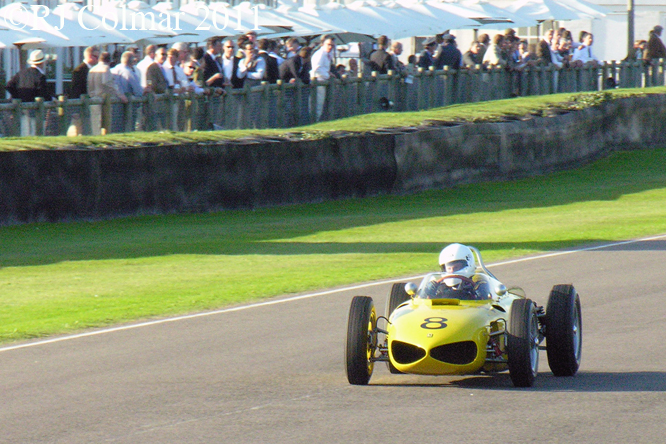
Factory Floor Reinforcement – Ferrari 156 #0002R

The 1961 season ushered in the 1.5 litre / 91.5 cui era of Formula One and only one team was fully prepared for what was to follow, namely Ferrari who had developed a suitable V6 motor for the previous Formula 2 rules. The British manufacturer BRM as usual was behind schedule with it’s V8 motor and so resorted to using the four cylinder Coventry Climax motors that most of the remaining British garagiste entrants were forced to use until the Coventry Climax V8’s became available.

Ferrari entered only seven of the eight championship events and won five of them beaten only by Stirling Moss in an outdated Lotus 18 at Monaco and the Nurburgring. Ferrari team leader Wolfgang “Taffy” von Trips won the Dutch and British Grand Prix, Phil
Hill won the Belgian Grand Prix and privateer Giancarlo Baghetti driving an FISA entered won the French Grand Prix, coming off a run of two non championship Formula One Victories to make him the only man to win from his first three Formula One race starts.

Ferrari 156, Replica, Goodwood Revival

Going into the penultimate race of the championship von Trips lead Phil Hill in points, however despite starting from pole von Trips was involved in an accident with Jim Clark that sent the German’s Ferrari into a collision with a grandstand at the end of the second lap. Consequently Von Trips and 15 spectators were killed and Phil Hill who started forth went on to win both the 1961 Italian Grand Prix and the Championship with one race to go.

Ferrari withdrew from the US Grand Prix, won by Innes Ireland driving a Lotus Climax 21 to record Team Lotus’s first team victory. At the end of 1961 the 156’s designer Carlo Chitti and team manager Romolo Tavoni walked out on Ferrari to found a new team called ATS, leaving Phil Hill and Baghetti joined by rookies Ricardo Rodriguez and Lorenzo Bandini to soldier on with the 156’s in 1962. The cars remained competitive in the opening races of the season but were eclipsed by both the V8 powered BRM P578 and Lotus 25, driven by Graham Hill and Jim Clark respectively, as the season progressed.

Ferrari 156, Replica, Goodwood Revival

At the end of 1962 Enzo Ferrari had all of the 156’s, known as Sharknoses, broken up with reusable parts saved for future use, while the chassis frames were cut up and used to reinforce a new Ferrari factory floor. For 1963 lighter versions of the 156’s were built in anticipation of a new V8 powered car designed by Mauro “Fury’ Forghieri that John Surtees drove to the 1965 World Drivers Championship Title.

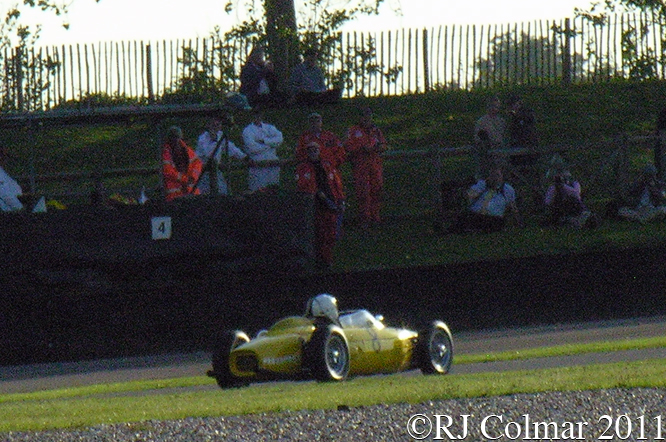
The car driven by Jan Biekens featured today replicates the 65° V6 powered chassis #0002 in the colours of Equipe National Belge driven by Olivier Gendebien to a forth place finish with the three 156’s, all using more powerful 120° V6’s of Phil Hill, von Trips and Richie Ginther ahead of him. Von Trips drove the same car painted red at the Monaco Grand Prix where he was classified 4th after crashing on lap 98 of 100.

Ferrari 156, Replica, Goodwood Revival

I believe French GP winner Giancarlo Baghetti moved from the FISA to the Scuderia Sant Ambroeus team for the 1961 British Grand Prix at Aintree where he drove the original #0002 still fitted with the 65° V6 qualifying 19th and retiring after an accident having completed 27 laps. At the German Grand Prix Willy Mairesse drove the original repaired #0002 qualifying 13th on the tortuous Nürburgring and crashing out on the 13th of 15 laps.

For the Italian Grand Prix at Monza the original #0002 was fitted with the latest 120° V6 and given to Phil Hill who drove it to victory in the race and championship as outlined above.

In 2004 Jan undertook the building of this replica with Jim Stokes Workshops Ltd and it was completed some five years later using many original parts, you can see a diary of the work progressing in the ‘News’ pages of Jan’s website.

Thanks for joining me on this “Factory Floor Reinforcement” edition of “Gettin’ a li’l psycho on tyres”, I hope you will join me again tomorrow. Don’t forget to come back now !
Share