Tag Archives: Lotus

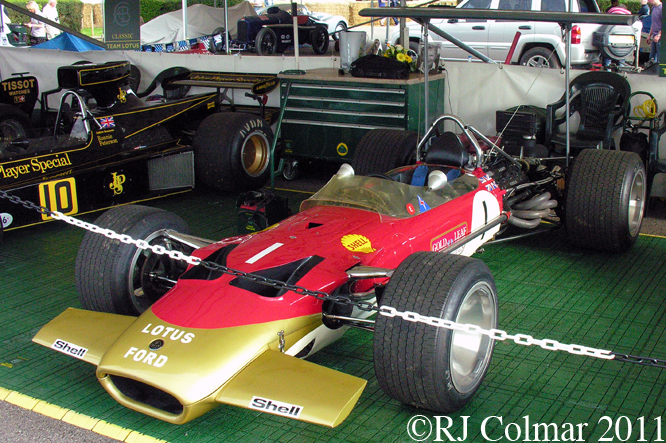
Flower Power – Lotus 51A

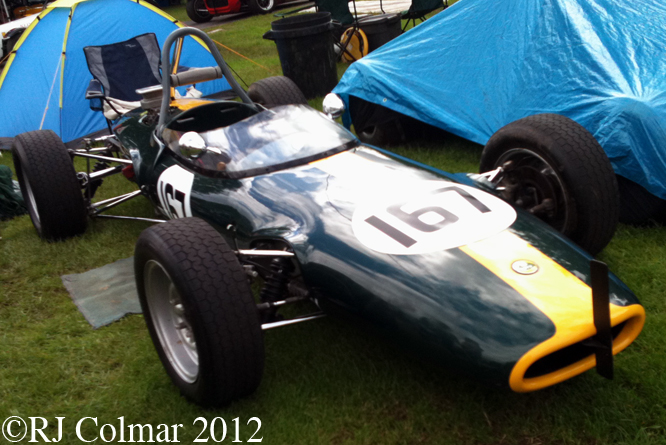
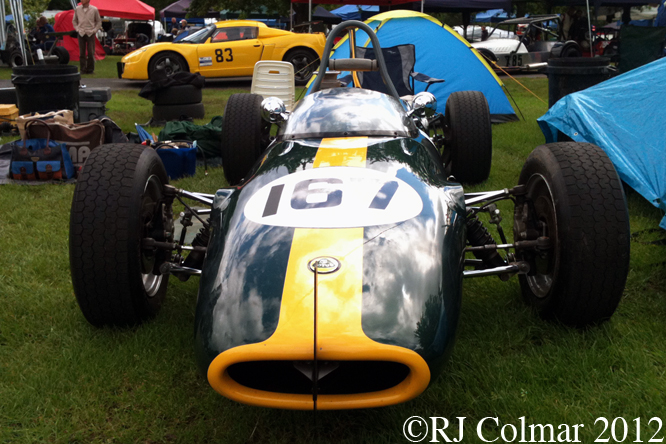
Conceived by Geoff Clarke, manager of the racing school at brands Hatch, Formula Ford was introduced in 1967 for novice drivers as a means of getting a start in racing at an affordable cost.

Lotus 51A, Prescott

The original Formula Ford cars were based on those used at the racing school but fitted with a stock 1500cc / 91.5 cui pre crossflow Ford Cortina GT motor in place of the much more expensive to maintain Formula 3 race tuned motors.

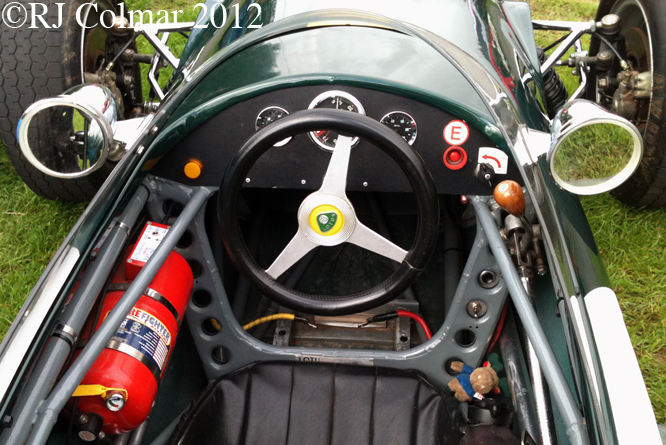
Lotus 51A, Prescott

Brands Hatch played host to the very first Formula Ford race on July 12th, 1967. The race was one by Ray Allen driving a Lotus 51 similar to the one featured in todays blog.

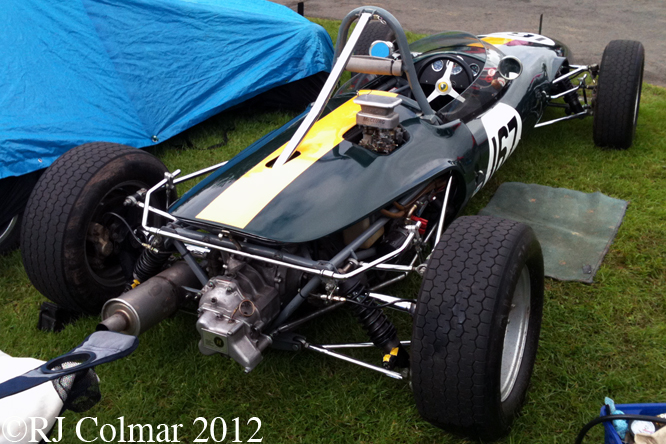
Lotus 51A, Prescott

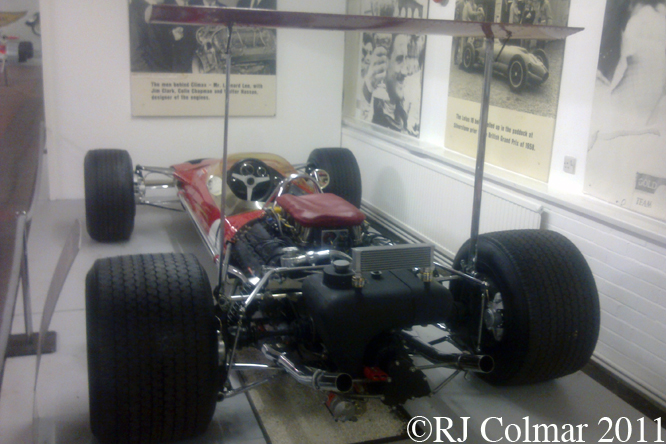
The first batch of Lotus 51 frames, including Ray Allen’s car, were actually welded up as Lotus 31‘s for use in Formula 3 but were retrospectively given the Lotus 51 tag when built to Formula Ford spec.

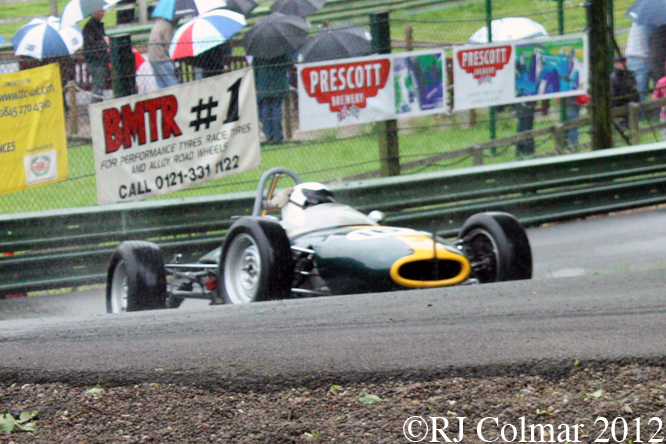
Lotus 51A, Prescott

Differences between the Lotus 51 and later 51A, seen here at Prescott, were minimal. For example brackets for an oil reservoir were not required on many 51A’s, if they ran with wet sump motor’s.

Lotus 51A, Prescott

Of the estimated 251 Lotus 51’s built, one, known as the 51R and unofficially as the Flower Power Lotus, was built as a road legal car complete with lights and mud guards.

Today’s featured Lotus 51A is driven by hill climber Briony Serrell.

Thanks for joining me on this ‘Flower Power’ edition of “Gettin’ a li’l psycho on tyres” I hope you will join me again tomorrow. Don’t forget to come back now !

Share

Fourth Season Swan Song – Lotus 49C #R6/2 & #R10

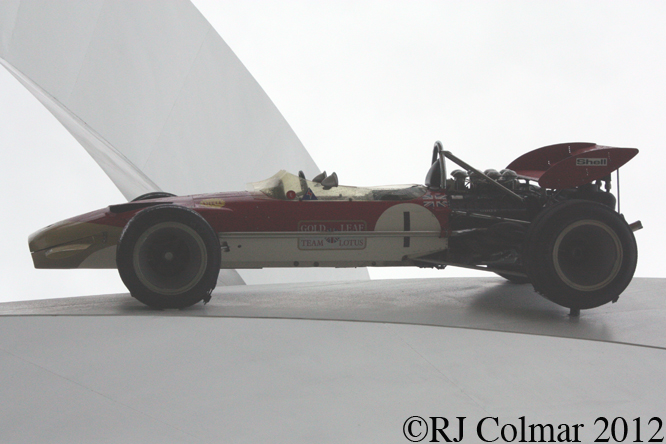
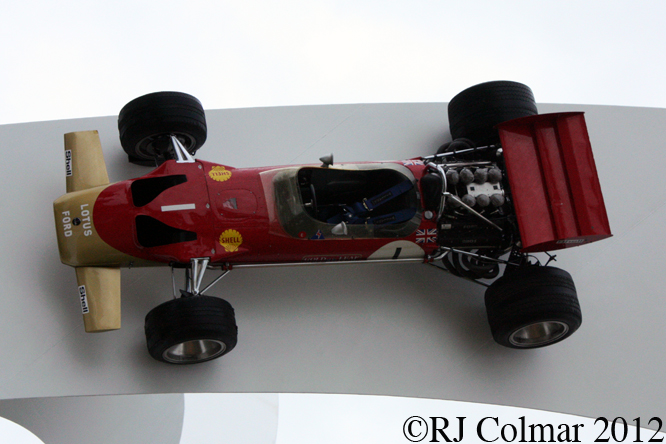
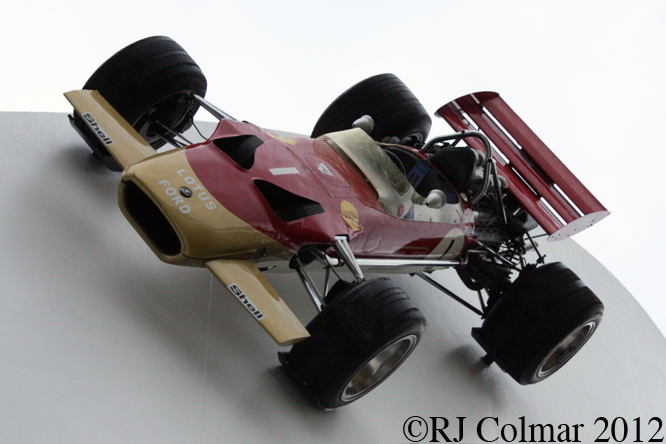
For 1970 Lotus had planned to have the 4 Wheel Drive Lotus 63 ready to challenge for championship honours however even Mario Andretti could not capitalise on any of the cars supposed advantages during 1969 and so the Lotus 49 was updated for a fourth season of competition with 13 inch front wheels to make use of the latest Firestone Tyres as a stop gap while the design and build of the Lotus 72 was finalised.

Lotus 49C, Goodwood Festival Of Speed

The car seen above is Lotus #R6/2 the second car to carry the #R6 chassis plate. The first incarnation of #R6 was the first 49 to be built to ‘B’ spec. Unfortunately it was written off by Jackie Oliver during practice for the 1968 French Grand Prix, and in order to make use of existing travel documents the eighth Lotus 49 to be built was given the #R6 chassis plate and is known as #R6/2. Some parts of #R6/1 damaged beyond repair by Oliver are thought to have been used in the replacement #R6/2 seen here, Rob Walkers privately entered 49 #R7, and the #R12 show car built for Ford which was donated to the Donington Museum.

In it’s second incarnation #R6/2 still in high wing ‘B’ spec was used by Graham Hill to win the 1968 Mexican Grand Prix which clinched the 1968 World Championships for Graham and Team Lotus. Graham continued to use #R6/2 in 1969 before the car was given to Jochen Rindt to drive. Jochen scored his first two Grand Prix victories with R6/2 the 1968 US Grand Prix with the car in ‘B’ spec and the 1970 Monaco Grand Prix with the car ‘C’ spec with the low triple plane rear wing that was designed for the Lotus 72. Jochens win at Monaco would be the third consecutive win in the Principality and also the 12th and final Grand Prix win for the Lotus 49 type.

Lotus 49C, Goodwood Festival Of Speed

The second Lotus 49C featured today appears to be chassis #R10 which has given me a bit of a mental run around. This car appeared at Goodwood last year in high wing ‘B’ spec.

Lotus 49C, Goodwood Festival Of Speed

As you can see from my heavily revised Lotus 49B blog the car started life as Lotus 49 #R5 and for reasons that are not clear the car was renumbered #R10 and sent to the Antipodes for Jochen Rindt to use in the Tasman Series.

Lotus 49C, Goodwood Festival Of Speed

Graham Hill used #R10 to win the 1969 Monaco Grand Prix as he had done in 1968 when the car carried the chassis #R5. In 1970 Graham drove #R10 in the 1970 Monaco Grand Prix to fifth place when it was loaned out to the Rob Walker team for whom he was driving.

Emerson Fittipaldi made his first three Grand Prix starts in #R10 towards the end of 1970 scoring a best 4th place finish second time out in the 1970 German Grand Prix at Hockenheim.

Thanks for joining me on this “Forth Season Swan Song” edition of “Gettin’ a li’l psycho on tyres” I hope you will join me again tomorrow. Don’t forget to come back now !

Share

What’s In A Tooth ? – Lotus Ford 49 #R2 & #R3

The Lotus 49 consolidated the principle of using the motor that as an integral structural component of the design that was first seen on the BRM P83 and Lotus 43 which were both powered by the novel BRM H16 motor in 1966. The 49, designed by Maurice Phillipe however was powered by the then brand new, and much simpler Ford sponsored 3 litre / 183 cui 8 cylinder Cosworth DFV that was the brainchild of Keith Duckworth and Mike Costin.
Lotus 49, Goodwood Festival of Speed

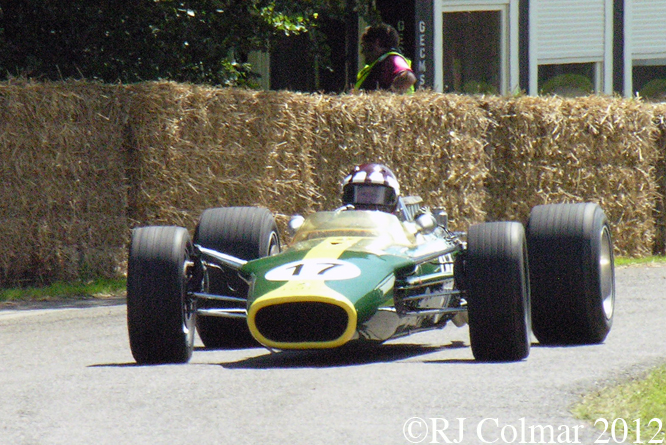
Despite many faults that would surface and be ironed out over the ensuing seasons the Lotus 49’s made a dream debut at Zandvoort for the 1967 Dutch Grand Prix with Graham Hill qualifying on pole and Jim Clark who had never so much as sat in the car before the first practice qualifying 8th. During the race Clark driving chassis #R2, seen above with Jackie Oliver at the wheel at Goodwood, used his legendary speed and mechanical sympathy to well judged victory while Hill experienced timing gear failure with two teeth next to each other on the timing gear breaking. After the race it was discovered Clark’s car had experienced a similar failure however a single tooth remained between the two broken teeth on Clarks timing gear ensuring just enough drive to make it to the finish.

Clark used Chassis #R2 to win both the 1967 British and US Grand Prix before being converted to 49T spec for the Tasman Series of races in Australasia which required an engine capacity of 2.5 litres / 152.5 cui which was achieved by fitting a different crankshaft with a shorter stroke to the DFV motors making them DFW spec. Jim won 4 races in the 8 race Series with the 49T spec chassis #R2 which combined with a couple of points paying places was enough to win the Championship from Chris Amon in his Ferrari 246 Dino.

Chassis #R2 was then loaned to Rob Walker racing during 1968 to replace chassis #R4 which driver Jo Siffert had crashed on his debut in a non championship race at Brands Hatch. Although #R4 was not damaged beyond repair by that accident it was subsequently destroyed in a workshop fire at Rob Walkers premises necessitating the loan of #R2. Once Walkers team had built up a new car, chassis #R7 now in B spec with the tall rear wing, which Siffert used to win the 1968 British GP.

Once chassis #R2 was returned by Rob Walker to Lotus it was immediately pressed into service again after Jackie Oliver had a comprehensive accident in #R6 at the 1968 French GP. For the British Grand Prix #R2 was repainted in Gold Leaf Team Lotus colours and fitted with the winged 49B spec nose cone and high rear wing. The car received further B spec upgrades for the German Grand Prix. Oliver would use chassis #R2 for the remainder of the 1968 season scoring a best 3rd place finish at the season finale in Mexico.
Lotus 49, National Motor Museum Beaulieu

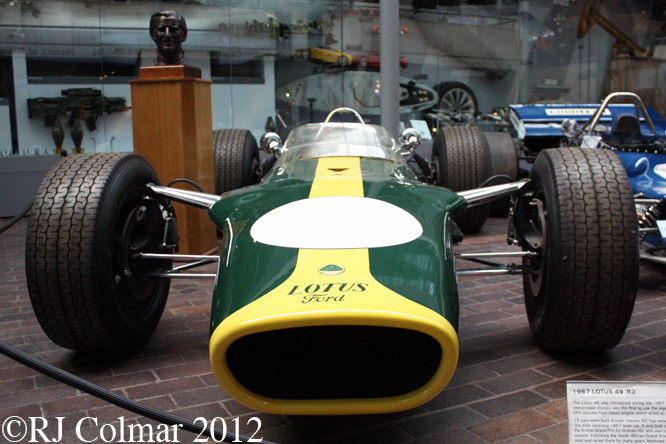
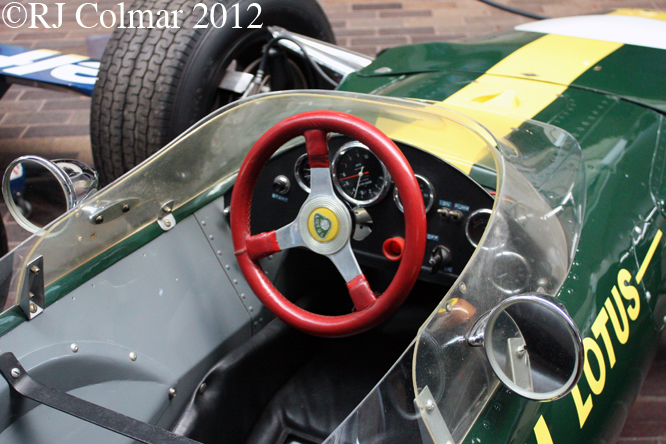
The car seen above at Beaulieu National Motor Museum is chassis #R3 which featured subtle differences to chassis #R1 and #R2 to aid the distribution of loads under braking at the front and to aid access to the brake balance adjuster which had previously only been possible by two mechanics picking up a third smaller mechanic and lowering him into the cockpit upside down ! Note the sculpture of Graham Hill on the plinth to the left of the car in this photo.
Lotus 49, National Motor Museum Beaulieu

Chassis #R3 first appeared at the 1967 British Grand Prix with Graham Hill at the wheel, he qualified 2nd behind Clark but while leading the race first an allen screw dropped off the rear suspension and after it was replaced the engine failed while he was making up good time. Chassis #R3 has the second longest track record of the 12 Lotus 49’s built.

After Hill scored a season best 2nd place in the 1967 US Grand Prix, behind Clark, and opened his championship winning 1968 season with another second place, again behind Clark at Kyalami chassis #R3 was sold to Rhodesian John Love who used the car to win the last two of six consecutive South African Formula One titles in 1968 and 1969, his successor Dave Carlton won the 1970 South African Championship driving the Lotus 49 chassis #R8 which was built to the final C spec.

Lotus 49, National Motor Museum Beaulieu

The 400 hp Ford Cosworth DFV was to become the mainstay of Formula One right through the 1970’s, it was far in advance of the Lotus 49 chassis and would only be toppled by the hugely more expensive turbocharged motors in the early 1980’s after 155 Grand Prix Victories. One of the triangular aluminium top engine mountings can be seen bolted with three bolts on the leading edge of the cam cover tapering into the back of the monocoque to which it was attached by a single bolt. Three further such mountings were all that were required to integrate the motor into the structure of the car.
Lotus 49, National Motor Museum Beaulieu

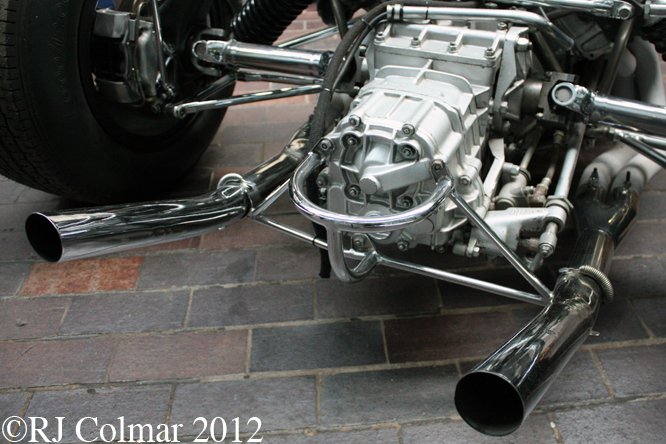
The rear suspension and drive shafts and gearbox would repeatedly prove trouble some for team Lotus as they got to grips with having such a powerful motor. The ZF gearbox in it’s original form was not strong enough and required additional strengthening which can be seen in the form of the thick vertical plate into which the drive shaft disappears. The ZF gearboxes were replaced on the 1968 B spec cars with Hewland units which were much easier to maintain trackside.
Lotus 49, National Motor Museum Beaulieu

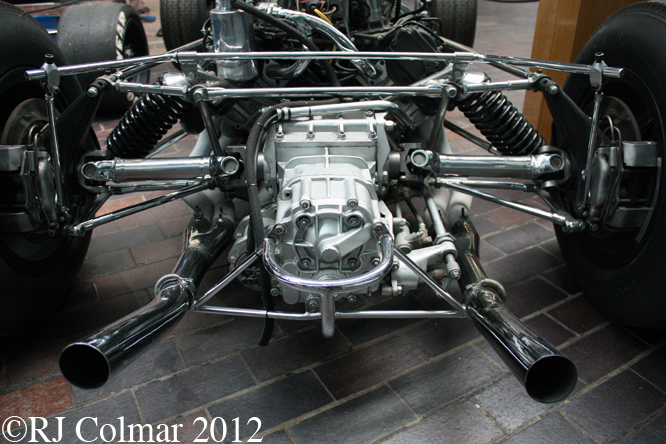
The vestigal nudge bar was added to the back of the ZF gearboxes after the 1967 Dutch Grand Prix win in order to comply with a regulation about the dimensions between the end of the exhaust pipe and the back of the car. In other words when Jim Clark won the 1967 Dutch Grand Prix his Lotus 49 did not comply fully to the letter of the existing regulations.

Chassis #R3 is the only one of the Lotus 49’s never to run in B or C spec. Since it has been in the care of the National Motor Museum it has been involved in two serious accidents. The first, on a demonstration run, involved a tree in the Beaulieu grounds where it is kept in 1999 further details of the accident damage can be seen on this link. The second accident with the same driver occurred at a Silverstone Press Day in 2009 fortunately the damage was restricted ‘only’ to the left side suspension as can be seen in these linked photo’s.

Thanks for joining me on this “What Is In A Tooth ?” edition of “Gettin’ a li’l psycho on tyres”, I hope you will join me again tomorrow when I will be looking at a GSM Delta. Don’t forget to come back now !

Share

Flattery Will Get You Anywhere – Lotus 47 #47-GT-04/78

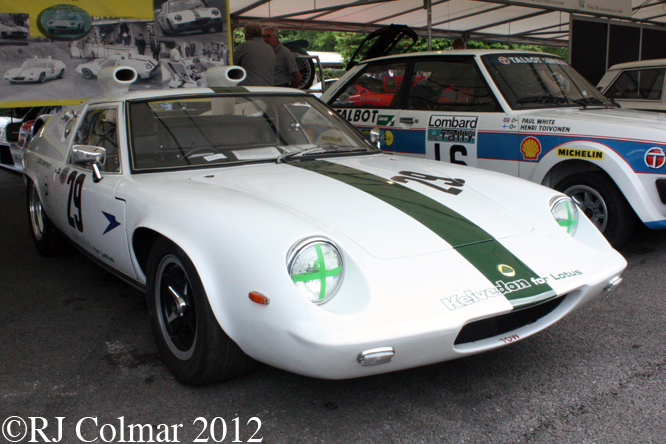
The Lotus 47 was conceived as a racing version of the Lotus Europa (Type 46). The 47 featured a lightened backbone chassis, 168 hp fuel injected Ford Cosworth C13 motor, in place of the Renault used in the road going Europa, Hewland FT200 Formula Two gearbox and suspension derived from the Lotus 22 and Lotus 23 racing cars.

Lotus 47, Goodwood Festival of Speed

The Lotus 47 first appeared at Brands Hatch on Boxing Day 1966 making an immediate impression finishing 1-2 on the road with John Miles winning and Jackie Oliver in second place, though Jackie was penalised for a push start off the grid and so did not figure in the final classification.

The car seen here started life as chassis # 47-GT-04 and was driven by Miles and Oliver to a 9th place overall, first in class, in the 1967 Brands Hatch 6 hours. The car was then acquired by John Calvert and raced under the Sunderland Racing Developments banner in 1968. An collision with Doug Hardwick, driving #47-GT-61 in April ’68 necessitated the replacement of the chassis and so the car became identified as #47-GT-04/78.

While no further International success was attributed to Lotus 47’s after the class win at the 1967 Brands Hatch six hours they did score many wins in national events. Of the many drivers who raced 47’s one was rookie B Rahal who made his first appearance on the race track in #47-GT-60, a car he purchased from Lotus Midwest near Janesville, Wisconsin in the summer of 1972.

In all around 55 cars seems to be the accepted number of Lotus 47’s built confusingly some appear to have been built solely for the road and the chassis numbers run to #47-GT-85.

Several special 47’s were built with Climax motor’s and one, known a Type 47D, with a Rover V8 was built by the factory for GKN that is said to have been capable of 186 mph.

When John Blundsten tested the prototype 47 for Motor Racing magazine he said that while a couple of recent Lotuses had not “exactly flattered their owners. This one is very different … and flattery will get you anywhere !’

Thanks for joining me on this “Flattery Will Get You Anywhere” edition of “Gettin’ a li’l psycho on tyres”, I hope you will join me again tomorrow. Don’t forget to come back now !

Share

The English Ford Line – Lotus 28 #17

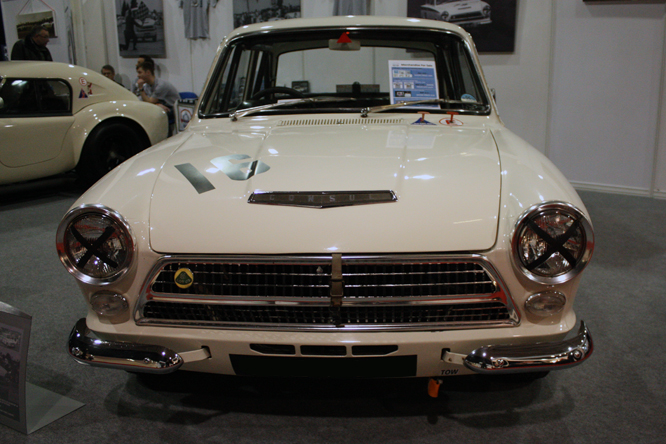
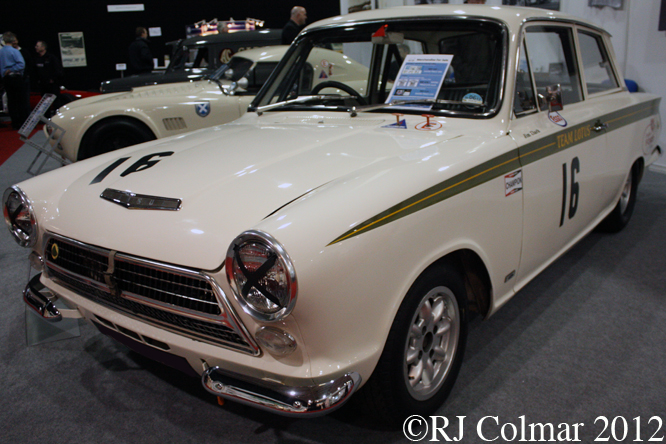
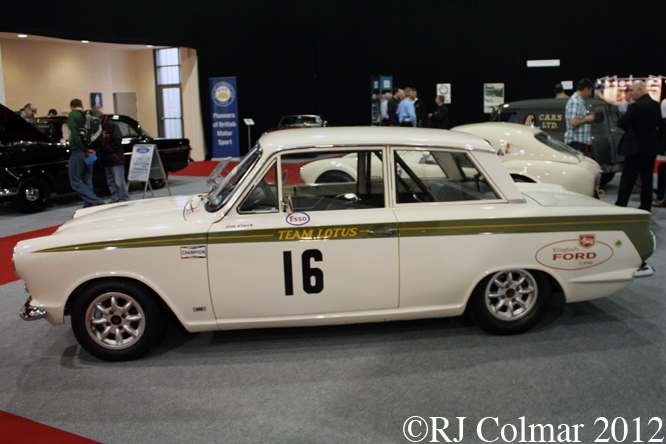
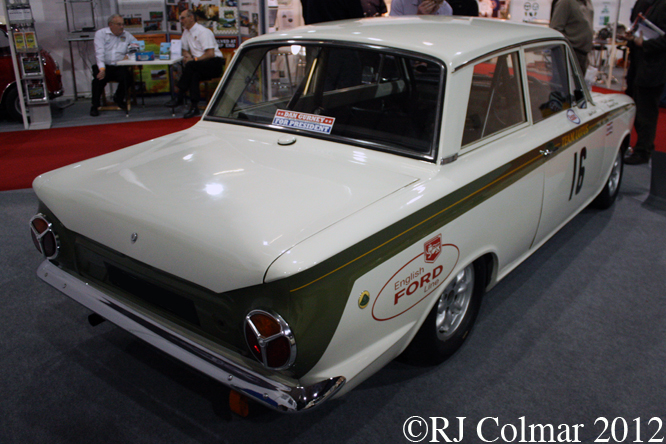
I first featured a Ford Consul Cortina by Lotus, Lotus Type 28, just over a year ago and believe the model is worth a second look today because the car featured here is thought to be the 17th of 1000 that were originally scheduled to be built.

Ford Consul Cortina by Lotus, Race Retro

Furthermore this car registered ‘166 RUR’ is the first, of a team of twelve works Team Lotus racers, that was built in 1963.

Ford Consul Cortina by Lotus, Race Retro

“166 RUR’s” racing career started at Oulton Park on the 20th September 1963 with inaugural, 1958, British Saloon Car Champion Jack Sears at the wheel. This ‘Lotus Cortina’ along with an earlier Ford Cortina GT and Ford Galaxie helped Jack become the British Saloon Car Champion for a second time in 1963.

Ford Consul Cortina by Lotus, Race Retro

The week after “166 RUR’s” debut 1963 World Driver Champion Jim Clark took over the wheel at Snetterton, Jim would become the 1964 British Saloon Car Champion driving Works Lotus Cortina’s.

Ford Consul Cortina by Lotus, Race Retro

This cars next appearance was as a part of “The English Ford Line” team entered for the Sebring “250” on the 22nd March 1964 with Dan Gurney at the wheel. Dan came in 16th while Clark in the sister team car came home third behind Augie Pabst, driving a Galaxie, and Walt Hangsen driving a Falcon Sprint.

Ford Consul Cortina by Lotus, Race Retro

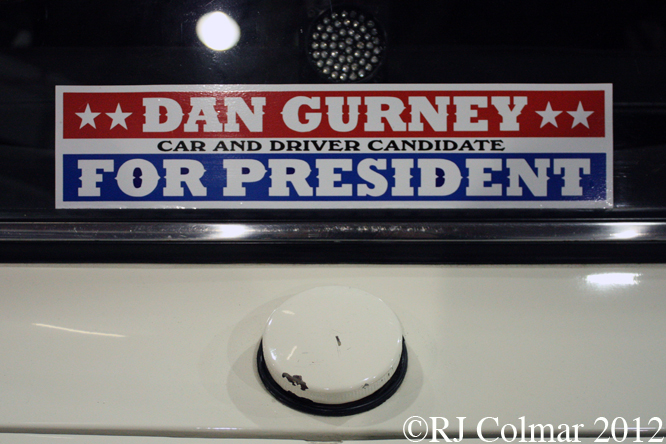
Dan Gurney’s 1964 presidential campaign started by Car and Driver Editor David E. Davis Jr did not get under way until May 1964, just over a month after Dan drove this car.

Ford Consul Cortina by Lotus, Race Retro

A variety of drivers continued to campaign “166 RUR” through 1964 including Sir John Whitmore winner at Pensacola, Grand Prix driver Peter Arundell, 6th at Riverside, abd towards the end of the year future TV pundit David Hobbs shared the car with Dave Clark, no relation to Jim, for a 9th place finish in the Marlboro 12 hours in Virginia.

Thanks for joining me on this “The English Ford Line” edition of “Gettin’ a li’l psycho on tyres” I hope you will join me again tomorrow. Don’t forget to come back now.

Share

Classic & Sports Car Action Day – Castle Combe

On Saturday David Roots kindly invited me to join him and the Bath & West Car Club for the Classic and Sports Car Action Day at Castle Combe.

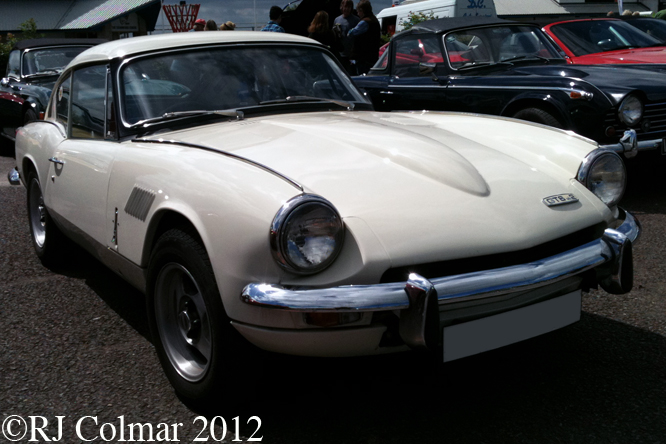
Triumph GT6 MkII, Castle Combe C&SCAD

Among the cars on display was this Triumph GT6 MkII which reminded me that GT6 enthusiast Hazen Wardle is soon to release the third of his Reche Plimpton, The Triumph Detective stories.

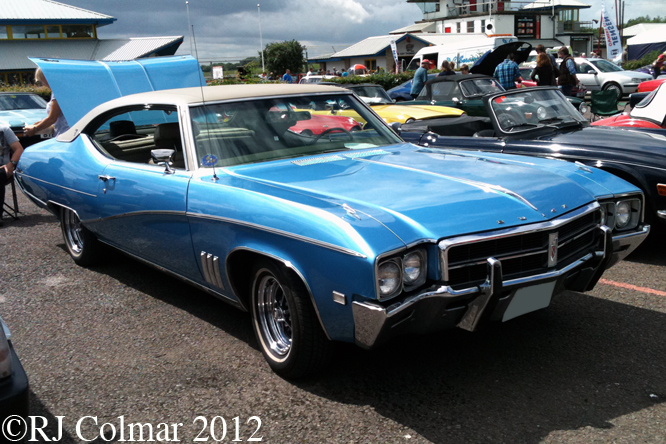
Buick Skylark, Castle Combe C&SCAD

With out a doubt car of the show for me was this third Generation 1969 Buick Skylark, with the post modern descending curved chrome that harks back to an all together different age of motoring before the use of unitary bodies became commonplace.

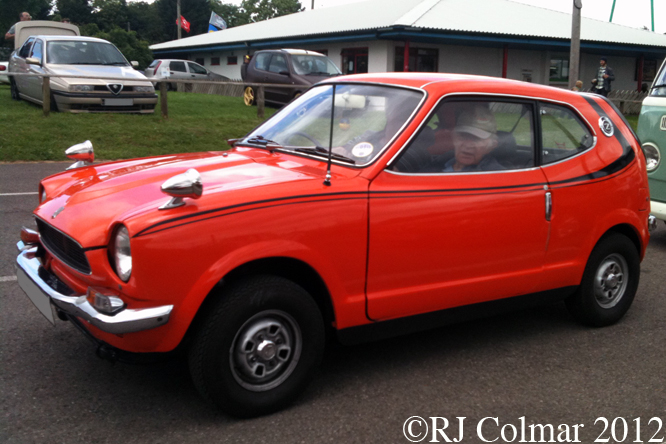
Honda Z600, Castle Combe C&SCAD

The 1972 Honda Z600, from the Honda S800 Sports Car Club, preparing to take part in the on track parade above predated the Honda Civic range and is powered by 36 hp 598cc / 36.4 cui two cylinder single overhead cam motor that could be taken up to 9,000 revolutions per minute and was recorded as capable of using less than 130 mpg (imperial) at a steady 30 mph.

Lotus Seven S2, Castle Combe C&SCAD

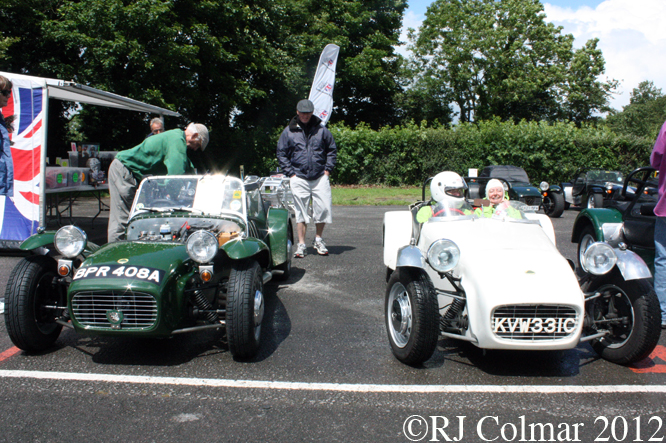
The Lotus Seven Club were in attendance in large numbers, above two Lotus Seven S2’s one of which was the feature on my regular Lotus blog on Saturday.

Bobbies, Castle Combe, C&SCAD

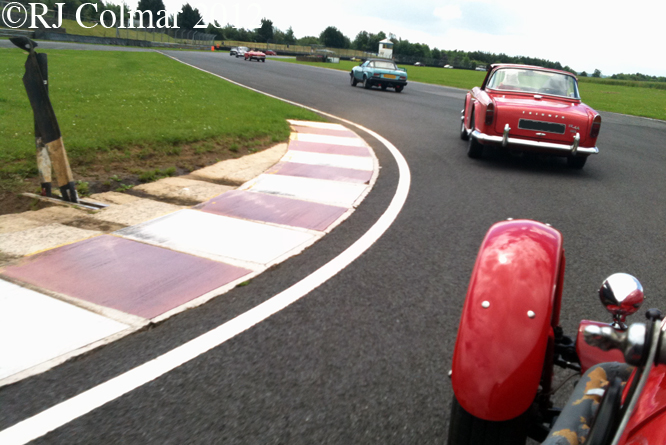
Despite his far better judgement David kindly took me round Castle Combe on the parade laps, here we are passing through the Bobbies Chicane.

Lotus Esprit Sport 350, Castle Combe, C&SCAD

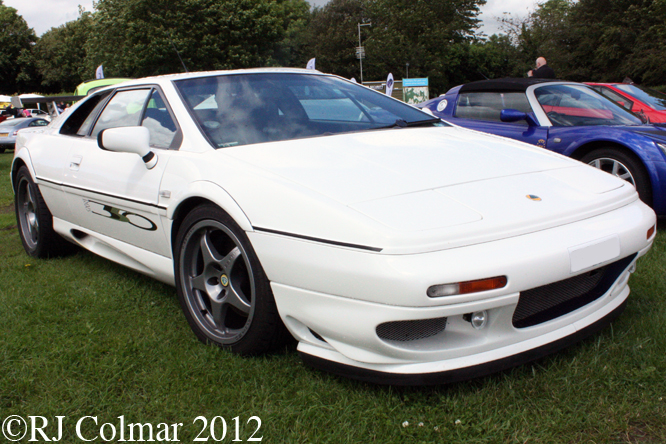
Coming all the way from Wales in the Club Lotus (South Wales) area was this 2000 Lotus Esprit Sport 350, the final iteration of the Esprit line of which just 50 were manufactured.

Lotus Carlton, Castle Combe, C&SCAD

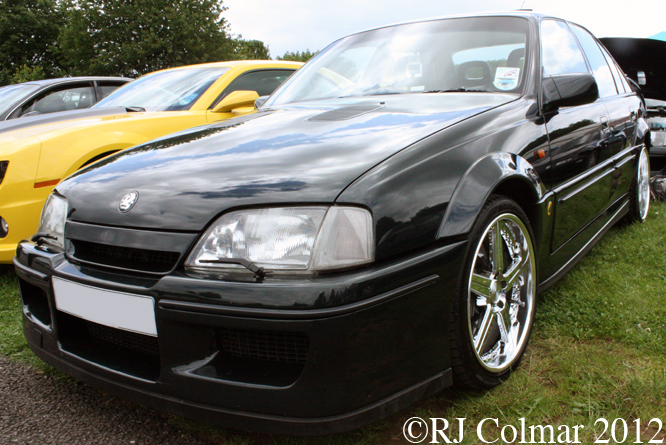
Four years after acquiring Lotus, GM handed Lotus the task of upgrading the mundane Vauxhall Carlton, The 177 mph Lotus, Type 104, Carlton was the result, capable of reaching 60 mph in just 5.2 seconds with the aid of twin turbochargers, Corvette Z1 gearbox and Holden rear limited slip differential. This was a Q car of the first order, very popular with both police forces and security services when helicopters and light planes were in short supply. All Lotus Carlton’s and Lotus Omega’s, for the European Market, were painted a shade of green so dark it looks black in all but the strongest sunlight.

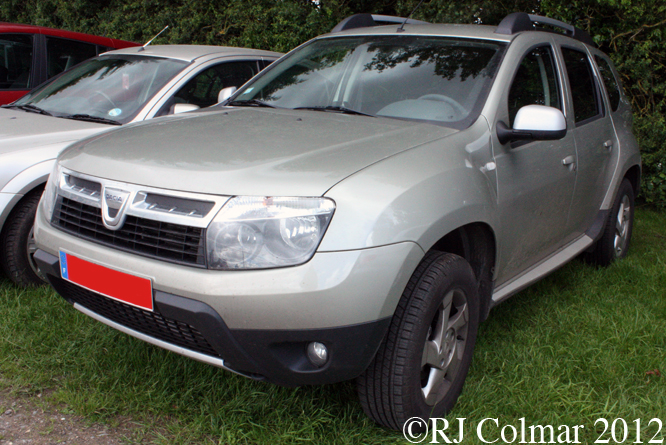
Dacia Duster, Castle Combe, C&SCAD

We don’t see too many Romanian built Dacia’s in the UK and when we do they are usually on Romanian plates so it was a surprise to see this Dacia Duster on French diplomatic plates. The Dacia Duster is based on a Nissan platform and running gear with 2 and 4 wheel options available, they are priced to compete with second hand cars. Expect to see a Dacia powered by an 850 hp Nissan GTR motor on Pikes Peak in the not too distant future.

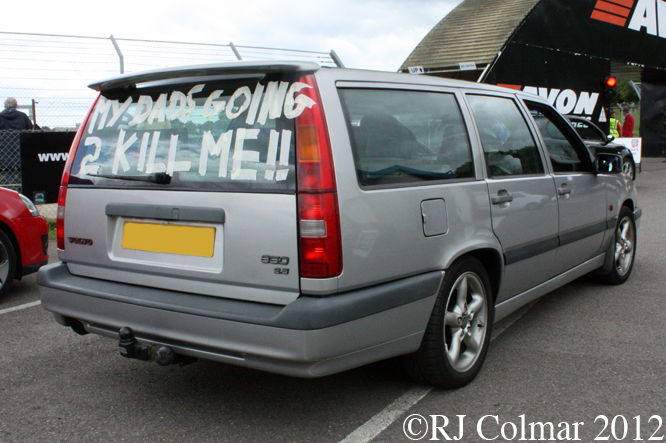
Volvo 850, Castle Combe, C&SCAD

Looks like someone borrowed a 1996 Volvo 850 while Dad was still asleep last Saturday morning.

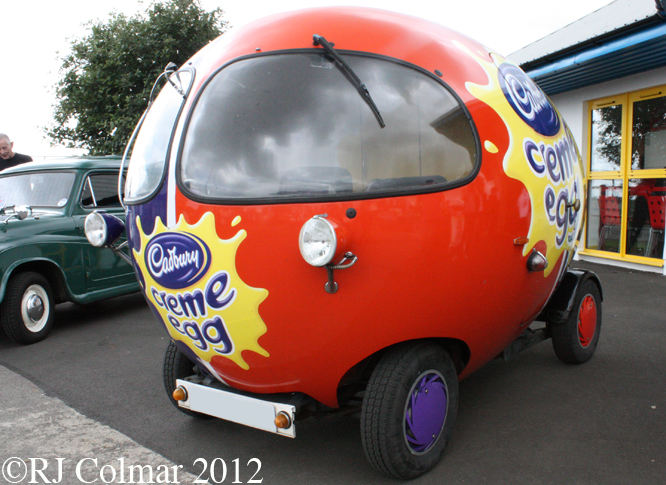
Bedford Rascal, Castle Combe, C&SCAD

There used to be an advertisement on British TV that advised us to go to work on an egg, this Cadbury’s cream egg was built on a 1995 Bedford Rascal Microvan.

Marcos Owners Club, Castle Combe, C&SCAD

Marcos which used to be based in Bradford upon Avon in Wiltshire used to be one of several local car manufacturers during the 1960’s and 1970’s prior to moving to Kenilworth in 1981, following insolvency in 1972. So it was no surprise to see a strong showing from the Marcos Owners Club.

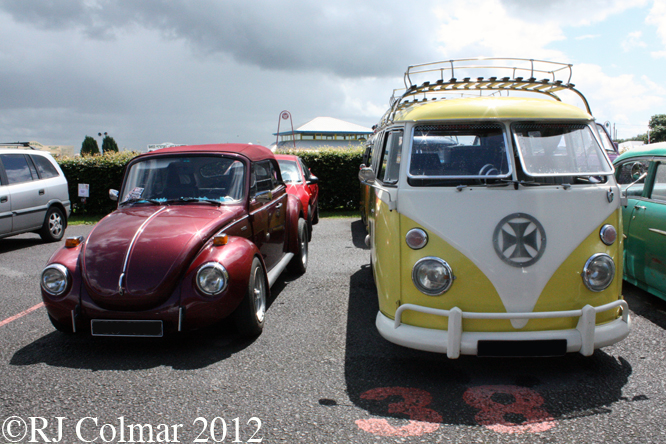
Victory Car Club, Castle Combe, C&SCAD

The 1972 Beetle Cabriolet and 1964 VW Type 2 show that my own ’99 Golf Mk IV still has an achievable if long way to go before becoming a classic !

Thanks for joining me on this “Classic & Sports Car Action Day” edition of “Gettin’ a li’l psycho on tyres” I hope you will join me again tomorrow. Don’t forget to come back now !

Share

I Am Not A Number – Lotus Super Seven 1500 Cosworth #SB1688

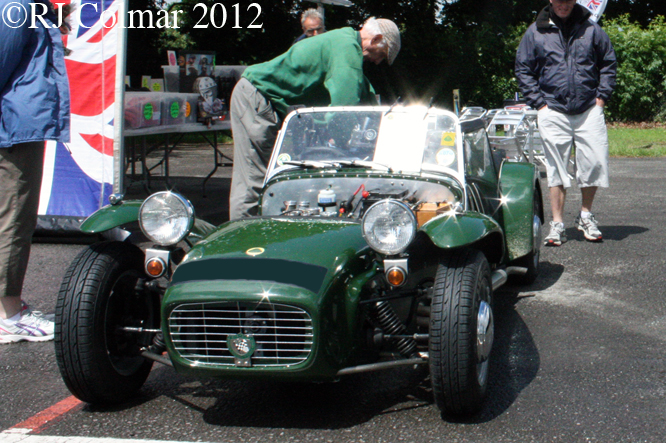
Series 2 Lotus Sevens were introduced in June 1960 and remained in production until August 1968, they could be ordered either ready made or as complete knockdown kits (CKD’s). In order not to attract purchase tax the CKD’s were not allowed to be sold with instruction manuals on how to assemble the car. Ever the genius Colin Chapman sold his CKD’s with instructions on how to ‘disassemble’ his CKD’s.

Lotus Super Seven 1500 Cosworth, Castle Combe C&SCAD

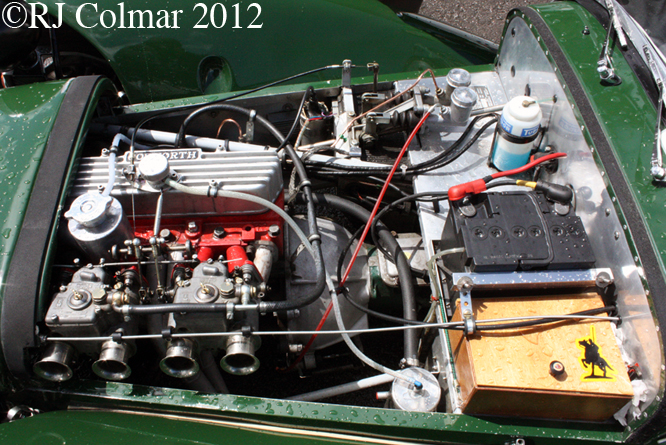
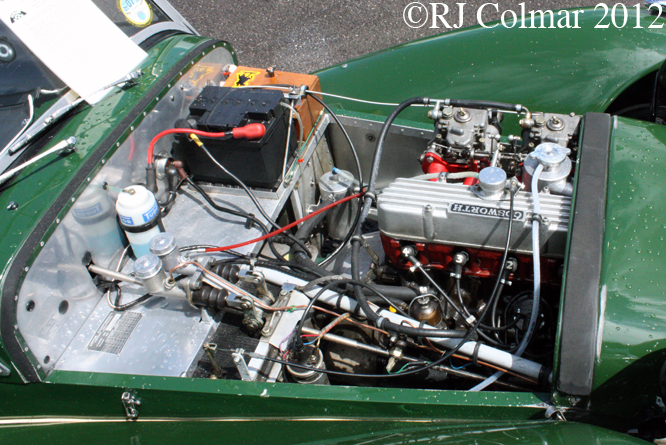
The Super Severn 1500 Cosworth variation of the Lotus Seven S2 was first seen in 1961 featuring 1498 cc / 91.4 cui pre coss flow Ford Motor that was more commonly found in the Ford Consul Classic, it’s two door sibling the Consul Capri and later the Ford Cortina.

Lotus Super Seven 1500 Cosworth, Castle Combe C&SCAD

Alongside the fast bits like the Cosworth camshaft and close ratio gearbox, came a Standard 10 rear axle with drum brakes, a Triumph Herald steering rack, front hubs, fitted with 9″ Girling disc brakes and on this particular car fetching optional wheels with hubcaps from the Lotus Elan.

Lotus Super Seven 1500 Cosworth, Castle Combe C&SCAD

Television buffs will recognise the Lotus Super Seven as the vehicle Patrick McGoohan selected as “A symbol of all The Prisoner was to represent; standing out from the crowd, quickness and agaility, independence and a touch of the rebel” for his character in ‘The Prisoner’ TV series.

This 1963 model, one of 1310 Series 2 cars built, is thought to have originally been sold to a Clubmans racing driver and was found and restored by the current owner eighteen years ago.

Thanks for joining me on this “I Am Not A Number” edition of ‘Gettin a li’l psycho on tyres’, I hope you will join me again tomorrow. Don’t forget to come back now !
Share