Tag Archives: Lotus

Classic Team Lotus – Lotus Climax 21 #933

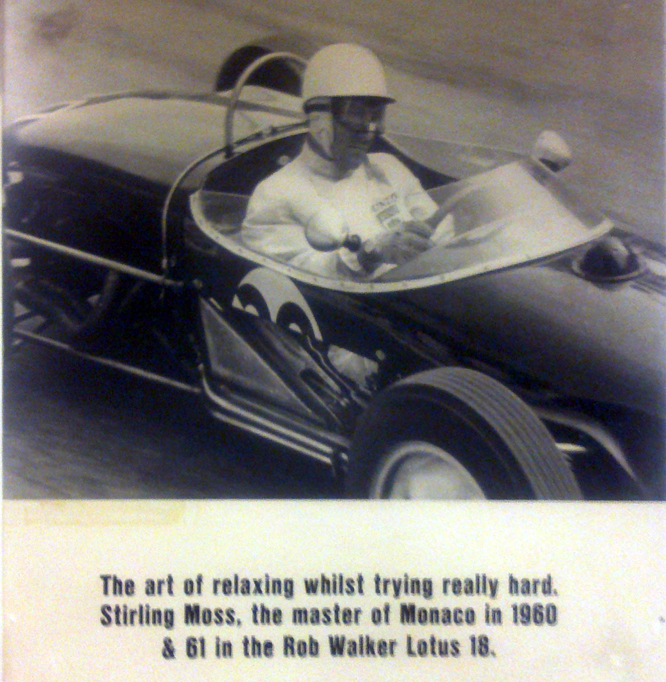
As we saw a couple of weeks ago Stirling Moss drove a privately entered Lotus 18 to the Lotus marques first Grand Prix victory in a Lotus 18 in 1960, Moss used the same car to win three more Grand Prix in 1960 and 1961.

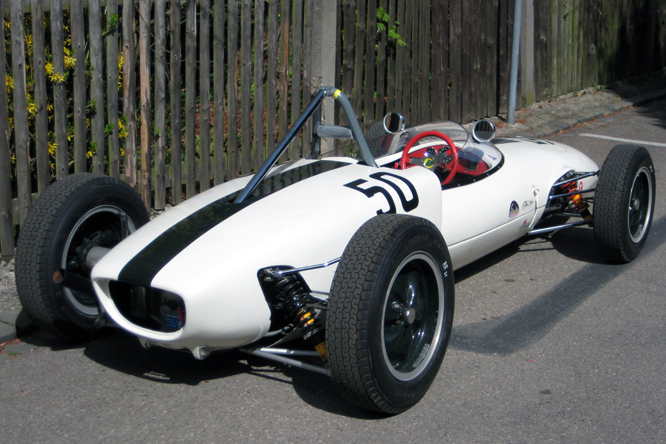
Lotus Climax 21,

It was not until the end of the 1961 season that the works Team Lotus scored their first Grand Prix victory in the season finale at Watkins Glen. Innes Ireland driving a Lotus 21 similar to the one above held off Dan Gurney in Porsche to win the US Grand Prix.

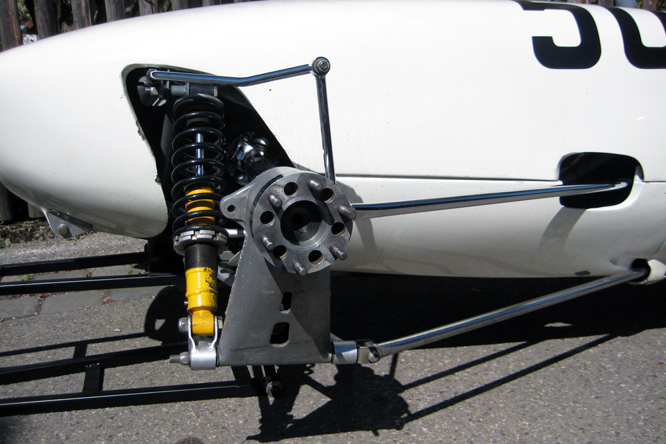
The 1.5 litre / 91.5 cui 4 cylinder Coventry Climax powered Lotus 21 was a development of the Lotus 18 Stirling Moss had used to challenge the dominant Ferrari team with in 1961. Some of the parts of the 21 are interchangeable with the older 18 and some 18’s were run in 18/21 spec.

Ten Lotus 21 chassis were built in 1961 5 were destroyed in period with an 11th replacement chassis being built in 1964.

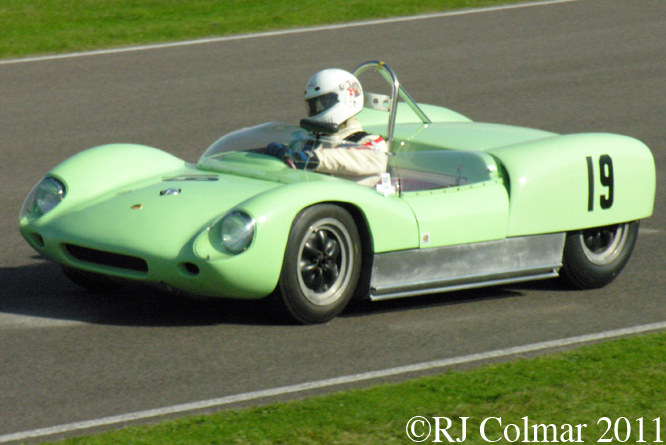
Dan Collins is seen above at the Goodwood Revival in his Lotus Climax 21 chassis #933 which is entered and maintained by Classic Team Lotus.

My thanks to David McKinnley at The Nostalgia Forum for his background information and Andy Arnold for informing me of the chassis number.

Thanks for joining me on this Classic Team Lotus edition of ‘Gettin’ a li’l psycho on tyres’. I hope you will join me again tomorrow. Don’t forget to come back now !

PS Don’t forget …

Automobiliart GALPOT Seasonal Quiz

Automobiliart, Paul Chenard

December 26th – January 2nd

Win a set of Paul Chenard Greetings Cards

Sports-GT cars set, Paul Chenard

Set 1 Sports & GT Cars

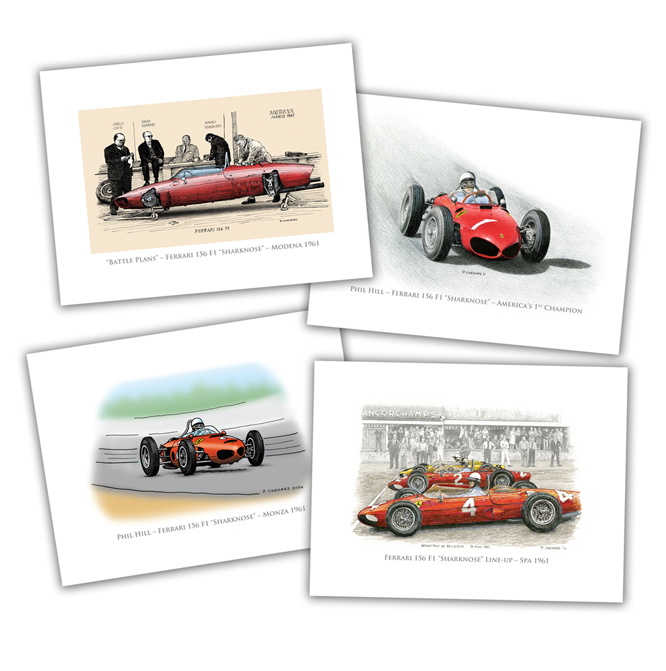
Phil Hill, Sharknose Ferrari Set, Paul Chenard

Set 2 Phil Hill World Drivers Championship 50th Anniversary Edition

1934 GP Season Card set, Paul Chenard

Set 3 1934 Season

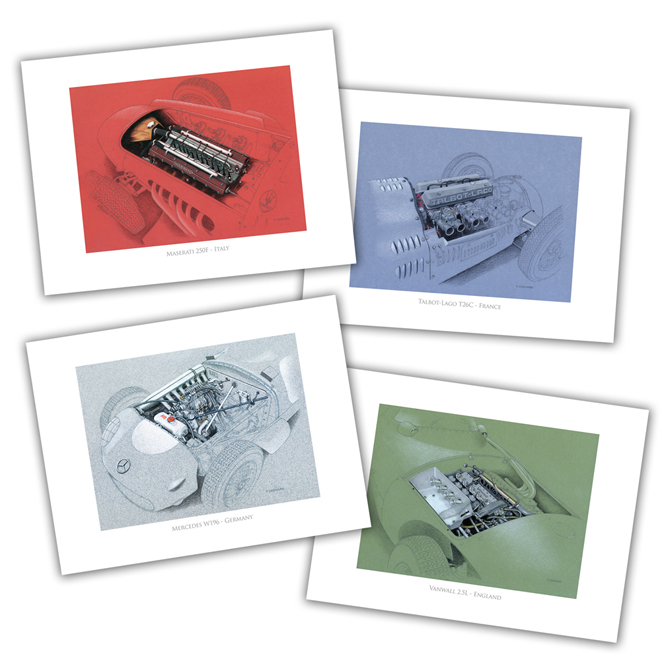
1950s Grand Prix Engines

Set 4 Grand Prix Engines of the 1950’s

or

Mike Hawtorns racecars Card set, Paul Chenard

Set 5 Mike Hawthorn’s Race Cars

The Automobiliart GALPOT Seasonal Quiz will comprise 8 categories.

Overall winner chooses one set of Paul Chenard Greetings Cards from the five sets shown above.

The cards measure 15.24cm x 11.43cm, come in packs of 12 with 3 copies of 4 designs in each set, plus A6 envelopes.

Which set will you choose ?

The free to enter Automobiliart GALPOT Seasonal Quiz will run from December 26th – January 2nd Entries close January 8th 2012, Winner announced January 16th 2012.

Full details on December 26th at GALPOT.

Looking for Automotive Seasonal Gift Idea’s? Visit Automobiliart Now !

Share

Wheels & Studs – Lotus 23B

The Lotus 23 is a 900 lb / 408 kgs sports racing car, with a nominal passenger seat, built around a wide version of the Lotus 22 chassis frame with identical suspension to the single seater.

Customers had motors installed, from 750 cc / 41 cui to 2 over litres / 122 cui, that were manufactured by Coventry Climax, Lotus, Ford, BMW, Saab and even Ferrari amongst others.

Chris Goodwin, Lotus 23B, Goodwood Revival

In 1962 over 130 Lotus 23’s were built that are known to have been entered in over 600 national and international events and recorded over 110 outright victories and a more than a further 130 class victories up to the Kyalami 9 hours in 1981.

The Lotus 23 has two important footnotes recorded in the annals of Motor Racing history, both dating to 1962 first Jim Clark qualified a Lotus 23 6th for the 1000 kms race at Nurburgring, a race which included an impressive array of powerful Ferrari’s Porsche’s and Jaguars. The race started in the rain and the nimble Jim and the 100 hp Lotus 23 shot away from the Le Mans type start into the lead and remained there ahead of Dan Gurney in a Porsche until lap 12 of 44 when he was overcome by fumes from a split exhaust manifold and crashed, without injury. Phil Hill and Olivier Gendebien eventually won the race in a Ferrari 246S.

For Le Mans in 1962 Lotus entered two cars one 750 cc / 45 cui and the other 1 litre 61 cui which is said to have upset several French teams causing the organisers to throw the Lotus team out of the race first on the grounds that the front and rear wheel hubs had 4 and 6 studs respectively, when this was rectified the organisers threw the cars out again because the front a rear wheels were different sizes meaning the spare wheel which had to be carried could not be fitted to front & rear axles. This was the final straw for Colin Chapman who vowed “We will never race again at Le Mans!” a promise he kept until his death in 1982.

Chris Goodwin, Lotus 23B, Goodwood Revival

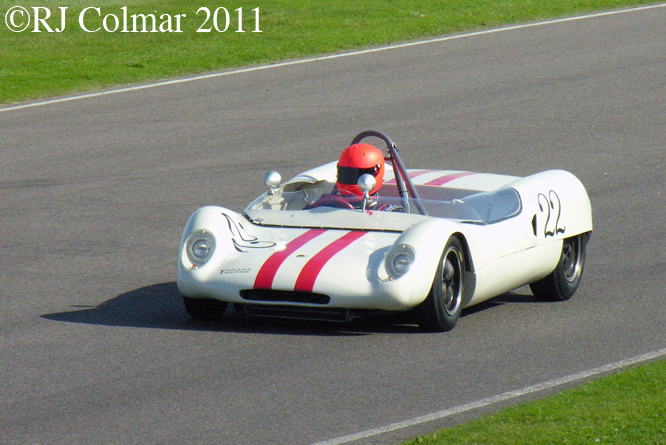
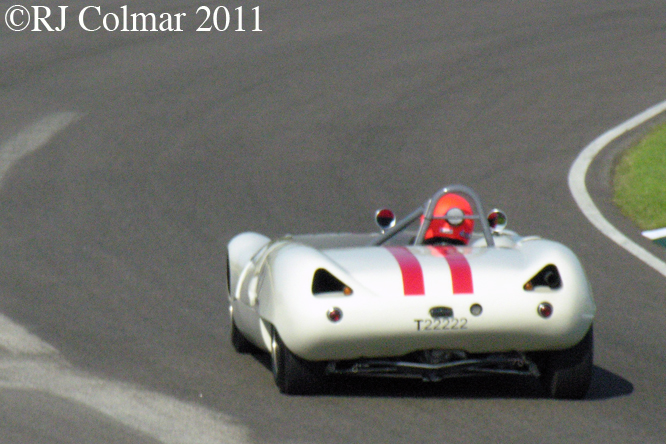
The Lotus 23B seen here at the Goodwood Revival is driven by Chris Goodwin who finished third in the Madgwick Cup.

T22222 is an Austrian registration number that appeared on chassis 23-S-68 that was driven by Austrian hotelier Alban Scheiber on hillclimb events in 1963.

Chris Goodwin is yet another of my former racing instructors at Brands Hatch, who is better known as a sportscar racer, TV presenter and McLaren Automotive’s Chief Test Driver and Bruno Senna’s Manager.

My thanks to Lutz ‘r.altos’ M for the information regarding Alban Scheiber.

Thanks for joining me on this Wheels and Studs edition of ‘Gettin’ a li’l psycho on tyres’, I hope you will join me again tomorrow. Don’t forget to come back now !

PS Don’t forget …

Automobiliart GALPOT Seasonal Quiz

Automobiliart, Paul Chenard

December 26th – January 2nd

Win a set of Paul Chenard Greetings Cards

Sports-GT cars set, Paul Chenard

Set 1 Sports & GT Cars

Phil Hill, Sharknose Ferrari Set, Paul Chenard

Set 2 Phil Hill World Drivers Championship 50th Anniversary Edition

1934 GP Season Card set, Paul Chenard

Set 3 1934 Season

1950s Grand Prix Engines

Set 4 Grand Prix Engines of the 1950’s

or

Mike Hawtorns racecars Card set, Paul Chenard

Set 5 Mike Hawthorn’s Race Cars

The Automobiliart GALPOT Seasonal Quiz will comprise 8 categories.

Overall winner chooses one set of Paul Chenard Greetings Cards from the five sets shown above.

The cards measure 15.24cm x 11.43cm, come in packs of 12 with 3 copies of 4 designs in each set, plus A6 envelopes.

Which set will you choose ?

The free to enter Automobiliart GALPOT Seasonal Quiz will run from December 26th – January 2nd Entries close January 8th 2012, Winner announced January 16th 2012.

Full details on December 26th at GALPOT.

Looking for Automotive Seasonal Gift Idea’s? Visit Automobiliart Now !

Share

The Sure Bet – Lotus 22 #22-J-17

In 1962 Lotus built one of their more significant models, the Lotus 22, for competition in the 2nd tier open wheel Formula Junior in 1962. The 22 was an upgraded version of the Lotus 20 but now featuring disc brakes all round.

Cristoph Burckhardt, Lotus 22, Goodwood, Revival

The Lotus 22 dominated Formula Junior in 1962 with Peter Arundell and Alan Rees at the wheel of the works cars which dominated the European Junior scene.

Arundell won 75 % of his races including the Monza Loteria and was crowned British Junior Champion. Moises Solana won FJ races in Mexico.

The design of the 22 was also used as the basis of the two seat the Lotus 23 sports racer, which I’ll be looking at next week, the 22 design was given a second lease of life with the emergence of the third tier open wheel Formula 3 in 1964 which mandated single seat vehicles with space frame chassis like the 22 which was upgraded to Lotus 31 spec in F3 guise though the chassis numbers for Lotus 31 curiously ran 22-F3-xx. The 22 design had yet another lease of life when Jim Russel converted a couple of 22’s and 31’s into Ford Kent powered racing cars and inadvertently invented Formula Ford leading to yet another run of cars being built to the basic Lotus 22 design now upgraded to Lotus 51 spec.

It is thought 77 Lotus 22’s were built in their original Formula Junior spec between 1962 and 1963.

Formula Junior was open to cars weighing a minimum 400 kgs / 880lbs fitted with 1100 cc / 67 cui motors or 350 kgs vehicles weighing a minimum of 350 kgs / 770 lbs with 1000 cc / 61 cui.

Chritoph Burckhardt’s car, thought to be chassis 22-J-17 seen above at Goodwood Revival, like most FJ cars in 1962 is the heavier 400 kgs type with 90 hp Cosworth tuned Ford 4 cylinder engine with a mandated production based block, this one canted over at 30 degrees to lower the centre of gravity and minimise the frontal area of the car.

Other FJ engine options included a BMC and DKW two stroke motor as used successfully by a German Gerhard Mitter in his Lotus 22.

At this point I’d usually wrap up this post in the usual way but I’d be doing the model a grave injustice since the Lotus 22 is the stuff of legend that ultimately brought down hitherto respected Porsche racing driver Richard von Frakenberg who survived flying literally of the Avus track to become an equally respected journalist for Auto Motor und Sport one of Germany’s most successful motoring publications.

On Sept 30th 1962 there was a German Formula Junior Championship race on the short 5 mile Südschleife track at the Nurburgring. There was much rumor and gossip in the paddock that weekend about a simple way to increase the engine capacity of the stock block Ford Formula Junior motors by changing the Ford Anglia crankshaft for a crankshaft sourced from the larger capacity Ford Consul that used the same block with the same diameter cylinders but increased the combined swept volume of the blog by having a longer stroke.

The race was notable because the championship title was to be decided between two drivers, the aforementioned Mitter in his DKW powered Lotus 22 and reigning champion Kurt Ahrens jr driving a Cooper T59 with a Cosworth prepared Ford motor of the type which could be easily oversized.

To secure the title all Ahrens Jr needed to do was finish ahead of Mitter, if he finished just one place behind Mitter the two would share the title. bizzarely the latter is exactly what happened Ahrens trundled around behind Mitter’s DKW powered Lotus until the DKW lost one of it’s three cylinders when Mitter pitted Ahrens Jr drove as far as the Müllenbach corner at the back of circuit and promptly stopped his perfectly good car and waited for Mitter to affect his repairs and come past and then followed Mitter across the line to ensure a tie in the Championship.

Richard von Frankenberg absorbed some of the rumors, which should probably have been taken with a pinch of salt in the first place, from the meeting and the following week published a story full of scandalous accusations under the Title “The Biggest Disgrace in International Motorsport”.

In his exposé Richard pointed out that during the Formula Junior season none of the motors had been checked to measure their capacity during scrutineering either before or after races and alleged that some teams had taken advantage of the situation.

Specifically Frankenberg accused reigning champion Kurt Ahrens jr & Austrian Kurt Bardi-Barry winner of the race of running with an oversize engines on September 30th.

He also accused Alan Rees who was running in a work Lotus 22 with a Cosworth Ford motor of running in practice with an oversize motor during which he crashed and eliminated himself from the race.

Frankenberg then went on to report Alan had openly declared that his team (Lotus) had been running oversize motors through out the season.

Finally Frankenberg challenged Colin Chapman to send two cars to Monza to rerun the Lotteria race distance at the same average speed that the cars had achieved in June and then have the motors legality checked.

In the aftermath of the publication Kurt Ahrens Jr and Kurt Bardi Barry won civil actions against von Frankenberg and Auto Motor & Sport both presented motors which passed inspection well after the event but it was concluded that hear say in the paddock was not sufficient proof that either driver had cheated.

The ONS, governing body of motorsport took Ahrens Jr, Bardi-Brady and Mitter to task about events on the September 30th 1962 and concluded that the hear say evidence of Mitter was not proof positive that Ahrens or Bardi-Brady had cheated but they did find Mitter and Ahrens Jr guilty of conspiring to fix the race results for which they both had their licenses suspended for six months.

Colin Chapman accepted von Frankenbergs suggestion, offering to run one Lotus 22 Formula Junior car at Monza over the 30 lap distance of the Lotteria held in June and made a bet of £1000 that his car would not only achieve the same or better speed at Monza over the 30 race distance and be proved perfectly legal. In the event von Frakenberg and Auto Motor und Sport lost the bet they would pay Chapman £1,000 and publish a retraction of the accusations against the team.

All parties duly deposited their stakes and convened at Monza on December 1st 1962. Peter Arundell did some slow warm up laps and blew his engine, it was agreed this should be repaired for a second attempt the next day.

On December 2nd a new attempt was made after cement had been strewn across patches of ice found under the trees at the first Lesmo Corner. Despite another slow start Peter Arundell soon started lapping ahead of the target time eventually crossing the line for the 30th time 52 seconds faster than he had in June.

On completion of the race distance he did one final blinding flying lap and lowered his lap record of 1’50.9′ in June to 1’49.8′ in December.

It was noted at the time the cooler conditions gave Peter an advantage, as much as 4% extra horse power by my calculations, but his times by my calculations are only 1.5% quicker for the race and and 1% quicker for fastest lap.

Once Peter returned to the pits the car was meticulously weighed, the engine dimensions were measured, as 1092 cc / 66.6 cui, and so the car was declared fully compliant with the Formula Junior regulations to the satisfaction of all concerned.

Immediately after the technical inspection the “Monaza Lion” as the car became known was sold for £2,000 to a Sig. Motta, thereafter Richard von Frankenberg shook Colin Chapman’s hand and formally apologized in front of all those present and an apology with full retraction of the false statements was printed in the following issue Auto Motor und Sport.

Peter Arundell won a second consecutive British Formula Junior Championship in 1963 and looked to have a promising future until an accident in 1964 saw him thrown out of his car. Colin Chapman kept a seat for Peter until his return in 1966, however Peter showed none of his earlier promise during his comeback season and retired from the sport completely in 1969, after selling his Garage Business from which he and his family were lucky to escape from a serious fire he moved to Florida where he founded the notorious adult software gaming company Mystique.

Colin Chapman went from strength to strength his Lotus team wining the first of six World Drivers and seven World Constructors Championships in 1963.

Kurt Ahrens jr regained his German Formula Jr title in 1963 but never quite broke into the big time he did however win the 1969 Austrian and 1970 Nurburgring 1000kms races driving with Jo Siffert and Vic Elford respectively, the 1968 Austrian event was the first ever to be won by a Porsche 917, he also took two consecutive pole positions at Le Mans for the 24 hour races in 1969 and 1970 both in works Porsche 917’s. He retired in 1970 to look after his family’s car dealership and scrap metal business and still takes an interest in the historic racing scene.

Gerhard Mitter drove in seven Grand Prix but like Ahrens Jr never secured a permanent seat on the Grand Prix circuit, he won the 1969 Targa Florio driving a Porsche 908 with Udo Schutz. Gerhard was kiiled during practice for the 1969 German Grand Prix after either suspension or steering failure caused him to crash.

Soon after he lost the Monza bet von Frakenberg left his staff position at Auto Motor und Sport. He was killed in a road accident in 1973 aged 52.

My thanks to every one on The Nostalgia Forum particularly, Doug Nye, Arese, r.atios, Ralf Pickle and Charlieman, on the L’affaire Lotus/von Frankenburg thread, RWB, Macca & Rob on the How many Lotus 22s? thread, finally but not least Cheapracer and saudoso on the Ambient air temperature and car performance thread.

Thanks for joining me on this bumper edition of ‘Gettin’ a li’l psycho on tyres I hope you will join me again tomorrow. Don’t forget to come back now !

PS Don’t forget …

Automobiliart GALPOT Seasonal Quiz
Automobiliart, Paul Chenard

December 26th – January 2nd

Win a set of Paul Chenard Greetings Cards
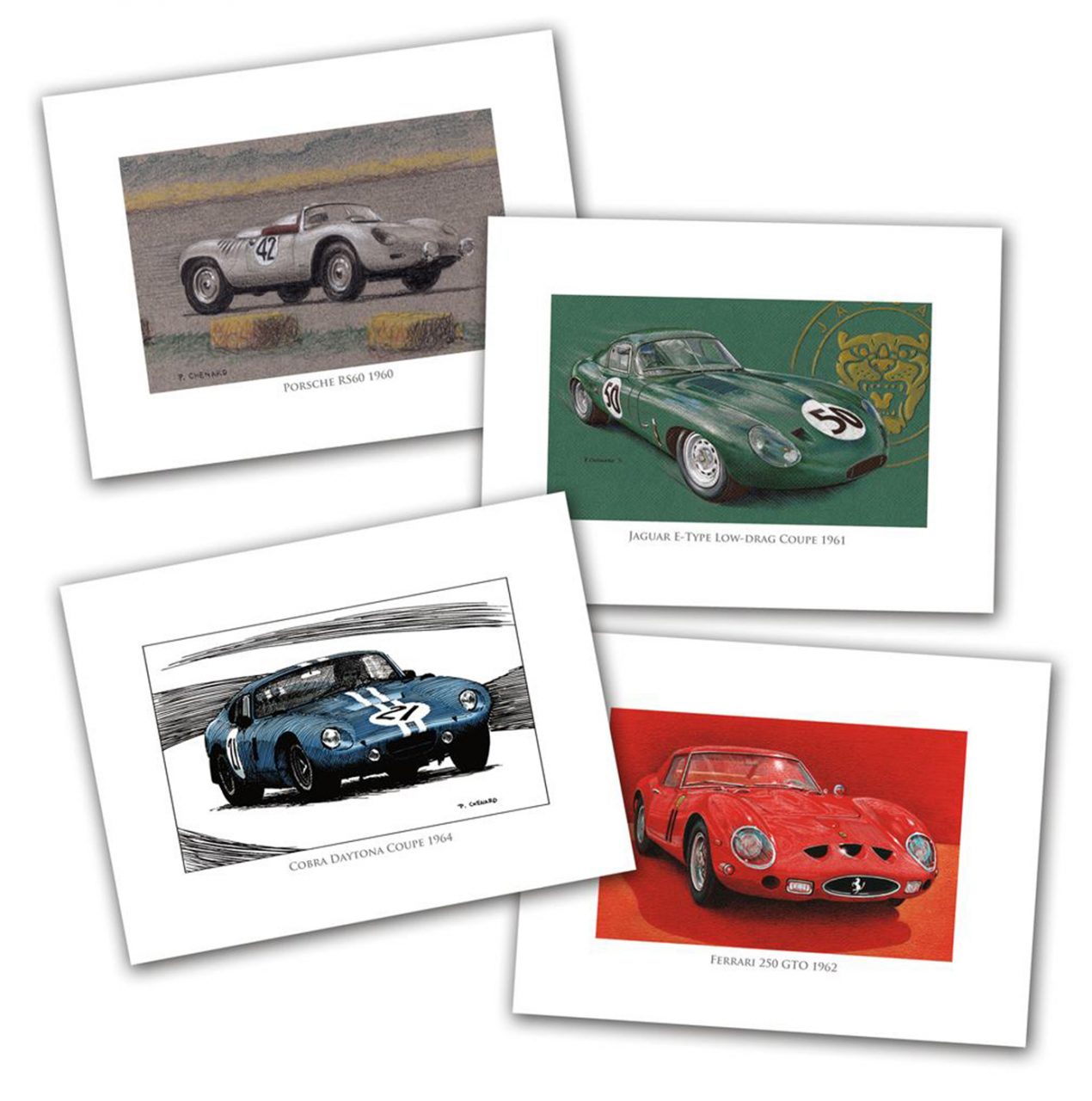
Sports-GT cars set, Paul Chenard

Set 1 Sports & GT Cars

Phil Hill, Sharknose Ferrari Set, Paul Chenard

Set 2 Phil Hill World Drivers Championship 50th Anniversary Edition
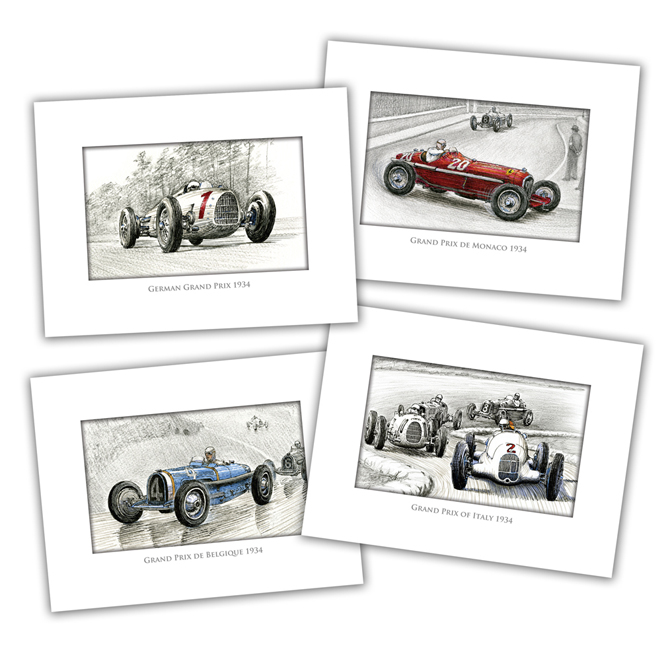
1934 GP Season Card set, Paul Chenard

Set 3 1934 Season

1950s Grand Prix Engines

Set 4 Grand Prix Engines of the 1950’s

or
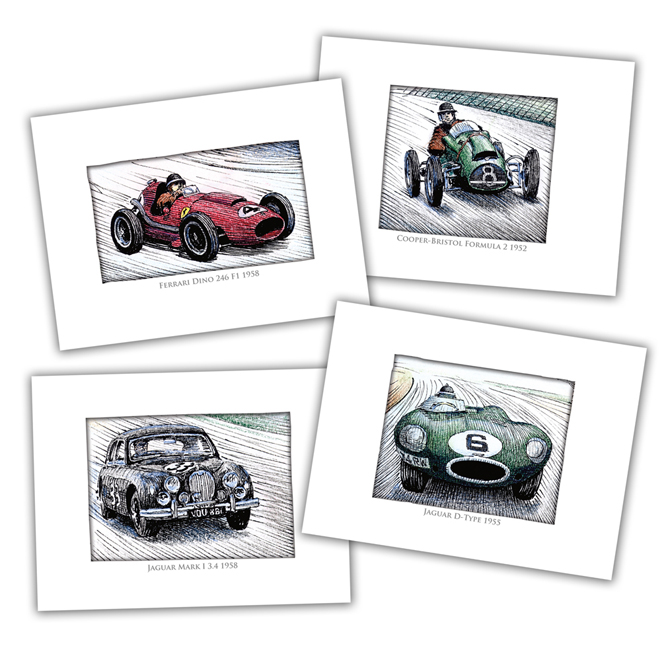
Mike Hawtorns racecars Card set, Paul Chenard

Set 5 Mike Hawthorn’s Race Cars

The Automobiliart GALPOT Seasonal Quiz will comprise 8 categories.

Overall winner chooses one set of Paul Chenard Greetings Cards from the five sets shown above.

The cards measure 15.24cm x 11.43cm, come in packs of 12 with 3 copies of 4 designs in each set, plus A6 envelopes.

Which set will you choose ?

The free to enter Automobiliart GALPOT Seasonal Quiz will run from December 26th – January 2nd Entries close January 8th 2012, Winner announced January 16th 2012.

Full details on December 26th at GALPOT.

Looking for Automotive Seasonal Gift Idea’s? Visit Automobiliart Now !
Share

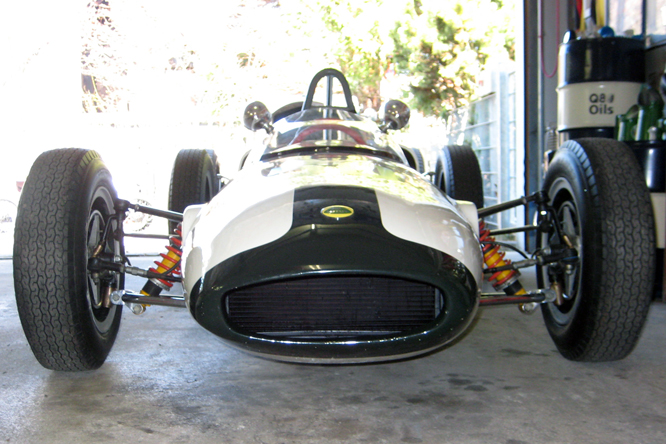
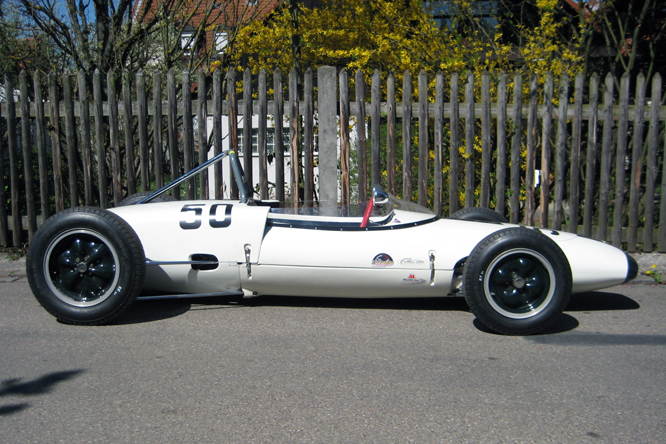
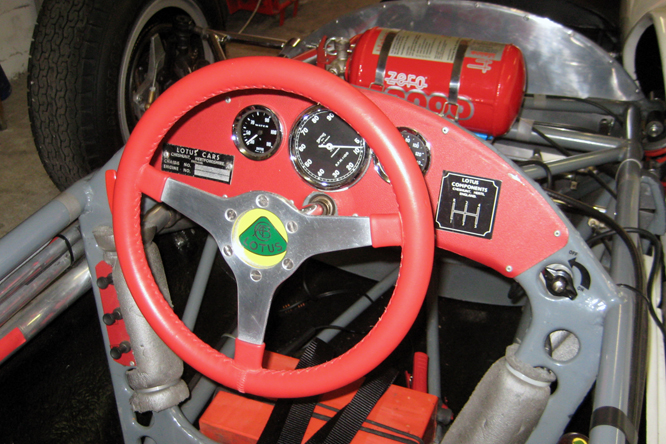
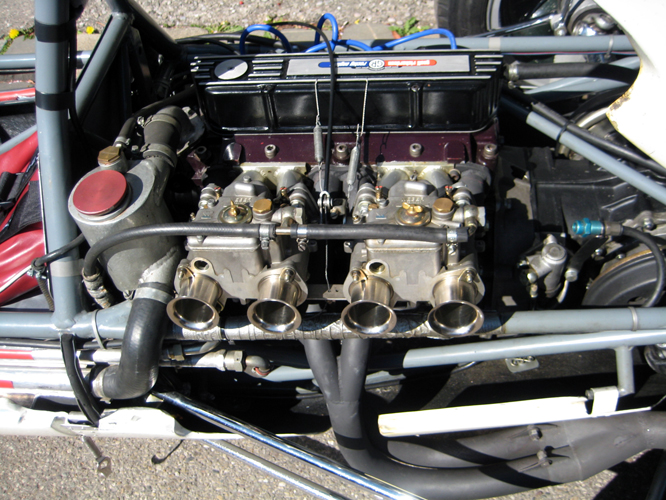
Thread Breakers – Lotus 20 # 20-J-892

In 1958 at the suggestion of engineer, journalist and former racing driver Count Giovanni “Johnny” Lurani Formula Junior was adopted as an entry level form of open wheel racing that mandated the use of engines, gearboxes and brakes from everyday production road cars.

Lotus Ford 20

There were two classes up to 1000cc / 61 cui vehicles were allowed to run with a minimum weight of 360 kgs / 792 lbs and up 1100cc / 67 cui were allowed to run with a minimum weight of 400 kgs / 880lbs. The larger engine class was the most popular and initially a large variety of motors were used including FIAT, BMC, Moskvitch with 4 stroke 4 cylinder engines while SAAB and DKW 2 stroke 3 cylinder engines were also popular.

Lotus Ford 20

The series initially featured front engine vehicles but followed the trend set in Formula One and went the rear engined route at the turn of the decade. Lotus built a successful variation of the Lotus 18 Formula One car for formula Junior in 1960 and followed that up with Lotus 20 model that is featured today.

Lotus Ford 20

This particular Lotus 20, # 20-J-892, belongs to long time Lotus enthusiast Ralf Pickel, who fell in love with Lotus cars thanks in part to Matchbox, from Schwabach in Southern Germany.

# 20-J-892 was supplied new to Honda Racing Team manager and ex motorcycle racer Reg Armstrong fitted with a Cosworth tuned Ford engine number # 61425. Reg is thought to have driven the car at several events in Ireland.

Lotus Ford 20

After being sold on, first to Edmund Gill then to Bill Popplewell, who shared the driving with Frank Keane in Ireland, the car was fitted with a larger engine in 1965 by Brian Cullen for entry into Formula Libre events.

At Phoenix Park a drive shaft, which also acts as a critical suspension component, snapped causing an accident while Brian was at the wheel, that damaged the left hand side of the chassis.

Lotus Ford 20

Gordon Percy bought the damaged 20-J-892 with the intention of using it to build a grass track racer but over a period of 20 years he never quite got round to it and in 2000 the car left Ireland and ended up being restored by Michael Hibberd who replaced the damaged chassis members. After a couple of further documented changes of ownership Ralf bought the car from Richard Smeeton, who had a fresh £12,000 Richardson built Ford Formula Junior engine installed, earlier this year.

Lotus Ford 20

Ever since he bought the car Ralf has been wondering why the mirrors are mounted so high and close together on the screen, the probable answer has recently come to light that in the absence of timing beams on hill climbs a thread was stretched across the finish line of these events that mechanically stopped the timing clock when it was broken as cars crossed the finish line.

One one occasion when Reg Armstrong was driving today’s featured Lotus 20, which was considerably lower than all of the other vehicles in a contest, the thread was broken not by the car but Reg’s chin, reportedly causing copious blood shed.

Subsequently it is thought the mirrors were placed high on the screen to prevent further injury. A similar bloody fate befell the slightly taller Edmund Gill when he drove 20-J-892 following year when again the height of the finish line thread took no account of how low the Lotus 20 was.

To date Ralf has only had the opportunity to do some testing and demonstration events with this neat racer, but has plans to drive the car in anger for the first time next year hopefully at Hockenheim in April and Salzburgring in May.

My thanks to Ralf for sharing the photo’s and information on his Lotus. Thanks to TNFers Alan Cox, David Mckinney, Simon Thomas, Bill P, Richard Hinton, David Beard, Tim Murray, Richard Young, Edward Fitzgerald and larryd who contributed to the Lotus 20 and Reg Armstrong threads on The Nostalgia Forum.

Thanks for joining me on this Formula Junior edition of ‘Gettin’ a li’l psycho on tyres’ I hope you will join me again tomorrow. Don’t forget to come back now !

Share

A tale of two chassis frames – Lotus Climax 19 Monte Carlo #952

The Lotus 19 was a two seat version of the Lotus 18 mid engine Formula One car that Stirling Moss drove to an unexpected first marque Grand Prix victory for Lotus at Monaco in 1960.

In a case of history repeating itself, two years earlier in 1958 Moss had driven a Cooper to record that marques first Grand Prix victory and Cooper dubbed their 1958 sports car the Cooper Monaco, Colin Chapman dubbed the 19 the Lotus Monte Carlo in honour of Stirling’s achievement.

Lotus 19, Goodwood Revival

The Lotus 19 chassis #952 was originally purchased along with two others, #950 & #953, by the British Racing Partnership (BRP) team #952 & #953 were both acquired in 1961 and #950 in 1960.

BRP, co founded by Stirling’s Dad and Stirling’s ex manager entered the car under sponsors UDT-Laystall banner. The exact racing history of #952 from 1960 to 1962 is not known to me but by 1962 it was acquired by the Rosebud Racing Team in the USA and was successfully raced in the USA by Marsten Gregory and Innes Ireland.

By the end of 1963 the Rosebud Racing Team had managed to attach a 3 litre Ferrari V12 to #952 in place of the usual Coventry Climax 4 cylinder.

Innes Ireland sustained severe injuries when he crashed the now Ferrari powered #952 during practice at Pacific Raceways, Washington for the Pacific Northest GP.

Rescue workers had to cut Innes, who had a broken leg and hip, out of the wreck while he was still fully conscious on account of his morphine allergy.

Rosebud Racing replaced the chassis on their Ferrari powered racer while retaining the #952 chassis number, see second photo in this link and Innes Ireland bravely stepped in to drive it again.

Many years later, after ownership of #952 along with a Ferrari 250 GTO (!) was transferred to Victoria High School in Texas, #952 eventually ended up back in England with the Higgins brothers who rebuilt #952 in the 1980’s replacing the Ferrari V12 motor with a 2 litre / 122 cui 4 cylinder Coventry Climax.

The second chassis frame incarnation of chassis #952 is seen above driven by the Danish Baron Otto Reedtz-Thott at the Goodwood Revival.

Footnote this car should not be confused with a Lotus 21 Grand Prix car belonging to Alex Morton that carries the chassis number 939/952, apparently after 939 was damaged a replacement Lotus 21 chassis with the number 952 was sent to repair 939 and the frame has carried the 939/952 number ever since.

My unreserved thanks and congratulations to the many contributors on the Case history: Lotus 19 Monte Carlo thread on The Nostalgia Forum which has been attempting since 2004 to piece together the histories of all 17 of the Lotus 19 Monte Carlo’s that left the factory. Particular thanks to Micheal Oliver, David Birchall and David McKinley who kindly answered specific questions.

Thanks for joining me on this Carceaology Edition of ‘Gettin’ a li’l psycho on tyres’, I hope you’ll join me again tomorrow. Don’t forget to come back now !

Share

Leased Winner – Lotus 18

Following the lead set by Cooper Cars winners of the 1959 World Manufacturers Championship for Formula One cars Colin Chapman took the rear engine plunge and built the Lotus 18 open wheeler that could be entered with the correct engine spec in to either Formula Junior, Two or One races.

Lotus 18, Donington Museum

Rob Walker, heir to the whiskey family of the same name, leased a Lotus 18 with a Coventry Climax motor for Stirling Moss to drive in the 1960 Grand Prix season. On the cars debut, in Monaco, Stirling qualified on pole and eventually won the race, giving Lotus their first Formula One victory after both Jo Bonnier in a BRM and Jack Brabham driving a Cooper Cliax had spent time leading the intermittently wet race.

http://www.youtube.com/watch?v=0yH9fiJX1_s

An accident at Spa interrupted Stirling’s 1960 season but he bounced back with a win at the season ending US Grand Prix again driving this Lotus 18 for entrant Rob Walker. The following season a smaller Coventry Climax motor was fitted to this chassis, seen here at Donington Park Museum, as required by the new regulations for the 1961 season.

Stirling Moss, Lotus 18, Monaco 1961

(Copyright holder unknown image will be removed or credited upon request)

Amazingly Stirling Moss managed to not only win pole at Monaco in 1961 ahead of three more powerful shark nose Ferrari’s but then, after dicing with Richie Ginther in his Ferrari, proceeded to win the race, a then record setting third Monaco Grand Prix victory.

Lotus 18, Donington Museum

Later in the season Stirling Moss would take his final Formula One victory driving the Lotus 18, fitted with newer Lotus 21 bodywork, at the German GP at the Nurburgring. At the start of the 1962 season Moss was lucky to escape with his life from a career ending accident at Goodwood before the Grand Prix season got under way.

Thanks for joining me on this Stirling Moss edition, of ‘Gettin’ a li’l psycho on tyres’, I hope you will join me again tomorrow. Don’t forget to come back now !

Share

Low Rider – Lotus 15

The Lotus 15 was built to accept larger motors than had been possible with the hitherto very successful Lotus XI.

Lotus 15

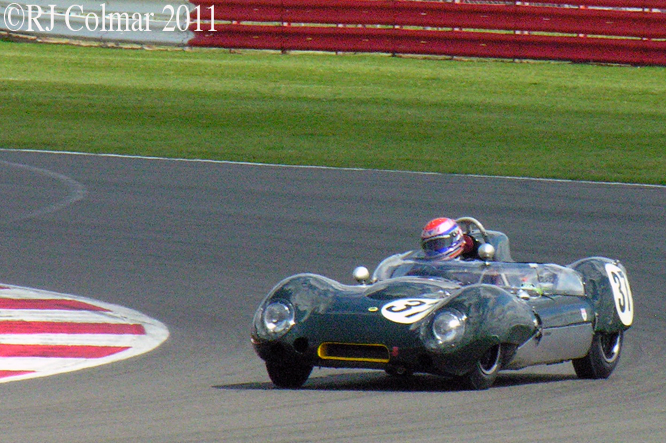
Built to take 4 cylinder Coventry Climax motors of between 1.5 litres / 92 cui and 2.5 litres / 153 cui the Lotus 15 stood just 24″ tall. The #37 built in 1958 seen at Silverstone above of Philip Walker and Danny Wright is powered by a 2 litre / 122 cui motor.

Ewan McIntyre, Lotus 15, Oulton Park, 2011

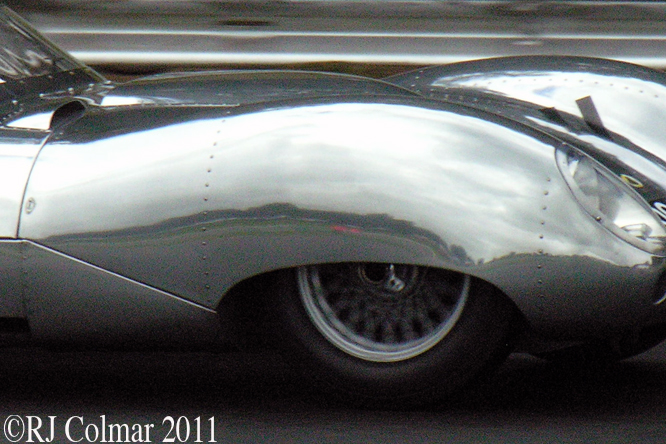
In order to lower the centre of gravity and improve the aerodynamics and handling the Coventry Climax 4 cylinder motors were 17 degrees off horizontal, one degree more than the 1958 Epperly Belond Exhaust Special that won the Indy 500 in 1958 and 1959, under the Williams and Pritchard designed and created aluminium skin.

Ewan McIntyre, Lotus 15, Oulton Park, 2011

The combination of slippery shape and good handling allowed Graham Hill to record 5th best time in practice at Le Mans in 1958 with a 2 litre Lotus 15 ahead of numerous 3 litre cars entered in the race.

Ewan McIntyre, Lotus 15, Oulton Park, 2011

However the Lotus 15 was hampered by unreliability Hill managed only three laps at Le Mans in 1958 before he had to retire with head gasket failure. It has been suggested that the Lotus 15 suffered a lack of development and attention to detail due to Colin Chapmans efforts to get his open wheel programme under way, along with development of the Lotus Elite road car. However the fact that three distinct variations of the 15 were built between 1958 and 1960 suggests this might not have been the case.

Ewan, McIntyre, Lotus 15, Oulton Park, 2011

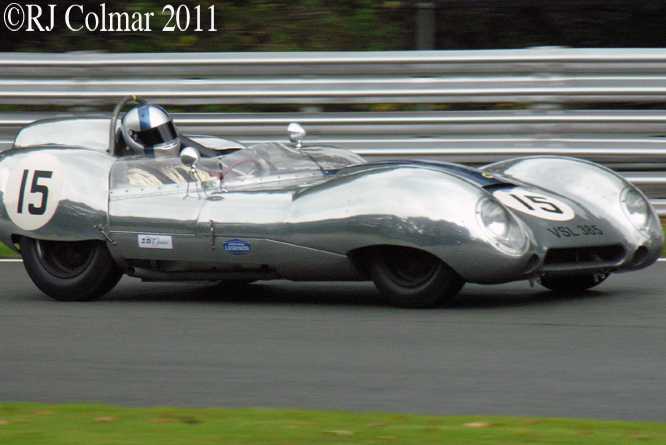
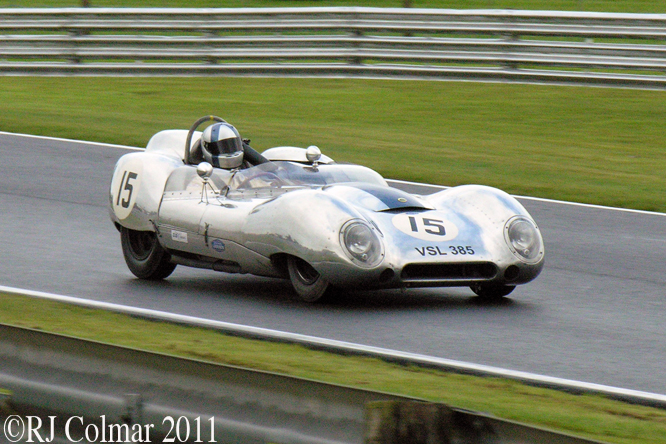
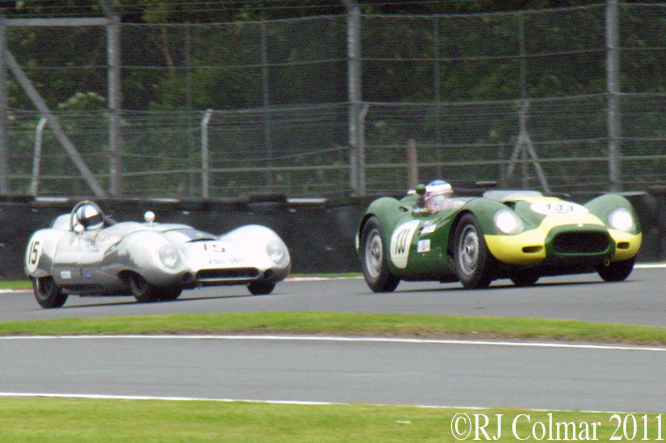
The Lotus 15 was not as successful as the Lotus XI and only 27 were built. Despite the lack of success today examples of the Lotus 15 like the the #15 of Ewan McIntyre seen chasing the #133 3.8 litre / 231 cui Lister Jaguar of Jon Minshaw and Martin Stretton at Oulton Park above are still capable of punching well above their weight in Historic events.

Thanks for joining me on today’s edition of ‘Gettin’ a li’l psycho on tyres’, I hope you will join me again tomorrow. Don’t forget to come back now !

Share