Tag Archives: Ralph Colmar

Over Budget & Over Weight – Ford Thunderbird SC

In late 1988 Ford launched the tenth generation Ford Thunderbird featuring; a 140 hp (Canadian) Essex V6 motor, 4 speed automatic transmission, independent suspension on all four wheels and rear wheel drive and a 19 gallon fuel tank. The combination of independent suspension and rear wheel drive was shared with just two other North American models the Mercury Cougar and Chevrolet Corvette.
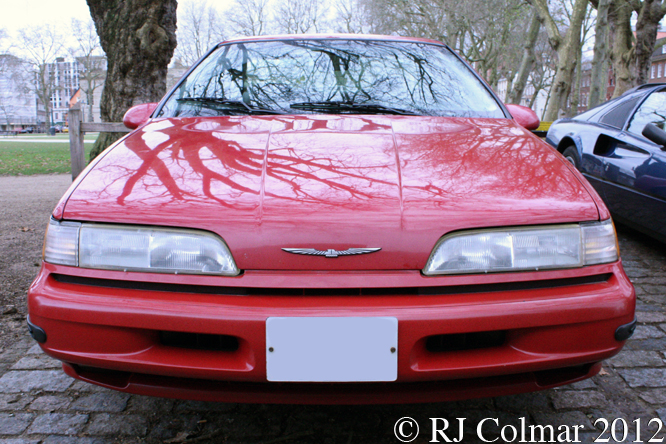
Ford Thunderbird SC, Avenue Drivers Club, Queen Square Bristol

While the new car was lauded by the press behind the scenes at Dearborn the team responsible for the car were were heavily criticised for building a car 250lbs / 110 kgs over the target weight and $900 over the the target cost price. Anthony “Tony” S. Kuchta who was responsible for the MN12 platform shared between the Thunderbird and Cougar that featured the independent suspension and rear wheel drive that accounted for a large part of the overruns voluntarily retired early 6 months after the 10th generation Thunderbird’s launch, because the Ford Management directed their criticism at his staff rather than him personally.
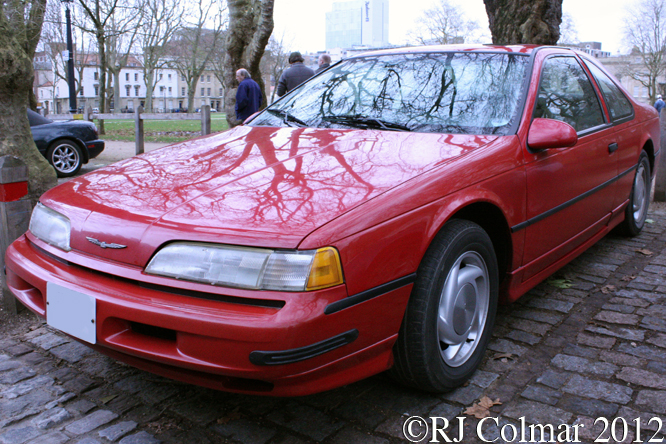
Ford Thunderbird SC, Avenue Drivers Club, Queen Square Bristol

Today’s featured ’91 Thunderbird is fitted with a 210 hp supercharged version of the (Canadian) 3.8 litre / 231 cui Essex V6 which boosted the rest to 60 mph time from around 11.2 second to 7.2 seconds. In 1991 a 5 litre / 302 cui V8 option was also introduced with a rest to 60 mph time of 9.2 seconds.
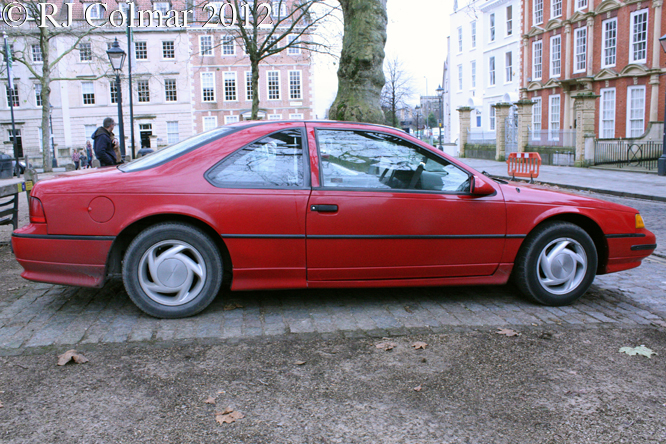
Ford Thunderbird SC, Avenue Drivers Club, Queen Square Bristol

The Thunderbird SC came with all round vented disc brakes with anti lock system, 16″ x 7″ wheels, adjustable shock absorbers, limited slip differential, 5 speed manual transmission and speed sensitive variable assist steering.
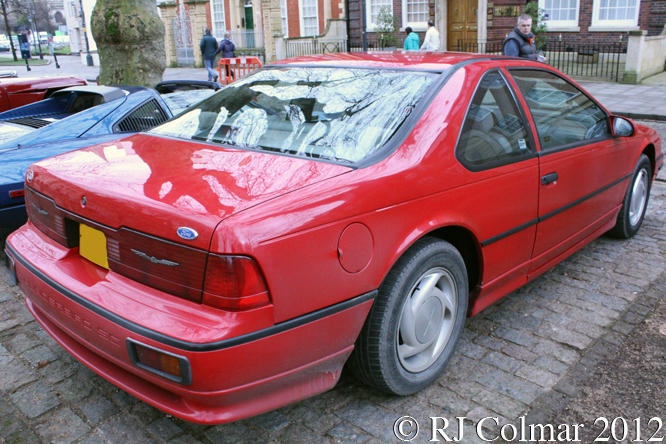
Ford Thunderbird SC, Avenue Drivers Club, Queen Square Bristol

In 1990 on a week long vacation in Connecticut with some friends I hired a regular Thunderbird and was amazed that it could easily seat 4 adults and two kids, when we all piled out of the car our hosts just fell about laughing telling us the view reminded them of a scene from 101 Dalmatians.
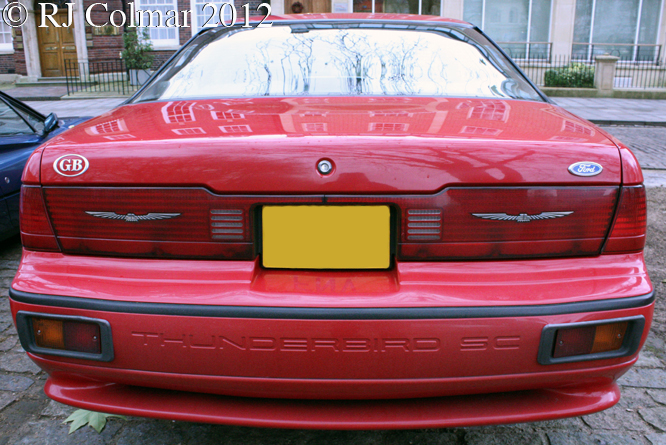
Ford Thunderbird SC, Avenue Drivers Club, Queen Square Bristol

In 1992 outside shot owner driver Alan Kulwicki won NASCAR’s Sprint Cup at the last race of the season with his Tenth Generation Thunderbird bodied car baring the legend “Underbird” on the front splitter.

961,624 Tenth Generation Thunderbirds were built between 1989 and 1997 the model range received minor exterior detail changes and upgrades in 1992, 1996 and 1997 the last year of production. The model was discontinued from 1998 until 2002.

Thanks for joining me on this “Over Budget & Over Weight” edition of “Gettin’ a li’l psycho on tyres” I hope you will join me again tomorrow for Ferrari Friday. Don’t forget to come back now !

Share

Ferrari Road Treasures – Blackhawk Museum

A couple of weeks ago Geoffrey Horton kindly asked me what kind of cars I was looking for pictures of and I responded that I was desperately short of Ferrari’s, as you can see from today’s Ferrari blog, and will see in next weeks blog Geoffrey has come up trumps and saved Ferrari Friday single handedly probably up until Christmas. Here is a preview of some of the Ferrari road cars that will feature in the coming weeks.

Ferrari 342 America Vignale Cabriolet, Blackhawk Museum, CA

The Ferrari America series started in 1950 was designed to meet the requirements of Ferrari’s customers who wanted a little more than a racing car adapted for the road. The America cars featured more leg room and head room but were still powered by motors derived from Ferrari’s racing programmes. This 1952 Ferrari 342 America Cabriolet features a unique, as in one of, body by Vignale and is powered by a 230 hp Lamperedi designed V12.

Ferrari 375 America Coupé, Blackhawk Museum, CA

Following the 23 342’s came the Ferrari 375 America with a larger and more powerful Lampredi V12 which produced 300 hp. This 1953 Vignale bodied Coupé is one of two, regular readers may remember reading about the other one nearly a year ago.

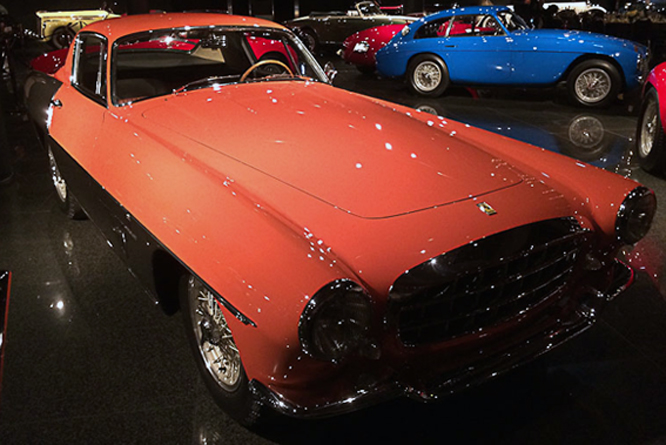
Ferrari 375 MM Ghia Coupé Speciale, Blackhawk Museum, CA

Sporting it’s original salmon paintwork and with just over 8000 miles on the clock this unique, one of, 1954 Ghia bodied Coupé sits on a 375 MM chassis designed for racing. It was the last Ferrari chassis to be fitted with Ghia body.

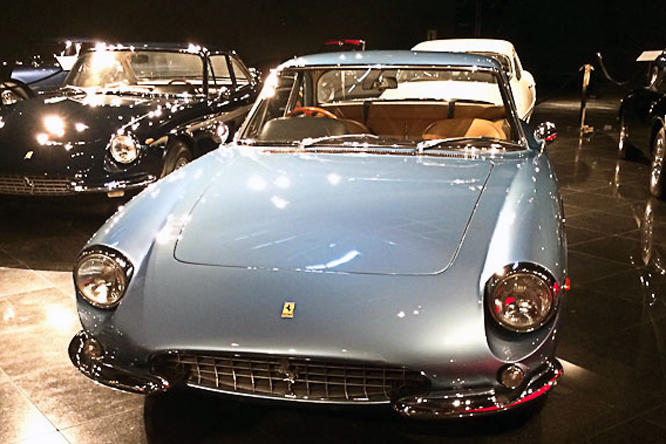
Ferrari 400 Superamerica, Blackhawk Museum, CA

In 1961 the Ferrari 400 Superamerica made it’s debut at the Geneva Motorshow with a downsized 4 litre 244 cui V12 which produced 340 hp. The second series Superamerica’s like the 1964 example seen here was built on a slightly longer chassis. Only 47 Superamerica’s of all types, Coupé, Cabriolet and Spider were built up until 1964.

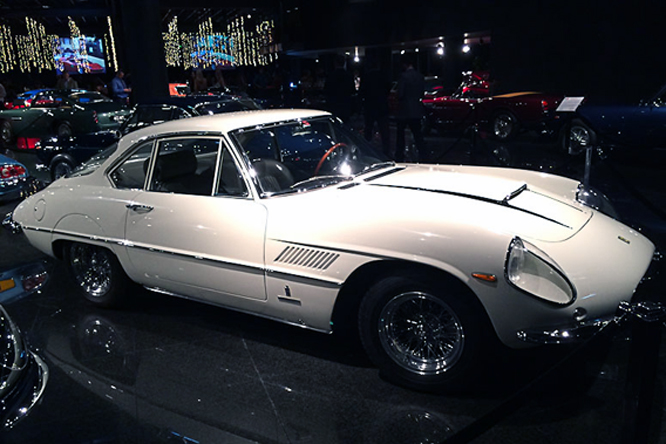
Ferrari 500 Superfast Coupé, Blackhawk Museum, CA

In 1964 the 500 Superfast Coupé was introduced to replace the America series cars, like the earlier models the Superfast was only built to order and now powered by a 5 litre / 302 cui motor giving 400 hp.
This 1966 example is a series 2 500 Superfast with Pinin Farina Coupé body, the 33rd of 37 Superfasts built up until 1967.

My thanks to Geoffrey Horton for sharing today’s photographs.

Thanks for joining me on this Ferrari Road Treasures edition of “Gettin’ a li’l psycho on tyres” I hope you will join me again tomorrow when GALPOT’s 50th Anniversary Celebration of the Porsche 911 resumes. Don’t forget to come back now !

Share

Squarebird – Ford Thunderbird Convertibe

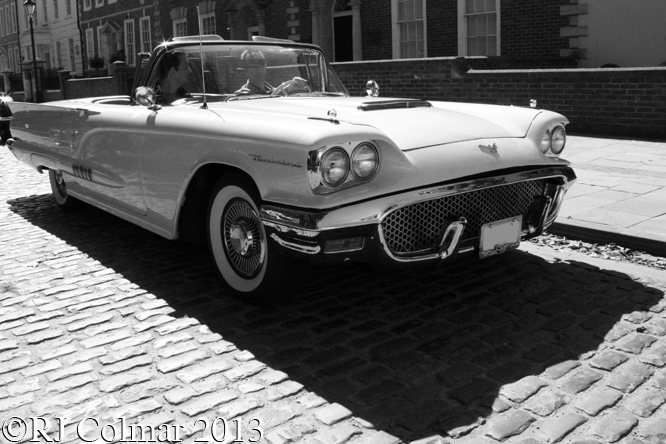
Despite the success of the original 2 seat personal luxury Ford Thunderbird launched in 1955 for 1958 at the insistence of Robert McNamara the second generation 1958 Ford Thunderbird was restyled as a 4 seat 2 door vehicle with coupé or convertible body styles.

Ford Thunderbird, Avenue Drivers Club, Queen Square, Bristol

Larger and heavier second generation Thunderbirds with a 113 inch wheel base were switched to unitary body construction a technique which was still a novelty for the period.

Ford Thunderbird, Avenue Drivers Club, Queen Square, Bristol

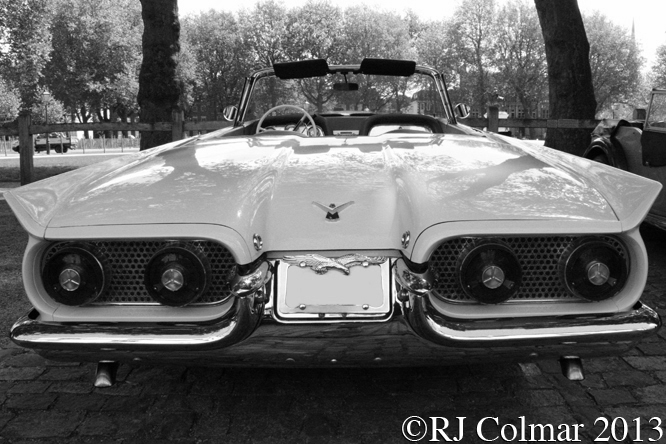
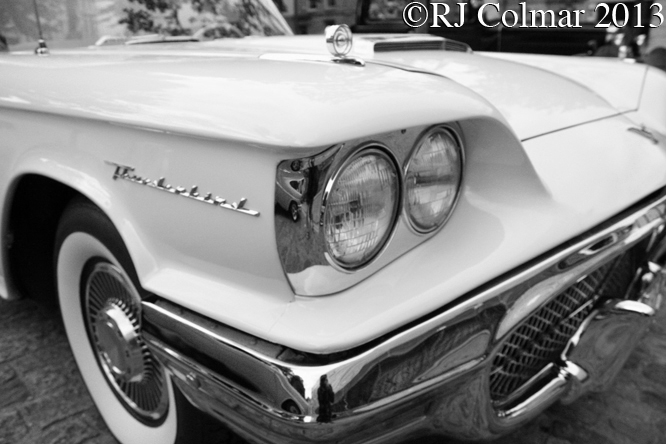
Overall the ’58 Thunderbird with all of it’s baroque chrome and tailfins maintained a boxy appearance from which it’s “Squarebird” nick name was derived among enthusiasts.

Ford Thunderbird, Avenue Drivers Club, Queen Square, Bristol

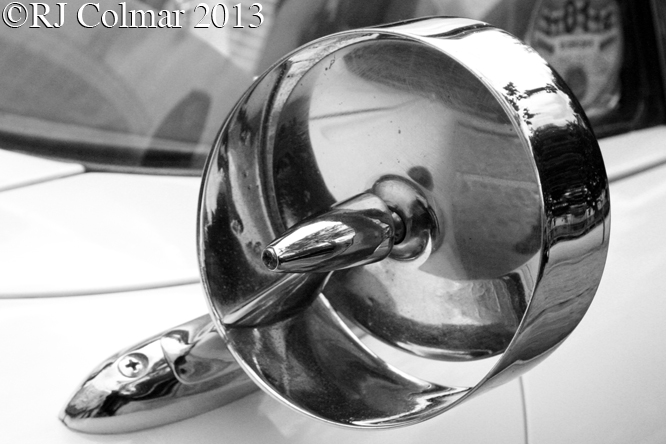
The bomb sight motif seen on the front wings / fenders were echoed in the design of the rear view mirrors.

Ford Thunderbird, Avenue Drivers Club, Queen Square, Bristol

A fold away hard top had originally been envisaged as seen on the Ford Skyliner but this was abandoned in favour of a convertible roof operated by a hydraulic system powered by a complicated system of electric motors, switches and solenoids which opened a rear hinged panel ahead of the boot / trunk lid.

Ford Thunderbird, Avenue Drivers Club, Queen Square, Bristol

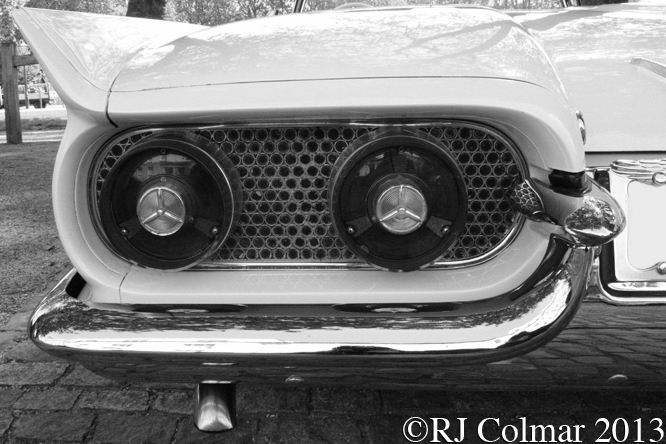
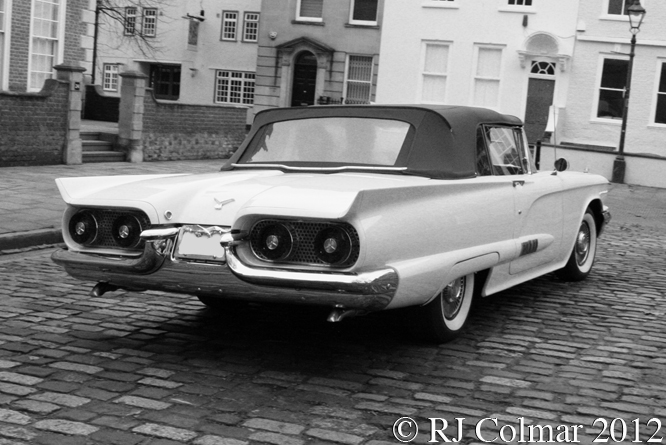
The science fiction rocket pod styling of the tail lights appears to have been lifted by the Next Generation Start Trek design team for the Starship Enterprise NCC 1701-D.

Ford Thunderbird, Avenue Drivers Club, Queen Square, Bristol

Of the, up until then, record 37,892 Thunderbirds built in 1958 only 2,134 were convertibles. Today’s featured ’58 Thunderbird has put in regular appearances at Avenue Drivers Club meetings at Queen Square in Bristol.

Thanks for joining me on this “Squarebird” edition of “Gettin’ a li’l psycho on tyres” I hope you will join me again tomorrow for Ferrari Friday. Don’t forget to come back now !
Share

A Motorsports Gathering – The Quail

On Friday I had a look at some of the Great Ferrari’s at The Quail Concours d’Elegance, some of the other vehicles present are featured today.

Wales, La Bestioni Beast, The Quail

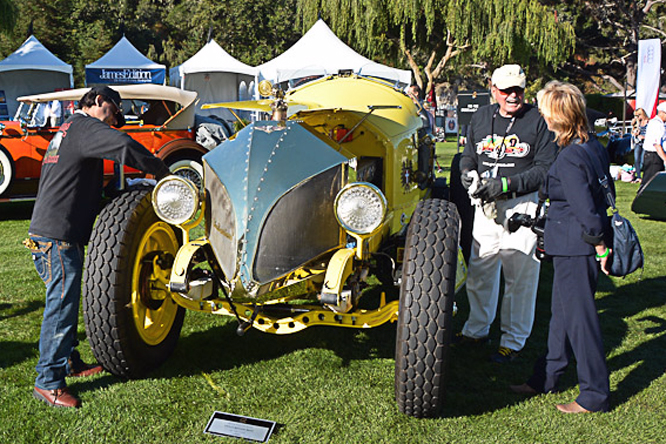
Towards the end of last year I looked at one of a matching pair of matching Rolls Royce Boattail Speedsters by Gary L Wales, Gary is seen above right standing next to one of his latest Retro Design creations La Bestioni Beast a 1919 LaFrance Speedster.

Bugatti Type 57G, The Quail

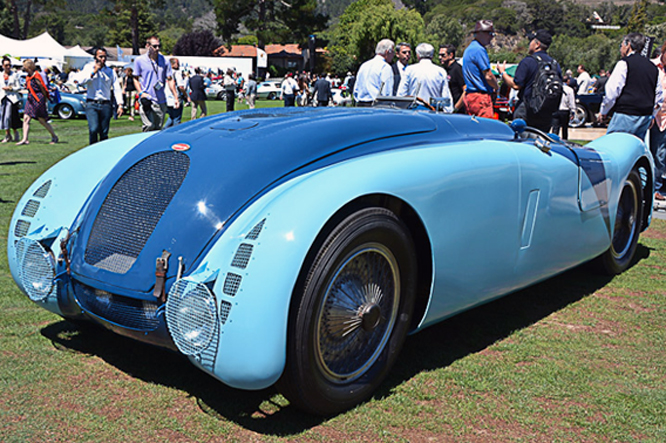
Going straight to the top 3 museums to visit in the USA is the Simeone Automotive Museum in Philadelphia who own this Bugatti T57G the car driven by Jean-Pierre Wimille and Robert Benoist to victory by 7 laps at Le Mans in 1937.

Lincoln Continental Cabriolet, The Quail

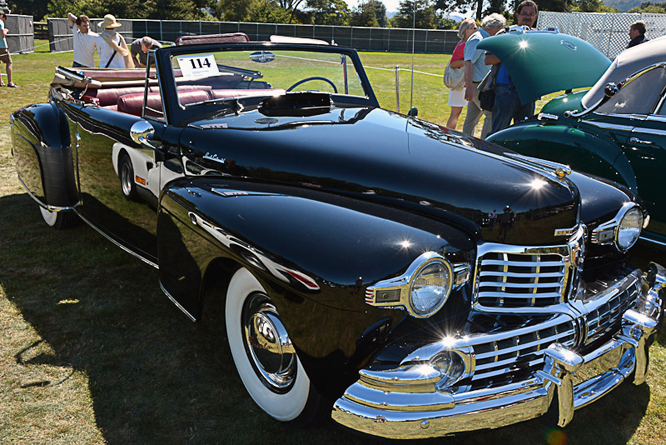
The 1948 Lincoln Continental like the Cabriolet above was the last US production model ever built with a V12 motor.

Jaguar XK 120, The Quail

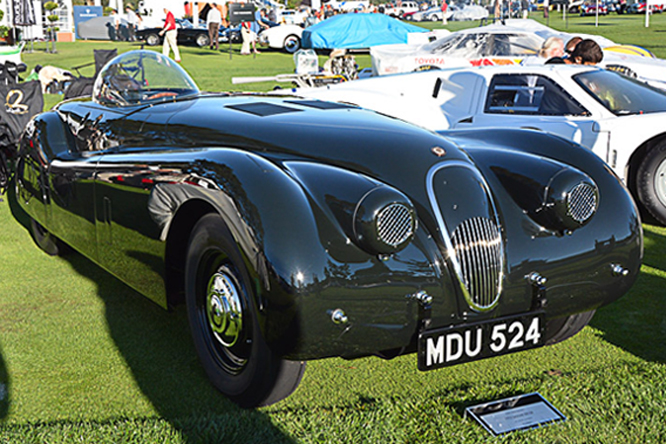
On the May 30th 1949 the bubble top on this prototype Jaguar XK 120 was bolted over the head of Norman Dewis who proceeded to record a two way timed average run of 132.6 mph on an empty stretch of motorway twixt Ostend and Jabbeke in Belgium.

Aston Martin DB2 Coupe, The Quail

The Aston Martin DB2 Coupé above was originally sold as a right hand drive vehicle to a Swedish customer Sölve Relve in 1951, it has also belonged to Swedish racing driver Sture Nottorp. In 1960 Yngve Eriksson bought the car and had the body work face lifted with a larger grill, fared headlights larger rear window and had the steering moved from the right to the left.

Bosley GT, The Quail

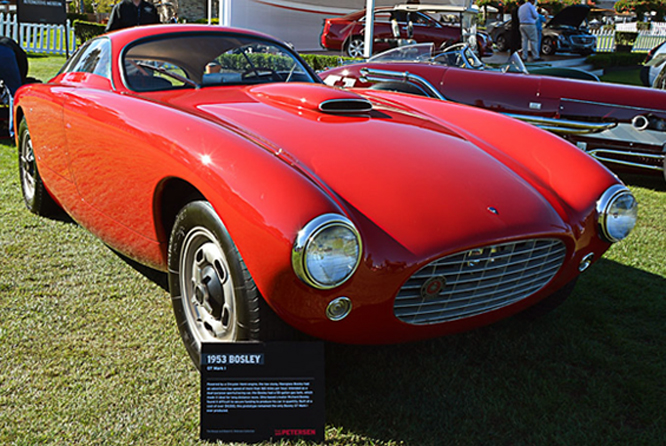
Of all the cars featured today the story of the 1953 Bosley GT is perhaps the most remarkable of all, aged just 21 Robert Bosley a horticultural farmer from Mentor Ohio, was dissatisfied with his XK 120 and Oldsmobile Rocket 88 and so he set out to build a dream machine in 1952. Robert had no design experience and taught himself self how to build the car including the fibre glass body as he went along using auto parts that dated back to the 1930’s. The motor he chose was a six carb Chrysler Hemi which gave the striking unique car a claimed top speed of 160 mph !

Alfa Romeo 1900C SS Ghia, The Quail

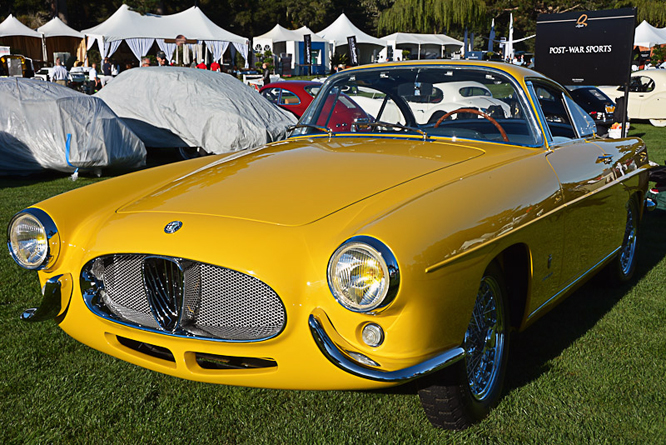
So far as I have been able to discern the Alfa Romeo above is ‘the’ unique 1953 1900C SS Coupé with coachwork by GHIA, if you know different please do not hesitate to chime in below or on the GALPOT FB page.

Jaguar XK 140, The Quail

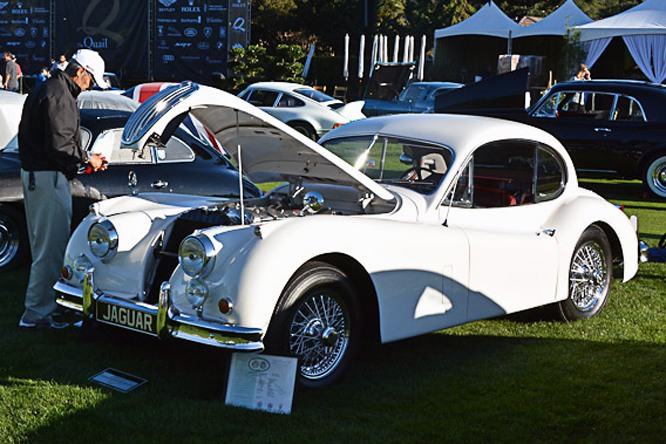
GALPOT contributor Geoffrey Horton’s immaculate 1955 Jaguar XK 140 FHC SE/MC is seen above keeping some exotic company.

Chevron B16, The Quail

The Chevron B16 above appears to have been built in 1970, no other information is available on the car which appears to have been withdrawn from the Bonham’s Auction, if you know why please do not hesitate to chime in below.

My thanks to Geoffrey Horton for taking and sharing today’s photographs.

Thanks for joining me on this “A Motorsports Gathering” edition of “Gettin’ a li’l psycho on tyres”, I hope you will join me again tomorrow. Don’t forget to come back now !
Share

Another Fine Mess – BRM P139 #P139/2

With the benefit of hindsight it could be said that the introduction of the 3 litre era Formula One regulations was the perfect excuse for unprecedented levels of chaos to reign at BRM. When the new regulations were announced BRM forgot its past troublesome experience with the supercharged BRM V16 and elected to built an even more complicated motor a 3 litre / 183 cui H16, effectively two flat 8 motors on top of one another sharing a common crankshaft. This heavy motor required four men to lift it and although powerful was also predictably unreliable though it did power Jim Clark to victory in the 1966 US Grand Prix, sitting in the back of a Lotus 43.

Alongside the H16 program BRM also developed a 24 valve V12 which Bruce McLaren used to power his one off McLaren M5A. When it lasted the V12 was capable of finishing in the points as Denny Hulme’s 5th in the 1968 South African Grand Prix had proved, however by then Bruce had already decided that the future of his Grand Prix team lay with the Ford Cosworth DFV which was used to power the 1968 McLaren M7A.

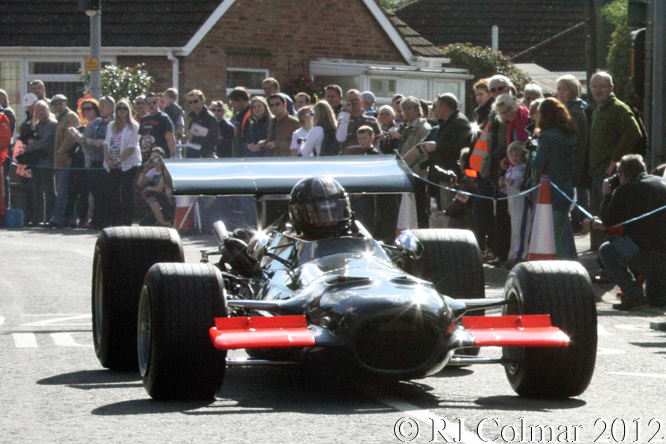
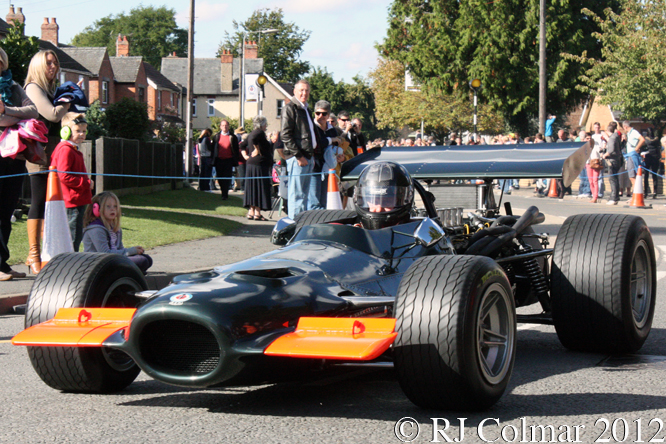
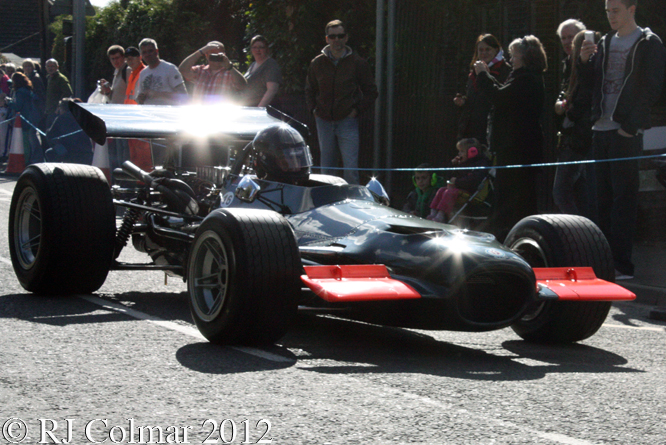
BRM P139, BRM Day, Bourne, Lincs

For 1968 BRM decided that the simpler and lighter V12 might be the better bet and abandoned it’s H16 and free lance designer Len Terry was drafted in to design a new V12 powered BRM P126 of which second evolution P133 and third evolution P138 variants were built in the same season. The teams best results were a second place in Monaco for Attwood in the P126 and 2nd place in the following Belgian Grand Prix for Pedro Rodriguez driving the P133.

1965 World Champion John Surtees was teamed up with Jackie Oliver in the BRM team for 1969 by which time BRM had developed a 48 valve version of the V12. The first half of the 1969 season went so badly with a best 5th place finish for John Surtees in Spain and 6 retirements from the opening 8 starts in 4 races that the team missed the 1969 French Grand Prix to regroup. During the break Tony Rudd, who had been working on a ground effect design with Peter Wright, was forced to resign and the team prepared a new challenger, the P139, for John Surtees to drive at the British Grand Prix.

 BRM P139, BRM Day, Bourne, Lincs

John retired on the second lap of the 1969 British Grand Prix when the suspension of the new P139 collapsed in the remaining five races of the 1969 season John managed two finishes the best of which was third in the Italian Grand Prix. At the end of the season John left BRM to start his own Formula One team.

Today’s featured car is #P139/2 which was ready for Jackie Oliver to drive in the 1969 Italian Grand Prix. Jackie Oliver ended his rookie season with Team Lotus in 1968, in which he replaced the much missed Jim Clark, with a season high third place finish in the season finale Mexican Grand Prix where team mate Graham Hill over came the odds to win the race and his second world drivers championship.

BRM P139, BRM Day, Bourne, Lincs

After the 1968 Mexican Grand Prix Jackie was replaced at Team Lotus by Jochen Rindt and Jackie found himself with the second seat at BRM for the 1969 season which started with a seventh place finish driving the BRM P133 at the South African Grand Prix. Jackie then had a run of four retirements in the P133 up to the British Grand Prix a fifth straight retirement driving the P138 at the German Grand Prix followed by three more in Italy Canada and the USA driving #P139/2. In Mexico Jackie’s fortunes changed and he finished 6th two laps down on Denny Hulme who drove his McLaren M7A to the models final final victory.

Jackie remained with BRM in 1970, but again he retired from all but two races with the P139’s replacement the Tony Southgate designed P153 scoring a best fifth in Austria. In 1973 Jackie teamed up with Don Nichols and designer Tony Southgate, who was part of the team that replaced Tony Rudd and Peter Wright at John Surtees insistence, to form the Shadow and later Arrows teams.

BRM P139, BRM Day, Bourne, Lincs

Tony Rudd joined Lotus production car operation when he left BRM and was still there when Peter Wright joined Lotus some years later. After joining Lotus Wright became involved in the development of the Lotus 78 ground effect and Lotus 79 moving on the work Wright and Rudd had started on the never completed BRM P142 in 1969.

Last time I looked today’s featured car seen in these photographs at last years BRM Day in it’s home town of Bourne was being offered for sale by Hall & Hall.

Thanks for joining me on this “Another Fine Mess” edition of “Gettin’ a li’l psycho on tyres” I hope you will join me again tomorrow. Don’t forget to come back now !
Share

Alf’s Shot – Walker Climax

When Stirling Moss won the 1958 Argentinian Grand Prix driving an underpowered Cooper Climax T43 he became the first man to win a Formula One Championship race driving a rear engined car and also the first man to win such a race in a privately entered car for wealthy Walkers Whiskey heir Rob Walker. At the following championship race Maurice Trintignant won for the second time at Monaco driving Walkers Cooper Climax T45.

Walker, a former racer, had promised his wife he would no longer race when he married in 1940 and after the 39/45 war he became a well respected entrant of all manner of cars starting with a Formula 2 Connaught for Tony Rolt in 1953 going on to include; a Lotus 18, the Ferguson P99 and a couple of Lotus 49’s, one of which became the last privately entered car to win a Formula One Championship race at Brand Hatch in 1968 with Jo Siffert at the wheel.

From 1971 to 1973 Rob joined forces with John Surtees, the following year he supporting a third Yardley sponsored McLaren for former Surtees Driver Mike Hailwood with his last financial involvement being in 1974 when he teamed up with Harry Stiller to enter a Hesketh for future, 1980, Formula One Champion Alan Jones, after which he continued as a time keeper for a number of teams.

Walker Climax, Goodwood Revival

1959 Stirling won two more championship races driving a Rob Cooper Climax T51 which was wrenched by chief mechanic Alf Francis with whom Stirling had worked through most of the 1950’s starting when Alf was working for HWM.

Alf Francis managed to persuade Moss and Rob Walker, who paid the bills, to let him have a shot at designing a Formula One car for the 1960 season. By all accounts out of loyalty they agreed and Alf working with former Ferrari and Maserati chassis designer Valerio Colotti, who had gone into business under the Studio Tecnica Meccanica, abbreviated to Tec Mec, name, came up with today’s featured Climax powered car

Stirling did test the car, but found it not to his liking so Moss and Walker opted to lease a Lotus 18 with which they won four races over the next two years with Stirling finishing 3rd in the championship in ’60 and ’61.

02 IMG_1435sc

Alf Francis had worked closely with Colotti when Moss bought a Maserati 250F in 1954 and went on to found Colotti Francis Systems. Alf Francis was later responsible for the Derrington Francis with engine tuner Vic Derrington. The ATS powered Derrington Francis made one appearance before Dan Gurney tested the car, after he had damaged it the Derrington Francis team folded.

Stirling Moss observed that his long serving mechanic Alf was like a good PA who thinks they can run the company and that when they set up they fail.

Although the Walker Climax never raced in period it has regularly appeared in historic events driven by owner Richard Parnell. Note Colotti’s involvement sometimes sees the car referred to as the Walker Climax Tec Mec Tipo 10.

Thanks for joining me on this “Alf’s Shot” edition of “Gettin’ a li’l psycho on tyres” I hope you will join me again tomorrow. Don’t forget to come back now !
Share

Satoru’s Fastest Lap – Lotus Judd 101

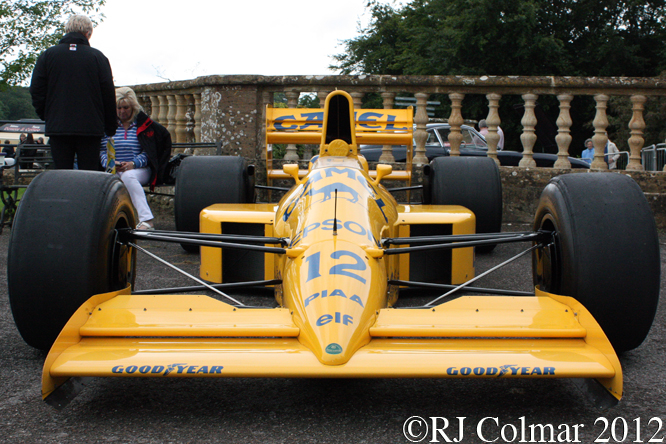
1989 saw the phenomenally expensive 1200 – 1500 hp 1.5 litres / 91.5 cui turbo charged engines that had first been seen in Formula One racing in 1977 and that had come to dominate the sport by 1983 finally outlawed in 1989. New regulations mandating 3.5 litre / 213 cui motors were introduced for the 1989 season but Honda who had come to dominate the last years of the turbo era were about to dominate the opening years of the new normally aspirated era with a V10 motor that was simply more reliable and more powerful than the opposition.

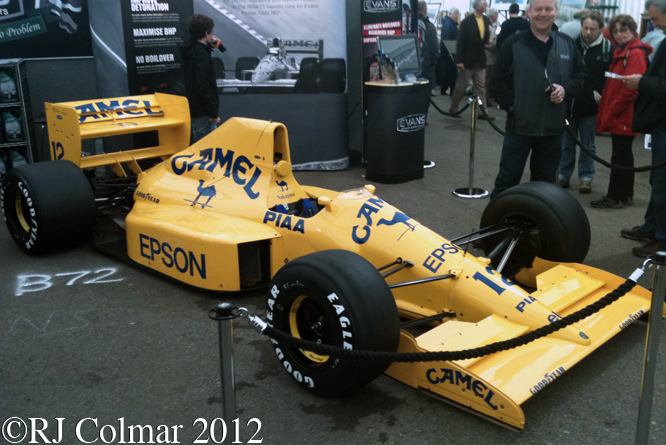
Lotus Judd 101, Classics at the Castle, Sherborne

Team Lotus were on the upper slopes of steep decline in 1989 neither Nelson Piquet or Satoru Nakajima had offered the dominant McLaren’s with whom they shared an engine supplier in 1988 much by way of competition, and Lotus finished a poor 4th behind Ferrari and Benetton when their motors should have been good enough to finish second behind McLaren.

Lotus Judd 101, Race Retro, Stonleigh

For 1989 Lotus lost their Honda deal and ended up with Judd V8 CV spec motors while Judd’s preferred customer March was on EV spec motors.

Lotus Judd 101, Bristol Classic Car Show, Shepton Mallet

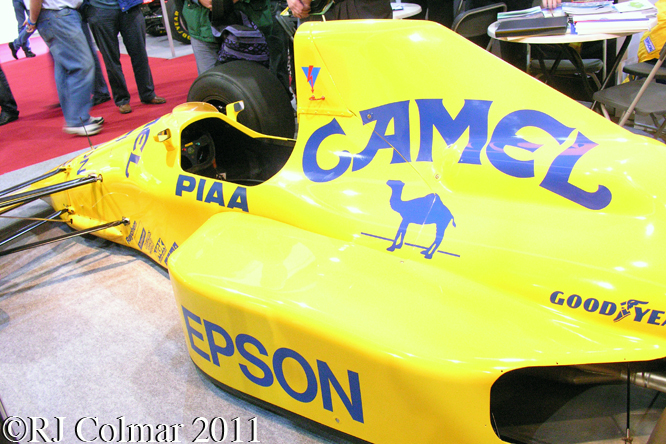
The 1989 Lotus 101 cars were designed by Frank Dernie a former Williams aerodynamicist Frank Dernie whom Nelson Piquet had persuaded to defect, though by the time Frank arrived much of the design had been completed by future short lived MWR, Micheal Waltrip Racing, design consultant Mike Coughlan.

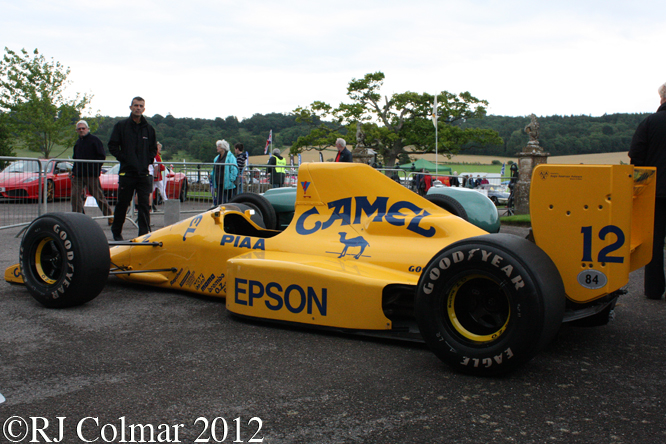
Lotus Judd 101, Classics at the Castle, Sherborne

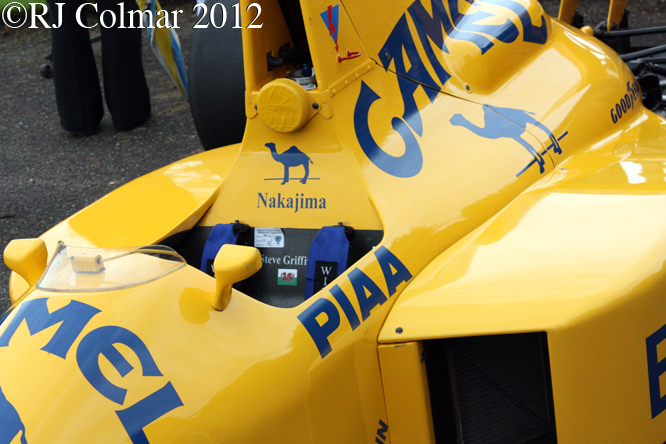
In order to save weight and seek aerodynamic advantage on their competitors the Lotus 101 cockpit was so narrow that Momo were commissioned to build ultra narrow steering wheels so that Nelson and Satoru did not scrape their knuckles on the cockpit sides.

Lotus Judd 101, Race Retro, Stonleigh

Lotus entered an agreement with Tickford to develop 5 valve per cylinder heads for their 2nd string Judd V8’s to make up some of the 125 hp the CV motors had on the most powerful Honda V10’s but the idea was eventually scrapped mid season.

Lotus Judd 101, Classics at the Castle, Sherborne

Team Lotus scored four seasons high 4th places 3 for Nelson and one for Satoru enough with two more points finishes for Nelson to secure 6th place for Team Lotus in the 1989 Championship.

Lotus Judd 101, Bristol Classic Car Show, Shepton Mallet

Possibly the most remarkable result for the team came at the season ends Australian Grand Prix in Adelaide where the race was run in monsoon conditions, only 8 of the 26 qualifiers were running at the races end and of them Satoru Nakajima came through from 23rd of the grid to finish 4th and final runner on the lead lap. In the process Satoru recorded the races fastest lap a feat he would never repeat.

Lotus Judd 101, Bristol Classic Car Show, Shepton Mallet

Although Lotus were running second string Judd CV engines they finished ahead, in championship points, of the other Judd users Brabham; March, and Euro Brun the latter who like Yamaha powered Zakspeed failed to even pre qualify for a single on of the seasons 16 races.

Thanks for joining me on this “Saturo’s Fastest Lap” edition of “Gettin’ a li’l psycho on tyres” I hope you will join me again tomorrow. Don’t forget to come back now !
Share