Tag Archives: Silverstone Classic

Backyard Hi Tec – Amon Cosworth AF101

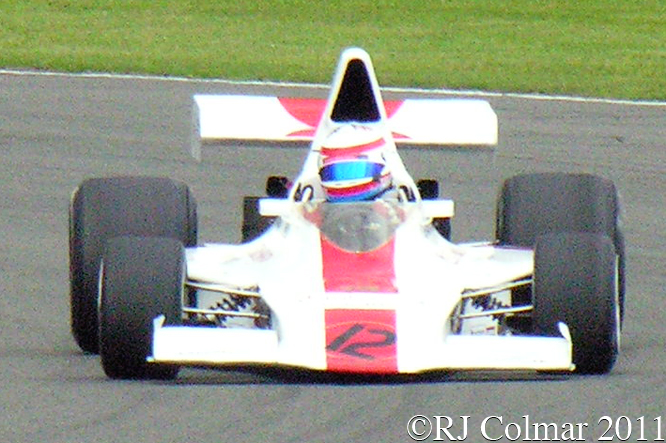
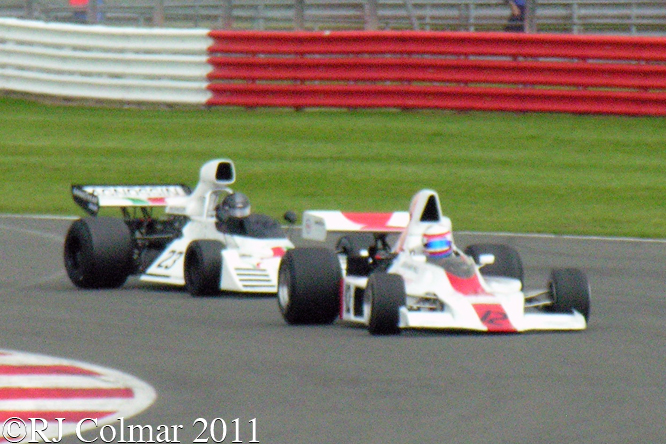
This month’s Sunday posts will feature 5 Formula One cars that ran in the 1974 season for which the then 31 year old Le Mans winner Chris Amon decided to follow in the foot steps of Jack Brabham and Bruce McLaren by building a car bearing his own name.
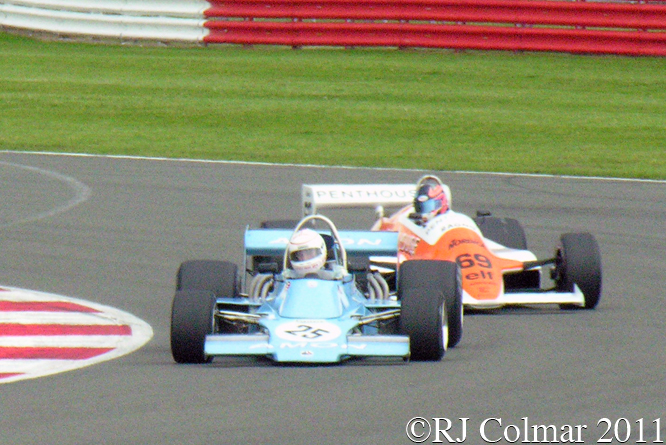
Amon Ford F101, Maydon, Siverstone Classic

It would appear Chris had plans to build both Formula 1 and Formula 5000 cars the latter to race in the lucrative US series with up and coming Australian Larry Perkins; a driver, engineer and sofa surfer who was making his way through the junior ranks in the UK. However despite financial backing from amateur racer John Dalton only the Formula One spec AF101 featured here ever saw the light of day.

Chris commissioned Gordon Fowell to provide him “with a sophisticated chassis” powered by a Ford Corsworth DFV motor driving the rear wheels through a Hewland gearbox. Gordon had designed the attractive, if underpowered, Martini sponsored 1973 Tecno E731 that Chris drove in practice at three meetings in 1973 but had never raced.
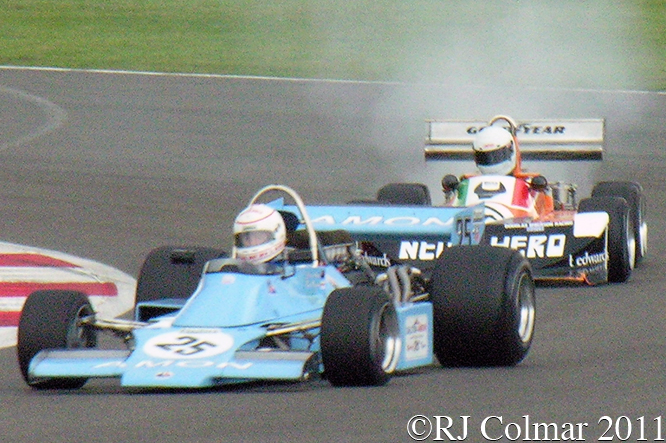
Amon Ford F101, Maydon, Siverstone Classic

The AF101 chassis, fabricated by Thompson who were also responsible for fabricating the Tecno E731 and Ferrari 312 B3, was certainly sophisticated with unique, for the time, central fuel cell that would become deriguer once ground effects were better understood with the introduction of the Lotus 79 in 1978. The car also had titanium torsion bar suspension and inboard front brakes, as did the well proven Lotus 72.

Responsibility for the aerodynamics was handed over to Professor Tom Boyce, and almost every time the car appeared it had a different nose including a high wing when it was first tested, a chisel nose in Spain where it first raced, a shovel at Monaco where the car qualified but did not race and then a lower full width wing was tried when the car failed to qualify in Germany and Italy.
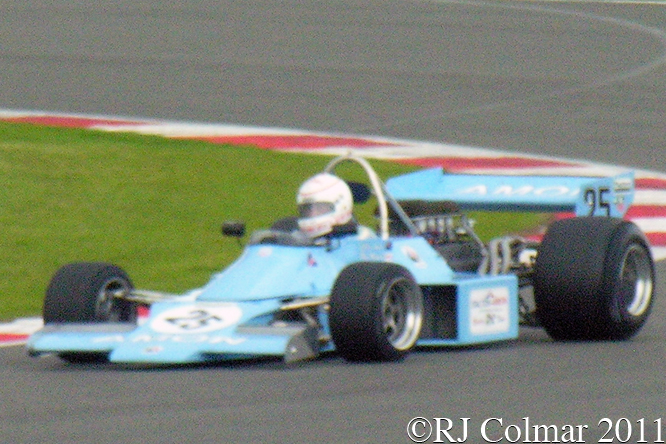
Amon Ford F101, Maydon, Siverstone Classic

Unfortunately the AF101 proved a little to sophisticated for Chris’s budget, despite Larry Perkins saving a fortune in hotel bills with his sofa surfing skills, the little team folded having clocked just 22 laps in the 1974 Spanish Grand Prix before a brake shaft broke. Looking back on the project Chris conceded that he had attempted to build, what turned out to be a fragile hi tec vehicle on a backyard budget when he might have achieved more with a vehicle that was a little less ambitious and a little more reliable.

Larry Perkins loyalty was rewarded with an attempt at qualifying the Amon in the German Grand Prix after Chris was taken ill, unfortunately the combination of the Nurburgring, a rookie driver and a fragile car proved too much of a challenge for the team.
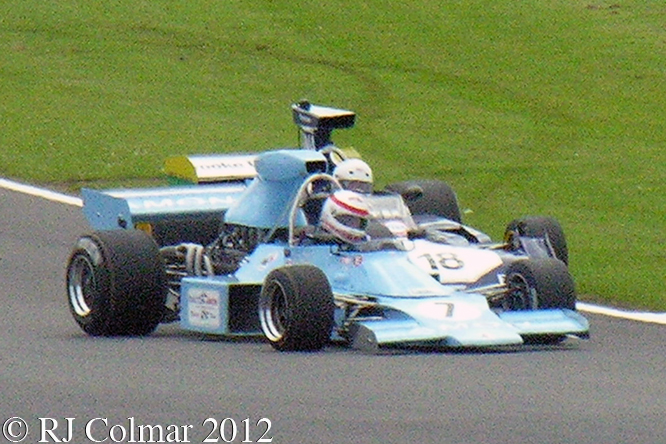
Amon Ford F101, Maydon, Siverstone Classic

After out qualifying Ricky von Opel and his works Brabham BT44 in the 1974 Spanish Grand Prix Chris was offered the second works Brabham drive for the rest of 1974, but turned it down out of loyalty to his own employees. Just as in 1973 when Tyrrell stepped in to offer Chris a couple of end of season drives after the demise of the Tecno team, at the end of 1974 BRM stepped in to offer Chris a couple of drives in the wonderful BRM P201, a model I’ll be looking at in a couple of weeks.

Post Italy 1974 the Amon was abandoned, restored and languished in a German Museum before it was restored to running condition in 2005. It is currently owned and raced by Ron Maydon in the Grand Prix Masters Series, Ron is seen driving the AF101 at Silverstone a few years ago.
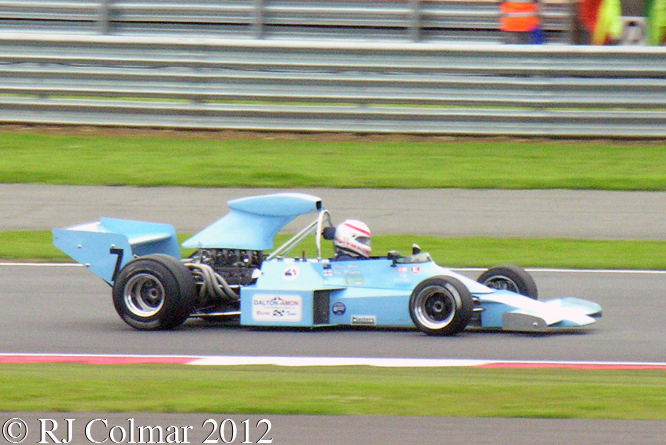
Amon Ford F101, Maydon, Siverstone Classic

Thanks for joining me on this Backyard Hi Tec edition of “Gettin’ a li’l psycho on tyres” I hope you will join me again tomorrow when I’ll be starting a new GALPOT feature “Maserati Monday”. Don’t forget to come back now !

Share

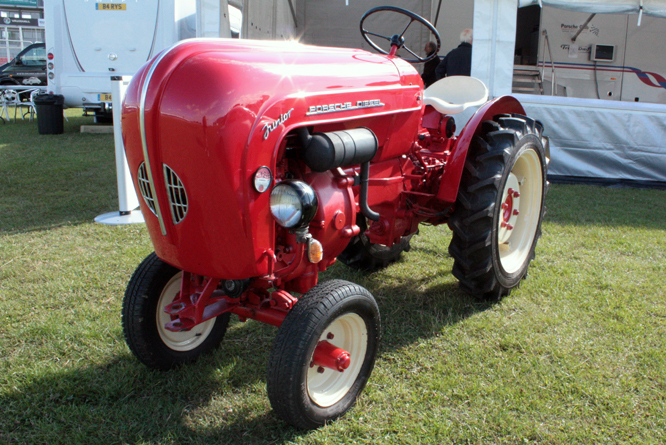
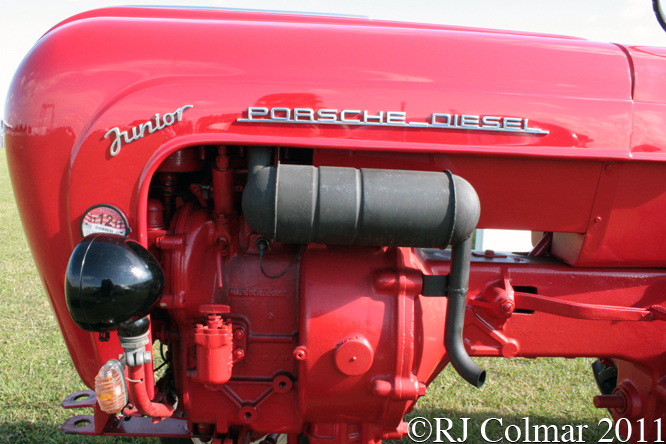
Sturdy, Powerful and Foolproof – Porsche Diesel Junior AP 108

Dr Ferdinand Porsche looked at agricultural applications of his products as early as 1914 when he used a military Austro Daimler vehicle to plough fields at the Austro Daimler works.

Porsche Diesel Junior AP108, Silverstone Classic, Siverstone

By 1937 Ferdinand had noted that “Tractors must have a low purchase price. Secondly, they must have low maintenance cost. Thirdly, they must be of universal application in agriculture. Sturdy, powerful and foolproof” in a list of criteria for an agricultural vehicle that was to become known as the ‘Volksschlepper’ for which many prototypes were built, but never went into production.

Porsche Diesel Junior AP108, Silverstone Classic, Siverstone

By the 1950’s Porsche had designed a range of four air cooled diesel powered tractors producing 14 – 50 hp with the advantage of all the motors being multiples of the basic 1 cylinder 14hp design meaning all the parts including cylinders, pistons and cylinder heads were interchangeable.

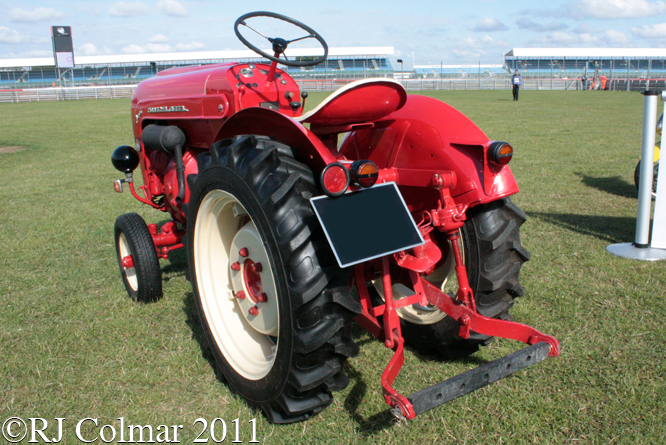
Porsche Diesel Junior AP108, Silverstone Classic, Siverstone

Porsche initially sold the production rights to a German Company called Allgaier who marketed their vehicles as Allgaier – System Porsches, and the Austrian manufacturer Hofherr Schrantz who’s products were marketed as Hofherr Schrantz – System Porsches.

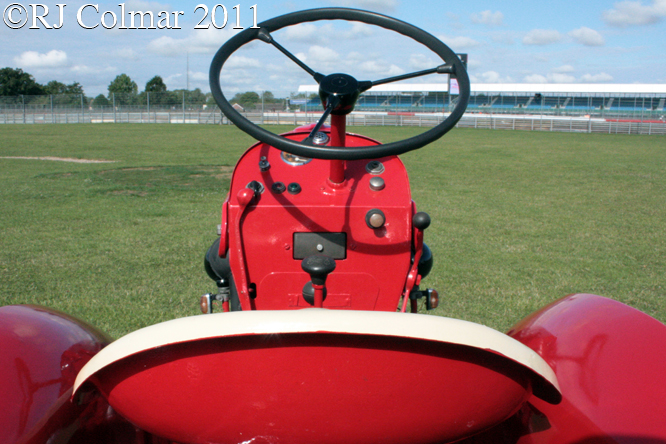
Porsche Diesel Junior AP108, Silverstone Classic, Siverstone

Mannesmann AG bought the Allgaier – System Porsche rights in 1956 and converted the former Zepplin works at Fredrichshafen, Lake Konstanz in to a state of the art facility at which 20,000 units were manufactured in 1958. Production at the plant ceased in 1963 when the facility was turned over to the production of motors for military motors for use in NATO vehicles.

Porsche Diesel Junior AP108, Silverstone Classic, Siverstone

In part to meet the fool proof criteria and in part because the tractor operates most efficiently at constant revs a fluid transmission commissioned from Voith, based on their marine transmissions, for Porsche Diesel tractors, a feature well ahead of the development curve of other tractor manufacturers of the period.

Porsche Diesel Junior AP108, Silverstone Classic, Siverstone

Today’s 1958 Junior fitted with a single cylinder 822 cc / 50 cui 14hp motor is one of the 125,000 Porsche-Diesel tractors produced at the Mannesmann AG facility between 1956 and 1963, when an arrangement was reached with Renault to continue servicing them world wide.

Thanks for joining me on this “Sturdy, Powerful and Foolproof” edition of “Gettin’ a li’l psycho on tyres” I hope you will join me again tomorrow when I’ll be looking at an Edwardian competition car that was among the earliest to carry sponsorship. Don’t forget to come back now !

Share

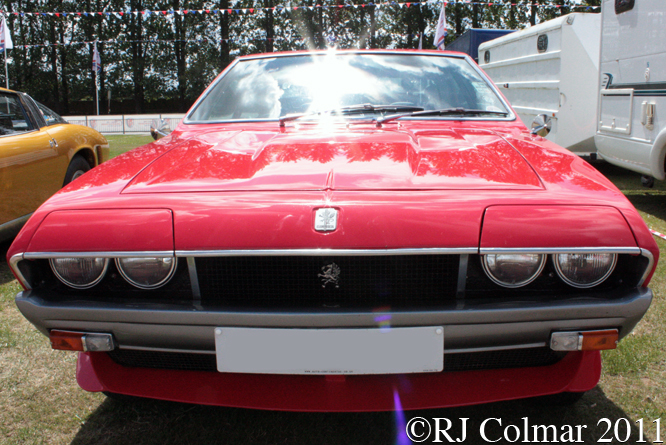
Wife’s New Clothes – Iso Rivolta Lele IR6

Before designing the body for the 2+2 Lamborghini Jarama which I looked at a couple of weeks ago, Bertone’s Marchello Gandini was commissioned to design what was intended to be a one off 2+2 body for an ISO Rivolta IR300.

ISO Rivolta Lele IR6 Sport, Silverstone Classic

Piero Rivolta was so impressed with Gandini’s new design that he had the one off put into production lending his wife’s name to the new ISO Rivolta Lele which was launched in 1969 powered by a Chevrolet V8 tuned to either give 300hp or 350 hp.

ISO Rivolta Lele IR6 Sport, Silverstone Classic

In 1972 after General Motors demanded payment for it’s motors prior to shipping ISO Rivolta switched to using Ford Cleveland motors in it’s Grifo, Fidia and Lele models with the Ford powered Lele becoming the Lele IR6 with 325hp of which 130 were built from 1972 until ISO Rivolta went bankrupt in 1974. Around 20 Lele IR6 models with manual transmissions were built with their Cleveland motors tuned to give 360 hp and these were known as IR6 Sports.

ISO Rivolta Lele IR6 Sport, Silverstone Classic

In all 285 ISO Lele’s, of all types, are thought to have been built including 3 or possibly 4 cars commissioned by Philip Morris for ISO Marlboro F1 drivers Howden Ganley and Nanni Galli along with associated promotions.

Thanks for joining me on this “Wife’s New Clothes” edition of “Gettin’ a li’l psycho on tyres” I hope you will join me again tomorrow. Don’t forget to come back now !
Brighton Speed Trials Under Threat of Permanent Cancellation !

In their infinite wisdom, Brighton & Hove City Council are seeking to ban the Brighton Speed Trials from 2014.

If you care about speed and or motorsport history, please sign this linked petition to save Brighton Speed Trials in 2014 and beyond.

It’s a faf to Register before signing, but relatively painless compared to loosing the event which has been run with few interruptions since 1905.

You do not need to be resident in Brighton or even the UK to sign.

Thanks and please spread the word through whatever social media you have at your disposal.

Share

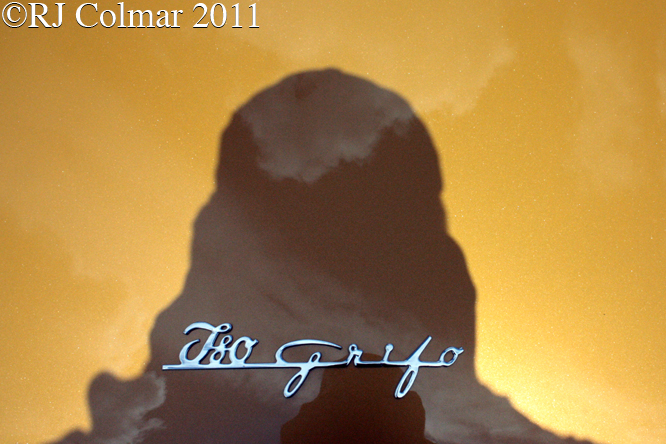
Bow Tie Or Oval – ISO Grifo Series 2

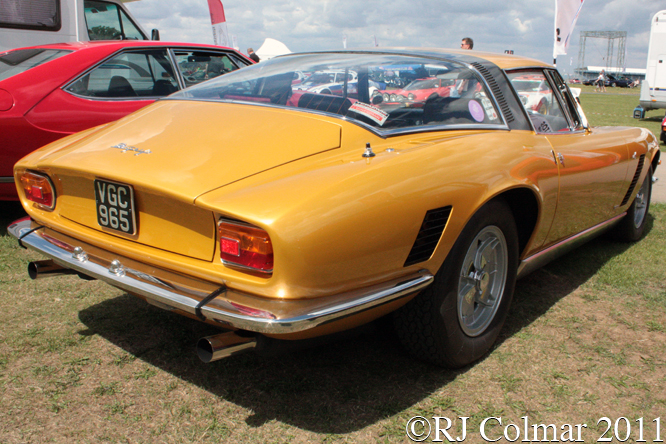
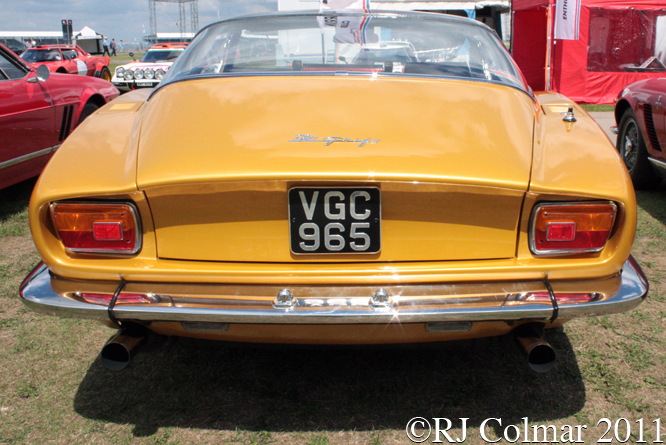
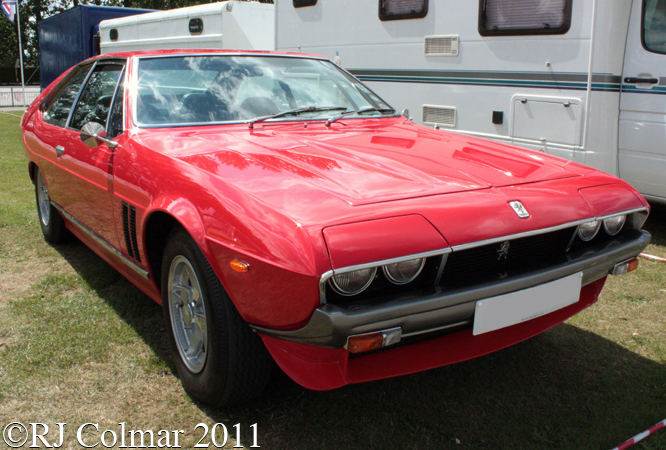
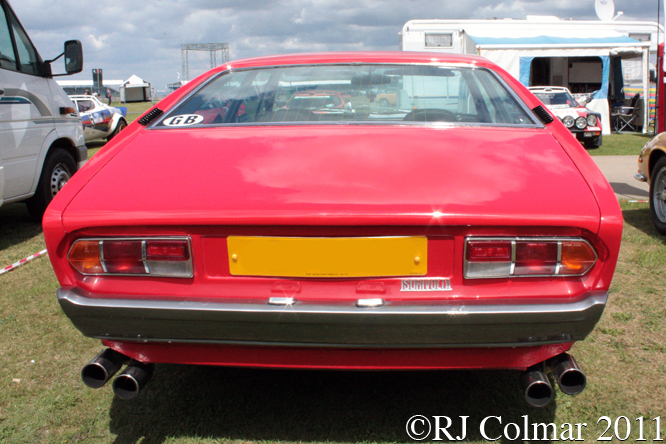
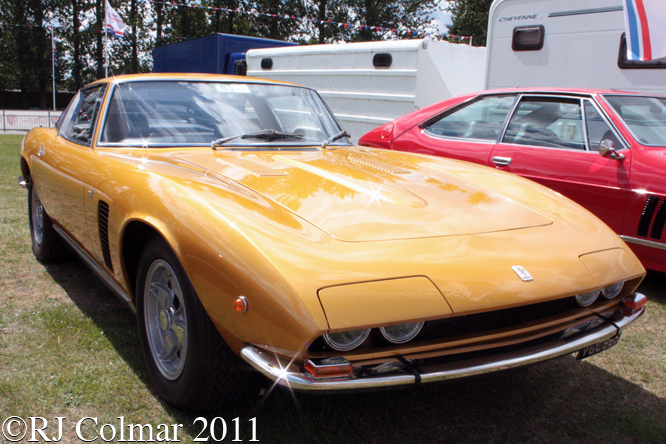
Today’s featured car, seen at Silverstone Classic a couple of years ago, is a 1972 ISO Grifo Series 2 with the half hooded head lights that were first seen in 1970.

Iso Grifo, Silverstone Classic

1972 saw the Grifo offered with a 7.4 litre / 454 cui Chevrolet V8 known as the CAN Am, newly introduced 5.8 litre / 351 cui Ford Boss V8 known as the IR8, or the 5.4 litre / 327 cui small block Chevrolet V8. The records lodged with the licensing authorities for this car and the absence of a large pagoda intake on the bonnet show that this car has a Bow Tie (Chevrolet) under the bonnet.

Iso Grifo, Silverstone Classic

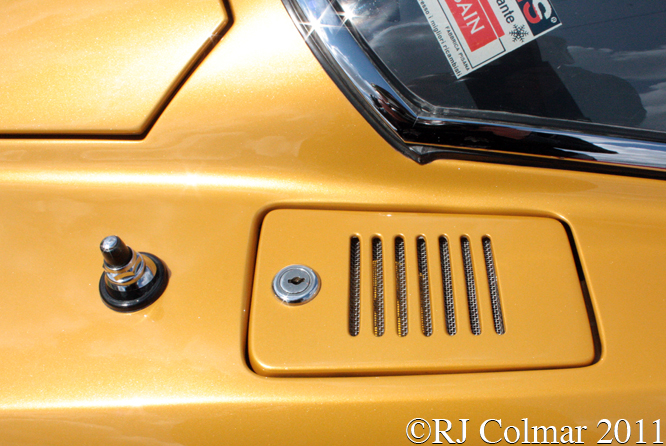
I don’t recall seeing any other car with a vented fuel cap cover before. By 1972 the oil crisis was beginning to emerge with the price of fuel rocketing tough trading conditions for manufacturers of large motorcars began to set in.

Iso Grifo, Silverstone Classic

But as we shall see in the coming weeks that did not stop ISO Rivolta introducing two updated models during the course of the year in which the production of the ISO Grifo CAN Am was halted.

Iso Grifo, Silverstone Classic

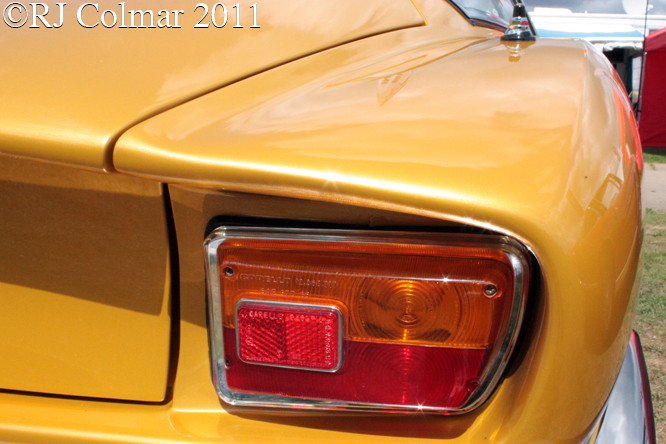
I am reasonably certain the rear lights of all Grifo models were sourced from the ALFA Romeo Junior / GTV parts bin, if you know this for a fact please do not hesitate to chip in below.

Iso Grifo, Silverstone Classic

By all accounts the French sourced electric windows could be a little temperamental and the factory being aware of this thoughtfully provided a little crank which when inserted into small hole in the door panel would allow one to crank open or close the window as required. If only manufacturers were so thoughtful today !

Iso Grifo, Silverstone Classic

The with a Giotto Bizzarrini designed chassis and Marcello Gandini, working for Bertone, body the Series I Grifos are considered classics, the 78 Series II cars with the half hidden headlights are considered timeless.

Thanks for joining me on this “Bow Tie or Oval” edition of “Gettin’ a li’l psycho on tyres” I hope you will join me again tomorrow when I’ll be looking at a Morris Pickup. Don’t forget to come back now !
Share

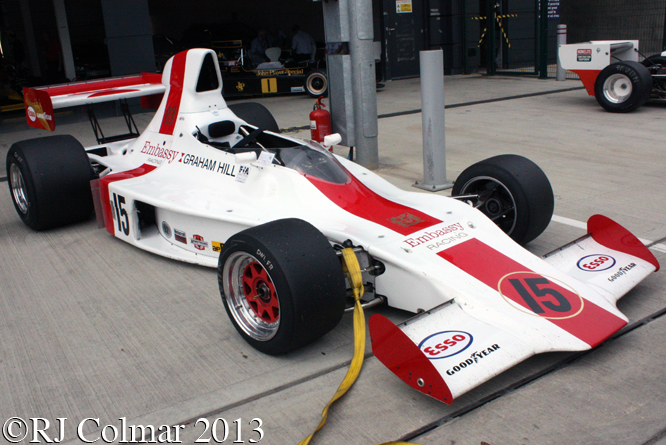
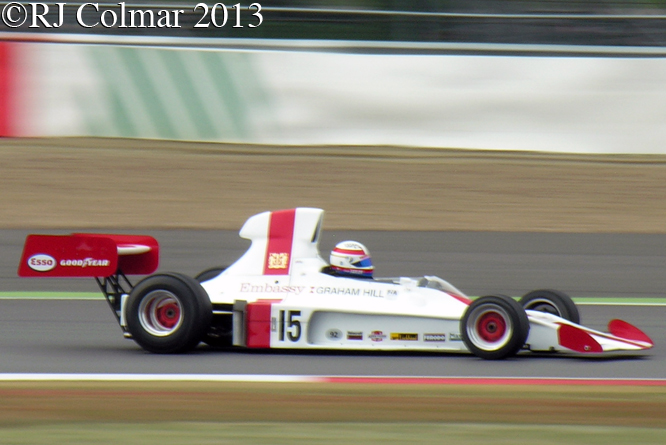
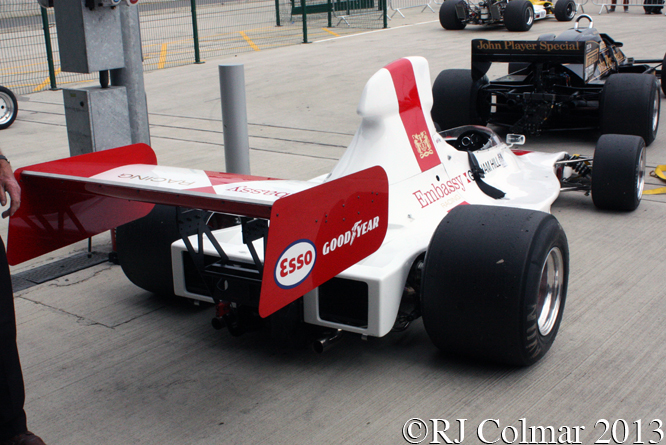
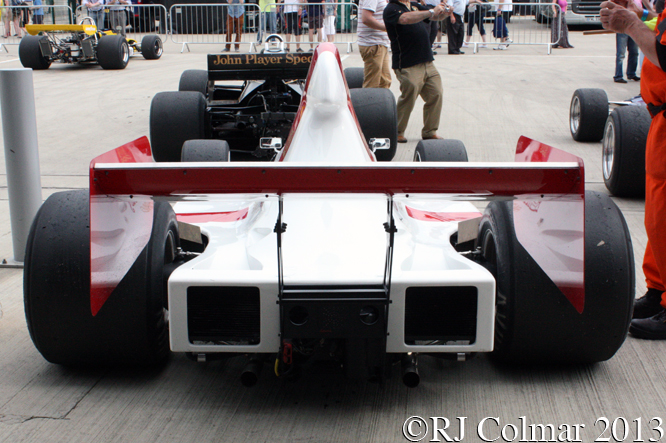
The Ambassador’s Embassy – Shadow Cosworth DN1 #DN1-3A

Ten years after winning his first World Championship driving for BRM, in 1963, and five years after winning his second World Championship driving for Lotus, in 1968 (Norman) Graham Hill had become the senior citizen of the sport with wins at Indianapolis in 1966 and at Le Mans in 1972 to make a unique triple crown of victories which only he has achieved, making him arguably the most versatile driver in the history of the sport. Graham was also the first man to win the Monaco Grand Prix five times a record that was not equaled until 1992 and beaten until 1993 when Ayrton Senna won his fifth and sixth Monaco Grand Prix victories.

Shadow Cosworth DN1, Silverstone Classic

As the wise cracking head of Embassy, UK brand cigarettes, quipped in 1973 at the launch of Graham Hills Embassy sponsored Formula One Team every ambassador needs an Embassy. Graham’s was built by, the then relatively unknown in Europe, Shadow a team that had cut it’s teeth in Can Am primarily with Graham Hill’s former Lotus Team mate Jackie Oliver.

Shadow Cosworth DN1, Silverstone Classic

The Shadow DN1 was designed by Tony Southgate who’s CV includes designing the last two BRM’s to win major races the P160, an example of which Jackie Oliver had driven in 1972, and P180 which bears a familial resemblance to today’s featured DN1 apart from the fact that the latter is powered by a by 1973 ubiquitous Ford sponsored Cosworth V8 which Graham Hill had been instrumental in testing back in 1967.

Shadow Cosworth DN1, Silverstone Classic

Under the umbrella of Mr Shadow, Don Nichols, sponsored by UOP Lead Free fuel the Shadow team ran two black works cars for Jackie Oliver and 1972 Can Am Champion George Follmer and sold a third car #DN1-3A to Graham Hill for him to run as a privateer. Not for the first, or the last, time none of the Shadow cars were ready for the start of the season the works team missed two races before making their debut in South Africa where George starting 21st came through to finish 6th and score a single world championship point on his Grand Prix debut.

Shadow Cosworth DN1, Silverstone Classic

Graham’s car was ready at the next race the Spanish Grand Prix where Graham qualified 22nd but failed to finish after experiencing problems with his brakes, while George Follmer came through to a seasons equal best 3rd place finish in his second championship Grand Prix. At the Belgian Grand Prix Graham qualified 23rd and came through to finish ninth which would prove to be his best result in an otherwise totally frustrating year for his fledgling Embassy Racing Team.

Shadow Cosworth DN1, Silverstone Classic

The works UOP Shadow teams debut season was similarly also fraught with disappointment until the Canadian Grand Prix where Jackie Oliver scored his a career equaling best third place finish, five years after he had finished 3rd in the 1968 Mexican Grand Prix. For the 1974 season Graham Hill took his Embassy sponsorship to Lola while Jackie Oliver and George Follmer returned to the Can Am series where they finished 1st and 2nd respectively when the series finally stopped one race short of the scheduled season.

Shadow Cosworth DN1, Silverstone Classic

Jackie Oliver became increasingly involved in the management of the Shadow team while keeping his hand in driving the mighty Dodge powered Shadow DN6 Formula 5000 cars and put in a one off final Formula One appearance at the 1977 Swedish GP where he finished 9th.

Daryl Taylor is seen at the wheel of #DN1-3A at recent Silverstone Classic events.

Thanks for joining me on this “The Ambassador’s Embassy” edition of “Gettin’ a li’l psycho on tyres” I hope you will join me again tomorrow. Don’t forget to come back now !
Share

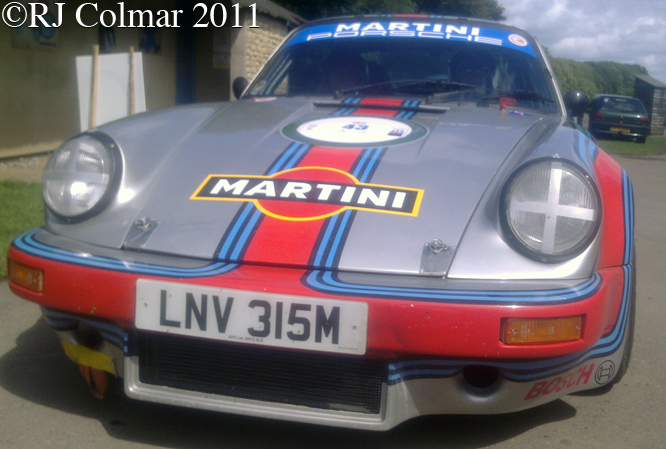
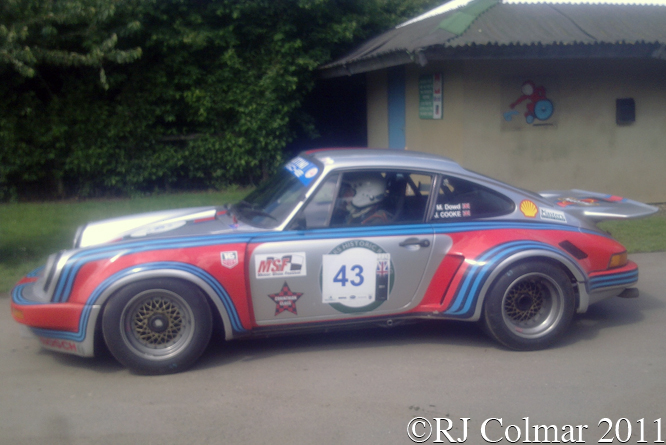
The Seriously Flared One – Porsche 911 Carrera RSR 3.0

Having won the 1970 and 1971 Le Mans 24 Hours and sports car championships with the short lived Porsche 917, Porsche had no suitable motor with which to compete in the top tear of sports car racing which mandated maximum displacement 3 litre / 183 cui motors, of which those designed for and adapted from Formula One dominated the overall honours from 1972 until 1975.

Porsche 911 RSR, Tour Britannia, Castle Combe

To meet the demand from customers running in the GT class Porsche embarked upon a programme of building RSR race cars based on the 911 shell for GT competition in 1973. Initially these cars came with a ‘duck tail’ and motors up to 2.8 litres to 178 cui. Peter Gregg and Hurley Haywood scored back to back overall victories at the Daytona 24 hours with this type of car in 1973 and 1975, and were joined by Dave Helmick in 1973 to win the Sebring 12 hours. Perhaps the single most famous victory for any RSR came on the epic Targa Florio where Herbert Müller and Gijs van Lennep won beating the 3 litre / 183 cui protoypes in the process.

Porsche 911 RSR, Tour Britannia, Castle Combe

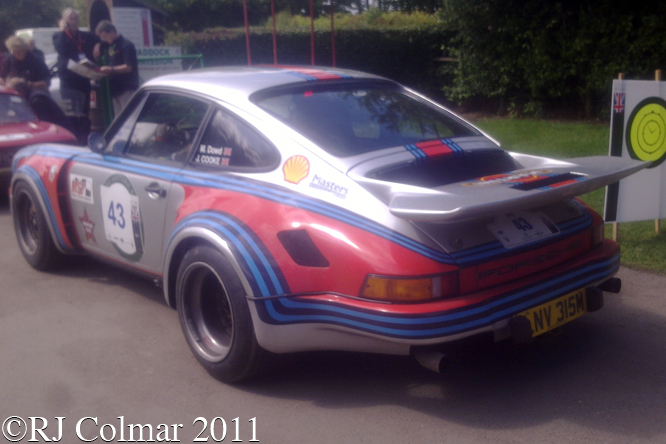
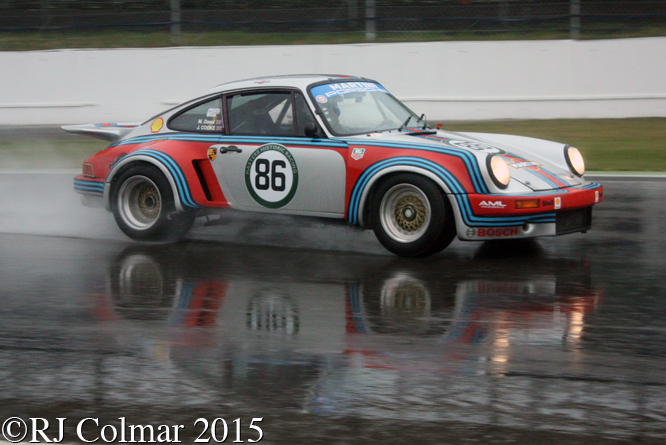
By the end of 1973 the first RSR’s with 330hp 3 litre / 183 cui motors, coil springs replacing torsion bars, flared wheel arches housing wheels with centre locking nuts and ‘whale tales’ came onto the scene most notably in the first International Race of Champions (IROC) series. The first IROC series ran in the winter of ’73 and ’74 at Riverside and Daytona for which 12 identical Carrera 911 RSR 3.0’s, like the one seen in today’s photographs, were prepared for the likes of, Formula One champions; Emerson Fittipaldi and Denny Hulme, Indy 500 winners; Bobby Unser, AJ Foyt, Gordon Johncock and Mark Donohue, Can Am Champions; Peter Revson and George Follmer, NASCAR Champions; David Pearson, Bobby Allison and Richard Petty with USAC Champ Roger McKlusky. Mark Donohue won three of the series four races to become the first IROC Champion.

Porsche 911 RSR, Tour Britannia, Castle Combe

The RSR remained competitive in the Daytona and Sebring endurance classics until 1977. Haywood, John Graves and Helmick drove an RSR to victory at Daytona in ’77, with Al Holbert and Mike Keyser winning the ’76 race at Sebring then George Dyer and Brad Frissell repeating the feat in another RSR in ’77. In Europe Clemens Schickentanz is thought to have made over 75 starts with at least seven outright victories in RSR’s primarily for the Kremer Brothers.

Porsche 911 RSR, Tour Britannia, Castle Combe

In all 60 RSR 3.0’s were built by Porsche and many more 911’s have been upgraded to RSR spec since the models inception. RSR’s were still being raced regularly in front line competition into 1993 when an all new Carrera RSR was introduced with a 3.8 litre / 231 cui motor.

Porsche 911 RSR, Silverstone Classic

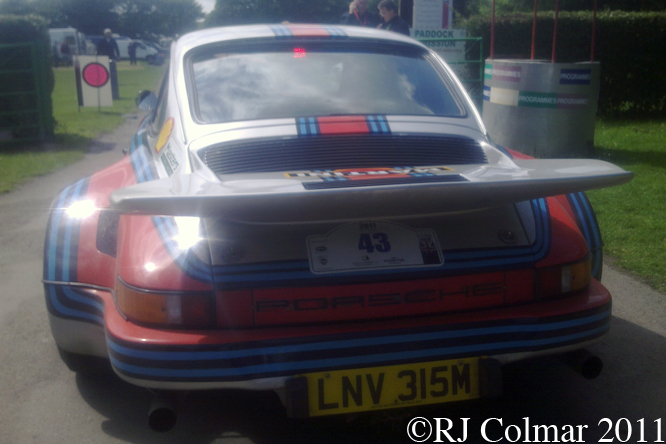
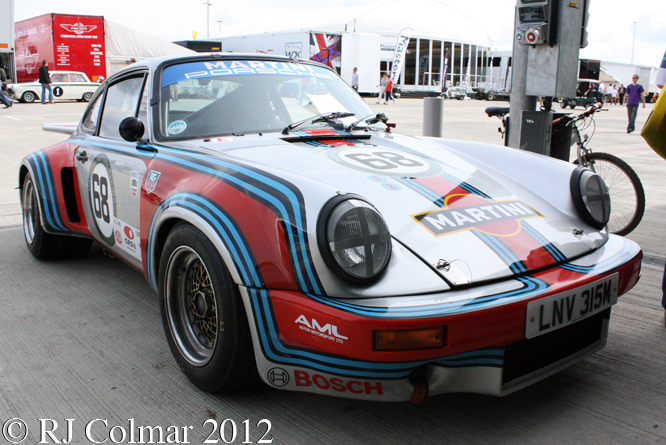
I do not have a history for the 1974 Martini liveried car featured today which, in the 2011 dated pictures, are seen at Castle Combe with Jeremy Cook and Mike Dowd who were taking part in the Tour Britannia, the 2012 and 2015 photo’s were taken at Silverstone Classic where Jeremy and Mike competed in the FIA Masters Historic Sports Car races, if you know anything more about this car please do not hesitate to chime in below.

Porsche 911 RSR, Cooke, Dowd, Silverstone Classic

Thanks for joining me on this “The Seriously Flared One” edition of “Gettin’ a li’l psycho on tyres” I hope you will join me again tomorrow. Don’t forget to come back now !
Share

American Beauty – Scarab #3

After writing off a Maserati 200S in a sports car race at Snetterton, having been banned from racing in the USA for racing underage, Woolworth heir Lance Reventlow visited Lister and Maserati in 1957 and was appalled by the apparent backward chaos he found at the factories.

Scarab, Autumn Classic, Castle Combe

Determined that he could do better Lance Returned to the United States and founded Reventlow Automobiles Incorporated and initiated a successful sports car program for 1958.

Scarab, Silverstone Classic,

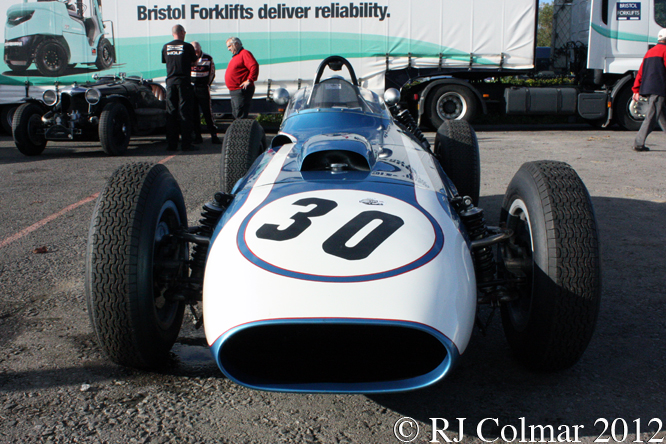
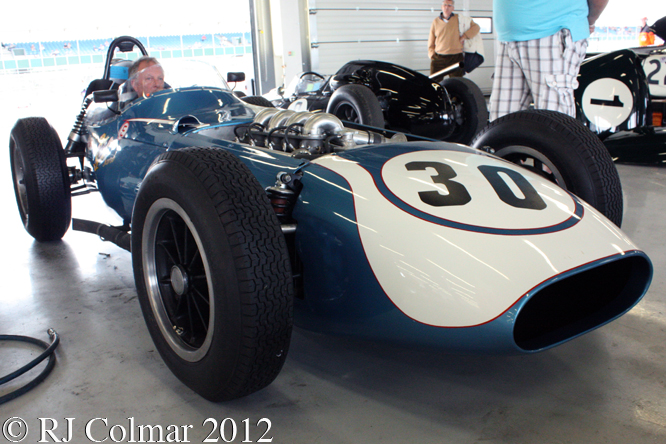
Encouraged by his success Reventlow Automobiles Incorporated engaged Troutman & Barnes to design a space framed contender for the highest level of the sport, Formula One.

Scarab, Silverstone Classic,

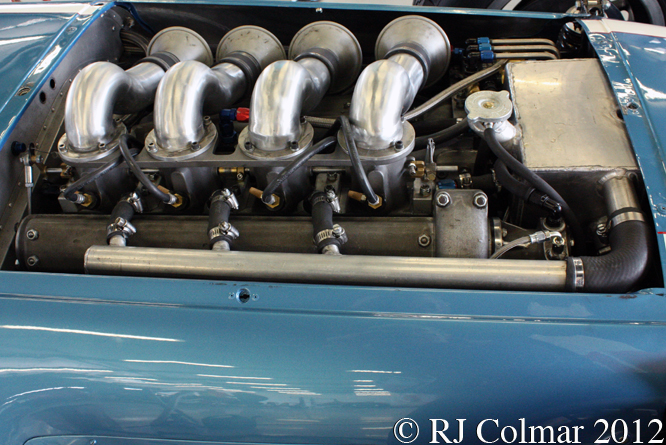
The motor for the new car was designed by Leo Goosens, of Offenhauser fame, who designed a Hilborn fuel injected 2.5 litre / 152 cui 4 cylinder motor with desmodronic, mechanically opened and closed which did away with valve springs, valves as had been favoured by Mercedes Benz during their successful Formula One campaigns from 1954 to 1955.

Scarab, Autumn Classic, Castle Combe

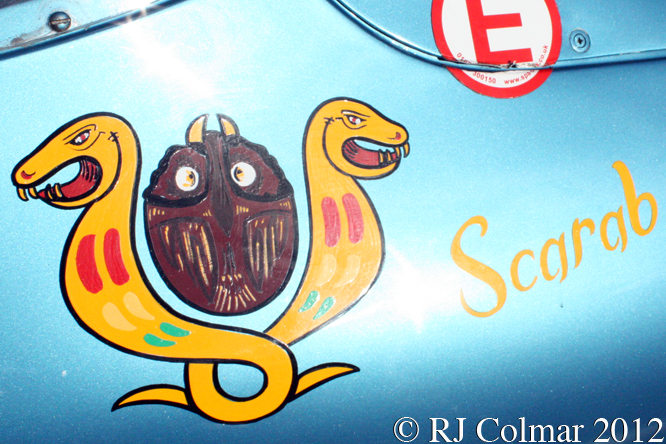
With a wry sense of humour Reventlow deliberately went against the grain of macho exotic names given to racing cars by chosing to call of the cars built by Reventlow Automobiles Incorporated Scarab after a compost beetle.

Scarab, Autumn Classic, Castle Combe

Widely respected for their beauty and build quality the team turned up in Monaco for the start of the World Championship season. Looks were deceiving as the cars proved to be too slow to qualify for the Monaco Grand Prix even after the Goodyear tyres had been replaced with Dunlops, not even Stirling Moss could set a competitive time in a Scarab.

Scarab, Autumn Classic, Castle Combe

Chuck Daigh and Lance Reventlow both qualified for the Dutch Grand Prix however they were both outside the top 15 which meant they did not qualify for start money and so both cars were withdrawn.

Bronson, Scarab, Autumn Classic, Castle Combe

Reventlow qualified 16th for the Belgian Grand Prix and Daigh 18th however Reventlow retired on the second lap and Daigh on the 17th, both with engine problems. In France Richie Ginther replaced Reventlow in the driving seat and qualified 20th with Daigh 23rd and last however neither started because of engine problems.

Scarab, Autumn Classic, Castle Combe

The team did not appear again until the 1960 US Grand Prix where a single car was entered for Chuck Daigh who qualified 18th. Chuck brought the car home 10th, 5 laps down, on what would be the teams final World Championship appearance.

Bronson, Scarab, Autumn Classic, Castle Combe

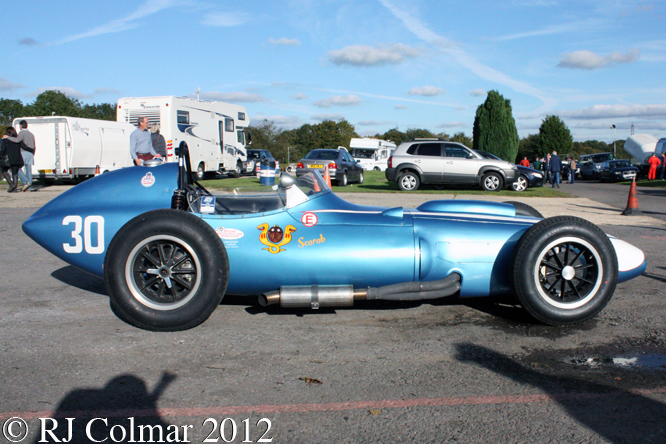
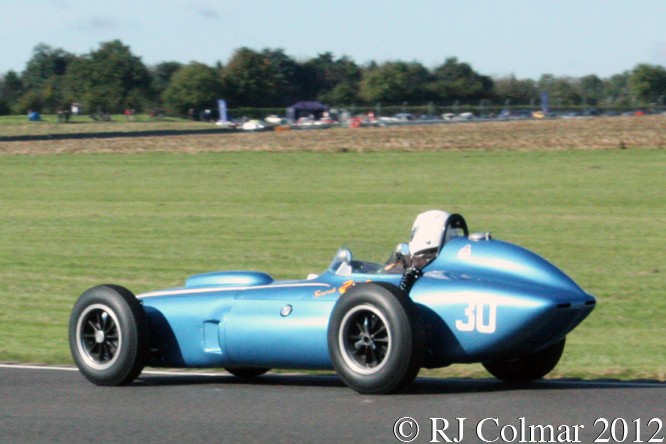
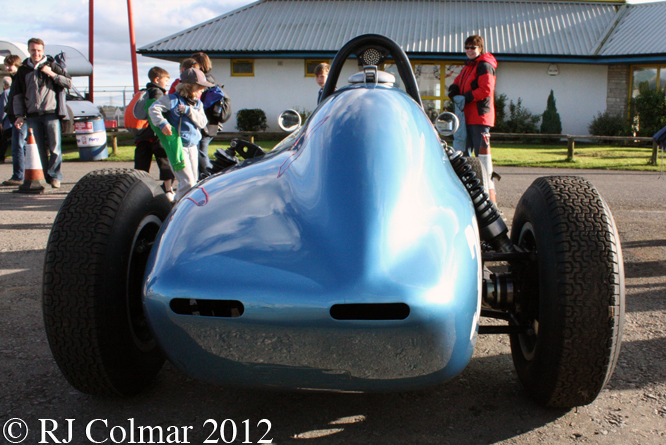
Chassis # 3 seen here was shipped to Europe in 1960 as the teams spare with out a motor. In 1961 Chuck Daigh drove the car fitted with an Offenhauser Indy type motor in the non championship International Trophy at Silvertone and Lavant Cup at Goodwood where he finished 7th and 8th. At the British Empire Trophy Meeting at Silverstone Daigh was badly injured when he crashed the car on what turned out to be the cars final ‘in period’ appearance.

The Scarab had proved to be underpowered and it’s front engined design rendered obsolete by the rear engined designs from Cooper and Lotus and Lance Reventlow had been deceived by the backward chaos he had seen in Europe which disguised much wisdom and craftsmanship gained from decades of experience.

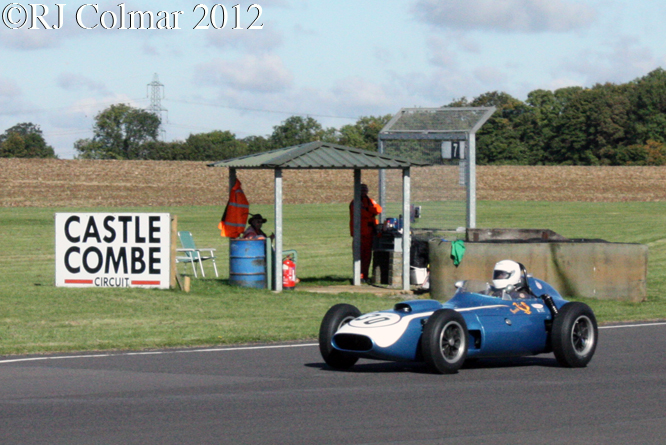
For many years this Scarab was exhibited sans motor at the Donington Park Museum before it was purchased by Julian Bronson who acquired another Offenhauser motor and can be seen demonstrating the car above at Castle Combe.

Wishing all my readers from the United States a festive Independence Day.

Thanks for joining me on this “American Beauty” edition of “Gettin’ a li’l psycho on tyres”, I hope you will join me again tomorrow.

Share