Tag Archives: Walker

Fourth Season Swan Song – Lotus 49C #R6/2 & #R10

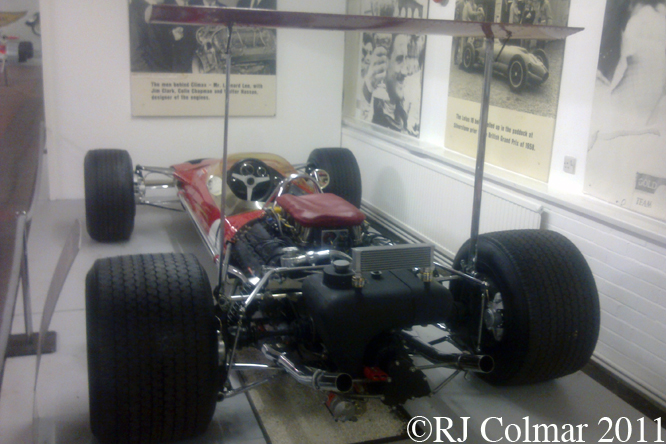
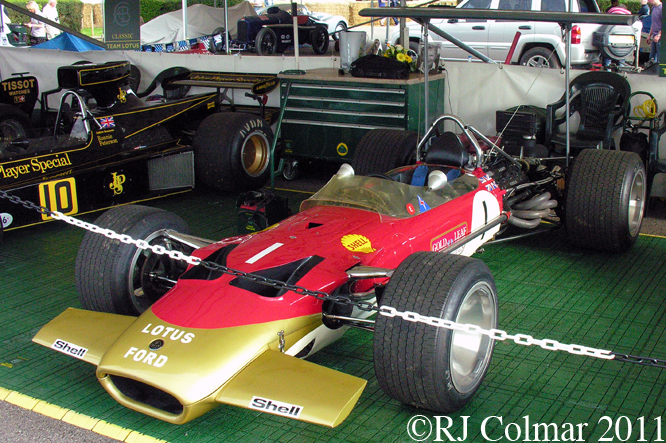
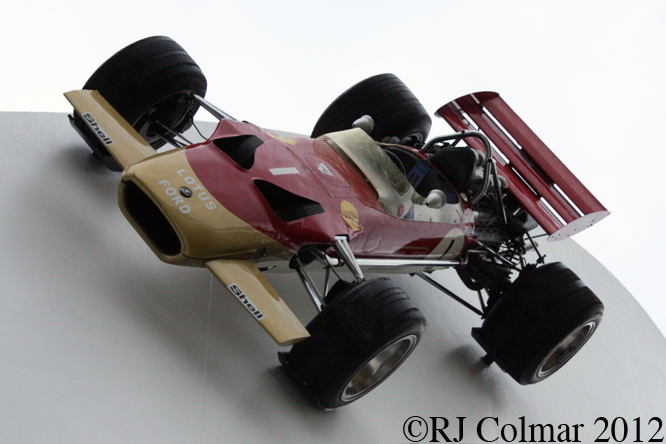
For 1970 Lotus had planned to have the 4 Wheel Drive Lotus 63 ready to challenge for championship honours however even Mario Andretti could not capitalise on any of the cars supposed advantages during 1969 and so the Lotus 49 was updated for a fourth season of competition with 13 inch front wheels to make use of the latest Firestone Tyres as a stop gap while the design and build of the Lotus 72 was finalised.

Lotus 49C, Goodwood Festival Of Speed

The car seen above is Lotus #R6/2 the second car to carry the #R6 chassis plate. The first incarnation of #R6 was the first 49 to be built to ‘B’ spec. Unfortunately it was written off by Jackie Oliver during practice for the 1968 French Grand Prix, and in order to make use of existing travel documents the eighth Lotus 49 to be built was given the #R6 chassis plate and is known as #R6/2. Some parts of #R6/1 damaged beyond repair by Oliver are thought to have been used in the replacement #R6/2 seen here, Rob Walkers privately entered 49 #R7, and the #R12 show car built for Ford which was donated to the Donington Museum.

In it’s second incarnation #R6/2 still in high wing ‘B’ spec was used by Graham Hill to win the 1968 Mexican Grand Prix which clinched the 1968 World Championships for Graham and Team Lotus. Graham continued to use #R6/2 in 1969 before the car was given to Jochen Rindt to drive. Jochen scored his first two Grand Prix victories with R6/2 the 1968 US Grand Prix with the car in ‘B’ spec and the 1970 Monaco Grand Prix with the car ‘C’ spec with the low triple plane rear wing that was designed for the Lotus 72. Jochens win at Monaco would be the third consecutive win in the Principality and also the 12th and final Grand Prix win for the Lotus 49 type.
Lotus 49C, Goodwood Festival Of Speed

The second Lotus 49C featured today appears to be chassis #R10 which has given me a bit of a mental run around. This car appeared at Goodwood last year in high wing ‘B’ spec.
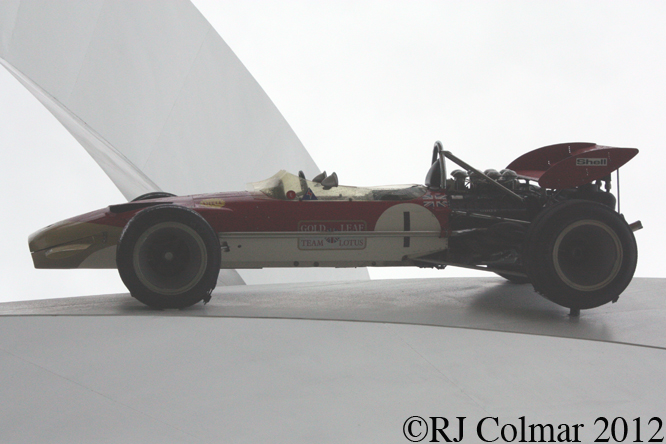
Lotus 49C, Goodwood Festival Of Speed

As you can see from my heavily revised Lotus 49B blog the car started life as Lotus 49 #R5 and for reasons that are not clear the car was renumbered #R10 and sent to the Antipodes for Jochen Rindt to use in the Tasman Series.
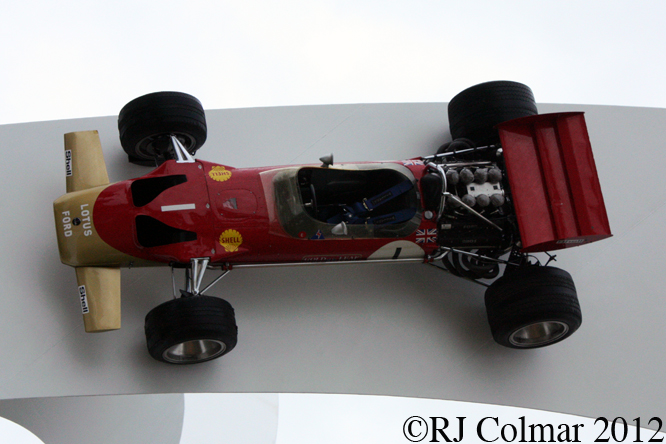
Lotus 49C, Goodwood Festival Of Speed

Graham Hill used #R10 to win the 1969 Monaco Grand Prix as he had done in 1968 when the car carried the chassis #R5. In 1970 Graham drove #R10 in the 1970 Monaco Grand Prix to fifth place when it was loaned out to the Rob Walker team for whom he was driving.

Emerson Fittipaldi made his first three Grand Prix starts in #R10 towards the end of 1970 scoring a best 4th place finish second time out in the 1970 German Grand Prix at Hockenheim.

Thanks for joining me on this “Forth Season Swan Song” edition of “Gettin’ a li’l psycho on tyres” I hope you will join me again tomorrow. Don’t forget to come back now !

Share

Family Affair – GSM Delta

In 1957 John Scott met South African Bob Van-Niekerk who had plans to build a sports car in South Africa. John told Bob that if he one of his cars won a race in Britain he would arrange to manufacture them in the UK.

GSM Delta, Prescott

Bob with fellow South African’s Willie Meissner and Verster de Wit who was responsible for the body styling produced a mould in the UK and sold the first body built in the UK in order to pay the cost of shipping the moulds to South Africa.

GSM Delta, Prescott

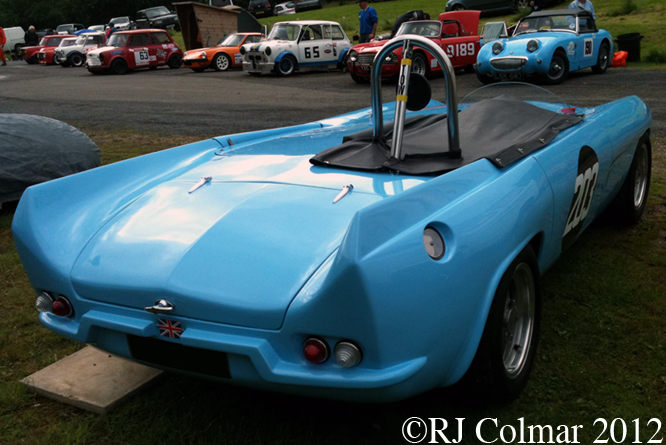
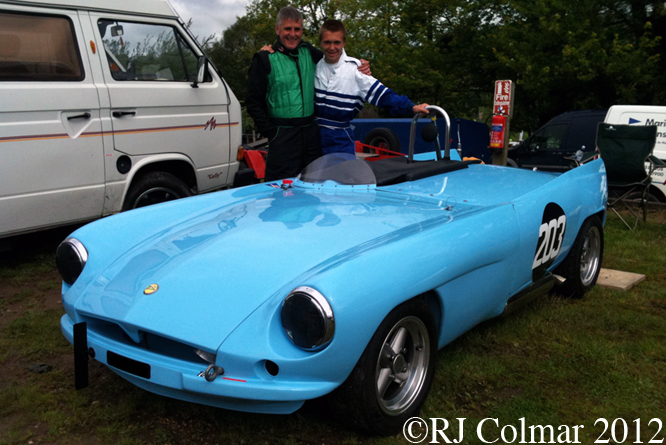
Above John Scott’s son Clive is seen standing next to his grand son, John’s great grandson, Ben behind the 1962 GSM Delta Clive purchased in 2009.

Bob went back to South Africa and set up GSM (Glass Sport Motors) with Willie Meissner and started production of their first vehicle which carried the Dart name.

GSM Delta, Prescott

Immediately competitive in South Africa, scoring 1-2 victory on it’s debut in a 4 hour race in Cape Town in 1958, by 1960 one of the GSM Dart’s found it’s way to the UK in 1960 and won first time out at Brands Hatch. True to his word John started a second production shop for the GSM in West Malling, Kent renaming the car Delta, as Daimler had already found out the Dart name was the property of Chrysler in the USA.

GSM Delta, Prescott

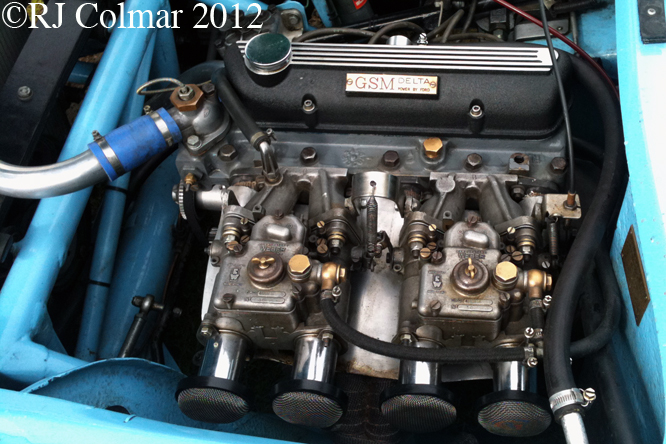
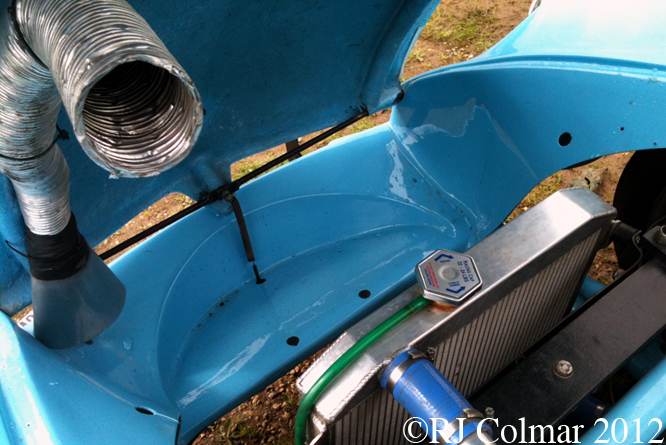
Power for the GSM Delta came from off the shelf Ford’s from 1 litre / 61 cui to 1.5 litres / 92 cui in size, the motor seen here is one of the larger pre crossflow Ford unit’s. Ford components were also used for the steering, brakes, gearbox and rear axle.

GSM Delta, Prescott

When Clive bought this car in 2009 he was surprised to find that he recognised his mothers handwriting in the log book.

GSM Delta, Prescott

Among the winners in the British built GSM Delta’s between 1960 and 1965 was Dutchman Jan van Niekerk, Jeff Uren, 1959 British Saloon Car Champion who is also known as the man behind the “Savage Cartina’s“, John Glyde Walker, Joe Krupwicz Americans Bob Clift, Bill Osband, Dave Johnson and Don Grohs.

GSM Delta, Prescott

Figures vary as to how many GSM Delta’s were built between 1960 and 1961, Clive puts the number at “approximately 40” of which he believes fewer than 10 remain. The car that Clive owns won the 2001 Paul Matty Challenge in 2001 and the 2006 Aldon / HSA Championship.

My thanks to Clive for his help with today’s blog.

Thanks for joining me on this “Family Affair” edition of “Gettin’ a li’l psycho on tyres”, I hope you will join me again tomorrow. Don’t forget to come back now !

Share

Personal Luxury – Ford Thunderbird Continental

Following the announcement of the Chevrolet Corvette sports car in 1953, Ford responded by developing the Ford Thunderbird which was differentiated from the Corvette by it’s emphasis on luxury and comfort over performance.

Ford Thunderbird, Race Retro

Former GM Executive Lewis D. Crusoe and Ford Stylist George Walker found inspiration for the Thunderbird design from a sports car they saw in Paris. They worked with Ford Designer Frank Hershey on the two seater.

Ford Thunderbird, Race Retro

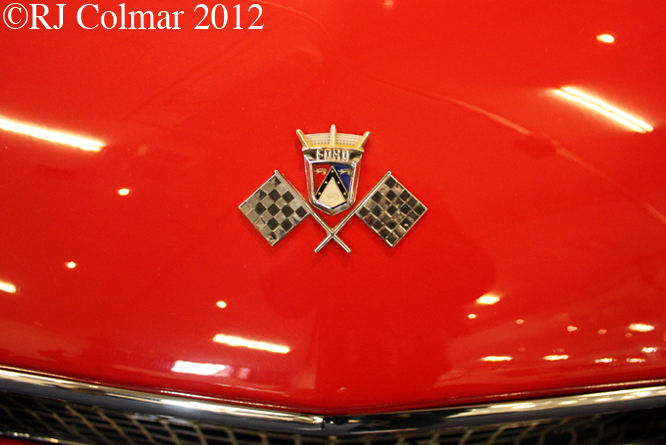
Ford Stylist Alden Gibberson was given a Saks suit complete with 2nd pair of trousers as his reward for coming up with the Thunderbird name which was first seen in public at the Detroit Motor Show in early 1954 and went in to production for the 1955 model year.

Ford Thunderbird, Race Retro

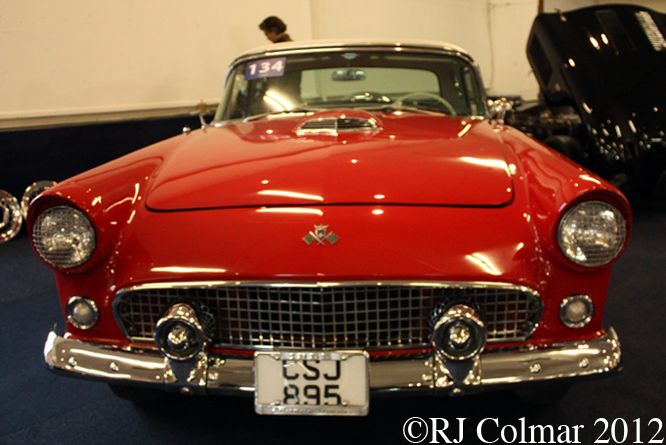
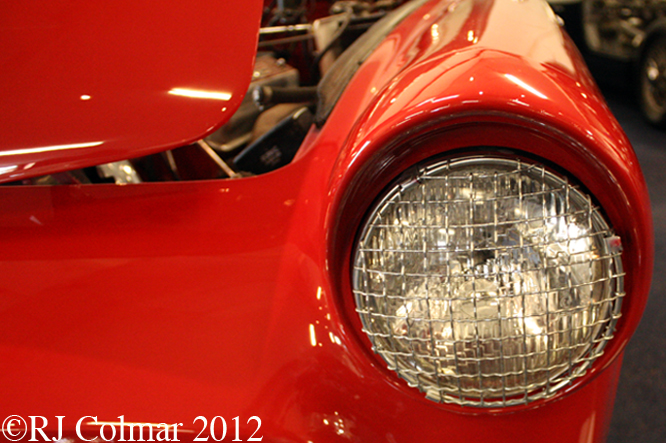
Despite many competition features like the stone guard grill over covering the front head lights the original Thunderbird was not intended for competition use.

Ford Thunderbird, Race Retro

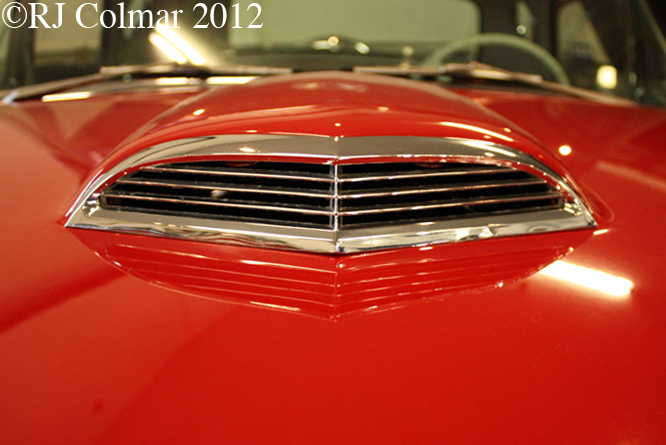
The intake on the bonnet / hood is just for show, as was the 150 mph speedometer fitted to the first series Thunderbirds which had a top speed of around 100mph.

Ford Thunderbird, Race Retro

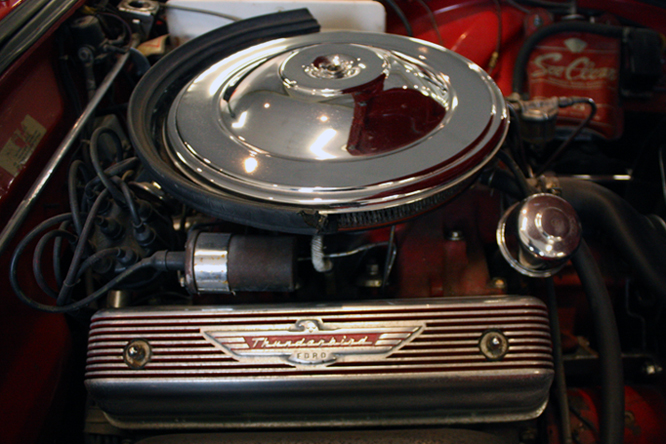
The distinctive Thunderbird rocker covers belie the fact that the 190 hp 4.8 litre / 292 cui Y block V8 was sourced from Fords Mercury division.

Ford Thunderbird, Race Retro

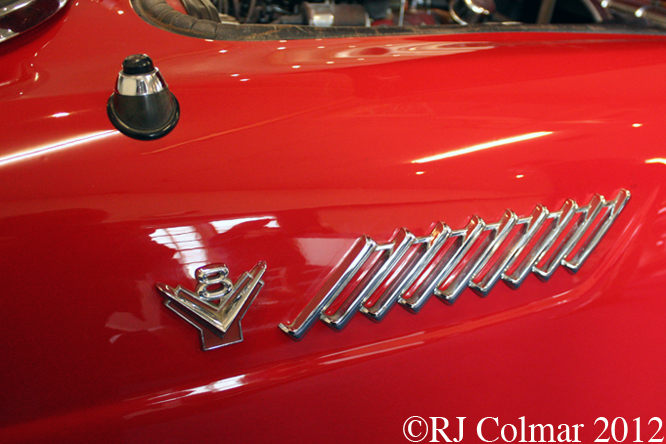
The detailing is typical of 1950’s dream cars note the V8 badge incorporates the Y which denotes the engine type.

Ford Thunderbird, Race Retro

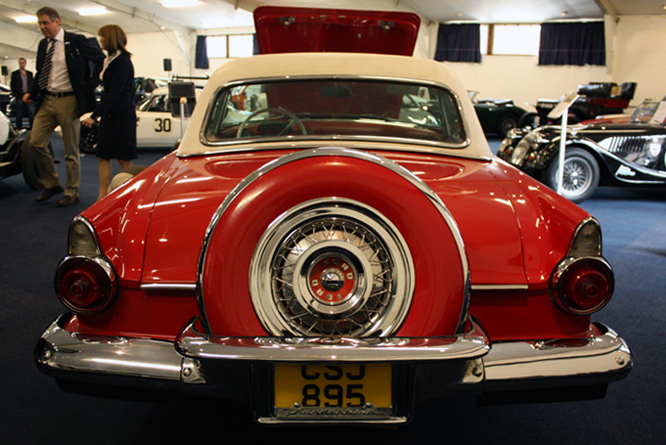
As I understand it the removable glass fiber hard top was part of the Continental option package …

Ford Thunderbird, Race Retro

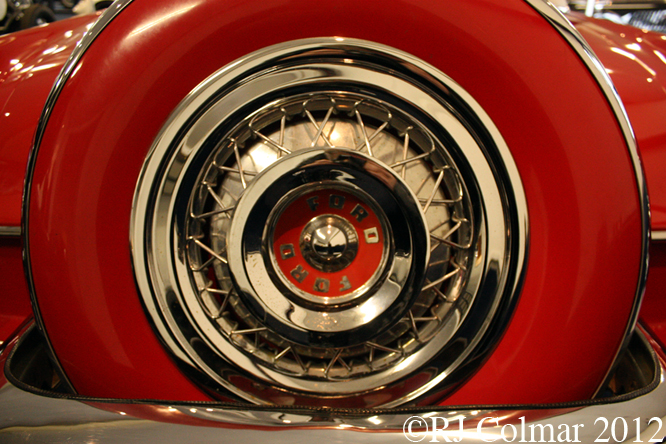
as was the bumper mounted spare wheel.

Ford Thunderbird, Race Retro

The first series Thunderbird out sold it’s Corvette competitor 20 fold with over 16,000 unit’s produced in the first year of production.

Thanks for joining me on this ‘Personal Luxury’ Edition of Gettin’ a li’l psycho on tyres’, I hope you will join me again tomorrow. Don’t forget to come back now !

Share

Pro ET – Race Ventora

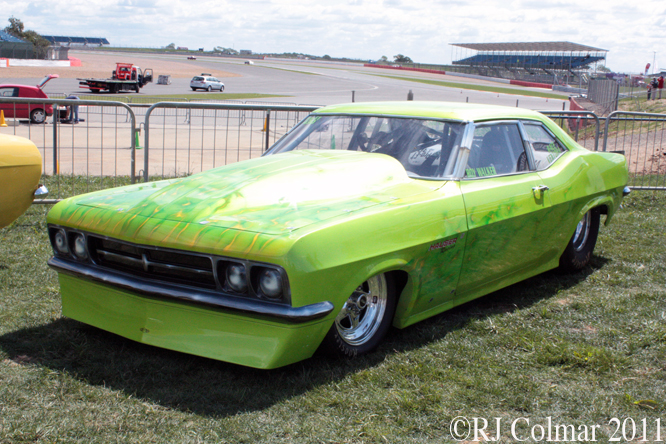
The Vauxhall Victor FD Series was built between 1967 – 1972 the Ventora ws launched in 1968 with a 3294 cc / 201 cui 6 cylinder motor replacing the standard Victor FD series 4 cylinder motor.

Race Ventora, Silverstone

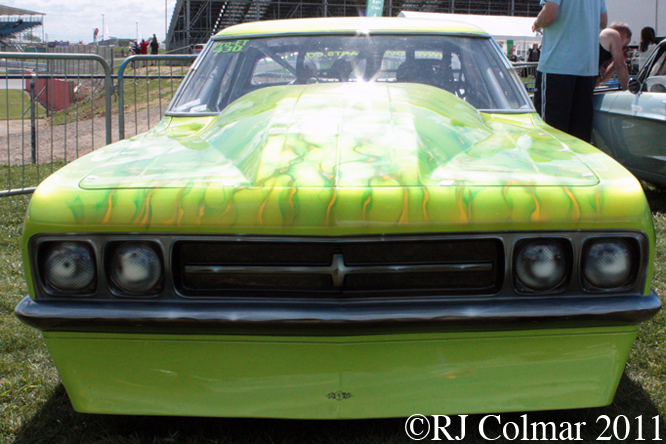
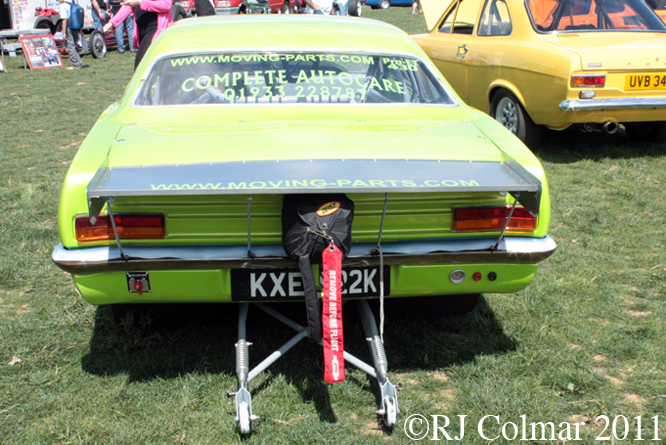
This Race Ventora, seen here at the Silverstone Classic, is powered by a 468 cui / 7669 cc V8 and driven by Ray Walker Pro ET drag events.

Race Ventora, Silverstone

Pro ET races see drivers paint the elapsed time (dial in) they believe they can achieve on their back window’s races are then staged between cars of different performance levels with the release times staggered by the difference dial in times. So that each driver should, in theory, cross the finish line at the same time.

Race Ventora, Silverstone

If a driver jumps his release time he is out, known as a ‘Red Light’, if a driver beats his dial in he is out, known as a ‘Break Out’, unless both drivers beat their dial ins in which case the driver who beats his dial in by the least amount wins.

While I was looking for information on Ray’s car i came across some information on another Vauxhall Victor of the same FD type that goes by the name of Red Victor.

Red Victor has gone through three evolutions and in the process lays claim to being the world fastest street legal car with a 0-60mph time of 0.9 seconds !

This link takes you to a youtube clip of Red Victor 2 and this second link takes you to a fascinating thread on the building of Red Victor 3.

I’ve just finished watching Tony Stewart round out a tremendous victory at Homestead Miami over his championship rival Carl Edwards. Kudos to all the fans of the Big 14 what an achievement to win the Cup as an owner driver. Commiserations to Carl who has earned my admiration for the way he competed and handled his defeat having drawn with Tony on points and lost on tie braking victories. Can’t wait until the new season starts at Daytona in February.

Thanks for joining me on this Pro ET edition of “Gettin’ a li’l psycho on tyres” I hope you will join me again tomorrow. Don’t forget to come back now !
Share

Leased Winner – Lotus 18

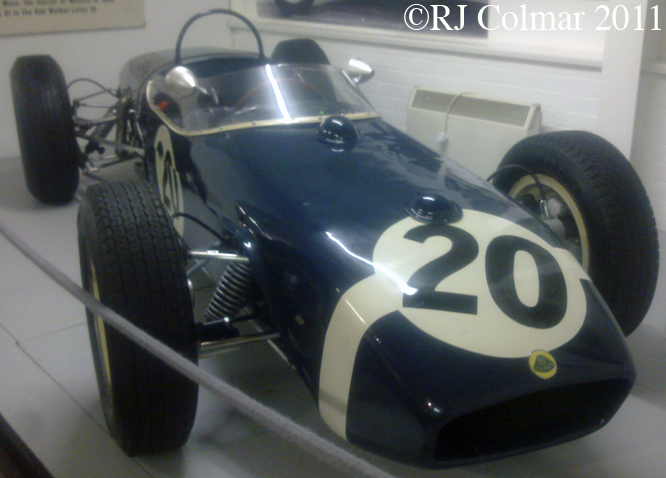
Following the lead set by Cooper Cars winners of the 1959 World Manufacturers Championship for Formula One cars Colin Chapman took the rear engine plunge and built the Lotus 18 open wheeler that could be entered with the correct engine spec in to either Formula Junior, Two or One races.

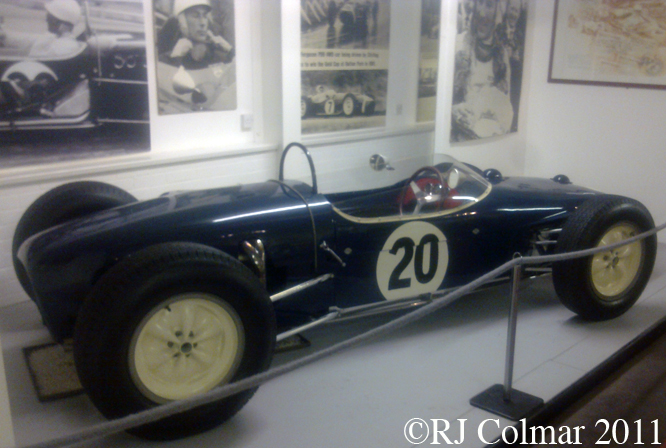
Lotus 18, Donington Museum

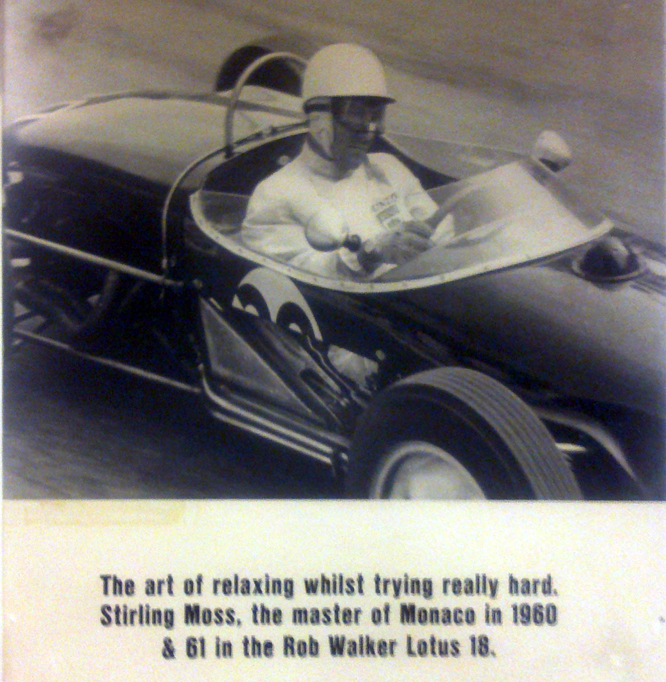
Rob Walker, heir to the whiskey family of the same name, leased a Lotus 18 with a Coventry Climax motor for Stirling Moss to drive in the 1960 Grand Prix season. On the cars debut, in Monaco, Stirling qualified on pole and eventually won the race, giving Lotus their first Formula One victory after both Jo Bonnier in a BRM and Jack Brabham driving a Cooper Cliax had spent time leading the intermittently wet race.

http://www.youtube.com/watch?v=0yH9fiJX1_s

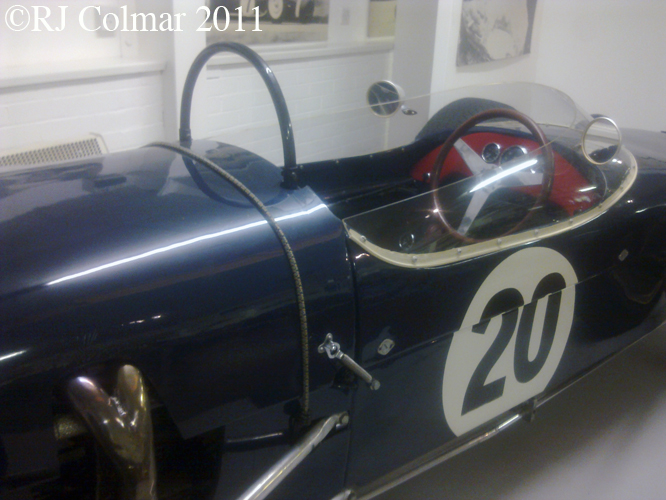
An accident at Spa interrupted Stirling’s 1960 season but he bounced back with a win at the season ending US Grand Prix again driving this Lotus 18 for entrant Rob Walker. The following season a smaller Coventry Climax motor was fitted to this chassis, seen here at Donington Park Museum, as required by the new regulations for the 1961 season.

Stirling Moss, Lotus 18, Monaco 1961

(Copyright holder unknown image will be removed or credited upon request)

Amazingly Stirling Moss managed to not only win pole at Monaco in 1961 ahead of three more powerful shark nose Ferrari’s but then, after dicing with Richie Ginther in his Ferrari, proceeded to win the race, a then record setting third Monaco Grand Prix victory.

Lotus 18, Donington Museum

Later in the season Stirling Moss would take his final Formula One victory driving the Lotus 18, fitted with newer Lotus 21 bodywork, at the German GP at the Nurburgring. At the start of the 1962 season Moss was lucky to escape with his life from a career ending accident at Goodwood before the Grand Prix season got under way.

Thanks for joining me on this Stirling Moss edition, of ‘Gettin’ a li’l psycho on tyres’, I hope you will join me again tomorrow. Don’t forget to come back now !
Share

2 miles a minute – 1905 Darracq 200hp

Using the profits from the sale of his Gladiator cycle factory, Alexandre Darracq founded Automobiles Darracq S.A.in 1896.

In 1905 he built a 200hp V8 specifically for setting Land Speed Records.

Straight out of the box Victor Hemery set an LSR on the V8 Darracq at 109 mph at Aries in France.

The Darracq was then shipped to Ormond – Daytona where Hemery’s belligerent behaviour did not go down well with officials so Louis Chevrolet was drafted in to drive the car to a 1 mile petrol powered LSR of 117.65 mph only 10 mph slower than Frank Marriott on his Stanley Steamer ! Finally Victor Demogeot set a 2 mile LSR beating the Stanley Steamer with an average speed of 122.5 mph becoming the first vehicle to cover 2 miles in less than 1 minute.

Sir Algernon Lee Guiness of the famous Brewing company became the next owner of the Darracq and he used it to set many records in the UK and France until 1909.

The car then fell into the hands of someone who scrapped the axles for no particularly obvious reason and somehow Sir Algernon retrieved the remaining car which was kept stored until 1956 when his widow sold the car to Gerald Firkins who recreated the vehicle as we see it today.

When the pistons were replaced it was found that the engine volume was 25400 cc / 1495.1 cui not 22.5 litres as had been thought for nearly 100 years !

Mark Walker purchased the vehicle in 2006 and has campaigned it regularly in hill climbs and races ever since. Notice anything missing from the front axle ? This vehicle has never had brakes acting on the front wheels yet still gets driven competitively in the rain !

Despite having no front brakes, or reverse gear, a rear axle recreated from a drawing in a 90 year old book and being well known for spitting flames the Darracq is road legal and Mark drives it to and from competitive events.

Hope you have enjoyed todays Edwardian edition of Gettin’ a lil’ psycho on tyres, looking forward to Ferrari Friday when I’ll be presenting a Ferrari that allegedly served time as a mini van on the dark side of the moon ! Don’t forget to come back now !

Share