Pourtout For All – Bugatti Type 44 #44769

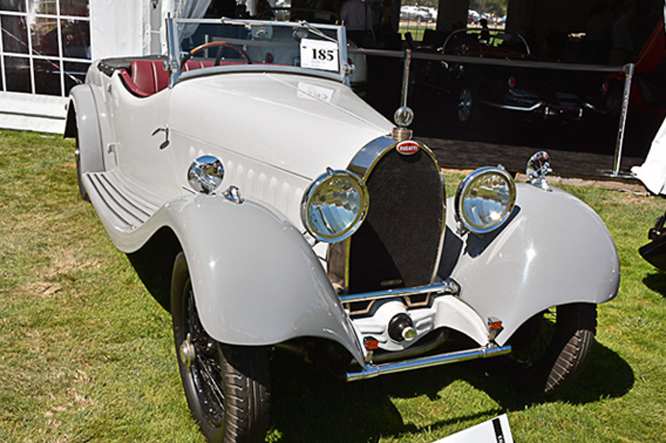
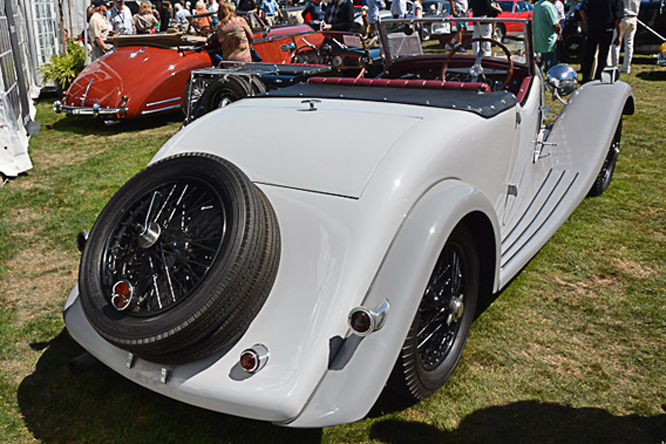
Bugatti chassis #44769 was completed in October 1928 and sent from Molsheim to Parisian Carrosserie Pourtout to have it’s body tailor made.

Bugatti Type 44, The Quail Auction, Geoffrey Horton

The finished 80hp 8 cylinder single cam, 3 valve per cylinder, 3 litre car was then sent to Parisian Bugatti agent Stand-Auto in December 1928 with a 44,450 French Franc price tag for its first owner.

Bugatti Type 44, The Quail Auction, Geoffrey Horton

#44769 remained in Europe where it’s owners included the renowned Marque expert “Monsieur Bugatti” aka Jean De Dobbeleer of Belgium until 1960 when it was sent to Reno Nevada for the owner who put into last years Quail Auction.

Bugatti Type 44, The Quail Auction, Geoffrey Horton

Starting in 1961 #44769 was dismantled and underwent a five decade preservation that included rebuilding the motor, wiring loom, chassis frame, body and interior which was completed in 2007.

Last year the 75 mph car, built as a contemporary rival to the 3 litre Bentley, sold at The Quail Auction for US$ 363,000 / £215,648 including premium.

My thanks to Geoffrey Horton for sharing his photographs of today’s featured Bugatti Type 44.

Thanks for joining me on this “Pourtout For All” edition of “Gettin’ a li’l psycho on tyres” I hope you will join me again tomorrow when I’ll be looking at a stickered BMW. Don’t for get to come back now !

Share

Tubular Chassis San Remo – Maserati 4CLT #1608

During 1946 the development of the Maserati 4CL had seen the introduction of chassis construction using tubular section materials to stiffen the original channel / box section frame.

The following year at least two 4CL chassis were built with thicker tubular section materials replacing the channel / box sections all together.
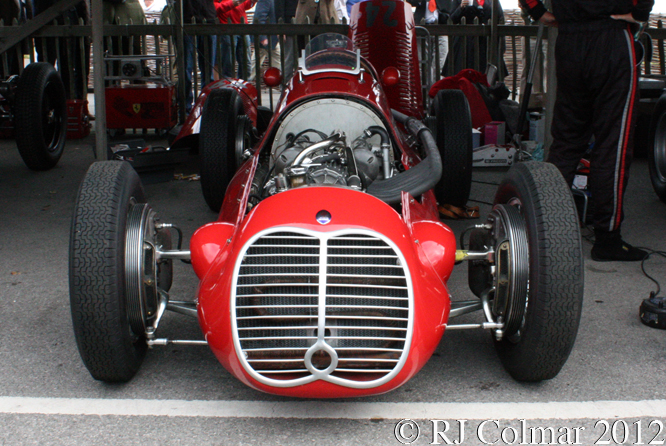
Maserati 4CLT, Goodwood Revival

In 1947 at least one 4CL was fitted with a twin stage, supercharger, replacing the earlier single supercharger. It would appear that in 1948 the tubular construction combined with twin stage super charged motor, to which a new factory body was fitted, became the vehicle known as the 4 CLT.

On it’s debut in San Remo Alberto Ascari drove a 4CLT to victory ahead of the sister car of Luigi Villoresi, with Clemar Bucci making it a Maserati 1,2,3 driving and older 4CL. Villoresi won 3 more races aboard a 4CLT and Reg Parnell claimed one more for the 4 CLT model to claim 5 victories in 1948.

Maserati 4CLT, Goodwood Revival

In 1949 the 4CLT’s including chassis #1608 received minor modifications to the brakes, cockpit layout and oil tank and in the hands of Ascari, Villoresi, Parnell, Juan Manuel Fangio and Toulo de Graffenried 4CLT’s were credited with at least 10 wins from at least 27 Grand Prix or similar events for which they were legible to run that year.

The exact histories of particular 20 4CLT chassis built between 1948 and 1950 is difficult to ascertain from my small library. The internet has helped me to establish that today’s featured car chassis #1608 appears to have been built in 1949 and was delivered to Piero Carini in September of that year.
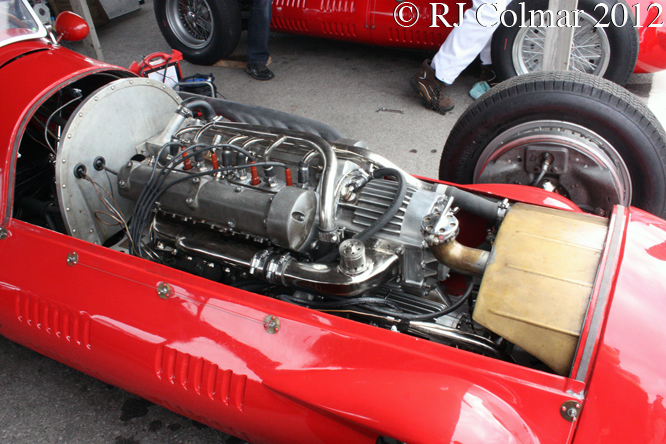
Maserati 4CLT, Goodwood Revival

The earliest reference I have been able to find for the car competing ‘in period’ is that it appears to have been raced on the 18th of December 1949 in the 15 lap IV Gran Premio del General Juan Perón y de la Ciudad de Buenos Aires from which Piero retired.

A couple of weeks later Piero also appears to have taken the start of the IV Gran Premio Extraordinario de Eva Duarte Perón at Buenos Aires driving the same car and is listed neither among the top 12 finishers or among the retirements.

A week later on the 15th of January 1950 Piero recorded a 12th place finish, 2 laps down, in the III Gran Premio Internacional del General San Martín El Torreón at Mar del Plata.

On January 22nd Piero is shown as retiring #1608 from the IV Copa Acción de San Lorenzo run at Rosario. Back in Europe Piero drove #1608 in the San Remo Grand Prix for which he qualified 10th, but spun out and stalled on lap 25.

Argentinian entrant José Vianini then took #1608 back to South America for the 1950/51 Temporada series in which it was driven by several yet to be identified drivers.

Uruguayan driver Azdrúbal Esteban Fontes Bayardo also known as “Pocho” is thought to have become the third owner of #1608 in 1952 and is described by one source as finishing sixth in the 1952 Eva Peron GP “in his Maserati 4CLT powered by a Chevrolet V8 engine”.

The last known ‘in period’ appearance of #1608 is on the 23rd of March 1952 in which ‘Pocho’ is listed as a starter. #1608 seen here at Goodwood today belongs to Klaus Lehr.

My thanks to Felix Muelas for posting his known results on the Argentinian Temporada series on The Nostalgia Forum in October 2000.

Thanks for joining me on this “Tubular Chassis San Remo” edition of “Gettin’ a li’l psycho on tyres” I hope you will join me again tomorrow when I’ll be looking at a 3 litre Bugatti. Don’t forget to come back now !
Share

AJ Watson RIP – Racing Associates Watson Roadster

Today’s post is dedicated to the memory or AJ Watson who passed four days past his 90th birthday on May 12th. AJ designed and built 23 Watson Roadster Indy Cars after redesigning John Zinks 1955 Indy 500 winning Kurtis KK500C driven by Bob Sweikert.

Rathman Watson, Sachs Ewing, 1960 Indianapolis 500

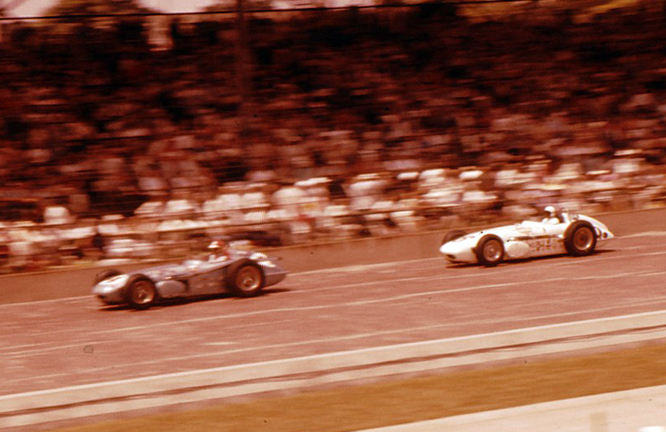
AJ’s own designs won the Indy 500 in ’56 with Pat Flaherty driving John Zinks car followed by Rodger Ward in the ’59 Leader Card Watson and Jim Rathman in the 1960 Ken – Paul Watson seen above being chased Eddie Sachs in the Van Dean Lines Ewing.

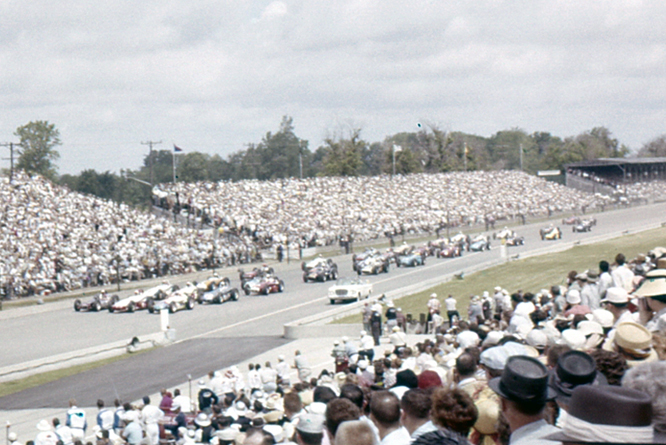
1962 Indianapolis 500

Rodger Ward won again in the Leader Card Watson in ’62, seen in the middle of the front row above, followed by Parnelli Jones in JC Agajanian example in ’63 seen below.

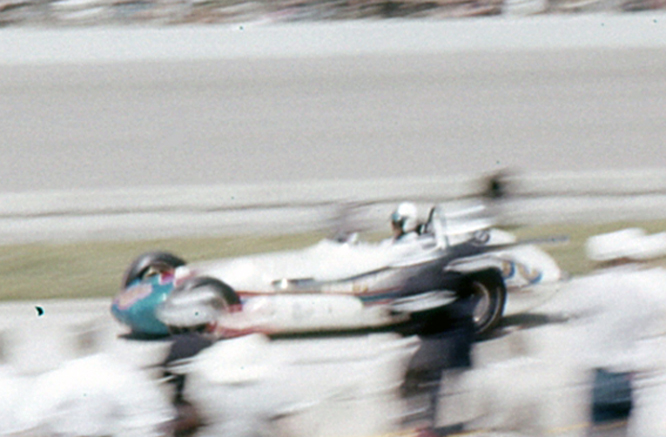
Jones, Agajanian , Watson, 1963 Indy 500

Finally AJ Foyt, seen above drove the Ansted-Thompson Racing Watson to victory in ’64 which would become the last Indy 500 victory for a front engined Roadster.

Foyt, Ansted-Thompson Racing Watson, 1964, Indianapolis 500

Today’s featured car is perhaps the ultimate development of the Watson line, it was built in 1963 for Racing Associates who entered Ebb Rose. Ebb got bumped off the grid, but the following year the car was entered for Johnny Rutherford who qualified 15th and was classified 27th.

Racing Associates Watson, Goodwood Festival of Speed

For 1965 Bobby Grim was entered in the Racing Associates Watson and failed to qualify the 252 cui Offy powered machine.

Racing Associates Watson, Goodwood Festival of Speed

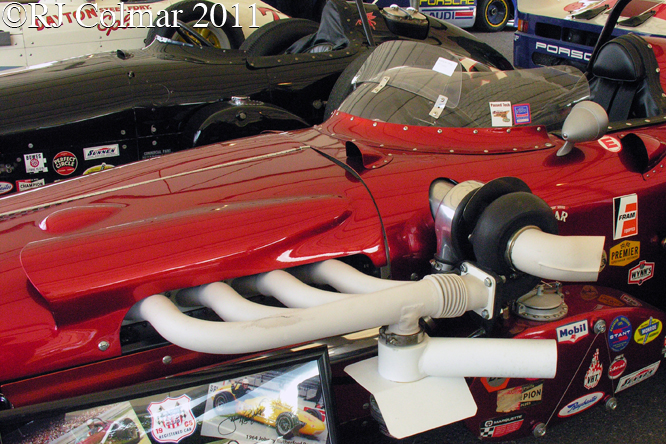
In 1966 Racing Associates has a 168 cui Offy fitted which gave an additional 50 hp thanks to the white pipes and turbocharger fitted to the exhaust. This time Bobby Grim just qualified 31st and was classified 31st after being involved in the start line pile up, on what would be the last appearance of a Watson in the Indy 500.

Racing Associates Watson, Goodwood Festival of Speed

This was also the beginning of a new and final chapter in the story of the famous Offy motor which in turbocharged form would power Bobby Unser to victory in 1968; Mark Donohue ’72, Gordon Johncock ’73, Johnny Rutherford in ’74 and ’76 interupted by Bobby Unser in ’75 and would continue to be used until 1983 when the two Offenhauser Volstedts failed to qualify.

My thanks to Steve Arnaudin for sharing his late Dad Ed Arnaudin’s photo’s of the Watson Roadster’s in their heyday.

I hope you will join me in wishing AJ Watson’s family and friends including GALPOT contributor my sincerest condolences.

Thanks for joining me on this “AJ Watson RIP” edition of “Gettin’ a li’l psycho on tyres” I hope you will join me again tomorrow. Don’t forget to come back now !
Share

Counter Clockwise Spider – FIAT 850 Spider

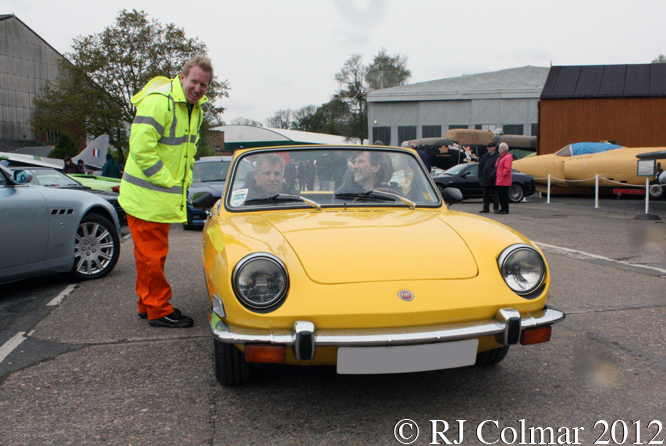
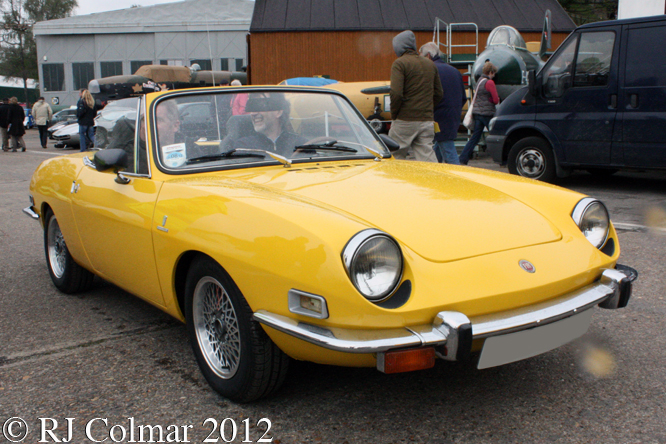
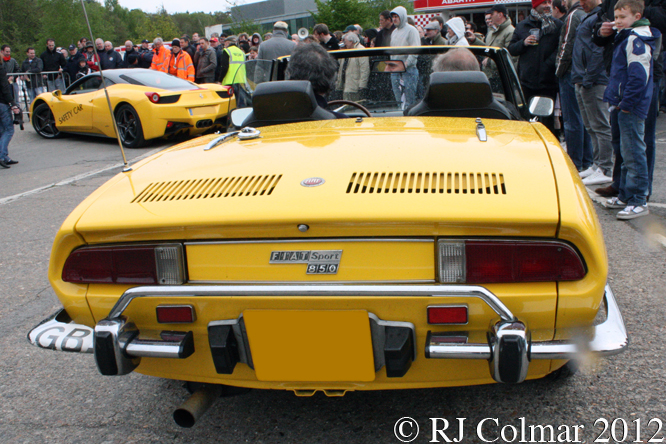
One year after the launch of the original FIAT 850 in 1964, FIAT brought out Coupé and Spider variants.

FIAT 850 Spyder, Auto Italia, Brooklands

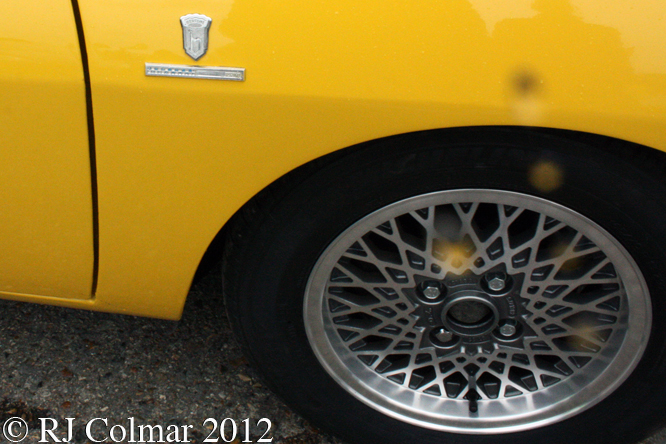
The 850 Spider featured body work designed and built by Bertone.

FIAT 850 Spyder, Auto Italia, Brooklands

The design appears to have been inspired by the 1963 Bertone Concept Vehicle the Corvair Testudo.

FIAT 850 Spyder, Auto Italia, Brooklands

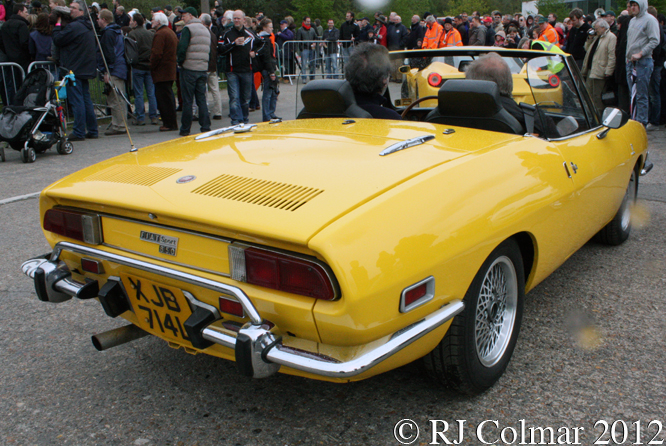
Among the features unique to the Spider was it’s instrument panel and it shared sports seats and steering wheel with the Coupé.

FIAT 850 Spyder, Auto Italia, Brooklands

The 850 Spiders motor was uprated from 34hp to 49hp and unlike it’s siblings it rotated counter clockwise to give a top speed of 90 mph.

FIAT 850 Spyder, Auto Italia, Brooklands

In 1968 a revised spider received a 902 cc / 55 cui motor which produced 52 hp. The 1972 model seen here at Auto Italia Brooklands was made the year before 850 Spider production ceased in 1973 by which time Bertone was engaged in the production of the FIAT X1/9 which would later become a Bertone badged product.

Thanks for joining me on this “Counter Clockwise Spider” edition of “Gettin’ a li’l psycho on tyres” I hope you will join me again tomorrow for a tribute to the late great AJ Watson. Don’t forget to come back now !
Share

Low Roof Coupé – Ferrari 250 GT Boano Coupé #0553GT

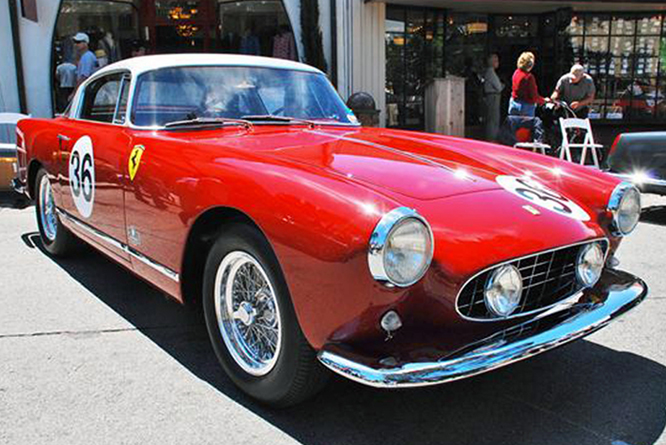
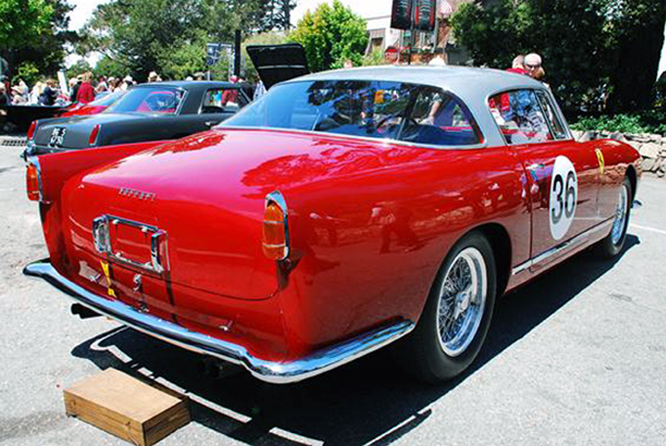
When Pinin Farina could no longer keep up with the production of Ferrari bodies in the mid 1950’s a deal was struck with Mario-Felice Boano of Carrozzeria Boano to manufacture bodies to a Pinin Farina design.

Ferrari 250 GT Boano, Concours on the Avenue, Carmel by the Sea

Today’s featured Low Roof Coupé chassis #0553GT was manufactured in 1956 and delivered to it’s first owner Franco Buzzoni in Pisa, Italy. By 1960 it was to be found in the United States the car then went to France and the Netherlands having it’s original motor swapped out in the 1970’s.

Ferrari 250 GT Boano, Concours on the Avenue, Carmel by the Sea

In 2006 #0553GT was reunited with it’s original motor and the following year owner Tony Schwartz gave the car it’s competition debut winning it’s class at Mt. Tremblant and in two races at Fontana.

In 2008 Gerald T. Vento of Velox Motorsport acquired #0533GT which is one of 88 Ferrari 250 GT’s for which Boano built bodies between 1955 and 1957.

My thanks to Geoffrey Horton for sharing his photo’s of #0533GT which were taken at Concours on the Avenue in Carmel by the Sea in 2011.

Thanks for joining me on this “Low Roof Coupé” edition of “Gettin’ a li’l psycho on tyres” I hope you will join me again for a FIAT by Bertone. Don’t forget to come back now !
Share

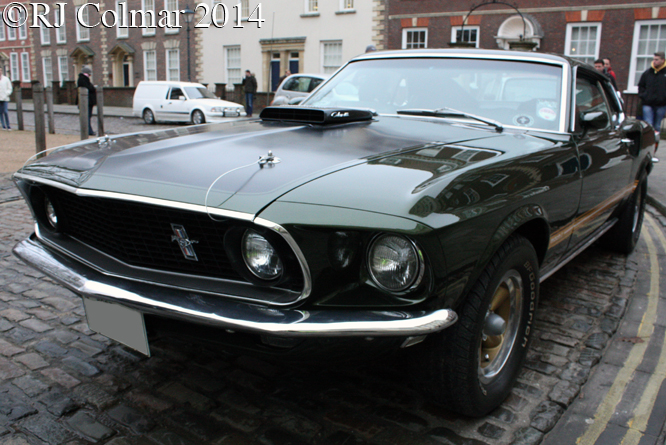
Insurance Special – Ford Mustang 428 Cobra Jet Sportsroof

For the 1969 model year Ford introduced the second body upgrade to it’s popular Mustang range featuring quad headlights, a nearly 4″ longer body on the original 108″ wheel base, new Pony tribar logo and the fastback was renamed sportsroof.

Ford  Mustang 428 Cobra Jet Sports Top, Avenue Drivers Club, Queen Square, Bristol

Ford offered three versions of the Mustang which were aimed with competition in mind, Cobra Jet as seen here,for Drag racers, Boss 302 built for eligibility in the Trans Am Series and BOSS 429 for engine size elegibility in NASCAR.

Ford  Mustang 428 Cobra Jet Sports Top, Avenue Drivers Club, Queen Square, Bristol

Possibly the fastest of which would be the 428 Cobra Jet aimed at drag racers who if they opted for either the 3.90 or 4.30 locking ratio rear axle ‘Drag Pack’ options also got a bundle of performance improvements including an engine oil cooler which replaced the deleted Air Conditioning cooler, stronger crankshaft and connecting rods along with a better balanced motor, meaning more carefully matched parts which was known as the Super Cobra Jet.

Ford  Mustang 428 Cobra Jet Sports Top, Avenue Drivers Club, Queen Square, Bristol

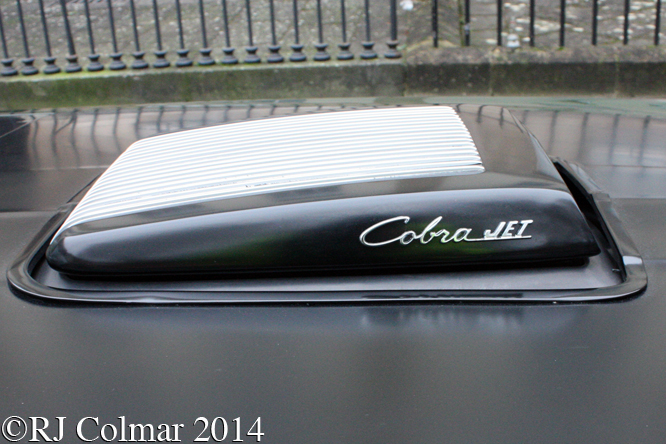
The Cobra jet in either form was quoted as a 335hp motor for insurance purposes though the actual figure was much closer to 400 hp. Cobra Jet motors could also be ordered with ram air scoops either attached to the bonnet/hood or ‘shaker’ scoops attached directly to the carburetor intake cleaner.

Ford  Mustang 428 Cobra Jet Sports Top, Avenue Drivers Club, Queen Square, Bristol

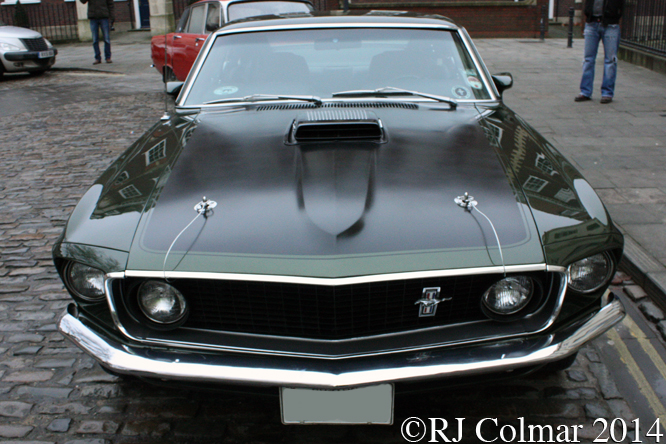
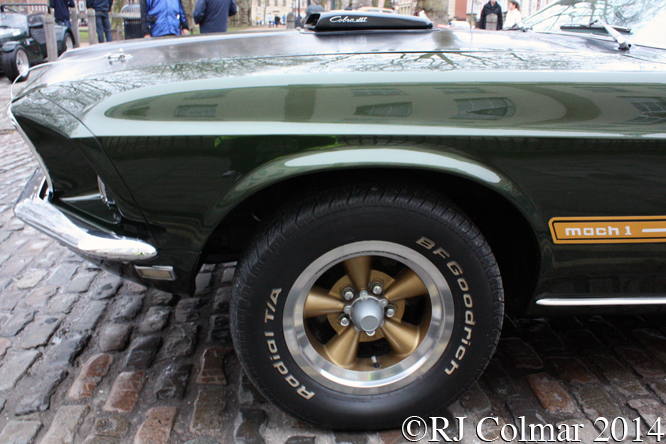
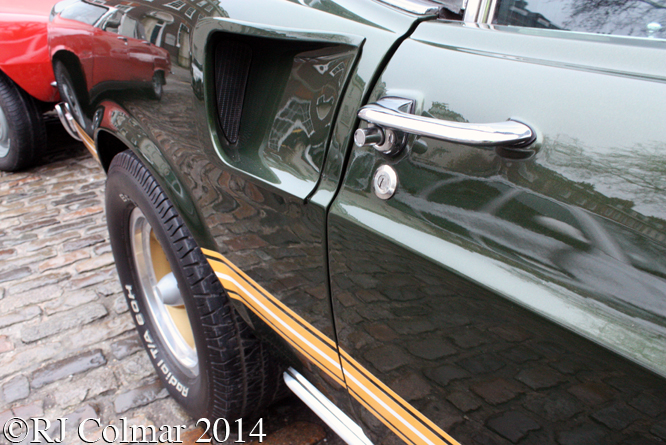
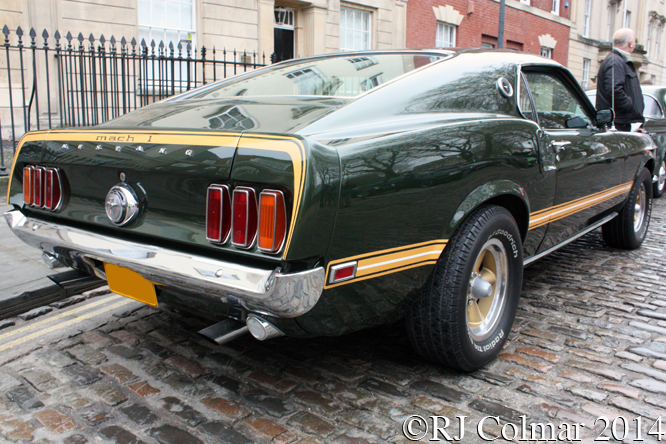
1969 also saw the introduction of the Mach 1 trim level which included distinctive Mach 1 body stripes, steel wheels with bold-lettered Goodyear Polyglas tyres, pop open fuel cap, dual exhausts, competition cable and pin bonnet / hood retainers, matt black bonnet / hood and simulated air scoop as seen here.

Ford  Mustang 428 Cobra Jet Sports Top, Avenue Drivers Club, Queen Square, Bristol

The deluxe Mach 1 interior included simulated wood trim, high backed seats, additional sound proofing and remote sports mirrors.

Ford  Mustang 428 Cobra Jet Sports Top, Avenue Drivers Club, Queen Square, Bristol

Of the 302,971 Mustangs built in 1969, 72,458 were fitted with Mach 1 interiors.

Thanks for joining me on this “Insurance Special” edition of “Gettin’ a li’l psycho on tyres” I hope you will join me for Ferrari Friday tomorrow. Don’t forget to come back now !
Share

Early Morning Risers – Avenue Drivers Club

I have not been posting any irregular blogs from the Avenue Drivers Club meetings this year, this is because most of my Sunday mornings have been dedicated to relearning to drive the Institute of Advanced motoring way, however I have managed to get to a couple of ADC meetings at 8am and stayed long enough to grab a Coffee Croissant and enjoy the company off fellow early risers for an hour or so before my driving lessons.

Talbot Matra Murena, Avenue Drivers Club, Queen Square, Bristol

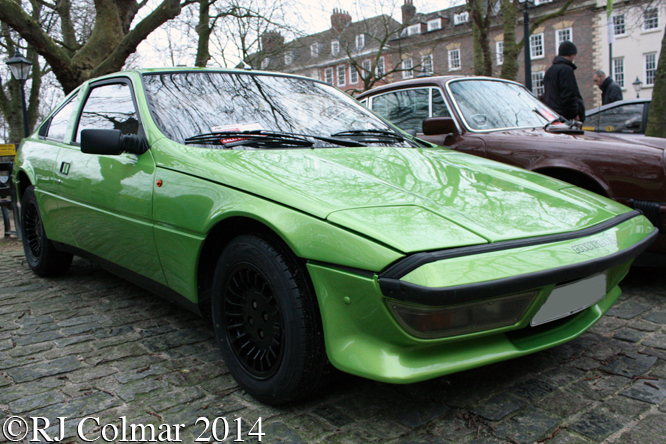
Among the cars that turned up in January was this recently preserved 1981 Talbot Matra Murena with a galvanised steel chassis and 3 abreast seating which represented the zenith of the Talbot Matra partnership.

Ford Escort RS Van, Avenue Drivers Club, Queen Square, Bristol

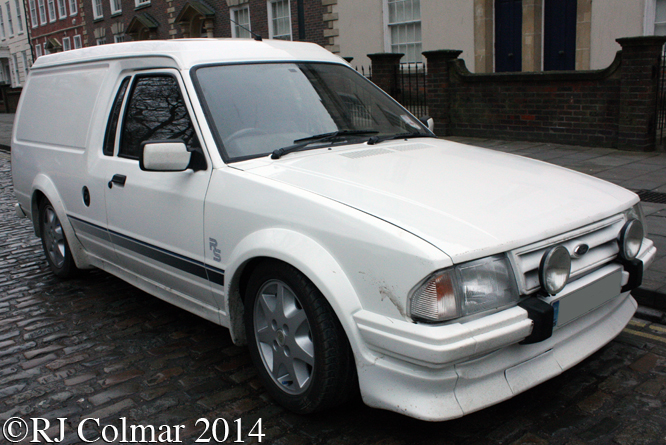
When I first came to Bristol in the late 80’s and early 90’s the lads vehicle of choice for a Saturday night in the city center was a white Escort 35 Van with either an RS, like the 1989 example seen here or RS Turbo power train and styling features including the RS alloy wheels and decals which would normally be seen on hot hatch versions of the Escort.

FIAT GMC, Avenue Drivers Club, Queen Square, Bristol

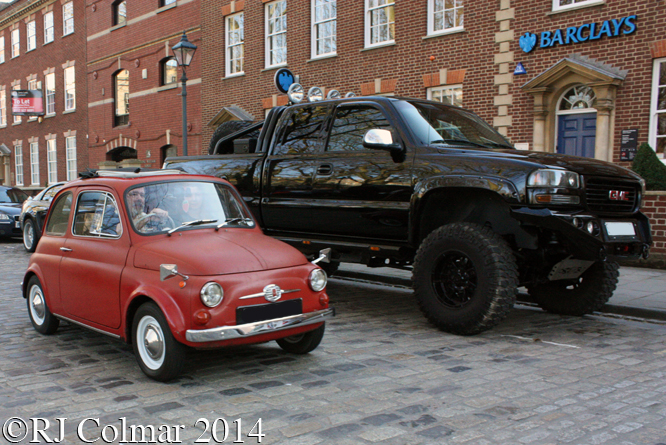
Two contrasting early risers at the March Avenue drivers meeting were this 1969 FIAT 500D and 1999 dual fuel GMC Sierra Pickup.

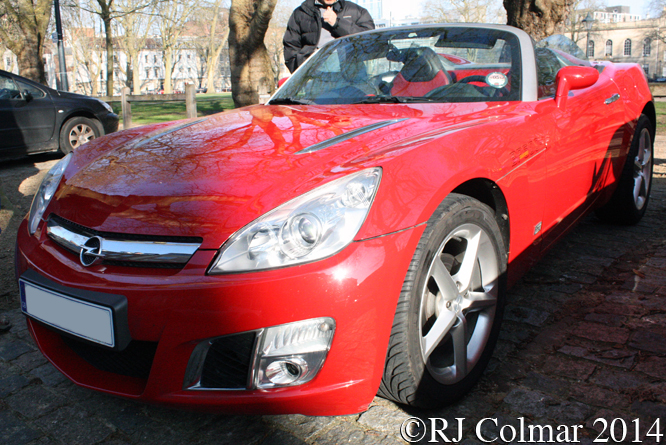
Opel GT Roadster, Avenue Drivers Club, Queen Square, Bristol

This 2008 Left Hand Drive Opel GT Roadster is a rebadged version of the Saturn Sky for the European Market, they were never sold in the UK because they were never manufactured with right hand drive.

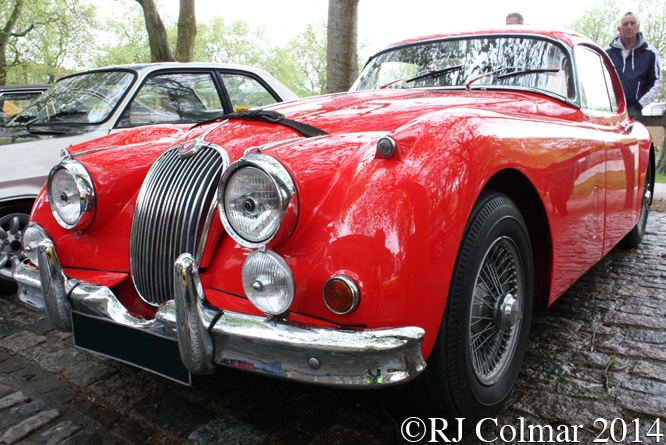
Jaguar XK150, Avenue Drivers Club, Queen Square, Bristol

This magnificent 1959 Jaguar XK 150 was amongst the stars of this months Avenue Drivers Club meeting.

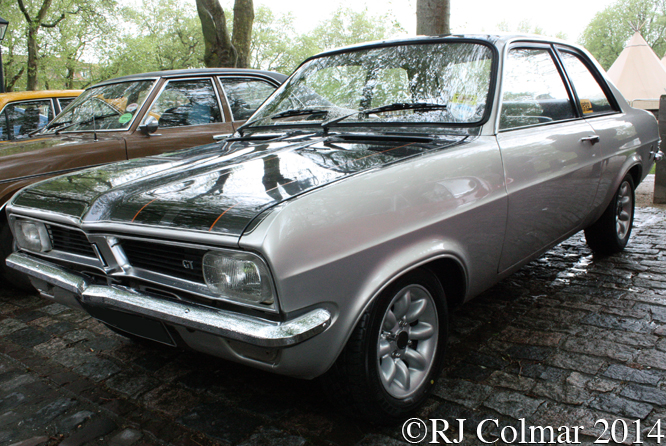
06 IMG_7543sc

When Vauxhall introduced the HC version of the Vauxhall Viva in 1970 they dropped the 2 liter twin carburetor version except for the Canadian market where the car was sold without Vauxhall Branding as the Frienza by Pontiac/Buick dealers. This particular car has is a 1971 Viva Deluxe that has been upgraded with a 2 litre / 122 cui motor and an unusual paint job.

Thanks for joining me on this Early Risers edition of “Gettin’ a li’l psycho on tyres” I hope you will join me again tomorrow for a look at a ’69 Mustang. Don’t forget to come back now !
Share