Myth & Skullduggery- 16b Marquette Buick

Today ‘Gettin’ a lil’ psycho on tyres’ will be starting a month long celebration of the 100th Anniversary of the first running of the Indianapolis 500.

Apart from tomorrow’s post, and the four Ferrari Friday posts, all blogs up until and including May the 29th will be about the Indy 500.

Combining Ed Arnaudin‘s and my own collection of photographs I hope to take you through a marginally less than random history of this extraordinary event.
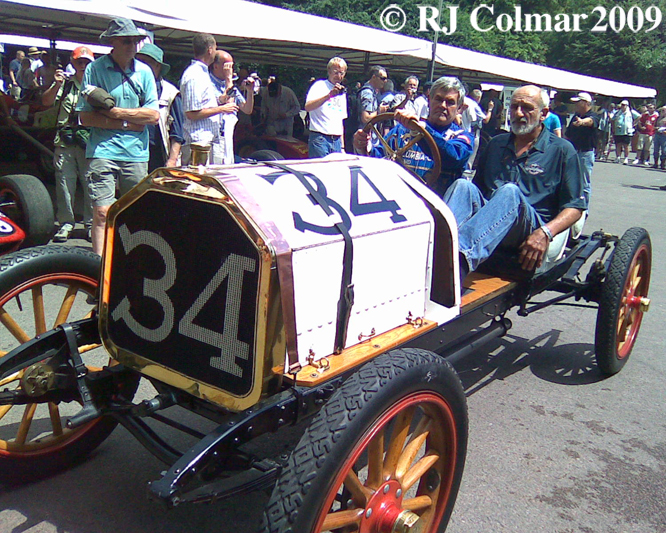
Image340sc

When I started reading up on this car a few hours ago all I knew about it was that according to the 2009 Goodwood Festival of Speed Guide was that it was a 4.8 litre 4 cylinder 293 cui Buick “thought to be the actual Buick that won the first race at Indy, driven by Louis Chevrolet on the four lap, 10 mile race”.

However I only had to check with the Wheels, Winter / Spring 1998 Journal of the National Automotive History Collection published by the Detroit Public Library to find that the winner of the first race at Indianapolis on Aug 19th was now well known automotive engineer Louis Schwitzer driving a four cylinder 212 cui Stoddard Dayton in a two lap 5 mile race.

Louis Schwitzer would become famous for designing the 1911 inaugural Indy 500 race winning engine for Marmon and later still for designing a variety of automotive pumps used in a wide variety of civil and military applications along with superchargers and latterly turbochargers as used by the, subject of a future blog in this series, 1952 Cummins Diesel.

Thanks to Gerry Godin’s ‘Buick City‘ blog I found the 16b Marquette Buick model name for today’s featured vehicle a wonderful photo of this vehicle on the Indy start line dated 1910 can also be seen on the blog.

Once armed with the model name I found out something about the myth of Buick winning the first automobile race at Indy dating back to at least the September – October 2002 Vol. 66, NO. 5 edition of Antique Automobile (Official Publication of the Antique Automobile Club of America, INC.) and the truth about some of the history of the #34 16b. Marquette Buick in an article by Terry B. Dunham which starts on page 29.

Terry asserts in paragraph 2 on page 43 of his article entitled ‘Something Wicked This Way Comes’ “The first races run at the Indianapolis Motor Speedway were held August 19th, 20th and 21st 1909, some two years before the first 500. Buick entered and won two of the three events, including the first race ever held at the track.”

Why Terry’s account in his otherwise excellent article should be at variance with the Journal of the National Automotive History Collection I cannot imagine but I believe the Journal of the National Automotive History Collection has got the story correct about Schweitzer winning the first automobile race at Indianapolis in 1909. May be someday Mr Dunham will chime in below. [EDIT See Post Script below]

So having cleared up a few myths here is what I do know about the 16b Marquette Buick seen here driven by 4 time Indianapolis 500 winner Al Unser Snr.

The origins of the 16b Marquette Buick can be traced to an accident in the 1908 Savannah Grand Prix which befell Fritz Erle after a tire on his, otherwise superior, overhead valve 11.7 litre 716 cui Benz threw a thread which knocked the unfortunate Erle unconscious causing him to loose control of the car which ended upside down on the side of the track.

This misfortune was all the opportunity Buick designer Walter Marr, who’s Buick stood no chance against the superior handling and power of the FIAT’s and Benz vehicles in Savanah that day, needed to inspect the superior suspension design of the Benz while it was upturned and commit the detail to memory.

Later Marr directed a Buick photographer to take photographs of the dismantled overhead valve Benz engine that was stripped down inside the Benz camp while it was left unattended. You can see photographs of this skullduggery on page 37 of Mr Dunham’s article.

Marr used this information to build three hot rods one of them, the one in the photograph, with a 5.2 litre / 318 cui 4 cylinder overhead valve racing engine and all three with chassis built by the Marquette Motor Company, part of the General Motors conglomerate.

These three hot rods were variously called regular model Buick 30 and then regular Buick 16 Roadster while they were actually ‘illegal’ racing specials with non production engines and chassis taking part in races designed for ‘stock’ vehicles.

The vehicle in the photograph above, entered as a Buick 30, is credited as the one driven by Louis Chevrolet to the most important of Buicks 166 (one hundred and sixty six) race victories during the 1909 season in The Cobe Trophy.

The race of attrition, held at Crown Point over 395 miles was won when Chevrolet running on only three cylinders thanks to a broken valve snatched a 65 second victory from a Locomobile which had been delayed by half an hour by magneto problems and beat an otherwise apparently healthy Knox.

By May 1910 the AAA got wise to the loose ways of Buick model naming policy and excluded the three Buick specials for not being ‘stock’ production vehicles.

An interesting foot note to the question of who won the first auto race at Indianapolis in 1909 is that in 1911 Louis Chevrolet turned up with a Marquette Buick for the first Indy 500 without a proper entry, despite being told to ‘sandbag’ go only as fast as necessary to qualify (around 75 mph) Louis foolishly went round at 93 mph.

The organisers of the race agreed to let Louis start on condition the owners of the other teams unanimously agreed to sign a waiver. Having blown every one into the weeds in qualifying three teams declined to sign one of them was Marmon who’s engine designer was Louis Schwitzer and who’s car went on to win the very first Indy 500, I wonder if there is some inter state rivalry between Indiana and Michigan afoot to explain the discrepancy in the answer as to who won the very first auto race at Indianapolis? [EDIT Turns out there is not see postscript]

My thanks to everyone mentioned in this blog for their contributions.

Hope you have enjoyed today’s extended history lesson edition of ‘Gettin’ a lil’ psycho on tyres’ and that you’ll join me and a very smart young lady tomorrow for a Birthday celebration. Don’t for get to come back now !

01 05 11 PS the mystery over who won the first race on the opening day at Indianapolis has been resolved thanks to Tim Murray at The Nostalgia Forum :-

Louis Schwitzer won the very first five mile race at Indianapolis aboard his Stoddart-Dayton.
A Buick was driven to victory in the 3rd 5 mile race.
Bob Burnham won the very first 250 mile ‘FEATURE’ race aboard his Buick !


Share

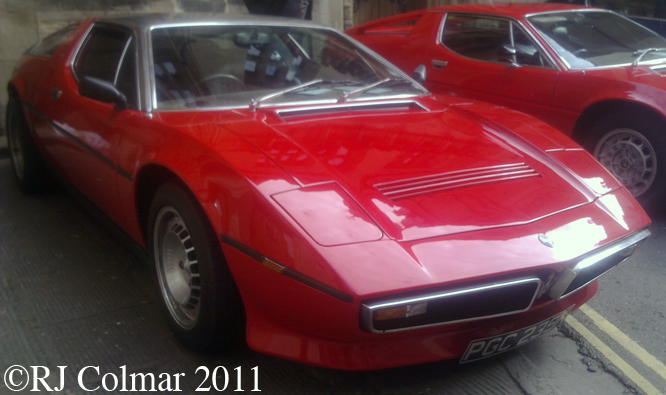
Brushed Steel Roof – Maserati Bora

01 Image3335sc

The Maserati Bora was developed in 1968 to go up against the mid engine De Tomaso Mangusta, Lambourghini Muira and later Ferrari 365 GT4 BB. 524 examples of the model were built from 1971 to 1978.

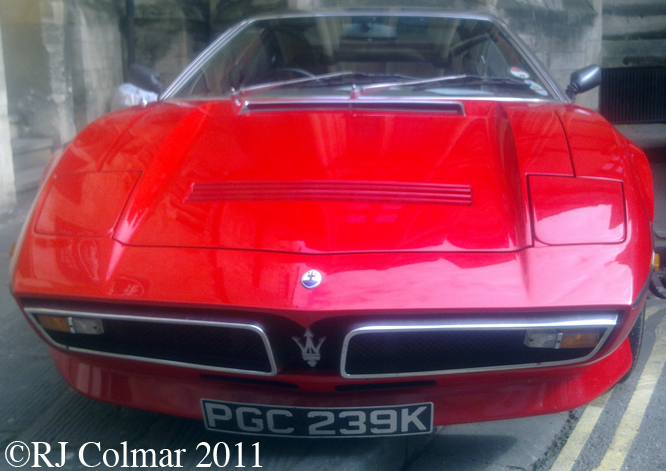
02 Image3330sc

Under the direction of Citroen owners of the Maserati marque at the time, the Bora featured a steel monocoque with the longitudinal engine mounted on a subframe at the back and for the first time on a Maserati independent suspension on all four wheels.

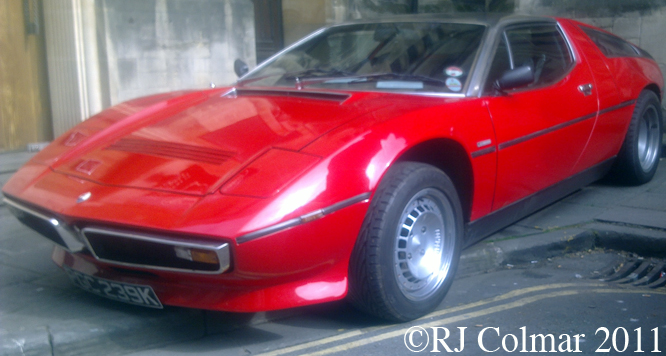
03 Image3331sc

Giorgetto Giugiaro of Ital Design was responsible for the steel bodywork which featured an unusual for the time brushed steel roof.

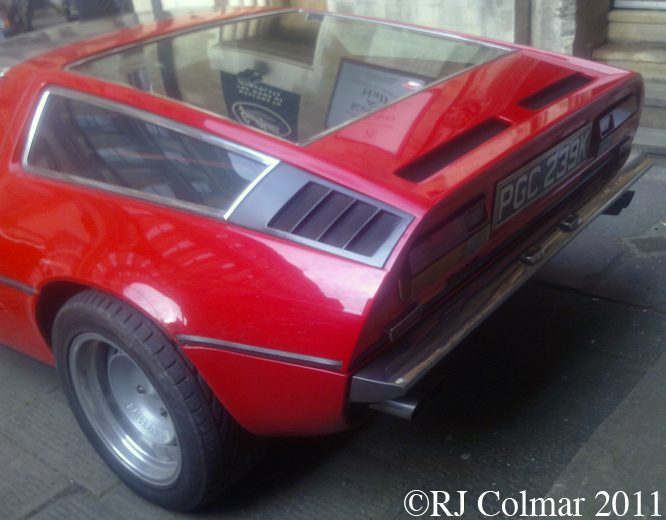
04 Image3333sc

289 Bora’s including this 1972 model were powered by a 310 hp 4719 cc / 288 cui V8 with a further 235 built from 1973 to 1978 being fitted with a larger 320 hp US emissions spec 4930cc / 301 cui motors giving the vehicle a 160 – 170 mph capability. The engine compartment featured double glazing to separate it from the cabin and a carpeted aluminium cover to keep the noise down.

By the time production of the Bora had ceased Maserati was in the ownership of De Tomaso.

Hope you have enjoyed today’s brushed steel roof edition of ‘Gettin’ a lil’ psycho on tyres’ and that you will join me again tomorrow. Don’t forget to come back now !

Share

Grazin’ Arizona – Ferrari 166 MM #0052M

Thanks to more photographs from Geoffrey Horton today we are looking at possibly one of oldest and most original known Ferrari race cars, one which regular eagle eyed reader Racer 187 spotted in my blog last week on the Phil Hill XK120.

Ferrari 166 MM, Danville Cd'E

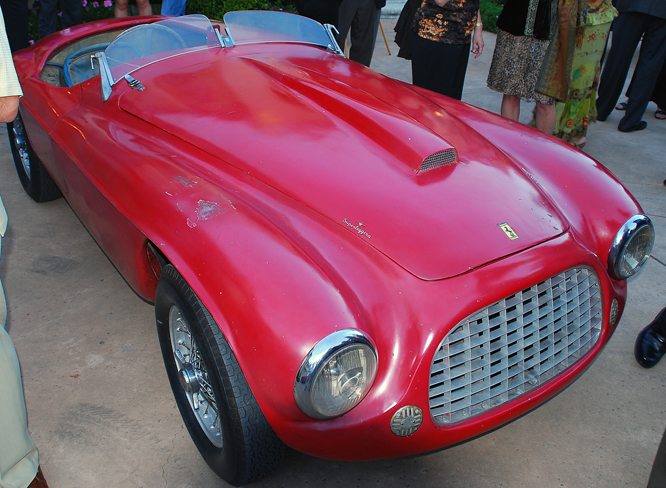
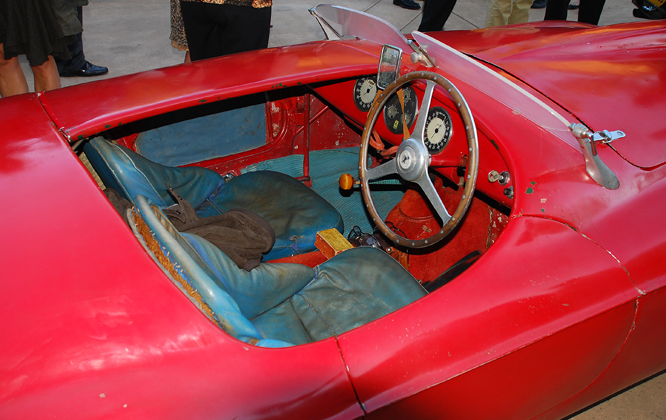
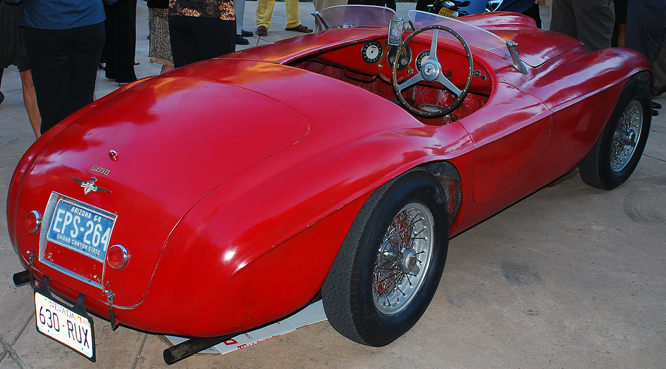
This is a Ferrari 166 MM chassis #0052M shown here at the 2007 Danville Concours d’Elegance some 3 years after it was credited as having been identified by Ferrari Expert Marcel Massini in Arizona in 2004 where, it had been grazing in a barn for forty five years.

An unusual right hand drive model this 166 MM appears to have been delivered to Chinetti & Plisson in Paris and originally purchased by the 1949 Le Mans 24 hour winner, who famously won aboard another 166 MM #0008M after driving for just 20 mins, Lord Selsdon. Selsdon, real name Peter Mitchell-Thomson, raced #0052 at Le Mans in 1950 with Jean Lucas, a race from which the car retired after accident damage.

The car then was turned over to Luigi Chinetti and Jean Lucas who won the Paris 12 hours race. It came second in the 1950 Daily Express Trophy race at Silverstone driven by Dorino Serafini before Chinetti took the wheel and drove it to some 2 litre class speed records at Monthlery in France.

In 1952 owner TASO Mathieson finished 8th in the Targa Florio driving this car and in 1954 the car was fitted with a larger 2.3 litre / 142 cui Colombo V12 from the 195 S model. In 1955 the car was converted back to 166MM spec with a 140 hp 2 litre / 121 cui V12 by the factory.

Ferrari 166 MM, Danville Cd'E

By 1958 this Touring Superleggera bodied car was known to be owned in Switzerland and in 1959 a couple of owners later it was with Chinetti Motors in New York, Chinetti sold it to a Mr RL Litton of Scottsdale, AZ and despite being registered for road use in Arizona in 1964 it apparently was never seen on the road in his hands.

When the car was found in 2004 it transpired that the engine was not an original 166MM type rather a 2 litre V12 more commonly found in a Ferrari Formula 2 open wheel racer, while it is not unusual for Ferrari racers of this period to swap engines, as indeed has been recorded for this vehicle it is still a mystery as to why this car should have an engine common to an open wheel Ferrari.

Under the stewardship of Manny del Arroz the car was preserved and returned to working condition and won the Preservation Award at Pebble Beach in 2007.

#0052M is last known to have transferred ownership in Germany to Mr J Pawluk of Poland in 2008 for a reputed € 3.5 million, approx £ 3 million or US$ 5 million at todays prices.

Ferrari 166 MM, Danville Cd'E

Readers of my 2009 Rowdy posts might remember the freshly restored 166 MM chassis #0040M Reg YPY 333 belonging to the Mason – Styrrons at Goodwood.

This is a clear case where, in my humble opinion, the preserved bucket of rust is worth far more than the restored brand new machine. More photo’s of #0052 M, as it was found by Marcel Massini, in Arizona can be seen on this excellent thread at Ferrari Chat, you will probably have to sign up to see the thread.

My thanks to Geoffrey for today’s photo’s, to Michael Platzer for the chassis number and to every one who posted on Marcel Massinis Ferrari Chat thread.

Hope you have enjoyed another original patina edition of ‘Gettin’ a lil’ psycho on tyres’ and that you will join me again tomorrow. Don’t forget to come back now !

Share

‘Making Time’ – Jaguar 3.8 MK 2

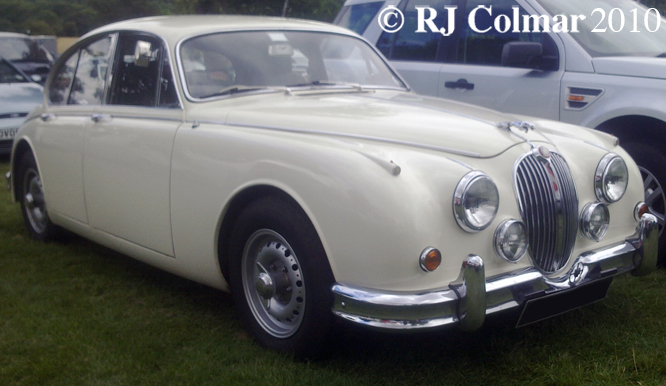
The MK 2 Jaguar introduced in 1959 was available with a choice of 3 six cylinder XK6 motors this 1962 model is fitted with the top of the range 220 hp 3.8 litre / 231 cui engine that was slightly detuned from that found in E-Type Jaguars.

Jaguar, 3.8, Mk 2, Prescott VSCC

Sharing the same shell as the contemporary Daimler 2.5 V8 and later budget Jaguar 240, 340 and Daimler V8 250 it is thought around 110,000 vehicles of this type were built between 1959 and 1969 including all the variations on this shell.

MK 2 Jaguars with their rest to 60 mph 8.5 secs performance and top speed of 125 mph were used as Motorway cruisers by the police and have gained what is generally considered an unfair reputation as the criminal car of choice thanks no doubt to films like the hard core, for it’s time, ‘Get Carter‘ (see 55 secs) clip contains violence and strong language.

TV detective Inspector Morse drives a 120 hp 2.4 litre MK 2 Jaguar, which actor John Thaw described as an ‘arse’ to drive, though in the original novels, by Colin Dexter, Morse is described as driving a Lancia.

My favourite Jaguar MK2 media appearance is in ‘Withnail and I‘ warning this clip contains strong language.

Hope you have enjoyed today’s MK2 edition of ‘Gettin’ a lil psycho on tyres’ and that you will join me again tomorrow. Don’t forget to come back now !

Share

Springbok Special – ALFA Romeo GTV6 3.0

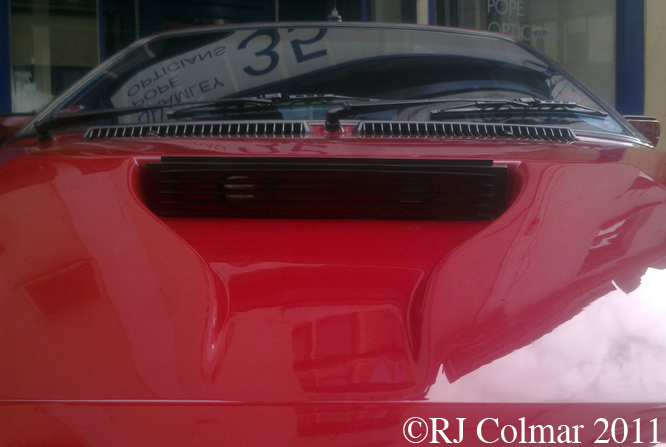
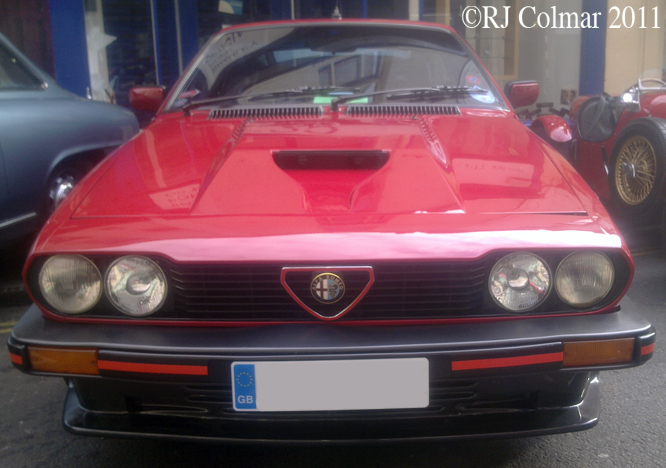
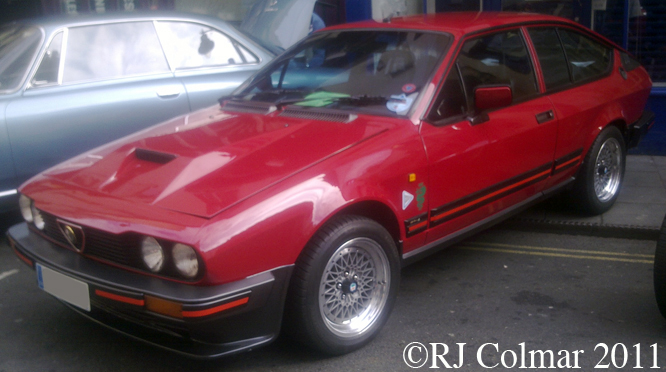
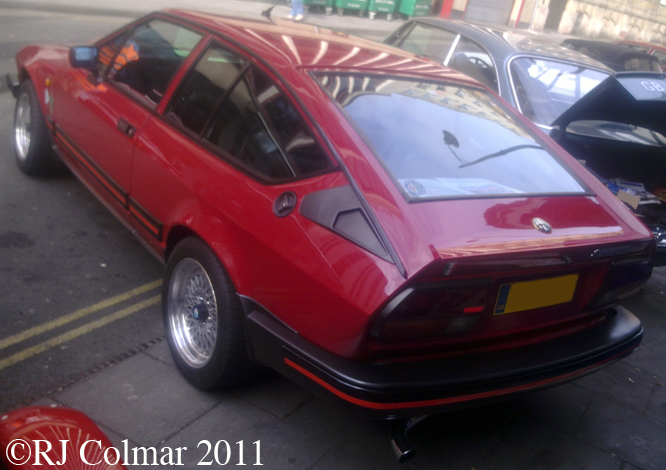
The ALFA Romeo GTV 2.5 was in production from 1980 to 1987 it featured a a fuel injected 156 hp 2,492 cc / 152 cui V6 motor from the Alfa 6 model, a rear mounted gearbox to optimise weight distribution just like the Porsche 924/944/968 and an attractive Giorgetto Giugiaro body with a bulge in the bonnet / hood to accommodate the V6 engine.

ALFA Romeo GTV6 3.0, BIAMF

These vehicles won four consecutive European Touring (stock) Car titles, however out in South Africa the touring cars were running to different regulations with a 3.5 litre / 213 cui class cut off as opposed to the 2.5 litre 152 cui class cut off as used in much of the rest of the world.

ALFA Romeo GTV6 3.0, BIAMF

In order to race competitively against BMW which ran 3.5 litre engines in South African Touring Car Races ALFA Romeo in South Africa approached Autodelta the competition arm of ALFA Romeo who obliged by supplying enough parts developed for a rally programme to build around 220 2934 cc / 179 cui carbureted V6 engines which were assembled and tuned in South Africa.

ALFA Romeo GTV6 3.0, BIAMF

The outcome was a vehicle that in 1983 beat BMW to win the South African Touring Car Championship and in mid 1984 was declared the fastest South African assembled vehicle with a top speed of 139 mph / 224 kph.

ALFA Romeo GTV6 3.0, BIAMF

With that ALFA Romeo Montreal inspired NACA duct in the bonnet and deep spoiler this 3 litre GTV6, belonging to Richard an acquaintance from ‘The Nostalgia Forum‘, is quite easy to distinguish from its 2.5 litre brethren.

My thanks to Richard for bringing his pride and joy to the Bristol Italian Auto Moto Festival.

Hope you have enjoyed todays Springbok edition of ‘Gettin’ a lil’ psycho on tyres’ and that you will join me again tomorrow. Don’t forget to come back now !

Share

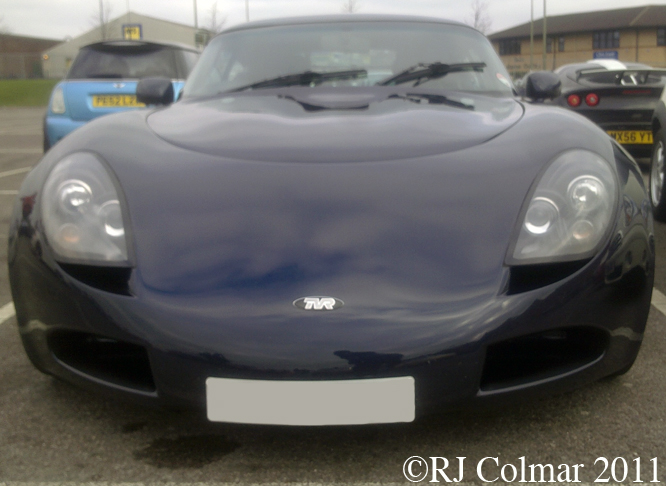
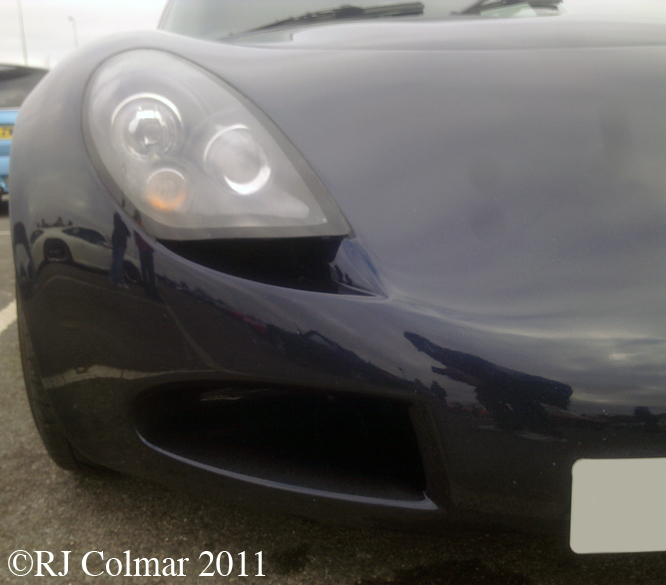
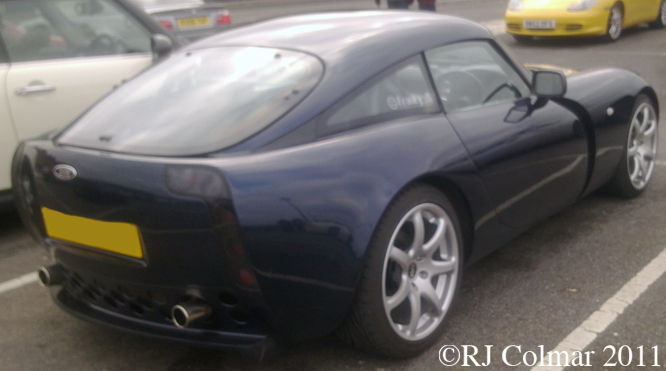
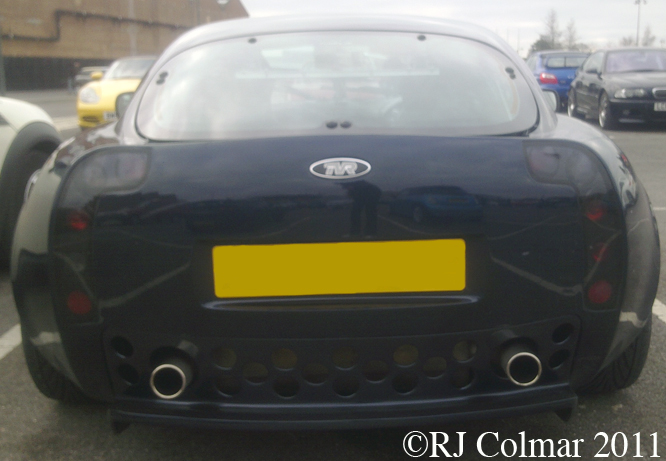
Mechanical Orchestra – TVR T350

TVR T350, Pistonheads, BMW Plant

The TVR T 350 is probably as close as one can get to a four wheeled motorcycle that will scare a young mans prospective in laws to death, it’s small and according to one journalist in 2004 the engine belongs in an orchestra pit.

TVR T350, Pistonheads, BMW Plant

The T 350 comes with TVRs own 350 hp 3605 cc / 219.9 cui Speed Six all alloy 24 valve engine that is canted over at 30 degrees so that it fits into the svelte T 350 body that measures just over 13 feet long by six feet wide by 47 inches high.

TVR T350, Pistonheads, BMW Plant

TVRs under the direction of previous owner Peter Wheeler dispensed with creature comforts like interior lights, air bags and traction control, though these vehicles did come with air conditioning.

TVR T350, Pistonheads, BMW Plant

Weighing just 2,616 lbs / 1,187 kg performance from rest to 62 mph was 4.4 secs up to 100 mph in 9.5 secs with an official top speed of 175 mph.

TVR T350, Pistonheads, BMW Plant

Production of the T350 ran from 2002 until 2006 when Russian/Greek/British baby oligarch Nikolai Smolenski took over the company and soon after halted production of all TVR models.

Allegedly Mr Smolenski has announced various plans to restart production most recently with a Corvette powered model which might be built anywhere between Blackpool and Cape Town, here is hoping this hairiest of automobile brands finds its way back to the market soon.

My thanks to the Pistonhead who brought this T350 along to the Sunday Service at the BMW plant back in January.

Hope you have enjoyed todays orchestral edition of Gettin’ a little psycho on tyres and that you will join me again tomorrow. Don’t forget to come back now !

Share

Mission Accomplished – Bristol Cars Ltd

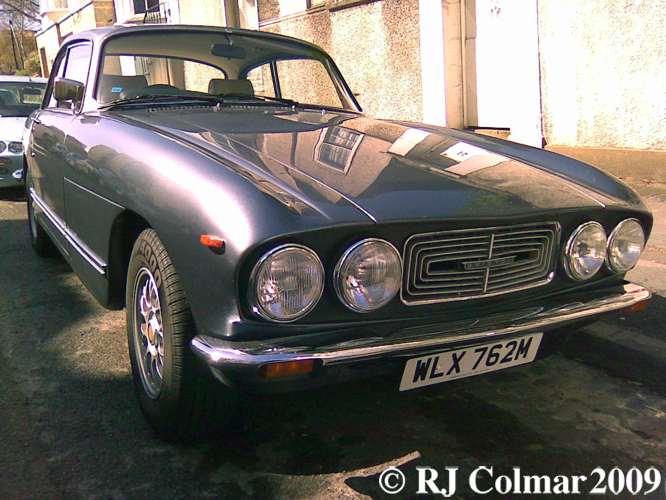
Bristol 411

Bristol 411

On Saturday I was very pleased to receive an e-mail from Geoff Hawkins, Chairman of the Bristol Owners Club, informing members that the future of Bristol Cars Limited which was in administration has been secured by Kamkorp Autokraft which also owns Frazer Nash Research Ltd.

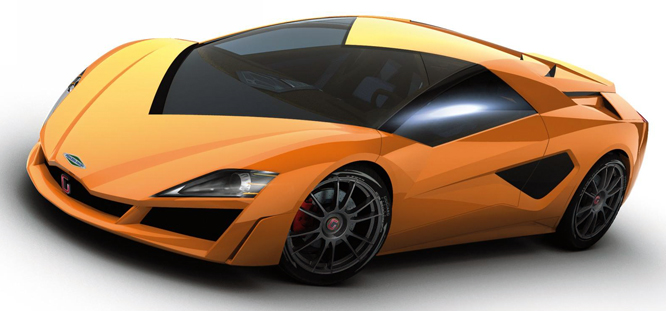
FN Namir

Italdesign Frazer Nash Namir (Photo Italdesign)

It should be noted that Frazer Nash Research which made the 2009 prototype Italdesign Frazer Nash Namir is

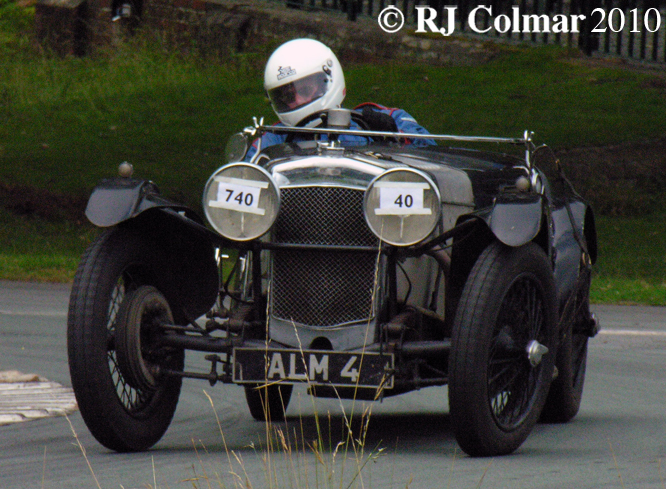
Fraser Nash, Loton Park

Frazer Nash Colemore

not directly related to the company that made pre WW2 Frazer Nash chain drive vehicles,

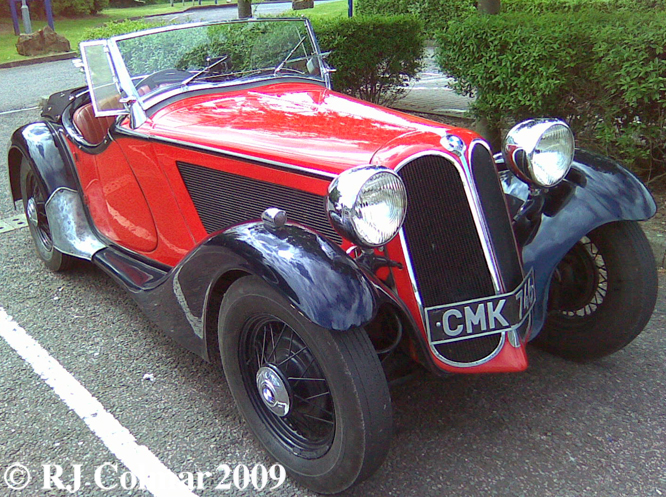
Fraser Nash BMW

Frazer Nash BMW

Frazer Nash BMW’s and

Fraser Nash, Thompson CT

Left F Thwaits Fraser Nash 100/163 (Picture Ed Arnaudin)

post WW2 Frazer Nash Bristols from 1927 to 1957.

That company, AFN Ltd, was sold by Archie Frazer Nash to the Adlington brothers when it ran into financial difficulties.

Under the Adlington’s stewardship in 1946 AFN were briefly partners with Bristol Aeroplane Company in Bristol Cars, however BAC bought Adlington out of Bristol Cars when it became clear the two companies had differing visions of the future.

After AFN Ltd ceased manufacturing in 1957 it became a successful Porsche dealer which along with the Frazer Nash trademark was sold in turn to Porsche.

In 1929 after Archie Frazer Nash had divested himself of his interests in AFN Ltd and motor vehicle manufacturing he set up Nash & Thompson which specialised in manufacturing hydraulic gun turrets for aircraft, this led to the development of a variety of 2 and 4 gun turrets used on WW2 Beaufort, Blenheim, Halifax, Lancaster, Manchester, Sterling, Sunderland and Wellington bombers.

Nash & Thompson which in 1996 was acquired by ML Aviation and later defence contractor Cobham spun off Frazer Nash Research Ltd which specialises in Electric and and Hybrid Power Trains, automotive multiplexing, advanced composites and mass transit systems.

It is this engineering branch of Archie Fraser Nash’s post vehicle manufacturing business that is now connected for the first time with Bristol Cars Ltd.

Kamkorp Autokraft a private limited company with offices registered in Mytchet, Surrey, is majority owned by chairman Mr Kamal Siddiqi, who like Archie Frazer Nash appears to have been born in India, and who has / had interests in Cicco Holding AG, Lithium Technology Corp, Electrosource Inc and Think Nordic, prior to acquiring Frazer Nash Research and Bristol Cars Ltd.

Spokesman for the Kamkorp Autokraft group and Director of Operations at Frazer Nash Research Mr ‘William’ Tet Hin Chia issued the following prepared statement :-

“Bristol Cars is a British institution and an important part of our national motoring heritage. Over the next few months we will start to reveal the details of our plans to combine Bristol Cars’ tradition and iconic marque with Frazer-Nash’s pioneering technology to showcase our cutting-edge electric and range-extended powertrains.

British engineers are globally recognised for their inventions and the quality of their innovation – and these attributes are inherent in all our systems and products. Mindful of Bristol Cars’ rich heritage and our responsibility as custodians of the brand, we are certain that our technology will blend seamlessly and successfully with the Bristol Cars tradition of engineering integrity.

Owners and enthusiasts of the cars should be assured that, even though these are early days in our tenure of the brand, we are committed to providing them and their cars with the highest levels of quality, technology and service”.

Geoff Hawkins e-mail suggests that Samuelson Wylie Associates, who represented TVR from 1993 to 2003, will be handling the PR and Marketing of Bristol Cars Ltd.

It will be fascinating to see what the future has in store for my local automotive manufacturer, with the prospect of all fossil fuelled vehicles being phased out of Europe by 2050, Bristol Cars may be well placed to become a leading edge manufacturer in the decades to come.

I hope you will all join me in wishing Bristol Cars every success.

My thanks to Geoff Hawkins of the Bristol Owners Club, James Trigwell a trustee of the Frazer Nash Archives, and bristol 7527 also known as Claude for the detailed information in this blog.

I hope you have enjoyed this edition of ‘Gettin’ a lil psycho on tyres and that you’ll join me again tomorrow. Don’t forget to come back now !

Share