Tag Archives: Psychoontyres

4th Autumn Classic – Castle Combe

Last Saturday saw the 4th action packed Autumn Classic at Castle Combe which saw large numbers of fans entertained with nine races and several demonstrations most notable for this observer of which were a pair of BRM P160’s from 1972 and a 1973 which regaled the Wiltshire countryside with the awesome sound of a couple of unsilenced V12’s.
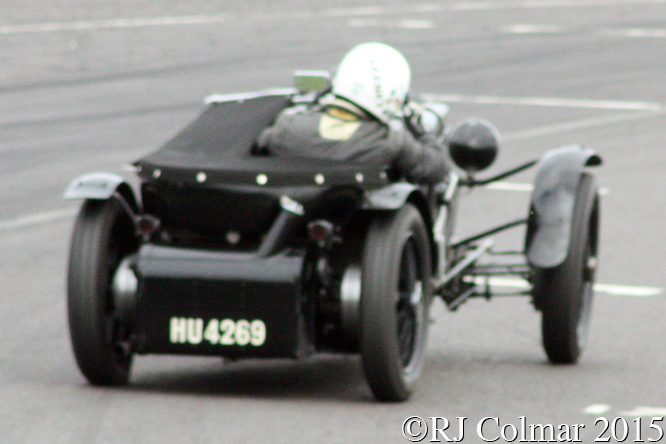
Frazer Nash Super Sports, Patrick Blakeney-Edwards, Castle Combe

Patrick Blakeney-Edwards had a moderately successful day as a driver, above he is seen scampering away from a delightfully varied field to win the VSCC Sports Car Race aboard his Frazer Nash Super Sports.
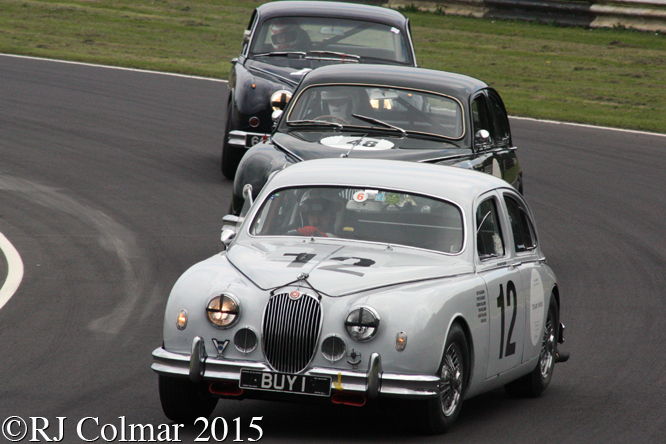
Jaguar Mk 1, Williams, Butterfield, Dorlin, Castle Combe

The JEC Norman Dewis Trophy for Pre 66 Jaguars was won by Martin Hunt driving a Blakeney Motorsports prepared E-type Jaguar while one of the most entertaining battles of the day was fought by Grant Williams and Richard Butterfield both in Mk 1 Jaguars and Peter Dorlin in his Mk2 after Andy Wallace also in a Mk2 retired from third at the half way stage, Grant hung on to finish first saloon home in the #12 seen above.
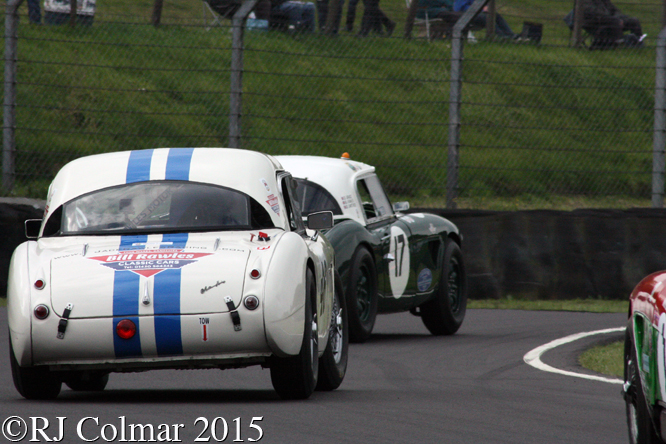
Austin Healey 3000 Mk1, David Grace, Castle Combe

David Grace driving the #17 Austin Healey 3000 Mk1 won the first of the two Healey Driver International Challenge 25th Anniversary races from second on the grid beating pole sitting white and blue #46 driven by Healey Specialists Bill and Jack Rawles by just under 4 seconds.
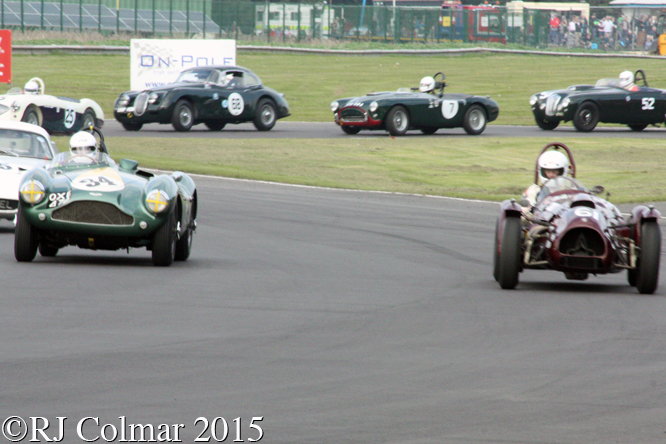
Cooper Bristol T24/25, John Ure, Castle Combe

Steve Brooks starting from third on the grid in the #34 Aston Martin DB3S is seen above about to go into the lead on the opening lap of the Fiscar Historic Intermarque race, he looked set for a win until the race had to be called on lap 12, before the compulsory pit stops had cycled through, which meant Stephen Bond in the #95 Lister Bristol starting from 8th on the grid was declared the winner after an accident involving three cars without injury to the drivers blocked the track at Quarry.
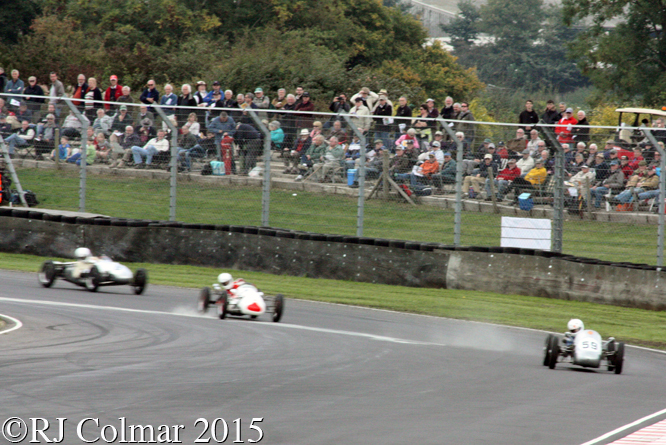
Staride Mk3. Xavier Kingsland, Castle Combe

Andrew Turner in the white and red #2 Cooper Mk VI led the opening 8 laps of the BAC Motor Sports Club Challenge for F3 500’s race from 3rd on the grid until he was caught and passed by Xavier Kingsland in the silver Staride Mk 3 two laps from home, pole sitter Darryl Woods in the Cooper Mk XII kept the two race leaders honest and finished 3rd just less than 1 second behind the winner !
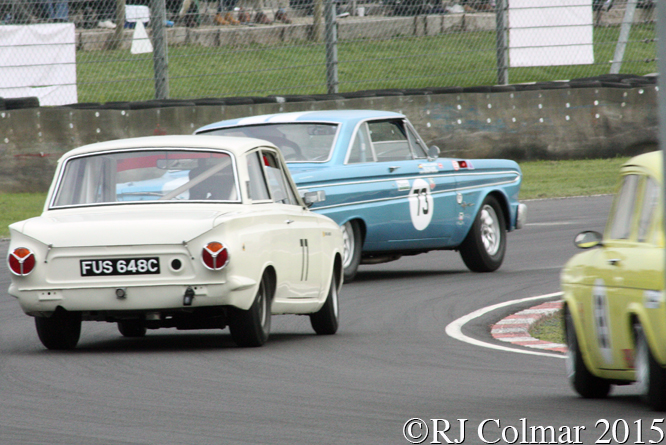
Ford Falcon, Chris Clarkson, Castle Combe

Michael Squire easily won the HSCC/HRSR Historic Touring Cars race from pole driving a flame spitting Ford Mustang, but second place finisher Chris Clarkson had a very busy time keeping eventual third place finisher Chris Saunders in the white #77 Ford Cortina and Bob Bullen in the yellow #69 Ford Anglia behind.
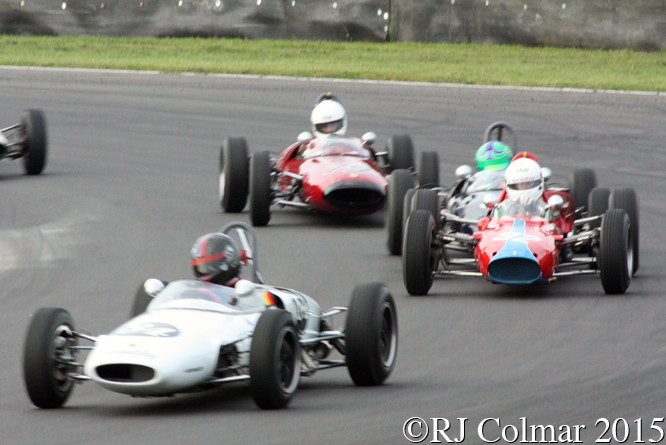
Lotus 20/22, Jack Woodhouse, Castle Combe

Jack Woodhouse made a great start from 2nd to lead the opening 9 laps of the FJHRA/HSCC Millers Oils Formula Junior race in the white #84 Lotus 20/22 before yielding to the faster #53 Lotus 20/22 driven by 3rd place starter Sam Wilson seen in third place at Quarry above. Sam however tripped up behind a back marker on the final lap to let Jack back into the lead which was just .2 of a second over Sam at the finish line.
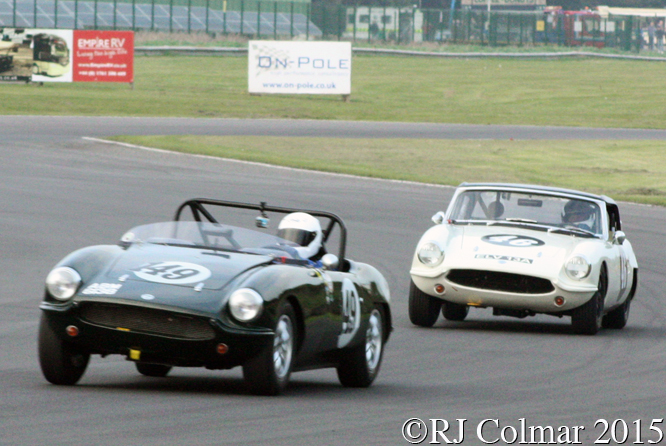
Elva Courier Mk4T. Sean Kukula, Castle Combe,

Having been unlucky in the Fiscar Historic Intermarque race Stephen Brooks easily won the Jon Gross Memorial race in his DB3S leaving Sean Kukula and Jonathon Loader to squable over second place in their #149 and #46 Elva Courier Mk4T’s respectively, Sean won the Elva battle which was fittingly once raced by American Jon Goss.
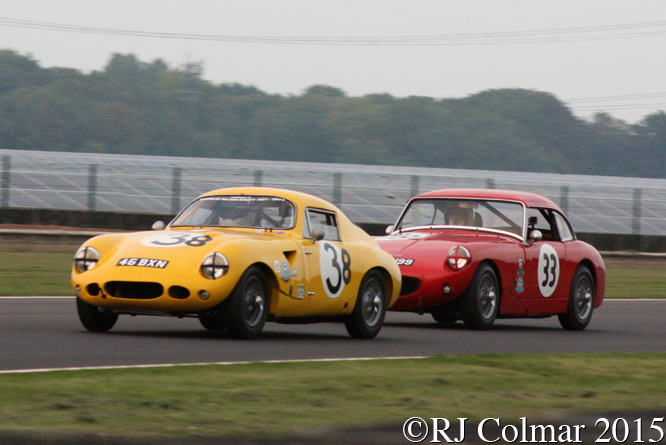
Austin Healey Sebring, Richard Woolmer, Castle Combe,

Finally the Healey’s came out for a second race which again provided plenty of thrills with third place starter Marc Campfield making the running for the opening 8 laps until his car ground to a halt which left pole man David Grace to claim a 4.5 second victory over the Healey 3000 shared by 5th place starters Jack and Oliver Chatham, above as in the first race the Healey Sebring of Sprites of Richard Woolmer #38 and Gordon Elwell #33 kept spectators entertained further down the field on their way to 9th and 10th place finishes less than 2 seconds apart.

Thanks for joining me on this “4th Autumn Classic” edition of “Gettin’ a li’l psycho on tyres” I hope you will join me again tomorrow when I’ll be looking at a six cylinder Plymouth. Don’t forget to come back now !

Share

Dropping Zedel – Donnet G2 Torpedo Lux

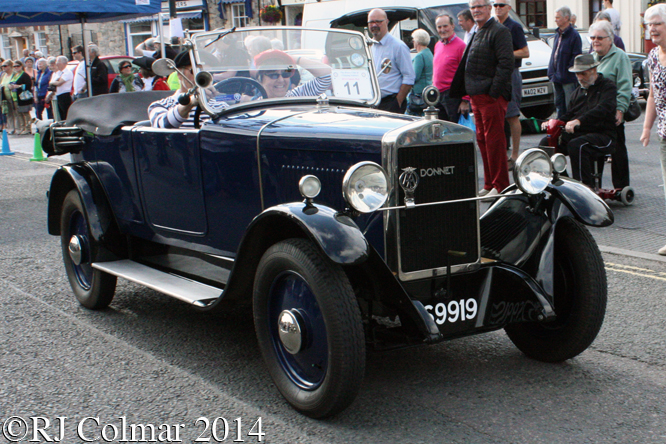
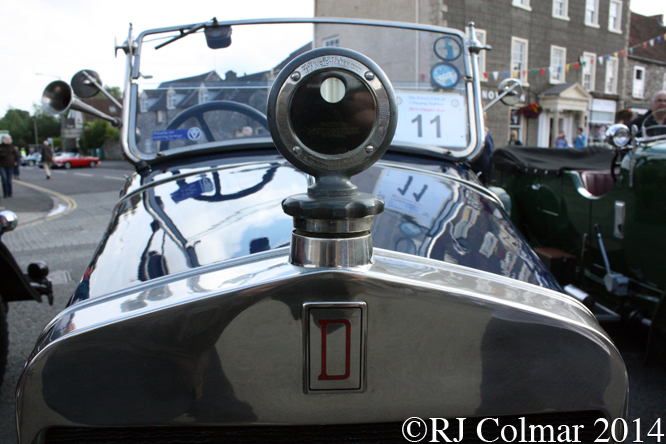
In 1919 five years after founding the successful flying boat manufacturer Donnet-Denhaut at Neuilly-sur-Seine designer François Denhaut parted ways with co founder Jérôme Donnet who then switched from aircraft manufacturing to become an automobile manufacturer with the acquisition of Automobiles Zedel of Pontarlier, Doubs from whence he marketed the Donnet-Zedel CI-6 a Zedel design originating from 1912.

Donnet G2 Torpedo Lux, Classic Run, Chipping Sodbury,

In August 1924 the production of a chassis for the all new four cylinder 1098 cc / 67 cui Donnet Zedel Type G commenced in a new factory at Gennevilliers, Seine with final assembly of the new model taking place at the former and Donnet flying boat factory on Ile de la Jatte.

Donnet G2 Torpedo Lux, Classic Run, Chipping Sodbury,

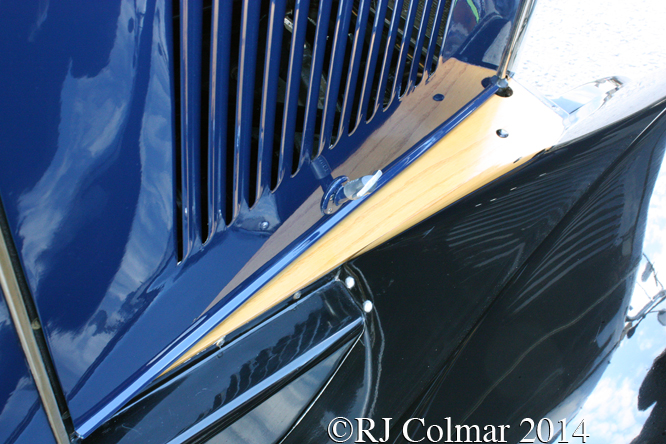
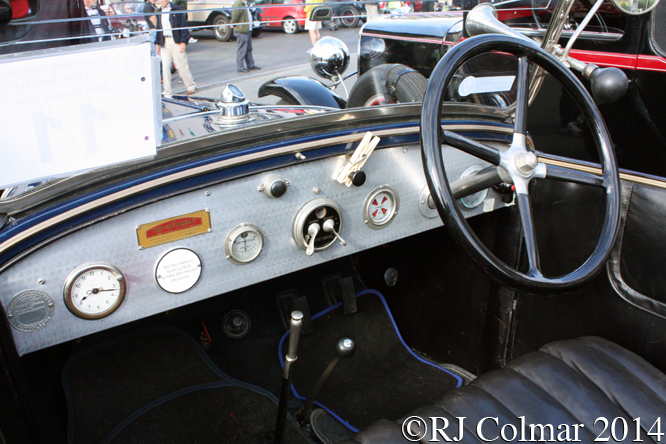
The 16 hp (9.5 hp UK taxable) side valve engine featured magneto ignition and a two bearing crankshaft, it drove the rear wheels through a four speed gearbox a foot brake operated on the drive shaft and the hand brake operated the drums on the rear axle.

Donnet G2 Torpedo Lux, Classic Run, Chipping Sodbury,

Manufacturing 20 G types and 15 CI-6 types a day Donnet was on it’s way to becoming Frances fourth largest automobile manufacturer by 1927 when today’s featured G2 was built.

Donnet G2 Torpedo Lux, Classic Run, Chipping Sodbury,

The Donnet G2; with a revised chassis, standard 2 blade engine cooling fan, four wheel drum brakes, relocated hand brake lever, and more substantial rear axle, was launched in May 1926 when Zedel was dropped from the brand name.

Donnet G2 Torpedo Lux, Classic Run, Chipping Sodbury,

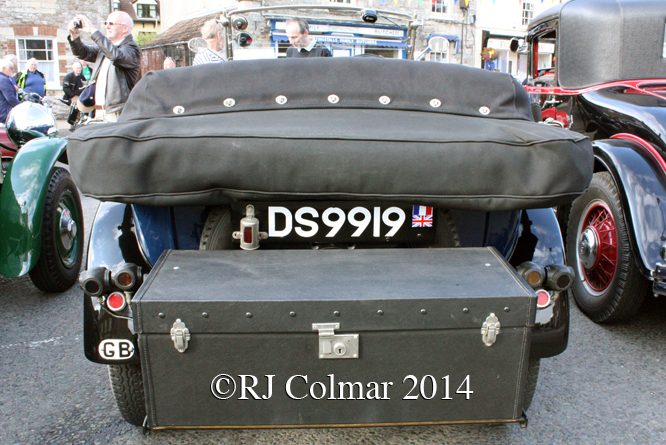
Today’s featured G2 scene at last years Classic Run in Chipping Sodbury is believed to have originally been resident near Avignion in France and was not imported into the UK until 1981.

Donnet G2 Torpedo Lux, Classic Run, Chipping Sodbury,

It was rescued from a field in 1989 and after restoration was first registered in the UK 6th Ocotber 1992.

Donnet G2 Torpedo Lux, Classic Run, Chipping Sodbury,

13,400 Donnet G2s are believed to have been built from May 1926 to October 1928 and this example is one of only two G2s and three Donnets known to exist in the UK.

Thanks for joining me on this “Dropping Zedel” edition of “Gettin’ a li’l psycho on tyres” I hope you will join me again tomorrow when I’ll be visiting Castle Combe. Don’t forget to come back now !
Share

An Unbelievable Machine – Mercedes Benz 300 SLR # no.4

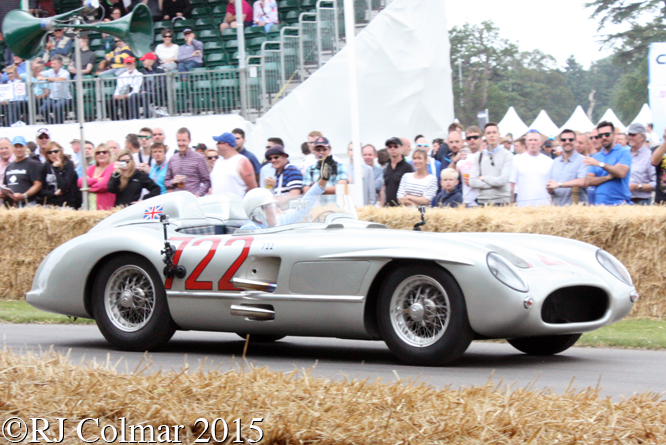
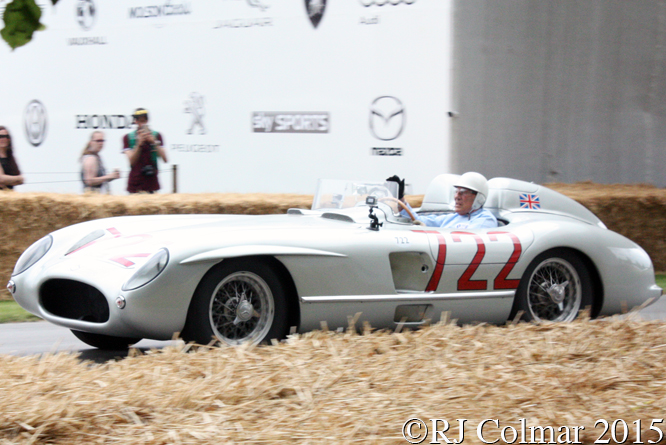
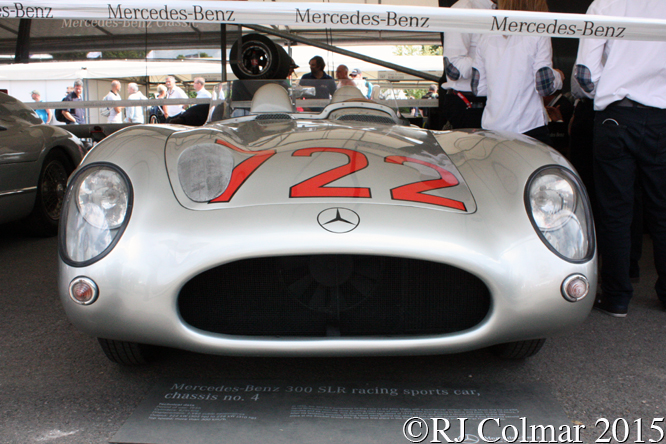
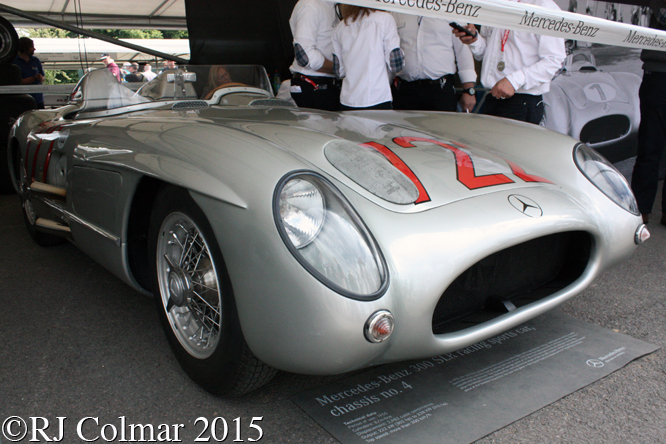
At 7:22 am on the morning of the 1st of May 1955 Stirling Moss and his co driver Denis Jenkinson sitting in today’s featured Mercedes Benz # no.4 registered W21-6170 were flagged away for the start of the Mille Miglia from Viale Venezia in Brescia with 525 cars ahead of them and just six more to start at one minute intervals behind them.

Mercedes Benz 300 SLR, Goodwood Festival of Speed

With the aid of course notes recorded on an 18ft roll of paper, edited from their six reconnaissance drives along the entire route, Denis used 15 hand signals to keep Stirling informed of what was coming up ahead over the 1000 mile course via Rome back to Brescia.

Mercedes Benz 300 SLR, Goodwood Festival of Speed

10 hours, 7 minutes and 48 seconds later Stirling and Denis crossed the finish line to record the all time fastest race average speed of 97.96mph / 157.65 kmh over the course which actually measured only 992 miles, and become only the second non Italians to win the event after Rudolf Caracciola and riding mechanic Wilhelm Sebastian won with their Mercedes-Benz SSKL in 1931.

Mercedes Benz 300 SLR, Stirling Moss, Goodwood Festival of Speed
Juan Manuel Fangia came home second in the 300 SLR # no.3 31 mins and 45 s behind the winners in one of the greatest solo drives of all time.

Stirling Moss then drove # no.4 to a second place finish behind Fangio in the non championship Eifelrennen at the Nurburgring before Karl Kling and André Simon were entrusted with the car at Le Mans where it was withdrawn by the board of directors at Mercedes Benz after the fatal accident that killed team mate Pierre Levegh and 84 spectators .

Mercedes Benz 300 SLR, Stirling Moss, Goodwood Festival of Speed

Stirling drove # no.4 to another second place finish in the non championship Swedish Grand Prix behind team leader Fangio to keep up the models remarkable 1-2 finishing record in all events completed.

Mercedes Benz 300SLR, TNF Herts Film Show, Ware

Amazingly Stirling then drove # no.4 to two more World Championship sports car victories in the RAC TT at Dundrod with John Fitch and in the Targa Florio with Peter Collins so that this car has the rare record of finishing 1st in every World Championship event which it completed.

Stirling Moss called this car which he is seen driving in these photographs at Goodwood Festival of Speed, “The greatest sports racing car ever built — really an unbelievable machine.” Which is why it is probably the most desirable Mercedes Benz ever built and possibly the most desirable car ever built.

Thanks for joining me on this “An Unbelievable Machine” edition of “Gettin’ a li’l psycho on tyres” I hope you will join me again tomorrow when I’ll be looking at a hot French Simca. Don’t forget to come back now !
Share

Rising Rate Improvements – Lola T400 #HU5

After the successes of the Lola T332 model which was driven to to two Formula 5000 Championshp victories in the United States by Brian Redman, in the UK by Bob Evans, in Australia with Max Stewart in a year old T330 and loosing only the Tasman Series to Peter Gethin’s Chevron B24 and the New Zealand Series to David Oxton in the Begg FM5 in 1974, Lola looked to be the manufacturer to go with in 1975.

The Lola T400 was designed with superior aerodynamics and rising rate suspension to the previous years T332 for the 1975 Formula F5000 season.

01 Lola T400_8734sc

That at least was the theory although when customers like Richard Oaten Racing, van der Straten (VDS) and McKechnie Racing Organisation took delivery of theirs they found the rising rate suspension, designed to get stiffer the more the suspension traveled, was not so easy to set up, because they did not realise that the spring rates originally chosen were not stiff enough, infact the opposite they thought the spring rates were too hard and made the handling worse by attempting to rectify the problem with softer springs that reduced the contact patch of particularly the rear tyres with the road even further.

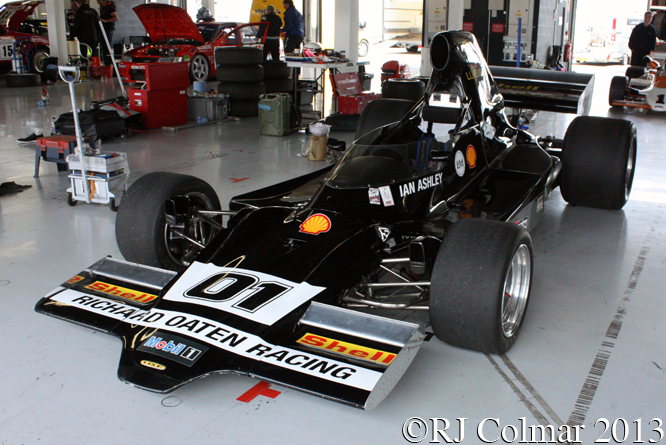
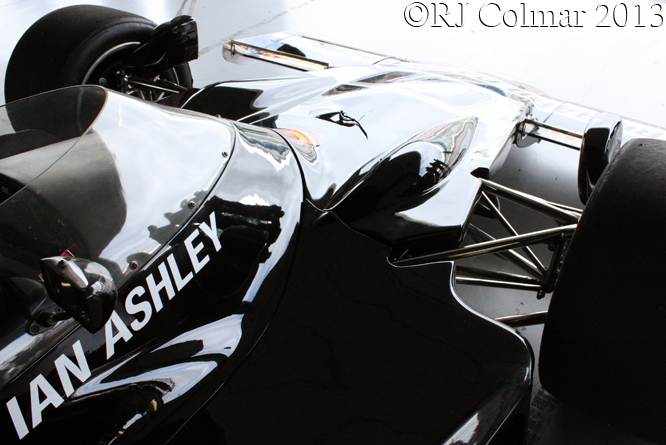
Despite being invoiced for today’s featured T400 chassis #HU5 on February 17th 1975 Richard Oaten Racing’s driver Ian Ashley started the first two races of the 1975, British based, European Formula 5000 championship driving the two year old Lola T330 chassis #HU17.

Lola Chevrolet T400, Lance Robinson, Silverstone Classic Press Day,

Ian won with the 2 year old car at Brands Hatch from 4th on the grid and crashed out at Oulton Park, not for the last time, on the opening lap again from fourth on the grid.

Two weeks later back Brands with the T330 not repaired sufficiently after it’s accident at Oulton Park Ian had little option but to drive today’s featured T400 #HU5 from the back of the grid to 7th in a race noted for being the first to be won by David Purley in his one off Chevron B30 powered by the 3.4 litre Ford GAA V6.

Lola Chevrolet T400, Silverstone Classic Press Day,

By Silverstone the Oaten T330 had been repaired with much new metal in the form of a new T332 tub fitted with T330 suspension and a mixture of T330, T332 and T400 body work with which Ian qualified 2nd and finished 5th in a race that became notorious when the good old Auntie British Broadcasting Corporation refused to televise it because of the presence of Richard Scotts T400 #HU8 which was sponsored by prophylactic brand Durex. Richard won the race in #HU8 after it had been fitted with the older type T332 suspension after future Williams design guru Patrick Head was consulted about the T400 handling issues.

Ian’s second and final public appearance in #HU5 was at Zolder after gearbox damage to the repaired T330/332 #HU17 forced Ian in to the T400 with which he qualified 5th behind 3 other T400’s and was classified 2nd behind the van der Straten VDS T400 chassis #HU4 driven by Peter Gethin.

Lola Chevrolet T400, Silverstone Classic Press Day,

#HU5 is then said to have been abandoned as uncompetitive before the next race at Zandvoort where Ian returned to the wheel the T330 HU17 and retired with a broken big end on lap 3 after starting from pole.

The T400’s of Peter Gethin in the VDS #HU4 his team mate Teddy Pelitte in the VDS #HU11 and Richard Scott in the McKechnie Racing Durex sponsored chassis #HU8 finished that race in the top three showing uncompetitiveness was not an issue for the new T400 model once fitted with the modifications first seen on Richards #HU8 at Silverstone.

Lola Chevrolet T400, Silverstone Classic Press Day,

Ian driving the repaired T330/T332 beat Teddy Pilette’s VDS T400 at Thruxton, but did not feature in the top three again while Teddy Pilette driving his VDS T400 went on to win four of the remaining nine races on his way to securing the 1975 European F5000 Championship.

As I understand it Ian latter crashed #HU5 in testing and at the end of the season Lola rebuilt it to the same specification as Teddy Pilette’s championship winning VDS car before it was shipped to the United States where it remained until 2008.

Lola Chevrolet T400, Silverstone Classic Press Day,

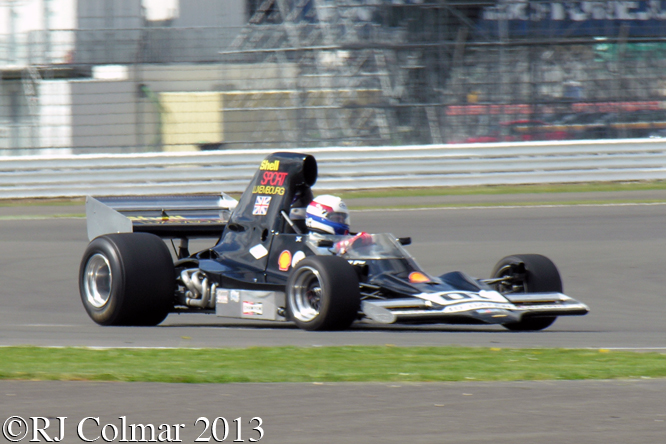
Canadian Hamish Somerville drove #HU5 in New Zealand in 2011 and the car is seen above with former Prosport LM3000 driver Lance Robinson at the wheel during a Silverstone Classic Press Day.

#HU5 is currently nearing completion after a rebuild necessitated by the accident Lance had in the car during testing on the day before 2013 Silverstone Classic meeting according to Kevin McLurg.

My thanks to Kevin McLurg of Facebook, Ray Bell, Lee Nicole, kingswood, Tim Murray, Allen Brown, Mallory Dan and MCS at The Nostalgia Forum for their help

Thanks for joining me on this “Rising Rate Improvements” edition of “Gettin’ a li’l psycho on tyres” I hope you will join me again tomorrow for Mercedes Monday. Don’t forget to come back now.

Share

IRS 7 Beater – Chevron B1 #01

Born in Manchester in 1933 Derek Bennett took a keen interest in model aircraft before completing an apprenticeship in mechanical and electrical engineering.

Working as a mechanic Derek was soon applying his skills and intuition to motor racing applications that included a V8 powered model Ford Model Y (British) stock car, two JAP powered Midgets for oval racing and Austin 7 specials for 750 Formula events organised by the 750 Motor Club at his local Oulton Park and Aintree Circuits.

Chevron B1, Race Retro, Stoneleigh.

At the same time Derek was building a reputation as a quick driver racing his Formula 750 special which was upgraded to Clubmans spec with a mandatory Ford 1172 engine and was pitted against the ubiquitous Lotus Seven’s and rarer Len Terry designed Terrier a MkII version of which Derek also prepared and raced for Doug Linton.

Derek graduated to a less than successful Formula Junior car of his own devising, allegedly originally conceived on the back of a piece of wall paper, which was replaced by a Gemini FJ and BT9 Brabham F3 car, along with a Lotus Elite and TVR.

Chevron B1, Race Retro, Stoneleigh.

While successfully racing a Formula Libre Lotus Twin Cam powered Brabham BT14 for Robert Ashcroft Derek was approached by accounts clerk Brian Classic, for whom Derek had earlier helped sort out a Daimler SP250 and another Lotus Elite, to build the Clubmans car that kick started Derek Bennett Engineering Ltd as a racing car manufacturer of Chevron Cars with financial help from John Bridges who’s initial B would become synonymous with the Chevron type designations.

Derek decided that he would build two such Clubman’s cars, the first for himself, which were to be Lotus Seven beaters. Using typical for racing practice for the period Derek specified proprietary Triumph suspension uprights and steering rack, a Lotus Elite differential housing and Brabham wheels to save on costs.

Chevron B1, Race Retro, Stoneleigh.

The rest of the car, named B1 after it’s first appearance, was drawn out in chalk on the floor at Derek’s Salford workshop at 31 Church Street with David Willars and featured independent rear suspension (irs) all round unlike the contemporary Lotus which it set out to beat.

Despite not being complete the first Chevron was taken to Ireland for three races in July 1965 where Derek won the first at Kirkistown on the cars debut, setting fastest lap for good measure before his Formula Libre entrant Robert Ashcroft won in the car on it’s second appearance at Dunboyne where he beat future Formula One star John Watson who was driving a Crosslé.

Chevron B1, Race Retro, Stoneleigh.

Back on the mainland Derek is known to have driven his first Chevron to at least two further victories in 1965 at Mallory Park in August and Silverstone in October, successes which set the phone lines at Salford ringing with new orders for 1966.

Chassis #01 is seen in these photographs at Race Retro earlier this year after a full restoration by Vin Malkie who I believe owns or has recently owned 5 of the first 6 Chevrons built.

Note an under powered prototype Chevron B1 Mk II road car project appeared in 2007 but is appears never have gained traction for a production run.

Thanks for joining me on this “IRS 7 Beater” edition of “Gettin’ a li’l psycho on tyres” I hope you will join me again tomorrow. Don’t forget to come back now !
Share

Unique Factory Rear Seats – Ferrari 500 Superfast #6659SF

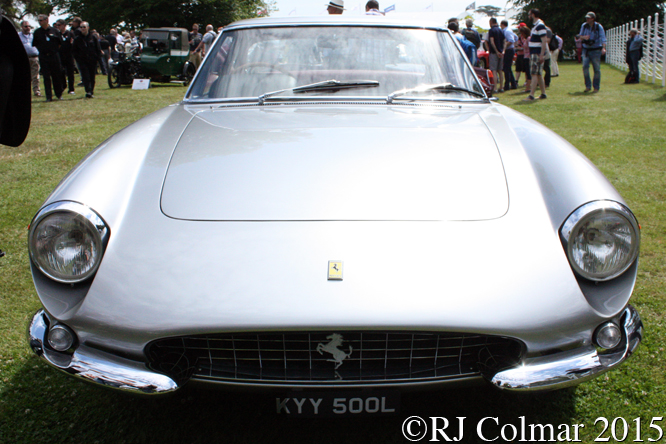
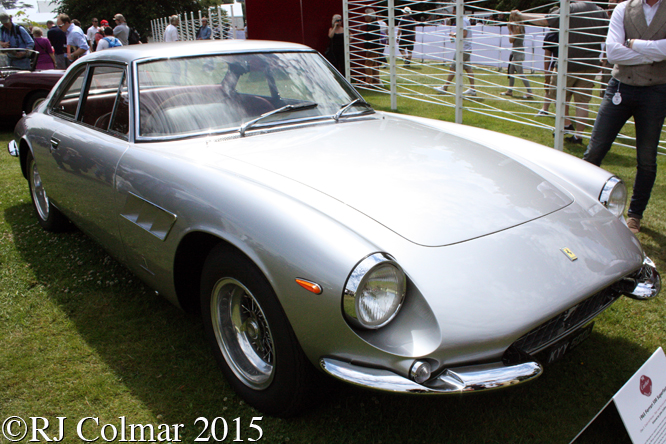
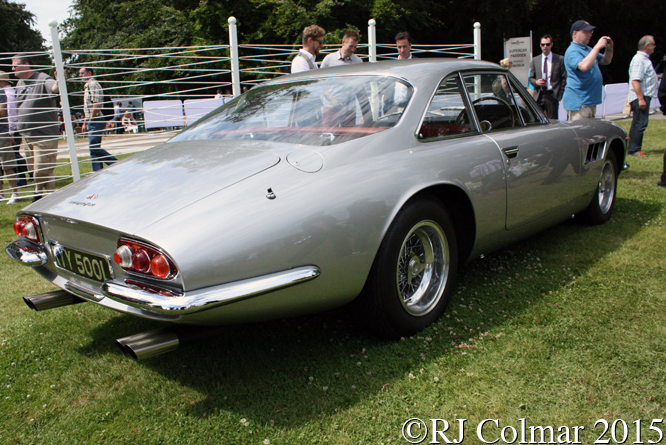
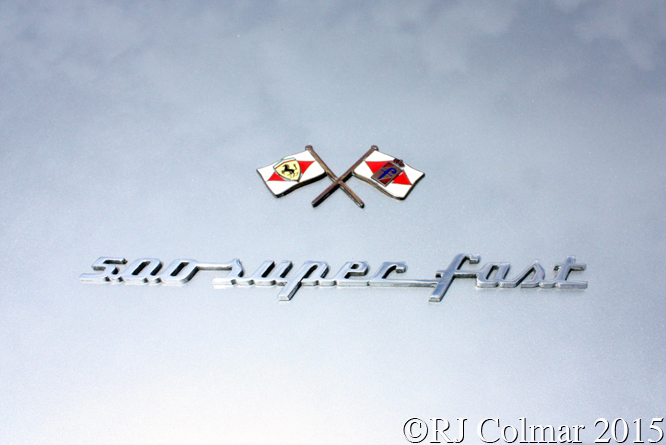
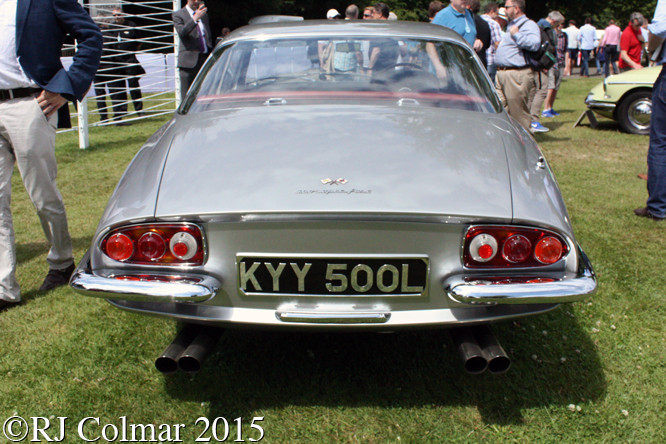
Today’s featured 1965 Ferrari 500 Superfast chassis s/n 6659SF was invoiced to Maranello Concessionaires, GB on the 21st September 1965.

Ferrari 500 Superfast, Goodwood Festival of Speed

It was the 22nd of the 25 Series I Superfasts built and finished in the Argento exterior and Rosso interior colours still worn by the car today.

Ferrari 500 Superfast, Goodwood Festival of Speed

#6659SF appears to have been the very first Superfast to have been fitted with a five speed gearbox as were all 12 Series 2 Superfasts.

Ferrari 500 Superfast, Goodwood Festival of Speed

Uniquely amongst all 37 Superfasts this was the only one supplied with factory fitted rear seats, it was also supplied with the factory fit air conditioning option

Ferrari 500 Superfast, Goodwood Festival of Speed

Peachy Property Corp. tycoon, Fulham Football Club director and later treasurer of Socialist International Sir Eric Merton Miller bought #6659SF on the 9th of February 1966.

Ferrari 500 Superfast, Goodwood Festival of Speed

Even as he was being Knighted in 1976 rumours of financial impropriety at the Peachey Property Corp. were circulating and after being issued with four writs for the restitution of funds Sir Miller shot himself on the Jewish Day of Attonement 22nd of September 1977.

Since then #6659SF has had a succession of Australian and British owners and is seen in these photographs at Goodwood Festival of Speed where it was entered by John Collins of the classic Ferrari Specialists Talacrest.

Thanks for joining me on this “Unique Factory Rear Seats” edition of “Gettin’ a li’l psycho on tyres” I hope you will join me again tomorrow when I’ll be looking at the very first Chevron built by Derek Bennett. Don’t forget to come back now.

Share

Four Cylinder Zenith – Plymouth PB Sports Roadster

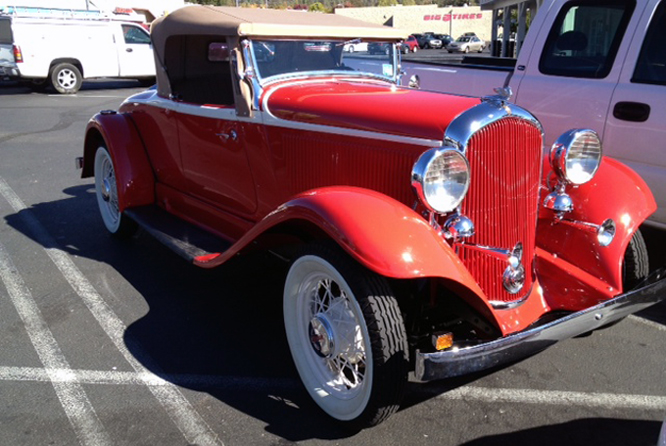
Six months before production of the Plymouth PA came to an end production of the PB commenced on February 4th 1932.

Plymouth PB, California,

The PB would be the last 4 cylinder model using the same 196 cui / 3.2 litre 4 cylinder motor inherited from both the PA and earlier U series Plymouths, though now with oil filters fitted as standard equipment.

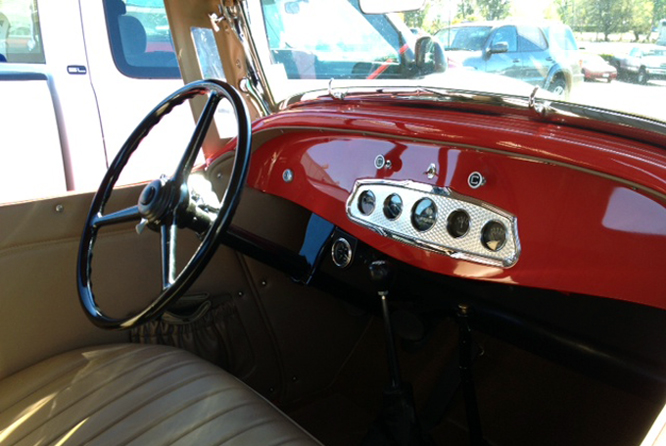
Plymouth PB, California,

The 109″ chassis was the same wheel base as the PA and U series to but with X pattern cross bars for additional chassis rigidity.

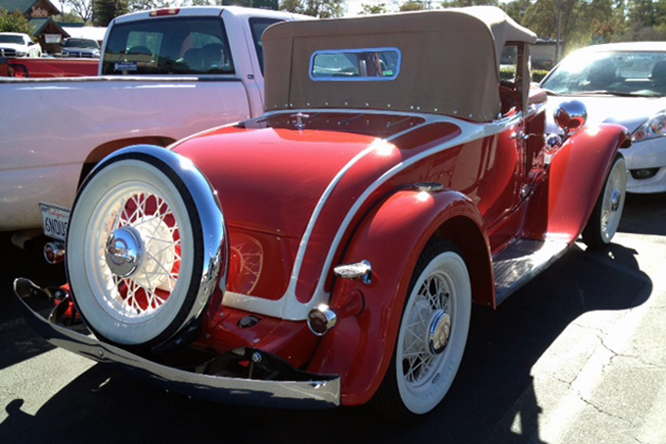
Plymouth PB, California,

The hydraulic brakes were also upgraded to a centrifuse type featuring steel drums with fused cast iron friction surfaces.

It is believed that 2,163 PB Convertible Coupés were built like the example seen here in a California car park, though they were only available new from the factory painted; Black with either Black or Casino Red mouldings, Limousine Blue No. 4, Uhlan Gray, Merrimac Beige, or Biscay Sand, bodies, the 4 cylinder PB’s would be replaced by 6 cylinder PC’s and PD’s in 1933.

My thanks to Geoffrey Horton for sharing his photographs.

Thanks for joining me on this “Four Cylinder Zenith” edition of “Gettin’ a li’l psycho on tyres” I hope you will join me again tomorrow for a Superfast Friday. Don’t forget to come back now !
Share