Tag Archives: Ralph

Thread Breakers – Lotus 20 # 20-J-892

In 1958 at the suggestion of engineer, journalist and former racing driver Count Giovanni “Johnny” Lurani Formula Junior was adopted as an entry level form of open wheel racing that mandated the use of engines, gearboxes and brakes from everyday production road cars.
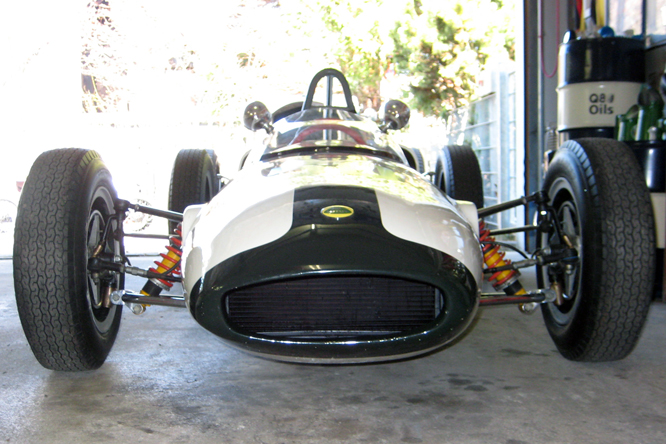
Lotus Ford 20

There were two classes up to 1000cc / 61 cui vehicles were allowed to run with a minimum weight of 360 kgs / 792 lbs and up 1100cc / 67 cui were allowed to run with a minimum weight of 400 kgs / 880lbs. The larger engine class was the most popular and initially a large variety of motors were used including FIAT, BMC, Moskvitch with 4 stroke 4 cylinder engines while SAAB and DKW 2 stroke 3 cylinder engines were also popular.
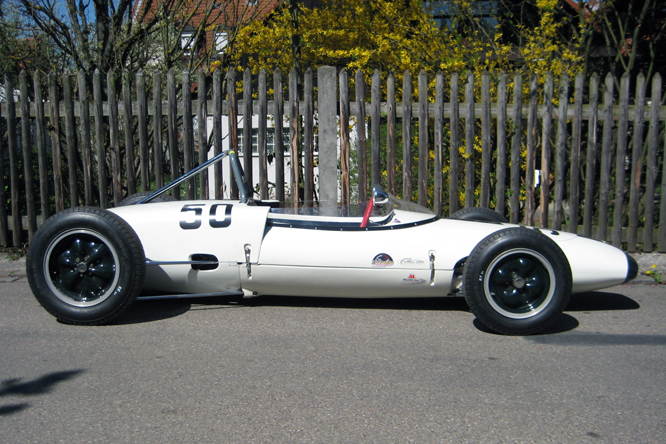
Lotus Ford 20

The series initially featured front engine vehicles but followed the trend set in Formula One and went the rear engined route at the turn of the decade. Lotus built a successful variation of the Lotus 18 Formula One car for formula Junior in 1960 and followed that up with Lotus 20 model that is featured today.
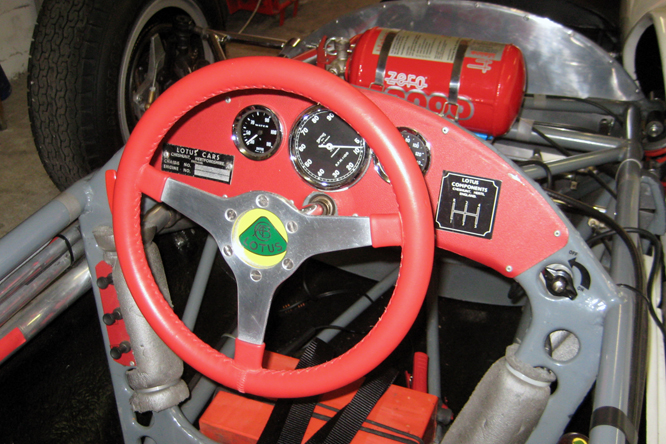
Lotus Ford 20

This particular Lotus 20, # 20-J-892, belongs to long time Lotus enthusiast Ralf Pickel, who fell in love with Lotus cars thanks in part to Matchbox, from Schwabach in Southern Germany.

# 20-J-892 was supplied new to Honda Racing Team manager and ex motorcycle racer Reg Armstrong fitted with a Cosworth tuned Ford engine number # 61425. Reg is thought to have driven the car at several events in Ireland.
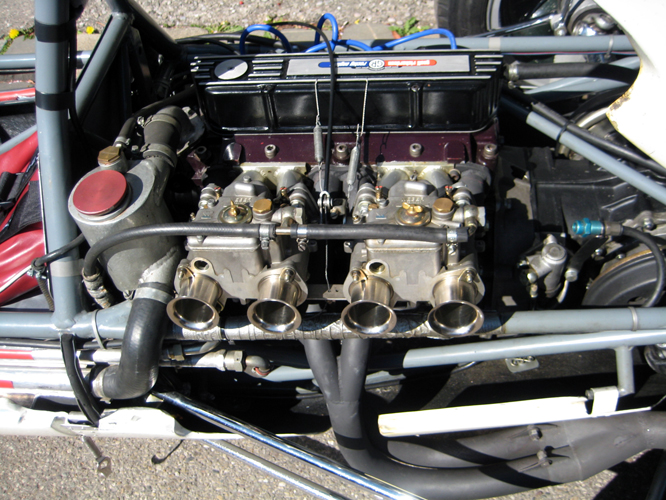
Lotus Ford 20

After being sold on, first to Edmund Gill then to Bill Popplewell, who shared the driving with Frank Keane in Ireland, the car was fitted with a larger engine in 1965 by Brian Cullen for entry into Formula Libre events.

At Phoenix Park a drive shaft, which also acts as a critical suspension component, snapped causing an accident while Brian was at the wheel, that damaged the left hand side of the chassis.
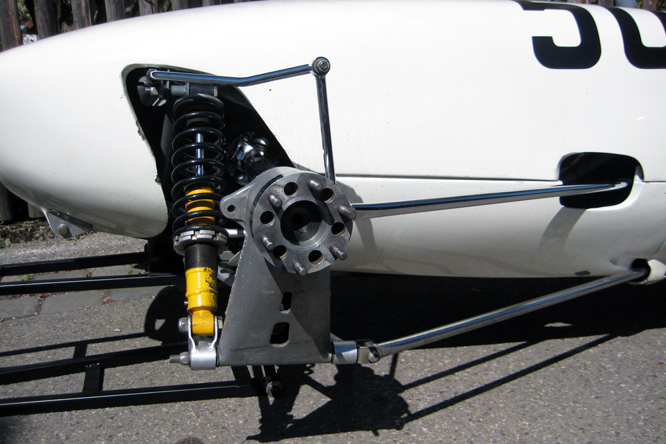
Lotus Ford 20

Gordon Percy bought the damaged 20-J-892 with the intention of using it to build a grass track racer but over a period of 20 years he never quite got round to it and in 2000 the car left Ireland and ended up being restored by Michael Hibberd who replaced the damaged chassis members. After a couple of further documented changes of ownership Ralf bought the car from Richard Smeeton, who had a fresh £12,000 Richardson built Ford Formula Junior engine installed, earlier this year.
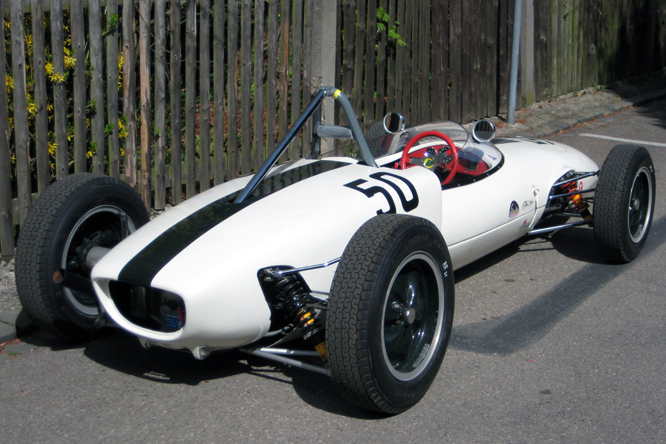
Lotus Ford 20

Ever since he bought the car Ralf has been wondering why the mirrors are mounted so high and close together on the screen, the probable answer has recently come to light that in the absence of timing beams on hill climbs a thread was stretched across the finish line of these events that mechanically stopped the timing clock when it was broken as cars crossed the finish line.

One one occasion when Reg Armstrong was driving today’s featured Lotus 20, which was considerably lower than all of the other vehicles in a contest, the thread was broken not by the car but Reg’s chin, reportedly causing copious blood shed.

Subsequently it is thought the mirrors were placed high on the screen to prevent further injury. A similar bloody fate befell the slightly taller Edmund Gill when he drove 20-J-892 following year when again the height of the finish line thread took no account of how low the Lotus 20 was.

To date Ralf has only had the opportunity to do some testing and demonstration events with this neat racer, but has plans to drive the car in anger for the first time next year hopefully at Hockenheim in April and Salzburgring in May.

My thanks to Ralf for sharing the photo’s and information on his Lotus. Thanks to TNFers Alan Cox, David Mckinney, Simon Thomas, Bill P, Richard Hinton, David Beard, Tim Murray, Richard Young, Edward Fitzgerald and larryd who contributed to the Lotus 20 and Reg Armstrong threads on The Nostalgia Forum.

Thanks for joining me on this Formula Junior edition of ‘Gettin’ a li’l psycho on tyres’ I hope you will join me again tomorrow. Don’t forget to come back now !

Share

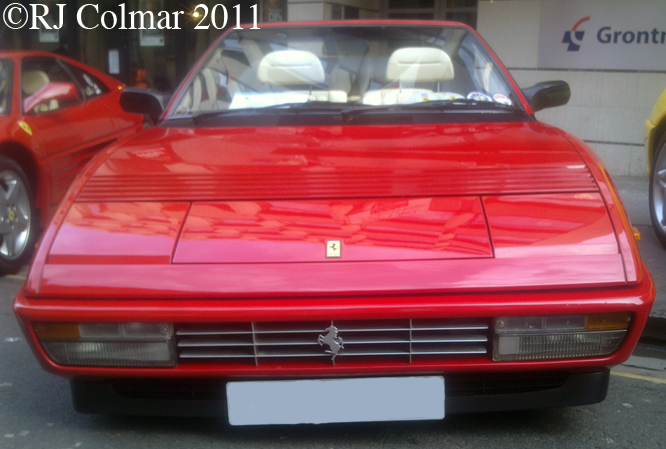
Ferrari Mondial Cabriolet

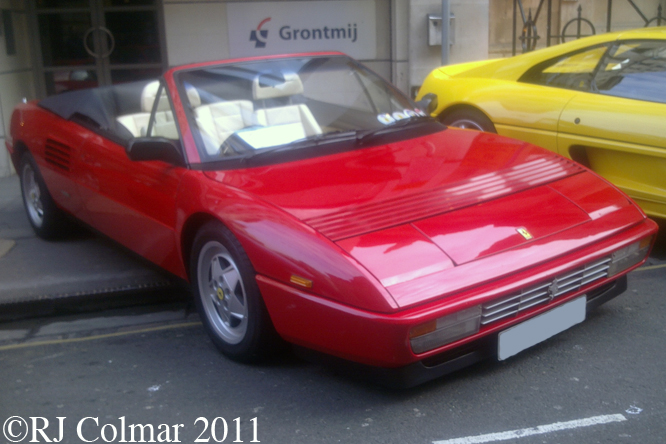
Ferari replaced the 308 GT4 2 + 2 I looked at last week with the Mondial model, like the one seen here at Bristol Italian Auto Moto Festibal, in 1980. The Cabriolet was not introduced until 1983.

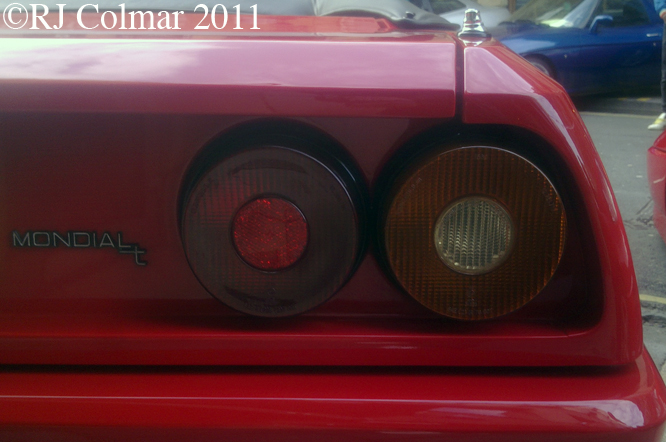
Ferrari Mondial T Cabriolet

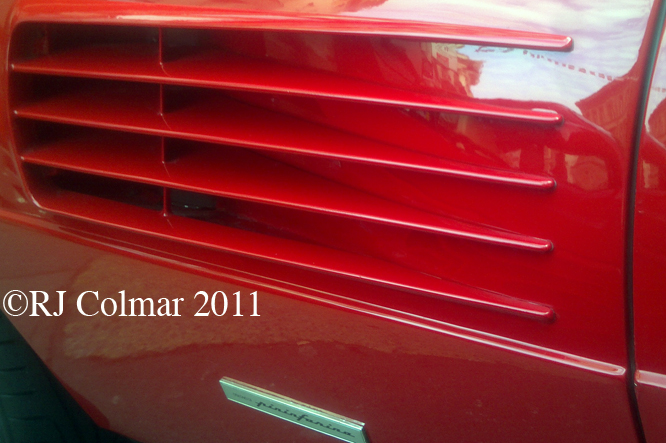
Pininfarina was chosen to design the replacement for the Bertone designed 308GT4, the Mondial featured a steel body built by Carrozzeria Scaglietti to sit over a steel box section space frame.

Ferrari Mondial T Cabriolet

The second generation Mondial t was introduced in 1989 with smaller tidier side intakes and bumpers in matching body colours.

Ferrari Mondial T Cabriolet

The engine and gearbox of the Mondial is mounted, for ease of maintenance, on a subframe which makes taking the engine out to change the spark plugs a much easier process, this innovation has transferred to all subsequent V8 Ferrari’s.

Ferrari Mondial T Cabriolet

Originally the Mondial 8 was powered by a 4 cam 2 valve per cylinder 3 litre 183 cui V8, in 1982 QV Quattrovalvole, four valve per cylinder heads were fitted to the 3 litre / 183 cui motors. In 1985 these motors were increased in bore and stroke to give 3185 cc / 194 cui for the 3.2 Mondial models with 280 hp up from 240 hp on the original Mondial motor. 1989 saw the introduction of 3.4 litre / 207 cui motors which produced 300 hp.

The T designation introduced in 1989, seen on today’s featured 1990 car, denotes a change in the power train layout from transversely mounted engine and gearbox of all models up to 1989 to a longitudinally mounted engine and transverse gearbox that allowed the engine to be mounted lower in the chassis which consequently improved the handling. This engine gearbox layout was also carried over to future Ferrari V8 models.

Thanks for joining me on this drop top edition of ‘Gettin’ a li’l psycho on tyres’ I hope you will join me again tomorrow. Don’t forget to come back now !
Share

Comic Discovery – Hudson Suburban Sedan

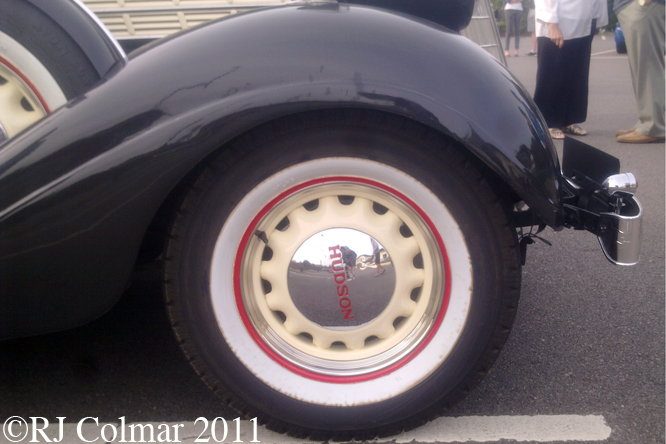
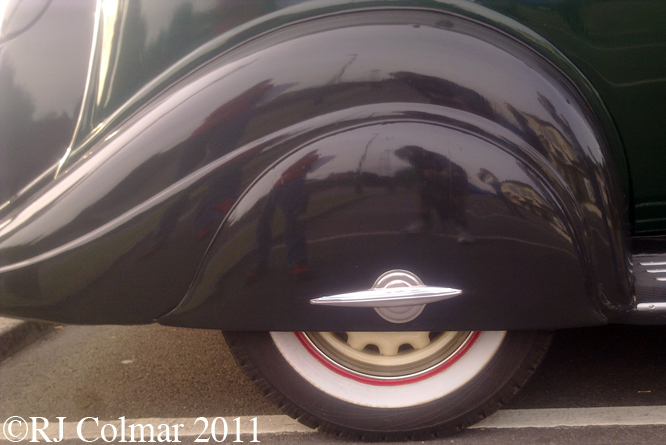
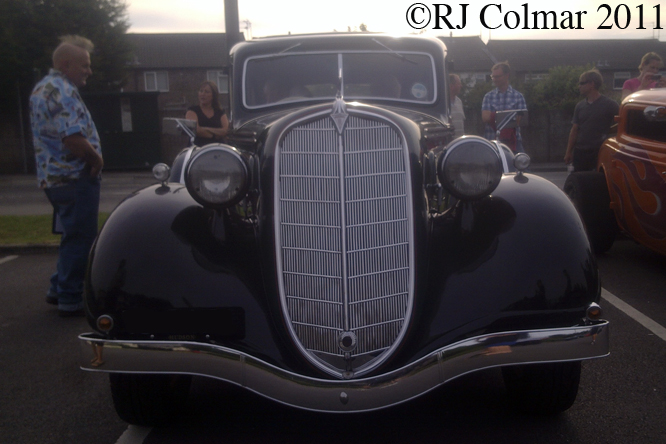
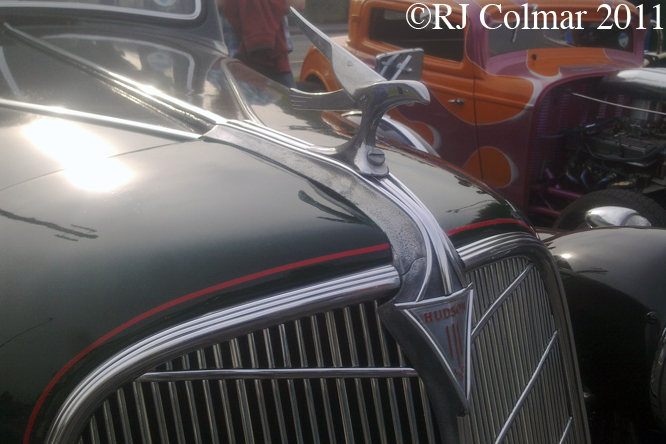
Back on Independence Day during the Rally organised by the Bristol Pegasus Motor Club I came across this delightful 1935 Hudson, unfortunately I did not get any details about the car from the owner at the time so I have had another carcaeology session to discover more.

Hudson Big Six, Model 53

This Hudson chassis #533370, with blue body work probably marketed as Surban Sedan model, was one of just four vehicles first registered in Dundee, where the strap line reads City of Discovery, on the 7th of May 1935.

Hudson Big Six, Model 35

The Hudson was registered to a Mr R D Low of Westleigh, Number 9 Nevill Street, Downfield, Dundee alongside a Morris Saloon, BSA Motorcycle and a 3 ton Commer Coal merchants truck.

Hudson Big Six, Model 35

Robert Duncan Low is known to have been a journalist to the Dundee City Archive, but as we know journalism can cover a multitude of sins and it would appear that Robert was no gum shoe rather he was employed by DC Thompson & Co in Dundee where he was responsible for launching a number of publications aimed at children including Adventure (1921) The Rover (1922) The Wizzard (1923) The Skipper (1930) and The Hotspur (1933).

Hudson Big Six, Model 35

In 1937 Robert became managing editor at DC Thompson and over saw the launch of The Dandy and the following year the Beano for which with artist Ken Reid he created Roger the Dodger in 1953, when he also oversaw the launch of The Topper. Earlier in his career Robert is also credited with co creating the Scottish vernacular comic strips Oor Wullie and The Broons with illustrator Dudley Dexter Watkins.

Hudson Big Six, Model 35

It is not at present known how long Robert Low kept this Hudson he died in 1980 aged 85. This car is reported to have been ‘knocking around the North West of England in the 1990’s’ before it was offered at auction in 2005 when the body was painted maroon and sold for £1,500. The history of the cars original ownership outlined above appears to have been unknown to the auctioneers at the time when the car was noted to have had 4 previous owners with 92,275 miles shown on the clock and the model name was given as Big Six Saloon, the chassis number indicated the car would have been known as a 53 model at the Hudson factory from whence it was probably sent as a knockdown kit for assembly in Brentford west of London.

Hudson Big Six, Model 35

According to the best source I have available 29,476 cars were shipped and it is thought that number included the knockdown kits.

My thanks to John MacDonald form ‘oldcarandtruckpictures.com‘, Jon B, Terraplane 33, Geoff C NZ, Alex ‘Hudsontech’ Burr, Old Fogey UK and Paul Butler over at Hudson Forum who helped me identify this car and finally to Richard Cullen at the Dundee City Archive who provided the final clue as to the original owners identity.

Thanks for joining me on this comic edition of “Gettin’ a li’l psycho on tyres” I hope you will join me again tomorrow. Don’t forget to come back now !

Share

3 Graces – Ford Zephyr MK2

In 1954 Colin Neale lead a team that styled the Ford Consul, Zephyr and Zodiac Mk2 that all shared the same body, by the end of the year prototype cars were being tested across Europe and in 1955 further prototypes were being tested against the back drop of the Mau Mau uprising in Kenya.

Ford Zephyr Farnham Mk2

In February 1956 the ‘3 Graces’, as the models became unofficially known, were launched on the market the Consul with a 4 cylinder 1703 cc / 104 cui motor and the Zephyr and Zodiac with 6 cylinder 2553 cc / 156 cui motors.

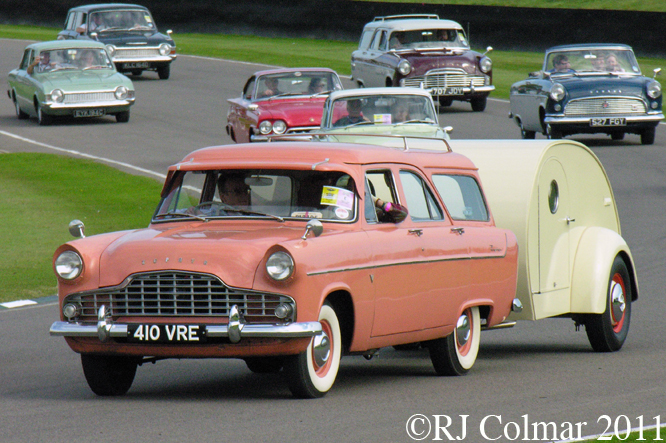
Versions of the ‘3 Graces’ can be seen above, 410VRE is a 1958 Zephyr Farnham, a model which was selected by five police forces to became Britain’s first Motorway Patrol Cars in 1959. The Convertible 527FGY is a ’62 Consul, less than 30 ‘3 Grace’ Convertibles are thought to exist because the soft top conversion took so much strength out of the unitary chassis. 707JDV following the Consul is a 1961 top of the range Zodiac Farnham estate / station wagon.

Ford Zephyr Mk2, Mallory Park

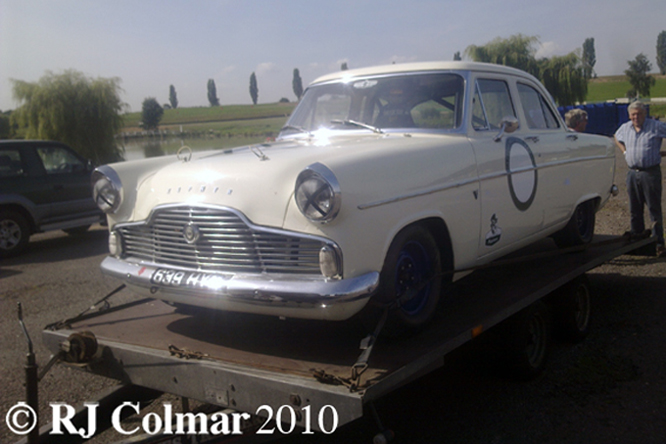
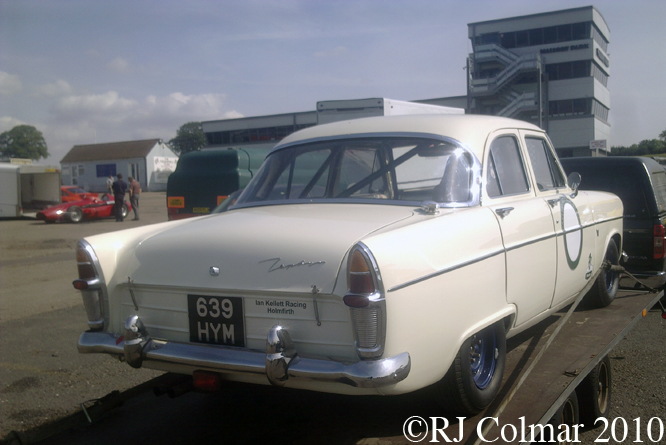
The 1959 Zephyr Mk2 is seen above at Mallory Park being prepared by Ian Kellet Racing for Barrie ‘Whizzo’ Williams, seen standing to the right of the photo above, to drive in last year Goodwood Revival meeting.

Ford Zephyr Mk2, Mallory Park

Between 1956 and 1962 294,506 3 Grace models were built alongside 6,911 Convertibles. Some of all three variants were built in Fords Geelong factory south of Melbourne.

Thanks for joining me on this 3 Graces edition of ‘Gettin’ a li’l psycho on tyres’ I hope you will join me again tomorrow. Don’t forget to come back now !
Share

Pro ET – Race Ventora

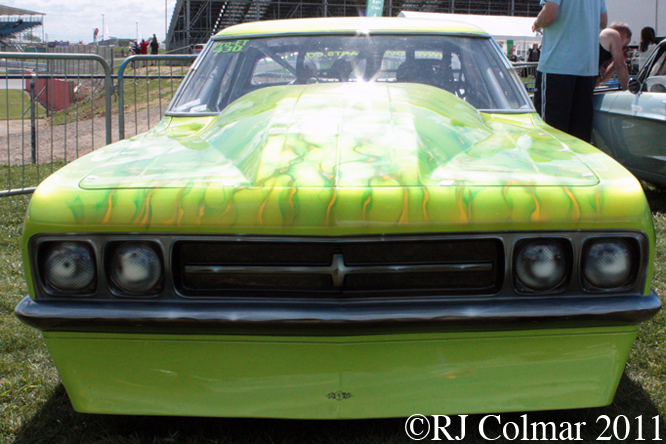
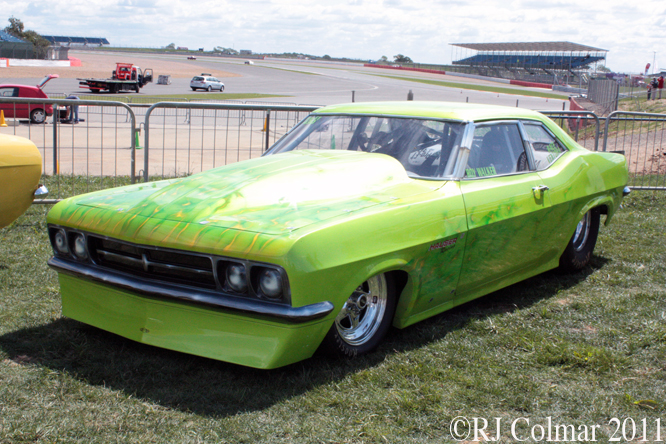
The Vauxhall Victor FD Series was built between 1967 – 1972 the Ventora ws launched in 1968 with a 3294 cc / 201 cui 6 cylinder motor replacing the standard Victor FD series 4 cylinder motor.

Race Ventora, Silverstone

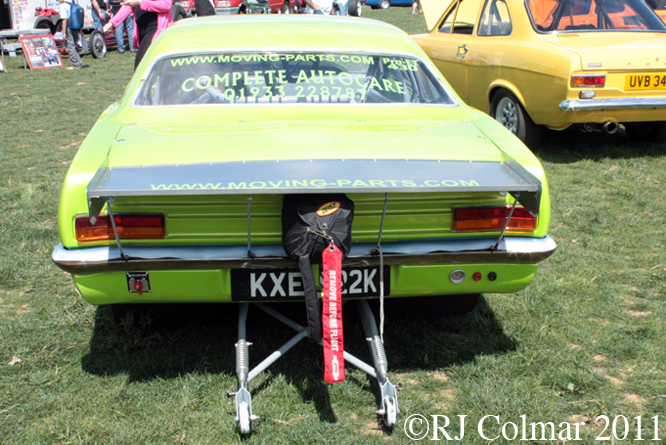
This Race Ventora, seen here at the Silverstone Classic, is powered by a 468 cui / 7669 cc V8 and driven by Ray Walker Pro ET drag events.

Race Ventora, Silverstone

Pro ET races see drivers paint the elapsed time (dial in) they believe they can achieve on their back window’s races are then staged between cars of different performance levels with the release times staggered by the difference dial in times. So that each driver should, in theory, cross the finish line at the same time.

Race Ventora, Silverstone

If a driver jumps his release time he is out, known as a ‘Red Light’, if a driver beats his dial in he is out, known as a ‘Break Out’, unless both drivers beat their dial ins in which case the driver who beats his dial in by the least amount wins.

While I was looking for information on Ray’s car i came across some information on another Vauxhall Victor of the same FD type that goes by the name of Red Victor.

Red Victor has gone through three evolutions and in the process lays claim to being the world fastest street legal car with a 0-60mph time of 0.9 seconds !

This link takes you to a youtube clip of Red Victor 2 and this second link takes you to a fascinating thread on the building of Red Victor 3.

I’ve just finished watching Tony Stewart round out a tremendous victory at Homestead Miami over his championship rival Carl Edwards. Kudos to all the fans of the Big 14 what an achievement to win the Cup as an owner driver. Commiserations to Carl who has earned my admiration for the way he competed and handled his defeat having drawn with Tony on points and lost on tie braking victories. Can’t wait until the new season starts at Daytona in February.

Thanks for joining me on this Pro ET edition of “Gettin’ a li’l psycho on tyres” I hope you will join me again tomorrow. Don’t forget to come back now !
Share

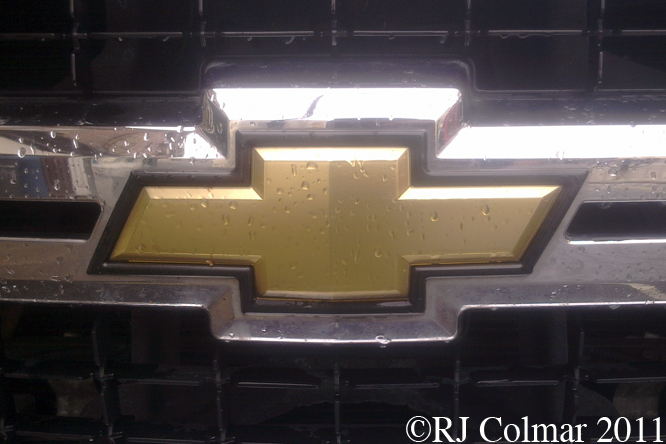
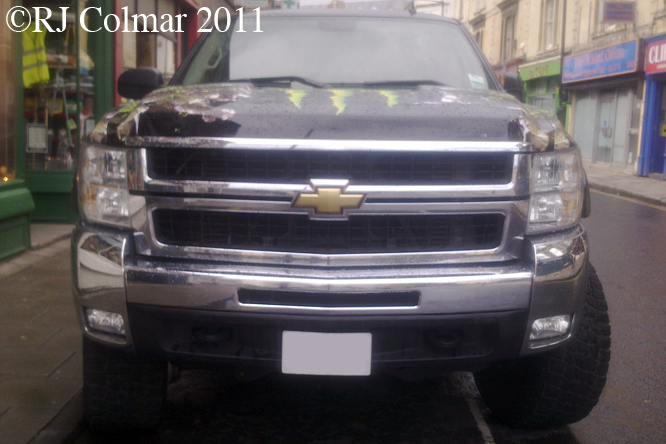
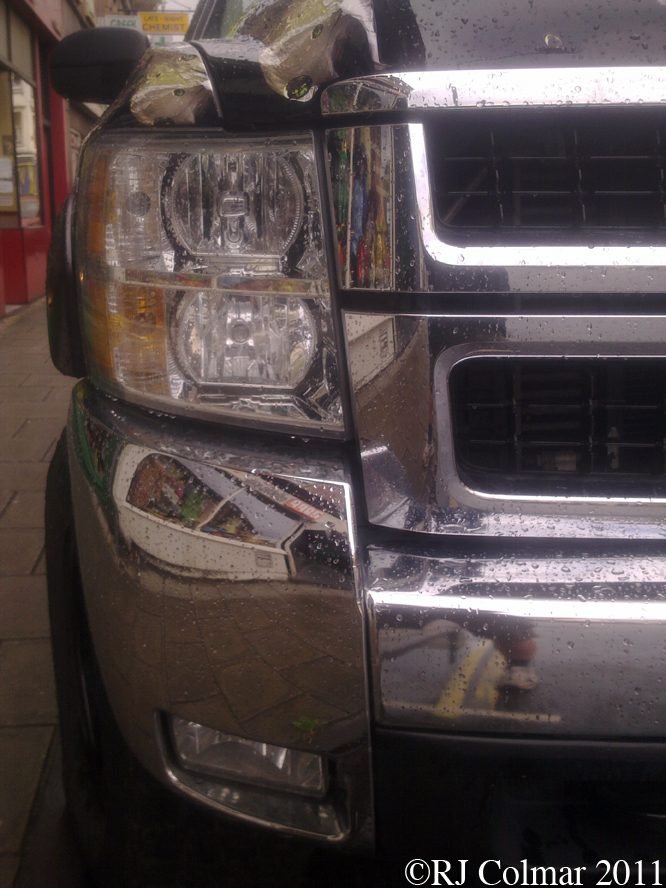
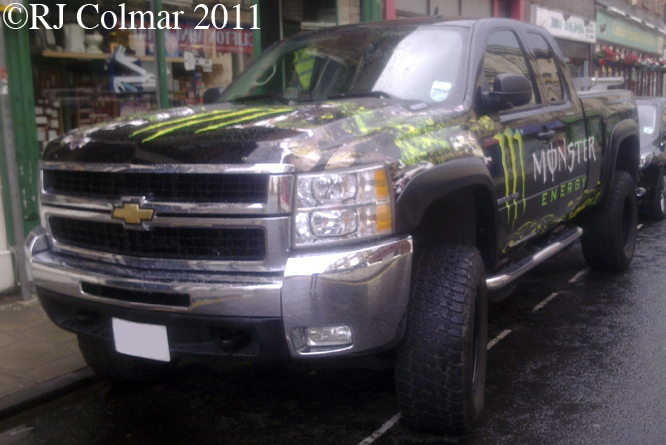
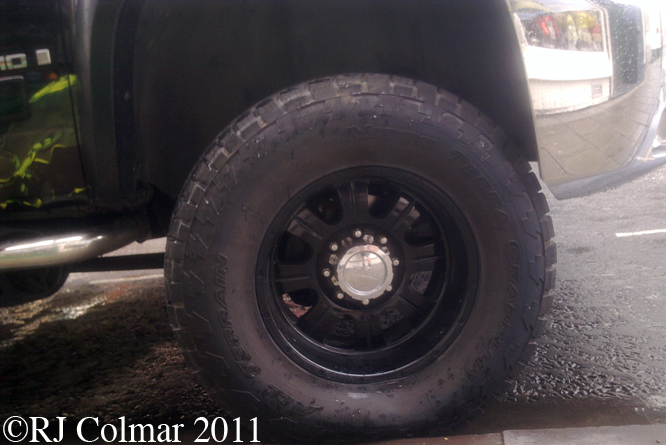
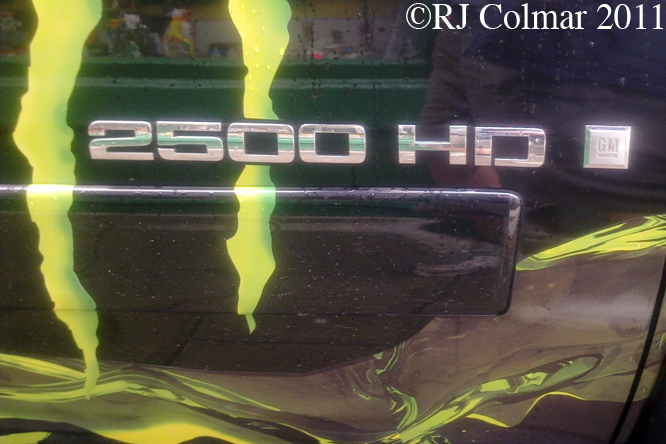
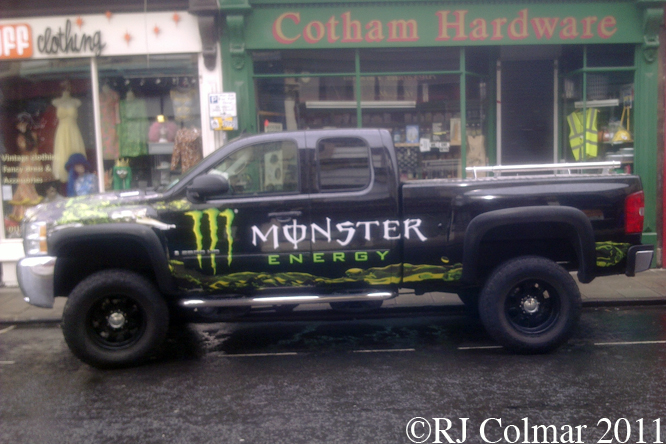
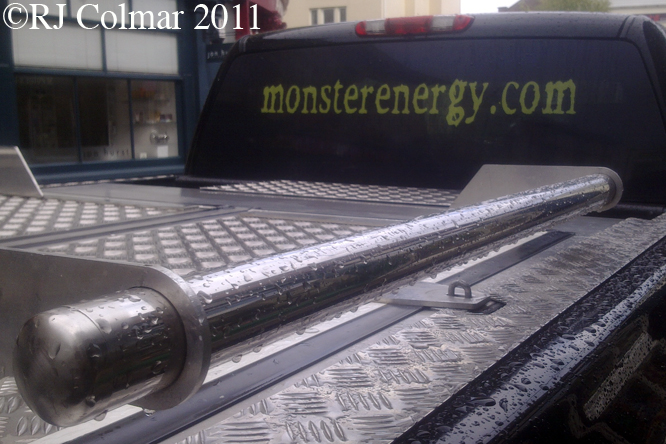
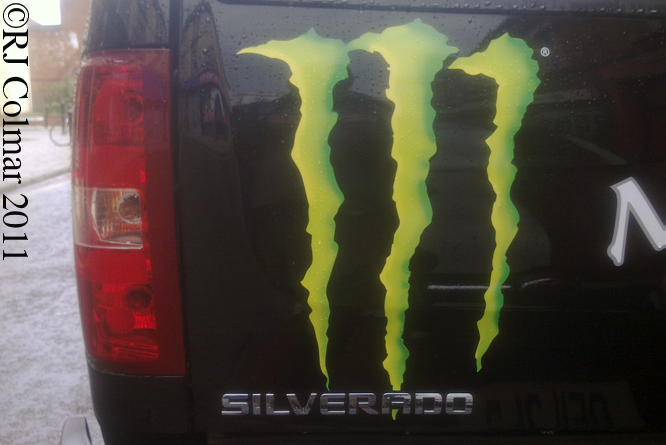
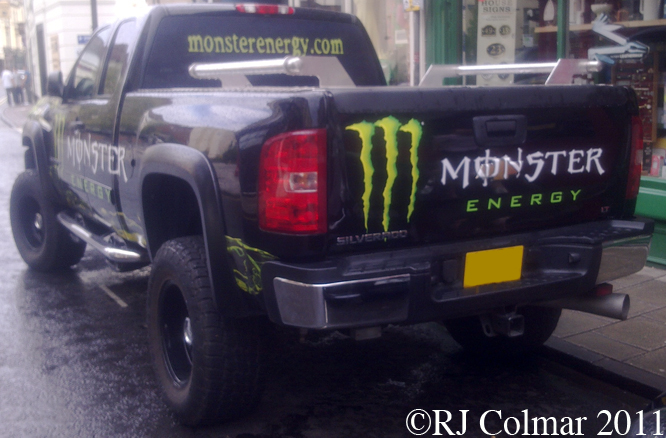
Monster Bow Tie – Chevrolet Silverado 2500HD LT

The Silverado name was used to denote variations in trim on Chevrolet pickups from 1975 to 1999.

Chevrolet Silverado 2500HD

The first generation full size Silverado model was built in 1998 for the ’99 model year Production of the first generation Silverado came to an end in 2007.

Chevrolet Silverado 2500HD

Strengthened heavy duty variants of the 1st generation Silverado were produced from 2001 to 2007.

Chevrolet Silverado 2500HD

The second generation of Silverado’s was launched in 2007 when the model was awarded both the North American and the Motor Trend Truck of the Year gongs.

Chevrolet Silverado

Not sure that this Monster decalled example has anything to do with the Turner Motorsports team that runs Ricky Carmichael in the NASCAR Camping World Series

Chevrolet Silverado

… or even if it sees any off road action …

Chevrolet Silverado

or why Monster needed a heavy duty vehicle with a 4000 lb carrying capacity …

Chevrolet Silverado

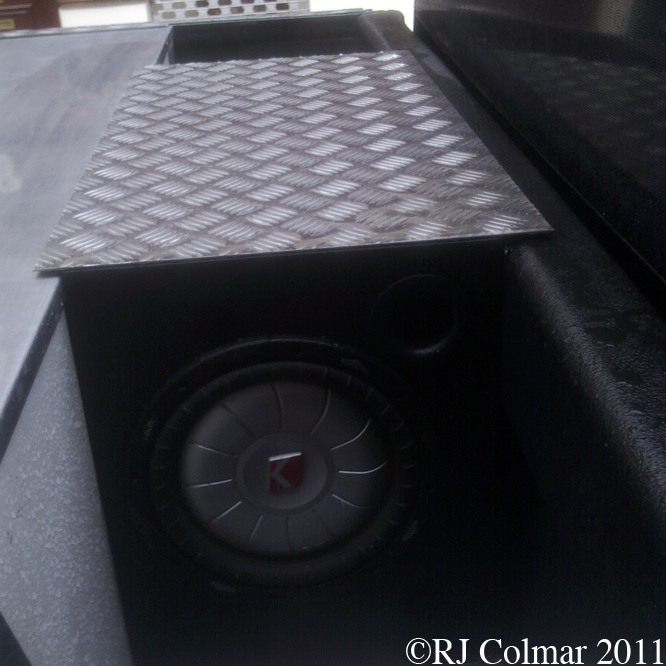
when all the vehicle seems to carry is …

Chevrolet Silverado

a giant ghetto blaster…

Chevrolet Silverado

and a few cases …

Chevrolet Silverado

of energy drink.

Chevrolet Silverado

But one thing is for sure in li’l ole England the Monster Silverado from Flint Michigan is pretty much king of the road.

Thanks for joining me on this Monster Truck edition of ‘Gettin’ a li’l psycho on tyres’. I hope you’ll join me again tomorrow. Don’t forget to come back now !
Share

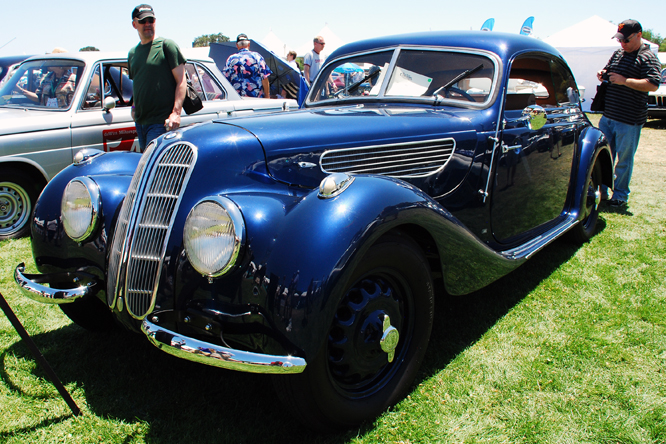
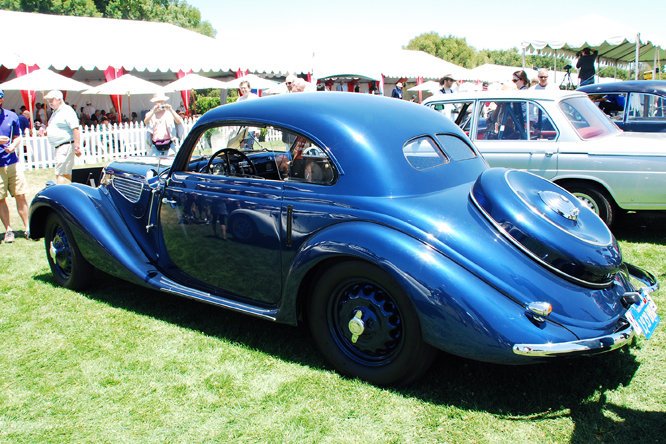
Pillarless Coupé – BMW 327/28

The BMW 327 was a short chassis version of the BMW 326 manufactured originally in cabriolet form in 1937 and from 1938 it was also available as a Coupé.

BMW 327/28, Palo Alto

The 327 built with either a standard 55 hp 6 cylinder motor as used in the BMW 326 or with the 80 hp from the higher state of tune 6 cylinder found in the BMW 328. Cars supplied with 80 hp motors like the one in Geoffrey Horton’s photographs taken at Palo Alto are known as BMW 327/28 models.

BMW 327/28, Palo Alto

This pillarless coupé is one of just two known to have been built from more than 560 cars built with pillars until 1940. It was acquired by a US serviceman in Germany in 1958 who shipped it to NY and then drove it to California where it has remained, changing ownership just once since then.

My thanks to Geoffrey Horton for the fabulous photo’s.

Wishing all GALPOT contributors and readers in the USA a Happy Thanksgiving.

Thanks for joining me on this pillarless edition of ‘Gettin’ a li’l psycho on tyres’. I hope you will join me again tomorrow. Don’t forget to come back now !
Share